
An advanced graphing calculator is less a gadget and more a lifelong academic companion — the one you reach for through four years of high school, a demanding STEM college curriculum, and even professional exams. The wrong choice means sluggish plotting, limited memory, and functions you will outgrow halfway through Calculus II. The right one becomes an extension of your thinking, handling symbolic algebra, 3D graphing, and even Python programming without hesitation.
I’m Rikta — the co-founder and writer behind Gadgets Feed. I spend my time analyzing the processor speeds, display resolutions, and operating system architectures that separate student tools from true computational powerhouses. (And Homer 🐱 tested the stylus on the Casio touchscreen before I could get a word in.)
The graphing calculator landscape has polarized into two camps: the TI ecosystem, which dominates classrooms with software support and exam compatibility, and a rising wave of modern alternatives with open-source firmware, color touchscreens, and built-in CAS. Sorting through these options to find the best advanced graphing calculator for your specific coursework requires understanding not just brand loyalty, but the actual hardware and feature limits that define each model.
How To Choose The Best Advanced Graphing Calculator
The decision tree for an advanced graphing calculator is shorter than you think — it comes down to your exam board’s policies, your need for symbolic computation, and whether you value an open ecosystem or standardized software support. Let’s walk through the three factors that separate a calculator you will love from one you will fight.
CAS vs. Non-CAS: The Symbolic Equation Test
A Computer Algebra System (CAS) lets the calculator manipulate algebraic expressions symbolically — factor polynomials, solve equations with variables, and perform indefinite integration — rather than just outputting numeric approximations. This is a superpower for higher-level math and engineering courses, but many standardized tests (including the ACT) ban CAS models. If your goal is college exam prep, confirm which calculators are permitted before investing in a CAS-equipped unit.
Display Quality and Screen Real Estate
An advanced graphing calculator lives and dies by its display. A higher pixel density (measured in DPI) and color depth (e.g., 16-bit color) make complex 3D surfaces, overlaid functions, and statistical plots readable at a glance. Some models now offer 320×240 resolution or larger touchscreens up to 4.8 inches, which transforms how you navigate menus and manipulate graph windows. Backlighting matters too — a non-backlit screen is harder to use in dim lecture halls or during evening study sessions.
Processor Speed, Memory, and Programmability
Graphing calculators are small computers. Models with 100MB of RAM and 64MB of flash storage can run larger programs, store more data sets, and handle iterative calculations without freezing. If you plan to write or run custom applications (for physics simulations, finance models, or game scripts), look for units that support Python or Lua scripting. Open-source firmware, like on the NumWorks, provides frequent updates and community-driven features that extend the device’s useful life well beyond a single course.
Quick Comparison
On smaller screens, swipe sideways to see the full table.
| Model | Category | Best For | Key Spec | Amazon |
|---|---|---|---|---|
| TI Nspire CX CAS | Premium CAS | College STEM & symbolic computation | 100MB RAM; 3.2″ color backlit | Amazon |
| Casio fx-CG500 | Touchscreen CAS | Intuitive CAS with drag-and-drop | 4.8″ touchscreen; stylus included | Amazon |
| Casio fx-CG100 | Color Graphing | 3D graphing & MicroPython | Color 3.7″ LCD; 65,000+ colors | Amazon |
| TI-84 Plus CE | Mid-Range Color | Classroom standard & exam prep | 140 DPI; 16-bit color; rechargeable | Amazon |
| TI-Nspire CAS with Touchpad | Value CAS | Budget-friendly symbolic algebra | High-res greyscale; AAA powered | Amazon |
| NumWorks Graphing Calculator | Modern Open-Source | Frequent updates & Python coding | 320×240 color; USB-C rechargeable | Amazon |
| TI 83 Plus | Entry-Level | Budget-friendly basic graphing | Certified reconditioned; screen protector | Amazon |
In‑Depth Reviews
1. Texas Instruments Nspire CX CAS

The TI Nspire CX CAS is the undisputed heavyweight of the advanced graphing calculator segment. Its Computer Algebra System solves symbolic equations, factors polynomials, and performs indefinite integration that non-CAS models cannot touch. The 3.2-inch backlit color display runs at a resolution that keeps graphs crisp even when zooming into complex functions, and the 100MB of RAM handles multi-step statistical analyses without lag.
Battery life is powered by included AAA batteries or a rechargeable option, and the unit is permitted on SAT, PSAT, AP, and Praxis exams — though not on the ACT due to its CAS capabilities. The touchpad navigation takes deliberate practice, especially if you are migrating from a traditional D-pad interface, and the alphabetical keyboard layout can slow down initial typing sessions.
For college-bound students in calculus, engineering, or advanced physics, the CX CAS eliminates the need to juggle a separate scientific calculator. Its file-saving capability and PC/Mac connectivity let you transfer work between the device and desktop software, making it a true portable computational workstation.
Why it’s great
- Full CAS for symbolic algebra and calculus
- Backlit color display with 140 DPI clarity
- Ample 100MB RAM for large programs
Good to know
- Steep learning curve for new users
- Alphabetical keyboard layout is non-standard
- Battery life is shorter than older TI models
2. Casio fx-CG500 Graphing Calculator

The Casio fx-CG500 breaks the graphing calculator mold with a 4.8-inch color touchscreen and stylus input — a display large enough to view split-screen graphs, tables, and equations simultaneously. Its built-in CAS handles symbolic manipulation with a user interface that many find more intuitive than TI’s document-centric approach. The Natural Textbook Display renders fractions, integrals, and matrices exactly as they appear in print, reducing input errors.
Drag-and-drop functionality between graph, table, and equation windows makes it one of the fastest devices for exploring mathematical relationships visually. The stylus is accurate for selecting points on dense plots, though its tethered storage is a potential point of loss. The calculator runs on four AAA batteries with longevity that regularly exceeds TI-84 models in real classroom use.
Where the fx-CG500 shines is higher-level CAS work — users report it outperforming HP and TI competitors in symbolic calculus accuracy. The trade-off is a learning curve around its unique operating system, and some physical buttons feel less responsive than dedicated keypad models. At its tier, it offers the most screen real estate for the price.
Why it’s great
- Large 4.8″ color touchscreen with stylus
- Powerful CAS with drag-and-drop workflow
- Excellent battery life vs. color competitors
Good to know
- Stylus can be easily misplaced
- Some button feedback feels mushy
- Cursor sluggishness for certain operations
3. Casio fx-CG100 ClassWiz
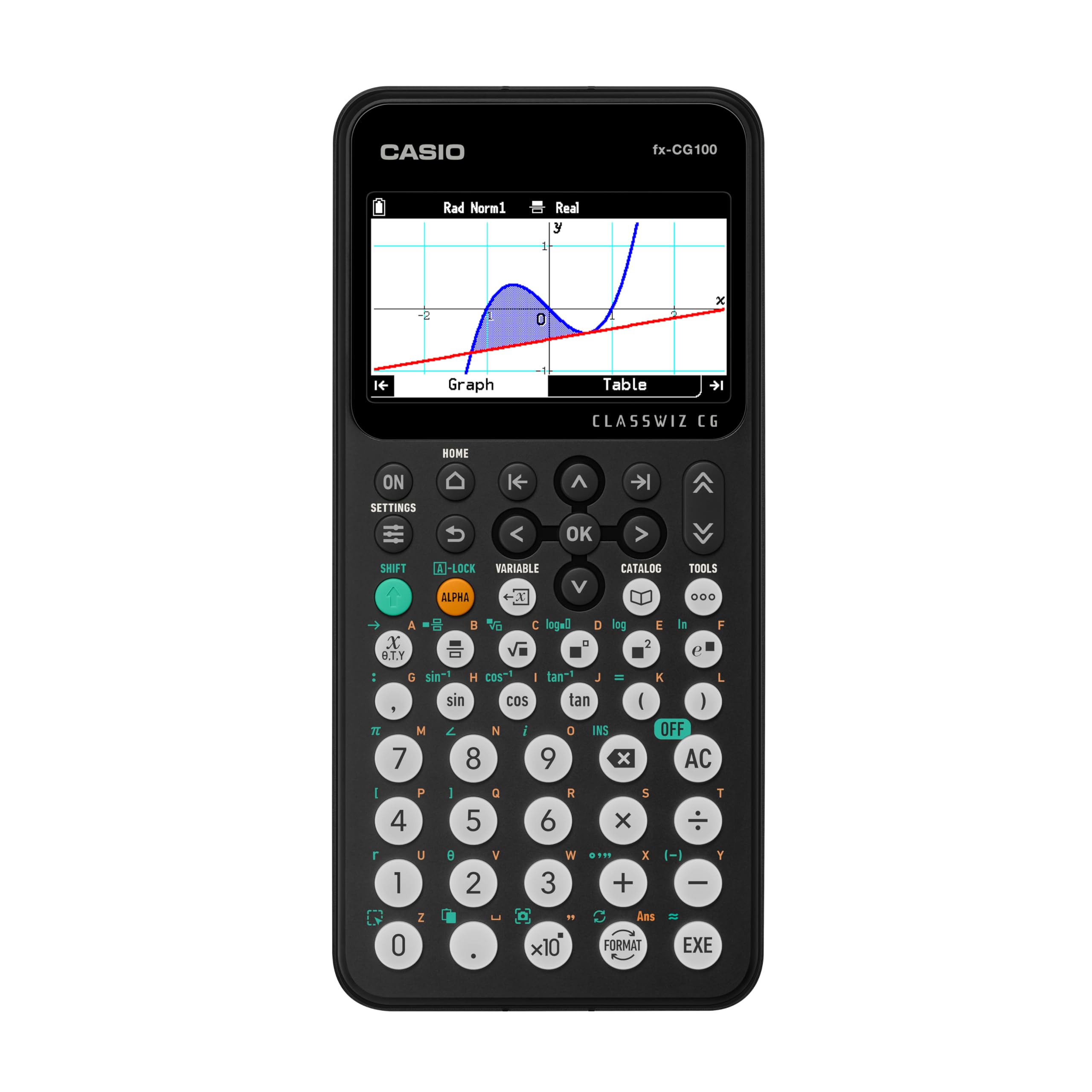
The Casio fx-CG100 brings a 3.7-inch high-resolution color display with over 65,000 colors to the mid-range graphing market, supporting 3D graph renderings of spheres, cylinders, and planes alongside traditional 2D plots. Its flush-gloss LCD panel and enhanced contrast make data analysis and graph transformations noticeably clearer than older models. The tab-based menu structure and glyph-labeled keys speed up menu navigation compared to dropdown-heavy interfaces.
A defining feature is built-in MicroPython integration, allowing students to write and execute scripts directly on the calculator. This opens the door to programming concepts without requiring a separate computer, aligning with modern STEM curricula. The device is approved for AP, SAT, PSAT, and ACT exams, with a mode-switching feature that locks functionality during testing.
The fx-CG100 effectively merges the computational abilities of a ClassWiz scientific with a full color graphing platform. Its USB connectivity enables data and program transfers, and the 3D graphing performance is fluid enough for classroom demonstrations. Battery life from four AAA cells is solid, and students upgrading from a scientific calculator will find the key layout familiar.
Why it’s great
- Vivid 3.7″ 65K color display for 3D plots
- Built-in MicroPython for on-device coding
- Approved for all major college entrance exams
Good to know
- No CAS — numeric computation only
- 4 AAA batteries add to recurring cost
- Limited community-developed apps compared to TI
4. TI-84 Plus CE Color Graphing Calculator (Coral)

The TI-84 Plus CE is the classroom standard for a reason — its 140 DPI color backlit display and 16-bit color depth make it the clearest non-CAS graphing calculator in TI’s lineup. The metallic coral finish stands apart from the sea of black graphing calculators, but the real value is the rechargeable lithium-ion battery that eliminates the hunt for AAA replacements. At 9.6 ounces and a slim profile, it slides easily into any backpack pocket.
Functionally, the CE handles everything from basic algebra through Calculus II and statistics. The color periodic table built into the operating system is a genuine asset for chemistry students, and the interface retains the muscle-memory-friendly TI layout that generations of students already know. It is approved for SAT, PSAT, AP, and ACT exams, making it a safe choice for test-takers who cannot risk using a CAS-enabled unit.
Where the CE falls short is raw power — it cannot handle symbolic algebra or indefinite integration the way a CAS model can. For advanced college coursework, you may eventually hit its limits. But for high school through early college, particularly in mixed math and science curricula, the TI-84 Plus CE remains the most balanced, exam-safe graphing calculator available.
Why it’s great
- Stunning 140 DPI color backlit display
- Rechargeable battery with long life
- Approved on all major exams including ACT
Good to know
- No CAS — numeric solutions only
- Less RAM than CX series for large programs
- Charging cable not included with all units
5. TI-Nspire CAS with Touchpad

The TI-Nspire CAS with Touchpad is the budget-friendly gateway into TI’s CAS ecosystem. For a fraction of the cost of the CX CAS, you get full symbolic algebra, 3D graphing, unit conversions, and the ability to perform indefinite integration — features that crush the TI-83 and TI-84 in advanced coursework. The high-resolution greyscale display is not backlit, but it remains readable under most lighting conditions and offers more screen real estate than older monochrome models.
The touchpad operates like a laptop trackpad, allowing you to navigate graphs and documents without fumbling through nested menus. The Scratchpad feature is particularly useful for quick calculations without saving, and the Grab-and-Move function lets you explore function transformations intuitively. It runs on four AAA batteries and supports rechargeable cells, with battery life lasting roughly two months under daily use.
Key trade-offs include a steeper learning curve compared to the TI-84 series, and the CAS functionality means it is not ACT-approved. The document-based operating system can feel restrictive if you are accustomed to traditional calculator workflows. But for the price, this is the most powerful CAS calculator available, making it a strong recommendation for students who need symbolic computation on a tight budget.
Why it’s great
- Full CAS at a fraction of the premium cost
- Touchpad navigation for efficient graphing
- 3D graphing and unit conversions included
Good to know
- Not backlit — harder to read in dim rooms
- Not permitted on ACT or IB exams
- Steep learning curve for document workflow
6. NumWorks Graphing Calculator

The NumWorks graphing calculator challenges the TI-Casio duopoly with an open-source operating system that receives frequent, community-driven updates. Its 320×240 color display is crisp, and the USB-C charging and data transfer mean you never need proprietary cables. The interface is designed from the ground up for intuition — no manual required for most operations — making it an excellent choice for students transitioning from a scientific to a graphing calculator.
MicroPython integration is a highlight, allowing on-device coding with a full Python shell. The graphing engine is fast, particularly for trigonometric and polynomial functions, and the equation solver handles complex numbers elegantly. At 220 grams and a slim white plastic chassis, it is one of the lightest and most portable graphing calculators on the market. It is approved for AP and SAT exams.
Downsides include a limited app library compared to TI’s ecosystem, and the physical buttons have a mushy feel that lacks the tactile feedback of higher-end models. The option to install custom firmware is limited, and the white plastic case shows scratches more readily than darker models. But for students who want a modern, updatable calculator without being locked into a proprietary platform, the NumWorks is a compelling and affordable choice.
Why it’s great
- Open-source with regular software updates
- USB-C charging — no proprietary cables
- Intuitive interface with minimal learning curve
Good to know
- Button feel is mushy compared to TI models
- Limited app and program ecosystem
- White plastic scratches relatively easily
7. TI 83 Plus Graphing Calculator (Certified Reconditioned)

The TI 83 Plus is the veteran of the graphing calculator world — a proven workhorse that has been getting students through high school math for decades. This certified reconditioned model comes with a Guerrilla Military Grade screen protector set, adding a layer of durability to a device already known for its ruggedness. It runs on four AAA batteries and delivers the classic TI interface that teachers and exam proctors universally recognize.
Functionally, the 83 Plus handles algebra, trigonometry, statistics, and basic calculus with reliable performance. Its monochrome LCD is not flashy, but it is readable, and the device is permitted on the SAT, PSAT, AP, and ACT. The included screen protector set is a smart addition for students who tend to toss their calculator into a backpack without a case.
The limitations are clear: no color display, no CAS, no backlight, and no USB connectivity for modern data transfer. The connectivity cord has been discontinued, making software updates difficult if not impossible. This calculator is best suited for budget-conscious students who need a reliable graphing device for basic high school coursework and do not require advanced features like 3D plotting or Python programming.
Why it’s great
- Rock-bottom entry cost for graphing capability
- Includes military-grade screen protector set
- Universal exam approval
Good to know
- No USB connectivity — software updates impossible
- Monochrome display with no backlight
- Limited to basic graphing and numeric functions
FAQ
Can I use a CAS graphing calculator on the ACT or SAT?
What is the real difference between the TI-84 Plus CE and the TI Nspire CX CAS?
Is the NumWorks calculator allowed for college entrance exams?
How much RAM do I need for advanced calculus and engineering coursework?
Does a color display really matter for graphing calculators?
Final Thoughts: The Verdict
For most users, the best advanced graphing calculator winner is the Texas Instruments Nspire CX CAS because it combines a full Computer Algebra System with a backlit color display, 100MB of RAM, and universal exam approval for the SAT, PSAT, AP, and Praxis. If you need the largest screen and most intuitive CAS workflow, grab the Casio fx-CG500. And for budget-conscious students who still need symbolic computation, nothing beats the value of the TI-Nspire CAS with Touchpad.