
That one bolt buried behind the alternator, wedged between the frame rail and a coolant hose, is why the ratcheting wrench exists. A standard combination wrench demands a full swing arc you simply do not have. The 7/8 ratchet wrench solves this exact pain — swapping the open-end back-and-forth shuffle for a fast, directional click that keeps you locked on the fastener in the tightest engine bays and equipment panels.
I’m Rikta — the co-founder and writer behind Gadgets Feed. I’ve spent thousands of hours cross-referencing tooth counts, swing arcs, and alloy composition data on ratcheting wrenches to separate genuine engineering from marketing gloss. (And Homer 🐱 supervised the research from atop the toolbox, tail draped over the GearWrench).
Whether you are a professional mechanic swapping suspension arms or a DIY homeowner fighting a seized tractor bolt, choosing the right tool matters more than you think. I’ve combed through the specs and real-world feedback to bring you the definitive guide to the best 7/8 ratchet wrench options available today.
How To Choose The Best 7/8 Ratchet Wrench
The best 7/8 ratchet wrench for your toolbox depends on three interrelated specs: tooth count, build material, and the reversing mechanism. Each one determines how much swing room you need, how long the tool survives daily abuse, and how easily you can change direction one-handed in a cramped engine bay.
Tooth Count and Swing Arc
A 72-tooth ratchet mechanism requires a 5-degree swing arc to engage the next tooth, while 90-tooth designs cut that to 4 degrees, and 120-tooth heads drop it to 3 degrees. In practical terms, the difference between 5 and 3 degrees can mean the difference between finishing a caliper bolt in two minutes and fighting it for ten. For a 7/8 fastener — common on axle nuts, suspension links, and heavy equipment — that small angular advantage is critical when obstructions leave you less than a hand-width to work.
Chrome Vanadium Steel vs Standard Alloy
Chrome vanadium steel (often marked Cr-V) adds vanadium to the alloy, increasing tensile strength and fatigue resistance without adding brittleness. A 7/8 ratchet wrench made from Cr-V can handle the higher torque demands of larger fasteners without the box end cracking or the gear stripping. Wrenches made from standard carbon steel may cost less but are more likely to deform under repeated high-load use, especially on fasteners torqued to 100 ft-lbs or more.
Quick Comparison
On smaller screens, swipe sideways to see the full table.
| Model | Category | Best For | Key Spec | Amazon |
|---|---|---|---|---|
| GearWrench 86951 | Reversible | Professional daily use | 90-tooth, 4° swing | Amazon |
| TEKTON WRC23322 | Reversible | Home mechanics | 72-tooth, 5° swing | Amazon |
| Williams 1228RC | Reversible | Industrial precision | Snap-on parent, polished Cr-V | Amazon |
| Greenlee 0354-21 | Reversible | Electrical work | 5° swing, reversible toggle | Amazon |
| Jaeger RW78IN | Compact | Extreme tight spaces | 72-tooth, 5° swing | Amazon |
| TightSpot T-RW78IN | Ultra-Compact | Appliance repairs | 120-tooth, 3° swing | Amazon |
| Titan 12611 | Entry-Level | Budget builds | 72-tooth, Cr-V steel | Amazon |
In‑Depth Reviews
1. GEARWRENCH 7/8″ 4 Degree Swing Arch 12 Point Ratcheting Combination Wrench – 86951

The GearWrench 86951 uses a 90-tooth ratchet mechanism that requires just 4 degrees of sweep to engage, making it one of the most clearance-friendly options at this size. The double off-corner loading design on both the box end and open end directly reduces fastener rounding — a spec that matters when you are torquing a 7/8 axle nut to 150 ft-lbs.
Real-world feedback from users confirms that this wrench survived over 450 ft-lbs on a caliper bolt using a pry bar extension, while a Snap-on equivalent reportedly broke in the same scenario. The full-polished chrome finish resists corrosion well, and the 12-point box end grabs both 6-point and 12-point fasteners without slipping. At 12 inches long, the extra leverage is noticeable on larger fasteners.
The trade-off is the slightly longer head length compared to compact designs, which may limit access in extremely tight engine compartments. But for a single wrench that bridges professional durability and enthusiast pricing, the 86951 is the benchmark in this category.
Why it’s great
- Off-corner loading reduces fastener rounding significantly
- 90-tooth gear delivers a 4° swing for tight access
- Proven durability under extreme torque loads
Good to know
- Slightly longer head may not fit the tightest recesses
- Ratcheting feel is less smooth than some competitors
2. TEKTON 7/8 Inch Reversible 12-Point Ratcheting Combination Wrench | WRC23322
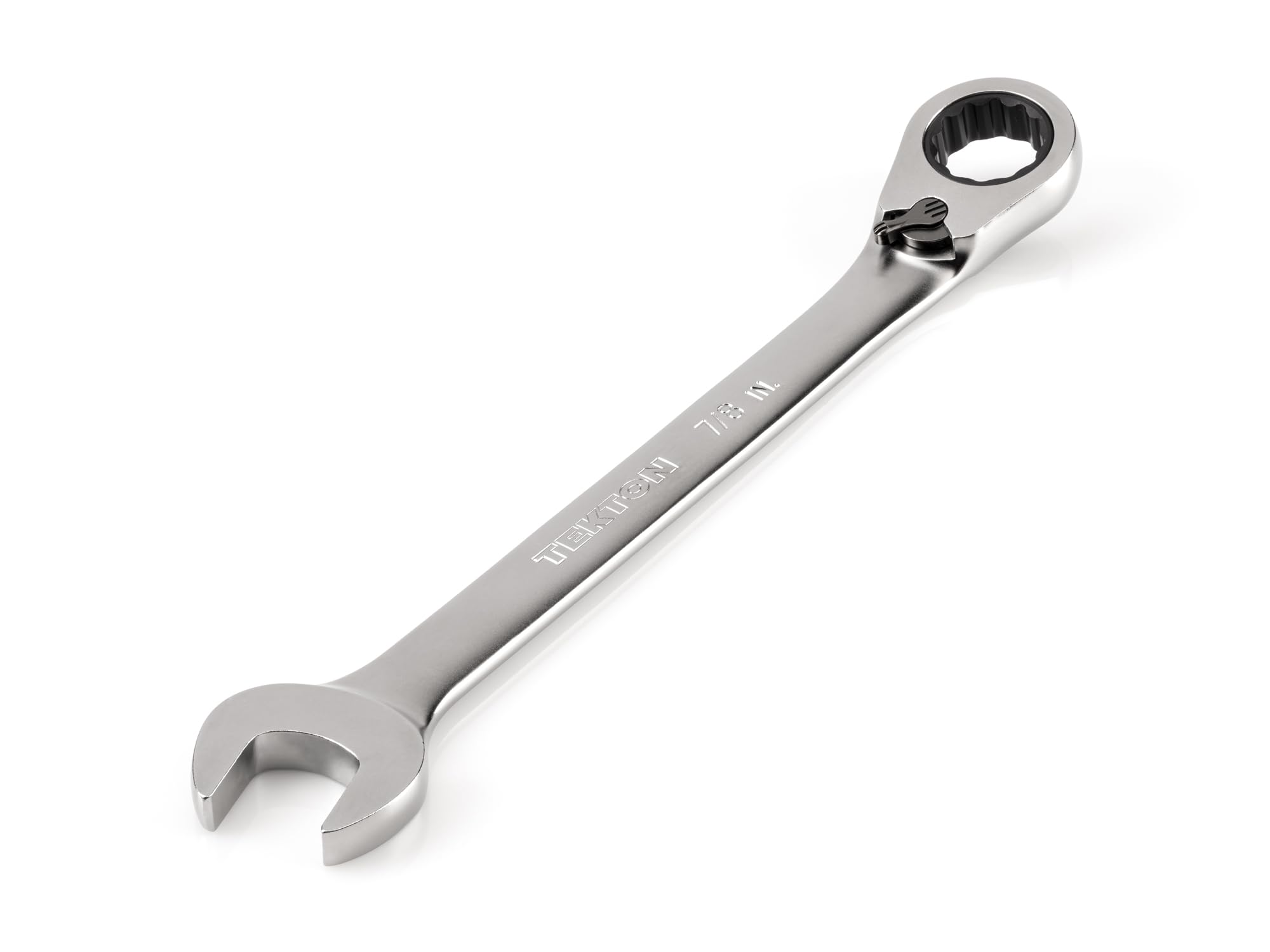
The TEKTON WRC23322 brings a 72-tooth ratchet with a 5-degree swing arc to the 7/8 size, paired with a satin nickel finish that resists scratches better than high-polish chrome. The box end is offset by 15 degrees, which creates finger clearance when working around obstructions like brake lines or suspension brackets.
The drive switch on the box end allows quick direction changes without removing the wrench from the fastener — a feature mechanics rely on when threading long bolts through multiple alignment holes. Users have reported using this wrench on driveshaft U-joint bolts and heavy maintenance tasks with no signs of gear stripping or handle flex. The 12-point box end fits both 6-point and 12-point fasteners, plus square drives when needed.
The satin finish, while more durable cosmetically, does not wipe clean as easily as polished chrome when covered in grease. Also, the 72-tooth mechanism requires marginally more swing than the premium 90-tooth options, but for most DIY and light professional use, the difference is negligible.
Why it’s great
- 15° offset box end provides extra finger clearance
- Satin nickel finish resists scratches and wear
- Reversible drive switch for one-handed direction changes
Good to know
- Satin finish holds grease more visibly than polished chrome
- 72-tooth requires a slightly wider swing than 90-tooth designs
3. Williams 1228RC Ratcheting Combination Wrench, 12 Point, 7/8-Inch

The Williams 1228RC is manufactured by Snap-on’s industrial division, sharing much of the same forging and heat-treating processes that make Snap-on wrenches legendary among professionals. The high-polished chrome finish on chrome vanadium steel gives it a mirror-like surface that resists corrosion and wipes clean with minimal effort.
Users consistently describe the ratcheting action as the smoothest they have ever used straight out of the box, with no skipping or binding even under heavy load. The recessed corners on the open end provide extra turning power and reduce the chance of fastener rounding — a key spec when dealing with rusted 7/8 bolts. The easily accessible ratchet lever allows direction changes without removing the wrench, which speeds up repetitive threading tasks.
The main consideration is the price, which sits at the upper end of the field. You are paying for the Snap-on lineage and the industrial-grade quality control, and for a professional who needs absolute reliability, it is worth every cent. For the occasional DIY user, a mid-range option may offer similar performance at a lower entry point.
Why it’s great
- Smoothest ratcheting action in this comparison
- Snap-on parent company quality control
- Recessed corners reduce fastener rounding
Good to know
- Premium price point may not suit casual users
- Standard length, not a compact design
4. Greenlee 0354-21 Combination Ratcheting Wrench, 7/8-Inch

Greenlee built its reputation on professional electrical tools, and the 0354-21 carries that precision into the ratcheting wrench category. The compact reversible switch and 15-degree offset on the box end give you the clearance needed to work around conduit, bus bars, and panel enclosures without constantly repositioning the tool.
The 5-degree ratcheting design is paired with a polished chrome finish that offers superior corrosion resistance — especially important for electricians working in damp or outdoor environments. Users report a smooth, high-frequency ratchet action that does not skip or bind, and the direction toggle is firm enough that it will not flip accidentally during use. The hardened steel construction holds up well to repeated daily use on threaded rods and heavy-duty fasteners.
The key downside is the head size, which is slightly bulkier than ultra-compact designs. If you are working in an exceptionally tight engine bay, you may still find the head too wide to fit. However, for general maintenance, electrical work, and mechanical repair, the Greenlee is a solid performer with a reliable mechanism.
Why it’s great
- Smooth, high-frequency ratchet action with no skipping
- Firm directional toggle that resists accidental flipping
- Polished chrome finish resists corrosion effectively
Good to know
- Bulkier head may not fit the most confined spaces
- Price is in the upper tier of this comparison
5. Jaeger 7/8 Inch Ratcheting Wrench with 5° Ratcheting Precision
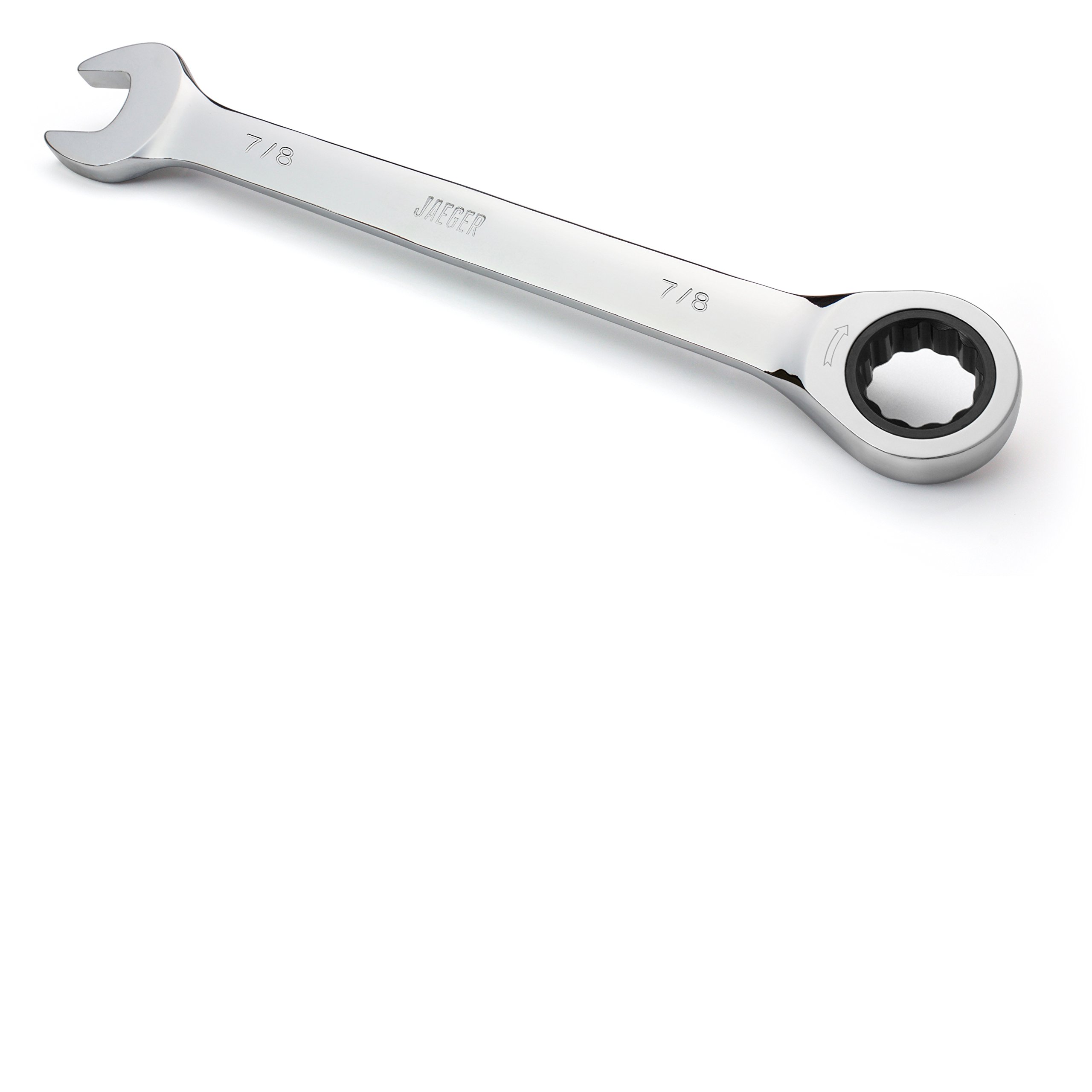
The Jaeger RW78IN is engineered from the ground up for confined access, using aerospace-grade vanadium in the chrome vanadium steel alloy for added hardness and corrosion resistance. The 72-tooth ratchet provides a 5-degree swing — adequate for most tight spots — but the real story is the thin wall profile around the ratchet head that lets it slide into gaps where standard wrenches cannot reach.
Users have specifically praised this wrench for accessing rear axle nuts on motorcycles and milling machine maintenance without needing to remove surrounding components. The reinforced open end grips fasteners firmly to reduce bolt rounding, and the 7-stage heat treatment process ensures the handle does not flex under high torque. The lifetime guarantee adds confidence for buyers who plan to use it hard.
The 72-tooth mechanism is not as fine as the 120-tooth option from TightSpot, so you will need a slightly larger swing arc in extremely tight areas. Also, some users noted that the claimed tooth count felt closer to 72 than the higher numbers advertised — but for most real-world scenarios, the performance is still excellent.
Why it’s great
- Thin-wall head design fits extremely tight spaces
- Aerospace-grade vanadium alloy for extra hardness
- Lifetime guarantee with no-hassle replacement
Good to know
- 72-tooth requires more swing than 90 or 120-tooth options
- Some users report tooth count feels standard, not premium
6. TIGHTSPOT 7/8 Inch Ratchet Combination Wrench with Precision Movement
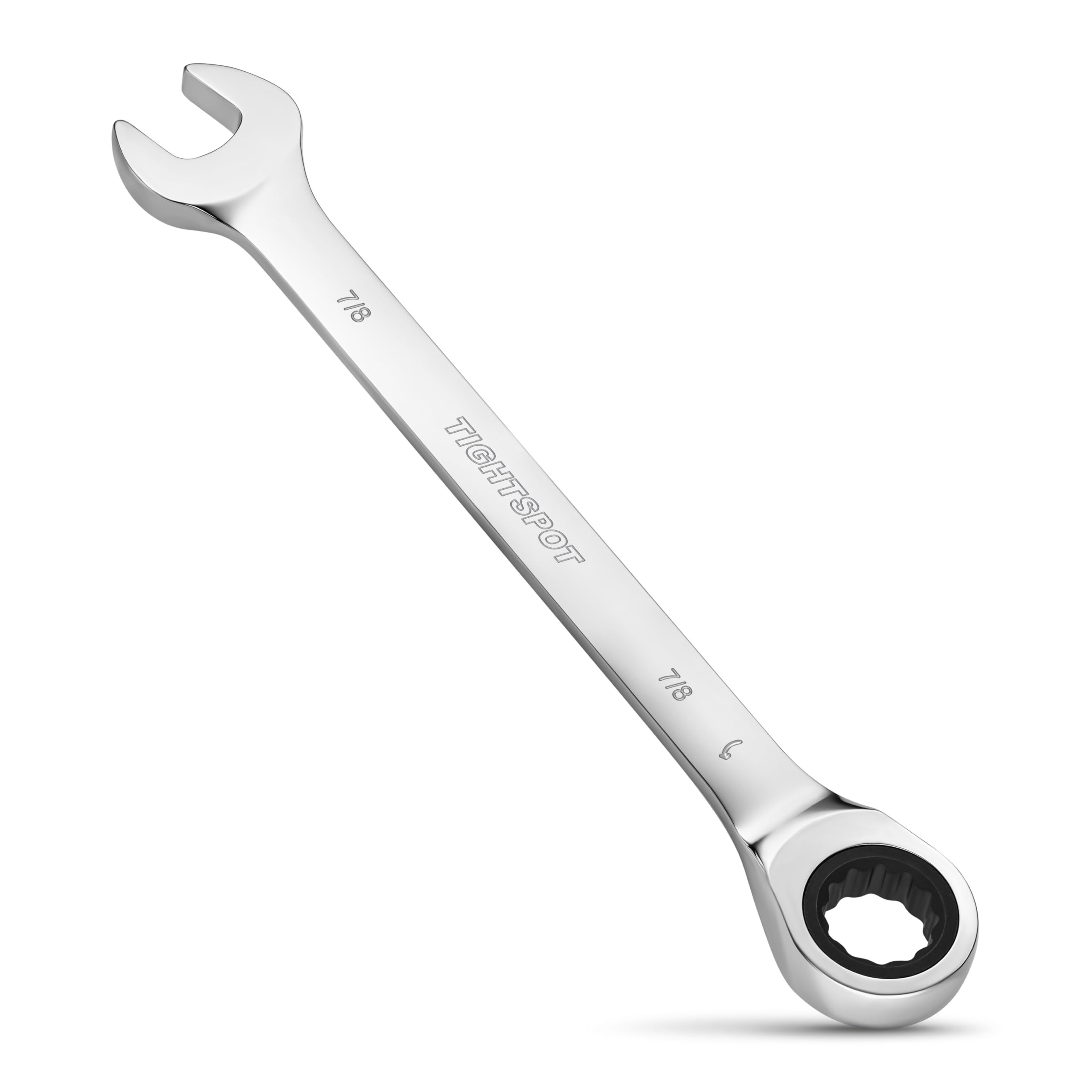
The TightSpot T-RW78IN takes the compact concept to its logical extreme: a 120-tooth ratchet that needs only a 3-degree swing to engage the next tooth. That is the smallest swing arc available in this category, making it the definitive choice for fastener positions where your wrist barely has room to move — think deep inside an appliance panel or behind a wheel well liner.
The chrome vanadium steel construction with drop forging and heat treatment provides a strong, durable handle that resists bending under load. Users have reported using it for 24-bolt installations where previously only a box-end wrench worked, calling the thin wall around the ratchet the critical feature that made the job possible. The reinforced open end also helps prevent bolt rounding on stubborn fasteners.
The trade-off for that extreme tooth count is a slightly more delicate internal mechanism. While the lifetime warranty covers defects, applying extreme torque with a cheater bar could damage the 120-tooth gear faster than a coarser 72-tooth design. Stick to hand-torque applications and this wrench will perform brilliantly in the tightest spots.
Why it’s great
- 120-tooth mechanism with only 3° swing arc
- Extremely thin wall profile for deep access
- Reinforced open end reduces fastener rounding
Good to know
- Fine-tooth gear may be less durable under extreme torque
- Best suited for hand-torque, not breaker-bar applications
7. Titan 12611 7/8″ Ratcheting Wrench
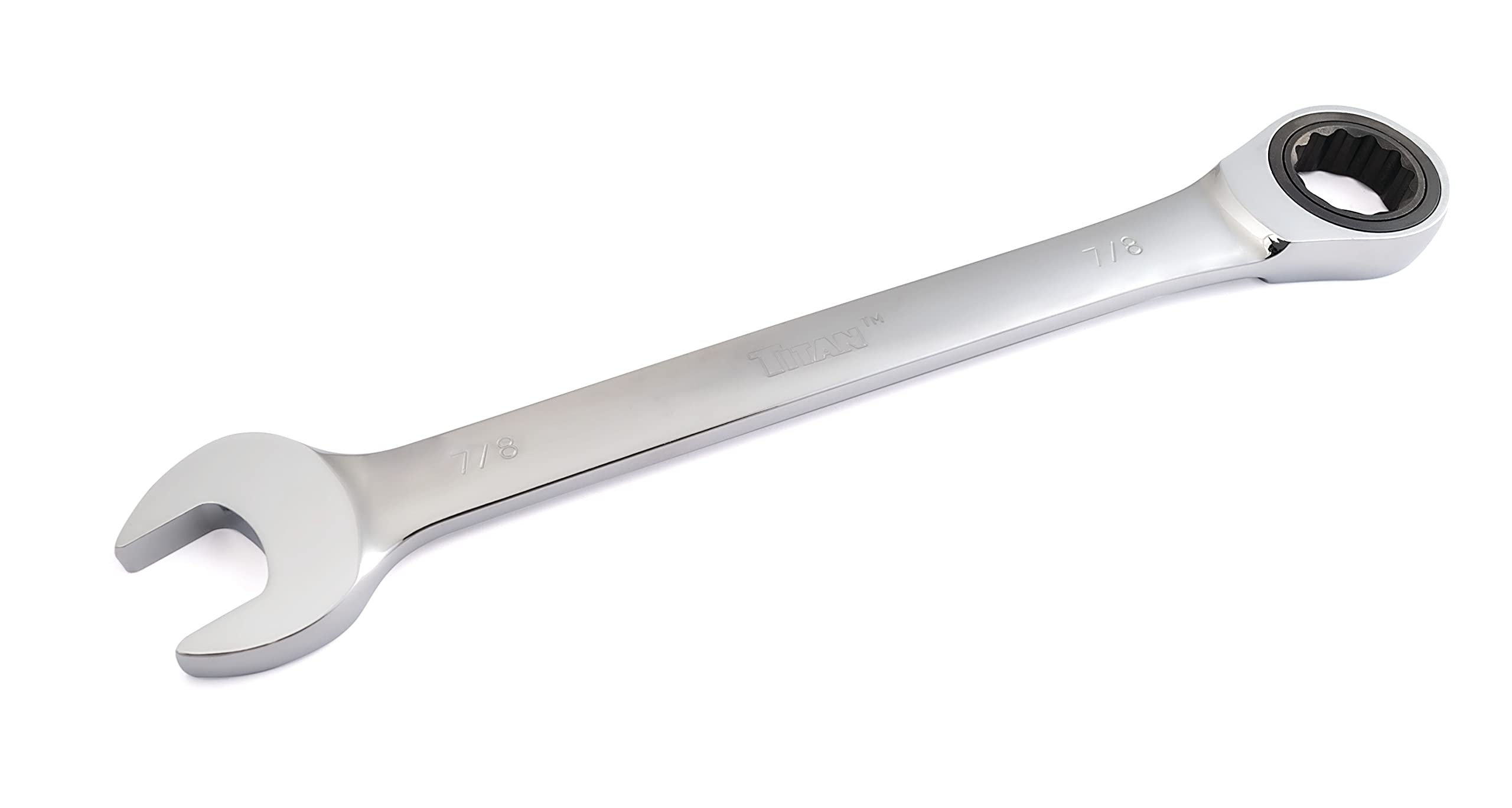
The Titan 12611 is an entry-level 7/8 ratcheting wrench built from chrome vanadium steel with a mirror finish that looks far more expensive than its price suggests. The 72-tooth box end delivers a 5-degree swing, matching the performance of many mid-range wrenches at a fraction of the cost.
Users have reported using this wrench for heavy tasks like ball joint alignment, where they beat it with a rubber hammer to persuade stubborn pins into place — and the wrench came through without damage. The 5-degree sweep is sufficient for most general automotive and equipment maintenance, and the combination open-end/box-end design gives you flexibility when a ratchet won’t fit.
The main compromises are the feel and finish longevity. The mirror polish looks great out of the box but will show scratches and wear faster than a satin or industrial chrome finish. The warranty also requires contacting the vendor rather than a straightforward replacement process, which may be a concern for heavy users.
Why it’s great
- Excellent value for chrome vanadium steel construction
- 5° swing handles most general maintenance tasks
- Proven durability under heavy hammer-assisted use
Good to know
- Mirror finish shows wear and scratches over time
- Warranty process requires contacting the vendor directly
FAQ
What is the difference between 72-tooth and 120-tooth ratchet mechanisms for a 7/8 wrench?
Can I use a 7/8 ratchet wrench on a 21mm fastener?
Final Thoughts: The Verdict
For most users, the best 7/8 ratchet wrench winner is the GearWrench 86951 because it combines a 90-tooth 4° swing with off-corner loading that prevents fastener rounding, backed by proven durability under extreme torque. If you want the smoothest ratcheting action and Snap-on lineage, grab the Williams 1228RC. And for ultra-tight spaces where every degree of swing counts, nothing beats the TightSpot T-RW78IN with its 120-tooth 3° mechanism.