
Our readers keep the lights on and my morning glass full of iced black tea. As an Amazon Associate, I earn from qualifying purchases.
Specs are compiled from manufacturer listings and verified buyer reviews and can change over time — please confirm the key details on the product page before buying.
If your home is wired for 220-volt power, a standard 115-volt window unit is a non-starter — you need a 230V window AC that actually matches the heavy-duty outlet on your wall. The right 230V unit cools a 1,500 sq ft floor plan in minutes, runs as low as 43 dB for sleep, and trims energy use with inverter tech. This guide ranks seven 230V window ACs by cooling power, noise, and plug compatibility for your 220-volt circuit.
I’m Min — the founder and writer behind Gadgets Feed. This guide is built by comparing the manufacturers’ published specifications and the patterns across verified customer reviews, so you get each pick’s real strengths and trade-offs instead of marketing spin.
This guide helps you find the best 220 air conditioner window unit by matching power, noise, and cooling capacity to the real size of your rooms and the wiring you already have.
Quick Picks
- Midea 24,000 BTU Smart Inverter 230V Window Air — Best Overall
- LG 23,500 BTU Dual Inverter Smart Window Air — Top Performer
- Keystone 23,200 BTU Window Air Conditioner — Year-Round Pick
- Whirlpool 18,000 BTU Window Mounted Inverter — Best Value
- Durastar 23,200 BTU 230V Window Air Conditioner — Pro-Grade Heat & Cool
- Durastar 18,800 BTU Window 208/230V Air — Heat & Cool Value
- Friedrich Chill Premier Inverter 18 — Flexible Mount
How To Choose The Best 220 Air Conditioner Window Unit
Buying a 230V window unit is different from grabbing a standard plug-in model. The circuit, the breaker, and the plug shape all have to match before you even think about cooling. Match the circuit, breaker, and plug shape first, then focus on BTU and noise for comfort.
Match the BTU to your square footage
BTU measures heat removed per hour, so 18,000 BTU suits 1,000 sq ft and 23,000–24,000 BTU covers 1,500 sq ft. Oversized units in small rooms short-cycle and dehumidify poorly, so match BTU to square footage. For a large living area or open floor plan up to 1,000 square feet, look in the 18,000 BTU range; for spaces up to 1,500 square feet, a 23,000 to 24,000 BTU unit is the more sensible fit.
Check your outlet and breaker amp rating
A 230V window AC is a heavy-duty appliance. Many units here specify a 30 Amp 230 Volt breaker, and the plug is often a 6-30P style that will not fit a standard dryer or stove outlet. Before ordering, confirm the outlet shape and amperage, or expect to buy an adapter or have an electrician swap the receptacle — a step several owners wish they had planned for.
Quick Comparison
| Model | Best For | Cooling Power | Room Coverage | Compressor | Amazon |
|---|---|---|---|---|---|
| Midea 24,000 BTU | Fast whole-floor cooling | 24,000 BTU | 1,500 sq ft | Inverter | Amazon |
| Durastar 18,800 BTU | Cooling plus supplemental heat | 18,800 BTU | 1,000 sq ft | Reciprocating | Amazon |
| Keystone 23,200 BTU | Year-round heating & cooling | 23,200 BTU | 1,500 sq ft | Standard | Amazon |
| LG 23,500 BTU | Ultra-quiet smart control | 23,500 BTU | 1,440 sq ft | Dual Inverter | Amazon |
| Whirlpool 18,000 BTU | Quiet midsize rooms | 18,000 BTU | 1,000 sq ft | Inverter | Amazon |
| Durastar 23,200 BTU | Heating plus cooling in a tiny house | 23,200 BTU | 1,500 sq ft | Inverter | Amazon |
| Friedrich 18,000 BTU | Window or wall installation | 18,000 BTU | — | Inverter | Amazon |
In‑Depth Reviews
1. Midea 24,000 BTU Smart Inverter 230V Window Air Conditioner

The 24,000 BTU beast that drops a whole second floor to cold in 20 minutes.
This is the pick for anyone who needs raw power fast. At 24,000 BTU it tops this list, and it covers a large 1,500 square feet — the same footprint as the Keystone below, but with a stronger punch if your heat load is brutal. The inverter compressor (a variable-speed motor that runs only as hard as needed) trims energy use, and the maker rates it at more than 40% energy savings against the Energy Conservation Standard.
You get a barely-there hum, not a roar. This unit runs as low as 48.5 dBA (a decibel level about as loud as a quiet library), and buyers report it’s barely noticeable even on high — one described it as “Quiet, strong cold air; cools entire second floor in 20 mins.” You control 4 modes (Auto, Cool, Dry, Fan), 3 speeds, a 24-hour timer, and an ECO saver from the panel, the remote, the SmartHome app, or your voice via Alexa and Google Assistant.
Installation needs a 230V outlet, and some units ship with mismatched screws that require re-drilling. This unit requires a 230V outlet, and a few owners mention the included screws do not match the frame holes, calling the assembly a “giant pain” that sometimes needs re-drilled pilot holes. Plan for a 40-minute install and keep a drill handy. Buyers also note the plug is not a standard 120V — one paid for a separate 30A/250V cord — so confirm your receptacle before it arrives. The crowd favorite here holds a solid 4.1-star average that outpaces most of the field.
Why It Leads
- 24,000 BTU is the strongest cooling in this lineup
- 48.5 dBA noise floor is genuinely sleep-friendly
- Full app, voice, and remote control flexibility
- Cools 1,500 sq ft and still impresses in 95°F+ heat
Where It Trips Up
- Included hardware sometimes doesn’t fit the frame
- Needs a specific 230V outlet, often a 20A/250V plug
- 3,200-watt draw is the highest here
Your best bet if: you need maximum cooling for a big space and want app or voice control.
Look elsewhere if: you want plug-and-play from the start — budget time for possible hardware fiddling.
2. LG 23,500 BTU Dual Inverter Smart Window Air Conditioner
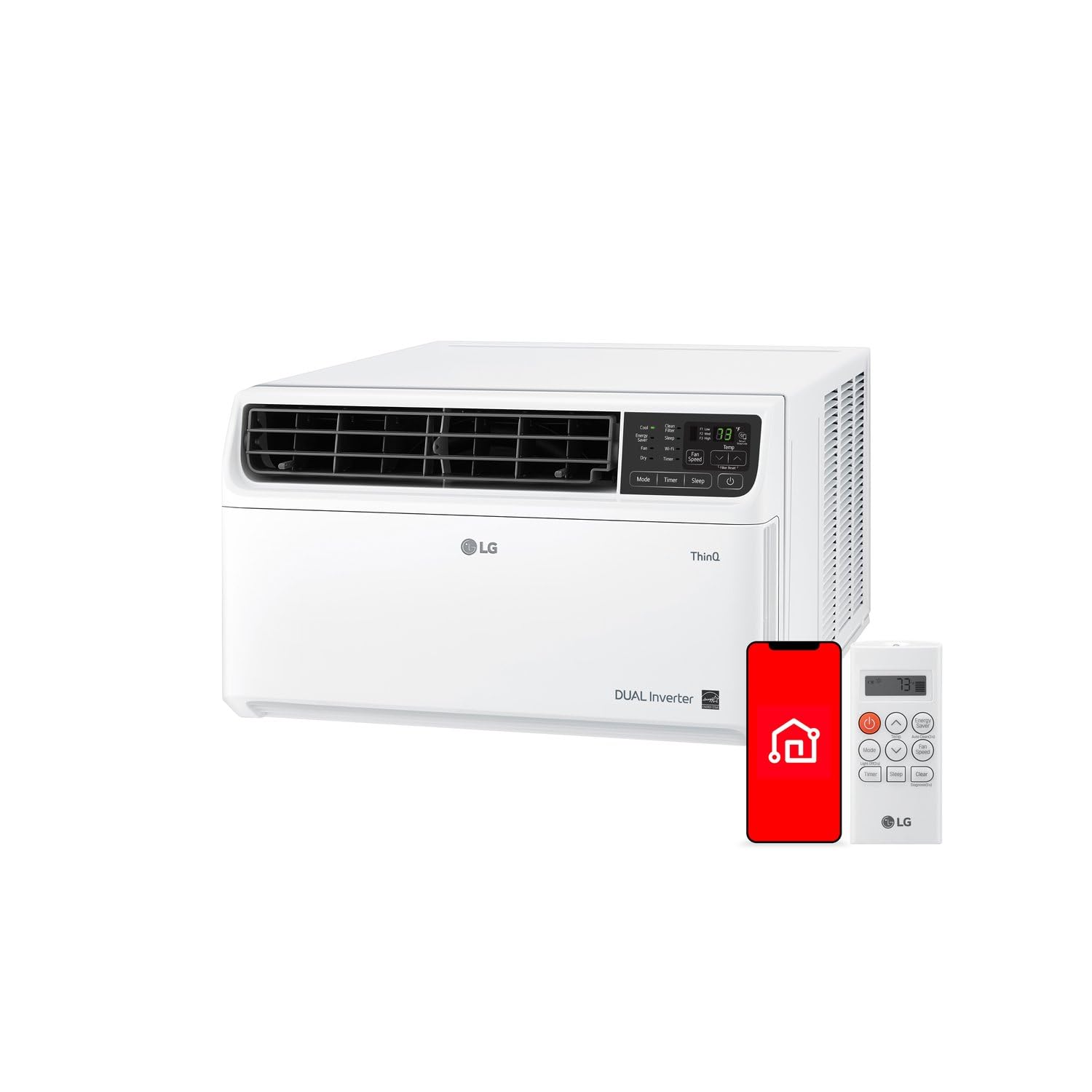
The dual-inverter whisperer that cools a 1,440 sq ft house at 44 dB.
If noise is your number one enemy, this LG is the quietest pick on the list. Its Dual Inverter compressor drops to 44 dB in sleep mode — even softer than the Midea’s 48.5 dBA floor — and owners describe a “quiet whoosh” that is easy to sleep through. It pushes 23,500 BTU across rooms up to 1,440 square feet, so it stays in the big-cooling class while staying much more hushed than most.
Your electric bill gets a break here. The maker claims dual-inverter tech (a compressor that adjusts its speed to hold your set temperature) is up to 50% more energy efficient than the Energy Star certification requirement, and buyers back that up — one cooled a 1,200 sq ft house and noted the LG ran cheaper per year than their old central AC. You control it through the LG ThinQ app, a remote, or voice with Amazon Alexa and Hey Google. One buyer liked the app’s cost tracking but found Alexa integration weak and switched to ThinQ scheduling instead.
Reliability is the honest trade-off. The 3.7-star score is the lowest here, and while many owners praise the cooling and quiet, a chunk report units arriving damaged from shipping and some say it stopped working after about a year. This one also needs a 19-inch minimum window opening and a 100+ lb bracket for support, per the install guides. It is a brilliant unit when it lands intact — just check the cabinet and packaging the moment it arrives.
What Wins People Over
- 44 dB sleep mode is the quietest on this list
- Up to 50% more efficient than the Energy Star benchmark
- App scheduling plus voice and remote control
- Cools a 1,500 sq ft home to 70°/72° all summer
What Gives Pause
- Shipping damage is a recurring theme in reviews
- Some units reportedly stop working after a year
- Requires a 19-inch minimum window opening
Grab it for: the quietest cooling and app-driven scheduling in a large space.
Think twice if: you want maximum long-term reliability — inspect for damage on delivery.
3. Keystone 23,200 BTU Window Air Conditioner with Supplemental Heat
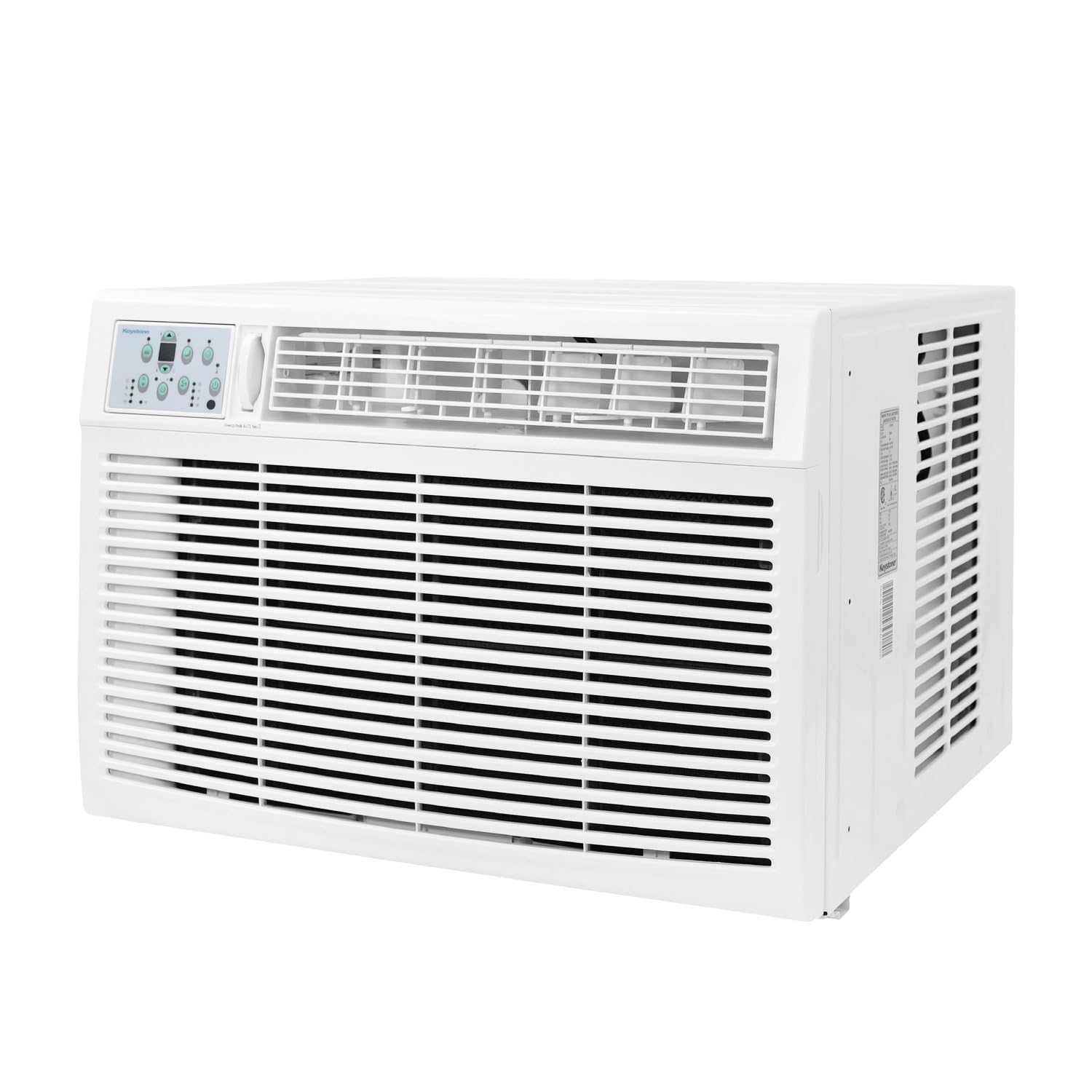
A 23,200 BTU workhorse that also warms the room when winter bites.
This Keystone works twelve months a year, not just summer. It pulls 23,200 BTU for cooling and adds 16,000 BTU of supplemental heat, covering large spaces up to 1,500 square feet — the exact same footprint as the Midea above but with a heating mode the Midea lacks. The heat is meant to help when outdoor temps sit between 23 and 76 degrees, so treat it as a boost, not your primary furnace.
In a 1,500-square-foot space, it matches the Midea’s coverage, but the Keystone stands out for its smart remote. The remote reads the temperature in the room you’re sitting in, shows it on an LCD screen, and sends a corrective signal to the wall unit every 3 minutes — so you stay comfortable where you sit, not just near the window. Owners in extreme Arizona heat call it reliable where a previous inverter unit failed, and several praise the low electric bill in Energy Saver or Sleep mode.
What customers note most is strong heat and cool performance, and that is the Keystone’s reputation — performance is its most-cited strength in owner feedback by a wide margin. The big caveat is the plug: one buyer found the 25-amp round-ground plug impossible to source locally when it did not match their outlet, and customer service frustration followed. Verify your receptacle before ordering, and expect a loud unit with some odd on-off cycling after startup, as a few owners note.
Standout Strengths
- Cooling plus 16,000 BTU supplemental heat in one unit
- Smart remote re-syncs room temp every 3 minutes
- Covers the full 1,500 sq ft with a lower electric bill
- Rated a reliable survivor in extreme Arizona heat
Honest Weaknesses
- Uncommon 25-amp plug can be hard to match
- Owners call it loud with brief on/off cycling
- Supplemental heat is not a primary heat source
Pick this when: you need one window unit that cools and supplements heat across a big floor plan.
skip it if: you cannot confirm your outlet matches its unusual plug style.
4. Whirlpool 18,000 BTU Window Mounted Inverter Air Conditioner
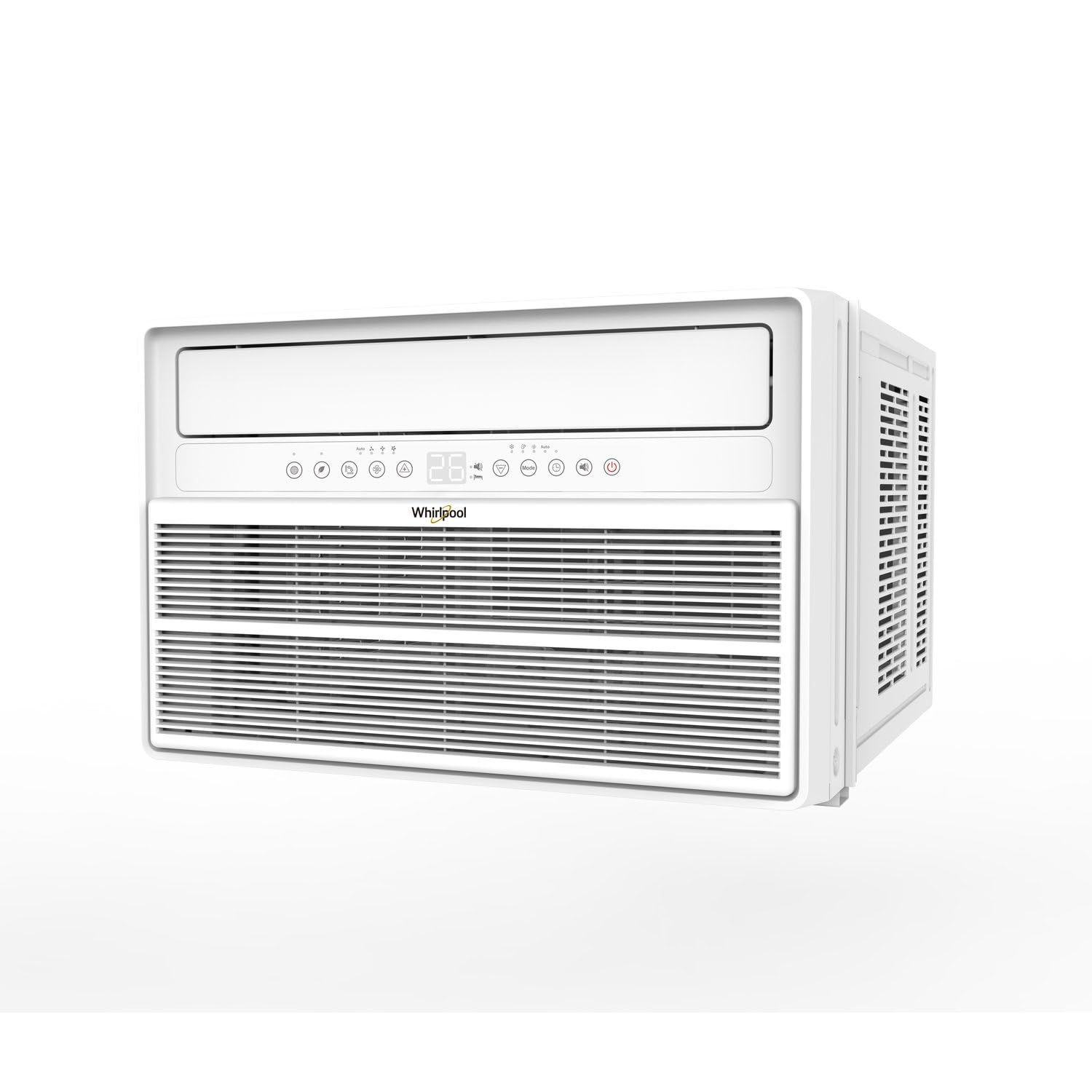
The 18,000 BTU inverter that covers a 1,000 sq ft home at 43 dB.
For a 1,000-square-foot house or a large apartment, this Whirlpool hits a balance between power and price. Its 18,000 BTU rating covers rooms up to 1,000 square feet, and the inverter compressor (a motor that adjusts its speed to hold your set temperature) avoids the wasteful on-off cycling of a standard unit. In a 100-degree Georgia heat wave, reviewers point out it handled a full 1,000 sq ft house on auto and ran very quietly — one says it cools an entire 1,500 sq ft ranch and keeps it cool on 90-degree-plus days.
Noise is the defining trait here, and it is a direct rival to the LG on this front. The mute mode drops sound to 43 dB — the same quiet peak as the LG’s sleep mode — by lowering the fan speed, which is ideal for a nap or TV time. You also get 3 fan speeds, a 24-hour programmable timer, and Eco and sleep modes, plus a washable filter with a clean-filter alert so you know when to rinse it.
This unit needs a 230V/15A outlet, so confirm your receptacle before ordering to avoid a return. This unit requires a 230V/15A outlet, and at least one buyer discovered that only after delivery, forced to return it because it wouldn’t fit a standard socket. It pulls 18,000 BTU so it runs at a more moderate energy level than the 23,000 BTU giants, but the trade-off is less ceiling for very large spaces. This is the sensible middle-tier choice for a typical home rather than a workshop or open warehouse.
Why it fits most homes: 18,000 BTU matched to a 1,000 sq ft footprint gives strong cooling without the oversized-unit short-cycling that wastes energy in smaller homes.
Meet it halfway: the 43 dB mute mode makes this one of the two quietest units here, yet it costs less than the LG — just confirm your 230V/15A outlet before you commit.
Reach for this if: a typical 1,000 sq ft home needs quiet, efficient cooling on a 230V circuit.
Look past it if: your space exceeds 1,000 square feet and demands bigger BTU muscle.
5. Durastar 23,200 BTU 230V Window Air Conditioner with Supplemental Heat
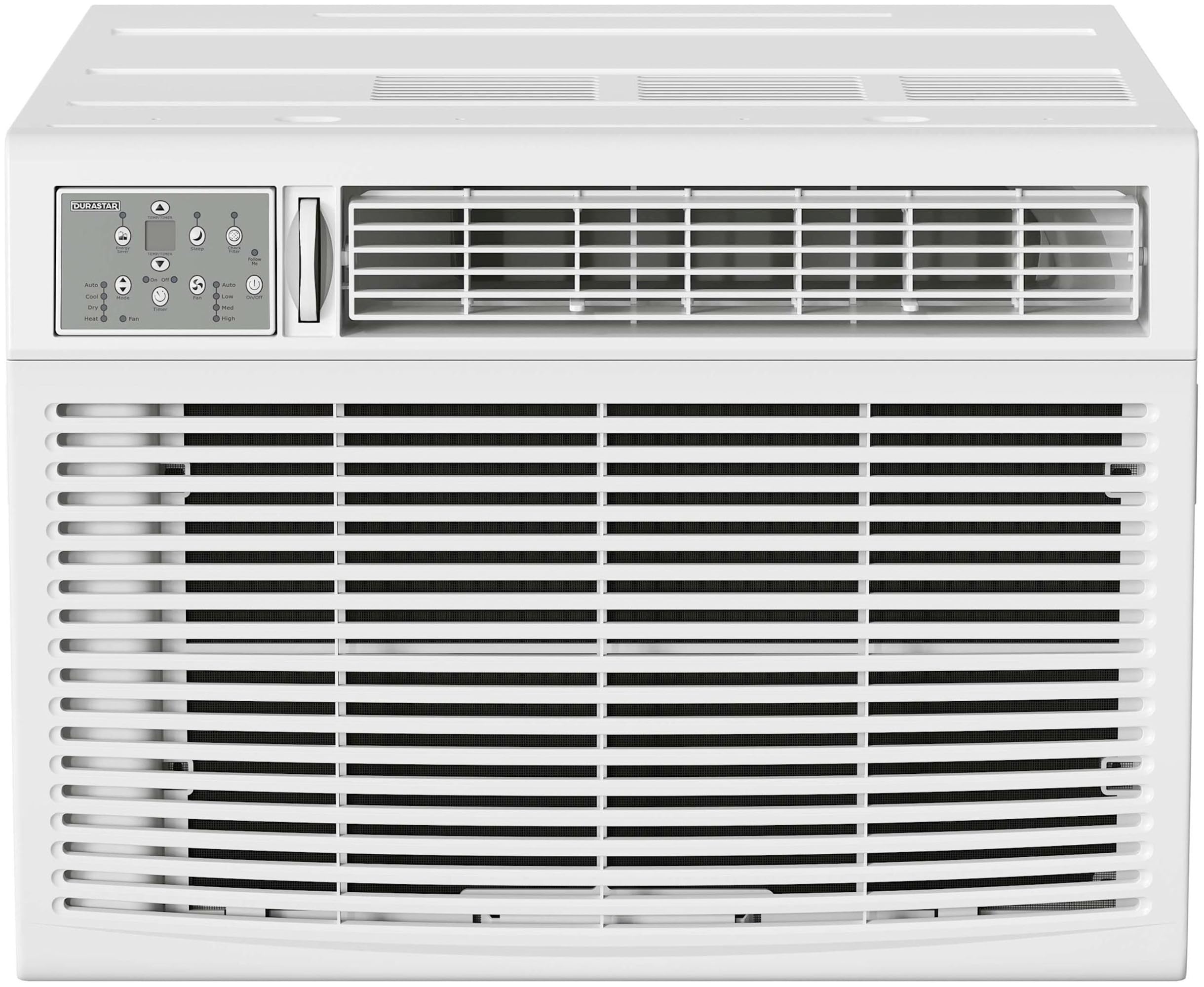
The tiny-house champion that cools 1,500 sq ft and heats 700 sq ft.
This Durastar is the one owners mention coming back to — literally. It cools 1,500 square feet and delivers 16,000 BTU of supplemental heat for 700 square feet, with four operation modes and three fan speeds. A tiny-house owner reports two full years of use, saying it keeps the space warm in winter and cool in summer so reliably that they would buy it again without hesitation.
That 16,000 BTU heating is the same figure the Keystone advertises, giving you real all-season versatility rather than a cooling-only box. The 24-hour timer and 4-way air directional louvers (adjustable slats that guide airflow where you want it) make it easy to aim cool air across a room. Owners call the install easy and the remote good, and note it runs energy-efficiently with moderate noise.
Shipping damage is the main risk, with some units arriving dented but still functional. Several units arrived with a dented cabinet or bent coil — one buyer saw damage twice — though most found it “didn’t affect the operation of the unit.” At 121 pounds, it is the heaviest pick on this list, so a bracket and a helper are wise. It also demands a 30 Amp 230 Volt breaker and uses an LCDI 6-30P plug (a power cord with a leakage current detector), so your outlet choice is locked in.
Why owners stick with it: the combination of 23,200 BTU cooling and 16,000 BTU heat covers a large space year-round for a price below the LG.
Who it doesn’t suit: anyone without a 30 Amp 230 Volt breaker, or anyone who cannot accept that some units ship with cosmetic dents.
Best for: small homes, tiny houses, and workshops that want one unit to carry both seasons.
Not for: buyers who want pristine out-of-the-box cosmetics — check the cabinet on arrival.
6. Durastar 18,800 BTU Window 208/230V Air Conditioner with Remote
A cooling-and-heating combo that trims power use to 2,254 watts.
This smaller Durastar is for a 700 to 1,000 square foot space that also wants heat. It delivers 18,800 BTU of cooling and 16,000 BTU of supplemental heating, running at an annual energy consumption of 2,254 watts — noticeably lighter than the 3,200 watts the Midea draws at its bigger 24,000 BTU output. For a mid-size home that wants a milder power bill, that difference matters.
The 4-way air directional louvers help spread air evenly, and the included remote plus weather seals simplify setup. At 9.8 amps, it is a lighter electrical load than the big 23,200 BTU siblings that need a 30-amp breaker. Owners who got a good unit are repeat customers — one said “the a/c duraster is working fine” and would buy another the same. It heats and cools well, which is the core job done right.
The sticking point is the provided hardware. Shoppers say the screws are simply too small for the unit’s holes, making installation “almost impossible” with what ships in the box, and the fan control offers only one speed on the heat setting. One unit arrived with a damaged casing, and another shut off seconds after plugging in. This one is a solid value on paper, but set expectations for a hardware-store run and careful inspection on delivery.
Efficient Strengths
- 18,800 BTU cooling plus 16,000 BTU heat in one box
- 2,254-watt draw is the lightest power appetite here
- Remote and weather seals included
- Lighter 9.8-amp load on your electrical system
Frustrating Flaws
- Included screws don’t fit the frame holes
- Fan speed is locked to one setting in heat mode
- Some units arrive with damaged casings
Choose it for: a modest electric bill and a 1,000 sq ft space needing heat and cool.
Pass on it if: you want an easy install — the hardware will likely test your patience.
7. Friedrich Chill Premier Inverter 18,000 BTU 230/208V Unit

A cool-only 18,000 BTU inverter that mounts in a window or a wall.
This Friedrich is the flexible installer’s pick. It is rated for both window and wall mounting, which matters if you have a sleeve in an exterior wall and want a cleaner look than a window box. It runs on 230/208V for cooling only — no heat mode here — and owners replacing ancient units are the ones singing its praises.
Quiet is the theme in owner feedback. Multiple buyers report it is “extremely quiet compared to the 35 year old one I replaced,” with one saying you don’t even know it’s on. The inverter compressor (variable-speed, again) cools fast, and the sweep feature pushes air evenly across the room. It is Energy Star certified, so it meets a recognized efficiency bar rather than just claiming one.
The trade-off is installation complexity and the absence of heat. One owner could not separate the casing for a through-wall install despite following the instructions to remove four screws, and phone support did not resolve it. It is also the premium-priced pick here, so you are paying for the brand and the dual-mount flexibility rather than raw BTU. An activated carbon filter (a mesh that helps trap odors and particulates) is a nice touch for fresher air.
Its Defining Strengths
- Mounts in a window or a wall sleeve
- Energy Star certified efficiency
- Extremely quiet with fast cooling
- Activated carbon filter for fresher air
Its Limitations
- Cooling only — no supplemental heat
- Casing separation can be troublesome for wall installs
- Premium price for 18,000 BTU
Reach for it when: you need a cool-only unit that can go in a wall sleeve or a window with minimal noise.
Hold off if: you want heating or a no-fuss install — the casing can fight back.
Understanding the Specs
BTU and Room Coverage
BTU stands for British Thermal Units — the amount of heat a unit can remove from a room in an hour. A higher number cools a bigger space faster. In this lineup, 18,000 BTU units suit about 1,000 square feet, while 23,000 to 24,000 BTU units reach 1,440 to 1,500 square feet. Buying too much BTU for a small room causes wasteful short on-off cycles; too little leaves you sweating.
Inverter vs. Standard Compressor
A standard compressor (also called non-inverter) runs at one fixed speed, cycling on and off to hold temperature. An inverter or dual-inverter compressor adjusts its motor speed continuously, so it runs longer but at lower power. That usually means quieter operation, steadier temperatures, and lower energy use — the LG claims up to 50% more efficient than the Energy Star benchmark — at a higher upfront cost.
Noise in Decibels (dB)
Decibels measure sound pressure, and in window ACs the numbers tell you how sleep-friendly a unit is. Normal conversation sits around 60 dB; a quiet library is roughly 40 dB. On this list, the Whirlpool and LG both hit 43 dB in their quiet modes, the Midea runs as low as 48.5 dB, and a standard non-inverter like the Keystone is noticeably louder. For a bedroom, aim for the 43-48 dB range.
230V Power and Plug Types
All units here need 208/230V power, not the standard 115V household outlet. Some demand a 30 Amp 230 Volt breaker with an unusual plug like the LCDI 6-30P, while others run on a 20A or 15A 230V circuit. Confirm the plug shape and breaker amperage in your home before ordering — a mismatched plug means an electrician visit or a return, and owners mention this is the most common surprise.
FAQ
Will a 220 air conditioner window unit fit my existing outlet?
How do I know what BTU rating my room needs?
What is the difference between an inverter and a dual-inverter compressor?
How loud is too loud for a bedroom air conditioner?
Can a 230V window air conditioner also heat my room?
What is a 6-30P plug and why does it matter?
Why do some 230V units arrive with damaged cabinets?
Are the included installation screws reliable on 230V window units?
Final Thoughts: The Verdict
Across the board, the 220 air conditioner window unit winner is the Midea 24,000 BTU because it pairs the strongest cooling on this list with 48.5 dB quiet operation and full app, voice, and remote control. If you want the quietest possible unit with smart scheduling, grab the LG 23,500 BTU Dual Inverter. And for a space that needs both heat and cool across the whole year, the Keystone 23,200 BTU is the one to reach for — just verify its plug first, since the crowd favorite here has the highest rating in the group and the strongest cooling reputation to back it.
How We Picked
We do not accept paid placement. Every pick is matched to a real buyer and a real use-case; we do not hands-on test units.
Sources & Methodology
Specifications: manufacturer listings and product documentation. Review insights: verified customer reviews, as of August 2026. Pricing: not shown on this page (it changes often); check the current price via the retailer link.
As an Amazon Associate, Gadgets Feed earns from qualifying purchases. This does not affect which products we feature.