
Our readers keep the lights on and my morning glass full of iced black tea. As an Amazon Associate, I earn from qualifying purchases.
Specs are compiled from manufacturer listings and verified buyer reviews and can change over time — please confirm the key details on the product page before buying.
Your speakers only sound as good as the amplifier driving them. Pick one with enough clean power, and your passive speakers (ones without built-in amps) deliver detail and punch; pick a weak one, and you get hiss, distortion, or a flat, lifeless sound. This guide covers nine popular models, from a premium streaming hub to budget workhorses, so you can match the amp to your actual setup.
I’m Min — the founder and writer behind Gadgets Feed. This guide is built by comparing the manufacturers’ published specifications and the patterns across verified customer reviews, so you get each pick’s real strengths and trade-offs instead of marketing spin.
The WiiM Amp Ultra earns the top spot here, with 4.6 stars from 700+ owners. It suits a simple amplificador de sonido for bookshelf speakers or a rack-mounted unit for live sound, and the lineup spans different power levels, inputs, and use cases.
Our Picks at a Glance

How To Choose The Best Amplificador De Sonido
Before you look at any spec, figure out your speakers. An amp’s job is to deliver clean power to passive speakers that don’t have their own built-in amplification. The size of your room, the type of speakers, and the sources you want to connect all decide which class of amplifier you need.
Power and Impedance: The Real Numbers
Amplifiers are rated in watts per channel, and this number only means something when it’s tied to a speaker’s impedance (measured in ohms, which is the electrical resistance your speaker presents to the amp). A 100W amp into 8-ohm speakers delivers fine for a living room, while a venue needs hundreds of watts per channel. Always match the amp’s output to what your speakers can handle so you get volume without distortion or damage.
Inputs Matter More Than You Think
Check what you’ll plug in. If you stream from a phone, Bluetooth is essential. For a TV, an HDMI ARC or optical input gives the cleanest connection while avoiding lip-sync issues. Turntables, CD players, and game consoles need analog RCA inputs. Professional rigs for microphones and instruments use XLR connections. The best amplifier for you has the inputs your gear requires, no more and no less.
Form Factor: Bookshelf to Rack Mount
Consider where the amp will live. Compact desktop-sized units slip into a bookshelf and are made for a pair of HiFi speakers in a room. A rack-mounted professional power amp is bigger, heavier, and built for reliable, continuous output in a venue environment or with multiple pairs of speakers. A powered mixer combines a mixer and amplifier into one chassis, which is ideal for a small band.
Quick Comparison
| Model | Best For | Output Power | Channels | Key Inputs | Amazon |
|---|---|---|---|---|---|
| WiiM Amp Ultra★ Best Overall | Streaming & TV | 100W/ch @ 8Ω | — | HDMI ARC, Wi-Fi 6 | Amazon |
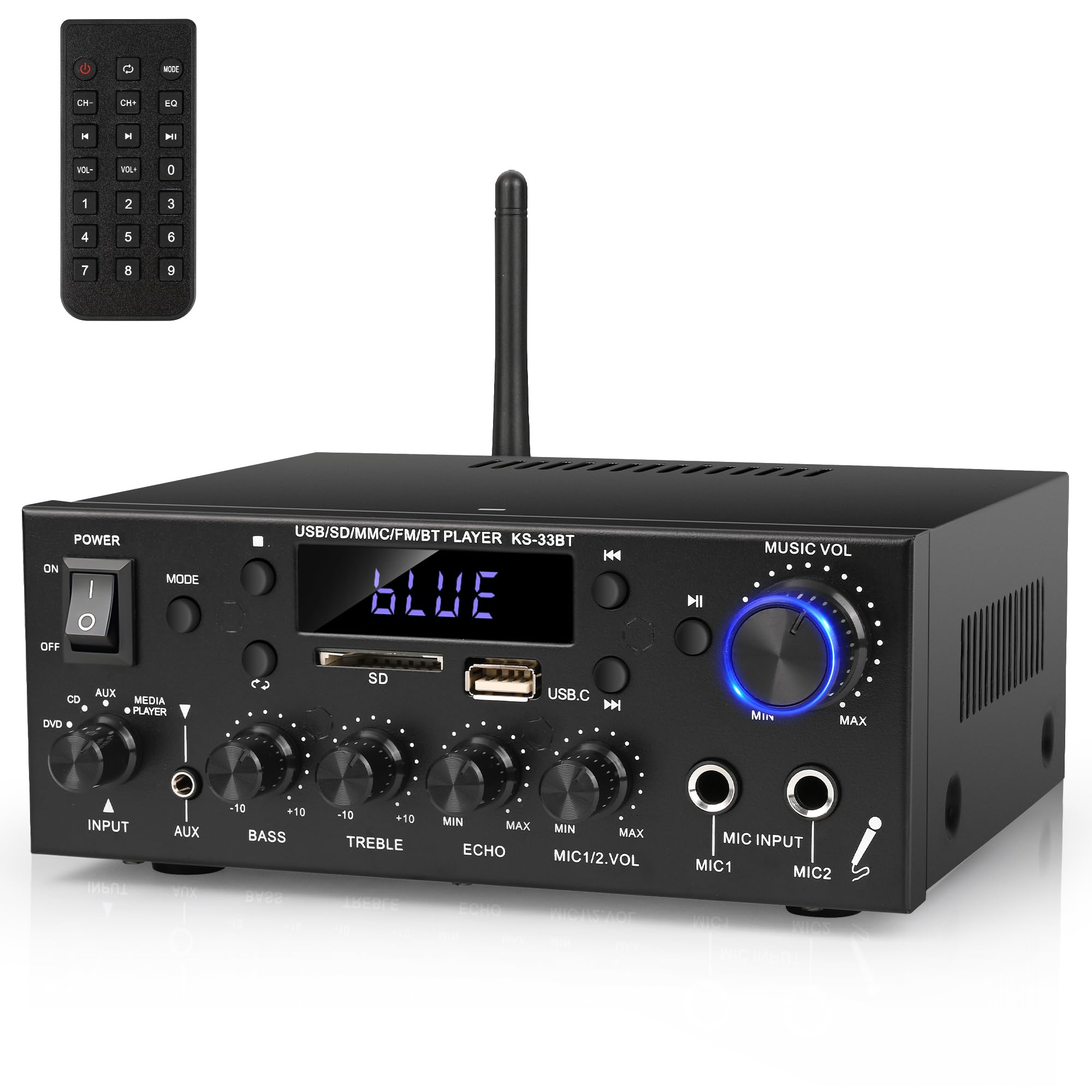
| Romicta KS-33BTBest Budget Pick | Budget HiFi | 60W+60W Rated | 2.0 | Bluetooth, USB, SD | Amazon |
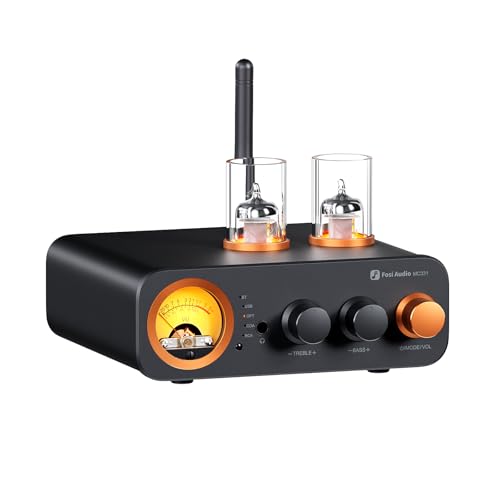
| Fosi MC331Coolest Retro Design | Tube sound | 105W x2 @ 4Ω | 2 | USB, Optical, Coax | Amazon |
| Pyle PDA77BU | Karaoke | 800W Peak | 4 | Bluetooth, USB, SD | Amazon |
| S.M.S.L AD18 | Desktop HiFi | 80W x2 | 2.1 | USB, Optical, Coax | Amazon |
| Rockville RPM45 | Small Venues | 225W x2 RMS | 4 | 4 XLR, USB | Amazon |
| Donner MAMP6 | Home Karaoke | 1000W Peak | 6 | Bluetooth, Optical | Amazon |
| MUSYSIC SYS-2000 | Pro DJ | 2000W Peak | 2 | XLR, 1/4″ | Amazon |
| Rockville RPA9 | Venue PA | 800W RMS | 2 | XLR, RCA, Speakon | Amazon |
In-Depth Reviews
1. WiiM Amp Ultra Stereo Streaming Amplifier
Our pick — over 4.5★ from 700+ verified ratings; the strongest balance of quality and price.
A streaming hub that upgrades your passive speakers with audiophile-grade clarity and easy control.
What wins people over is the sound: ultra-low distortion at -106 dB THD+N means your music comes through clean and detailed, whether you’re running a pair of bookshelf speakers or a full home theater. The built-in ESS SABRE DAC handles hi-res files up to 24-bit/192kHz, and buyers report it drives demanding towers like Emotiva T2 (200W) with punchy, clean sound. This is the one box that replaces a separate amp, DAC, and streamer.
Setup is simple for everyday users. The built-in RoomFit Room Correction (a system that adjusts sound to your room’s acoustics) auto-calibrates, so you get balanced audio without being an engineer. The 3.5” glass touchscreen shows album art and settings, and it streams via Wi-Fi 6, Bluetooth 5.3 with LE Audio (a low-power Bluetooth mode), and HDMI ARC (a port that sends TV audio back to the amp) for easy TV hookup. It works with Spotify, TIDAL, Qobuz, Amazon Music, Roon Ready, and Chromecast, and it syncs with Alexa or Google speakers for multi-room audio and voice control.
Owners love the flexibility of per-source EQ, presets, and volume limits, plus a rechargeable aluminum remote. The note to know: it does not support AirPlay, and Bluetooth is limited to SBC/AAC codecs. The 5.4-pound unit is the heaviest all-in-one here, but the build quality and feature set justify it. Owners mention it sounds better after a short warm-up, and the sound is a clear step up from a simpler streaming amp.
Why it leads the list
- RoomFit correction tailors the sound to your actual room
- HDMI ARC makes TV audio easy with one cable
- Owners note it pairs beautifully with ELAC and Klipsch speakers
Know before you buy
- No AirPlay support for Apple ecosystem user
- Bluetooth is SBC/AAC only, no high-quality codecs
- The heavier chassis is built to last but takes up space
Reach for this if: you want a single premium hub for streaming and TV audio with room correction, and you care about reference-quality detail.
Look elsewhere if: you rely on AirPlay or want to save money for a simpler amp with fewer features.
2. Romicta Stereo Audio Amplifier
A no-frills workhorse that delivers surprising punch for passive speakers and a subwoofer.
For a genuine entry-level upgrade, this amp gives you 60W+60W rated power (500W+500W peak) — plenty for a small apartment, bedroom, office, or garage. It handles two passive speakers and an active subwoofer through a 2.0 channel output, and owners have used it to power outdoor Bose speakers and larger Sony speakers without difficulty. The design is compact enough for a bookshelf or A/V cabinet.
Input flexibility is the real story here. Beyond Bluetooth 5.0 streaming, you get dual input ports, microphone, RCA, and AUX connections, plus USB and SD card slots and FM radio. Volume, bass, and treble knobs let you tune the sound, and a remote control means you can adjust it from across the room. As buyers put it: “The Bluetooth connected to my Amazon fire stick and for the price point it’s amazing.”
The catch is in the details. The knobs arrive maxed out — turn the volume down before powering on. Some owners found the RCA port detached but fixable, and the manual’s tiny print is hard to read. Bluetooth range is limited to about 30ft/10m without walls, and 15ft/5m for TV or PC connections. It’s a budget-friendly way to revive old speakers with Bluetooth and multiple inputs.
What you get for the price
- Dual mic inputs and FM radio for versatile setups
- Drives bookshelf and outdoor speakers with ease
- Easy to set up and use right from the start
What to watch for
- Knobs ship at maximum settings — turn them down first
- Bluetooth range drops with walls in the way
- Occasional quality control issues on the RCA port
Pick this for: a no-risk budget setup for a small room or garage, where you want Bluetooth and multiple inputs without spending much.
skip it if: you need fuss-free assembly or a premium build quality.
3. Fosi Audio MC331 Tube Integrated Amplifier
A tiny tube amp with a bouncing VU meter that brings warm, detailed sound to your desktop.
The glowing 5725W vacuum tubes and the dancing VU meter give this amp a retro charm that owners consistently say looks cool on a shelf. It’s a compact all-in-one with DAC, amplifier, preamplifier, and headphone amp in a 4.2-pound chassis. The 105W x2 @ 4Ω maximum output drives bookshelf speakers with ease, and there’s a pre-out and 3.5mm headphone output for flexibility.
Connectivity covers nearly everything you’d need: Bluetooth, USB, coaxial, optical, and RCA inputs. Owners pair it with turntables and bookshelf speakers, praising the warm, detailed sound that emerges after a short warm-up. The replaceable tube design lets you customize the sound signature — just note the tubes ship randomly and you can’t pick which ones you get. The all-metal build feels sturdy, and the remote adjusts bass and treble from your listening chair.
The honest trade-offs: the remote has noticeable latency and needs direct line-of-sight to work. You must use the remote to power the unit on, which some find inconvenient. The tubes sit recessed, so the glow isn’t visible from the front. At lower volumes, some detail drops out of the mix. It’s an affordable, fun entry into tube audio with warm sound and retro styling.
Why owners love it
- Gorgeous retro aesthetic with glowing tubes and VU meter
- Versatile inputs for turntables, phones, and CD players
- Sturdy all-metal construction
The quirks
- Remote has latency and needs line-of-sight
- Tubes require DIY assembly
- Power-on only via remote control
The verdict: a striking desktop amp that makes tube sound affordable and fun for HiFi newcomers.
Think twice if: you hate using a remote just to turn your gear on.
4. Pyle Home Stereo Receiver with Bluetooth

A 4-channel receiver with dual mics and reverb that turns any room into a karaoke stage.
With 800W peak power and four channels, this receiver can drive 4 high-output speakers at once — owners have used it to power 4 400-watt speakers and whole-house ceiling setups across a 3,300 sq ft home. The dual 1/4” microphone jacks with independent volume, reverb, and delay controls make it a natural fit for karaoke nights and presentations. A digital LED display and front-panel controls keep everything accessible.
Bluetooth 5.0 connectivity stretches up to 30+ feet, which owners confirm works reliably for streaming from a phone or connecting an outdoor TV wirelessly. Beyond Bluetooth, you get USB and SD card slots with MP3 playback, FM radio, and AUX, RCA, and 3.5mm inputs for game consoles and DVD players. Owners consistently rate the sound quality as clean with no distortion, even at high volume.
The recurring quirk: the receiver remembers its last Bluetooth pairing and doesn’t easily forget it, which can be a nuisance in an apartment building if a neighbor’s device connects. This makes it better suited to a house where you control the Bluetooth environment. Owners call it a solid value for the money.
Standout strength: 800W peak power across 4 channels with independent mic controls makes this a genuine multi-room and karaoke solution.
Notable quirk: “the Bluetooth memory can hold onto the last device, but for a single-home setup it’s a non-issue.”
Best for: families who host karaoke, garage DJs, and anyone adding Bluetooth to ceiling speakers throughout a house.
Not ideal for: apartment dwellers sharing close quarters with many Bluetooth devices.
5. S.M.S.L AD18 Audio HiFi Stereo Amplifier

A 1.3-pound desktop dynamo that drives bookshelf speakers with studio-grade clarity.
The thing everyone raves about is its sound quality — this little 80W x2 Class D amp powers passive bookshelf speakers and a subwoofer output with authority, running barely warm even after long sessions. Owners have driven 3-ohm speakers without clipping and run it daily for years without failure. The compact 6.77 x 2.01 x 3.35-inch footprint fits neatly beside a monitor or in a garage setup.
Flexibility defines it. Six input methods cover USB, coaxial, analog, Bluetooth 4.2 with apt-X, and two optical fibers, with a separate headphone output on independent circuitry. The USB input uses Texas Instruments’ TAS1020B supporting 24bit/96kHz, while SPDIF uses Cirrus Logic’s CS8422 decoding up to 24bit/192kHz. Owners note the coax input sounds better than USB, and Bluetooth pairs flawlessly via NFC.
The honest limitations: the headphone amp is best for 32-ohm cans (53mW) and weak for high-impedance models (11mW@150ohm). There’s no headphone/speaker toggle button, and the volume knob sits close to the headphone jack. A static discharge from carpet can cause a momentary audio drop, though customers note it recovers quickly. For a desktop or garage HiFi system, it’s tough to beat at this size.
Why it wins for desktop users: “superior sound quality vs other DAC/amps at this size, the AD18 was used daily for 4+ years, never failed.”
Just know: high-impedance headphones are underpowered, and you may want a USB-to-coax converter for the best sound.
Pick this for: a computer desk, small room, or garage where you want excellent HiFi sound without big gear.
pass on it if: you mainly use high-impedance studio headphones and need a strong headphone amp.
6. Rockville RPM45 Powered 4-Channel Mixer Amplifier

A powered mixer that handles a full 5-piece band with clean, loud sound in one rugged box.
This is the solution for live music and events. The RPM45 delivers 1800W peak power (225W x2 RMS @ 8 Ohm), which easily handled an 8-channel mixer with 5 instruments and 3 singers during a 6-hour gig at medium volume without getting warm. The rugged wooden enclosure and 18 lbs weight make it portable enough to haul to shows, and the compact 5.75″ x 19.44″ x 9.5″ size fits in standard gear.
What makes it a mixer first: 4 XLR and 1/4″ TRS inputs, USB input, RCA AUX input, and RCA Rec output. Each channel has its own bass, treble, and volume controls, plus adjustable echo, delay, and reverb effects. It even includes +15V phantom power for condenser mics and a fan cooling system for extended use. Owners note the built-in MP3 player is easy to control, and the sound is clean and loud for small venues.
The main caveat is the fan noise, which a few owners flag as noticeable in quiet settings, though it’s a fair trade for reliable cooling during long gigs. The overall build is solid — smooth, precise knobs and quality connections. A first gig went off without a hitch, with the audience enjoying the sound. This sits perfectly between a budget home amp and a high-end professional rack system.
Why bands choose it
- 4 XLR inputs plus phantom power for condenser mics
- Built-in effects: echo, delay, and reverb
- Rugged wooden enclosure built for transport
The trade-offs
- Fan noise is noticeable in quiet rooms
- At 19 lbs, it’s not a one-hand carry
- Sound quality gets mixed reviews at extreme volumes
Reach for this if: you play in a small band, host karaoke events, or need to power a church fellowship hall with one versatile unit.
Look elsewhere if: you need dead-silent operation for a very quiet listening room.
7. Donner Stereo Receiver MAMP6

A 6-channel receiver with dual mics and Bluetooth 5.3 that handles home theater and karaoke.
This receiver packs a lot of connectivity into one box. It supports Bluetooth 5.3, USB (up to 64 GB), 2 pairs of RCA, 2 mic inputs, AUX IN, and FM radio, plus digital optical and coaxial interfaces for smart TVs. The 12 speaker hookups with individual volume knobs mean you can run multiple pairs of speakers around a home or camp setup. Owners note the Bluetooth connection is instant and the unit is heavy with a good build quality.
For karaoke, the dual 1/4” microphone jacks pair with a Talk Over function that lowers the background music for clearer vocals during hosting or speeches. The multifunction remote controls treble, midrange, bass, echo, and Talkover in any input mode, and the amp remembers your EQ and volume settings between startups. Owners say it works great with a TV via optical for easy karaoke sessions.
The honest reality: the 1000W peak rating is aspirational — reviewers point out it delivers more like 25W per channel, so it’s not the venue-level beast the packaging suggests. It plays loud for a home and gives “plenty of power for Bluetooth” in a camp setup, but if you need to fill a large space with three pairs of speakers at high volume, this will fall short. For a home living room, game room, or cabin, it’s a fair value.
Owners appreciate
- Instant Bluetooth pairing and easy setup
- Karaoke-friendly dual mics with Talk Over
- EQ settings save automatically between uses
Keep expectations in check
- Real-world power is well below the 1000W peak claim
- No HDMI input, so optical is your TV connection
Best for: a casual home setup with multiple speaker pairs where karaoke and Bluetooth ease matter more than raw volume.
Not for: anyone who needs genuine high-power output for a large room or live event.
8. MUSYSIC Power Amplifier SYS-2000
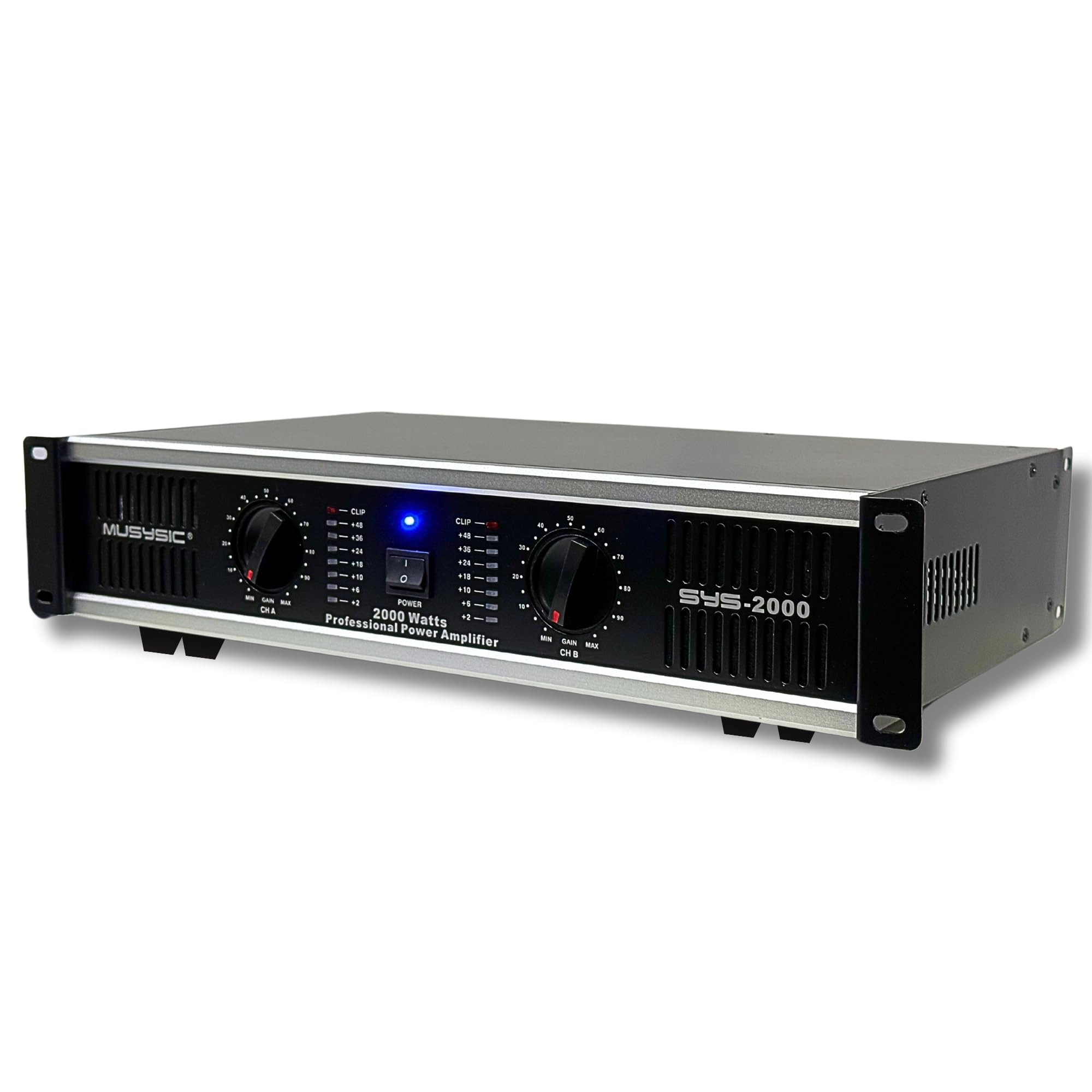
A 2-channel rack powerhouse delivering 2000W peak for DJs and live performers.
For serious sound reinforcement, this 2U rack-mount amp brings 2000W peak power with an extended 10Hz–50kHz (±1.5dB) frequency response and ultra-low <0.1% THD for clean output. The ATR Technology responds instantly to demanding bass transients, providing punchy dynamics at any volume. Owners note it sounds clean with no noise or hum right from the start.
Build for professional use, it offers XLR and 1/4-inch inputs, plus thermal protection and a rack-mountable 19 x 12 x 4-inch chassis. The 0.77V input sensitivity means weak signals get transformed into powerful, high-fidelity output with low noise. The aluminum and knob construction feels solid, and owners find it easy to install and operate. This works as a speaker amp, guitar power amp, or DJ amplifier in multiple environments.
The noise level gets mixed feedback — some say it’s quiet, while others find the rear fans pretty loud. Power delivery is also mixed: some find it powerful, others want more. One owner even planned to upgrade to the 3200W version. The 13-pound weight is manageable for rack installation. For a home studio or small venue looking for clean, professional-grade power, this is a serious step up from consumer receivers.
Professional strengths: The amp keeps total harmonic distortion (THD, a measure of audio distortion) under 0.1%, so sound stays clear even at high volumes, and its rack-mount design fits standard equipment racks for live or installed setups.
Honest limits: rear fan noise varies by unit — some owners find it loud, and power-hungry users want the bigger model.
Choose this for: a DJ rig, live band rack, or studio setup where clean high-power output and pro connections are non-negotiable.
it’s not for you if: you need whisper-quiet operation for a home listening room.
9. Rockville RPA9 2-Channel Power Amplifier

A rugged 2U rack amp with 800W RMS for DJs and live events requiring reliable, clean power.
Built for large venues, this 2-channel amp delivers 3000W peak and 800W RMS with a rugged metal chassis for touring DJs and mobile entertainers. Owners praise its clarity and quiet operation, with one critical audio snob noting zero noise or hiss. It works great with an OSD Audio Pre-1 mixer/preamp and drives Klipsch 51/4 speakers effectively, offering clean, powerful sound with headroom for small to medium events.
Connectivity is comprehensive: XLR, 1/4-inch, and RCA inputs, plus speakON and banana outputs, compatible with mixers, speakers, and pro audio gear. A built-in crossover and stereo/bridged modes add flexibility for bi-amping or high-power mono setups. The dual fans and heat sink design prevent overheating during extended use, and front-panel controls with LED indicators make operation easy in low-light environments. Shoppers say it stays reliable after 2-3 years of use.
The trade-offs are practical. The fans can be loud at low volume — some owners replaced them with quieter models. Rack mounting has minor quirks: flange holes may need re-drilling, and a protruding bottom screw requires countersinking. Power is somewhat overstated, with a small transformer that lacks headroom, but it’s sufficient for recreational DJing. Owners consistently call it excellent value for the price-per-watt.
Why it’s a pro favorite
- 800W RMS of clean, quiet power for events
- Built-in crossover and stereo/bridged modes
- Durable metal chassis with dual-fan cooling
Real-world notes
- Fans are loud at low volume — some swap them out
- Rack mounting needs minor DIY tweaks
- Power rating is optimistic; plan around RMS figures
Pick this for: gigging DJs and mobile entertainers who need reliable rack power with pro connections for small to medium venues.
Look elsewhere if: you need silent fan operation in a home setting.
Understanding the Specs
Peak vs. RMS Power
Peak power is the maximum wattage an amp can briefly produce, which is used in marketing. RMS (root mean square) is the continuous power the amp can sustain, which is the number that matters for real listening. A huge peak rating does not mean the amp can deliver that power for more than a split second, so use the RMS figure when matching an amp to your speakers.
Impedance Matching
Impedance is the resistance your speakers present to the amp, measured in ohms. Most home speakers are 8 ohms, while professional gear often runs at 4 ohms. An amp rated for 100W at 8 ohms may produce more power at 4 ohms, but it’s critical to match your speakers’ impedance to what the amp is designed to drive for clean, safe operation.
FAQ
How many watts do I really need for my amplifier?
What is the difference between peak and RMS power?
Can I use a home amplifier with professional speakers?
Why is my amplifier making a humming or hissing noise?
Is a tube amplifier better than a solid-state amplifier?
How do I connect my TV to an amplifier?
What does a built-in DAC do in an amplifier?
Can I connect a subwoofer to these amplifiers?
Final Thoughts: The Verdict
For most buyers, the amplificador de sonido winner is the WiiM Amp Ultra because it combines 100W/ch of clean power with streaming features, room correction, and HDMI ARC in one polished box. If you want a warm, retro tube sound for a turntable setup, grab the Fosi MC331. And for a gigging band or venue, the Rockville RPA9 is the one to reach for with its 800W RMS and rugged rack build.
How We Picked
We do not accept paid placement. Every pick is matched to a real buyer and a real use-case; we do not hands-on test units.
Sources & Methodology
Specifications: manufacturer listings and product documentation. Review insights: verified customer reviews, as of August 2026. Pricing: not shown on this page (it changes often); check the current price via the retailer link.
As an Amazon Associate, Gadgets Feed earns from qualifying purchases. This does not affect which products we feature.