
Our readers keep the lights on and my morning glass full of iced black tea. As an Amazon Associate, I earn from qualifying purchases.
Specs are compiled from manufacturer listings and verified buyer reviews and can change over time — please confirm the key details on the product page before buying.
Cutting cable starts with one make-or-break question: which antenna actually pulls in your local channels without you spending every weekend on the roof aiming it? Your location, terrain, and mounting effort determine whether an antenna delivers or disappoints. We dissect the specs that matter for 100-mile-range antennas so you pick the right signal-catcher the first time.
I’m Min — the founder and writer behind Gadgets Feed. This guide is built by comparing the manufacturers’ published specifications and the patterns across verified customer reviews, so you get each pick’s real strengths and trade-offs instead of marketing spin.
The honest truth is that “miles” ratings are optimistic, so we dig into the designs, filters, and real-world reception reports to find the best antenna for local tv stations that fits your home and budget.
Our Picks at a Glance

How To Choose The Best Antenna For Local TV Stations
Before any brand name matters, you need to know exactly where your local broadcast towers are and what stands between them and your house. Hills, dense trees, and metal roofs all chew up signal strength, so an antenna that works for a neighbor on the hill may fail for you in the valley. Don’t chase the biggest “mile range” on the box; focus on gain and interference rejection instead.
Directional Yagi vs. Omni-Directional
A Yagi antenna (the classic long horizontal bar with multiple cross-elements) is highly directional, meaning it focuses all its power in one direction to grab weak, distant signals. If all your towers are clustered in the same general area, a Yagi is almost always the right call for maximum range and clarity. An omni-directional antenna picks up signals from all directions at once, which sounds convenient, but that convenience usually costs you gain and can let in more interference from the sides.
Amplified vs. Passive
An amplified antenna has a built-in preamp (a signal booster sitting right at the antenna) that strengthens the signal before it travels down the long cable to your TV. This is essential for very long cable runs (50+ feet) or if you’re splitting the signal to multiple TVs. However, if you live close to the towers and the signal is already strong, an amplifier can actually overload and cause pixelation. The best high-end antennas let you run them in passive mode when you don’t need the boost.
Filtering and the Future-Proofing Factor
Modern antennas must filter out cellular (LTE/4G/5G) and FM interference to protect TV reception. Look for “ATSC 3.0” or “NextGen TV” compatibility for better picture and sound where available. Prioritize weather-resistant aluminum and stainless steel hardware for outdoor mounting.
Quick Comparison
| Model | Best For | Max Range | Reception Type | Built-in Amp | Amazon |
|---|---|---|---|---|---|
| Televes DAT BOSS Mix LR★ Best Overall | Fringe/Rural Reception | 80 mi | Directional | Yes (TForce) | Amazon |
| TV Outdoor Yagi AntennaBest Value | Value & High Functionality | 70+ mi | Directional | No | Amazon |
| CeKay Outdoor Yagi | All-Metal Durability | 70 mi | Directional | No | Amazon |
| GE Outdoor Yagi 33685 | Brand Trust & Support | 80 mi | Directional | No | Amazon |
| 1byone 360° Omni | Multi-Directional Simplicity | 100 mi | Omni-Directional | Yes | Amazon |
| PIBIDI UHD-8903 | Lightweight & Affordable Range | 200 mi | Directional | No | Amazon |
| Five Star Outdoor HDTV | High Channel Coverage | 200 mi | Directional | No | Amazon |
In‑Depth Reviews
1. Televes DAT BOSS Mix LR
Our pick — over 4.5★ from 450+ verified ratings; the strongest balance of quality and price.
The signal-hungry powerhouse built for the rural fringes where other antennas give up
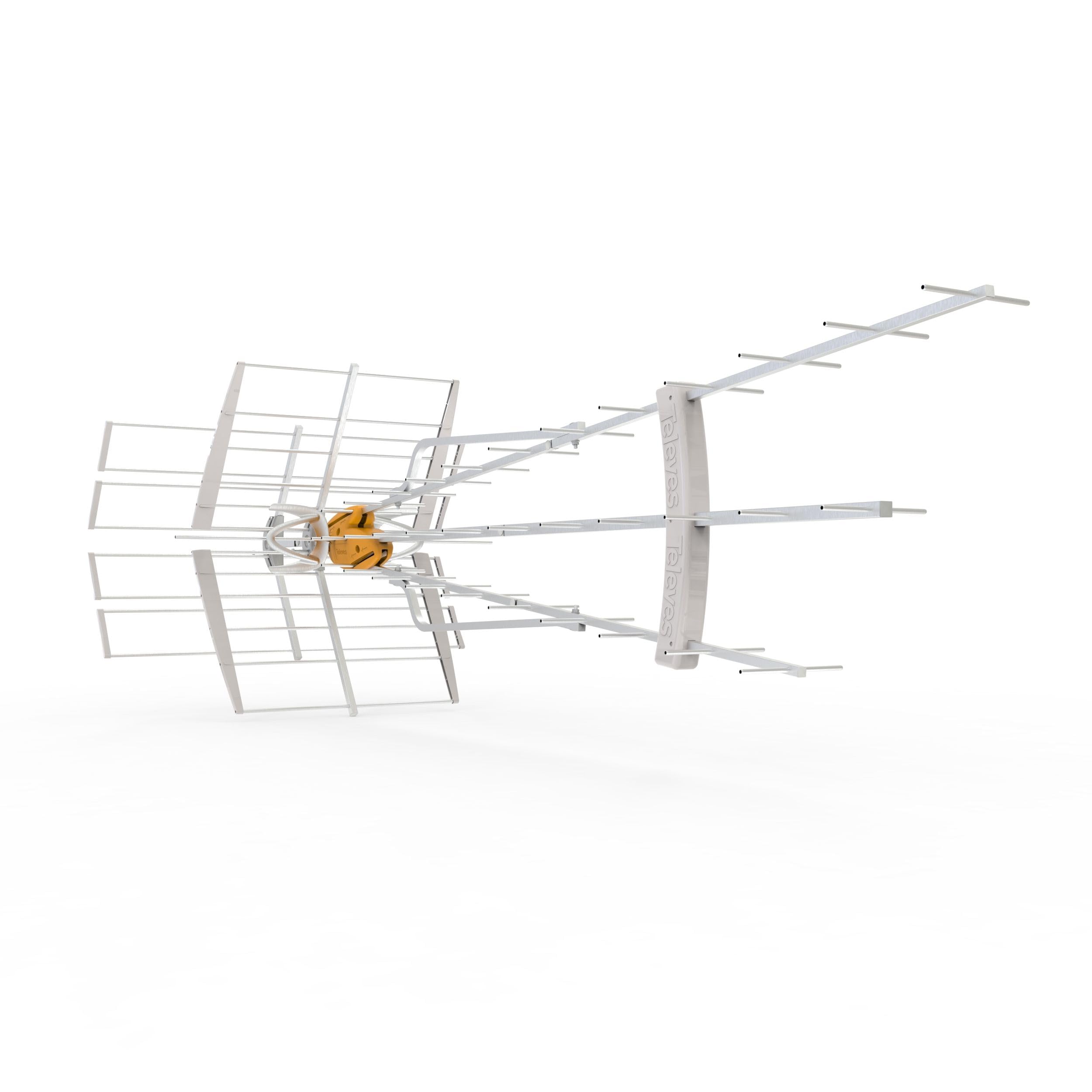
This is the definitive answer for anyone living in a broadcast dead zone. The Televes DAT BOSS Mix LR is the highest-rated pick here because it pairs a built-in TForce preamplifier with a patented triple-boom design that focuses raw gain toward the towers while keeping the assembly compact. That means owners in rural Maine with mountain interference go from “weak CBS/FOX” to “strong green signal on all channels” — the exact kind of turnaround that makes this worth the premium price.
What makes it special is the integrated filtering for FM and LTE/4G/5G interference, which clears out the cellular noise that ruins weaker channels. The front-to-back ratios are the real spec to note: 12 dB on High VHF and 25 dB on UHF, which tells you how aggressively it rejects signals coming from behind the antenna. All the crucial hardware is included in the box — a UL-listed 12V power inserter, mast clamps, a wrench, and a weather boot — and it handles mast diameters from 0.78″ to 2.4″. It’s rated for a maximum range of 80 miles, but the “miles” figure undersells it; the real-world claim is pulling in stations up to 100 miles away.
Assembly gets mixed feedback in the reviews, with some finding it easy (a 45-minute job) and others struggling with sparse instructions, though YouTube has assembly videos that solve that problem. The dual-operation mode is a clever safety net: it runs as an amplified antenna with power, and if the power fails, it keeps passing signals in passive mode. The build quality is what most owners rave about — solidly made, weather-resistant aluminum with stainless steel hardware that should laugh at the elements for years.
Why It Wins for Fringe Areas
- Superior gain and directivity for the toughest long-range scenarios
- 5G/LTE filtering prevents signal loss from cellular interference
- Dual operation mode continues working even without power
- Everything needed for install is included, even the wrench
Where It Demands Patience
- The fully assembled footprint is large and needs solid mounting
- Assembly instructions can be unclear enough to need a video
Choose it if: you are in a rural or fringe area where weak, distant signals are the only option and you want the strongest possible gain.
Think twice if: you are close to the towers — the premium price buys range you simply won’t need.
2. TV Outdoor Yagi Antenna by McDuory
The budget-friendly workhorse that consistently outperforms antennas in twice its price class
If you want to cut the cord without spending a fortune, this McDuory Yagi is the best bang for the buck you’ll find. It’s a passive antenna (no built-in amp), which is actually a smart design choice for owners within 50 miles of towers where the signal is already strong. The most impressive owner story involves an attic installation with an HDHomerun tuner that went from “65 pixelated channels to 101 perfect channels” — a massive upgrade for a very modest investment.
The design supports 1080i HDTV broadcasts and the full UHF/VHF spectrum, with a working frequency range of VHF 170~230MHz and UHF 470~860MHz. It comes mostly pre-assembled with only a few elements to combine, and it requires no tools at all. The included 40-foot coax cable is a genuine bonus that most competitors skip, saving you an extra trip to the hardware store. Build quality is the main caveat — some owners note the hardware can rust if left exposed to heavy weather, so it’s best paired with a weatherproofing treatment on the connection points.
What wins people over is sheer functionality — the reviews are full of stories where this antenna solved problems (like pulling in channels 8 and 19) after two other antennas had failed. It’s lightning-protected and sturdy in bad weather, with a sharp picture that holds steady through storms. For the price, there isn’t a more reliable path to free over-the-air HD, particularly for attic installs where it’s hidden away and protected from the elements.
The Case for It
- Delivers excellent reception with no amplifier needed within 50 miles
- Includes 40′ coaxial cable, so no extra components to buy
- 40-ft cable means flexible placement in high-reception areas
The Trade-offs
- Hardware can rust if not weatherproofed at the connections
- Requires forceful rod insertion during assembly for a solid connection
Reach for this if: you’re within 50 miles of towers and want maximum value with minimal setup fuss.
Look elsewhere if: you’re in deep fringe territory and need an amplifier to rescue weak signals.
3. CeKay Outdoor Yagi HD Antenna

The all-metal Yagi with honest range claims that beats the cheap plastic competitors
You want an antenna that survives hail and wind, and the CeKay Yagi’s all-metal build delivers that durability. It’s rated for 70 miles of range and pulls in 100 channels, with support for up to 8K resolution in addition to standard 4K and 1080p. Owners at 35 miles with hills in the way report crisp reception at 90-100% signal strength, so you can trust it even with obstacles.
What makes this different from cheaper options is its compact size paired with serious performance. Buyers report it outperforms cheap amplified antennas even when installed in a basement — a 90-100% signal in a below-ground test, and 100% across all channels once moved to the attic. It sits in a good spot between the budget McDuory and the premium Televes, offering the weather durability of a metal build without the high-end price tag. It’s ATSC 3.0 (NextGen TV) compatible too, so you’re future-proofed for the new broadcast standard.
The package is generous: it includes a 40FT RG6 coax cable and a J mount, so it’s ready to install from the start. The main criticism is that the metal elements fit very tightly into their holders, with some owners resorting to a hammer to slide the tubes in — clearly a design priority on signal security over easy assembly. It’s also note that one owner found it thin and bendy, noting it’s not truly “outdoor-rated” despite the marketing, so treat it gently and secure the pole connections with glue if it will face the elements.
The standout feature: The 40FT RG6 cable and J mount make this the rare antenna that’s genuinely ready to install the moment the box arrives.
The honest catch: The tight element fit during assembly demands patience — and some force.
Choose it for: an attic installation where the cable length and compact metal profile make setup painless, with a clear upgrade path to 8K broadcasts.
Consider something else if: you need an amplifier to punch through heavy terrain or very long cable runs.
4. GE Outdoor HD Digital TV Antenna

The trusted household name with a lifetime replacement pledge and serious reception chops
GE’s Yagi-style model earns its #1 brand status with an 80-mile range and 200-channel capacity. It’s rated for 80 miles of range and 200 channels, with owners reporting over 100 channels with crisp reception. The biggest edge isn’t just specs — it’s the backing. GE offers a limited-lifetime replacement pledge and free U.S.-based technical support at 1-800-654-8483, which is invaluable if you’re a first-time cord-cutter who needs hand-holding during setup.
You’re getting the standard Yagi directional design that supports 1080p and is 4K Ultra HD ready, with a working frequency range built for both VHF and UHF. The kit includes a weather-resistant mounting bracket, mast clamp, and J-mount, so you can attach it to a wall, roof, or standard antenna mast. One owner mounted it just 10 feet up on a shed in Seattle and got solid reception on all channels, another went up on the roof of their camper for RV travels. It’s clearly a versatile performer.
Channel reception and picture quality stay rock-solid even in bad weather — one owner reported no pixelation during storms from 35 miles out, which is genuinely better than cable. The weak spot is assembly; the instructions are basic at best, and the signal finder tool requires patience to get an accurate reading (be careful about magnetic vs. true bearing). It’s also an awkward antenna to manage in tight attic spaces. But for the confidence of a lifetime warranty and real human support, that assembly frustration is a fair trade.
The GE Advantage
- Limited-lifetime replacement pledge and free US-based technical support
- Strong channel reception with no pixelation in stormy weather
- Comes with mounting bracket, mast clamp, and J-mount
Where It Gets Fiddly
- Assembly instructions are poor and require patience
- Signal finder tool needs careful calibration for accuracy
Reach for this if: you value brand reliability and want the safety net of a lifetime warranty and phone support during your setup.
Who might skip it: anyone who hates assembling hardware and wants a truly tool-free process.
5. 1byone 360° Omni-Directional Antenna

The set-and-forget omni that pulls from every direction so you never touch a compass
This 1byone antenna flips the script on the traditional Yagi: it’s omni-directional, meaning it captures UHF/VHF signals from 360 degrees with no rotating and no aiming required. That makes it a lifesaver for RVers, apartment dwellers, or anyone whose local towers are scattered in multiple directions. The white, compact body is designed for indoor or outdoor placement, and the built-in pre-amplifier boosts the signal right at the source to compensate for long cable runs.
The 1byone’s performance is mixed, with strong results within 50 miles but inconsistent reception farther out. On a 2-year warranty with a built-in 4G LTE filter to remove cellular interference, the positives are real: owners mention 25-30 free channels hooked up to a satellite wire running to three TVs, and excellent HD quality within 50 miles of Philadelphia. But the reception is genuinely location-dependent. One 1-star review in LA went from 124 channels down to about 70, mostly non-English and shopping channels, and ended up with only one major network — a stark reminder that omni-directional antennas trade away raw gain for convenience. The included 39ft RG6 coax cable is a nice touch.
This is not the antenna for extreme fringe areas or for people who need to pull in weak signals from far away. But if you’re within 50 miles of the towers, don’t want to aim anything, and want weather-resistant, moisture-proof, flame-retardant construction that can survive wind and rain, this is the easiest path to free TV. Just remember: it supports one TV per antenna, and adding a splitter will divide the signal strength between TVs, which means you may not get every channel on every set.
Why It’s Easy to Love
- No aiming or rotating needed, perfect for scattered tower locations
- Built-in pre-amplifier boosts signal and filters 4G LTE interference
- Compact, weather-resistant design suits home, RV, or attic
When It Falls Short
- Reception can be wildly inconsistent, especially for VHF channels
- Some owners found signal quality dropped after the initial scan
Pick this if: you want a fast, simple install with zero aiming and your towers are within 50 miles in multiple directions.
skip it if: you live in rural or hilly terrain and need focused gain to pull in weak signals.
6. PIBIDI Outdoor TV Antenna

The featherweight Yagi that quietly outpaced a motorized “150-mile” antenna it replaced
The PIBIDI is a lesson in why the “mile range” on the box is marketing, not a guarantee. It advertises 200 miles, but the owners who get the best results treat that as a ceiling, not a promise. The real-world stories are still impressive: a rural Oregon owner went from 15-50 channels on three prior antennas to a balance of 64 channels, and another pulls in clear pictures from 80 miles away. One owner reports it beat a large, pricier 12-15-year-old antenna at pulling in stations 40-100 miles away.
It’s a passive (unamplified) Yagi supporting 1080p and 4K with a working frequency range of VHF 170~230MHz and UHF 470~790MHz. The design uses longer and larger receiving elements than typical antennas for more stable signal capture. Assembly is simple — it comes mostly pre-assembled with no tools needed — and its lightweight frame is a genuine advantage when you’re carrying it up a ladder or attaching it to a roof.
But there’s an important footnote: several owners say you’ll likely want a signal booster to reach the antenna’s potential. One review is blunt that it gets 28 channels with a booster versus just 3 without one, and another notes it “will not get the range advertised.” The size also draws mixed comments, with some finding it too small to be a true 200-mile antenna. This is a budget-friendly option that works best when you have solid nearby signals and aren’t trying to overcome enormous obstructions.
The key takeaway: Think of this as a 70-mile antenna that’s well-built, lightweight, and affordable — not a 200-mile miracle worker.
The caveat to know: Plan on buying a signal booster for the far-edge channels.
Choose it if: you’re handy and within about 70 miles of towers, or you’re replacing an aging antenna without spending much.
Look elsewhere if: you’re expecting true 200-mile fringe performance without buying additional gear.
7. Five Star Outdoor HDTV Antenna

The ATSC 3.0 ready antenna that feeds all 5 TVs in the house from a single mount
The Five Star is the antenna for the modern, multi-TV household. It’s advertised at a 200-mile range and ATSC 3.0 ready (the new NextGen TV broadcast standard for better picture and sound), supporting 4K and 1080p across VHF and UHF. The most telling review has this antenna mounted on a satellite dish post feeding excellent reception to all five TVs in the house, pulling in roughly 70 local channels plus 300+ streaming channels built into modern TVs. For a whole-home setup, that’s exactly what you want.
Assembly is genuinely the fastest of any pick here — owners complete it in under 15 minutes with all parts included, including the mounting bracket, J-pole, and simple instructions. The extended antenna length with larger receiving elements is designed for stable, strong signal capture. The reviews report solid performance at 41 miles from the transmitter with all local channels crisp, and it’s wind-resistant even in harsh weather. One owner even replaced a 20-year-old antenna destroyed in an ice storm and found performance just as good.
The honest asterisks matter though. Multiple owners confirm it does not get anywhere near 200 miles in practice — it reliably picks up everything within 60 miles, which is still plenty for most people. There’s also a reported quirk with VHF channels where interference from CFL (compact fluorescent) lamps can disrupt channels 7, 9, and 11 unless the lights are off. And the included mount and pole are adequate but not the most sturdy for heavy outdoor exposure, so a separate amplified booster can help if you’re aiming for the longest reach.
The Strongest Points
- Fastest assembly in this list, often under 15 minutes
- Purpose-built for multi-TV setups with excellent signal distribution
- ATSC 3.0 ready for next-generation broadcast quality
Reality Checks
- Real-world reliable range is closer to 60 miles, not the advertised 200
- Mount and pole feel light-duty for permanent outdoor installs
Choose it if: you have multiple TVs and want a quick, painless install that distributes strong signals everywhere.
Consider another if: you’re in a truly extreme fringe area needing maximum gain, or you’ll mount it in the open without protection.
Understanding the Specs
VHF vs. UHF Channels
TV broadcasts are split into two frequency bands, and your antenna needs to handle both. UHF (Ultra High Frequency) is where most modern channels live, while VHF (Very High Frequency) carries channels 2-13, which can be harder to receive and are worth checking first on a channel scan if signals are weak. Most long-range antennas cover VHF 170~230MHz and UHF 470~860MHz, but if your must-have channels are VHF, don’t underestimate the importance of the longer VHF elements on a Yagi design.
Mile Range & Gain
Manufacturer “mile” claims are measured in ideal, flat, clear conditions and are almost always optimistic — real world numbers are usually a fraction of the rating. A more honest spec is the antenna’s gain in dB, which measures its ability to focus on a weak signal. Higher gain (like the Televes’ 25 dB UHF ratio) means better performance on distant stations, but don’t chase a 200-mile rating unless you’re truly at the far edge of coverage.
FAQ
Will an attic antenna work as well as a roof-mounted one?
What is the difference between ATSC 3.0 and current NextGen TV?
How important is an amplifier in a TV antenna setup?
Can I use one outdoor antenna for multiple televisions?
Why do some of my channels disappear after a scan?
What does a Yagi antenna actually look like and why is it so common?
What kind of cable should I use for best results?
Can a neighbor’s house or trees block my TV signal?
Final Thoughts: The Verdict
For the majority of shoppers, the true winner for an antenna for local tv stations is the Televes DAT BOSS Mix LR because its built-in amplifier, 5G filtering, and top-tier build quality give you the best shot at pulling in distant, weak channels that frustrate lesser antennas. If you want the best blend of price and performance, grab the McDuory TV Outdoor Yagi, which delivers 100 channels of clear HD for a fraction of the cost. And for a whole-home setup that feeds multiple TVs without fuss, the Five Star Outdoor HDTV is the one to reach for.
How We Picked
We do not accept paid placement. Every pick is matched to a real buyer and a real use-case; we do not hands-on test units.
Sources & Methodology
Specifications: manufacturer listings and product documentation. Review insights: verified customer reviews, as of August 2026. Pricing: not shown on this page (it changes often); check the current price via the retailer link.
As an Amazon Associate, Gadgets Feed earns from qualifying purchases. This does not affect which products we feature.