
Our readers keep the lights on and my morning glass full of iced black tea. As an Amazon Associate, I earn from qualifying purchases.
Specs are compiled from manufacturer listings and verified buyer reviews and can change over time — please confirm the key details on the product page before buying.
Your phone is your co-pilot, and a dead battery on the highway is the worst kind of travel companion. The right car charger must hold tight in the socket, fast-charge multiple devices, and survive daily commutes. The choice depends on port count, real charging speed, and build toughness.
I’m Min — the founder and writer behind Gadgets Feed. This guide is built by comparing the manufacturers’ published specifications and the patterns across verified customer reviews, so you get each pick’s real strengths and trade-offs instead of marketing spin.
We are cutting through the specs to find you the most dependable car charger for fast power on every trip without the guesswork.
Our Picks at a Glance

How To Choose The Best Car Charger
Picking a cigarette-lighter adapter is about more than just the highest wattage. You need a charger that fits securely, supports your phone’s protocol, and has enough ports for everyone—each determined by clear specs.
Match the charging protocol to your phone
Real speed comes from the protocol, not just the wattage label. PD (Power Delivery) is the standard that fast-charges iPhones and many modern USB-C laptops, while QC (Quick Charge) handles a huge range of Android phones, and PPS is the adaptive protocol that lets Samsung Galaxy devices negotiate premium charging speeds. A charger that supports your phone’s own protocol is far more useful than one with a big total number that you cannot actually access from a single port.
Count the ports you will actually use
Before you buy, count the devices that ride with you daily. A two-port charger covers a single driver and one passenger, but a family or a rideshare driver will want four ports to handle phones, a dashcam, and a tablet at once. Check the port breakdown too, since a mix of USB-C and USB-A gives you more flexibility with older cables and newer devices that ship USB-C only.
Check the build for the real world
A wobbling charger is annoying, and overheating is a safety risk. Look for a snug plug fit, a metal or flame-retardant shell for heat, and built-in protection against over-current, over-voltage, and short circuits. These features keep the charger stable and safe on rough roads.
Quick Comparison
| Model | Best For | Total Wattage | Ports | Amperage | Amazon |
|---|---|---|---|---|---|
| Anker 40W PowerDrive III Duo★ Best Overall | Everyday two-device charging | 40W | 2x USB-C | 1.11 A | Amazon |
| AINOPE 67.5WLaptop Power | Laptops and one fast phone | 67.5W | 1x USB-C, 1x USB-A | 3 A | Amazon |
| WIDAQUO 90W 4-Port | Whole-family charging | 90W | 4x (2 USB-C, 2 USB-A) | 3 A | Amazon |
| 75W 3-Port Charger | Three devices at full speed | 75W | 3x (2 USB-C, 1 USB-A) | — | Amazon |
| Bangfun 3-Pack 65W Voltmeter | Keeping a spare in every car | 65W | 4x (2 USB-C, 2 USB-A) | 2.25 A | Amazon |
| Bangfun 5-Pack 36W | Budget-friendly multi-car coverage | 36W | 2x (1 USB-C, 1 USB-A) | 3 A | Amazon |
| Anker 30W 2-Port | Ultra-compact single-charger use | 30W | 2x (1 USB-C, 1 USB-A) | — | Amazon |
In-Depth Reviews
1. Anker 40W 2-Port PowerIQ 3.0 PowerDrive III Duo
Our pick — over 4.5★ from 9,500+ verified ratings; the strongest balance of quality and price.
A reliable two-port pick that has earned a permanent spot in thousands of gloveboxes.
If you only charge a phone and maybe a pair of earbuds, this Anker is the one that everyone seems to settle on. Its 40W of total power is split across two USB-C ports, both running PowerIQ 3.0, which is Anker’s fast-charging protocol that talks to iPhones, Samsung Galaxy phones, iPads, and AirPods without you thinking about it.
Buyers report “Fits perfectly in 12v port. Doesn’t wiggle or pop out, and my car can be rough in the road.” That snug fit is the thing owners praise most — reliability is the most-mentioned aspect, with over 460 owners singling out how dependable it is. The ultra-compact body sits nearly flush in the socket, so it does not block the gear shifter or other dashboard controls, and the 1.12-ounce weight means it is almost invisible until you need it.
The dual USB-C design is actually ahead of many pricier rivals; both ports fast-charge, so a passenger does not get stuck on a slow trickle. It is a 40W charger, which is the exact number most phones need to hit their top speed without needing a laptop-level power supply.
Built for daily drivers: A low-profile, wobble-free adapter with fast output on both ports, backed by an 18-month warranty and a customer-service reputation that makes the choice feel safe.
Who it falls short for: There is no USB-A port here, so older non-USB-C cables will not plug in, and the twin USB-C focus means it is not the pick for charging a demanding laptop.
Reach for this if: you want a set-and-forget charger that handles two modern phones quickly and never rattles loose — the safest, most proven pick on this list.
Look elsewhere if: you need to charge a MacBook or anything pulling more than 40W from a single port.
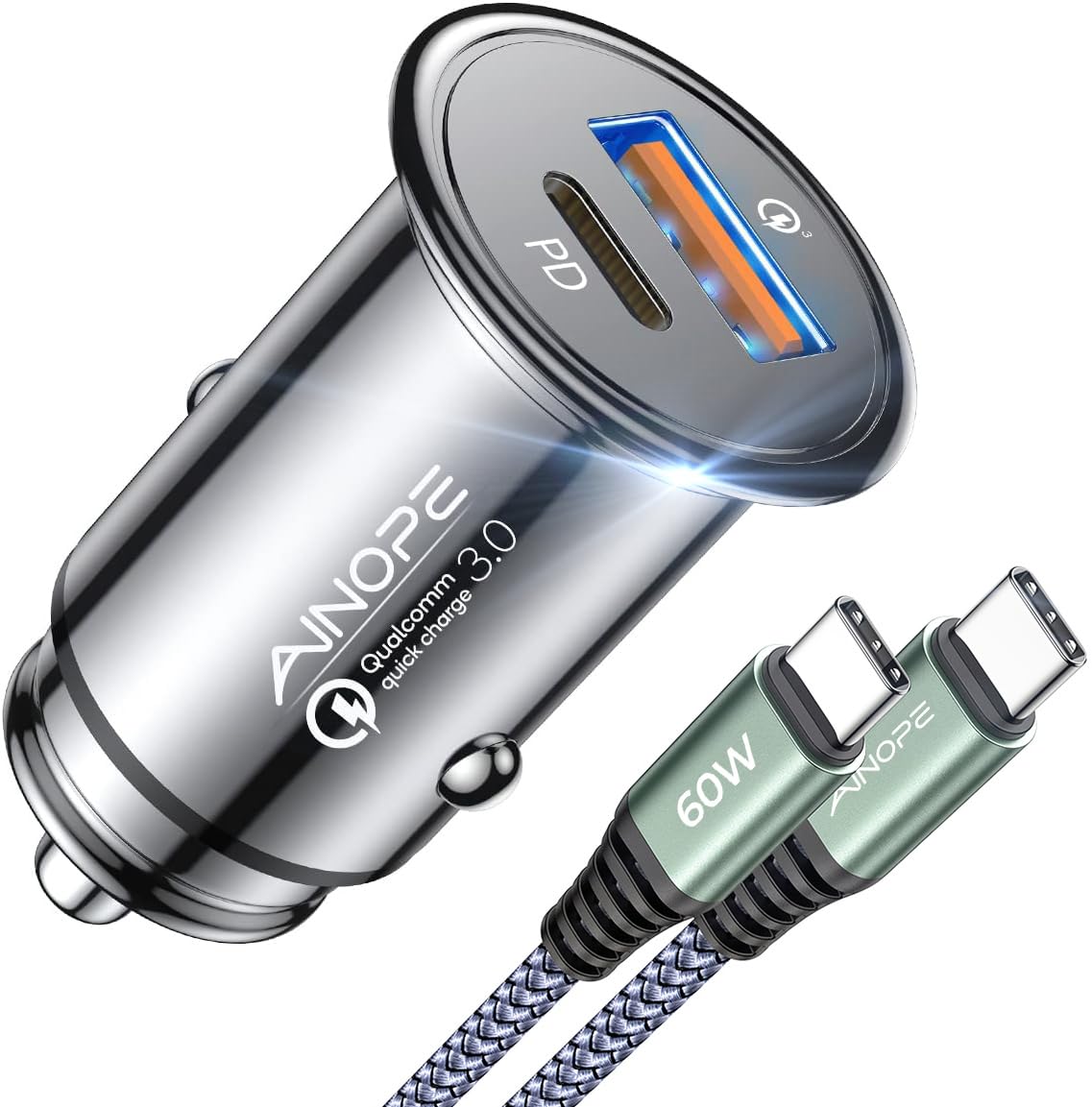
2. AINOPE 67.5W Mini & Metal USB-C Car Charger
The thumb-sized metal unit that still has enough muscle for a MacBook on the dash.
This one is for the driver who wants serious power without the bulky block. The AINOPE pushes 67.5W total, delivered through a 45W PD port that is 10 times faster than an old 2.4A charger, plus a 22.5W QC port that the maker says refills phones to 80% in 35 minutes. It even ships with a 3.3 ft nylon 60W USB-C cable, which is rare in this category — most rivals make you buy a cable separately.
The all-metal thumb-sized body sits almost flush in the socket, and owners like the fit, though pulling it out takes a bit more effort because there is so little plastic to grip. Charging speed is what wins people over here — it is the most-mentioned aspect by a wide margin, with over 1,000 owners calling it out as genuinely fast. The durability claims back that up: one owner says “After 3 years that I purchase it it’s still Super fast and no issues.”
There is a nuance worth knowing. Some owners mention the rated 67.5W is optimistic, and real-world output lands closer to a max of 55W, with the USB-C port delivering 35W in testing. The reliability feedback is genuinely mixed, so treat it as a strong performer rather than a lifetime guarantee.
Why owners stick with it
- 45W PD port charges a MacBook, iPad, and fast-phone on the go; 67.5W total from a tiny shell
- Thumb-sized all-metal body stays snug and looks tidy in the socket
- Includes a tough 3.3 ft nylon 60W USB-C cable rated for 40,000+ bend tests
Where the fine print bites
- Real-world output is often lower than the 67.5W label — expect around 55W max
- Flush body makes the charger harder to pull out by hand
- Reliability feedback is split, so a unit that fails is not unheard of
Best if: you regularly charge a laptop or need one very fast phone port and like a minimal, quality-feeling metal unit.
Think twice if: you are buying purely on the headline 67.5W number — you will likely get less, and the flush fit will test your fingernails.
3. WIDAQUO 90W 4-Port USB-C Super Fast Car Charger
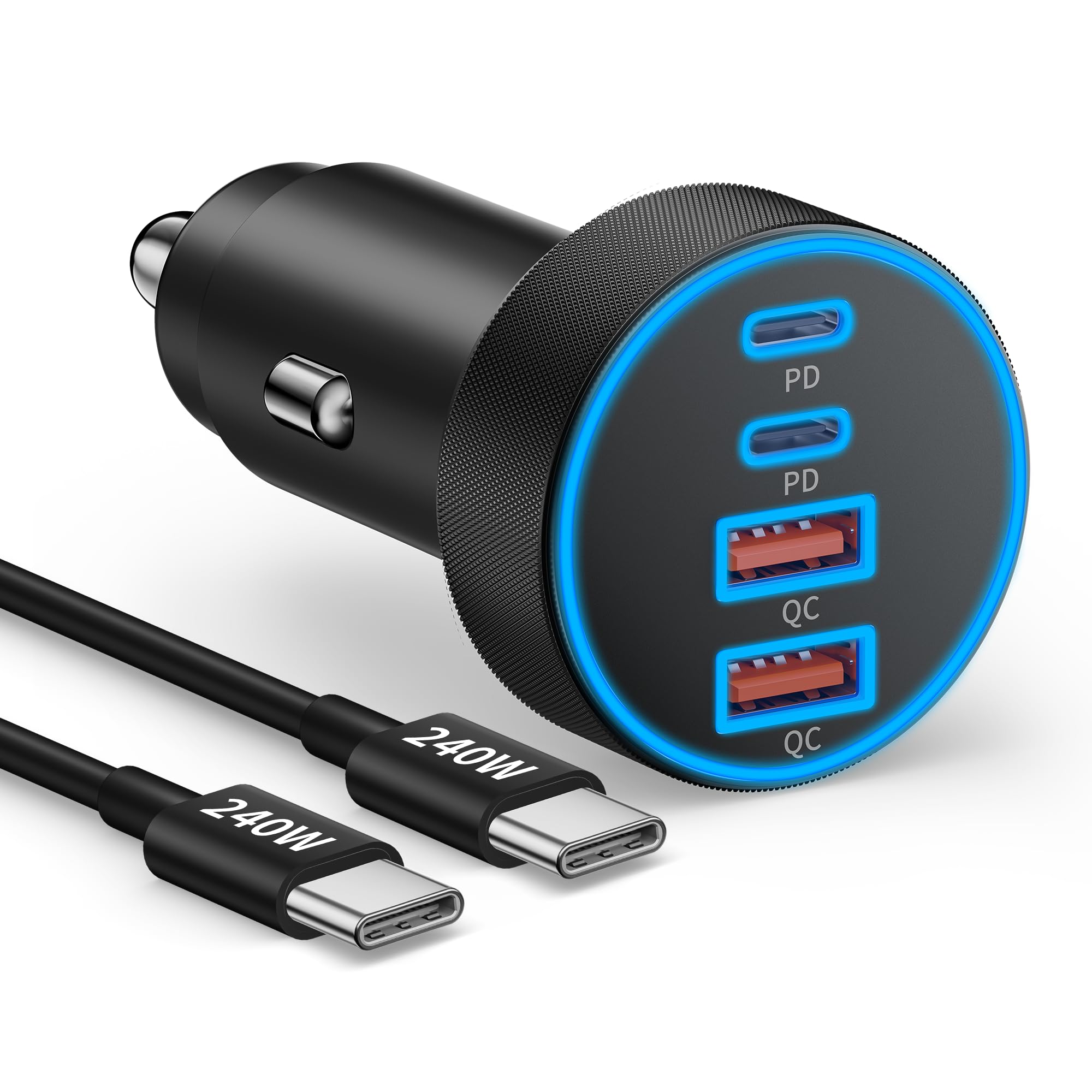
The four-port command center that keeps every screen in the car awake.
When the whole car needs power — two phones, a tablet, a dashcam — this is the setup that ends the argument over who gets the fast port. It delivers a 90W total output across four ports, and outperforms the Anker 40W by more than double the wattage, giving you room for devices the smaller pick simply cannot handle. The two USB-C ports each offer 45W PD, and the two USB-A ports each offer 45W QC, which is an unusually balanced spread for a car charger.
It uses PPS super-fast charging, so a Samsung Galaxy S26/S25/S24 Ultra can hit 80% in about 35 minutes, and an iPhone 17/16 Pro Max reaches 70% in about 30 minutes. The included 3FT cable is the standout accessory — it carries a 240W E-Marker chip and a PD3.1 EPR system, meaning one cable in this box can handle anything from a phone up to a 240W laptop, which is well beyond what most bundled cables can do.
The aluminum alloy body with a flame-retardant ABS+PC shell is built to manage heat during high-power charging, and the soft blue-lit design shows charging status at night without being a distraction. A small gripe shows up in reviews: some units only charge from one of the two USB-C ports, so it is worth a quick test of all four sockets when it arrives.
Whole-car solution: Four independently fast ports and a premium 240W cable make this the best value for families, rideshare drivers, or anyone who charges a laptop plus phones simultaneously.
Check on arrival: A few customers note a dead port from the start, so test every socket early — the 12-month replacement guarantee covers any that fail.
Reach for this if: you have multiple devices riding along every day and want a single adapter that fast-charges all of them without negotiation.
Look elsewhere if: you want a tiny, flush-fitting charger — this one is bigger because it has to hold four ports and serious heat management.
4. 75W 3-Port Super Fast Charging Cigarette Lighter Adapter
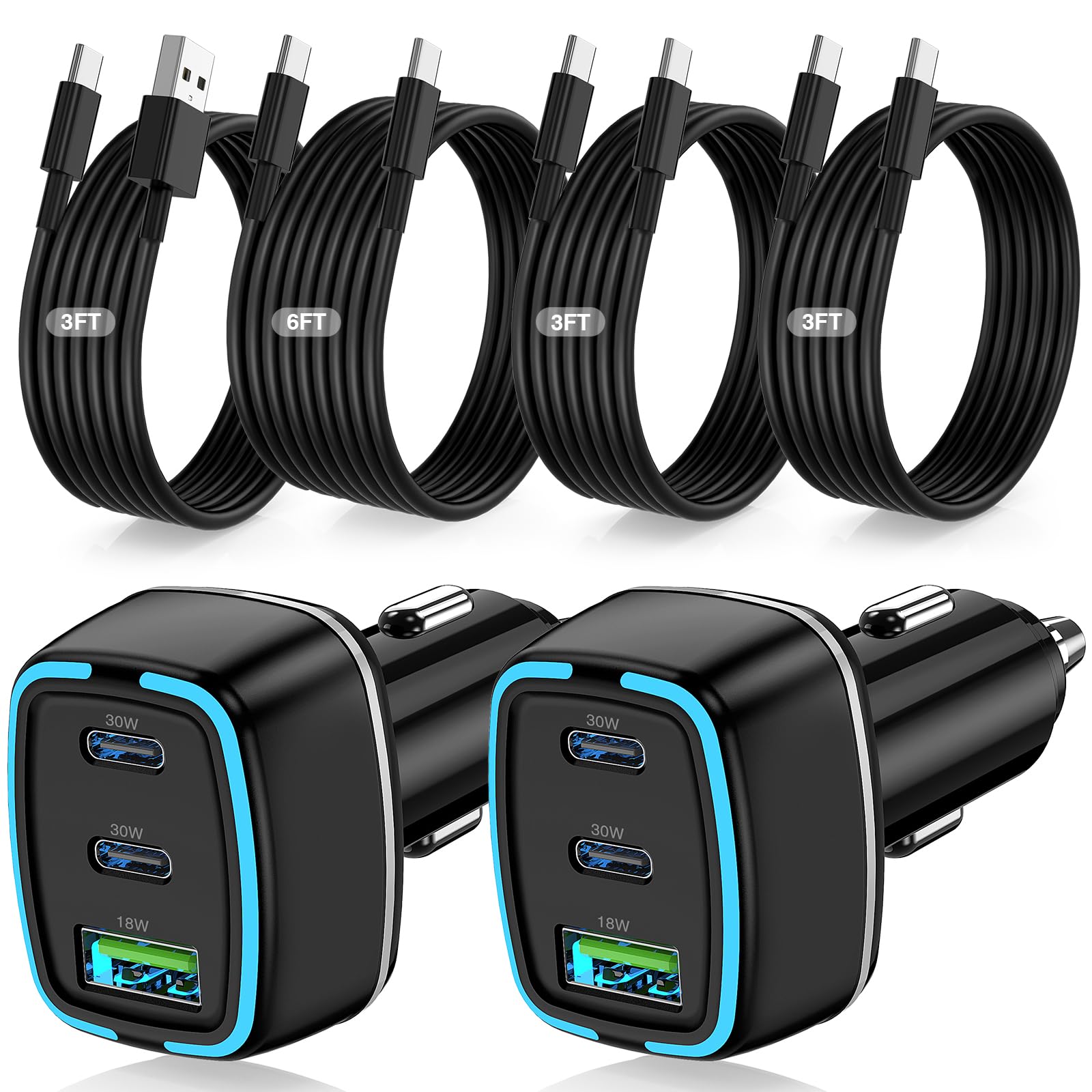
The setup that turns one socket into a full charging station, cables included.
This is the buy-once-and-forget option because the box already has everything you need. The charger itself has three ports — two 30W USB-C PD ports and one 18W USB-A QC port — for a 75W total. The maker says it can take an iPhone from 0% to 65% and a Samsung Galaxy from 0% to 70% in 30 minutes, which is the kind of real-world speed claim that matches what the PD 3.0 and QC 3.0 protocols are designed to deliver.
What makes this stand out is the included 4-pack of USB-C cables in 3 and 6.6FT lengths. That solves the most annoying part of buying a new charger — realizing you do not own a cable good enough to use its fast mode — and the longer 6.6FT cable actually reaches the back seat, which is ideal for rear passengers who do not want to lean forward. The compact streamlined profile fits snugly even on bumpy roads, which is exactly what owners mention most, with charging speed being the top-praised aspect.
The heat-dissipating PC housing with a metallic texture keeps things cool during long drives, and it works on any 12–24V vehicle. Owners describe it as reliable, easy to use, and flexible across front and back seats, with the 18-month warranty and 24/7 customer service adding confidence.
The complete package
- Two 30W USB-C PD ports plus one 18W USB-A QC port for a versatile 75W total
- Comes with 4 USB-C cables in 3FT and 6.6FT lengths, covering front and back seats
- Compact and secure fit that stays put on bumpy roads
Know before you buy
- There is just one USB-A port, so older non-USB-C accessories share that slot
- The 5-ounce weight makes it feel more substantial than a thumb-sized mini charger
Grab it when: you want one purchase that delivers the charger and all the cables, with enough reach for every seat in the car.
Skip it when: you already own a drawer full of quality USB-C cables and only need a compact single-device charger.
5. Bangfun 3-Pack 65W 4-Port Car Charger with Voltmeter

A three-pack that doubles as a battery health check for every car you own.
This bundle solves a very specific problem, which is that you probably own more than one car, and your old charger in the second car is probably garbage. You get three 65W chargers, each with four ports — two USB-C and two USB-A — so you can put one in every vehicle and still have a spare for the glovebox. Each unit delivers 30W PD 3.0 fast charging for the latest USB-C devices and 18W QC 3.0 for most Android phones.
The headline feature is the built-in voltage display, which works as a voltmeter to monitor your car battery’s condition in real time. Owners love this — the voltage indicator is the second most-praised aspect, with a note that the readout is accurate to within 0.1 volts, giving you genuine confidence on long trips. One owner puts it plainly: it is “really great to know how much life is left in the car battery!”
The all-aluminum exterior and smart chip inside protect against over-current, over-voltage, short-circuit, and over-heating, which matters especially in hot summer months. It handles 12–24V vehicles, so it works in cars, trucks, and SUVs, and the four-port design keeps a dashcam, phone, tablet, and a USB fan all running at once. The 2.25 A (6 A total across the pack) rating is solidly mid-range, which is fine for phones and tablets but not for a demanding laptop.
Multi-car confidence: The built-in voltmeter is the differentiator here — a genuinely useful battery-check feature bundled into a capable four-port charger.
A fair trade-off: At 65W total across four ports, heavy simultaneous drain will dip the per-port speed, so manage expectations with a laptop plugged in.
Best for: households with multiple vehicles that want a quality charger plus a battery-health monitor in each one.
Not for: owners who only have a single car and do not need the extra units or the voltmeter feature.
6. Bangfun 5-Pack 36W Dual Port PD & QC 3.0 Car Charger

Five chargers for less than the cost of one fancy unit, and they genuinely work.
If you have ever had a charger “borrowed” and never returned, or lost one to the void under a car seat, this 5-pack is the answer to that specific frustration. You get five dual-port chargers, each with one USB-C PD 3.0 port and one USB-A QC 3.0 port, running a 36W total. The USB-C port delivers up to 20W of PD fast charging, which the maker says is 3 times faster than a normal 2.4A charger, and the QC 3.0 port can take a Samsung Galaxy from 0% to 80% within 35 minutes.
The independent PD and QC protocol chips mean you can fast-charge two devices at the same time without a drop in power, which is genuinely unusual at this price tier. Each charger has a soft blue LED ring that lights up to help you plug in at night without fumbling, and the manufacturer assures it will not drain your car battery because all 12V outlets switch off when you remove the keys from the ignition.
The heavy-duty aluminum construction is the thing owners mention most, and durability is a real strength. The charging speed feedback is slightly mixed, which makes sense for a 36W budget unit — it is fast for a phone, but it will never match a wall charger or a premium 90W adapter. For the price of a single mid-range charger, you can outfit every car you own and still have spares.
Why the 5-pack wins
- Five chargers let you keep one in every car, at work, and in a travel bag
- Independent PD and QC chips keep both ports fast simultaneously
- Metal body and a soft blue LED ring for easy nighttime plug-in
The budget reality
- 36W total means no laptop charging and slower than premium adapters
- Charging speed is a mixed bag in reviews — great for phones, not for heavy devices
- Not every unit lasts; one owner notes theirs “doesn’t last long”
Pick this if: you want maximum coverage for the smallest spend — five reliable phone chargers to scatter across every vehicle you touch.
Pass if: you need serious power for a laptop or high-wattage devices, since 36W will not feed them properly.
7. Anker 30W 2-Port PowerIQ 3.0 USB-C Car Charger

The miniature Anker that disappears into the socket and still fast-charges an iPhone.
This is the pick for drivers who want a no-nonsense charger that takes up almost no space at all. The 30W USB-C port delivers a charging speed that Anker says is 3 times faster than a standard 5W charger, which is plenty of power to rapidly top up an iPhone 15 or 16 series phone.
It comes as a 2-pack, so you can keep one in your daily driver and one in the family vehicle, or stash a spare. The ultra-compact design is the standout feature — it is built to fit in the smallest of spaces, and it does not get in the way of the gear shifter or other dashboard controls. A key detail for some owners: there is no indicator light, which means no battery drain if you leave it plugged into an always-on socket, and it fits deep sockets that reject bulkier adapters.
The USB-C and USB-A combo lets you power two phones at once, and the built-in protection covers overvoltage, undervoltage, overcurrent, and over-temperature, plus intelligent power allocation to keep both ports efficient. Owners consistently call it high quality and good value, and the dual-charging performance is the one area that earns mixed feedback — a few note it does not charge two devices simultaneously at full speed, which is a common reality at 30W total.
Stealthy and dependable: The compact size and lack of a drain-inducing LED make it perfect for deeply recessed or always-on sockets, with the Anker build-quality reputation backing it.
The one hesitation: 30W total is entry-level power, so two phones plugged in will share the output rather than each getting full speed.
Take this if: you value a tiny footprint and trust Anker’s reliability for a single primary device, especially in vehicles with finicky sockets.
Leave it if: you regularly fast-charge two demanding phones or tablets at the same time — step up to the 40W version instead.
Understanding the Specs
PD, QC, and PPS protocols
These acronyms describe how your charger and phone negotiate speed. PD (Power Delivery) is the standard that fast-charges iPhones and modern USB-C laptops, QC (Quick Charge) covers a wide range of Android phones, and PPS is the adaptive protocol Samsung Galaxy devices use for premium charging speeds. When the charger supports your phone’s own protocol, you get the real fast-charging speed the label promises instead of a slow trickle.
Total wattage vs. per-port power
The big number on the box, like 90W or 67.5W, is the total power the charger can deliver across all ports at once. What actually matters is the per-port maximum, because a two-port charger might split 40W into two 20W slots. Check the spec for how much each port can output on its own — that tells you if a single port can charge a laptop or just a phone.
Amperage and the 12V socket
Amperage (the A in specs like 3 A) measures the current flowing to your device, and together with voltage it determines charging speed. All car chargers plug into the same 12V cigarette lighter socket, but the quality of that connection varies — a snug fit prevents wobble on rough roads, and a well-built metal or flame-retardant shell keeps things cool during high-power charging.
Voltmeter displays and safety
A built-in voltmeter shows your car battery’s resting voltage, which acts like a health check for your electrical system. Safety protections — overvoltage, overcurrent, overheat, and short-circuit — are the quiet features that prevent damage to your phone and your car. Well-built chargers include these safeguards plus an auto-cutoff when your device is fully charged.
FAQ
Will a USB-C car charger work with my older iPhone or Android phone?
How many ports do I really need in a car charger?
Does a higher wattage car charger charge my phone faster?
Can a car charger drain my car battery overnight?
What is the difference between PD and QC fast charging?
Will a multi-port car charger slow down when everything is plugged in?
Is it safe to leave a car charger plugged in all the time?
Can these chargers power a laptop or a tablet?
Final Thoughts: The Verdict
For most buyers, the car charger winner is the Anker 40W PowerDrive III Duo because it nails the fundamentals — rock-solid fit, fast output on both USB-C ports, and a reliability reputation that dominates its owner feedback. If you want serious laptop-level power in a tiny shell, grab the AINOPE 67.5W. And for a family that needs to charge everything at once, the WIDAQUO 90W 4-Port is the one to reach for. The crowd favorite among all of these is the Anker by a wide margin, holding the highest satisfaction score with over 9,600 owners behind it, which is the strongest signal you can get for a small daily-use accessory.
How We Picked
We do not accept paid placement. Every pick is matched to a real buyer and a real use-case; we do not hands-on test units.
Sources & Methodology
Specifications: manufacturer listings and product documentation. Review insights: verified customer reviews, as of August 2026. Pricing: not shown on this page (it changes often); check the current price via the retailer link.
As an Amazon Associate, Gadgets Feed earns from qualifying purchases. This does not affect which products we feature.