
Our readers keep the lights on and my morning glass full of iced black tea. As an Amazon Associate, I earn from qualifying purchases.
Specs are compiled from manufacturer listings and verified buyer reviews and can change over time — please confirm the key details on the product page before buying.
You want a 350-watt portable solar panel that charges your power station quickly without damaging its input. All four panels here fold up for travel, but they differ sharply in voltage, amperage, weight, and real-world sun performance. This guide ranks them by what their specs and owner experiences actually deliver.
I’m Min — the founder and writer behind Gadgets Feed. This guide is built by comparing the manufacturers’ published specifications and the patterns across verified customer reviews, so you get each pick’s real strengths and trade-offs instead of marketing spin.
Match the panel’s voltage to your generator’s input range, or you risk slow or no charging. This breakdown of the 350 watt solar panel options focuses on the specs that make or break that pairing.
Our Picks at a Glance
How To Choose The Best 350 Watt Solar Panel
Portable 350W panels are durable goods — you buy one for years of camping, RV trips, or emergency backup. So the decision is less about the wattage number and more about whether the panel’s electrical profile fits your generator and your travel style.
Match voltage to your power station first
Every solar generator has a maximum input voltage it accepts. A panel pushing 50.2 volts (an “Open Circuit Voltage” rating) can charge big 1kWh+ stations fast, but it will not work with small 12-20V units. A 37.4V panel is more forgiving with mid-size generators. Skipping this check is the number one reason a panel arrives and then underperforms.
Efficiency and cell type set your real-world output
Efficiency tells you how much sunlight becomes electricity. Higher efficiency (25%) means more power in low-light or cloudy conditions compared to a panel with the same surface area at 23%. N-Type cells with multiple “busbars” (the thin wires on the cell face) reduce internal resistance and resist the performance drop older P-Type cells show over time.
Weight and folded size decide if you actually take it
A 350W panel is a serious piece of gear — these range from about 19.8 pounds to 30.6 pounds. If you are hauling it to a campsite by hand, the lighter panels with carry handles win. If it mostly lives in a vehicle or stays home for outages, heavier build quality matters more than a few saved pounds.
Quick Comparison
| Model | Best For | Max Voltage | Amperage | Weight | Amazon |
|---|---|---|---|---|---|
| ZOUPW 350W★ Best Overall | High-voltage big stations | 50.2 volts | 8.1 A | 22.2 lbs | Amazon |
| GRECELL 350W | Balanced mid-size generators | 37.4 volts | 9.6 A | 19.8 lbs | Amazon |
| BLUETTI 350W | BLUETTI station owners | 46.5 volts | 9.2 A | 30.6 lbs | Amazon |
| BLUETTI Elite 200 V2 Kit | Complete plug-and-play backup | — | — | — | Amazon |
In-Depth Reviews
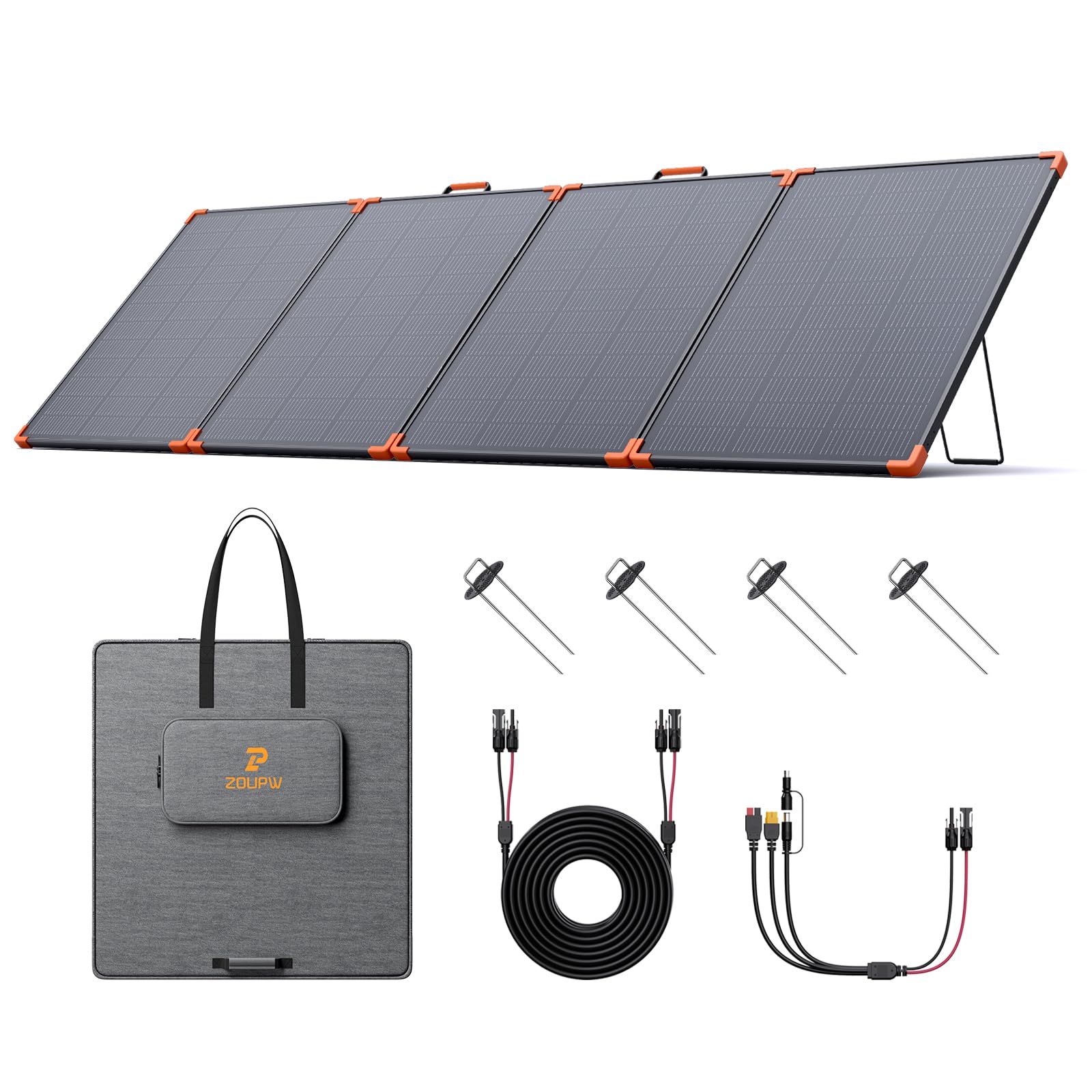
1. ZOUPW 350W Portable Solar Panel N-Type 16BB
Our pick — over 4★ from 80+ verified ratings; the strongest balance of quality and price.
The high-voltage specialist that refills big 1kWh generators faster than the rest.
That voltage feeds high-capacity stations like EcoFlow Delta 2/3, Bluetti AC200L, and Anker Solix C1000/C2000 fast, and the 4-in-1 cable (XT60, Anderson, DC7909, DC8020) makes hookup simple. The flip side: you must verify your generator accepts 50.2V input, because small 12-20V stations will not work with it.
Owner experience backs up the spec sheet. Buyers report it outputs at or exceeds its 350W rating in good sun, with One direct comparison showed the ZOUPW pushing 250-325W while a 400W RichSolar managed only 175-225W.. What wins people over is the build quality — it is the most-praised trait here, ahead of ease of setup and performance. At 22.2 lbs it is the midweight of the trio, and the padded storage bag gets consistent appreciation for carrying.
The N-Type cells with 16 busbars and 25% efficiency claim top billing for long-term reliability, resisting the Light-Induced Degradation (a gradual power loss) that affects older cell types. It folds into a compact briefcase with a magnetic handle for 10-second deployment. The honest caveats: kickstand opinions are mixed, and one early unit arrived with micro-cracks before a replacement shipped — the maker addressed it, but treat the surface with care and avoid partial shadows.
Why owners rate it highly
- Hit up to 352W peak output in real-world testing.
- IP68 rating shrugs off rain and dust
- Folds to briefcase size with magnetic handle
Know before you buy
- 50.2V only suits big 1kWh+ generators
- Kickstands draw mixed feedback
- Not built for permanent fixed mounting
Reach for it if: you own a large power station and want the fastest possible refill from sun.
Look elsewhere if: your generator is a small 12-20V unit — this voltage simply will not pair.
2. GRECELL 350W Portable Solar Panel

The lightest foldable 350W here, with amperage that tops the whole list.
At 19.8 pounds, this is the easiest panel to haul to a campsite, and it pairs a friendlier 37.4V with the highest amperage of the group at 9.6A — 19% more current than the ZOUPW. More amps means your power station’s battery refills faster when conditions are good, even though the peak voltage is lower. The built-in smart chip identifies your device and guards against overcharging and overloading.
The XT60 and Anderson outputs make it a natural match for most solar generators on the market, including GRECELL’s own 2200w, 2400w, and 4000w stations. Owners mention it pushing over 250W of its 350W rating in real use and praise the easy setup and quality. It also ships with two Y-branch parallel adapter cables, so you can link panels for double output and shorter charging time.
You capture a bit less energy in weak sun because the 23% conversion efficiency from monocrystalline cells trails the ZOUPW’s 25%. Durability draws mixed feedback; one reviewer noted a panel that lost output after months, seeing 71W on a sunny day versus a three-year-old 350W Bluetti managing 170W, and the warranty process frustrated them. The folding stand feels flimsy, though it held a set angle for a month outdoors in testing.
What it does well
- Lightest of the three standalone panels
- Highest amperage for faster refills
- Ships with parallel adapter cables included
Trade-offs to weigh
- Durability feedback runs mixed
- Legs feel light and flex under load
- Warranty support earned one poor review
Who it fits: campers and van lifers who carry their panel on foot and want generous amperage for a mid-size generator.
Who should pass: anyone planning years of harsh daily use who prioritizes warranty responsiveness above portability.
3. BLUETTI 350W Portable Solar Panel
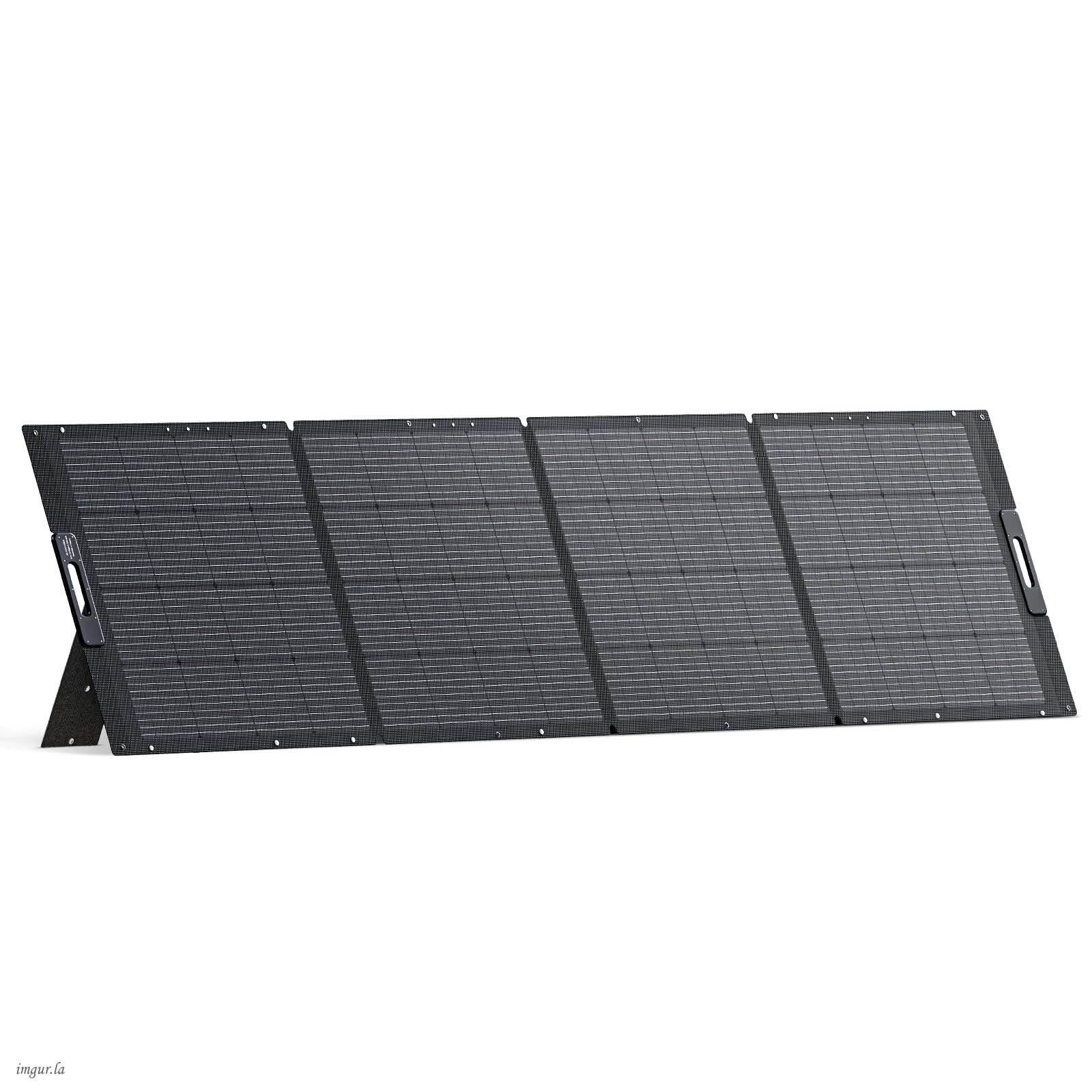
A rugged 46.5V panel engineered for BLUETTI’s own generator lineup.
This panel is the natural partner for BLUETTI stations — it lists wide compatibility with the AC70, AC180, AC240, AC200L, Elite 200 V2, and the big AC300 and AC500 systems. Its 46.5V maximum voltage sits between the ZOUPW’s 50.2V and the GRECELL’s 37.4V, and it pushes 9.2A of current. The 23.4% monocrystalline efficiency keeps producing electricity even on an overcast day, which is exactly when you need it most.
The ETFE surface resists scratches and water splashes, and the IP67 rating (a dust-tight and waterproof standard) handles real weather better than the IP65 on the GRECELL. Owners have linked three of these in series to run as a whole-house solar source, reporting two panels sustaining around 600W and three panels delivering 800W. Buyers praise performance most, repeatedly mentioning the adjustable kickstand and sturdy construction.
Some owners find the plastic leg stands could fail in heat, and there are no grommets for hanging. One buyer’s only real regret was learning it shouldn’t stay out in heavy rain long-term, so treat the IP67 rating as splash-resistance for travel, not a permanent roof mount.
Built for BLUETTI owners: if you already run an Elite 200 V2 or AC series station, this panel pairs without adapters and delivers the performance owners rave about.
The honest catch: the 30.6 lb weight makes it a vehicle-lifer’s panel, not a hike-in panel, and the legs deserve gentle handling.
Choose this if: you own a BLUETTI station and want a guaranteed match with serious weather resistance.
Think twice if: you need to carry panels on foot daily — the lighter GRECELL beats it there.
4. BLUETTI Elite 200 V2 Solar Generator + 350W Panel
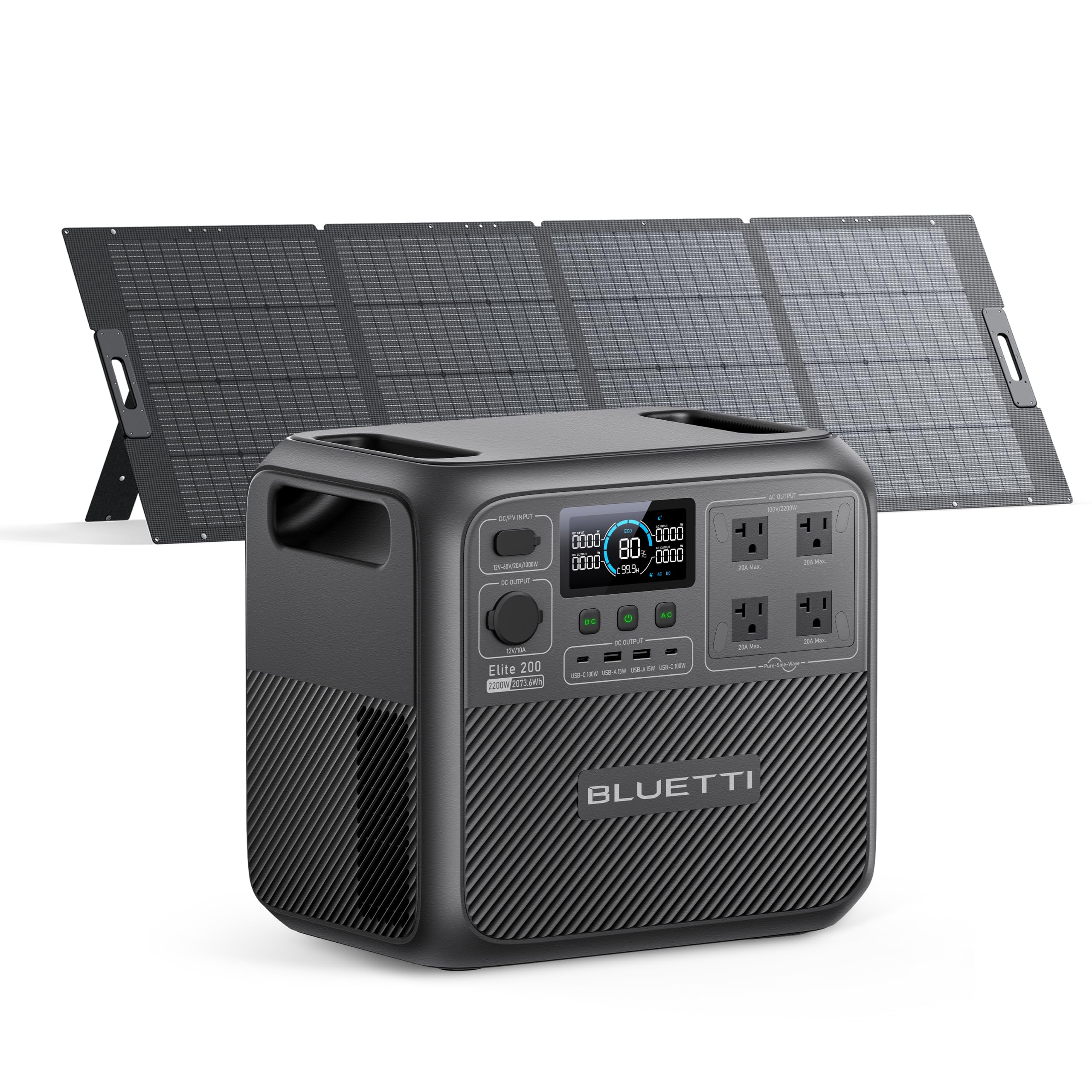
A complete 2073.6Wh backup system that pairs a power station with its matching 350W panel.
This is the buy-once-and-done option: an Elite 200 V2 power station with the 350W panel shipped separately, so pairing is guaranteed. The 2600W continuous AC output and 3900W “power lifting” mode run refrigerators, hair dryers, and coffee makers, supporting up to 9 devices at once.. The kit fully recharges from the 350W panel in about 8 hours of direct sun..
The battery chemistry is the headline: The CNAS-certified automotive-grade LiFePO4 pack is rated for over 6,000 cycles and a 17-year lifespan.. Standby draw drops to just 10W, so a 120V 60W fan running 3 hours daily lasts 11 days on a charge.. Real-world reports show it keeping a fridge running for a couple of days on a charge, with Bluetooth and WiFi monitoring as a welcome layer of control.
Owners love the runtime during outages, with one saying it runs a refrigerator, fans, and lamps “without hardly dropping wattage.” The realistic downside is solar charging speed — in weak sun it takes basically all day, which is why several owners plan to add a higher-wattage panel. Dual AC and DC charging refills it from 0-80% in 50 minutes when grid power is available., and The ≤15ms UPS transfer keeps devices alive through power flickers..
One-box backup: this removes all cable-matching guesswork for anyone who wants emergency power without assembling parts.
Know the limit: the bundled 350W panel is fine for a daily top-up but slow for a full refill — budget for a bigger panel if you run high loads off-grid.
Perfect for: homeowners building outage resilience and campers who want one system that just works together.
Not ideal for: budget-first buyers or anyone who already owns a separate solar generator — the standalone panel is the smarter add-on there.
Understanding the Specs
Maximum Voltage (Open Circuit Voltage)
This is the highest voltage the panel produces with nothing connected. It matters because your power station has a maximum input voltage — exceed it and the station refuses to charge or risks damage. A 50.2V panel feeds big 1kWh+ generators fastest, while a 37.4V panel is safer for mid-size units. Always check your generator’s input range before buying.
Amperage Capacity (Amps)
Amps measure the electrical current flowing into your battery. Higher amps mean faster energy transfer when the sun is strong, so a 9.6A panel refills a station quicker than an 8.1A panel under identical conditions. Pair this with voltage to understand total power: watts equals volts times amps.
FAQ
Will a 350W portable panel work with my smaller 12V power station?
Can I connect two 350W panels together for more power?
Why does my 350W panel only output 250W in real use?
How long does a 350W panel take to charge a power station?
Is a higher efficiency rating worth paying for?
Can I leave a portable solar panel out in the rain?
How heavy is a 350W portable panel to carry?
What cables are included with these panels?
How do N-Type cells differ from standard solar cells?
Is it better to buy a panel alone or as a generator kit?
Final Thoughts: The Verdict
For most buyers, the 350 watt solar panel winner is the ZOUPW 350W because it pairs the highest 25% efficiency with a 50.2V output that refills large generators fast, all at a middleweight 22.2 lbs. If you want the lightest carry at 19.8 lbs with top amperage, grab the GRECELL 350W. And for a complete, guaranteed-match backup system with a 2073.6Wh battery, the BLUETTI Elite 200 V2 Kit is the one to reach for.
How We Picked
We do not accept paid placement. Every pick is matched to a real buyer and a real use-case; we do not hands-on test units.
Sources & Methodology
Specifications: manufacturer listings and product documentation. Review insights: verified customer reviews, as of August 2026. Pricing: not shown on this page (it changes often); check the current price via the retailer link.
As an Amazon Associate, Gadgets Feed earns from qualifying purchases. This does not affect which products we feature.