
Our readers keep the lights on and my morning glass full of iced black tea. As an Amazon Associate, I earn from qualifying purchases.
Specs are compiled from manufacturer listings and verified buyer reviews and can change over time — please confirm the key details on the product page before buying.
When the light fades or you need to lock onto a moving bird, the right 8×42 binoculars keep the view bright and your eyes relaxed. The wrong pair leaves you with dim views, stiff focus wheels, or eye strain. The differences between these nine picks come down to field of view, eye relief, and lens coatings—each tuned for a specific use case.
I’m Min — the founder and writer behind Gadgets Feed. This guide is built by comparing the manufacturers’ published specifications and the patterns across verified customer reviews, so you get each pick’s real strengths and trade-offs instead of marketing spin.
You’ll see the widest fields, the longest eye relief, and the glass that handles dawn and dusk best in this breakdown of the best 8×42 binoculars.
Our Picks at a Glance


How To Choose The Best 8X42 Binoculars
Picking your first serious pair of 8x42s is about matching the optics to how you actually use them. Every pair here delivers the same 8x magnification with 42mm objective lenses, but the coatings, prisms, and ergonomics separate an easy day in the field from a frustrating one. Here are the three decisions that matter most.
Match the field of view to your quarry
The number that tells you how wide your view is at 1,000 yards is the one that determines whether you can find a quickly moving bird or keep up with a fast-flying subject. A wider field, like the 430 feet on the Timorn, makes it easier to catch moving wildlife, while a narrower field like the 315 feet on the ZEISS rewards you with more magnification detail on a stationary target. Decide what you’ll be tracking before you choose.
Check the eye relief if you wear glasses
Eye relief is the distance between your eye and the lens where you still see the full picture. If you wear glasses, you need at least 15mm to avoid a frustrating “black circle” blocking part of your view. The Nikon PROSTAFF P3 and P7 both offer a generous 20.2mm of eye relief, which is why glasses wearers love them, while the Timorn offers a still respectable 15mm.
Understand what the lens coatings do
The glass inside the binoculars does the heavy lifting for brightness and color. Extra-Low Dispersion (ED) glass reduces chromatic aberration — that purple or green fringing you see on high-contrast edges — for true-to-life color. Fully multi-coated lenses cut reflections and boost light transmission, which is what makes dawn and dusk viewing possible without losing detail. Knowing this helps you see why a premium pair costs more.
Quick Comparison
| Model | Best For | Field of View | Eye Relief | Exit Pupil | Amazon |
|---|---|---|---|---|---|
| Nikon PROSTAFF P3★ Best Overall | All-around value & glasses wearers | 377 feet | 20.2 mm | 5 mm | Amazon |
| Timorn 8×42 HDWidest View | Wide-field tracking & phone photos | 430 feet | 15 mm | 5.2 mm | Amazon |
| Athlon Neos G2 HDBudget Clarity | Budget-friendly clarity | 7 degrees | 17 mm | 5.25 mm | Amazon |
| PEIKETAO ED HD | ED glass on a budget | 393 feet | 17.5 mm | 5.3 mm | Amazon |
| Bushnell H2O Porro | Classic porro-prism ruggedness | 7.8 degrees | 17 mm | 5.25 mm | Amazon |
| Celestron Nature DX ED | True-color ED performance | 7.5 degrees | 17.8 mm | 5.25 mm | Amazon |
| Nikon PROSTAFF P7 | Glasses wearers & lockable focus | 377 feet | 20.2 mm | 5.3 mm | Amazon |
| Vortex Viper HD | Serious hunters & all-day carry | 409 feet | 18 mm | 5.25 mm | Amazon |
| ZEISS Terra ED | Brand-name precision | 315 feet | 18 mm | 5.3 mm | Amazon |
In‑Depth Reviews
1. Nikon PROSTAFF P3 8×42 Binocular
Our pick — over 4.5★ from 600+ verified ratings; the strongest balance of quality and price.
The all-rounder that keeps you sharp from dawn hikes to dusk birding
The PROSTAFF P3 earns its “Best Overall” spot by nailing the specs that matter most for everyday nature viewing.
Buyers report it’s “lighter than Celestron Outland; no edge fringing, sharp to edge,” thanks to the multilayer-coated lenses and silver-alloy prism coating that work together for vibrant color. The fiberglass-reinforced polycarbonate body with rubber armor keeps it light enough for long hikes while staying weather-ready with O-ring seals and nitrogen purging. You get a 53.4-degree apparent angle of view — that’s 7.6x wider than the Athlon’s 7 degrees — so your view feels rich, not tunnel-like.
What wins people over is build quality — it’s the most-cited strength in the reviews — followed closely by image clarity. Some find the diopter ring stiff to turn, and the center focus wheel takes a moment to adjust to if you’re coming from porro prisms. The trade-off for that simplicity is a focus that’s best for a single user rather than quick sharing between family members.
Why it leads the list
- Outstanding 20.2mm eye relief for glasses wearers
- Wide 53.4-degree apparent angle feels rich
- Lightweight rubber-armored body for all-day carry
Worth knowing
- Diopter ring is stiff to adjust
- Best set for a single user, not quick sharing
Reach for this if: you want a reliable, glasses-friendly pair that handles birding, hiking, and sports while staying affordable.
Look elsewhere if: you need to pass the binoculars between multiple users with different prescriptions all day.
2. Timorn 8×42 HD with Phone Adapter
The kit that scans a beach and shares the view through your phone
The 8.2-degree apparent angle backs that up, giving you a genuinely panoramic sweep when you’re scanning open water or treelines.
Owners mention taking these “to the beach last week & enjoyed using them to focus on ships & fish in the gulf,” and also sitting on the porch identifying birds at feeders. That ease comes from the fully multi-coated (FMC) green film on all lenses and the BAK4 roof prisms, which deliver clear, bright images. The 5.2mm exit pupil means a comfortable view even as light drops, and at 1.45lb it’s light enough that the weight actually helps stabilize the image.
The real differentiator is the included smartphone adapter and tabletop tripod — you can mount almost any phone and capture what you see. The 15mm eye relief is the shortest on this list, so glasses wearers will want to try them first. A recurring detail: the diopter wheel sits where a thumb can bump it accidentally, changing your setting mid-watch.
What stands out: the accessory bundle — a tripod and phone clamp included with this wide-field optical kit is rare at its price level.
Best suited for: the casual viewer who wants one kit for the backyard, the beach, and phone photos of what they see.
Think twice if: you wear glasses daily — 15mm eye relief is workable but the shortest here.
3. Athlon Optics 8×42 Neos G2 HD
Crisp glass that keeps up in rain, snow, and heat without the premium price
The Athlon Neos G2 is the pair that punches above its weight for clarity — the #1 thing owners praise is how sharp the image stays, with reports of it remaining crisp up to 600 yards. It’s a multi-coated (not fully multi-coated) optical system, but the 5.25mm exit pupil is 5% larger than the Nikon PROSTAFF P3’s 5mm, so it gathers slightly more light in dim conditions.
It has survived 15 months of use in rain, snow, and heat and still feels solid, which tells you the waterproof and fog-proof seals hold up. The 17mm eye relief works for most glasses wearers, and the wider +/-5 diopter range means more room to match your eyesight. The 7-degree apparent angle of view is the narrowest on this list, a 7.6x gap versus the Nikon P3’s 53.4 degrees, so you’ll feel a bit more tunnel-visioned when scanning.
Weighing less than older double-prism models, it rides well on a harness for a full day of birding. The trade-off is the field of view — owners consistently note it’s narrower than expected — so it’s better for watching a feeder or a single nest than tracking fast-flying birds across open sky.
Where it shines
- Exceptional clarity for its position in the lineup
- Proven weather durability over 15 months of use
- Wide +/-5 diopter range for varied vision
Keep in mind
- Field of view runs narrower than expected
- Multi-coating is a step below fully multi-coated
Grab these if: you want dependable, sharp glass for amateur birding without paying for a big brand name.
Skip them if: you need a wide field to track birds in flight or scan large areas quickly.
4. PEIKETAO ED HD 8×42 Binoculars
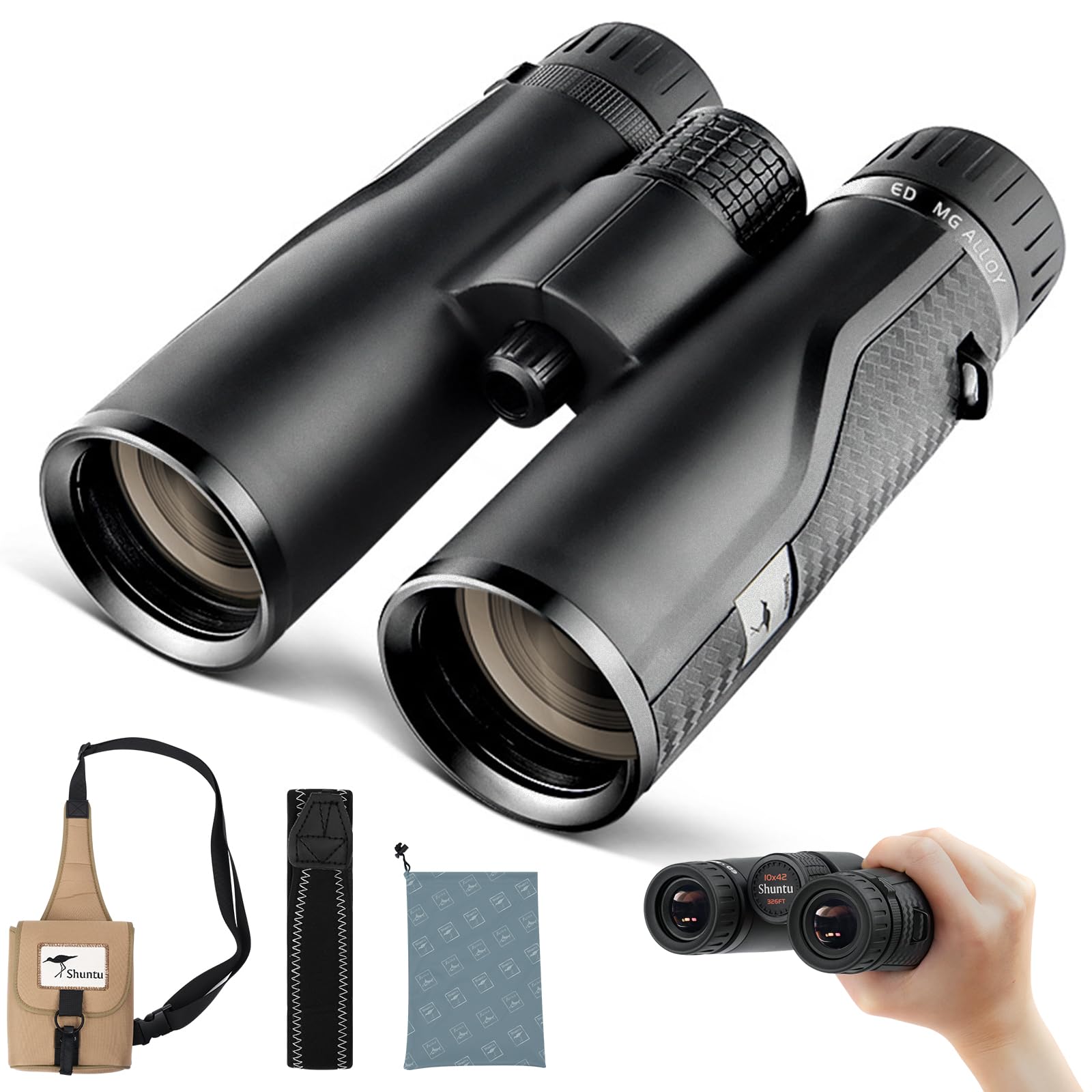
ED glass and a magnesium body that beat binoculars twice the price
The PEIKETAO is the wildcard of this list: it brings Extra-Low Dispersion (ED) glass — the same optical technology premium brands use to kill color fringing — plus a magnesium alloy chassis that’s lighter and more thermally stable than aluminum. It’s the only pair here with an IPX7 waterproof rating, meaning it survives submersible conditions at 1 meter for 30 minutes, and it’s argon-purged rather than nitrogen-filled for better fog-proofing.
The phase-coated BAK4 prisms with dielectric coating claim to boost light transmission to 98%, which explains why it’s bright at dawn and dusk. The 18mm eye relief is glasses-friendly, and the 6.5ft close focus lets you lock onto butterflies or a wren at arm’s length — something many 8x42s can’t do. Image quality is the most-praised aspect, with buyers saying the view is worth more than what they paid, and the focus is easy to dial in.
Buyers do note sharpness falls off slightly at the very edges, and there’s a touch of flare when the sun hits the objectives directly. The included carrying case is snug, so you might want to upgrade the strap. It also comes with a VIP Lifetime Warranty, which is rare at this level.
Why it surprises
- ED glass and dielectric prisms at a value price point
- IPX7 waterproof rating beats most competitors
- 6.5ft close focus for nearby subjects
The honest trade-offs
- Edge sharpness drops off at the frame
- Slight lens flare with direct sun on objectives
Choose this for: the buyer who wants premium ED glass and rugged waterproofing without paying premium-brand prices.
Be aware: you’ll likely swap the snug stock strap and case for better ones for all-day comfort.
5. Bushnell H2O Porro Prism 8×42
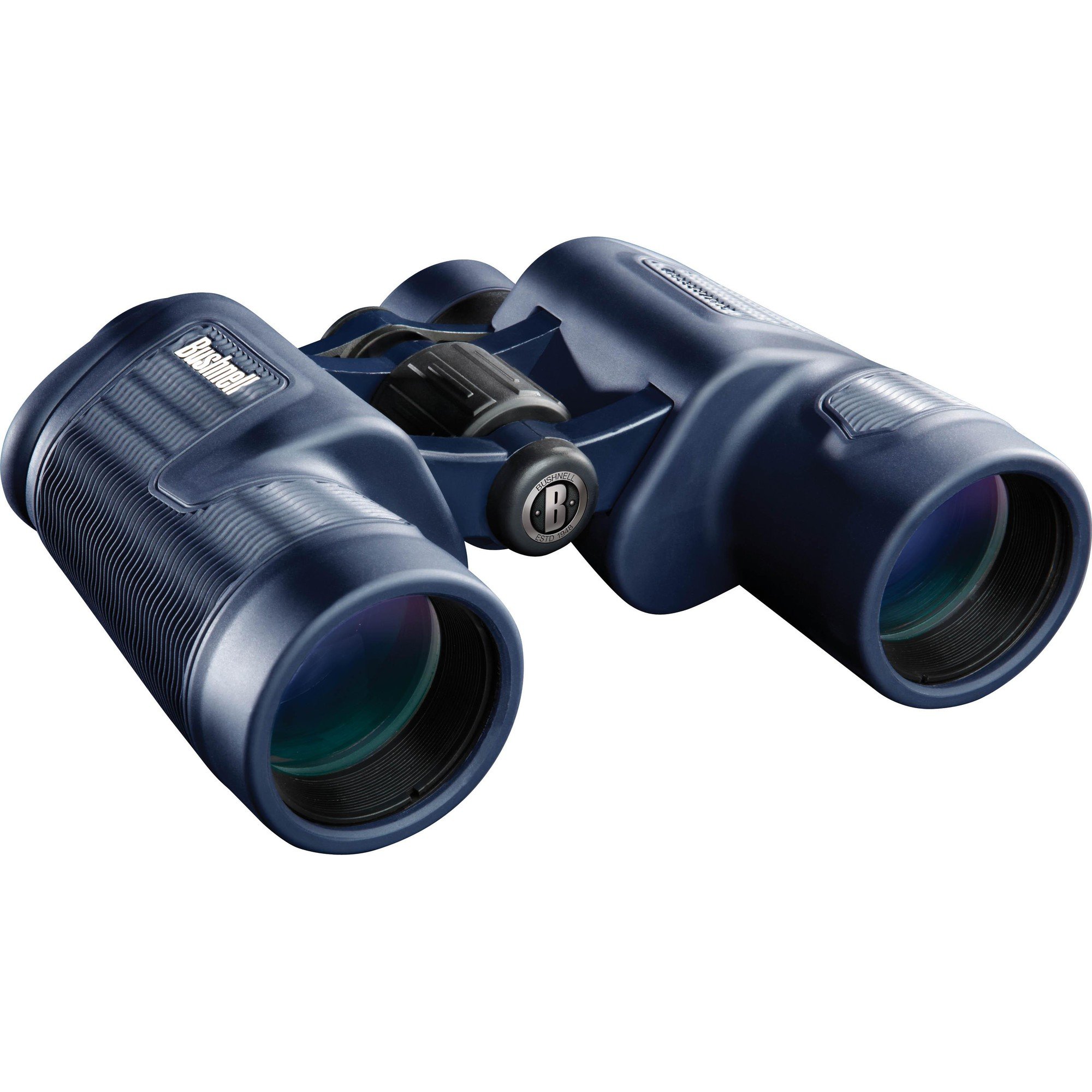
The tough porro prism classic for overlooks, stadiums, and rain-soaked days
The Bushnell H2O takes a different optical route with porro prisms instead of the roof-prism design most of this list uses. Porro prisms are bulkier but often deliver a more “3D” image and better light transmission for the money. The BaK-4 prisms and multi-coated optics keep images crisp, and the non-slip rubber armor with a textured grip absorbs shock if you drop it on a rocky overlook.
The 17mm eye relief fits glasses wearers, and the 18-foot close focus lets you examine a feeder up close. The 5.25mm exit pupil is solid for low light, and pairs like this one have been used to spot Jupiter and its moons — though not with telescope-level detail. The 7.8-degree apparent angle of view gives a comfortable, moderate sweep.
The recurring trade-off is weight and bulk — it’s noticeably heavier and larger than the Nikon PROSTAFF P3, which makes it cumbersome for small-framed users or long days on the trail. The focus mechanism also gets mixed feedback: some love the big center knob, others find it stiff. But for roof inspection, football games, and looking across a lake, buyers consistently call it great value.
Its strengths
- Rugged porro prism build with shock-absorbing armor
- Clear views for stadiums, hunting, and water views
- 100% waterproof with O-ring seals and nitrogen purging
Its limits
- Heavier and bulkier than roof-prism rivals
- Focus feel varies from stiff to smooth
Reach for it if: you want a tough, trustworthy pair for general outdoor use and don’t mind extra heft on the strap.
Not ideal for: small-framed users or anyone packing light on long hikes.
6. Celestron Nature DX ED 8×42

ED glass that renders true-to-life color the moment you raise it to your eyes
The Celestron Nature DX ED is built around a simple promise: Extra-Low Dispersion (ED) objective lenses that virtually eliminate color fringing, the purple-green edge artifact common in cheaper glass. With fully multi-coated optics and phase-coated BaK-4 prisms with dielectric coatings, the view is bright and edge-to-edge sharp, which is why optical quality is the most-praised aspect across its reviews.
The 17.8mm eye relief is comfortable with glasses, and the 5.25mm exit pupil holds up well in dusk light. It’s a favorite for backyard birding — owners grab it daily for watching feeders — and it’s forgiving enough to have won over an older user with macular degeneration who needed an easily adjustable, bright pair. The nitrogen-purged, rubber-armored polycarbonate build shrugs off rain and snow.
The catch is ergonomics: some owners find the grip less natural than rival models and the focus wheel harder to turn smoothly. It’s also a touch heavier than expected for its size. But the ED glass performance at this level is why it’s a trusted name in birding circles.
The headline: true-to-life color from ED glass that owners say outperforms binoculars costing far more.
Pick this for: backyard birding and everyday exploration where accurate color and brightness matter most.
Steer clear if: you need a perfectly balanced, quick-focusing grip for fast-moving targets.
7. Nikon PROSTAFF P7 8×42

The flagship PROSTAFF that adds a locking diopter and oil-repellent lenses
The Nikon PROSTAFF P7 builds on everything the P3 does well and adds two meaningful upgrades: a locking diopter ring that keeps your focus settings secure, and oil- and water-repellent lens coatings that make cleaning a quick wipe instead of a chore. It shares the same wide 377-foot field of view and generous 20.2mm eye relief as the P3, so glasses wearers get the same unobstructed view — with no black circle compared to the Celestron Nature DX.
The optics step up with Nikon’s dielectric high-reflective multilayer prism coating on phase-correction coated roof prisms, which boost light transmission for vivid, lifelike color. Buyers have used these on an Alaska cruise to spot distant marine mammals and bald eagles clearly, and they’re a frequent glasses-wearer favorite at this level. The fiberglass-reinforced polycarbonate body with rubber armor stays light and weatherproof through rain and snow.
The honest question is value: some owners who also own the P3 wonder if the P7 is worth the price jump for the extra coatings and locking diopter. If you rarely change your setting, the P3 delivers nearly the same view for less. But if you want the flagship build and the convenience of a locking ring, the P7 is the more refined instrument.
What you gain
- Locking diopter preserves your eye setting
- Oil- and water-repellent coatings speed up cleaning
- Dielectric prism coating for maximum brightness
What to weigh
- Sits only modestly above the P3 for the price
- Fast, not instant, delivery service noted
Worth it for: glasses wearers and anyone who wants the top of the PROSTAFF line with a locking focus you can set and forget.
Question it if: you’re content with the P3’s optics and want to save the difference.
8. Vortex Viper HD 8×42

For the hunt: a razor-sharp 409-foot view with all-day carry included
The Vortex Viper HD is where this list starts to feel serious. The high-density optical system with XR anti-reflective coatings delivers exceptional resolution and edge-to-edge clarity, and the 409-foot field of view at 1,000 yards is wider than both Nikons — a real advantage when you’re glassing a ridgeline or tracking a buck. The 7.8-degree apparent angle keeps the sweep rich.
Argon purging and O-ring seals promise a lifetime of waterproof and fog-proof performance, and the 18mm eye relief is glasses-friendly without sacrificing brightness. The 5.25mm exit pupil keeps the view alive in the low light of dawn and dusk when hunting matters most. The included GlassPak Chest Harness is a standout — it spreads the weight across your chest for strain-free, all-day carry instead of dangling from your neck.
The locking right-eye diopter tailors each barrel to your eyes, and the ultra-hard Armortek coating protects the exterior lenses from scratches and dirt. Buyers consistently note it approaches the performance of much pricier glass while staying at a mid-range price, and the unconditional warranty is a genuine safety net. The main recurring gripe is eyecup longevity — some customers note them failing after about a year of heavy use, though the warranty covers it. It’s also slightly heavier than the Nikon rivals.
Why hunters choose it
- 409-foot field beats the Nikon rivals for scanning
- Included GlassPak harness for all-day comfort
- Argon purged and O-ring sealed for lifetime waterproofing
Before you commit
- Eyecups have shown wear after heavy, prolonged use
- Slightly heavier than the Nikon PROSTAFF pair
Reach for these if: you’re a serious hunter or birder who wants wide, sharp glass and a harness for long days out.
Think twice if: your budget stretches here but you mostly watch a backyard feeder — lighter, cheaper pairs do that fine.
9. ZEISS Terra ED 8×42
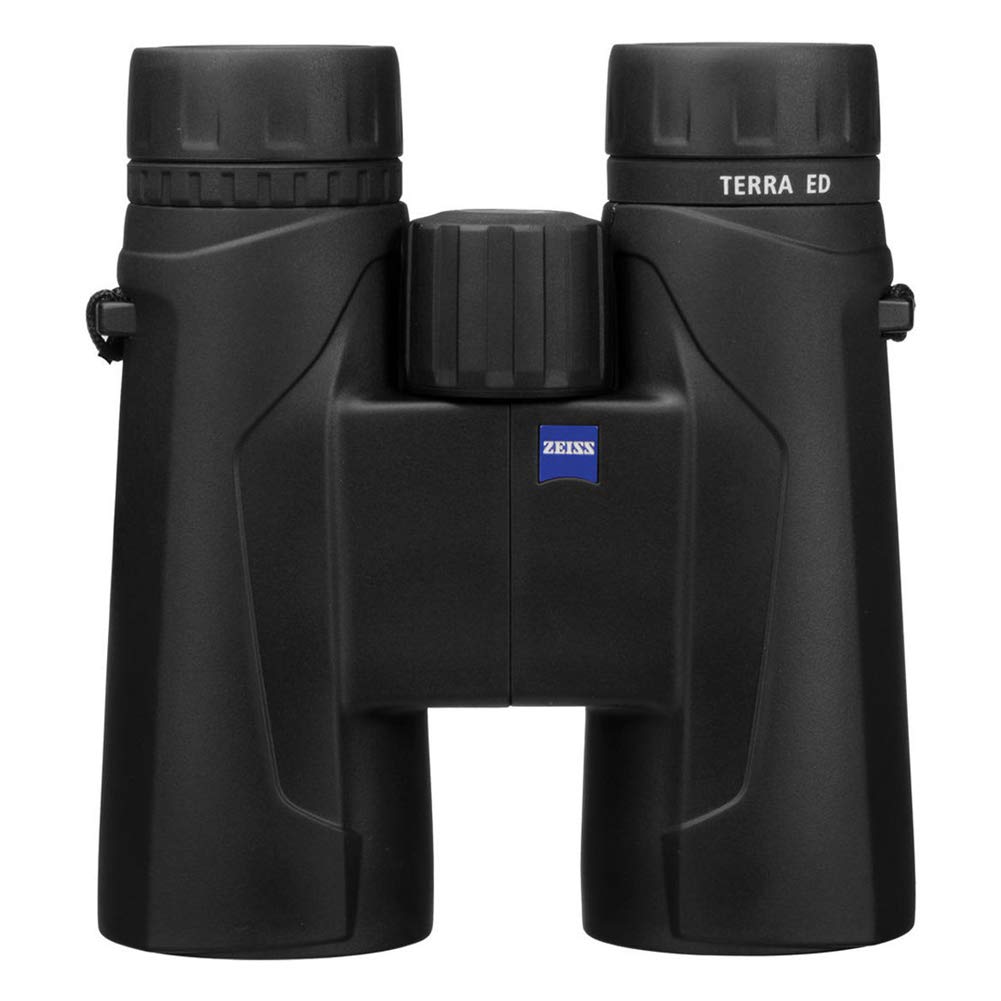
A Zeiss badge on a Schmidt-Pechan ED design that sees sharp in low light
The ZEISS Terra ED is the name-brand statement here, pairing Schmidt-Pechan ED glass with a hydrophobic multi-coating that claims 88% light transmission — a number that shows up in real viewing as surprising brightness and sharpness, especially in twilight. The 62-degree apparent angle of view is the widest on this entire list, giving you an exceptionally rich panorama even though the 315-foot field at 1,000 yards is the narrowest.
The large, easy-to-grip focus wheel is designed so your index finger lands on it naturally, ready for sudden movement in front of you. Owners describe it as “crisp and super sharp,” and it’s a favorite for birding just outside the window thanks to its ability to focus on close subjects. The fiberglass-reinforced casing is waterproof and built to be nearly indestructible, and the 18mm eye relief fits glasses comfortably.
The trade-offs are real: the 315-foot field is noticeably tighter than the Timorn’s 430 feet, so tracking fast-flying birds across open fields is harder. Some owners also find it heavier than expected for a “compact” design. The included case is minimal with no padding or lanyard, and it won’t zip with the strap attached — you’ll likely replace it. None of that touches the glass quality, which is the reason people pay for the name.
What you’re paying for
- Exceptional 88% light transmission for low-light viewing
- Widest 62-degree apparent angle for an rich view
- Naturally placed focus wheel for fast reactions
What to accept
- Narrowest 315-foot field makes tracking harder
- Minimal case and heavier-than-expected heft
Choose this for: the buyer who values proven ZEISS optics and 88% light transmission for those last minutes of usable daylight.
Accept that: the tight field of view and basic accessories are where this premium pair cuts corners.
Understanding the Specs
Field of View
Measured in feet at 1,000 yards, this is how wide a scene you see at a glance. A wider field like the Timorn’s 430 feet makes it far easier to find and follow a moving bird or animal. A narrower field like the ZEISS’s 315 feet gives you more detail on a single distant object but requires more scanning to locate targets. If you track moving wildlife, prioritize a wider field.
Eye Relief
This is the space between your eye and the eyepiece where the full image stays visible. For glasses wearers, longer eye relief means you don’t have to jam your glasses against the lens or remove them to get the full picture. The 20.2mm on the Nikon pair is exceptional, while the 15mm on the Timorn is workable but noticeable if you wear glasses daily.
FAQ
What does 8×42 actually mean?
Is 8×42 or 10×42 better for bird watching?
Will these binoculars work if I wear glasses?
What is ED glass and is it worth paying extra for?
What is the difference between roof prism and porro prism binoculars?
How waterproof do my binoculars need to be?
What is eye relief and why does the “black circle” happen?
Do I need a tripod adapter for my binoculars?
Final Thoughts: The Verdict
The overall winner for most buyers is the Nikon PROSTAFF P3 because it pairs the longest 20.2mm eye relief with a wide 377-foot field and a lightweight build at a mid-range price. If you want the widest view and the included phone adapter for sharing what you see, grab the Timorn. And for the hunter or serious birder who spends all day in the field, the Vortex Viper HD with its 409-foot field and GlassPak harness is the one to reach for. Before you buy, ask yourself one question: do I track moving targets or study stationary details — that single answer points you to the right pair on this list.
How We Picked
We do not accept paid placement. Every pick is matched to a real buyer and a real use-case; we do not hands-on test units.
Sources & Methodology
Specifications: manufacturer listings and product documentation. Review insights: verified customer reviews, as of August 2026. Pricing: not shown on this page (it changes often); check the current price via the retailer link.
As an Amazon Associate, Gadgets Feed earns from qualifying purchases. This does not affect which products we feature.