
Our readers keep the lights on and my morning glass full of iced black tea. As an Amazon Associate, I earn from qualifying purchases.
Specs are compiled from manufacturer listings and verified buyer reviews and can change over time — please confirm the key details on the product page before buying.
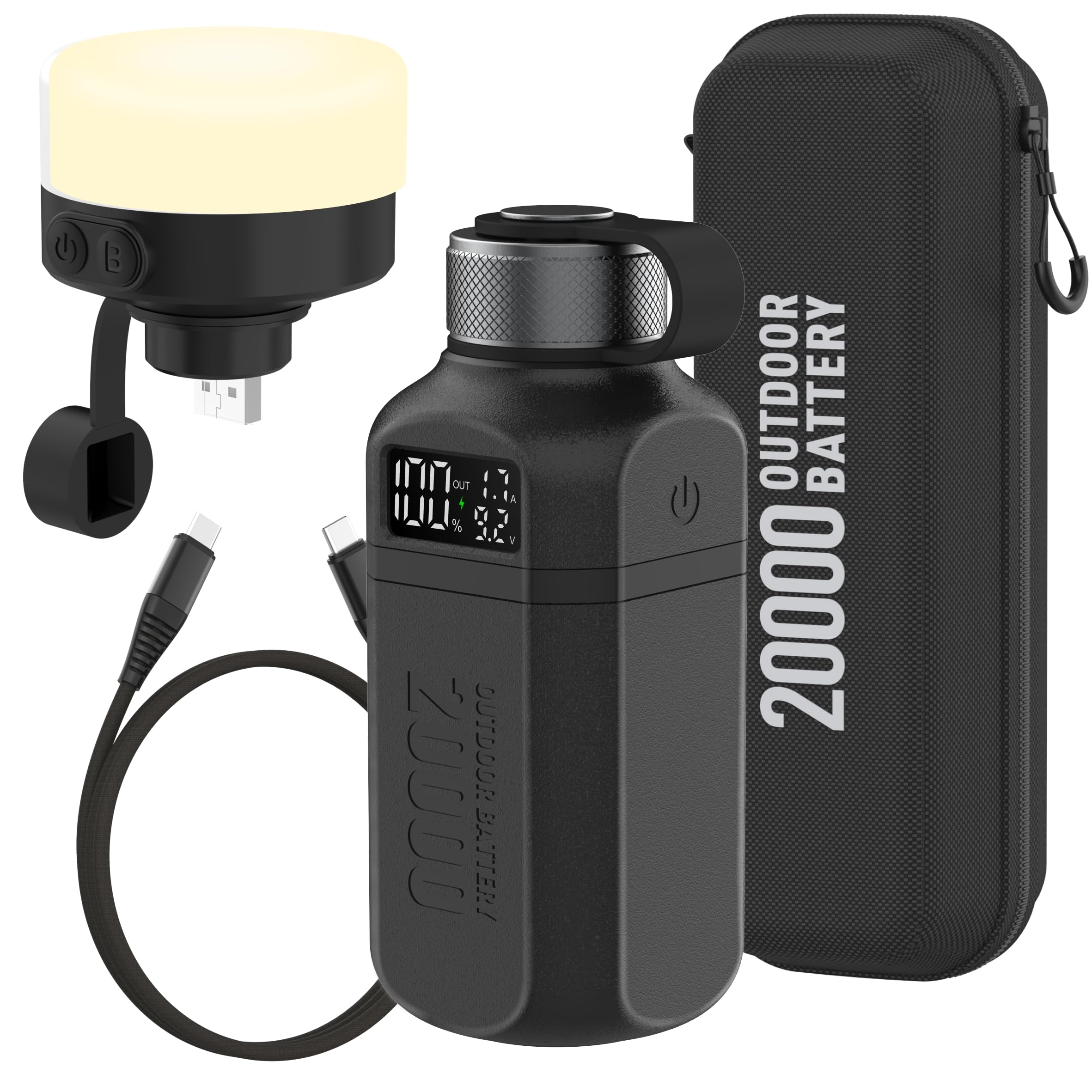
An adventure power bank is the difference between capturing the summit and watching your phone die halfway up. A rugged, high-capacity model survives rain, dust, and drops while keeping your camera, phone, and earbuds charged for days. We’ve ranked the best rugged, high-capacity options to match your specific travel style.
I’m Min — the founder and writer behind Gadgets Feed. This guide is built by comparing the manufacturers’ published specifications and the patterns across verified customer reviews, so you get each pick’s real strengths and trade-offs instead of marketing spin.
Here is the honest breakdown of the best adventure power bank choices, ranked by real-world durability, capacity, and charging speed for your next trip.
Our Picks at a Glance

How To Choose The Best Adventure Power Bank
A reliable outdoor power bank balances capacity, durability, and port selection. A weak link in any of these areas can ruin your off-grid experience. First, estimate your off-grid days, then choose capacity accordingly.
Capacity and Why It Matters on the Trail
Capacity is measured in milliamp-hours (mAh) — the higher the number, the more energy stored. A 10,000mAh bank roughly doubles a phone’s battery, while a 20,000mAh unit covers a multi-day weekend. Be wary of extreme claims: an honest 49,800mAh battery weighs over a pound, so if a small, light bank promises a massive number, it is likely overstated. Match capacity to your trip length, not the highest mAh on the label.
Waterproof Ratings Explained Simply
IP ratings tell you how well the case keeps out water and dust. IP65 handles rain and splashes, IP67 survives submersion in a meter of water for 30 minutes, and IP68 goes deeper — 1.5 meters for 30 minutes. For river crossings, kayaking, or monsoon season, you want IP67 or IP68 from a trusted brand. For light drizzle, IP65 is plenty.
Charging Speed: Watts Matter More Than Ports
Charging speed is measured in watts (W). The higher the wattage, the faster your phone refills. For modern phones, 15W to 20W is genuinely fast; for a laptop, you’ll need 45W to 65W. A power bank with many ports but low watts per port will feel slow when you actually plug in. Ensure the wattage supports your largest device, like a laptop, not just your phone.
Quick Comparison
| Model | Best For | Capacity | Max Charging Speed | Waterproof Rating | Amazon |
|---|---|---|---|---|---|
| ELECOM NESTOUT 10000mAh★ Best Overall | Award-winning rugged EDC | 10000mAh | 20W USB-C PD | IP67 | Amazon |
| ASWAYKE 20,000mAhBest with Lantern | Lantern + power combo | 20000mAh | Fast USB-C PD | IP68 | Amazon |
| DJKK 66800mAh Hand CrankBest for Emergencies | Off-grid emergencies | 66800mAh | 22.5W | IP67 | Amazon |
| HOWEASY 135W Station | AC outlets for small gear | 98Wh | 65W PD | Rugged design | Amazon |
| EnginStar 150W AC | Laptop and AC powered gear | 42000mAh | 150W AC | Not specified | Amazon |
| XACZKOM 49800mAh Solar | All-in-one cable set | 49800mAh | 15W Type-C | IP65 | Amazon |
| Dexnor 27,000mAh | Magnetic wireless charging | 27000mAh | 65W PD | IP54 | Amazon |
| ToughTested 24000mAh | Rugged solar with USB-C PD | 24000mAh | 18W USB-C PD | IP66 | Amazon |
In‑Depth Reviews
1. ELECOM NESTOUT 10000mAh Rugged Power Bank
Our pick — 4.5★ from 200+ verified ratings; the strongest balance of quality and price.
This award-winning rugged bank charges your phone and watch from dead to full.
This is the power bank that looks like a vintage fuel bottle but runs on clean energy — and it earned an IF Design Gold Award for that look. You get 10000mAh of capacity, which topped up an iPhone and a watch from dead to full in just a few hours, per buyers. The 20W USB-C Power Delivery port is genuinely fast — at 20W versus the 15W on the big solar unit below.
The shell is the real story here. It carries an IP67 rating, so it survives submersion in a meter of water for up to 30 minutes, and it passed the US Military Standard MIL-STD 810G 516.7 drop test. A silicone cushion around the batteries absorbs vibration and shock, which is why mountain-bike GPS users trust it for two full 90-minute rides per charge. At 241 g it is featherlight, while the 49800mAh solar bank weighs 550 g.
What wins people over is portability — owners consistently praise how easy it is to pack, and the water resistance gets its own share of shout-outs. A bottom ¼-20″ tripod mount lets you attach NESTOUT’s lantern or LED panel, turning it into a camp light. The honest trade-off is reliability over time: a chunk of buyers report it works well for about six months, and a few mention cords failing after 2-3 months of jarring rides. The crowd favorite sits at 4.5 stars across 211 ratings.
What Makes It a Winner
- IP67 waterproof and dustproof — survives a 1-meter dunk for 30 minutes
- Passes a US Military Standard drop test for real trail falls
- 20W USB-C PD means fast refills for phones and tablets
- Only 241 g, so it disappears into a pack pocket
The Honest Trade-offs
- Reliability is mixed over the long haul — some units falter around six months
- Capacity is modest next to 20,000mAh+ options
- Charging the bank itself can be slow without an 18W+ adapter
Reach for this if: you want a compact, genuinely waterproof, award-worthy companion for day hikes and EDC.
Look elsewhere if: you need multi-day, high-capacity power for a whole campsite.
2. ASWAYKE 20,000mAh Rugged Power Bank
The tank-like pick that pairs a 20,000mAh charge with a seriously bright camp lantern.
This one marries power and light in a single rugged package. The 20000mAh capacity delivers 5 full charges for an iPhone, and it tops up your phone and a tablet at the same time through its dual Type-C/Type-A ports. It carries the highest waterproof rating on this list — IP68 — meaning it survives a 1.5-meter submersion for 30 minutes, plus dust, sand, and mud. The 3.2mm ABS+PC shell is built to shrug off a 3-meter drop.
What buyers rave about is the included 420-lumen camping lantern with multiple modes — it is genuinely useful, not a gimmick, and it turns the bank into a campsite centerpiece. A smart digital display shows the exact battery percentage and the current flowing in and out, so there’s no guessing how much charge you have left. The Type-C port charges both ways, letting you refill the bank itself through the same fast port.
The thing everyone raves about is reliability — a huge share of owners call it sturdy, well-built, and solid, with battery life that holds its charge when idle. The recurring note is weight: at about 1 pound it is heavier than the ELECOM, but most owners judge that a fair price for the durability and the lantern. It sits at 4.4 stars with strong praise for practical emergency and camping use.
Rugged and ready: IP68 water protection beats the ELECOM’s IP67 rating, and the built-in lantern gives you two tools for the weight of one.
The catch is size: at roughly a pound, it is a heavier carry than smaller banks — fine for car camping and base camps, less ideal for ultralight hiking.
3. DJKK 66800mAh Hand Crank Solar Power Bank
The survivalist’s pick with a hand crank, solar panel, compass, and a lamp that runs 100+ hours.
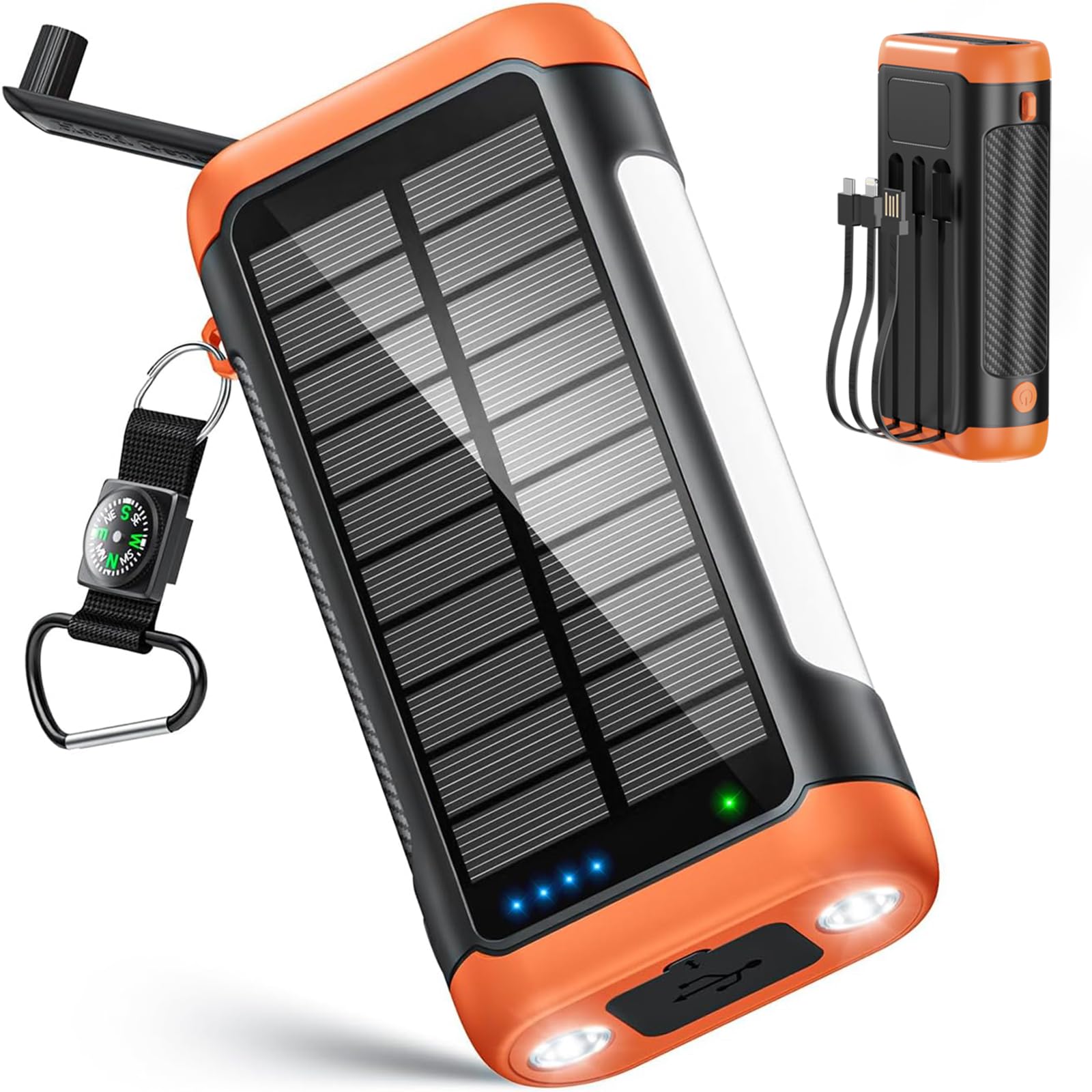
When the grid is gone, this is the bank you want in your bug-out bag. It packs a massive 66800mAh of lithium-polymer capacity, and one owner reported it powered devices for 5 straight days. Beyond the sheer size, it combines three recharging methods — solar, a hand-crank generator, and a wall cord — so you always have a way to top it up. A built-in compass carabiner and a desk lamp with over 100 hours of illumination round out the emergency kit.
Charging flexibility is the headline. It charges up to 5 devices at once through 4 ports plus 2 built-in cables, and the USB-A2 port hits 22.5W max. The USB-C output supports 5V/3A, 9V/2A, and 12V/1.5A for high-speed refills, and the built-in Type-C cable is compatible with Apple 15/16 series at up to 20W. The body is IP67 waterproof, dropproof, and dustproof, built from professional ABS that resists chemicals and heat.
What owners praise most is functionality — a huge share call it reliable and long-lasting, holding its charge for long stretches, which is exactly what you need in a glove box or go-bag. The honest caveat is that the hand crank and solar are slow, backup sources, not fast rechargers; owners note solar is “rather slow” and the unit feels heavy at 480 g. It holds 4.4 stars across 226 ratings, with enthusiastic notes about the multiple recharging methods.
Built for the worst day: the hand crank alone justifies it for serious preppers; the lamp and compass are genuine bonuses.
The weight is the bill: 480 g and a 6.9-inch frame make it a gear-drawer resident more than a trail-runner’s friend.
4. HOWEASY Portable Power Station
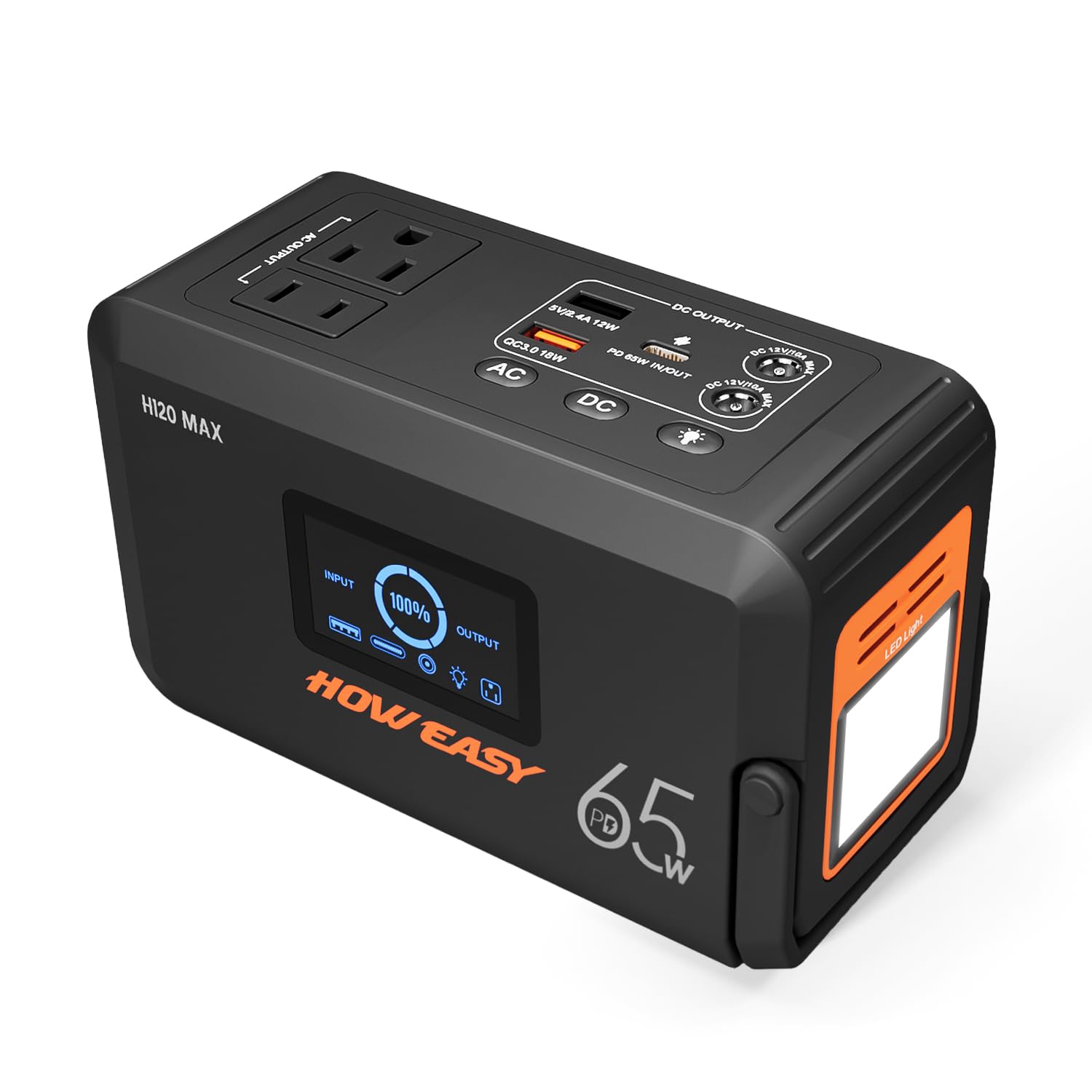
The weekend-camping pick that adds real AC outlets so you can run small appliances off-grid.
This is the bridge between a power bank and a power station. Its 135W (270W peak) inverter feeds 2 AC outlets at 110V, so you can plug in a small radio, a fan, or a phone charger just like at home. It holds 98Wh of energy — enough that one owner ran a 250-watt amp for at least 5 hours, and others note it charges phones twice from a full charge. A 65W PD port refills a laptop to 80% in about an hour.
Recharging is versatile: use the 65W PD wall adapter, a 12V car charger, or solar panels (15V-24V). A 4-mode LED light handles low, medium, high, and SOS signaling for campsite or emergency use. A six-layer BMS system actively guards against overvoltage, overload, overcurrent, overheating, short circuits, and overcharging. At just 2.3 pounds, it packs down far smaller than a traditional generator.
What owners rave about is power output — the ability to drive real AC gear from something that fits in a backpack. Portability and battery life get consistent praise, with owners calling it perfect for weekend camping and emergency kits. The honest trade-offs: the cooling fan can be loud, there is no true on/off switch (only a DC button), and capacity is modest for heavy users. It sits at 4.2 stars across 240 ratings.
The Big Wins
- Two 110V AC outlets let you run small appliances off-grid
- 65W PD charges a laptop to 80% in one hour
- Only 2.3 pounds with a compact, packable frame
- Solar, car, and wall recharging options
Know Before You Go
- 98Wh capacity means limited phone charges (about two)
- The cooling fan is audible during operation
- No dedicated 12V jack for devices like a CPAP
Best for: weekend campers who want a few AC outlets without hauling a generator.
Not for: multi-day expeditions needing high wattage for large appliances.
5. EnginStar 150W AC Outlet Power Bank
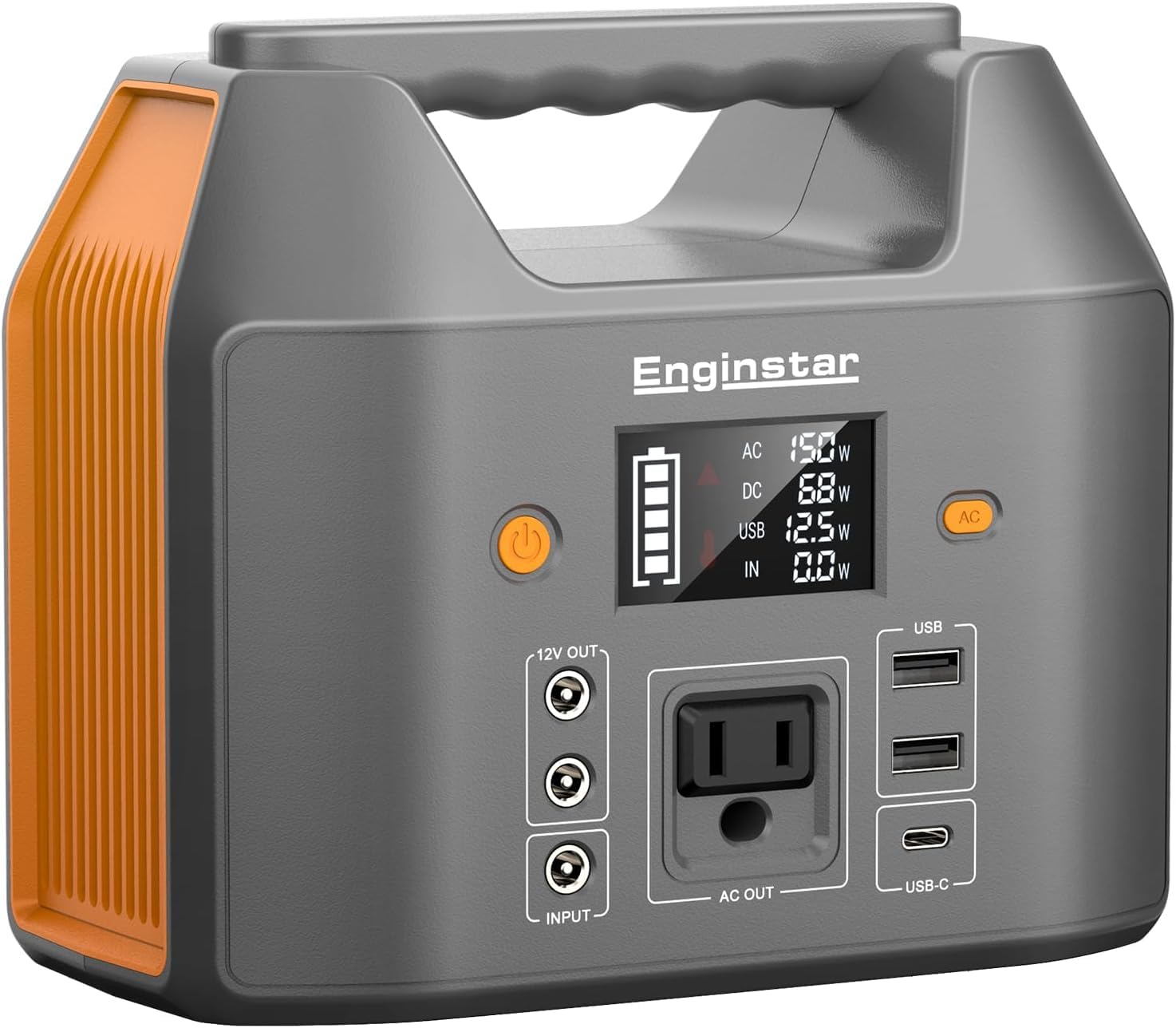
The desk-in-the-woods pick that charges a laptop up to 2.5 times from one 42000mAh cell.
This one is built for people who need to keep working while the world goes dark. Its 150W AC outlet at 110V powers a laptop up to 2.5 times, a smartphone over 10 times, or a 5W LED lamp for 25+ hours. That is a serious jump in capacity from the HOWEASY above — 42000mAh versus 98Wh — and one owner powered a 24-inch gamer monitor off it. You can run up to 6 devices at once across the AC, two DC, two USB, and one USB-C port.
Rated for 1000 charge/discharge cycles with a smart battery management system, it protects against overloading, overcharging, overheating, and short circuits. Recharge three ways: a 12-25V solar panel, a wall outlet, or a car’s 12V socket. Owners note it arrived about 75% charged and handled phones, a mattress inflator, and recharging in a storage locker without complaint. At 4 pounds, it is heavier than the HOWEASY, but the extra capacity and AC power justify the weight for many.
The headline praise is performance — owners call it “small but mighty” and love that it holds a charge for three days. Portability and value get solid marks despite the 4-pound frame. The honest mixed note is reliability: a meaningful number of owners mention inconsistent behavior, and while most are thrilled, the outlier complaints keep this from being a slam dunk. It holds 4.3 stars across 268 ratings.
Powerhouse for electronics: the 150W AC outlet and 42000mAh capacity beat the HOWEASY for laptop and monitor use.
The trade-off is bulk: 4 pounds and a 7.5-inch body make it a base-camp tool, not a trail companion.
6. XACZKOM Solar Power Bank 49800mAh
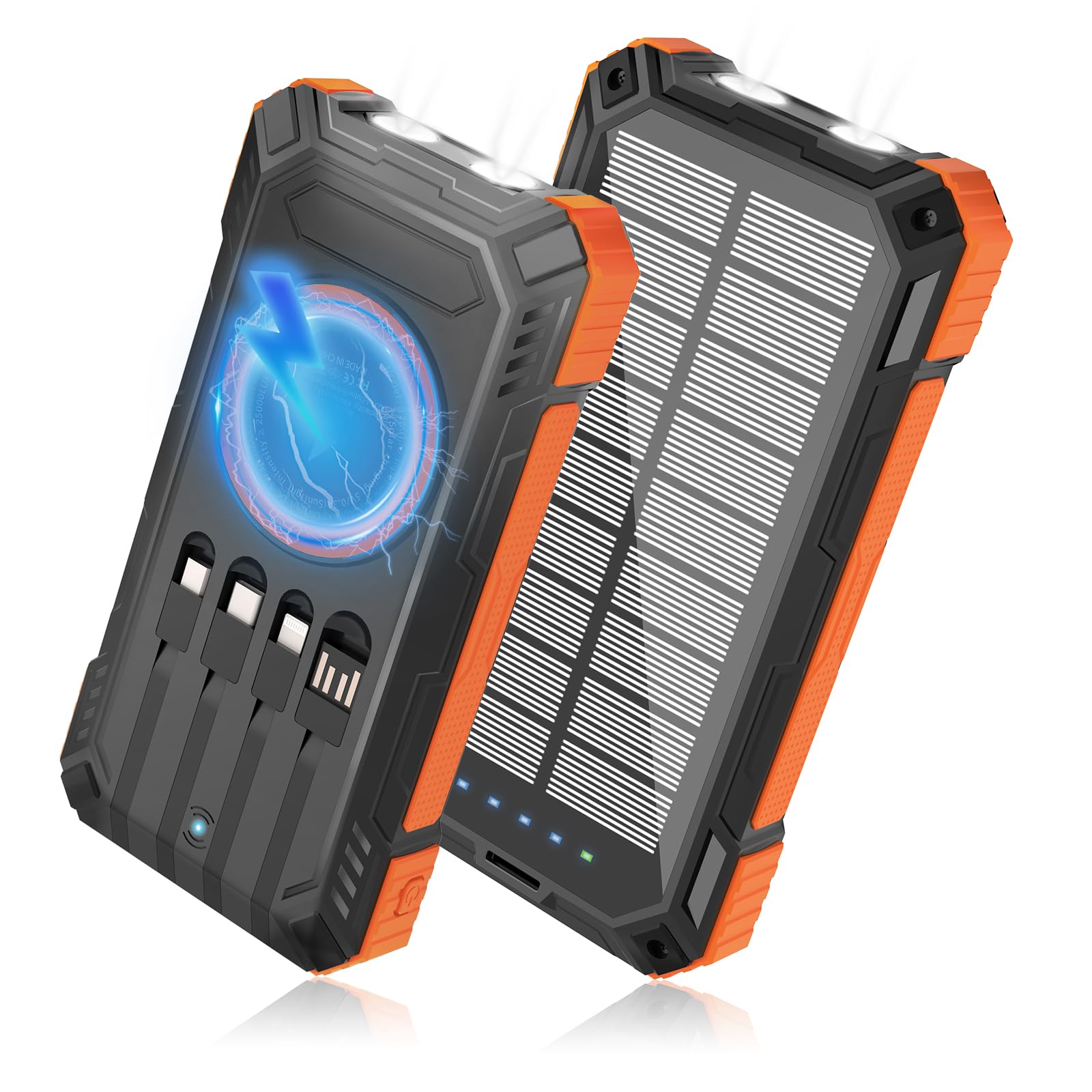
The no-cable-hunt pick with 4 built-in cords, wireless charging, and a 3-mode flashlight.
If you hate digging tangled cables out of your bag, this bank is a revelation. It packs 4 built-in cables right into the body — USB-A input, Type-C, Micro-USB, and Apple — plus 2 USB ports and wireless charging, so you can power up to 6 devices at once with zero extra cords. The 49800mAh capacity claims 8 full charges for an iPhone 16 and 5 for a Samsung Galaxy. Its 15W Type-C fast charging takes a phone from 0% to 50% in about 30 minutes.
For outdoor use, the bank is IP65 waterproof, heat-resistant, shockproof, and dustproof, wrapped in a non-slip fine-grained grip. A built-in LED flashlight offers 3 modes — steady, SOS, and strobe — for power outages and campsite emergencies. It even comes with a carabiner for clipping onto your pack. At 550 g it is heavy, but that is the price of 49800mAh of storage.
What owners appreciate most is the cable selection — having every kind of plug on hand, plus solar and wall recharging, makes it a genuinely versatile travel companion. The honest reality is mixed performance: customers note the charging is “inconsistent” and “stops after minutes” in some cases, and the solar panel has lifted on units for a couple of owners. It carries 4.0 stars across 98 ratings, with the biggest complaint cluster being overall quality.
Convenience king: the 4-in-1 cable design and wireless pad mean you never carry a cord again.
The durability gamble: quality is this bank’s most-discussed weak spot — a minority experienced failures, so buy with a return plan.
7. Dexnor 27,000mAh Solar Power Bank
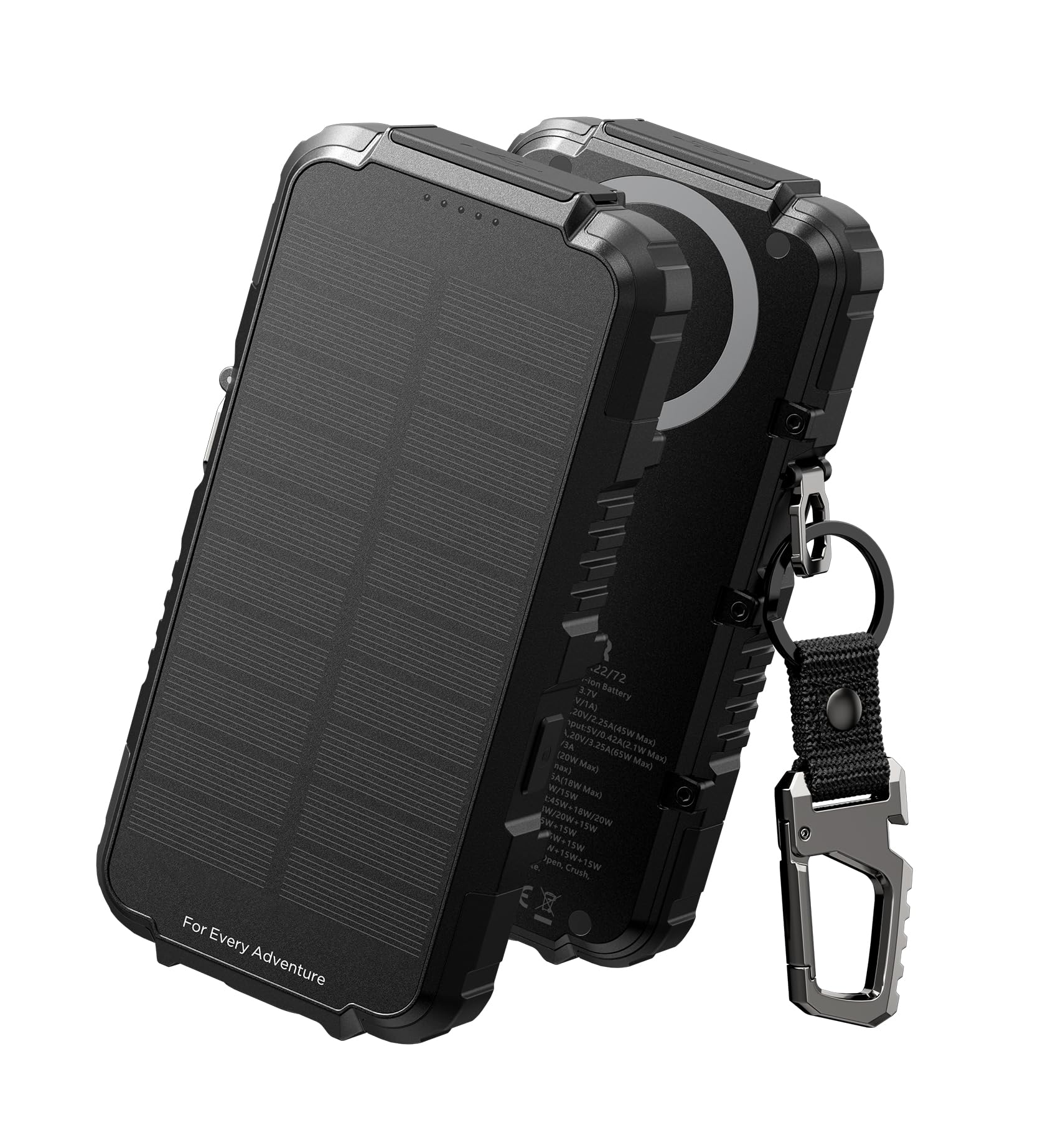
The speed-focused pick that fires 65W to a phone, tablet, or laptop from a magnetic-ready shell.
If fast refills are your priority, this bank delivers. Its 65W PD3.0 Type-C1 port charges an iPhone 16 to 50% in just 30 minutes, and it handles laptops too — a rarity in solar-style banks. The 27000mAh cell provides up to 4.5 full charges for an iPhone 16/17 and 4 for a Samsung Galaxy S25/S26 Ultra. Three fast ports plus a 15W magnetic wireless pad (7.5W for iPhones) let four devices charge simultaneously.
It is built for the trail: an IP54 water-resistant shell shrugs off splashes and light rain, and the shock-resistant construction handles backpack jostling. A rugged stainless steel carabiner clips it to your pack for hands-free carrying. Recharge the bank itself in 3 hours via USB-C (45W adapter required but not included), or use the built-in solar panel for emergency backup — though plan on roughly 50 hours of direct sunlight for a full charge.
What impresses owners is the wall-outlet-like charging speed — it feels almost as fast as plugging into your home. Portability and a fun unboxing get positive notes, and build quality feels durable. The honest gripe is reliability: reviewers point out the magnetic wireless charging “doesn’t seem to work” in several cases, and solar output is essentially a slow emergency trickle in real-world sun. It holds a mixed 3.8 stars across 156 ratings, so buy it for the 65W wired speed, not the wireless pad.
Speed demon: 65W PD wired charging is genuinely fast for phones and laptops.
The asterisk: the magnetic wireless pad is unreliable for several owners, and solar is a 50-hour slog — treat it as a bonus, not a feature.
8. ToughTested 24000mAh Solar Power Bank
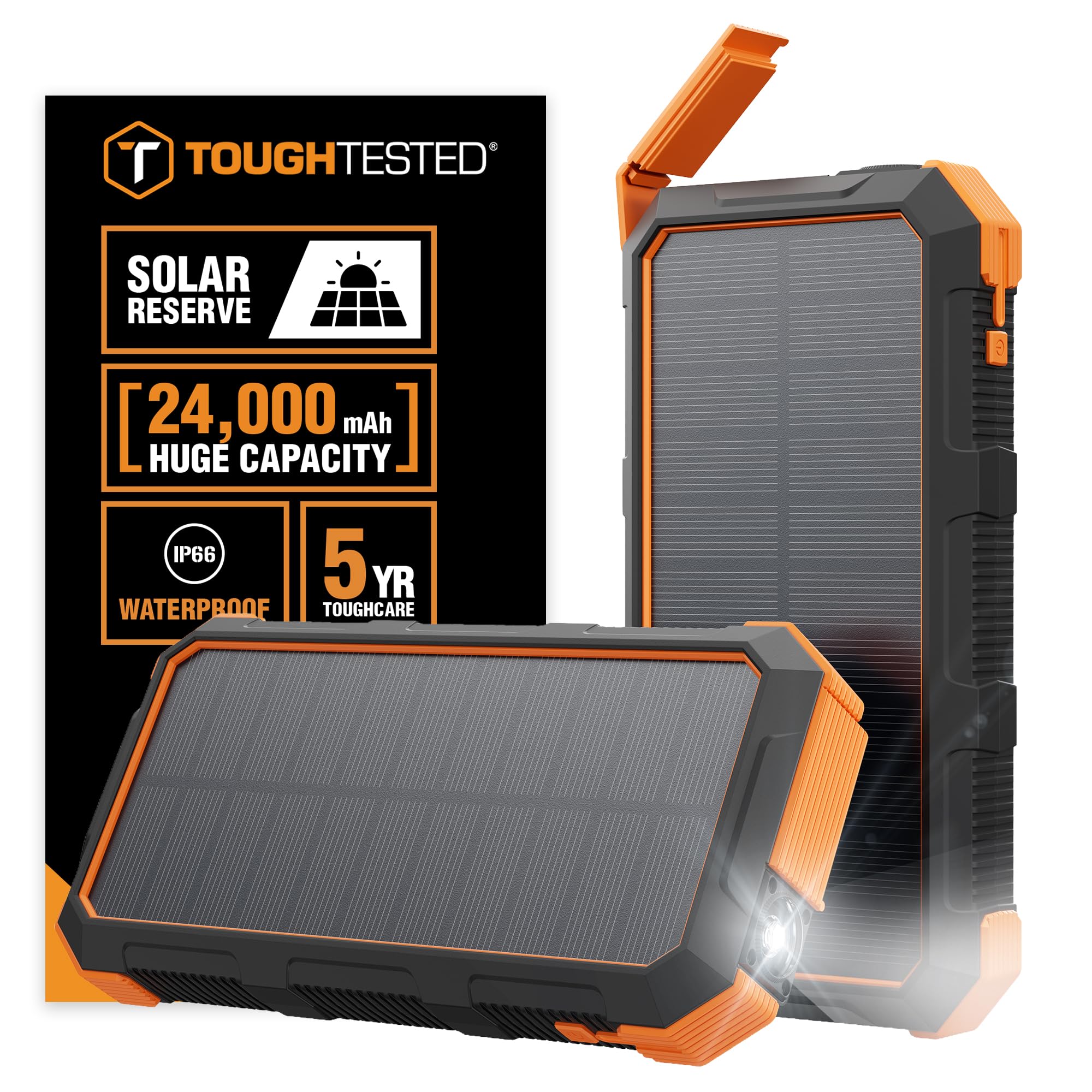
The build-like-a-tank pick with enough juice for 8-10 phone charges and a rugged solar top.
This is a serious workhorse for long trips. The 24000mAh capacity charges a smartphone 8-10 times — enough for a multi-day backpacking trek or remote work. A high-efficiency solar panel tops it up when outlets are gone, and the 18W USB-C Power Delivery port is tune for modern gear like MacBooks and tablets. It is IP66 rated, meaning it resists powerful water jets, dust, and heavy rain.
Owners consistently call it rugged and note it “recharges my iPhone 16 about 4 times” and “held the charge for days.” A built-in flashlight is handy for campsite and emergency use. The solar trickle is slow — one owner noted a “very, very long recharge time” — but for a rafting trip with no internet, it is enough to keep a phone topped off for photos.
The consistent praise is functionality and build quality — owners trust it in tough conditions and appreciate the solar backup. The honest trade-offs: charging speed is mixed across the board, with some finding it quick and others slow, and durability has its doubters over the long term. It sits at 4.1 stars across 238 ratings, with value getting a slightly negative lean from a minority who expected more for the cost.
The Strengths
- 24,000mAh delivers 8-10 smartphone charges
- IP66 resists heavy rain, dust, and water jets
- Solar panel adds off-grid top-ups
- Built-in flashlight for campsite duty
The Caveats
- Charging speed is mixed — some owners find it slow
- Solar recharging takes a very long time
- At 16 ounces it is a large, heavy carry
Choose it for: rugged reliability on long trips where you need 8-10 phone charges and weatherproof build.
Think twice if: you prioritize fast refills or a lightweight pocketable design.
Understanding the Specs
Capacity in mAh
Milliamp-hours (mAh) measures how much energy the bank stores. A rough rule: divide the mAh by your phone’s battery size to estimate charges. A 10,000mAh bank roughly doubles most phones, while 20,000mAh covers a long weekend. Be skeptical of huge numbers in small packages — a genuine 49,800mAh battery weighs over a pound, so a featherweight with a giant spec is likely overstated.
IP Waterproof Ratings
The IP code has two digits: the first (6 or 7) is dust protection, the second is water. IP65 handles light rain and splashes. IP67 survives a 1-meter submersion for 30 minutes — enough for a drop in a river. IP68 goes to 1.5 meters for 30 minutes. Match the rating to your activity: kayakers and monsoon hikers want IP67 or IP68; casual campers can live with IP65.
FAQ
How many times will a 20000mAh adventure power bank charge my phone?
Is solar charging on a power bank actually useful?
What does the IP rating on an adventure power bank mean in real life?
Can I take an adventure power bank on an airplane?
How long does a rugged power bank hold its charge when not in use?
What is the difference between USB-A and USB-C on a power bank?
How fast can a 15W power bank charge my phone compared to a 65W one?
Can a power bank charge my laptop on a camping trip?
Final Thoughts: The Verdict
For the majority of shoppers, the adventure power bank winner is the ELECOM NESTOUT because it pairs genuine IP67 waterproofing and a military-grade drop rating with a compact 241 g frame that disappears into a pack. If you want a lantern and power in one, grab the ASWAYKE. And for real AC outlets to run small appliances, the HOWEASY is the one to reach for — the crowd favorite at 4.4 stars across 185 ratings makes the ASWAYKE the safest bet for most campers.
How We Picked
We do not accept paid placement. Every pick is matched to a real buyer and a real use-case; we do not hands-on test units.
Sources & Methodology
Specifications: manufacturer listings and product documentation. Review insights: verified customer reviews, as of August 2026. Pricing: not shown on this page (it changes often); check the current price via the retailer link.
As an Amazon Associate, Gadgets Feed earns from qualifying purchases. This does not affect which products we feature.