
Our readers keep the lights on and my morning glass full of iced black tea. As an Amazon Associate, I earn from qualifying purchases.
Specs are compiled from manufacturer listings and verified buyer reviews and can change over time — please confirm the key details on the product page before buying.
Installing engineered hardwood is a race against your own tired knees, and the tool you choose decides whether that race ends in a clean, tight floor or a day of frustration. The heart of the decision is simple: do you want to swing a mallet, or just pull a trigger? This guide breaks down the best 18 gauge floor stapler options for both styles, using real owner experiences and the spec sheets that actually matter.
I’m Min — the founder and writer behind Gadgets Feed. This guide is built by comparing the manufacturers’ published specifications and the patterns across verified customer reviews, so you get each pick’s real strengths and trade-offs instead of marketing spin.
You can skip the rental fee and cover the tool’s cost on the first room if you pick the right 18 gauge floor stapler. The key is matching the tool to your floor’s thickness and how much setup you are willing to handle.
Our Picks at a Glance


How To Choose The Best 18 Gauge Floor Stapler
Before you compare models, you need to know that this category splits into two very different tools. Mallet-actuated staplers (you hit them with a rubber mallet) are the old standard for solid hardwood. Trigger-pull staplers work more like a giant nail gun and are often preferred for engineered plank. Both use the same 18-gauge narrow crown staples, but your comfort with each style matters more than any other feature.
Match the Tool to Your Floor Thickness
Each stapler below states the plank thicknesses it can handle. Some work with engineered floors from 3/8″ to 1/2″, while others go up to 5/8″ or even solid hardwood. If your floor is denser than standard oak—like strand-woven bamboo—you need enough driving force, or staples will curl instead of seating flush.
Check Your Air Compressor First
All of these are pneumatic, meaning they need an air compressor. Most owners run them successfully at around 100 PSI, but the exact pressure your tool needs should be listed in its manual. If you only own a tiny pancake compressor, confirm it can deliver steady pressure for the full run of a room, or you will be stopping to wait for the tank to refill.
Depth Adjustment Is Not a Luxury
Different planks sit at different heights, and a stapler with a tool-free depth wheel lets you dial in how deep each staple sinks without grabbing a wrench. Look for this feature if you plan to switch between floor types or work on multiple projects, since it saves you from a lot of trial-and-error hammering.
Quick Comparison
| Model | Best For | Actuation | Weight | Fastener Range | Amazon |
|---|---|---|---|---|---|
| 3PLUS HFS509040SP★ Best Overall | Budget-friendly engineered floors | Trigger-pull | 3.5 lb | 3/4″ to 2″ brads | Amazon |
| NuMax SFBC940Compact Pick | Compact finish and flooring work | Trigger-pull | 3.4 lb | 5/8″ to 1-5/8″ brads | Amazon |
| Freeman PFBC940 | High-volume DIY installations | Trigger-pull | 3.8 lb | 5/8″ to 1-5/8″ brads | Amazon |
| Metabo HPT N4004AB | Pro-preferred lightweight workhorse | Trigger-pull | 3.1 lb | 1/2″ to 1-9/16″ staples | Amazon |
| Powernail 1845F | Demanding DIY and small pro jobs | Trigger-pull | — | 7/8″ to 1-1/2″ staples | Amazon |
| BOSTITCH MIIIFS | Fast solid hardwood production | Mallet-actuated | 11.2 lb | 1-1/2″ to 2″ staples | Amazon |
In‑Depth Reviews
1. 3PLUS HFS509040SP 4-in-1 Pneumatic 18 Gauge Flooring Stapler/Nailer
Our pick — 4.5★ from 400+ verified ratings; the strongest balance of quality and price.
The budget-minded trigger-pull that tackles a whole room without complaint
You can carry this 3.5-pound tool across a 2,500 square foot parquet job without your arm giving out, and buyers report it handled that scale with ease. It drives 18 gauge brad nails from 3/4” to 2” and narrow crown staples from 5/8” to 1-1/2”, covering the fastener sizes most engineered floors need. It is designed for 1/4”-5/8” engineered or solid hardwood, so it fits typical home installations.
Owners rave about how close it gets to walls in both directions, which is the difference between a clean finish and hand-nailing the last planks. A large room with 3/8 engineered hardwood went down “flawlessly,” and a 300 sq ft oak engineered floor finished with zero misfires, doubles, or jams at 100psi. The multi-directional exhaust cover rotates 360° to blow air away from your face, and the tool-free depth control sets staple heads without needing a wrench.
The honest catch is that this gun fires brad nails, not the cleats some flooring rookies expect, so a few buyers were initially confused. Durability opinions split between owners who find it sturdy and those who call the construction cheap, and the adjustability earns the most criticism. For a first-time DIY installer on a budget who wants a trigger-pull rather than a mallet, this is the most forgiving entry point.
Why DIYers Grab It
- Wall-hugging nose in both directions means no hand-nailing the edges
- 4-in-1 design converts to a brad nailer for trim work
- 360° rotating exhaust keeps air out of your face
Know Before You Buy
- Uses brad nails, not floor cleats — read the manual first
- Adjustability is the most-mixed feature, so dial depth carefully
- Build quality reads budget-tier to some owners
Reach for it if: you want a lightweight trigger-pull that won’t break the bank for a one-time engineered floor project.
Look elsewhere if: you’re laying dense exotic hardwood and need pro-grade durability, because the construction here is decidedly entry-level.
2. NuMax SFBC940 Pneumatic 4-in-1 18-Gauge Mini Flooring Nailer/Stapler
A featherweight 4-in-1 that pulls double duty on floors and finish trim
Weighing in at just 3.4 pounds — the lightest of the trigger-pull trio here — this NuMax is built for long shifts where fatigue ruins your aim. It handles engineered flooring from 3/8″ to 1/2″ and then converts to finish work with the same magazine, holding 18 gauge brad nails from 5/8″ to 1-5/8″ and narrow crown staples from 1/2″ to 1-5/8″. For a homeowner who wants one tool for floors and then for baseboards, that range is the whole pitch.
Owners mention laying over 400 square feet on engineered hardwood with zero jams or stalls, and one owner ran a staggering 1,850 sq ft without a single problem. The one-piece hardened steel drive blade and diecast aluminum body give it a solid feel, and the tool-free depth wheel adjusts by hand. A reload indicator window shows when fasteners run low, which removes the guesswork mid-project.
The recurring gripe is the magazine: you can’t load a full rack of staples without breaking off about a quarter inch to get it to close easily. It’s a small quirk in an otherwise smooth operator. The comfort grip handle and 360° adjustable exhaust round out a package that proves you don’t need a heavyweight to do heavy work.
Light-touch power: the 3.4-pound frame and comfortable grip make this the pick for long days, yet it still punched through 1,850 sq ft of engineered flooring without a jam.
The trade-off: that same lightweight body skips the included 45-degree flooring attachment’s full convenience — you’ll break off a snippet of each staple stick to seat it cleanly.
3. Freeman 4-in-1 Pneumatic 18-Gauge Mini Flooring Nailer, Brad Nailer, Narrow Crown Stapler

The crowd-tested workhorse that keeps jamming out of the conversation
Reliability is the word buyers repeat about this Freeman, and the specs back it up: it handles engineered and solid hardwood from 1/4″ up to 5/8″, and the magazine also runs 18 gauge brad nails from 5/8″ to 1-5/8″ plus narrow crown staples from 3/8″ to 1-5/8″. The one-piece hardened steel drive blade and anodized aluminum cylinder and magazine are built to survive a multi-room install.
At 3.8 pounds, it is the heaviest of the trigger-pull group, yet owners still call it lightweight and comfortable for extended use. One skeptic admitted being “a little leery just due to how cheap it was compared to big name brands”—then used it for a couple of years with zero jams and it’s “still going strong.” Another ran 550 sq ft of engineered flooring after a bit of extra oil and higher initial pressure.
The 360° adjustable exhaust, quick jam release, and reload indicator are all here, and a tool-free depth wheel handles different plank heights. The honest limit surfaces on dense floors: one owner’s 1/2″ carbonized strand-woven bamboo curled the staples instead of seating them. This is the pick if you’re doing a big engineered floor and want the reassurance of hundreds of positive owner reports behind you.
What Wins People Over
- Reliability is the most-praised trait — customers note year-long use with no jams
- Doubles as a brad nailer, so one tool finishes floors and trim
- Anodized aluminum cylinder resists the damage heavy work causes
Where It Stumbles
- Struggles on ultra-dense bamboo, where staples curl rather than penetrate
- The 1-5/8″ max staple falls short for thick baseboards
- An occasional unit arrives needing extra oil or a missing part
Best for: the DIYer installing a medium-to-large engineered floor who wants proven jam-free performance without paying professional prices.
Think twice if: your floor is dense exotic bamboo, since the driving force here simply may not be enough.
4. Metabo HPT N4004AB Flooring Stapler
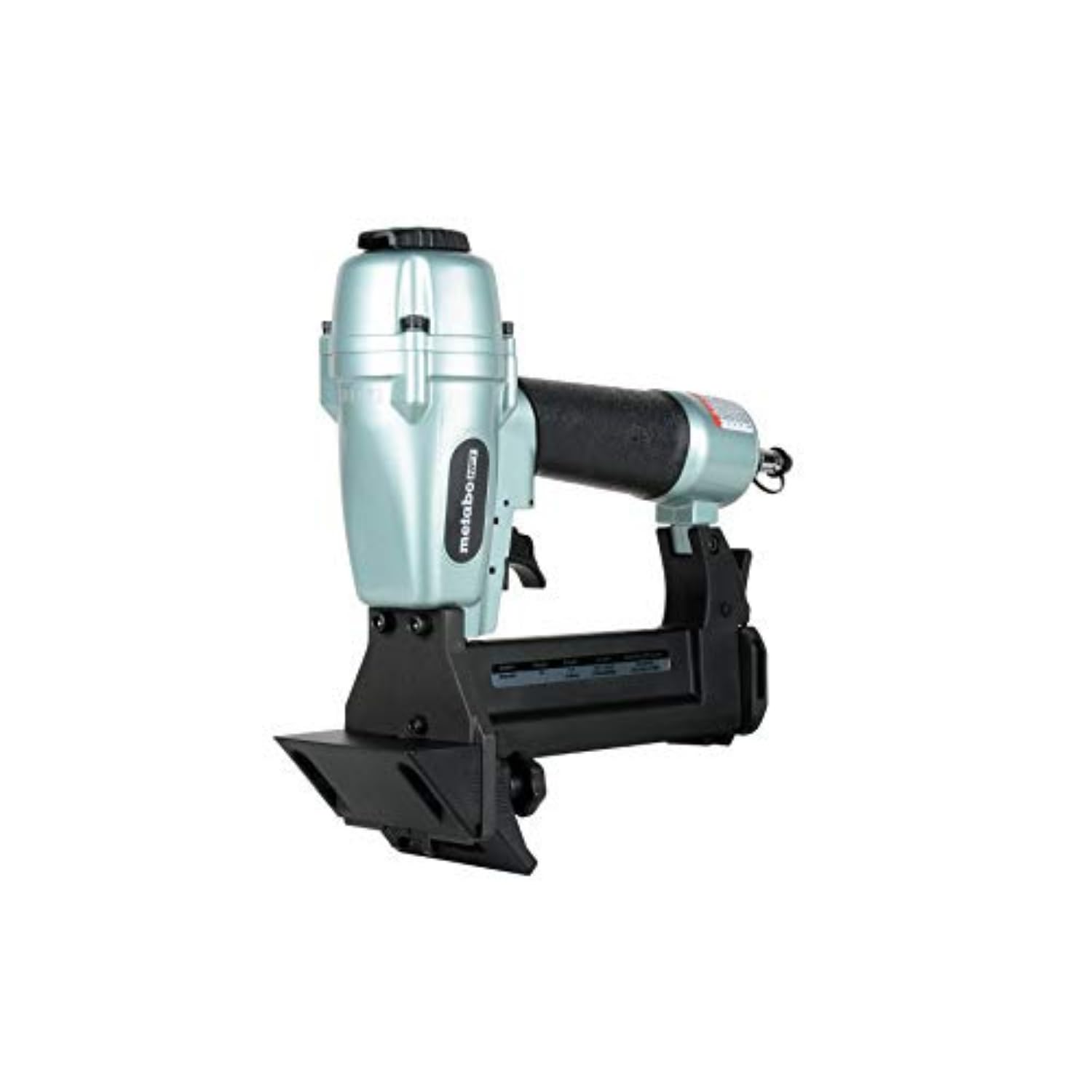
The pro-preferred lightweight that has racked up a decade-plus of awards
Builder and Developer Magazine has named this the Pro Preferred Nailer for 12 years running, from 2014 through 2025. It fires 1/4-in 18-gauge staples from 1/2-in to 1-9/16-in, and its tool-less depth adjustable base moves from 5/16” to 7/16” for solid hardwood and 1/2” to 5/8” for engineered. That range is why pros trust it across job sites with mixed materials.
At just 3.1 pounds it’s the lightest stapler in this entire lineup, which is remarkable for a tool that reviewers point out using to lay 1,000 feet of engineered hardwood without a single jam. The sequential trigger ensures accurate staple placement every time, and the over-molded rubber grip keeps your hand comfortable through a full day. A high-grade composite magazine protects against jams while cutting weight, and the 360° exhaust points air wherever you need it.
The one flaw a few owners note is the adjustment plates: they don’t stay put super well, so you’ll readjust from time to time mid-project. It’s a minor annoyance in an otherwise exceptional tool, and the included hex wrenches, air tool oil, and safety glasses mean you’re ready to work from the start. If you’re a serious DIYer who wants pro-grade reliability without the full pro price, this is the balance.
Pro-grade featherweight: the 3.1-pound frame and 12-year award streak make this the smart premium buy for anyone laying engineered floors regularly.
Minor friction: the depth plates drift out of position during heavy use, so budget a few seconds per room to re-check your setting.
5. Powernail 1845F Pneumatic Trigger-Pull 18 Gauge Flooring Stapler

The no-mallet trigger-pull with a flex foot that finds its own level
This Powernail is built around one standout idea: the FLEX adjustable foot, which fine-tunes to various wood profiles and thicknesses with no tools required. That means no shims, no pads, and no fiddling — you set it once and it conforms to the plank. It’s designed for 3/8″, 1/2″, 9/16″, and 5/8″ tongue & groove hardwood, and it fires 18-gauge 1/4” narrow crown staples from 7/8” up to 1-1/2”.
The owner reports here are emphatic: a pro with 24 years in the trade installed over 8,000 sq ft without one jam, and another ran 5,000 staples with zero issues. “By far” the best of several similar tools one owner has used. The trigger-pull operation means no mallet required, which is kinder to your joints and more precise for consistent staple depth. The compact design gets close to walls and into tight spaces.
The double trigger takes about 10 minutes to become second nature, which is the only learning curve. The unique nose profile accepts tongue & groove and interlocking plank, and since it’s a dedicated stapler rather than a 4-in-1, it’s simpler and more rugged for flooring pros. If you want a tool that disappears into the work and never complains, this is your match.
Why Pros Choose It
- FLEX foot eliminates shims and pads with tool-free adjustment
- Compact nose reaches walls and tight corners
- Shoppers say 8,000+ sq ft with zero jams
Consider This
- Double trigger takes 10 minutes to learn
- No 4-in-1 versatility — this is a dedicated flooring stapler
- Premium price targets serious installers, not one-room DIYers
Who it beats: it leads on adjustment ease versus the 3PLUS and Freeman, which both demand manual depth wheel turning mid-job.
Who should skip: budget DIYers doing a single room, since the flex-foot precision is overkill for one afternoon of work.
6. BOSTITCH MIIIFS Flooring Stapler
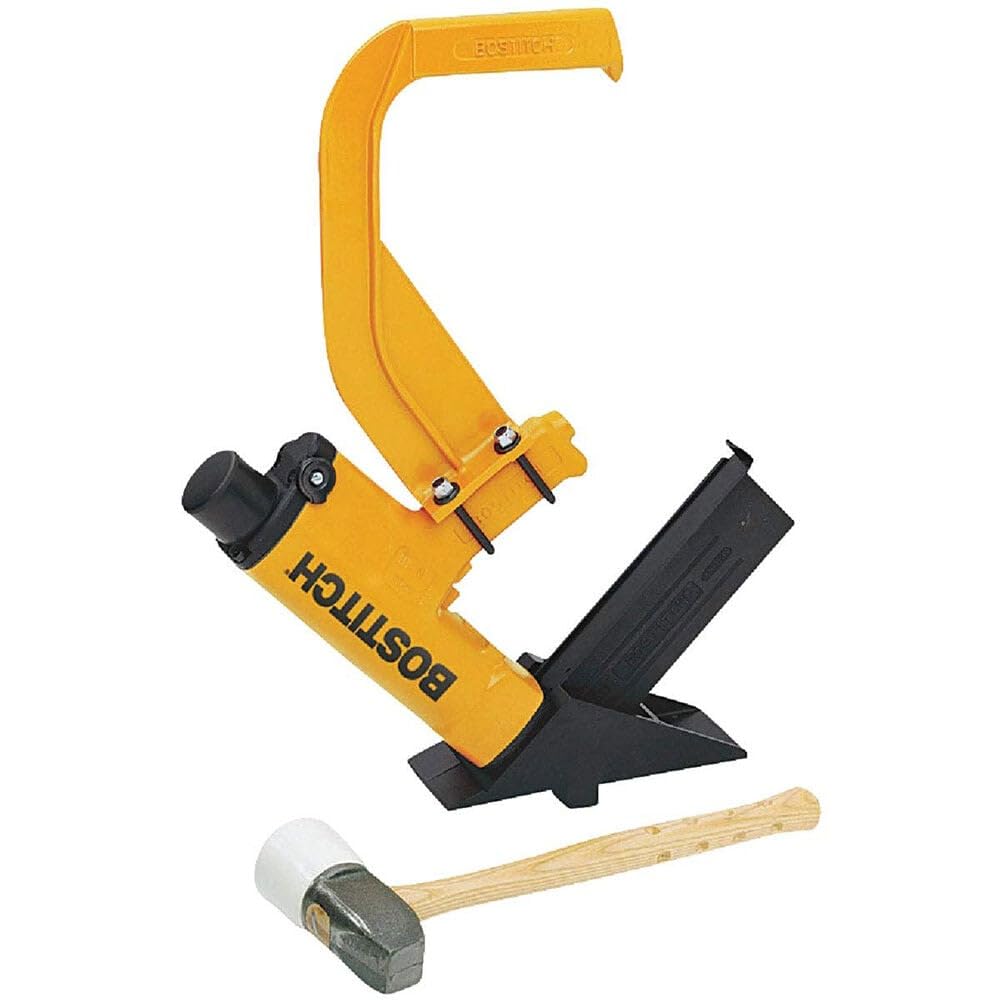
The 11.2-pound mallet-driven classic for solid hardwood production
This is a completely different animal from everything above: a high-speed, mallet-actuated pneumatic stapler that you hit with the included graphite mallet rather than firing with a trigger. It’s a heavyweight at 11.2 pounds, and it drives 1-1/2-inch to 2-inch staples — longer than any trigger-pull in this list — making it the go-to for solid hardwood and thick engineered plank. The extra-wide composite base plate (1/2-in and 3/4-in plates included) adds stability that prevents the dents you get with narrower bases.
Buyers report flawless performance installing 600 sq ft of oak and 1,200 ft of engineered hardwood without a single misfire, and the pre-finished foot protects plank edges from damage during installation. The long-reach handle adds comfort and control, and the padded mallet reduces hand fatigue during long sessions. The rolling floor adapter is a favorite feature, letting you glide along the row while driving staples.
The trade-offs are real: the wide base limits how close you can get to walls (you’ll need a finishing nailer within 10-12 inches of the wall), and weak mallet strikes leave staples partially driven. Assembly instructions are poor, and the tool needs a 3/4″ to 1/4″ air adapter that isn’t included. This is the pro’s tool for speed on open floors — not the pick for a weekend warrior in a small room.
Raw production speed: the mallet-driven design and 2-inch staple capacity make this the fastest option for large solid hardwood installations, with owners citing 1,200 ft of flawless work.
Heavy commitment: the 11.2-pound weight, wall-clearance limits, and missing air adapter mean it suits pros with the right setup, not first-timers.
Understanding the Specs
PSI and Air Compressor Needs
PSI (pounds per square inch) is the air pressure your compressor must deliver to drive a staple fully home. Most of these trigger-pull staplers run happily around 100 PSI, which a standard pancake compressor can provide. If your compressor is small, check that it can sustain pressure for a full run of staples — otherwise you’ll pause repeatedly while the tank refills, turning a two-hour job into a four-hour one.
Trigger-Pull vs. Mallet-Actuated
Trigger-pull staplers work like a nail gun: you press the nose against the plank, pull the trigger, and the staple fires. Mallet-actuated staplers are the traditional style — you hit the tool with a rubber mallet after each placement. Trigger-pull is easier on your body and more precise for engineered plank; mallet style is faster for solid hardwood production but physically demands more from you and can’t reach as close to walls.
FAQ
Can I use an 18 gauge floor stapler on solid hardwood?
What’s the difference between 18 gauge flooring staples and cleats?
Will an 18 gauge floor stapler work on bamboo flooring?
How close to walls can I staple with these tools?
Do I need a compressor to use a floor stapler?
What does the depth adjustment feature do?
Why does my stapler jam, and how do I clear it?
Can a flooring stapler also do trim and baseboards?
Is it cheaper to buy a floor stapler or rent one?
What maintenance does a pneumatic floor stapler need?
Final Thoughts: The Verdict
If you want the proven crowd favorite with the most owner confidence behind it, the Freeman 4-in-1 is the smart pick—its reliability is the single most-praised trait in its review pool, and it converts into a brad nailer for your trim work. For a budget entry that still finishes a whole room, the 3PLUS delivers solid results at a friendlier price. And if you’re laying solid hardwood fast, the mallet-driven BOSTITCH MIIIFS is the production-grade tool that owners trust for thousands of square feet at a time.
How We Picked
We do not accept paid placement. Every pick is matched to a real buyer and a real use-case; we do not hands-on test units.
Sources & Methodology
Specifications: manufacturer listings and product documentation. Review insights: verified customer reviews, as of August 2026. Pricing: not shown on this page (it changes often); check the current price via the retailer link.
As an Amazon Associate, Gadgets Feed earns from qualifying purchases. This does not affect which products we feature.