
Our readers keep the lights on and my morning glass full of iced black tea. As an Amazon Associate, I earn from qualifying purchases.
Specs are compiled from manufacturer listings and verified buyer reviews and can change over time — please confirm the key details on the product page before buying.
You need an inverter that runs your appliances without tripping or burning out. The key difference is the waveform: pure sine wave (clean power for sensitive electronics like laptops and TVs) versus modified sine wave (basic power for tools and simple devices). Also check the continuous power rating, not just the peak. This guide uses specs and owner reports to help you match a unit to your RV, truck, or home backup setup.
I’m Min — the founder and writer behind Gadgets Feed. This guide is built by comparing the manufacturers’ published specifications and the patterns across verified customer reviews, so you get each pick’s real strengths and trade-offs instead of marketing spin.
We focus on continuous wattage, waveform type, and protection features to find the most reliable 2500 watt inverter for your vehicle or off-grid power needs.
Our Picks at a Glance


How To Choose The Best 2500 Watt Inverter
The most common mistake is buying on peak wattage alone. Peak wattage (sometimes called surge) is the brief burst an inverter can handle when a motor like a refrigerator compressor kicks on — but the continuous wattage is what you actually live with. A 2500W continuous unit should comfortably run a microwave, a TV, and a coffee maker, but you need to add up your real loads to confirm.
Match the Waveform to Your Devices
Pure sine wave inverters produce clean, grid-quality power, which is essential for sensitive electronics like laptops, CPAP machines, and some televisions. Modified sine wave units are cheaper and perfectly fine for power tools, simple appliances, and basic chargers — but some devices may hum or run less efficiently. If you are powering a mix of sensitive gear in an RV, pure sine wave is the safer investment.
Check Your Battery Input Voltage
Most inverters run on 12V, which works with standard car and RV batteries. But if you have a solar bank or a 48V lithium setup, you want an inverter that matches that voltage — 48V systems draw less current, meaning smaller cables and less loss. Also check for adjustable low-voltage protection, which lets you tune the cutoff to protect lithium batteries from over-discharge.
Look for Protection and Cooling
Overload, over-voltage, over-temperature, and short-circuit protection are standard on quality units — but cooling fan reliability is what separates a long-lived inverter from a failure. Look for dual intelligent cooling fans, and remember that some owners wire in an external fan for hot climates. A remote control with an LCD display also saves you from walking to the unit every time you want to check load or battery level.
Quick Comparison
| Model | Best For | Waveform | Continuous Power | Peak Power | Amazon |
|---|---|---|---|---|---|
| ZETAWALE 2500W Pure Sine★ Best Overall | RV hardwire with ATS | Pure Sine Wave | 2500W | 5000W | Amazon |
| Sunivora 3000W ModifiedMost Versatile | Portable multi-device power | Modified Sine Wave | 3000W | 6000W | Amazon |
| SUDOKEJI 2500W ModifiedBudget Champion | Budget-friendly home backup | Modified Sine Wave | 2500W | 5000W | Amazon |
| VEVOR 2500W Pure Sine | Quiet pure sine backup | Pure Sine Wave | 2500W | 5000W | Amazon |
| EGSCATEE 2500W Pure Sine | RV permanent install | Pure Sine Wave | 2500W | 5000W | Amazon |
| JARXIOKE 2500W Pure Sine | Solar with Type-C ports | Pure Sine Wave | 2500W | 5000W | Amazon |
| OLTEANP 2500W Pure Sine (48V) | 48V lithium solar banks | Pure Sine Wave | 2500W | 5000W | Amazon |
| Cobra PRO 2500W Modified | Truck and boat use | Modified Sine Wave | 2500W | 5000W | Amazon |
| VEVOR 3000W Inverter Charger | 24V off-grid with charging | Pure Sine Wave | 3000W | — | Amazon |
| Go Power 3000W Heavy-Duty | Multiple appliance backup | Modified Sine Wave | 3000W | 6000W | Amazon |
In‑Depth Reviews
1. ZETAWALE 2500W Pure Sine Wave Inverter
Our pick — 4.5★ from 400+ verified ratings; the strongest balance of quality and price.
The RV-ready pure sine unit that switches shore power to battery without a thought.
This is the pick for RV owners who want a permanent install with zero manual switching. The built-in Automatic Transfer Switch (ATS) detects when shore power drops and flips to battery instantly, so your fridge and TV never blink during a campground outage. You get 2500W continuous and 5000W peak from a 12V battery, with a 3-wire hardwire terminal block (Live, Neutral, Ground) that slots straight into your breaker panel.
Buyers report powering a mini fridge, a TV, and an 800-watt microwave all at once, and one measured 90% efficiency at a 900-watt load. The pure sine wave output handles sensitive electronics cleanly — in fact, owners mention “3 units tested: all work perfectly,” which speaks to consistency. The dual intelligent cooling fans keep things stable under load, though a few note the fan can get noisy and the stock DC cables are worth upgrading to a heavier gauge like 2/0 AWG for full output.
The 8.2-pound unit supports lithium, AGM, deep-cycle, and lead-acid 12V batteries, so it fits nearly any existing bank. A remote controller comes in the box, and the 12-month support with 24/7 customer service covers troubleshooting. The catch is that a few owners found the hardwire connections “barely adequate” and wished the battery percentage display were more accurate with LiFePo4 batteries.
Why it leads the list
- Built-in ATS means hands-off switching between shore and battery power
- Pure sine wave safely runs microwaves, refrigerators, and TVs
- Hardwire terminal block integrates into RV breaker panels
What to watch
- Stock DC cables are weak — most owners upgrade to 2/0 AWG
- Cooling fans run loud, especially at high loads
- Battery percentage display is inaccurate for LiFePo4 batteries
Reach for this if: you want a true RV hardwire setup where shore power and battery switch automatically.
Look elsewhere if: you need a portable plug-and-play unit — this one rewards a proper installation.
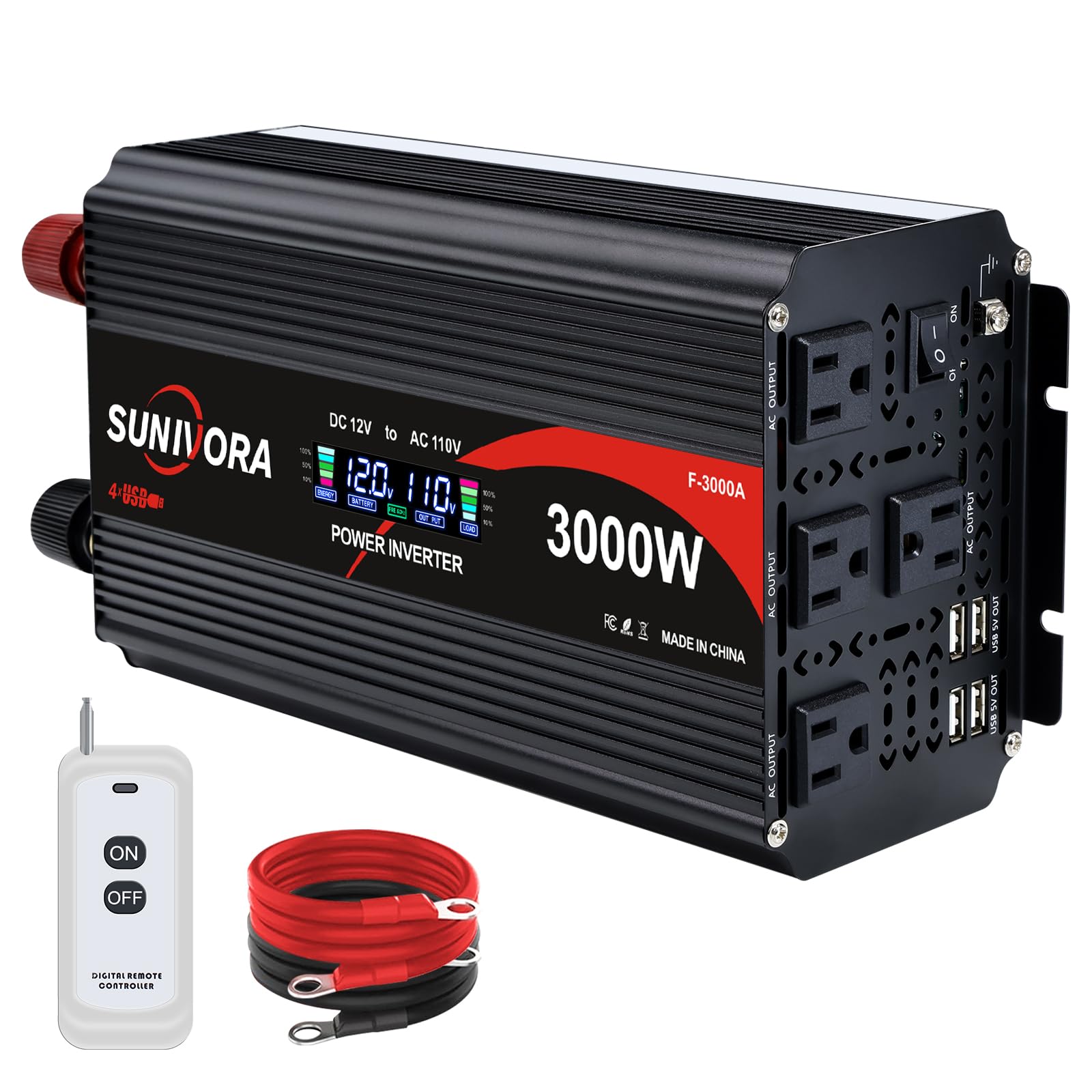
2. Sunivora 3000W Power Inverter
A 3000W portable powerhouse with four outlets and a remote that works from 165 feet.
This unit steps past 2500W to give you 3000W continuous and a 6000W surge, making it the strongest value for anyone running several devices at once. The four grounded AC outlets and four USB ports mean you can charge a drill, a TV, a coffee machine, and a phone simultaneously. It is also 2.7 pounds lighter than the ZETAWALE above — 5.5 pounds — so it travels better between truck, boat, and home. The remote control operates from 165 feet away, and the LCD shows input/output voltage, battery capacity, load, frequency, and temperature.
Owners love that the digital display and remote make it feel like a premium system, and one ran a refrigerator, a gas furnace, some 60-watt LEDs, a TV, and an internet box all at once. The aluminum shell resists impact, and the included 0 AWG pure copper cables are genuinely heavy-duty. Conversion efficiency is rated above 90%, so you are not wasting battery power.
The trade-off is the modified sine wave output, which is fine for tools and most appliances but not ideal for the most sensitive electronics. Also, one buyer found it could not run two Milwaukee chargers simultaneously and suspected a damaged battery cell — a reminder that surge-heavy tools need the peak power headroom, not just the continuous rating.
Best for: anyone who wants one portable box to power a mix of tools, appliances, and gadgets across the car, boat, and campsite.
Honest caveat: modified sine wave means delicate electronics may hum — pair it with sensitive gear only if they tolerate it.
3. SUDOKEJI 2500W Power Inverter
The entry-level 2500W that customers note is lightweight, easy to store, and a breeze to install.
If you want a dependable 2500W continuous unit (5000W surge) without paying for features you will not use, this SUDOKEJI is the value play. The 12.6-inch body with three AC sockets and a 3.4A USB port covers the basics — phones, laptops, TVs, power tools, even a microwave. The remote control works up to 100 meters, so you can switch it on from across a campsite or job site. It meets UL, CE, and FCC standards, which is solid reassurance at this tier.
Owners highlight that it powered a table saw without complaint and praise the build quality for the price. The dual cooling fans help it run cool, and protections include overvoltage, undervoltage, overload, short circuit, overheating, and soft-start technology. The 31.5-inch cables give you some reach, and the unit is light enough to store away easily.
The honest catch here is the remote — it ships without the A23 battery it needs, and that battery can be hard to find locally. A few owners also noted the green power light stays on whenever the unit is powered, which is a minor quirk rather than a fault. For the price, this is the best entry point into 2500W power.
Grab it for: a low-cost, reliable 2500W for tools, TVs, and small appliances at camp or home.
skip it if: you need pure sine wave for sensitive medical or audio gear.
4. VEVOR 2500W Pure Sine Wave Inverter
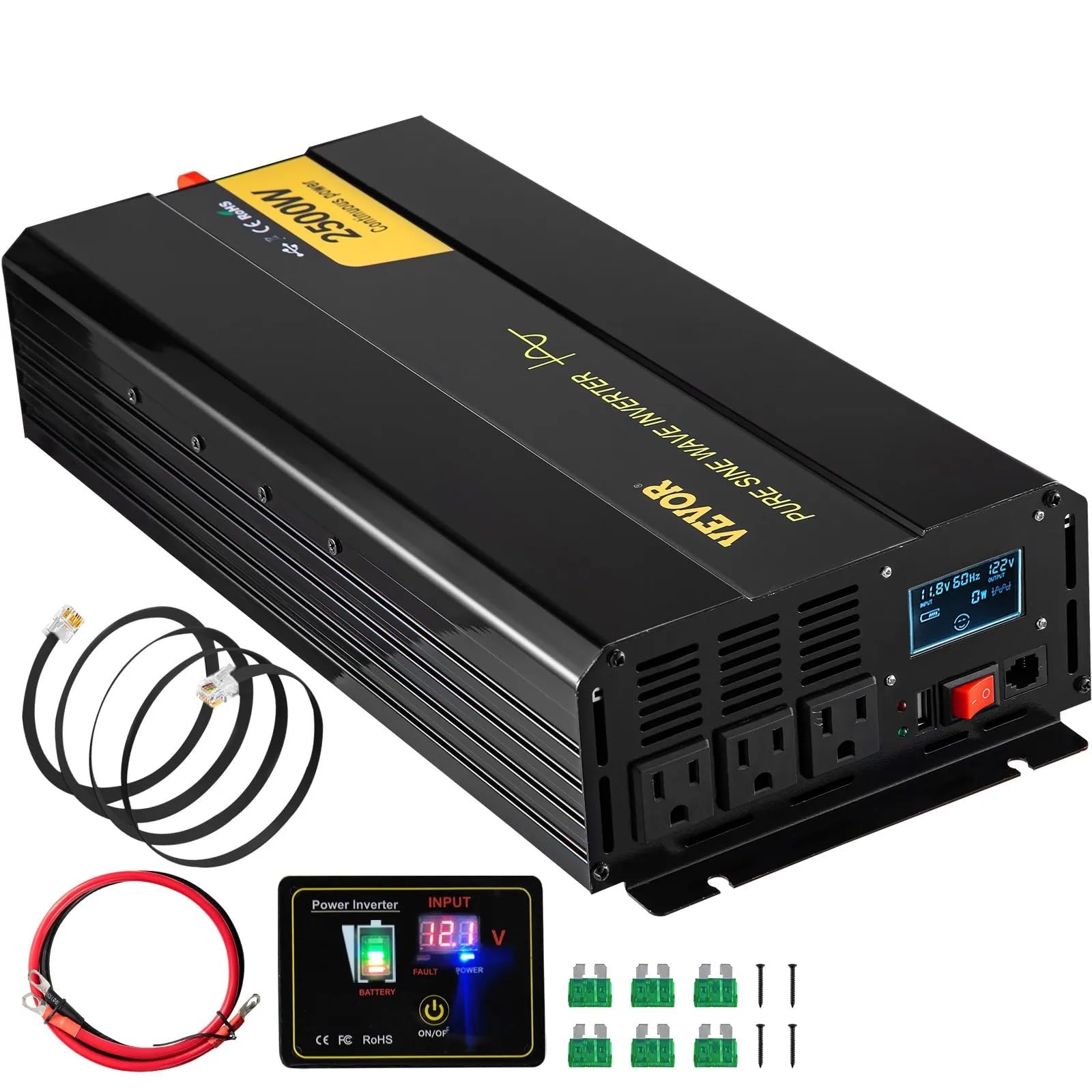
Pure sine wave output that owners describe as quiet during outages and smooth for tools.
Owners rely on the VEVOR 2500W pure sine wave inverter during outages, with several reporting it handled tools at around 2500W with repeated starts and stops. One buyer tested it with an oscilloscope and saw a clean full sine wave with no noise — exactly what you want for sensitive electronics. The 9.9-pound body is heavier than the Sunivora (5.5 pounds), but that mass comes with a sturdy aluminum build and an intelligent temperature-controlled cooling fan that only spins up when needed. It carries CE, FCC, RoHS, and PSE certifications (safety and quality marks for electronics).
The LCD display and plastic-wrapped remote controller make it convenient to monitor and switch from inside the house or an RV. Owners running it as a portable backup powered TVs, a DISH box, a sound bar, and lights off a large truck battery during short outages. The built-in protections cover overload, over-voltage, over-temperature, and short-circuit, so connected appliances run safely.
The recurring owner note is that power output opinions are mixed — some say it delivers plenty, while others feel it falls short of the advertised spec at the absolute top end. For most real-world loads a 2500W pure sine unit handles, this is a quiet, trustworthy performer that buyers recommend.
Why owners pick it: clean sine wave, quiet operation, and dependable outage performance at a mid-range price.
Keep in mind: a few buyers believe the top-end output does not fully match the label — size your continuous draw below the max.
5. EGSCATEE 2500W Pure Sine Wave Inverter
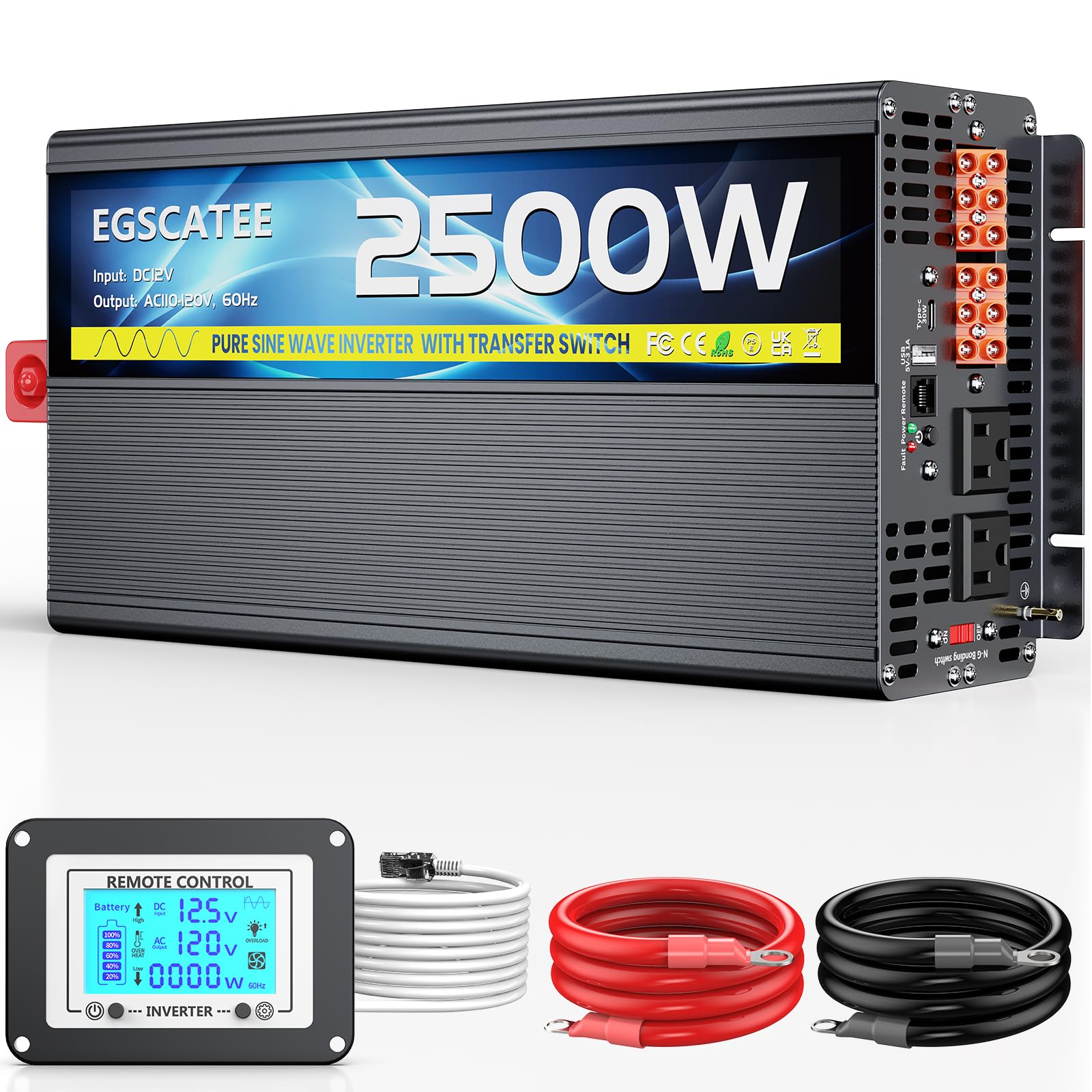
A 2500W pure sine inverter built for permanent RV installs that run appliances for years.
This is the twin-spirit of our top pick — same 2500W continuous / 5000W peak pure sine output and the same built-in Automatic Transfer Switch (ATS) — but with a few differences that matter to specific buyers. It is heavier at 8.8 pounds and includes a remote controller plus dual intelligent cooling fans. The hardwired AC input terminal block (Live, Neutral, Ground) is designed for direct integration into RV breaker panels, making it ideal for motorhomes, fifth wheels, and camper vans.
Owners who installed it in vans report running a microwave, a Keurig, and a TV simultaneously, and one used it across 2.5 seasons without failure. The remote display gets consistent praise, though the included 14-foot cord is short for some layouts — one owner extended it to 25 feet. The unit handles lithium, AGM, deep-cycle, and lead-acid 12V batteries, and one owner over-loaded it past 3000W only to see it shut down, beep, and self-recover.
The honest notes: the hardwire terminals are small (some owners just used the outlets), and the supplied cables are too thin for full output — 4/0 is the common upgrade. Also, reviewers point out the AC output voltage can fluctuate from 104V to 118V even when input stays steady. If you want a permanent RV system with automatic switching, this delivers.
Built for installs
- ATS switches shore power to battery automatically and instantly
- Remote display is praised, with a long optional cord
- Self-recovers after an overload shutdown
Install notes
- Stock cables are too thin — plan to upgrade to 4/0
- Small hardwire terminals; some owners use outlets instead
- AC voltage can fluctuate between 104V and 118V
Choose it for: a permanent RV or van install with automatic shore-to-battery switching and remote monitoring.
Think twice if: you prefer plug-and-play portability over a wired-in system.
6. JARXIOKE 2500W Pure Sine Wave Inverter

A 2500W pure sine unit with Type-C ports and a wireless remote for modern solar setups.
This JARXIOKE stands out by adding Type-C ports alongside three AC outlets and dual USB ports — a rare convenience for charging modern phones and laptops directly without a separate adapter. It delivers a true 2500W continuous and 5000W peak from a 12V battery, with pure sine wave output and conversion efficiency above 90%. The wireless remote controls the unit from up to 100 meters, and the LCD display shows battery level and audible alarms.
Shoppers say it running a chest freezer and fridge reliably, including through storms and a 24-hour outage on solar power. One has used it for two years and still calls the output “as stated,” noting it is only noisy when the fan kicks on in hotter temps. The isolated input/output design and soft-start technology help protect connected devices, and AIG backs the product liability. The 24-month warranty is among the longest here.
The key limitation to know: each of the three 15A outlets limits you to 1800W max, so the full 2500W is not available from a single plug. This means a single 1500W RV air conditioner may not run off one outlet. Also, the fans get noticeably loud in temperatures above 90°F — some owners added an external case fan to cope.
Great for: solar-backed fridges and freezers where Type-C charging and a wireless remote add convenience.
Know before buying: 1800W per outlet caps single-device loads, and the fan is loud in heat.
7. OLTEANP 48V 2500W Pure Sine Wave Inverter
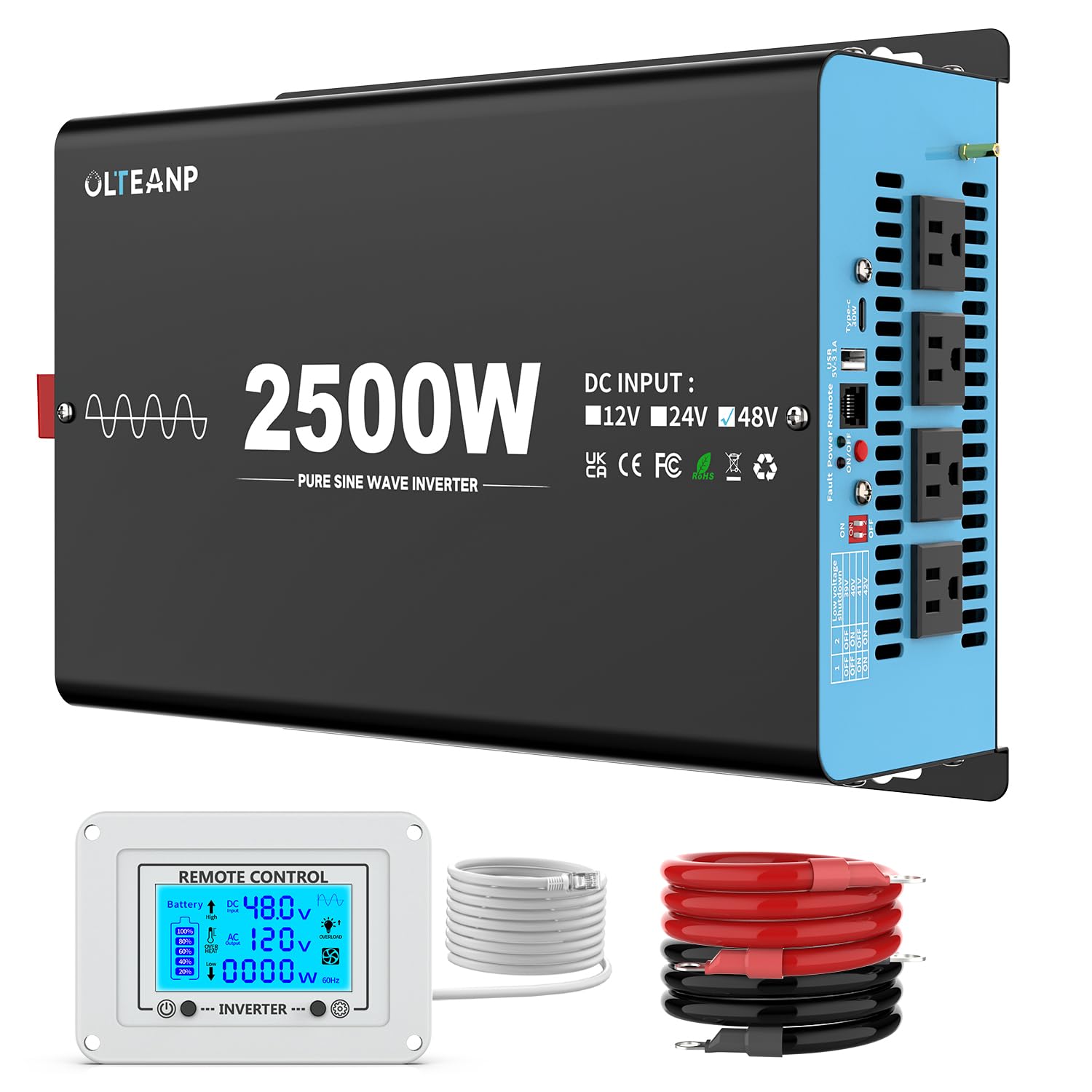
Built for 48V lithium banks, this pure sine inverter runs quietly and powers high-draw tools.
If your solar setup runs on a 48V battery bank, this OLTEANP is the match. The higher voltage means lower current draw, less cable loss, and better overall efficiency than a 12V system. It delivers 2500W continuous and 5000W peak pure sine wave, which owners say runs fridges, microwaves, coffee makers, and even a 1470-watt iron without issue. The adjustable low-voltage shutdown is a genuine plus for lithium users — you can tune the cutoff to protect your LiFePO4 batteries from over-discharge.
Owners praise the quiet operation, with one noting the fans rarely run even at 1200W load, and another confirming AC voltage stays high around 119V under load. The 15-foot wired remote with LCD shows real-time battery voltage, AC output, load wattage, and safety alerts, so you monitor the whole system from your power room. One owner ran a 7-1/4″ Skilsaw, compressors, and saws off a 200Ah LiFePO4 battery without a hiccup.
The mixed feedback centers on battery life — some get great performance while others report quicker-than-expected battery drain. Note this unit is strictly 48V input, so it will not work with a standard 12V car or RV battery. If you are building or expanding a 48V solar system, this is the one to reach for.
The 48V advantage
- Adjustable low-voltage cutoff protects lithium batteries from over-discharge
- Runs cool and quiet — fans rarely spin at 1200W
- 15-foot LCD remote for full system monitoring
Match your system
- Requires a 48V battery bank — not for standard 12V setups
- Battery life feedback is mixed, so size your bank generously
Ideal for: 48V solar and off-grid builds where quiet, efficient pure sine power and lithium protection matter.
Not for you if: you run a standard 12V car or RV electrical system.
8. Cobra PRO 2500W Power Inverter
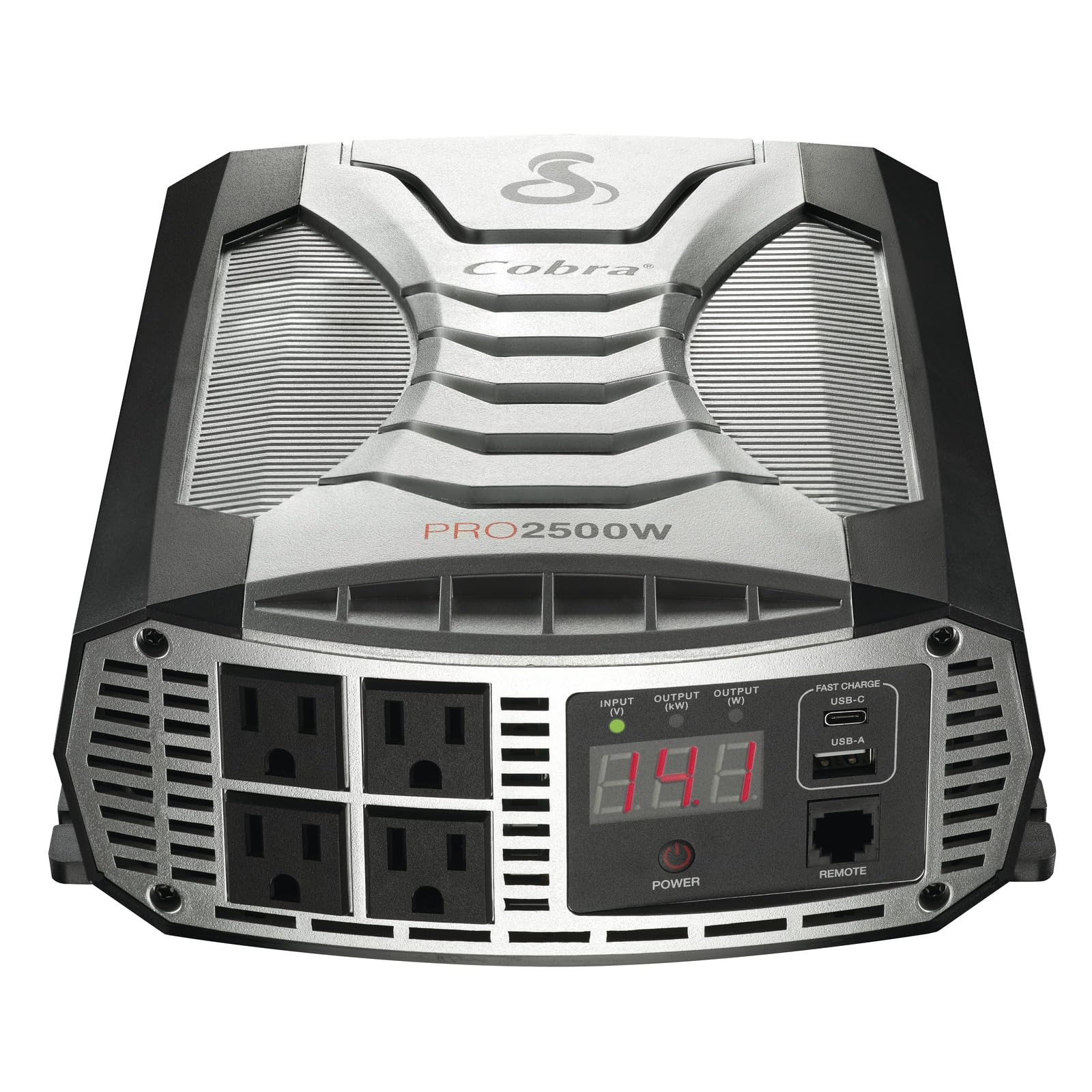
A 5.7-pound truck-and-boat favorite with GFCI-protected outlets and heavy-duty 2 AWG cables.
The Cobra name carries weight with truck drivers and boaters, and this PRO series earns it with 2500W continuous and 5000W peak modified sine wave output. The standout feature is the four GFCI-protected grounded AC outlets — a real safety upgrade for running power tools near water or in a damp boat environment. It also packs two Fast Charge USB ports (3.0 AMP USB-A and USB-C) plus a remote controller with a 7-color LED that shows battery voltage and current draw.
Owners in tractor trailers use it to run a fridge and microwave, and one calls it the peace-of-mind purchase for the road. The included direct-to-battery cables are heavy-duty 48-inch, 2 AWG, so you are not hunting for upgrades. The remote adds USB charging right at your fingertips inside the cab, which is a thoughtful touch for long hauls.
The mixed feedback is on reliability — most report it works as advertised, but a handful say theirs stopped working, so treat the fan vents and mounting location with care. Also, one owner believes the remote should be included rather than sold separately, so confirm what is in your box. For a portable, safety-focused 2500W for vehicle use, this is a strong, trusted pick.
Why owners trust it: GFCI-protected outlets, heavy-duty 2 AWG cables, and a brand proven in trucks and boats.
Consider: reliability is mixed in a small share of reviews — check the return policy and mount it with airflow.
9. VEVOR 3000W Pure Sine Wave Inverter Charger

A heavy 24V inverter plus charger that owners say rivals units costing hundreds more.
This is not just an inverter — it is an inverter and battery charger in one, built for 24V systems. It delivers 3000W of pure sine wave power (manufacturer recommends keeping each outlet below 1.2KW), and the integrated charger means you can replenish batteries from shore or generator power in one box. The 39.7-pound weight reflects the low-frequency transformer design, which owners describe as high quality — one calls it a “high quality low-frequency inverter” with decent transformer, E-caps, and chassis components that has run flawlessly for months.
The 32.8-foot / 10-meter remote cable lets you mount the unit out of the way and control it from a detachable panel. Owners used it to power a 1350W kettle and to run a kelpie in a 54-year-old RV restoration off a 230Ah lithium battery, praising the flexibility for boondocking. It is compatible with LiFePO4, lithium-ion, AGM, sealed lead-acid, and flooded lead-acid batteries, so it adapts to whatever bank you have.
Be honest about the mode claims: while the listing says 5 working modes, buyers report only 2 modes (AC and Battery Priority) actually function, and you cannot invert and charge at the same time. Also, the hardest output — 2000W — only comes through the hardwired port; the three outlets cap at 1200W each. If you need a true 24V inverter-charger for backup, this is a value giant; if you need generator load-leveling, look elsewhere.
The value play
- Inverter and charger in one 24V box — no separate charger needed
- Low-frequency transformer design praised as high quality
- 32.8-foot remote cable for flexible mounting
Set expectations
- Only 2 of the 5 advertised modes actually work
- Cannot invert and charge simultaneously
- 2000W only via hardwired port; outlets cap at 1200W each
Buy it for: a 24V off-grid system that needs both inversion and battery charging in one sturdy unit.
Pass if: you need generator load-leveling or the full 5-mode flexibility the listing suggests.
10. Go Power 3000W Heavy-Duty Inverter
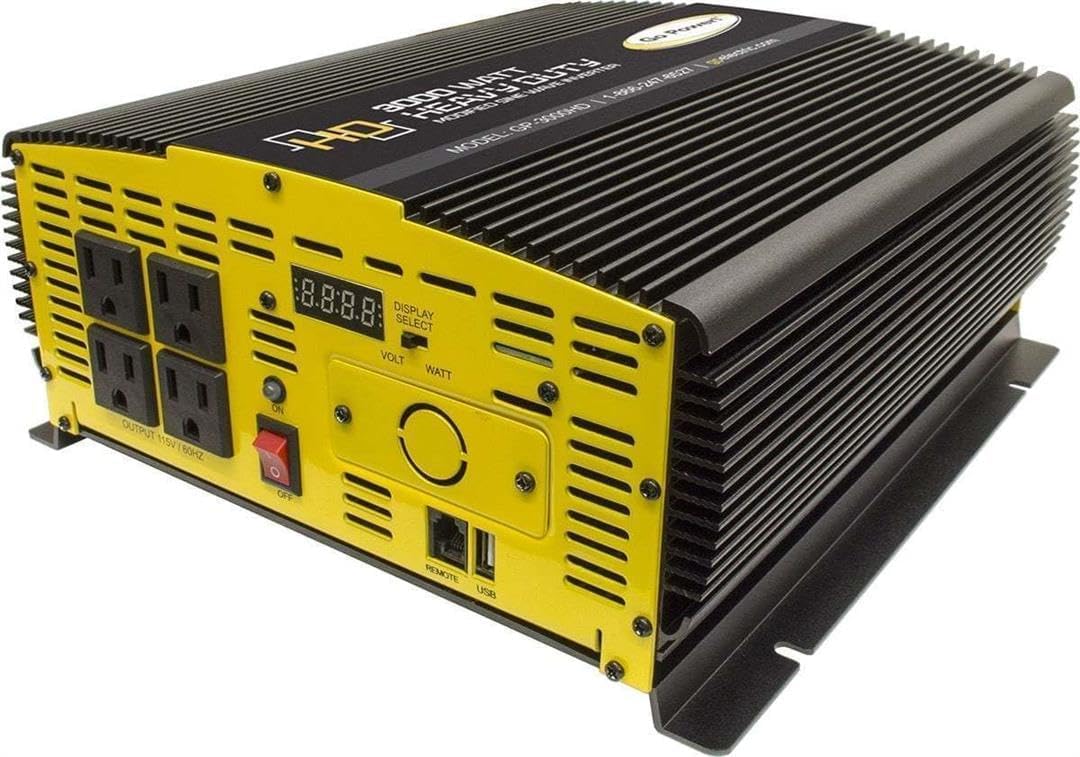
A 3000W, 10.5-pound heavy-duty unit that owners trust to run multiple appliances all night.
Go Power is a trusted name in RV electrical gear, and this GP-3000HD delivers 3000W continuous with a 6000W surge — enough headroom to run three circuits overnight, which owners confirm. The four AC outlets let you spread the load across multiple appliances, and the unit works with the optional Go Power transfer switch, so you can integrate it with a home or RV electrical system for automatic power management. At 10.5 pounds, it is the heaviest modified sine unit here, which speaks to the heavy-duty build.
Owners praise it as well-made and solid, using it as a backup for two 3/4-horsepower sump pumps with a 30A relay auto-transfer setup, and running tools and battery chargers off a 6V golf cart pair. The standby operation is silent and the fan is quiet, which matters for overnight backup. One used it for welding and still has it running years later, calling out the external regulator trick for vehicles that charge at 15V.
The reliability feedback is genuinely mixed — some report flawless performance, while one experienced a malfunction after about three weeks when the fan gave out and it overheated within five minutes of running lights. The good news is the company replaced the unit no-questions-asked, which owners call standout customer service. If you are pairing this with a vehicle, note that some trucks trigger an overvoltage alarm at 15V; an external adjustable regulator set to 14V solves it.
Why it endures: 6000W surge headroom, four outlets, transfer-switch compatibility, and a brand that stands behind its units.
Be aware: some fan-related failures occurred early — keep it cool and verify no-questions-asked warranty before installing.
Understanding the Specs
Continuous vs. Peak Wattage
Continuous wattage is the steady power an inverter can deliver hour after hour — this is the number that matters for your real appliance load. Peak wattage (or surge) is the brief burst the inverter tolerates when a motor first kicks on, like a refrigerator compressor or a table saw. A 2500W continuous unit with a 5000W peak can start most household motors, but you still need to keep your steady draw under the continuous rating.
Pure Sine Wave vs. Modified Sine Wave
Pure sine wave output is clean, grid-quality power that runs sensitive electronics like laptops, CPAP machines, TVs, and some microwaves without buzzing or interference. Modified sine wave output is a simpler, cheaper waveform that works fine for power tools, basic appliances, and chargers — but some devices may hum, run slightly hotter, or operate less efficiently. If you power a mix of sensitive gear, pure sine wave is the safer choice.
Input Voltage and Battery Matching
Most inverters run on 12V, matching standard car, truck, and RV batteries. 24V and 48V units exist for larger solar banks, and the higher voltage means lower current draw, smaller cables, and less energy lost to heat. If you already own a battery bank, match the inverter’s input voltage to it exactly — a 48V inverter will not work on a 12V battery, and vice versa.
Automatic Transfer Switch (ATS)
An ATS lets the inverter automatically switch between shore power (external AC input) and battery power. When shore power is present, the inverter bypasses conversion; when it drops, the ATS flips to battery instantly. This is a major convenience for RV owners who would otherwise manually switch sources — it keeps your fridge and electronics running through campground outages without lifting a finger.
FAQ
What is the difference between a 2500W continuous and a 5000W peak rating?
Can a 2500W inverter run a microwave and a refrigerator at the same time?
Does my 2500W inverter need a pure sine wave output for my TV and laptop?
Will a 12V inverter work with my 48V solar battery bank?
What does the built-in ATS (Automatic Transfer Switch) do for my RV?
Why do owners upgrade the DC cables on power inverters?
How can I use a 2500W inverter as a home backup power source?
Can a 2500W inverter charge batteries as well as power devices?
What protections should I look for in a 2500W inverter?
Does the remote control on a 2500W inverter work from inside my vehicle?
Final Thoughts: The Verdict
For the majority of shoppers, the top pick is the ZETAWALE 2500W Pure Sine Wave Inverter because its built-in ATS (automatic transfer switch, which switches between shore power and battery without you touching it) and hardwire design make permanent RV power genuinely hands-free, backed by strong owner reports of running a fridge, TV, and microwave at once. If you want a portable multi-device box with four outlets and a 165-foot remote, the Sunivora 3000W is the value-versatile grab. And for a 48V solar build, the OLTEANP 48V brings adjustable lithium protection and quiet pure sine output to the table. Match your battery voltage first, then choose your waveform, and you will land on the right unit for years of reliable power.
How We Picked
We do not accept paid placement. Every pick is matched to a real buyer and a real use-case; we do not hands-on test units.
Sources & Methodology
Specifications: manufacturer listings and product documentation. Review insights: verified customer reviews, as of August 2026. Pricing: not shown on this page (it changes often); check the current price via the retailer link.
As an Amazon Associate, Gadgets Feed earns from qualifying purchases. This does not affect which products we feature.