
That moment when warm air pours from the vents despite a full refrigerant charge — a pinhole in the evaporator coil, a weeping gasket, or a compromised seal — is the exact point where an AC stop leak earns its keep. A quality sealer circulates through the system as a liquid, reacting with air and moisture at the breach to form a permanent plug without solid particles that could clog a metering device or damage a compressor.
I’m Rikta — the co-founder and writer behind Gadgets Feed. I’ve spent years analyzing technical specifications and real-world performance data across hundreds of refrigerant additives, separating the formulas that chemically weld from those that just gum up a recovery unit. (And Homer 🐱 supervised the entire ranking from a warm laptop exhaust vent, tail flicking with each successful seal.)
This guide breaks down the seven most effective formulations on Amazon, comparing their compatibility, active chemistry, and real sealing success rates. Choosing the right ac stop leak means matching the sealer to your system type, leak size, and refrigerant — and that decision is exactly what the reviews below clarify.
How To Choose The Best AC Stop Leak
Not every stop leak is safe for every system. The chemistry behind the sealant — polymer-based, organosilane, or a reactive liquid — determines whether it chases a pinhole successfully or turns your expansion valve into a paperweight. Three factors separate the effective formulas from the costly mistakes.
Refrigerant Compatibility and Temperature Ceiling
Each stop leak lists an upper temperature rating — RED TEK ProSeal12 tops at 239°F, while ProSeal22 caps at 200°F. Exceed that ceiling and the sealant degrades, potentially releasing particles into the loop. Match the formula to your system’s operating range: R-410A residential systems run hotter than R-134a automotive loops, so a higher heat threshold provides a longer safety margin.
Particle Size and Clog Risk
Polymer-based sealants and formulas containing solid particulates carry a real risk of blocking metering devices like TXVs, capillary tubes, and orifice tubes. Non-polymer formulations, such as those from ComStar and Leak Saver, circulate as a liquid that reacts only at the leak site, leaving unobstructed passages untouched. For mini-splits and microchannel coils, a particle-free formulation is non-negotiable.
Injection Method and System Access
Pressurized cans offer a simple DIY route for automotive systems — screw the can onto the low-side service port and let the refrigerant carry the sealer in. Residential and commercial systems typically require a manifold gauge set or a dedicated injection tool like Leak Saver’s Leak Shot kit. Always confirm whether the sealer needs a vacuum pull beforehand; many products require the system to be evacuated to prevent air ingress at the leak site during injection.
Quick Comparison
On smaller screens, swipe sideways to see the full table.
| Model | Category | Best For | Key Spec | Amazon |
|---|---|---|---|---|
| RED TEK ProSeal12 | Automotive | Older R-12 and R-134a systems | 239°F upper temp rating | Amazon |
| Leak Saver Small System | HVAC / Auto | Systems up to 1 ton | Organosilane chemistry | Amazon |
| ComStar A/C Zero Leak | Multipurpose | Non-polymer preventive care | Polymer-free liquid | Amazon |
| RED TEK ProSeal22 | Residential HVAC | R-22 and mineral oil systems | 200°F upper temp rating | Amazon |
| BlueDevil Red Angel | Automotive | Evaporator core pinholes | Chemical weld formula | Amazon |
| Leak Saver Ultimate 3-in-1 | HVAC Pro | Systems up to 5 tons | UV dye + moisture remover | Amazon |
| A/C Pro Max-Seal | DIY Auto | Quick recharge + seal | 12 oz can with sealant | Amazon |
In‑Depth Reviews
1. RED TEK ProSeal12 A/C Seal Treatment (4 oz. can)
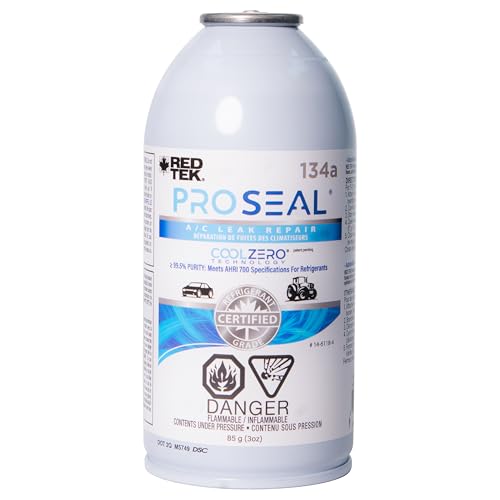
The ProSeal12 remains in the system as a liquid lubricant that activates only at the leak site, making it one of the safest formulas for preserving compressors and expansion valves. Its 239°F upper temperature rating is the highest among the can-based sealers tested, providing a generous safety margin for both R-12 and R-134a automotive loops that see sustained heat soak under the hood. The 2-fluid-ounce liquid volume is calibrated for a single passenger-car system, though some users on older R-12 setups with new dryers reported successful seals with one full can.
Customer feedback confirms strong results on 30-year-old cars and modern compressors alike — several verified buyers noted that the can’s metal construction avoided the plastic-tip leaking issue found with competing brands. The formula is less toxic than methanol-based alternatives and compatible with mineral, PAG, and ester lubricants, which means it won’t react poorly with residual oils during a retrofit. A handful of users criticized the sparse instruction sheet, but the injection process via low-side port is straightforward for anyone comfortable with a manifold gauge.
For a vehicle that loses a full charge over the course of weeks or months, the ProSeal12 delivers a cost-effective alternative to replacing the evaporator core or condenser. The non-refundable hazardous-materials policy is standard across the category and reflects the aerosolized delivery method rather than any product defect. If you need one sealer that covers the widest range of automotive refrigerants and temperatures, this is the benchmark.
Why it’s great
- Highest temperature ceiling (239°F) among can-based stop leaks
- Remains liquid until it contacts the leak site — no solid particles to clog valves
- Compatible with mineral, PAG, and ester lubricants across R-12 and R-134a
Good to know
- Non-refundable due to hazardous material classification
- Limited instructions — best for users with basic gauge-set experience
2. Leak Saver Direct Inject AC Leak Sealer Small System

The Leak Saver Small System formula uses an organosilane chemistry that reacts with air and moisture at the breach point to create a permanent seal without polymer particles. At a 1-ton maximum system capacity, it’s purpose-built for smaller residential splits, mini-splits, refrigerators, and automotive circuits where precise dosage matters. The 2.39-ounce injector fits directly into a manifold gauge hose, eliminating the mess and uncertainty of pressurized cans or syringes.
Verified buyers report success on DIY mini-split installations where a factory fitting was weeping, and one commercial refrigeration unit was saved entirely with a single application. The formula is safe for TXVs, Schrader valves, and capillary tubes — a critical advantage over polymer-based stop leaks that can turn a capillary into a clogged straw. For automotive use, a standard 134A-to-1/4-inch charging adapter is required, and mini-splits need a 5/16-to-1/4-inch adapter, both of which are common in any technician’s kit.
The primary limitation surfaces on larger leak volumes: if a system loses its full charge within a few days rather than weeks, the sealant may not have enough time to react and harden at the site. Two users reported the product failed to seal a wine cooler and a deep refrigerator leak, suggesting the ideal candidate is a slow weep of 1-2 ounces per year rather than a fast blowout. With over 4 million units sold since 2015, the formula has the longest field-tested track record in this comparison.
Why it’s great
- Polymer-free organosilane won’t clog metering devices or gauges
- Direct inject design — no hose or pressurized can required
- Proven track record across residential, commercial, and automotive systems
Good to know
- Rated for systems up to 1 ton only — oversize applications need the Ultimate version
- Requires separate adapter for mini-splits and most automotive ports
3. A/C Zero Leak Non-Polymer Formula (4 oz)

ComStar’s A/C Zero Leak is a silicone-based, non-hardening liquid designed to circulate as a preventive conditioner that seals small gaps without forming brittle solids. The 4-ounce container is notably larger than most automotive-focused competitors, providing enough volume for two applications on a typical passenger car or one treatment on a small residential split. Its polymer-free formulation ensures compatibility with POE, PAG, and mineral oils, and the non-hardening property means it won’t crack under thermal cycling.
Real-world results are encouraging: one user sealed a 2008 Trailblazer’s evaporator core after other stop leaks had failed, with the A/C maintaining ice-cold output through two Florida summer months. Another applied it as a preventive measure in a Hyundai H100 van and reported no clogging in the expansion valve even after prolonged circulation. The caveat is that success depends heavily on the leak being small — a sniffer-detectable evaporator coil breach that loses half a pound per year was resolved, while a larger perforation in the same coil type was not.
At a 4-fluid-ounce volume and silicone base, this is one of the most forgiving formulas for first-time users who are nervous about accidentally clogging components. The lack of hardening agents also makes it suitable for systems where you may later need to recover and recycle the refrigerant. For cost-conscious buyers who want a non-polymer sealer with a proven track record across multiple vehicle platforms, the A/C Zero Leak delivers strong value.
Why it’s great
- Non-hardening silicone formula — zero clog risk in TXVs and capillary tubes
- 4-ounce bottle provides generous volume for multiple applications
- Works as both a leak fix and preventive maintenance additive
Good to know
- Not intended for large or rapid leaks — best for slow weeps under 1 lb/year
- Injection via Schrader valve can be tricky without an oil injector tool
4. RED TEK ProSeal22 A/C Seal Treatment (4 oz. can)
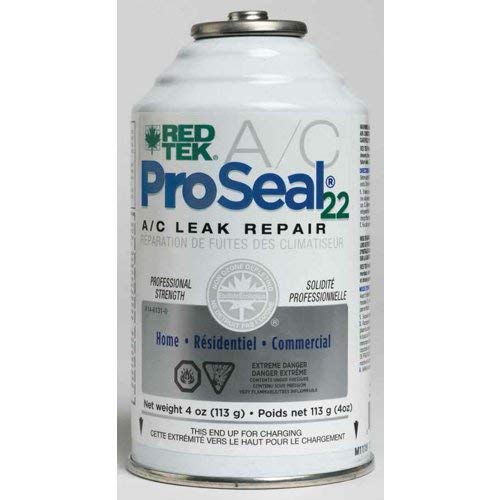
The ProSeal22 is RED TEK’s dedicated formula for R-22 residential and commercial systems, optimized for mineral oil lubricants and the higher discharge temperatures common in split-system compressors. Its 200°F upper temperature rating is slightly lower than the ProSeal12’s 239°F ceiling, but it remains well within the operating range of a typical R-22 condensing unit. The 2-fluid-ounce liquid volume is designed for a single treatment on a 3-5 ton system, and the liquid stays in circulation ready to seal future leaks as they develop.
Long-term field reports are impressive — one verified buyer reported their 4-ton unit held a pinhole coil leak for four years after a single application. Another user with a once-a-year recharge schedule saw the leak stop entirely over a two-month period, and the system held vacuum through an entire winter idle period. The formula is less toxic than methanol-based alternatives and compatible with the synthetic ester and PAG oils found in R-22 retrofits, though the primary compatibility target remains mineral oil.
The main drawback is the same as the ProSeel12: the can is non-refundable due to its pressurized hazardous material classification. Additionally, one user with a very small leak that lost refrigerant only over the winter found that the seal didn’t hold through the seasonal pressure cycle, requiring a second application. For systems where the evaporator coil is in a hard-to-reach location and replacement costs are high, this product offers a genuine chance at avoiding a full coil swap.
Why it’s great
- Optimized for R-22 and mineral oil systems common in older residential units
- Proven multi-year sealing on pinhole coil leaks up to 4 tons
- Liquid chemistry won’t harm TXVs or recovery equipment
Good to know
- Non-refundable; hazardous material shipping restrictions apply
- Upper temperature limit (200°F) lower than the automotive ProSeal12 variant
5. BlueDevil Products Red Angel 49496 A/C Stop Leak (2 oz)

The BlueDevil Red Angel distinguishes itself with a chemical weld mechanism — instead of relying on reactive liquids or polymer slurries, it forms a permanent molecular bond at the leak interface. The 2-ounce bottle is compact enough to store in a glovebox but potent enough to seal pinhole leaks in condensers, evaporators, O-rings, and gaskets. Crucially, the formula contains no solid or particulate matter, so it presents zero clog risk for recovery units or expansion valves.
Customer reports highlight its effectiveness on stubborn evaporator core leaks: a verified buyer with a 200k-mile Toyota Avalon applied the sealer, ran the car for two hours to circulate it, and reported ice-cold output with no further leak for months. Another user with a 2015 Nissan Versa that lost a full charge in six weeks saw the leak stop after a single evacuation-and-recharge cycle. The product works with both R-12 and R-134a, and the permanent seal claim is backed by a manufacturer guarantee — though the fine print requires proper installation under vacuum.
The primary criticism comes from a user with a sniffer-confirmed evaporator leak who saw the refrigerant drop again after one year, suggesting that the chemical weld is less effective on very large surface breaches than on localized pinholes. The small 2-ounce volume also means you get exactly one shot per bottle — there’s no room for a second attempt if the first application doesn’t take. For a targeted repair on a known small leak in an automotive system, the Red Angel is one of the most reliable options available.
Why it’s great
- Chemical weld forms a permanent bond — no hardening particles to clog valves
- Works on both R-12 and R-134a automotive systems
- Manufacturer guarantee backs the permanent seal claim
Good to know
- 2-ounce bottle treats only one system — no surplus for mistakes
- Best results require system evacuation before injection
6. Leak Saver Direct Inject Ultimate 3-in-1 (Up to 5 Tons)

The Leak Saver Ultimate 3-in-1 combines a polymer-free organosilane sealant with built-in UV dye and a moisture remover, packing three diagnostic-and-repair functions into one direct-inject cartridge. With a maximum system capacity of 5 tons, it covers the vast majority of residential central air conditioners, heat pumps, and commercial refrigeration circuits — far beyond the 1-ton limit of the small-system version. The UV dye let one user confirm a suspected coil leak after 11 days of circulation, saving the cost of a professional sniffer inspection.
Customer feedback consistently praises the ease of injection and the safety of the organosilane chemistry — multiple verified buyers with R-410A heat pumps avoided expensive replacement by applying this sealant when a slow leak was costing a pound of refrigerant per season. The formula is safe for all manifold gauges, hoses, Schrader valves, and expansion devices, and the moisture remover addresses the secondary problem of system contamination that can degrade performance even after a leak is sealed.
The higher price tag reflects the added UV dye and moisture-removal functionality, which deliver genuine value for technicians diagnosing a system with an invisible slow leak. One reviewer noted they couldn’t confirm the seal held until the next cooling season, underscoring that the dye helps locate the leak but doesn’t instantly confirm the fix. For a professional-grade tool that treats the largest systems and adds diagnostic capability, this is the most comprehensive single solution in the lineup.
Why it’s great
- Sealant, UV dye, and moisture remover in one cartridge — three functions
- Works on systems up to 5 tons, covering most residential and commercial units
- Polymer-free organosilane safe for TXVs, capillaries, and Schrader valves
Good to know
- Premium price reflects the added diagnostic features
- UV dye requires a blacklight to read — not included in the package
7. A/C Pro ACP-105 Refrigerant With Max-Seal (12 oz)

The A/C Pro ACP-105 is a combined refrigerant recharge and stop-leak treatment in a single 12-ounce can, designed exclusively for R-134a automotive systems. The Max-Seal chemistry contains sealing agents that re-condition rubber O-rings, gaskets, and hoses while corrosion inhibitors reduce moisture and acid buildup inside the loop. This is the most approachable product on the list for a car owner who wants to top off their refrigerant and address a minor leak in one 10-minute operation — no vacuum pump, no manifold gauge, just a screw-on hose to the low-side port.
Verified buyer reports are strong for the specific use case of slow leaks in older vehicles: a 2003 Honda Odyssey’s weak refrigerant charge was restored with a single can, and a 16-year-old car that hadn’t blown cold air in three years returned to 46°F vent temperatures within minutes. The sealing agents are best matched to rubber components rather than metal pinholes — a buyer with a 1999 Hyundai Accent reported the product sealed a small rubber-to-metal joint leak without issue.
The trade-off is that this is a one-size-fits-all solution and cannot be adjusted for different leak severities. The 12-ounce can adds both refrigerant and sealant simultaneously, so if your system already has a full refrigerant charge, the added volume could push pressures above the high-side limit. For a quick, low-investment repair on a car with a known small leak and low refrigerant level, the A/C Pro Max-Seal provides the fastest path back to cold air.
Why it’s great
- All-in-one recharge and seal — screw on and go in 10 minutes
- Re-conditions rubber O-rings, gaskets, and hoses to prevent future leaks
- Corrosion inhibitors reduce moisture and acid buildup
Good to know
- Only compatible with R-134a automotive systems — not for R-12 or R-410A
- Adds refrigerant plus sealant simultaneously — not for systems already at full charge
FAQ
Can an AC stop leak damage my compressor or TXV?
How long does an AC stop leak last once applied?
Can I use an automotive AC stop leak in my home HVAC system?
Final Thoughts: The Verdict
For most users, the best ac stop leak winner is the RED TEK ProSeal12 because its 239°F temperature ceiling, broad R-12/R-134a compatibility, and liquid-based chemistry offer the safest, most versatile seal for automotive systems. If you need a polymer-free sealer for a residential mini-split or a large home unit, grab the Leak Saver Ultimate 3-in-1 for its combined sealant, UV dye, and moisture remover — it covers systems up to 5 tons without clogging TXVs. And for a budget-conscious DIY recharge and seal on an older R-134a car, nothing beats the A/C Pro Max-Seal for its instant, no-tools-needed application.