
Our readers keep the lights on and my morning glass full of iced black tea. As an Amazon Associate, I earn from qualifying purchases.
Specs are compiled from manufacturer listings and verified buyer reviews and can change over time — please confirm the key details on the product page before buying.
Getting on the 40-meter band is the single biggest leap in your ham radio life—it is where the real DX lives, day and night. A wrong pick leaves you with static and frustration, while the right one turns a modest rig into a global station. This guide breaks down the verticals, end-feds, and dipoles that actually deliver on 7.0–7.3 MHz, without the engineering lecture.
I’m Min — the founder and writer behind Gadgets Feed. This guide is built by comparing the manufacturers’ published specifications and the patterns across verified customer reviews, so you get each pick’s real strengths and trade-offs instead of marketing spin.
Here is how to separate a 40 meter band antenna that cheats you from one that works the world on your first afternoon of setup, based on what owners actually live with in the field.
Our Picks at a Glance


How To Choose The Best 40 Meter Band Antenna
The 40-meter band sits between 7.0–7.3 MHz, and it is the workhorse of amateur radio—open to some part of the world nearly 24 hours a day. Before you spend anything, decide whether you are a park operator throwing a wire into a tree, a base station with a fence line to exploit, or a mobile operator who needs to switch bands at 70 mph.
Match the design to your real estate
Before you pick a 40-meter antenna, measure your yard: a full half-wave dipole needs roughly 66 feet of horizontal space plus height. If you live on a small lot or have HOA restrictions, a vertical on a ground plane or an end-fed half wave (which needs only one high support point and a bit of counterpoise wire) fits a much tighter footprint. Be honest about your space before you fall in love with a design.
Count the real cost of “no tuner”
Many antennas promise low SWR (standing wave ratio, the measure of how much power reflects back instead of radiating) with no tuning box. In practice, owners still report trimming a few inches of wire to hit resonance on 40 meters. Expect to need either a tuner or a wire cutter—not necessarily both, but never neither.
Quick Comparison
| Model | Best For | Bands Covered | Power Rating | Design Type | Amazon |
|---|---|---|---|---|---|
| JPC-12 Vertical★ Best Overall | POTA & field day | 8 (40m–6m) | QRP to 20W | Vertical | Amazon |
| JYR8010-150WBest Value | Multiband DX | 8 (80m–10m) | 150W SSB | EFHW | Amazon |
| Radiowavz DX40Contest Ready | Contest-grade dipoles | 4 (40/20/10/6) | 1500W SSB | OCF Dipole | Amazon |
| Gipsy Dipole | Go-bag portability | 5–50 MHz | 100W PEP | Dipole | Amazon |
| Radiowavz DX80 | Bigger DX footprint | 4 (80/40/20/10) | 1500W SSB/PEP | OCF Dipole | Amazon |
| JYR8010-400W | High-power multiband | 8 (80m–10m) | 400W SSB | EFHW | Amazon |
| Yaesu ATAS-120A | Mobile & HOA workarounds | HF thru UHF | 100W rig | Motorized vertical | Amazon |
| Hustler 5BTV | Fixed base vertical | 5 (10/15/20/40/80) | — | Vertical | Amazon |
| Comet CHA-250B | No-radial simplicity | 6–80 meters | 250W PEP | Ground-plane vertical | Amazon |
In‑Depth Reviews
1. JPC-12 HF Vertical Antenna
Our pick — over 4.5★ from 250+ verified ratings; the strongest balance of quality and price.
The park-operator’s dream that goes from backpack to on-air in about five minutes.
The defining move here is the sliding regulator that replaces screws and plugs—you tune the SWR (standing wave ratio) by sliding a block, no tools, no fumbling with tiny parts in the grass. Buyers report hitting worldwide contacts on 40m and 20m quickly, with the crowd favorite being the 2-minute assembly and the fact that 20W is enough to work Europe on SSB. The whole thing weighs 3 lb (1.35 kg), which makes it genuinely backpack-friendly for POTA (Parks on the Air) activations.
This vertical covers 8 bands from 40m down to 6m using a multi-band inductive coil, so you get 40 meters plus seven more bands in one compact setup. It needs radials—the included ground mesh has 10 strands, though owners say four radials is the practical minimum. The catch: the counterpoise wires tangle badly, costing some operators ten minutes of untangling before a session, and the instructions are thin enough that a NanoVNA (a small device that measures antenna resonance) is a wise add-on for fine tuning.
One buyer notes the upgraded coil delivers SWR readings between 1.1 and 1.4 on tuned bands, a solid sign for a field vertical. This is the pick that wins on flexibility: it is a true 40-meter band antenna that also gives you six other bands from the same ground stake.
What makes it a field favorite
- Tool-free sliding SWR adjustment speeds setup
- 3 lb total weight with a backpack-sized carry bag
- Rugged stainless steel top rod resists bending in wind
Where it asks a little patience
- Counterpoise strands tangle easily and need untangling time
- Manual is sparse; a NanoVNA helps for precise tuning
Reach for this if: you want one antenna that sets up fast in a park or field and covers 40m plus six more bands from a single stake.
Think twice if: you hate fiddling with radial wires—this design needs them, and they tangle.
2. JYR8010-150W End Fed Half Wave Antenna
The end-fed that rewards a long wire with contacts on five continents.
This is the antenna that turns one high tree into a full HF station. On 40 meters it is a 40m radiating element with a 1:64 impedance transformer at the feed point, and the maker claims no external tuner is needed for most setups—owners largely confirm a radio tuner is enough. The numbers tell the story: owners mention hitting 10,022 miles on FT8 (a digital mode favored for weak-signal DX) using just 48 watts, and one operator worked all US states plus 95 DXCC countries in two months at 35 feet.
The EFHW (End-Fed Half Wave) design is the quiet achiever here—it needs one support point, goes up horizontally, vertically, or diagonally, and handles SSB (voice) up to 150W, CW (Morse) up to 120W, and FT8 up to 80W. The package lives in a compact 8.3″ x 8.3″ x 4″ housing that weighs 1.8 pounds, so it disappears into a deployment bag. The trade-off is the real estate: the wire runs about 132 feet, and one owner notes it needs decent space and height to perform, with trimming a few inches common to nail 80 meters.
The natural cooling design—a waterproof M-J connector with a large ferrite core (63×38×14.55 mm)—is what keeps it stable during long FT8 runs. If you have the span for it, this is the highest-value 40 meter band antenna in the roundup for raw DX reach.
The DX verdict: for the reach per dollar, this is the strongest multiband performer on the list—one long wire, one transformer, and the world answers.
The honest note: plan the real estate before you buy; a 132-foot run needs two good support points and some height.
3. Radiowavz DX40 OCF Dipole
A contest-grade dipole that shrugs off weather and handles a full legal limit.
This OCF (Off-Center Fed) dipole is built for operators who push power—it is rated for up to 1,500 watts (SSB), which is the legal maximum in the US, and it covers 40, 20, 10, and 6 meters. The 67-foot copper-clad steel wire is UV-insulated, meaning years of sun exposure won’t degrade the radiating element, and the maker notes it is used by DX contesters worldwide. At 1.6 pounds, it is light enough to hoist single-handed into a tree or onto a 20-foot flag pole, which is exactly how one owner runs it, tied off with nylon cord.
There is a real condition here: the DX40 wants a tuner. Customers note it is not naturally resonant on every band out of the bag—one found it tuned only on 6 meters with an internal radio tuner, then worked great once an external tuner joined the chain. Another noted it performs best on 80, 40, and 10 meters, with the other bands stubborn even with an external tuner. This is an honest “bring a tuner” antenna, not a “no tuner” one.
Height is the other variable—at 20 feet it does well, but owners say 30+ feet is noticeably better. If you have the height and a tuner, this is a durable, high-power workhorse that earns its contest reputation.
Who it suits: the base-station operator with height to spare who runs high power and wants a weather-proof radiating element.
Who should look elsewhere: portable operators who can’t carry an external tuner—this one expects one.
4. Gipsy 5-50MHz HF Dipole

A palm-sized dipole that deploys into an inverted V and works the world on 40 meters.
The trick here is the marked wire—each band length is printed on the wire, so you extend the arms to the 7MHz mark at 19.4m and you are on frequency. Owners call it ideal for a go-bag, with one fitting it into a palm-sized bag and another stashing it in a Dewalt tool box for field work. It handles 100W PEP (peak envelope power) and covers 5–50 MHz, meaning 40 meters is right in the balance. The quality carbon-fiber balun gets praise, and the wire spools are the standout component.
Performance reports are strong: from a Pacific Northwest park, one operator worked Australia, Europe, and the US on 20–40m, and another logged 115 contacts in a second outing including Mexico and Canada. The honesty grows with time though—after two years, one owner notes the banana plug plastic broke, the balun lacks a solid attachment point, and the included bag’s compartments are poor. The marked wire and spools are the parts worth keeping.
This is the most genuinely portable option on the list for 40 meters, but it is not a “low-maintenance” base antenna—it is a field instrument that rewards careful handling and a little zip-tie reinforcement.
The portability win
- Marked band lengths make band changes simple to use
- Fits in a palm-sized bag or tool box for field work
- Quality carbon-fiber balun in a compact package
The long-term catches
- The banana plug plastic can break with rough handling
- Bag compartments are poorly designed; owners replace them
Grab this when: you want a 40-meter setup that lives in a go-bag and can be up in minutes anywhere two trees exist.
Be aware: the field-grade bits are great, but the connection hardware needs gentle treatment.
5. Radiowavz DX80 OCF Dipole
A 136-foot OCF dipole for operators who want 80 meters and a serious DX footprint.
This is the bigger sibling in the Radiowavz OCF family—it spans 136 feet end to end in 14 AWG (American Wire Gauge, a thicker, durable wire) UV-insulated stranded copper, and it adds 80 meters to the 40/20/10 coverage. It is rated for 1500W SSB/PEP and 200W CW, so it pairs comfortably with a full-power amplifier. Owners consistently report it as a strong DX performer that tunes well to favorite bands with an external tuner, and the OCF design gets credit for hearing more bands with less noise than an end-fed.
The practical reviews are warm: one owner hoisted it 25 feet into a tree and reports it “works really good,” while another praised it as superior to an end-fed for noise and band count. The honest friction points are setup related—the wire tangles during extension, and the end insulators could be better, with one owner suggesting an L-bend on the long leg for easier mounting. At 2.7 pounds, it is still manageable for a single person to raise with a pole or tree line.
If you already run high power and you have the 136-foot span, this is the more future-proof choice over the DX40—you get 80 meters as a bonus, with the same contest-grade construction DNA. It is a fixed-installation antenna, not a pack-in-the-car field piece.
The reach: a high-power OCF that covers four popular bands and earns its keep as a permanent backyard DX tool.
The setup tax: 136 feet of wire tangles during install, and the end insulators are the weak link.
6. JYR8010-400W End Fed Half Wave

The no-tuner end-fed built for higher power and long FT8 sessions.
This is the same 8-band EFHW platform as the 150W version, but with serious headroom: it handles up to 400W SSB, 300W CW, and 150W FT8. The heart is a bigger ferrite core (63×38×20 mm) inside a 1:64 transformer, which delivers the low SWR across all eight bands from 80m down to 10m that lets you skip the external tuner entirely. The maker claims true plug-and-play operation, and owners verify it—one runs it as a sloper at 20 feet and a low C-configuration at 4 feet, both yielding worldwide contacts.
The weather rating is a headline feature: a UV-resistant, waterproof ABS enclosure with a service life of 3–5 years and a recommended inspection every 6 months. An owner in Washington state reports picking up Japan, Australia, and stations across the US at full extension, while another used it for emergency field exercises and reached groups across the country and Europe. The trade-off is the physical footprint—the maker recommends at least 45m of installation space, keeping 3m from foliage and 5m from metal surfaces, so this is not a small-lot antenna.
Owners note it tunes 80–10m near 1:1 with no 160m coverage, and that checking the SWR and trimming for lowest reading is the smart first step. For the operator who wants end-fed simplicity with room to grow into a higher-power rig, this is the one.
Why it stands out
- 400W SSB headroom with a larger ferrite core for stability
- No external tuner needed across eight bands
- All-weather ABS housing built for 3–5 years outdoors
Before you commit
- Needs at least 45m of installation space
- Trimming for lowest SWR is still a recommended step
Choose this if: you run a 100W+ rig and want an end-fed that won’t flinch under higher power demands.
skip it if: your yard can’t spare 45 meters of wire run—this needs room to breathe.
7. Yaesu ATAS-120A Motorized Antenna

The motorized antenna that tunes itself as you drive, from 40 meters to 70cm.
This is a different beast entirely—a motorized “trombone” section that auto-lengthens and shortens to tune when you press the tune button on your Yaesu radio. It covers 40 meters through 450 MHz, extending to roughly 5 feet max, and it is designed for mobile use on FT-857D, FT-991, FT-991A, FT-897D, FT-891, FT-710, FT-450D, and several other Yaesu models. The killer feature is band switching at speed: owners love doing POTA (Parks on the Air) in a park, then switching bands while driving down the interstate. One operator mounted it on a tripod for camping and on a 30-foot pole at home, praising the quick-release rubber clamps for easy install.
The catch is compatibility and expectations. This is not a universal antenna—it needs a compatible Yaesu transceiver to drive the auto-tune motor, plus an optional mobile mount and coaxial cable. Owners are split on value, and while many report flawless operation, a few describe erratic behavior even when installed per the maker’s parameters. It is a specialized tool for the Yaesu ecosystem, not a general-purpose 40 meter band antenna.
The flexibility is real: mounted on a wrought-iron fence under HOA restrictions, one operator ran 100W on 10-meter FM from San Diego to the east coast, with WARC bands (the extra amateur bands 30/17/12 meters) working fine. If you live in a Yaesu rig and want one antenna that follows you from the car to the campsite, this is the pick.
The fit: a Yaesu owner’s all-in-one mobile and portable antenna that self-tunes across HF, VHF, and UHF.
The boundary: non-Yaesu radios and anyone wanting a passive base antenna should look at the verticals or end-feds above.
8. Hustler 5BTV Vertical Base Antenna

The no-nonsense fixed vertical that owners call a quality buy with clear assembly.
This is the traditional base-station vertical—a 5-band trap design covering 10, 15, 20, 40, and 75/80 meters, with 40 meters right in the middle of its balance. It is a permanent installation, not a field piece, and it does exactly what a fixed vertical should: sit in one place and work reliably. Owners praise the clear assembly instructions, with several noting it goes together easily and performs well whether mounted low on a fence or improve 12 feet up. One operator reports strong reports from 3,000 miles away on 20, 40, and 75 meters with just 7 radials.
The signature Hustler trait is simplicity—no tuner required for the covered bands if you follow the assembly, and it works with or without radials, though radials help. One owner attached it to a fence at just 2 feet high and found it still outperformed his horizontal antenna on signals he couldn’t otherwise hear. This is not the antenna for portability; it is for the operator who wants a dependable, no-fuss vertical that stays put.
Value is a recurring theme in the feedback, with owners calling it well worth the money even when instructions could be a touch more detailed for absolute beginners. If you want a set-and-forget base vertical that covers 40 meters and four other bands, the 5BTV is a proven, decades-old design.
The verdict: a reliable fixed vertical for the operator who wants one base antenna that covers five bands with minimal fuss.
The note: this is permanently mounted gear—look at the portables if you roam.
9. Comet CHA-250B Broadband Vertical
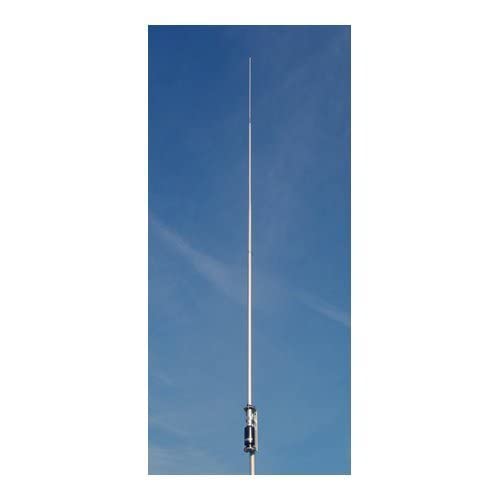
The no-radials, no-tuning vertical for small lots that still wants a worldwide signal.
Comet’s headline is the relief every small-lot owner wants: no radials required, no tuning or adjustments needed, with SWR of 1.6:1 or lower on all bands from 80 through 6 meters. It handles up to 250W PEP SSB and accepts any cable with a PL-259 (the standard UHF connector) with mast pipes between 1.2 and 2 inches in diameter. Owners confirm the broadband claim—one reports 1:1 SWR on 10, 20, and 40 meters with worldwide contacts on the first day, catching Germany, Italy, Washington, Montana, Florida, and Belize from North Carolina.
The performance reality comes with conditions. Height matters enormously: owners note it needs around 35 feet, with a grounded mast and specific coax length (60–66 feet of RG8X) to avoid SWR surprises, and below 15 feet it loses power noticeably. At 30 feet, one operator has run it since 2017 and completed Digital DXCC on 10–30 meters with solid scores on 40 and 80. One dissenting owner found the upper tubing flimsy in wind and called DX performance mediocre, so it rewards a sheltered mount.
This is a niche pick: the no-radial convenience is a genuine differentiator for HOA lots and apartment balconies, but it asks for height and a clean install to shine. It is a 7-pound permanent vertical, not a portable.
The convenience win
- No radials and no tuning—the simplest 40m vertical install
- SWR of 1.6:1 or lower across all bands
- Broadband design works 80m through 6m
What it demands
- Performance drops noticeably below 15 feet of height
- Upper tubing can flex in strong wind; a sheltered mount helps
Best for: the operator with a small lot or HOA limits who wants 40 meters without laying a radial field.
Who it isn’t for: anyone who can’t offer it 30+ feet of height—the vertical needs elevation to earn its keep.
Understanding the Specs
SWR (Standing Wave Ratio)
This is the number that tells you how much of your radio’s power actually leaves the antenna. A reading of 1:1 is perfect, and anything under 1.5:1 is excellent for most rigs. The lower the SWR, the more of your 100W actually goes into the air instead of bouncing back and heating up your radio. If you see 2:1 or higher, your radio’s protection circuits may cut power—so tuning matters.
Counterpoise vs. Radials
A vertical antenna needs a ground plane—a set of wires (radials) or a counterpoise—to complete the circuit and provide a low-impedance return path. Without them, your vertical becomes part of the coax shield, causing noise and poor performance. Plan for at least 4 radials, though more gives diminishing returns. An end-fed half wave needs just one counterpoise wire, which is why it suits portable ops.
FAQ
Do I really need an antenna tuner for a 40 meter band antenna?
How much space does a 40 meter dipole need?
What is the difference between an EFHW and an OCF dipole?
Will the Yaesu ATAS-120A work with my non-Yaesu radio?
Do vertical antennas need radials?
What power rating do I need for my 40 meter antenna?
Can I use a 40 meter vertical for POTA or portable field work?
Why is my SWR high after I set up the antenna?
Final Thoughts: The Verdict
If you want one dependable pick, the 40 meter band antenna winner is the JPC-12 because it pairs genuine 8-band coverage with tool-free tuning and a 3 lb packable design that goes from backpack to on-air in five minutes. If you want easy multiband DX with one long wire and no tuning box, grab the JYR8010-400W. And for a fixed base station that covers 40 meters plus four more bands with minimal fuss, the Hustler 5BTV is the one to reach for.
How We Picked
We do not accept paid placement. Every pick is matched to a real buyer and a real use-case; we do not hands-on test units.
Sources & Methodology
Specifications: manufacturer listings and product documentation. Review insights: verified customer reviews, as of August 2026. Pricing: not shown on this page (it changes often); check the current price via the retailer link.
As an Amazon Associate, Gadgets Feed earns from qualifying purchases. This does not affect which products we feature.