
Our readers keep the lights on and my morning glass full of iced black tea. As an Amazon Associate, I earn from qualifying purchases.
Specs are compiled from manufacturer listings and verified buyer reviews and can change over time — please confirm the key details on the product page before buying.
You want to hook up a washing machine, but you only have one cold-water tap, or you are tired of unscrewing hoses every time you switch between the washer and a garden hose. A 2-way washing machine tap solves this by giving you two independent outlets controlled by their own shut-off valves, so you can leave both hoses connected and just turn a handle to switch. The real question is if you need a full wall outlet box for a laundry room remodel, or a simple brass splitter that threads onto your existing faucet.
I’m Min — the founder and writer behind Gadgets Feed. This guide is built by comparing the manufacturers’ published specifications and the patterns across verified customer reviews, so you get each pick’s real strengths and trade-offs instead of marketing spin.
The right 2 way washing machine tap depends on your pipe type, your space, and if you want shut-off valves right at the wall.
Our Picks at a Glance

How To Choose The Best 2 Way Washing Machine Tap
Before you buy, you need to know what kind of water pipe you have coming out of your wall. This single detail decides whether your install takes ten minutes with a push-fit fitting or requires soldering a copper pipe. Match the inlet to your pipe type and the outlet to your washing machine hose, and the rest is easy.
Match the inlet to your pipe
Push-to-connect inlets (also called push-fit) grab onto 1/2-inch PEX, CPVC, or copper pipe without any tools or glue — you just push the pipe in until it clicks. A sweat inlet, by contrast, needs a torch and solder to join to copper. A threaded G1/2 or NPT inlet screws onto an existing faucet thread. Check your wall pipe before ordering, because a 1/2-inch inlet cannot connect to a 3/4-inch pipe.
Count the shut-off valves and check the pressure rating
A true dual-outlet tap gives you two independent valves, so you can shut off the washer while the second outlet stays live, or vice versa. Look at the maximum operating pressure too — many brass splitters handle up to 150 PSI, which covers standard household water pressure. If your house sits above 80 PSI, choose a valve with a clearly stated high pressure rating.
Decide between a wall box and an inline splitter
A washing machine outlet box mounts inside the wall, hides the shut-off valves behind the machine, and often includes water hammer arrestors (devices that absorb the shock and stop the banging noise when the washer stops filling). An inline splitter simply threads onto an existing faucet and gives you two hose connections — it is cheaper and much easier to install, but it sticks out from the wall and gives you less control over water hammer.
Quick Comparison
| Model | Best For | Inlet Type | Outlet Size | Shut-off Valves | Amazon |
|---|---|---|---|---|---|
| EFIELD Washing Machine Box★ Best Overall | Full laundry room install | 1/2″ push-fit | 3/4″ MHT | 2 (1/4-turn) | Amazon |
| GOTOTOP Brass SplitterBudget Champion | Budget faucet splitter | G1/2 thread | 2 hose outlets | 2 (lever) | Amazon |
| SOMATHERM 1630-20 | Two appliances, one faucet | M20/27 (3/4″) | 2x Mle 20/27 | 2 (1/4-turn) | Amazon |
| Lidertik Outlet Box | Versatile wall mount | 1/2″ push-fit | 3/4″ NH | 2 (brass ball) | Amazon |
| Kingston Brass KF1000 | Replacing old valve | 1/2″ sweat | 3/4″ hose thread | 2 (dual outlet) | Amazon |
In-Depth Reviews
1. EFIELD Washing Machine Box
Our pick — over 4.5★ from 200+ verified ratings; the strongest balance of quality and price.
The wall box that kills the banging noise while it feeds your washer.
The EFIELD outlet box is the pick for a proper laundry room setup, because it brings push-fit convenience and noise control in one unit. Its 1/2-inch push-fit inlet grabs onto PEX, CPVC, or copper pipe without soldering, while the 3/4-inch male hose thread outlet connects straight to your washing machine hose. Two 1/4-turn hot and cold ball valves let you shut off each line independently, and the stainless steel water hammer arrestors absorb the shock when the washer stops filling.
The build quality is what wins people over here — buyers report “no leaks and easy to install for an upgrade to my preexisting system.” The pre-installed support bracket and two disconnect clips mean the box mounts securely inside the wall, and the Snap-on Frame fits drywall up to 1 inch thick. Six hookups take about ten minutes each, and the fit is exactly what the installation needs.
What is the catch? Setup can be a bit tricky if you have never worked with push-fit fittings, though the included clips make removal easy if you need to reposition. The box measures 9.25 x 3.5 x 8 inches, so give yourself enough wall cavity space before cutting the hole.
Why it leads
- No soldering — push-fit inlet clicks onto pipe in seconds
- Stainless steel arrestors stop water hammer bang
- Support bracket and disconnect clips included
The honest trade-off
- Install can be fiddly for first-time DIYers
- Needs a decent wall cavity for the 8-inch depth
The right fit: If you are remodeling a laundry area and want a clean, flush wall box with quiet filling, this is the one.
Reach for it when: Your pipes are 1/2-inch PEX or copper and you would rather push than solder.
2. GOTOTOP Brass Splitter
A cheap brass workhorse that turns one faucet into two.
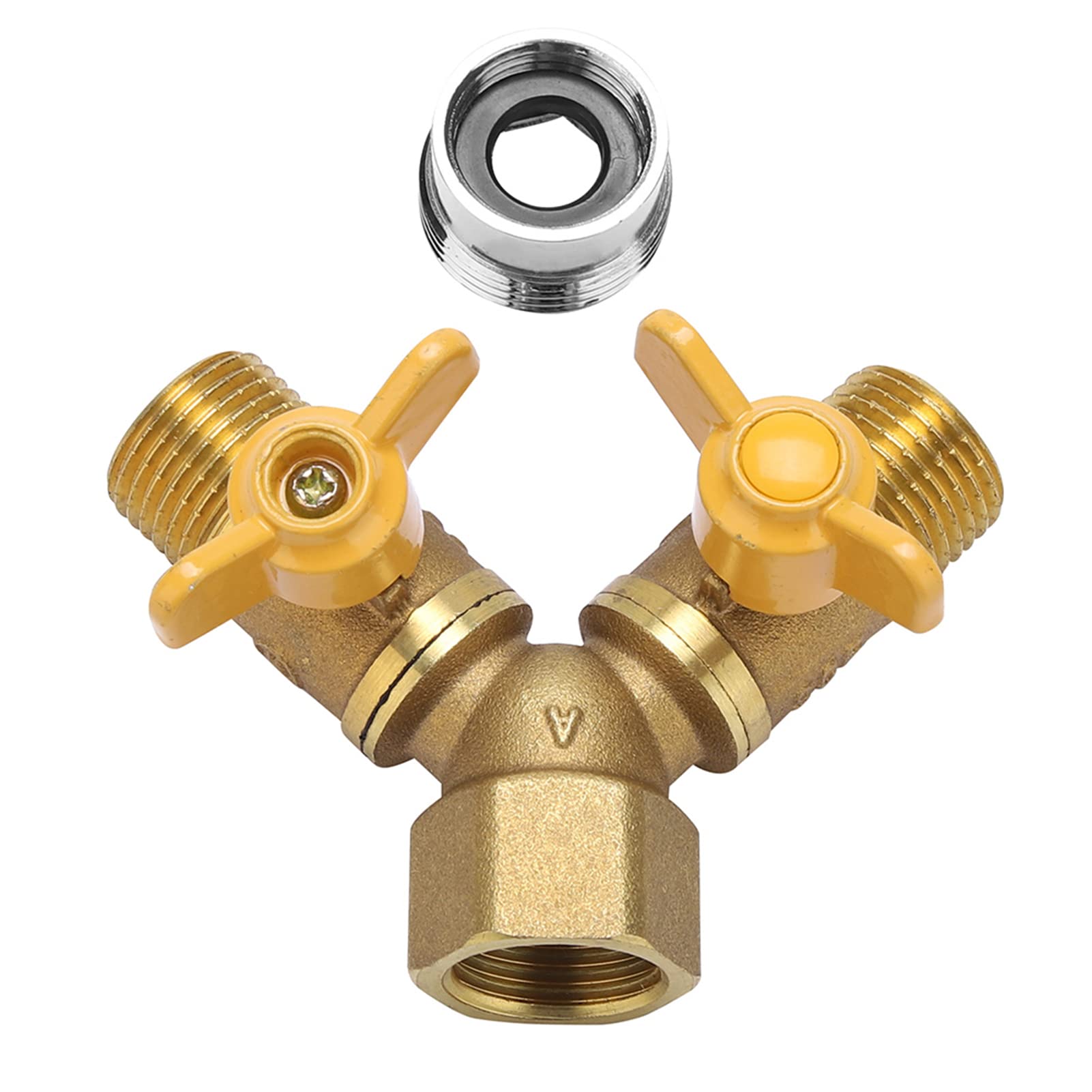
The GOTOTOP is the simplest way to get two outlets from one tap: it threads onto a standard 1/2-inch connection and gives you two hose outlets, each with its own lever shut-off valve. The whole body is solid brass, which is strong and resists leaks far better than plastic splitters at this level. Two ergonomic handles let you adjust the water flow on each side independently, so you can water the garden at full pressure while dripping into a bucket at low flow.
The real-world reviews are almost all the same story. Owners mention it “splits my camper water heater for shower and sink” with no issues, and others say it simply “works and doesn’t leak” after months of use. The G1/2 thread size and NPT threading are standard, so it fits most household faucets and garden hoses.
The trade-off is scope, not quality: this inline splitter gives you no water hammer protection and no wall-mounting, so it is best where you just need a second outlet fast. It is also a 1/2-inch connection only, so check your faucet thread before ordering.
Straightforward buy: For the money, this is the most direct route to two independent outlets — no wall work, no soldering, just thread it on and turn the levers.
Skinny on extras: It lacks the arrestors and bracket of a full outlet box, so treat it as a faucet adapter, not a laundry-room fixture.
3. SOMATHERM 1630-20 Diverter
A compact brass Y that feeds a dishwasher and washer from one tap.
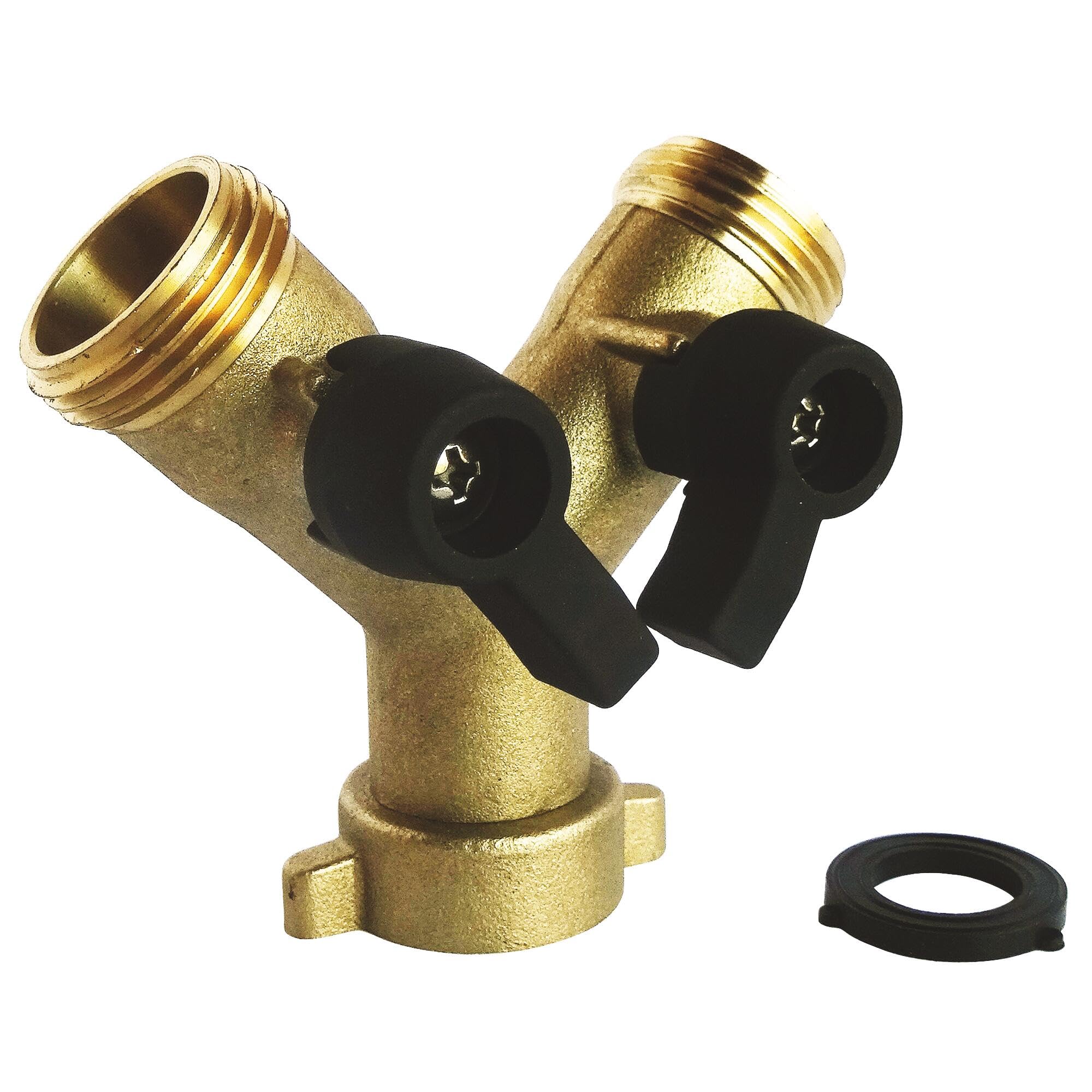
This one is built for a tight plumbing spot where two appliances share a single supply. The SOMATHERM is a brass Y-shaped connector with a double outlet (Mle 20/27, which is 3/4 inch) and two independent 1/4-turn shut-off valves, so you can run a dishwasher and a washing machine from the same feed without constant hose-swapping. Buyers call it “bien pratique pour brancher 2 appareils nécessitant deux arrivées d’eau lorsqu’il n’y a qu’un seul robinet disponible” — handy for hooking up two devices when only one tap exists.
It is rated for hot water, with a maximum operating temperature of 90°C, so it will not soften or warp on a hot supply line. The maximum operating pressure of 4 bar (about 58 PSI) covers typical home pressure. The brass body carries two plastic controllers, which keeps the weight down to 5.6 ounces — a fraction of the 12.8-ounce Lidertik box above.
The honest note: because both outlets share one feed, buyers advise running the two appliances one at a time, since simultaneous use can split the pressure too thin. This is a diverter for convenient switching, not a high-flow manifold.
What it does best
- Hot-water rated to 90°C, safe on supply lines
- Two independent 1/4-turn valves in a small brass Y
- Light at 5.6 ounces, easy to fit in tight spots
Know before you buy
- Best run one appliance at a time to keep pressure up
- M20/27 thread, so verify compatibility with your tap
Built for pairs: If you are wiring a washer plus a dishwasher into one supply, this Y keeps both ready without a wall box.
Remember: It is a pressure splitter, not a pressure booster — sequential use is the safer pattern.
4. Lidertik Outlet Box

The push-to-connect wall box that keeps the plumbing out of sight.
The Lidertik is a full washing machine outlet box with a slightly slimmer footprint than the EFIELD, measuring 10.19 x 3.2 x 7.8 inches, and it ships with everything you need to mount it. Its 1/2-inch push-to-connect inlet works with PEX, CPVC, or copper pipe, so no torch or glue is required — the outlet is a 3/4-inch NH thread that takes a standard washing machine hose. Two brass ball valves sit up top for hot and cold shut-off, and the included 2 adjustable mount brackets plus a disconnection clip tool make the install straightforward.
Early customers note it is working great with no drama, and the twin ball valves are smooth to turn. The box is compliant with US regulations, which matters if you are doing a permitted renovation. The brass-and-plastic construction keeps it light at 12.8 ounces, yet it still feels solid in the hand.
The catch is that it is a newer listing, so the long-term track record is thinner than the EFIELD’s, and the 3/4-inch NH outlet assumes you have a standard hose. If you want the cleanest look with a small wall cavity, this slim box is the smarter fit.
Quick and tidy: You get a recessed, professional-looking valve bank without breaking out a soldering torch.
Reach for it when: Space is tight but you still want proper wall-mounted shut-offs and a bracket kit included.
5. Kingston Brass KF1000

The drop-in valve that revives an old laundry setup without soldering.
The Kingston Brass is the odd one out here in the best way: it is a replacement valve, not a wall box, and it is a favorite for reviving aging laundry hookups. Its 1/2-inch sweat inlet is meant to be soldered onto copper, but the reviews make clear that most buyers never touch a torch — they just unscrew the two screws on their old valve, swap the top half, and go. Reviewers point out it is “so easy to replace… just unscrew the 2 screws and swap out” in about 10 minutes, with no leaks.
The dual outlet feeds two 3/4-inch hose threads, so it connects two washing machine hoses, and the all-brass body is rated for a maximum 150 PSI. The O-rings align well with older OEM valves, which is why it drops into 35-year-old bases perfectly. Owners expecting it to last describe the build as durable and solid.
This one is not the pick if you are starting from bare pipe in a new basement — you would still need to sweat the inlet. But as a serviceable replacement for a worn-out valve, it is the most proven option here, with a strong track record of clean swaps.
Why owners love it
- Two-screw swap replaces an old valve in about 10 minutes
- 150 PSI max pressure on a solid brass body
- O-rings align with older OEM valve bases
The fine print
- Sweat inlet means new installs need soldering
- Not a wall box — no mounting bracket or arrestors
For the handyman: If an old valve is leaking but the base is still good, this is the cheapest, cleanest fix on the list.
skip it if: You are running new pipe and want push-fit convenience instead of solder.
Understanding the Specs
Inlet connection type
This is the single most important spec, because it decides your installation effort. Push-to-connect means you push the pipe in and it locks — no tools. Sweat means you must solder the fitting onto copper pipe with a torch. Threaded (G1/2 or NPT) means you screw it onto an existing faucet. Match this to your wall pipe, not to your dream install.
Shut-off valves and pressure
Two independent shut-off valves let you control each outlet separately, which is the whole point of a 2-way tap. Pressure ratings tell you the ceiling: a valve rated to 150 PSI handles standard household pressure without stress, while a 4-bar (about 58 PSI) rating covers typical homes but leaves less headroom. Water hammer arrestors, when present, absorb the shock that makes pipes bang when the washer stops.
FAQ
Will a 2-way tap fit my existing washing machine hoses?
What is the difference between an outlet box and an inline splitter?
Can I run the washing machine and a second hose at the same time?
Do I need to solder a push-to-connect tap?
What is a water hammer arrestor for?
How do I know if my pipe is 1/2 inch or 3/4 inch?
Can these taps handle hot water?
What is the difference between a dual-outlet valve and a single-outlet valve?
Final Thoughts: The Verdict
If you are setting up a laundry room and want a clean, noise-free install, the EFIELD Washing Machine Box is the 2 way washing machine tap worth building around, because its push-fit inlet and stainless steel arrestors solve both the installation and the banging in one box. For a fast, cheap fix on an existing faucet, the GOTOTOP Brass Splitter gives you two outlets with minimal effort. And if you are reviving an old valve without touching a torch, the Kingston Brass is the proven swap-in that owners keep coming back to.
How We Picked
We do not accept paid placement. Every pick is matched to a real buyer and a real use-case; we do not hands-on test units.
Sources & Methodology
Specifications: manufacturer listings and product documentation. Review insights: verified customer reviews, as of August 2026. Pricing: not shown on this page (it changes often); check the current price via the retailer link.
As an Amazon Associate, Gadgets Feed earns from qualifying purchases. This does not affect which products we feature.