
Our readers keep the lights on and my morning glass full of iced black tea. As an Amazon Associate, I earn from qualifying purchases.
Specs are compiled from manufacturer listings and verified buyer reviews and can change over time — please confirm the key details on the product page before buying.
The quickest way to cut the charging cable out of your daily routine is a wireless charger adapter — a small receiver that gives a phone without built-in wireless charging the ability to work with any Qi charging pad. This guide sorts the DIY module builds from the plug-in receiver patches, so you can tell which one will actually keep your phone topped up before you spend a dime.
I’m Min — the founder and writer behind Gadgets Feed. This guide is built by comparing the manufacturers’ published specifications and the patterns across verified customer reviews, so you get each pick’s real strengths and trade-offs instead of marketing spin.
The right wireless charger adapter depends on whether that receiver is being built into a project or simply plugged into your phone’s port — and that one decision changes everything about speed, heat, and reliability.
Our Picks at a Glance
How To Choose The Best Wireless Charger Adapter
The single biggest mistake buyers make is confusing a receiver patch (which goes on your phone) with a charging module (which goes inside your own build). Decide which one you actually need first — one adds Qi to a phone that lacks it, the other lets you build a custom charging surface.
Receiver patch or DIY module — pick your lane
A receiver adapter is a thin coil you plug into your phone’s Type-C port (or stick to its back) so it can charge on any Qi pad. A PCBA module is a bare circuit board meant to be embedded into furniture, a car console, or a prototype. If you just want your current phone to charge wirelessly, you want the receiver. If you are building something, you want the module.
Voltage and wattage tell you the real speed
Look at the input voltage and amperage, because they decide whether your phone gains charge or just slowly drains. A receiver with a 5-volt / 2-amp input typically delivers around 5-7.5W of real-world output — enough to hold steady if you are not using the phone, but too slow to outpace heavy use. The DIY module in this list runs on 9 volts and supports charging tiers up to 20W, which is why it is the choice for faster builds.
Coil alignment and case thickness are everything
Wireless charging only works when the coil in the adapter lines up cleanly with the coil in the pad. A thick case or a misaligned patch can kill the connection entirely. If your phone sits in a rugged case, a receiver patch that plugs into the port is easier to position correctly than a stick-on coil.
Quick Comparison
| Model | Best For | Max Output | Input Voltage | Amperage | Amazon |
|---|---|---|---|---|---|
| Sevilinlu DIY PCBA Module (2-Pack)★ Best Overall | Custom Car or Furniture Builds | 20W | 9V | — | Amazon |
| Razanmo Receiver for Samsung Galaxy A-Series | Adding Qi to Samsung A-Phones | 7.5W | — | 1.5A | Amazon |
| IVY Ultra-Thin Type-C Receiver Patch | Qi Pads for USB-C Android Phones | 5W-7.5W | 5V | 2A | Amazon |
In‑Depth Reviews
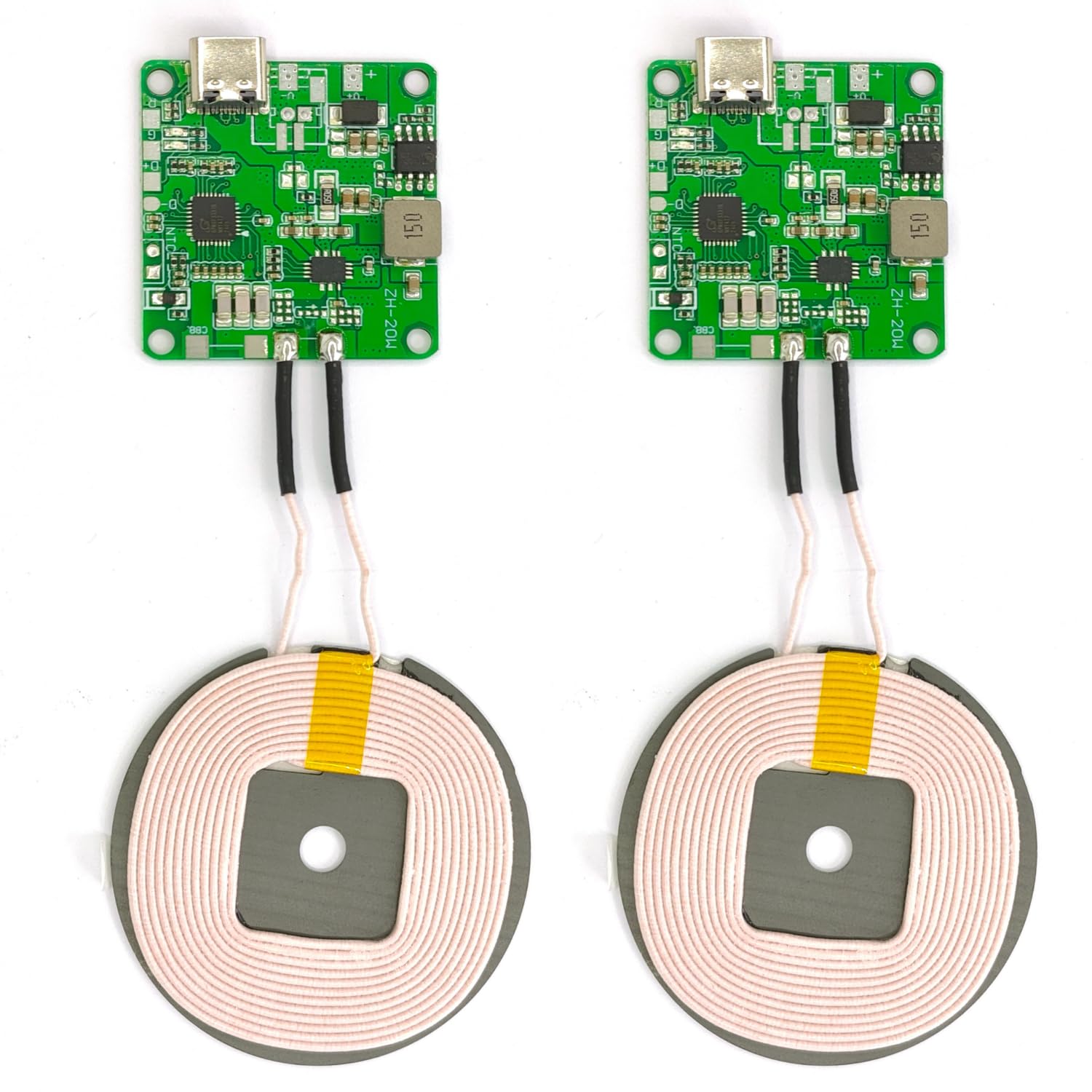
1. Sevilinlu 2Pcs 20W Max QI Wireless Charger PCBA Module Coil
Our pick — over 4★ from 20+ verified ratings; the strongest balance of quality and price.
A bare circuit board that turns your woodworking or truck build into a real 20W charging station.
If you are building a charging pad into a car console, a desk, or a wooden gift, this is the module to plan around. It runs on a 9-volt input and supports five charging power tiers up to 20W — so it comfortably beats the 7.5W ceiling of plug-in receiver patches. Buyers report real-world speeds around 10W with fast charging off, and higher when you enable it, which is plenty for a full charge during a drive.
The safety story here is unusually strong for a bare board. A built-in management chip adds six protections — over-current, over-voltage, over-heat, over-power, under-voltage, and short-circuit — so a mistake in your wiring is less likely to fry the phone sitting on top. The 0-8mm sensing distance is the catch: owners who embedded it under material say you should keep that gap to a maximum of 3mm between the coil and the phone, or the charge weakens noticeably. As owners mention: “distance may not be exactly as advertised I had to do a max of 3mm material between the charger and my phone.”
It has been bought three times over by one owner who built wood Qi cases as gifts, and it is used in prototype projects with the note to watch power draw when running off a battery. The two-pack means one failed experiment costs you nothing — you still have a spare. This is the pick if you enjoy the build itself.
Builder’s verdict: The most capable and safest module here, with 20W headroom and six protection circuits that forgive wiring mistakes.
The honest limit: Your enclosure material must stay under 3mm thick or you lose the charge — plan your build around that gap.
Reach for this if: you are embedding a charger into furniture, a car, or a prototype and want the fastest output of the three.
Look elsewhere if: you just want your phone to charge wirelessly today — a receiver patch is far simpler than a soldering project.
2. Razanmo Wireless Charging Receiver for Samsung Galaxy A12 A22 A32 A42 A52 A72
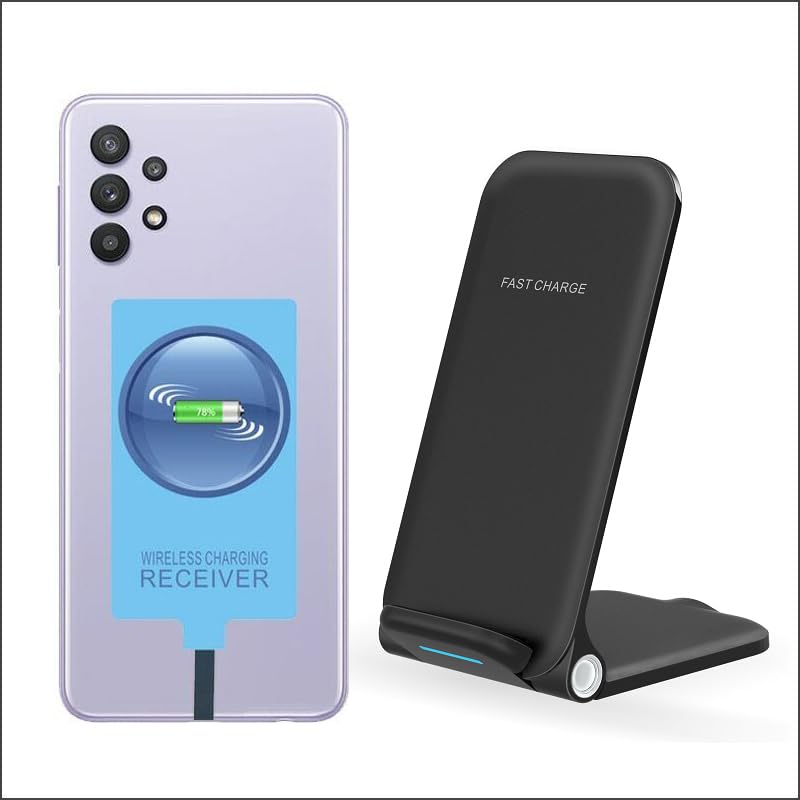
The plug-in receiver that finally adds wireless charging to Samsung’s budget A-series workhorses.
This one is built for a very specific crowd: anyone with a Samsung Galaxy A12, A22, A32, A42, A52, or A72 (4G or 5G) who is tired of hunting for a cable. It plugs straight into your Type-C port and delivers roughly 7.5W of output at a 1.5-amp draw — not a fast charge compared to wired, but enough for overnight or desk-top-up duty. The included folding stand props your phone up vertically or horizontally while it charges, which turns charging time into hands-free video or video-chat time.
The durability reports are the standout. Customers note it has been used daily for 5 months with no problem so far, and the design surprised owners who doubted it would work at all — “the charging is great and fast” despite the short cable. The key installation tip from the review pages is to seat the USB plug fully until it clicks, and if you run a two-part case, tuck the pack between the layers so it sits closer to the charging pad.
The compatibility wall is real, though. It is tuned for the A-series listed and no further — an owner pairing it with an A32 found it did not pair as stated, and another with a different model hit the same wall. It only works with simple TPU, PC, or silicone cases, and it draws 1.5A versus the 2A of the IVY patch below. Keep the model list in mind before you order.
Daily driver: A proven 7.5W receiver that has survived months of daily use and doubles as a viewing stand.
Fit warning: Buy this only for the exact Samsung A-series models in the title — other phones may simply refuse to pair.
Best for: Samsung Galaxy A-series owners who want wireless charging plus a hands-free stand in one compact package.
Think twice if: you carry anything outside that A-series list or a thick two-part case that pushes the coil away from the pad.
3. IVY Ultra-Thin Type-C Qi Wireless Charging Receiver Adapter [5V/2A Max]
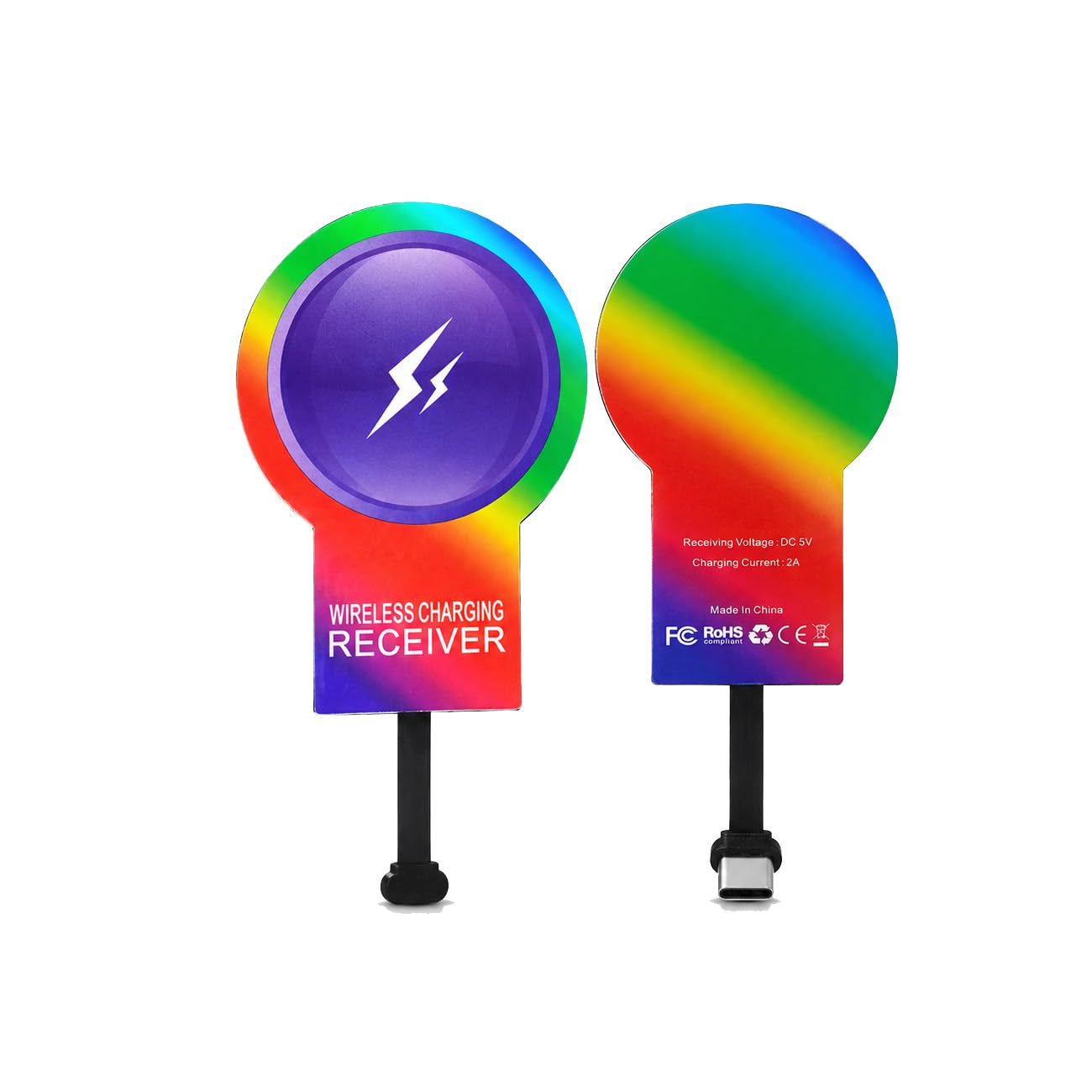
A 5-gram paper-thin patch that adds Qi to USB-C Android phones — if you feed it a powerful pad.
This receiver patch weighs just 5 grams and is built for USB-C Android phones like the Google Pixel 5 through 8a, plus a range of Samsung and Sony models. It takes a 5-volt / 2-amp input and converts it to a real-world output of roughly 5W to 7.5W — which is why the maker is blunt that this is not a fast charger. It is a receiver patch only: you must supply your own Qi charging pad and a PD/QC wall adapter rated at 15W or higher for the pad.
The build quality is genuinely praised — owners describe an easy install with a strong magnetic hold that exceeds its claimed 10W/2000mAh specs, reaching 11-12W/2600mAh in one measured test. Those same owners stress the two non-negotiables: the circular coil in the patch must align dead-center with your pad’s coil, and a wall adapter that is too weak will make charging repeatedly stop and start.
The honesty gap shows in the speed complaints. Reviewers point out charging that is “very very very slow” and, in some cases, a phone that drains instead of charges while sitting on the pad, with the phone warning that something is wrong. The consensus is clear: this patch works beautifully with a strong 25W Qi2 charger — one owner got 1.4A (7W) on a tablet through a wall plate — but it demands the right gear around it. Skimp on the pad or adapter and you will blame the patch.
What wins people over
- Featherweight 5-gram patch that disappears behind a phone case
- Geniune build quality that can exceed the claimed 10W spec with the right charger
- Works through a wall plate with proper magnetic alignment
The gear it demands
- Needs a 15W+ Qi pad and an 18W/20W PD/QC adapter or charging stalls
- Coil must align perfectly with the pad or you get slow or no charging
- Speed is the weakest link — shoppers say draining while on the pad
Choose this if: you already own a strong wireless pad and want a 5-gram patch to make a USB-C phone Qi-ready with solid build quality.
skip it if: you are working with a basic budget pad — the recurring complaints all trace back to underpowered charging gear.
Understanding the Specs
Input Voltage
This is the power the receiver asks for before it can charge your phone. The Sevilinlu module wants 9 volts, which open up its higher 20W ceiling — the IVY patch runs on a modest 5 volts, capping it near 7.5W in practice. A higher input voltage usually means a faster charge, but it also demands a wall adapter that can actually supply that voltage.
Amperage and Real Output
Amperage is the current flowing into the receiver, and it sets a hard limit on speed. The IVY patch accepts 2 amps, while the Razanmo draws 1.5 amps — that 0.5-amp gap is the difference between a receiver that can hold its own and one that may just tread water. Expect real-world output to land 20-30% below the rated input because converting wireless power always loses some energy to heat.
FAQ
Is a wireless charger adapter the same as a wireless charging pad?
Will a receiver adapter work with my phone if it already supports wireless charging?
Why does my phone drain instead of charge while on the wireless pad?
How thick can my phone case be for wireless charging to work?
Does coil alignment really matter for these adapters?
Can a DIY charging module be used to build a custom charger?
Are wireless charging adapters safe to leave plugged in overnight?
Is the Razanmo receiver compatible with any Samsung phone?
Final Thoughts: The Verdict
For most buyers, the wireless charger adapter winner depends on your project. If you are building a charging surface into a car or piece of furniture, the Sevilinlu DIY module is the clear choice — it is the only option here with 20W of headroom and six protection circuits. If you own a Samsung Galaxy A-series phone, the Razanmo receiver is the proven daily driver with a built-in stand and months of trouble-free use reported. And for Pixel or other USB-C Android users who already own a strong Qi pad, the IVY ultra-thin patch offers an impressive 5-gram build that rewards proper alignment and a powerful adapter — but punishes weak charging gear.
How We Picked
We do not accept paid placement. Every pick is matched to a real buyer and a real use-case; we do not hands-on test units.
Sources & Methodology
Specifications: manufacturer listings and product documentation. Review insights: verified customer reviews, as of August 2026. Pricing: not shown on this page (it changes often); check the current price via the retailer link.
As an Amazon Associate, Gadgets Feed earns from qualifying purchases. This does not affect which products we feature.