
Our readers keep the lights on and my morning glass full of iced black tea. As an Amazon Associate, I earn from qualifying purchases.
Specs are compiled from manufacturer listings and verified buyer reviews and can change over time — please confirm the key details on the product page before buying.
Cutting a 4 1/4 inch hole is usually where a project goes sideways. You fight a dull blade, watch it smoke through wood, or discover halfway through that it won’t fit your arbor. This guide separates carbide and bi-metal cutters that handle tough jobs from those that will frustrate you. You’ll see what makes each bite into steel or glide through drywall, so you can finish that deadbolt, recessed light, or vent install without frustration.
I’m Min — the founder and writer behind Gadgets Feed. This guide is built by comparing the manufacturers’ published specifications and the patterns across verified customer reviews, so you get each pick’s real strengths and trade-offs instead of marketing spin.
From deadbolt upgrades to recessed lighting, the right 4 1/4 hole saw makes the difference between a clean cut and a burned mess. 4 1/4 hole saw options vary wildly in tooth count, depth, and arbor fit, so this guide breaks down the best ones for your specific job.
Our Picks at a Glance

How To Choose The Best 4 1/4 Hole Saw
Before you buy, match the cutter to the material you’ll slice. A saw that glides through drywall can overheat and dull on a steel door. Your choice hinges on three specs: the tooth material (the cutting edge’s composition), the cutting depth (how thick a board it can pass through), and the shank (the part that locks into your drill chuck).
Match the teeth to the material
Bi-metal teeth, made from high-speed steel, are the everyday workhorse for wood, plastic, and thin metal. They’re affordable and cut clean. Tungsten carbide tips are the heavy lifters; they shrug off nails, cement board, and stainless steel that would dull a bi-metal blade in seconds. If your project involves anything abrasive, carbide is the answer.
Check the cutting depth for thick stock
Depth is measured from the teeth to the back of the cup. A standard saw cuts about 1 1/2 to 1 3/4 inches deep, fine for a single layer of drywall or a standard door. If you’re boring through a thick desktop or a laminated work surface, you need a deep-cut version that can clear 2 inches or more in one pass, saving you from flipping the material.
Verify the arbor connection before you buy
The arbor is the metal shaft that locks the saw into your drill chuck. Most use a 3/8-inch hex shank or a standard 5/8-18 thread. If you already own a mandrel from another brand, check that it’s a universal thread so your new cutter clicks right in. A mismatch means buying an adapter or a whole new arbor.
Quick Comparison
| Model | Best For | Tooth Type | Cutting Depth | Arbor Fit | Amazon |
|---|---|---|---|---|---|
| Disston Blu-MOL Xtreme★ Best Overall | All-around metal and wood cutting | Bi-Metal | 1 1/2 inch | Standard Mandrel | Amazon |
| DKIBBITH TCTBest Value | Steel doors and hard metals | Tungsten Carbide | 1 inch | 3/8-inch Shank | Amazon |
| CENYB TCTFast Cutter | Fast cuts in mild steel | Tungsten Carbide | 1 inch | 10mm Shank | Amazon |
| Genubi Industry Set | Recessed lighting with dust control | Bi-Metal | — | Matching Arbor | Amazon |
| MaxTool M42 | Deep cuts in one pass | Cobalt M42 | 1.75 inch | 5/8-18 Thread | Amazon |
| Spyder Carbide | Cement board and fiber cement | Tungsten Carbide | — | Universal Thread | Amazon |
| Diablo Demo Demon | Rough carpentry and demolition | Tungsten Carbide | 2-3/8 inch | SnapLock Plus | Amazon |
| Starrett Deep Cut | Deep holes with included arbor | Bi-Metal HSS | 2 inch | Included Arbor | Amazon |
| Starrett Carbide Tipped | Abrasive plaster and siding | Tungsten Carbide | 1-5/8 inch | Universal Arbor | Amazon |
In‑Depth Reviews
1. Disston Blu-MOL Xtreme Bi-Metal Hole Saw
Our pick — over 4.5★ from 250+ verified ratings; the strongest balance of quality and price.
The dependable workhorse that slices through stainless steel and still comes back for more.
What wins people over here is the cutting performance — it’s the thing owners talk about most. This saw chews through wood, OSB, and hardiplank siding with ease, and buyers report it even handles stainless steel smoothly and accurately with no wobble or binding. The teeth arrive sharp, and the blade makes the hole in seconds; one owner used it about four times and says it’s still good.
It gives you a 1 1/2-inch depth of cut, so it handles a standard door or a single layer of siding in one go. The fleem ground teeth are designed for longer life, and the wide slot designs on the sidewalls plus backing plate give you better visibility while you cut. Large openings in the backing plate let you pop out the cut material quickly.
The only note of caution is fit. A few owners mention it doesn’t match standard mandrels, even though others say it fits Lenox, Ridgid, Milwaukee, and Diablo arbors just fine. The sharpness also gets mixed feedback, with some saying it doesn’t last as long as they’d like. Check your arbor before you order.
Where it shines
- Cuts stainless steel, OSB, and siding cleanly
- Fits multiple standard mandrels including Lenox and Milwaukee
- Large openings make plug removal quick
Check before you buy
- Some units don’t fit standard arbors
- Sharpness doesn’t wow everyone long-term
Reach for this if: you want one versatile bi-metal saw for wood, siding, and occasional stainless steel work without overpaying.
Look elsewhere if: your project is pure abrasive demolition — you’ll want carbide tips for that.
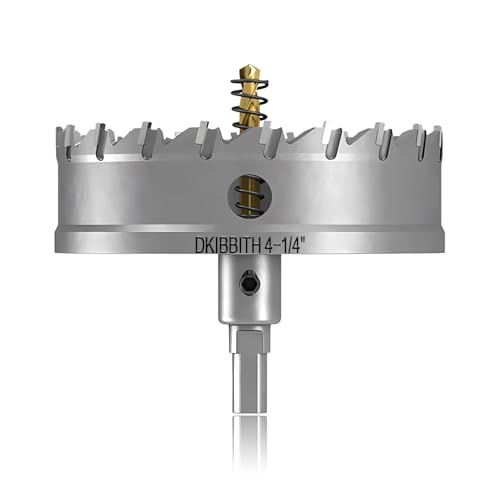
2. DKIBBITH TCT Heavy Duty Hole Saw Set
The steel-door specialist that cut through a deadbolt upgrade in seconds flat.
Cutting performance is the standout here — easily the most praised thing about this carbide cutter. One owner upgraded a deadbolt and first tried a hole saw that refused to cut the steel door. This one cut through in seconds, and the same story repeats in review after review. It powers through 3/8-inch hard steel, aluminum, copper, iron, and plastic with precision.
It packs 14 tungsten carbide teeth and a reinforced heavy-duty body, with a hole for efficient debris removal. The 3/8-inch 3-flatted shank gives you a strong, steady grip in your chuck, and it’s compatible with regular drills, impact drills, and CNC drilling machines. The kit includes detachable pilot drill bits and Allen wrenches, all oiled and packed in a carrying case for rust-resistant storage.
Be honest about the trade-offs. The build quality gets mixed feedback, with some calling it well-made and others saying it feels cheap. Durability is the recurring concern, with several reports of bits breaking on first use. Go slow with lower torque and use cutting oil, as buyers recommend, and it should serve you well.
Why it wins
- Chews through steel doors and hard metals quickly
- Includes pilot bits and Allen wrenches
- Oiled and stored in a carrying case
The honest catch
- Pilot bit durability is a recurring complaint
- Build quality reads cheap to some owners
Pick it if: you need a budget-friendly carbide cutter for a one-off steel door or metal project.
Think twice if: you plan on daily heavy use — the pilot bits are the weak link.
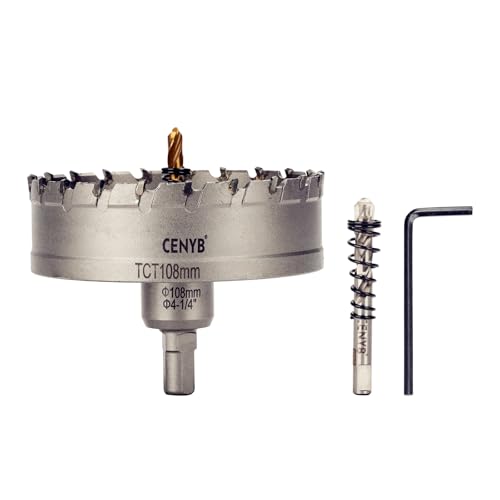
3. CENYB Tungsten Carbide Hole Saw
A 21-tooth carbide brute that chews through mild steel like it’s butter.
Performance is what everyone talks about here — the thing owners rave about most. This saw cuts through mild steel like butter and leaves clean holes behind, with cutting speed being a frequent positive. One buyer used it to cut a clean, true hole in aluminum and was very happy. The carbide is thick and sharp, lasting much longer than steel-tooth versions, according to repeat buyers.
The secret is the teeth count: 21 tungsten carbide teeth with a unique three-blade design — an outer, middle, and inner blade. That setup makes it sharper and more efficient for hard metals. The cutting diameter is 108mm (4-1/4 inches) with a 25mm (1-inch) depth, and the 10mm (3/8-inch) shank fits bench drills, magnetic drills, and gun drills.
Durability is the mixed bag here. While some say it lasts a long time, others report the tips breaking off on contact with certain material. It’s not for concrete, tiles, or stone, so keep it on metal and wood. The kit comes with 2 pilot drill bits and a hex wrench in a plastic box.
What impresses
- 21 teeth cut fast through mild steel
- Three-blade design boosts sharpness
- Big value for the price point
What to watch
- Carbide tips can break on hard contact
- Not rated for concrete or tile
Grab it if: you want a fast, sharp carbide cutter for steel, aluminum, or wood and don’t mind being gentle on initial contact.
skip it if: your work involves concrete, tiles, or stone — the tips won’t survive.
4. Genubi Industry Hole Saw Set with Dust Bowl
The recessed lighting kit that traps the dust so you don’t have to clean the whole room.
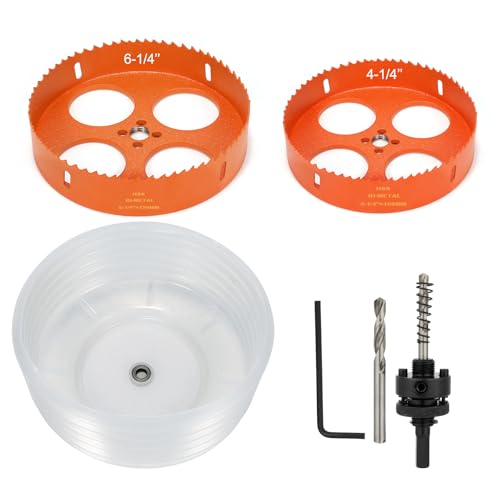
Dust containment is the headline feature here — easily the most praised aspect of this set. The dust bowl traps over 95% of drywall debris, preventing mess., keeping floors and clothing clean., preventing spills on floors and clothing. One owner drilled twelve 6-1/8-inch holes in their garage and says the dust shield surprisingly contained almost all of it. Another called the lack of cleanup “the cherry on top.”
This isn’t just one saw; you get a 6-1/4-inch and a 4-1/4-inch hole saw, a matching dust collection bowl, an arbor with drill bit, a replacement drill bit, and a hex key. The bi-metal construction uses high-speed steel teeth for precision cutting with a flexible steel body for durability. It’s made for ceiling drywall and plasterboard, and it slices through 40-year-old 5/8-inch ceiling drywall easily.
The dust bowl is exclusive to these bi-metal saws, so it won’t work with other brands. And this set is not for glass, ceramic, or concrete. For its intended job — installing canless LED recessed lights — it’s a time-saver that owners describe as capable and a great bang for the buck.
The big win
- Dust bowl traps over 95% of drywall debris
- Includes both 6-1/4 and 4-1/4 sizes
- Stays sharp through a dozen holes
Know the limits
- Dust bowl only fits these saws
- Not for glass, ceramic, or concrete
Choose it if: you’re installing recessed lights and want a clean ceiling with no dust on your floors.
Pass it by if: you’re cutting steel or masonry — this is a drywall and wood specialist.
5. MaxTool M42 Cobalt Hole Saw

The deep-cup cutter that bored a perfect hole through a 1.7-inch Formica desktop.
Quality is the thing owners praise most about this saw. It easily cut a perfect hole through a 1.7-inch thick desktop with a Formica top, which is exactly the kind of job that kills lesser blades. Another owner says it’s deeper than other hole saws and very durable, using it to drill holes for canless brass lights. The teeth arrived super sharp.
The M42 construction uses high-speed steel with 8% cobalt content, giving it superior heat and wear resistance. The variable tooth design — 4/6 varied teeth per inch — reduces vibration for a smoother, faster cut. A 1.75-inch cutting depth lets you get through thick materials in a single pass. It connects via a standard 5/8-18UNF thread so it fits most standard mandrels.
Durability gets mixed feedback, with one owner reporting it ruined two boards. The value for money also reads as mixed. This is a powerful saw that demands respect — owners note it needs a drill with real torque and a firm grip, and recommend starting on the lowest speed. Handle it with care.
Why it stands out
- Deep 1.75-inch cut handles thick desktops
- 8% cobalt resists heat and wear
- Standard 5/8-18 thread fits common arbors
Respect its power
- Needs a high-torque drill and firm grip
- Durability mixed on harder materials
Reach for it if: you’re cutting thick counters, desktops, or layered materials in a single pass.
Steer clear if: you only have a lightweight drill — this saw wants torque behind it.
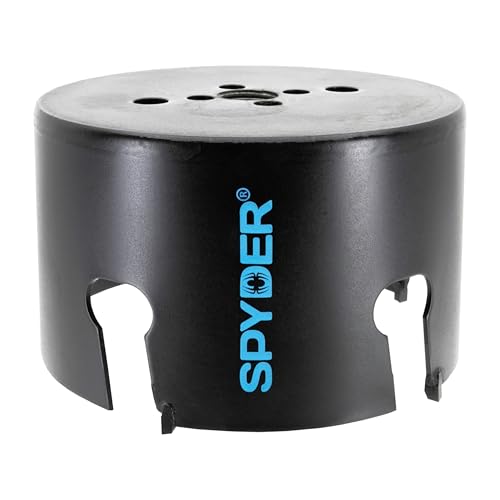
6. Spyder Carbide Tipped Hole Saw
The abrasive-material expert that cut through red cement block for an outdoor faucet.
Cutting performance leads the praise here — the thing owners single out most. One owner found it perfect for drilling through red cement block for an outdoor faucet, while another says it’s the best cutting tool they’ve ever found, cutting far faster than expected. It handles fiber cement, wood, PVC, and plaster and lath with ease. Quality feedback is strong, with buyers noting it’s superior to stamped hole saws.
This carbide-tipped saw is built for the nasty stuff. It drills wood, MDF, plywood, fiber cement board, porous concrete block, some brick, ceramic wall tile, plastic, and PVC. The Spyder Rapid Core Eject arbor system ejects cores without prying and lets you cut at an angle or enlarge existing holes. The universal thread works with Spyder arbors or other universal hole saw arbors.
Durability is the honest concern. Multiple customers note the teeth can break off extremely easily during use, especially if the carbide heats up. One owner advises adding water while drilling to keep the tip cool. The cutting diameter is 10.8 centimeters, and the shank is threaded. Keep it cool, and it’ll treat you well.
Its superpower
- Cuts cement block, fiber cement, and tile
- Rapid Core Eject ejects plugs without prying
- Clean, fast cuts with minimal wear
Handle with care
- Carbide tips can break if they overheat
- Add water during drilling to protect tips
Pick it if: your job involves cement board, brick, ceramic tile, or other abrasive surfaces.
pass on it if: you want a set-and-forget tool — this one demands cooling discipline.
7. Diablo Demo Demon Carbide Hole Saw
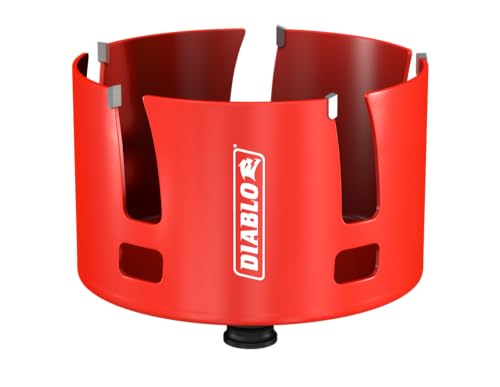
The demolition brute that drilled 80-plus holes through LSL and stayed sharp.
This 4 1/4-inch hole saw is built for tough jobs, and buyers confirm it. One reviewer drilled over 80 holes through 1.75-inch LSL (laminated strand lumber, a dense engineered wood) and reported it stayed sharp, calling it fast, durable, and worth twice the price. Owners describe it as a “beast,” and one self-described Milwaukee fan said it outperformed a Milwaukee model in a direct side-by-side test.
The Demo Demon is built for rough carpentry and demolition. It offers a substantial 60mm (2-3/8-inch) cutting depth — 40% deeper than standard 40mm saws, per the manufacturer. — so you make fewer stops on thick material. The enhanced carbide teeth are designed for precision and durability, and the tune body claims up to 5X faster drilling.. It works with drywall, wood, shingles, and fiber cement.
The tool-free SnapLock PLUS mandrel system makes cup changes quick, and plug ejection is tool-free too. It’s compatible with all Diablo hole saws from 5/8-inch to 6-inch diameter. In exchange for that power, owners note it needs a corded 1/2-inch drill and that it makes rough cuts — not for cabinetry. This is a rough-work specialist.
The raw power
- 2-3/8-inch depth for thick lumber
- Stays sharp through 80+ holes
- Tool-free plug ejection
The trade-off
- Demands a corded 1/2-inch drill
- Rough cuts, not for fine cabinetry
Choose it if: you’re doing heavy rough carpentry, demolition, or high-volume hole drilling and want it done fast.
Look elsewhere if: you need clean finish cuts for visible woodwork.
8. Starrett Deep Cut Hole Saw with Arbor

The deep-cut specialist that comes with its own arbor, ready to work right from the start.
Functionality is what owners appreciate most here. This saw cut clean holes in 1.5-inch particle board with teeth still sharp after five holes, and it’s been used to cut cooler plastic for sous vide setups with sharp, clean rounds and minimal cleanup. It even drilled through 1/16-inch steel successfully. The included arbor makes it a complete package — no hunting for a mandrel.
The cutting depth is 51mm (2 inches), letting you get through thick material in a single pass. It’s constructed of hardened steel and abrasion-resisting high-speed steel teeth with a tough alloy body and cap. The Starrett-designed tooth geometry is meant to deliver huge improvements in chip flow, aggressively clearing swarf as you cut.
Be aware of the arbor. The included one has a 3/8-inch hex shank, and some owners were disappointed it wasn’t a 1/4-inch, needing an adapter for their impact driver. Cutting performance gets mixed feedback, with one owner noting it took about 30 minutes to cut through 2-inch wood. Durability is also mixed, with a report of teeth falling out after two uses. It’s a capable saw, but verify your chuck fits.
What you get
- 2-inch cutting depth in one pass
- Comes with its own arbor included
- Aggressive teeth for chip clearance
Watch out for
- Arbor is 3/8-inch hex, not 1/4-inch
- Slow on thick wood per some owners
Grab it if: you want a deep-cut saw with the arbor included, ready for thicker stock without extra purchases.
Hold off if: your drill only takes a 1/4-inch chuck — you’ll need an adapter.
9. Starrett Carbide Tipped Hole Saw

The plaster-eater that cuts through lath and cement board like a hot knife through butter.
Cutting performance is the top praise here, and the stories back it up. One owner cut holes in plaster in seconds, noting a non-carbide saw was useless after just two cuts. Another drilled a 4-inch hole in a 1/2-inch sheet of hot rolled steel with a 9-amp drill and cutting fluid, and the saw was still sharp afterward. This thing holds its edge well, even through cement board and fiber cement siding.
It uses the high-performance triple chip tungsten carbide tipped design, with just 3 teeth per inch, for long life on difficult and abrasive materials. The 1-5/8-inch cutting depth handles standard plaster, lath, wood, PVC, and fiberglass with ease. One owner cut through 15 holes in plaster and lathe walls, solid wood siding, and vinyl siding with no signs of slowing, while noting a normal bi-metal saw would’ve been toast.
There’s a small trade-off: with only 3 TPI, the finish is smooth on entry and exit but the cut can be slower than finer-toothed saws. It works with universal arbors, and one owner confirmed it fits them fine. It’s priced higher than bi-metal options, but owners feel the cost-per-cut performance justifies it. This is a buy-once tool.
Why it lasts
- Carbide tips cut plaster, steel, and siding easily
- Stays sharp after 15+ abrasive cuts
- Works with universal arbors
The cost of durability
- Premium price over bi-metal saws
- 3 TPI means slower cutting pace
Invest in it if: you regularly cut abrasive materials like plaster, cement board, or nail-embedded wood.
Save your money if: you only need a few holes in plain drywall — a bi-metal saw will do.
Understanding the Specs
Tooth Material: Bi-Metal vs Carbide
Bi-metal teeth are high-speed steel welded to a flexible steel body. They cut wood, plastic, and thin metal cleanly and are the budget-friendly choice. Tungsten carbide tips are far harder, resisting the dulling that comes from nails, cement board, and steel. If your material is abrasive, carbide is the difference between a one-job saw and a long-term tool.
Cutting Depth and Arbor Fit
The cutting depth tells you how thick a material you can get through in one pass. Standard saws handle 1 1/2 to 1 3/4 inches; deep-cut versions clear 2 inches or more for thick desktops and laminated surfaces. The arbor is the shaft that locks into your drill. Universal threads and 3/8-inch shanks fit most chucks, but a mismatch means an adapter or a new arbor.
FAQ
Will a 4 1/4 hole saw fit my standard drill arbor?
Can a 4 1/4 hole saw cut through a steel door?
What is the difference between bi-metal and carbide tipped hole saws?
How deep can a 4 1/4 hole saw cut in one pass?
Will a 4 1/4 hole saw cut through cement board or fiber cement siding?
What is the best hole saw for installing recessed LED lights?
Why does my hole saw burn the wood instead of cutting?
How many holes can I expect from a carbide tipped hole saw?
Is a 4 1/4 hole saw the same as a 108mm hole saw?
Final Thoughts: The Verdict
If you want one dependable pick, the 4 1/4 hole saw winner is the Disston Blu-MOL Xtreme because it balances clean cutting, durability, and broad material compatibility at a price that makes sense for a job-site regular. If you need to chew through steel doors or metal, grab the DKIBBITH TCT. And for abrasive surfaces like cement board or plaster that wreck lesser blades, the Diablo Demo Demon is the one to reach for, with its deep 2-3/8-inch cut and carbide teeth that owners say last through punishing runs.
How We Picked
We do not accept paid placement. Every pick is matched to a real buyer and a real use-case; we do not hands-on test units.
Sources & Methodology
Specifications: manufacturer listings and product documentation. Review insights: verified customer reviews, as of August 2026. Pricing: not shown on this page (it changes often); check the current price via the retailer link.
As an Amazon Associate, Gadgets Feed earns from qualifying purchases. This does not affect which products we feature.