
Our readers keep the lights on and my morning glass full of iced black tea. As an Amazon Associate, I earn from qualifying purchases.
Specs are compiled from manufacturer listings and verified buyer reviews and can change over time — please confirm the key details on the product page before buying.
You don’t need the highest mile rating to get the channels you watch—indoor reception depends more on your walls, your neighbor’s Wi-Fi, and where you place the antenna. The best amplified indoor TV antenna for you is one that pulls in your local channels without constant fiddling, and that depends on the amplifier design and your location, not the biggest number on the box.
I’m Min — the founder and writer behind Gadgets Feed. This guide is built by comparing the manufacturers’ published specifications and the patterns across verified customer reviews, so you get each pick’s real strengths and trade-offs instead of marketing spin.
Below, nine amplified models are ranked by real-world reception feedback, range claims, and build quality, so you can pick the amplified indoor tv antenna that gives you free local channels without the monthly cable bill.
Our Picks at a Glance

How To Choose The Best Amplified Indoor TV Antenna
An amplified antenna uses a built-in or in-line amplifier to strengthen the signal it captures. That boost helps in most homes, but if you live within a few miles of the broadcast towers, too much amplification can actually overload the tuner and cause dropouts. The trick is buying a model that lets you control or switch the boost when you need it.
The Range Claim vs Your Zip Code
Manufacturers advertise maximum range figures like 50 or 65 miles, but those numbers assume a clear line of sight to the tower. In reality, trees, hills, and even the materials in your walls cut that distance dramatically. Check a site like AntennaWeb or RabbitEars for your exact tower locations first, then look for an antenna whose advertised range is at least double your actual distance to the nearest major towers.
Amplifier Type: Built-In vs In-Line Switch
Some antennas get their boost from a small amplifier built right into the flat panel, powered by a USB cable. Others, like the Jolt Switch models, put the amplifier in-line on the coax cable so you can toggle it on and off in real time. That switch is genuinely useful for city-dwellers who only need the boost when a storm rolls in or when they reposition the panel.
UHF vs VHF Band Coverage
Most local broadcast channels now live on UHF (channels 14-51), which travels well but is easily blocked by walls. VHF (channels 2-13) is lower frequency and travels farther, but its longer wavelengths need a physically larger antenna element. If you mainly want major networks, a multi-directional UHF design is usually fine; if you’re chasing a specific distant VHF station, choose a model that explicitly advertises Hi-VHF reception.
Quick Comparison
| Model | Best For | Max Range | Amplifier Style | Weight | Amazon |
|---|---|---|---|---|---|
| SHERRIVA Amplified★ Best Overall | Long-range cord cutters | 65 miles | Built-in USB | 7.68 oz | Amazon |
| GE 48732Suburban Stabilizer | Suburban stability | 50 miles | PureAmp Technology | — | Amazon |
| BEIMQN DAC-22Budget Omnidirectional | Budget omnidirectional | — | External booster | — | Amazon |
| CTCPIJE Magnetic | Flexible placement | — | Dual-mode switch | — | Amazon |
| RCA ANT1360E | Balanced home use | 40 miles | Dual-Stage | — | Amazon |
| ClearStream Flex | Fringe-area hunting | 50+ miles | Jolt Switch | 5 oz | Amazon |
| ClearStream Eclipse | Compact city living | 50+ miles | Jolt Switch 18 dB | 1.6 oz | Amazon |
| Mohu Leaf Plus | Painting/wall mounting | 60 miles | FirstStage | 9 oz | Amazon |
| Winegard FL5500A | Proven long-term value | 60 miles | Built-in amp | 5.44 oz | Amazon |
In‑Depth Reviews
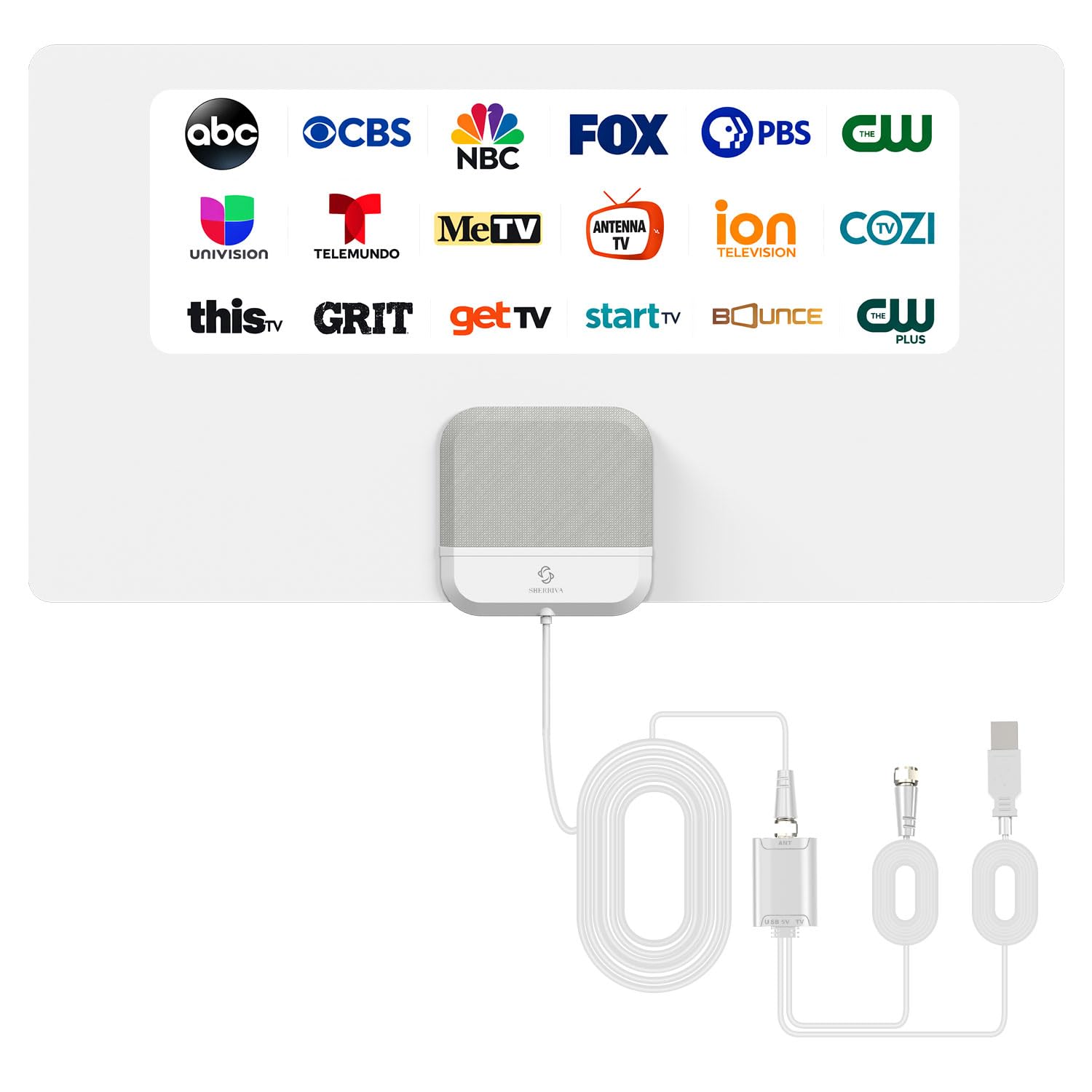
1. SHERRIVA Amplified Digital Antenna
Our pick — over 4★ from 60+ verified ratings; the strongest balance of quality and price.
The 65-mile reach that proved itself in remote Montana.
This model is rated at 65 miles, versus the GE below at 50 miles. That extra margin matters when you’re not in a perfect signal zone, and the built-in amplifier is powered straight from your TV’s USB port — no wall adapter, no batteries, no extra clutter behind the set.
Setup is genuinely plug-and-play: connect the 16ft coax cable, power the amp from the USB port, scan channels, and you’re done. The adhesive backing lets you stick it on a wall or window, and the multi-directional element means you won’t be constantly repositioning it to chase a signal. Buyers in remote Montana with poor cell reception report pulling in free over-the-air channels, validating the 65-mile claim.
The trade-off is placement sensitivity. Even with the wide reception angle, you may occasionally need to nudge the panel to lock in a specific channel — that’s just the physics of indoor TV. It handles VHF and UHF frequencies, pairs with Roku TV, Fire TV, Samsung, LG, and Sony, and comes with a 1-year manufacturer warranty.
What wins people over
- 65-mile maximum range
- USB power means one cable instead of a wall wart
- 16ft cable plus adhesive backing for flexible mounting
- Multi-directional pickup cuts down repositioning
Where it fits less
- Some channels may still need a nudge to lock in
- Actual reception depends on your tower distance and walls
Reach for it if: you’re far from towers and want the longest advertised range with a clean USB-powered install.
Look elsewhere if: you’d rather have an in-line toggle switch for the amplifier than a built-in boost.
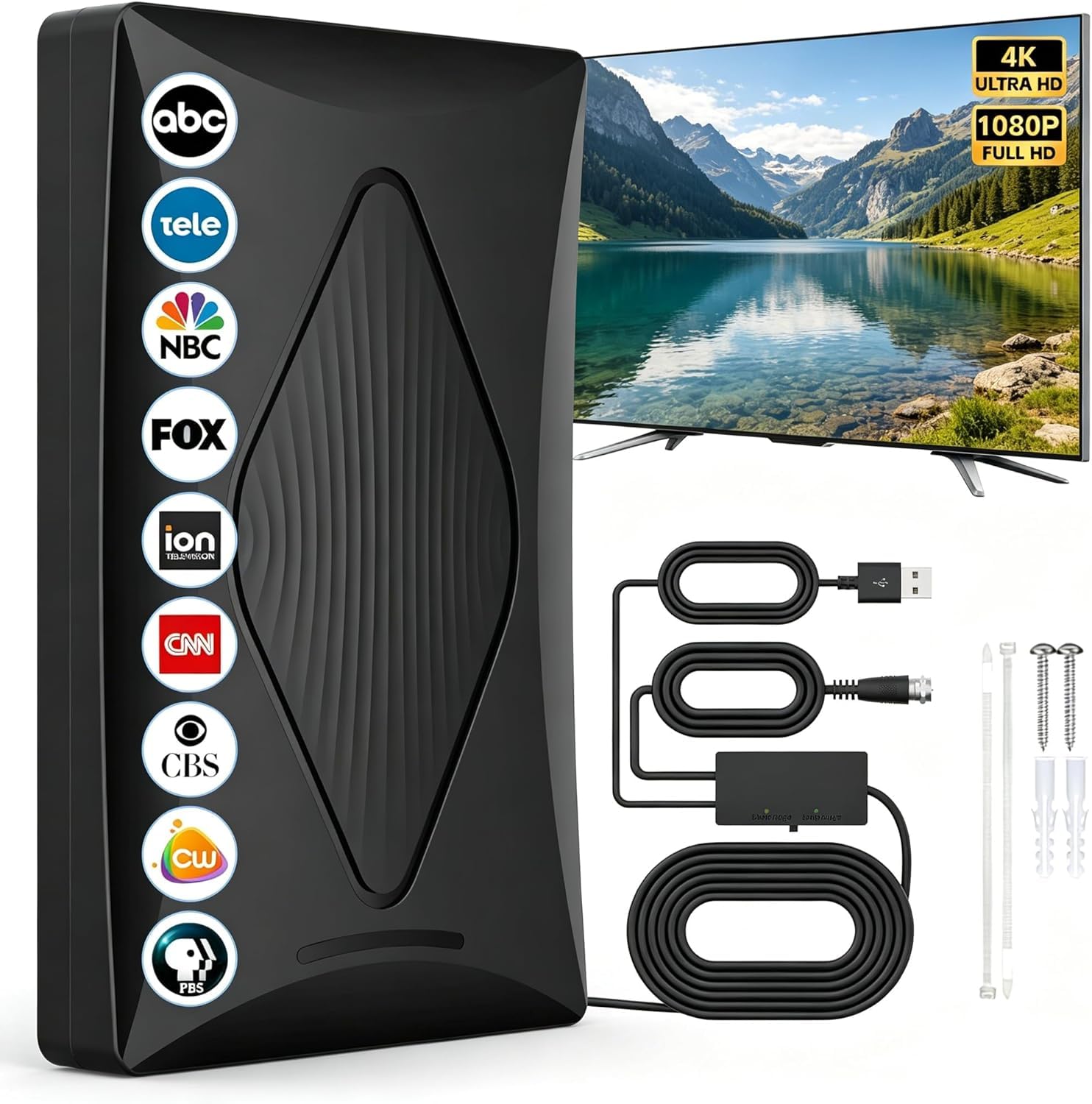
2. GE TV Antenna for Smart TV (48732)
The adjustable-stand flat panel that calms a flickering picture.
GE’s PureAmp Technology is the headline here — it increases signal strength while reducing dropouts, which is exactly the fix for suburban homes where signals flicker but rarely vanish. The adjustable stand lets you run it horizontally or vertically, so you can fit it on a narrow shelf or stand it tall behind a plant without losing stability.
With 50 miles of advertised range, it falls short of the SHERRIVA’s 65 miles, but buyers report remarkably consistent reception. A buyer 37 miles south of Chicago reports about 30 crisp local channels—news, weather, and Bears games—with no pixelation. It handles VHF and UHF in uncompressed 1080p and is 4K-ready, so your picture stays sharp on modern TVs.
The honest caveat is channel count, which runs the gamut from over 100 stations in strong areas to just a handful elsewhere. That’s not a flaw in the antenna, it’s the reality of tower distance. There’s also a recurring note that adding a cheap LTE/5G filter can make a big difference if you live near a 5G tower.
Steady performer: the pureAmp boost and adjustable stand make this a dependable first antenna for most suburban homes, with picture quality being the trait buyers praise most.
Know this before buying: channel count varies wildly by location, so check your local tower map first.
3. BEIMQN TV Antenna (DAC-22)
A paper-thin panel that grabs signals from every direction at once.
The selling point here is pure convenience: 360° omnidirectional reception means you don’t have to aim the panel toward the towers. The built-in smart chip filters out interference from nearby electronics, and the included external amplifier booster strengthens weak signals. It supports 4K, 8K, and 1080p, and the 16.5ft shielded coax cable gives you plenty of slack to reach a window or a higher shelf.
Setup is tool-free, and it pairs with both new smart TVs and older models with a tuner. The install experience draws the most positive feedback, with owners taking it from box to scanning channels in minutes. In a lower-level space 4 feet above ground, owners mention jumping from 6 to 37 channels, many in 4K.
The realistic limit is that omnidirectional pickup trades total range for convenience. In difficult terrain like hill country, it can struggle to lock in a weak ABC signal. Results are genuinely split: some homes get every local channel, others barely get a handful. If you’re in a flat, suburban area with decent signal strength, this is excellent value.
Easy win at the price: the easy setup and compact size are what owners single out most, with signal quality close behind.
The fit warning: reception is location-dependent, so it shines with strong local signals but falls short in hilly or obstructed terrain.
4. CTCPIJE Magnetic Amplified Antenna
The one that sticks to your TV mount and disappears.
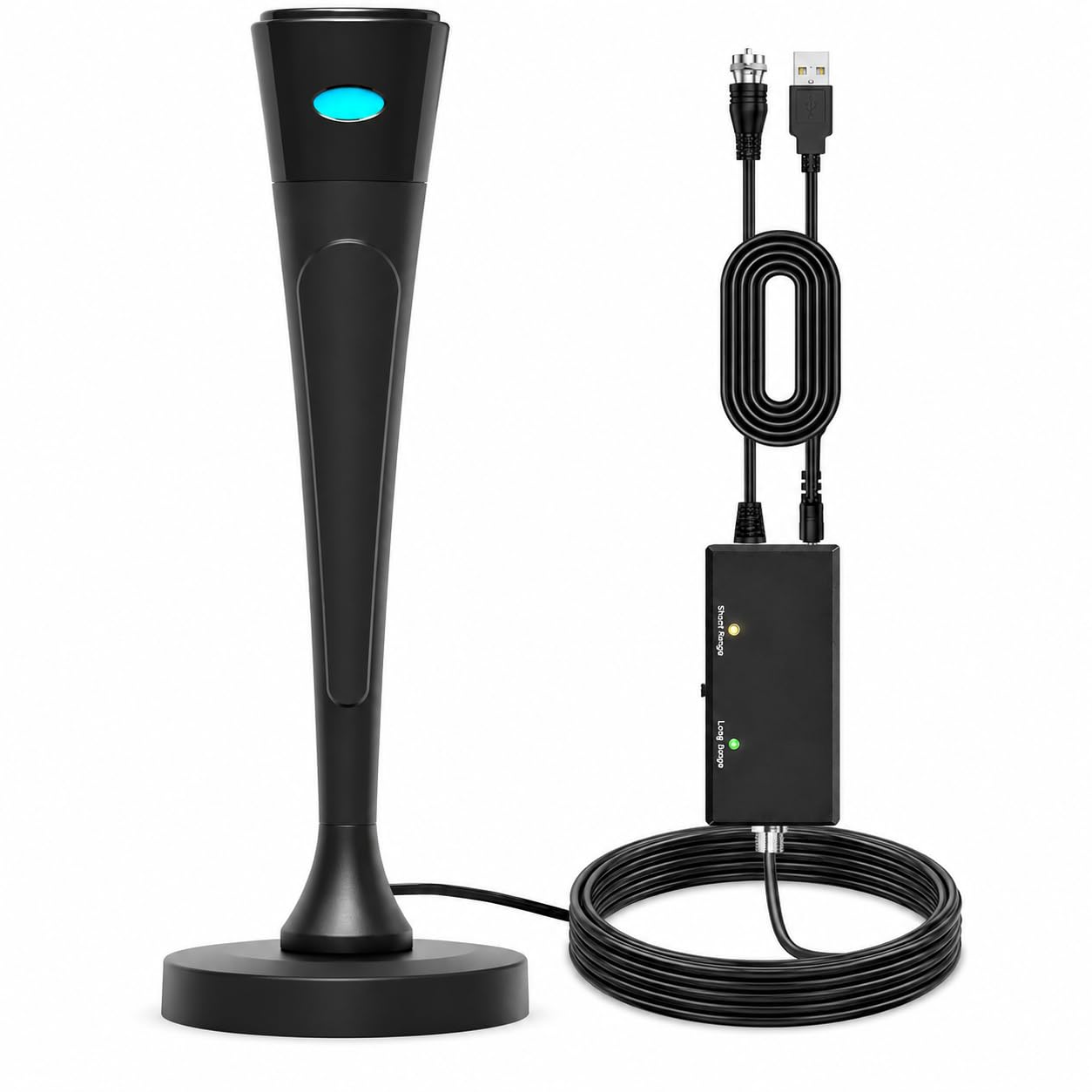
Most flat antennas need tape or pins; this one grabs hold with a magnetic base that grips metal surfaces on contact. You can mount it on a TV stand, a window frame, or even an RV wall, and the 16.5ft coax cable reaches the best signal spot in the room. The 360° reception element captures VHF and UHF from all directions, so pointing isn’t part of the chore.
The standout feature is the dual-mode amplifier with switchable yellow and green modes. Yellow is for shorter range, green for longer, and customers note that experimenting between the two while repositioning is the key to a stable picture. Setup takes about two minutes: connect to the ANT IN port, power the amp from a USB port, and scan. It’s compatible with ATSC and ATSC 3.0 tuners, and older TVs just need a converter box.
It’s a younger product with a small review base, but the feedback so far is uniformly positive and the 3-year warranty is the longest on this list. The one thing to remember is that reception still depends on your zip code, tower distance, and building materials — and you should keep it away from microwaves and routers.
Smart flexibility: the magnetic base plus the two amplifier modes make this the most placement-flexible amplified antenna here.
Fair warning: it’s a newer model with fewer long-term reviews, so you’re trusting the 3-year warranty over years of owner data.
5. RCA Amplified Flat HDTV Antenna (ANT1360E)
The 40-mile panel that quietly replaced a 10-year-old antenna.
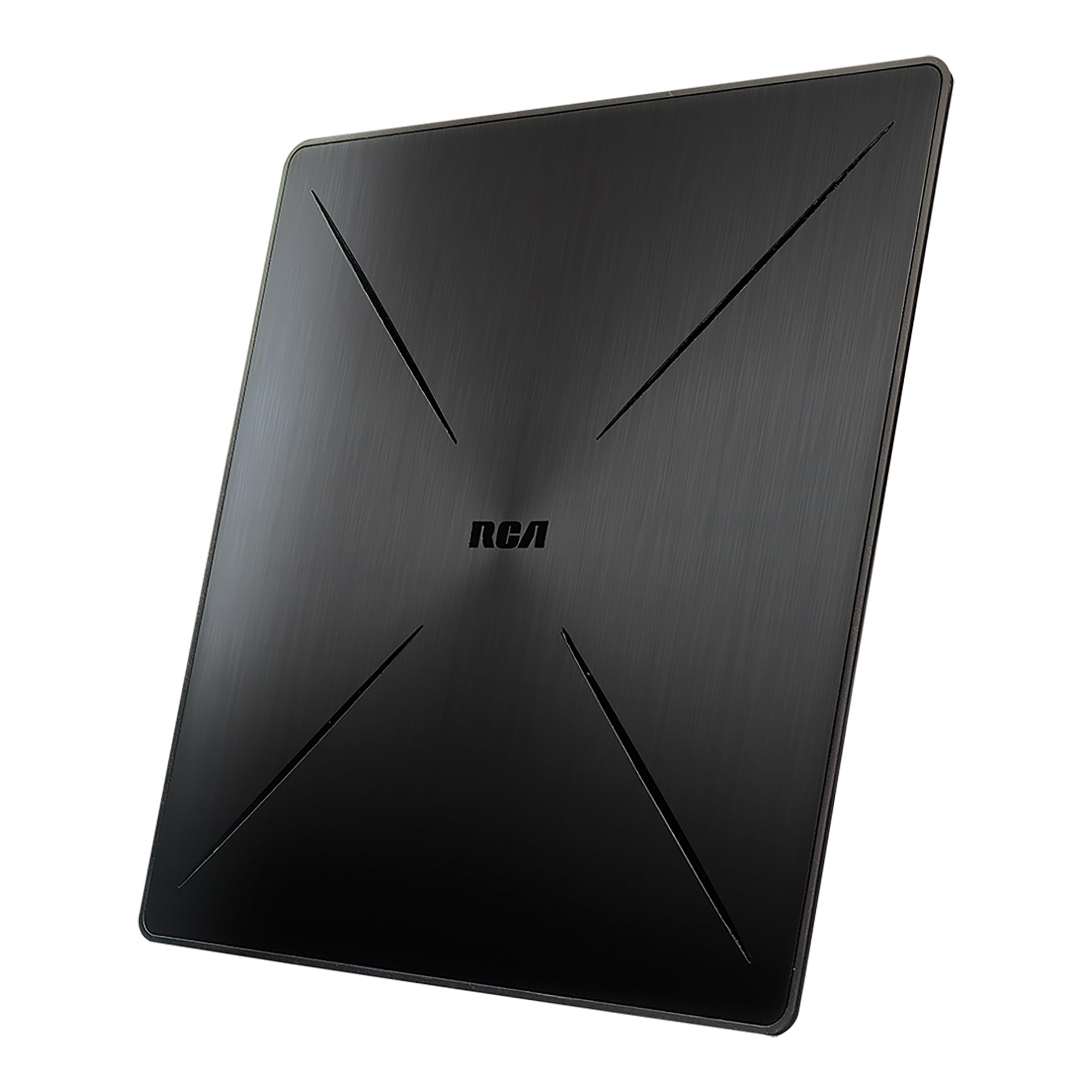
RCA’s Dual-Stage Amplification with Auto Gain Control is the feature that makes this a dependable everyday pick. It automatically adjusts the boost to keep the picture stable, and the patented 360° multi-directional design means you’re not stuck aiming it at a specific tower. Both UHF and VHF reception are covered up to 40 miles from the broadcast tower.
It’s also the most flexible mounting option here thanks to its paintable, flat profile. You can hang it on the wall, lay it flat behind the TV, or stand it up using the built-in easel stand. Everything arrives in the box: the antenna, a 15-foot coax cable, the amplifier, and a 3-inch USB power cable with adapter.
The realistic limit is the 40-mile range, which is the shortest on this list. For most suburban and urban homes that’s plenty, but if you’re counting on pulling in channels from 50 or 60 miles away, this isn’t the one. It’s also a great backup when storms knock out cable or satellite.
Why owners stick with it
- Dual-Stage Amplification automatically stabilizes the picture
- Paintable flat design with easel stand for three mounting styles
- Includes amplifier and USB adapter — no extra purchases
- Solid backup during cable or satellite outages
Its honest limit
- 40-mile max range is the shortest on this list
- Channel reception can still vary by local terrain
Choose this for: a dependable, no-fuss panel in an urban or suburban home with towers within 40 miles.
Pass it up for: long-range hunting beyond 40 miles, where the SHERRIVA or ClearStream models go farther.
6. Antennas Direct ClearStream Flex

A paper-thin loop with a real-time boost switch for fringe areas.
The ClearStream Flex earns its name from its flexibility — both in placement and in control. The Jolt Switch in-line amplifier lets you toggle the boost on and off in real time, which is genuinely useful when a signal needs a nudge but extra amplification would overload it. The multi-directional UHF and Hi-VHF elements deliver powerful range for urban and suburban areas, rated at 50+ miles.
It’s ultra-thin at just.04 inches deep, measuring 12″ H x 16″ W, and the reversible black/white design means you can match it to your wall. The removable coaxial connection is a thoughtful touch, and shoppers say you can swap in your own RG-6 coax cable if you need more length. It’s compatible with NEXTGEN TV, 4K, 8K UHD, and Full HD 1080p, with no internet required.
Buyers report over 30 stations with clear picture quality even in fringe areas, with channel count the most-praised trait. The one recurring theme is that placement is critical: mount it facing the towers and position it near a window for best results. It weighs just 5 ounces, so it’s easy to experiment with different spots.
Best for serious signal hunters: the Jolt Switch and 50+ mile range give you the tools to chase weak signals, with channel count being the trait buyers praise most.
Reality check: indoor range in practice is often 35-45 miles, so set expectations accordingly.
7. Antennas Direct ClearStream Eclipse
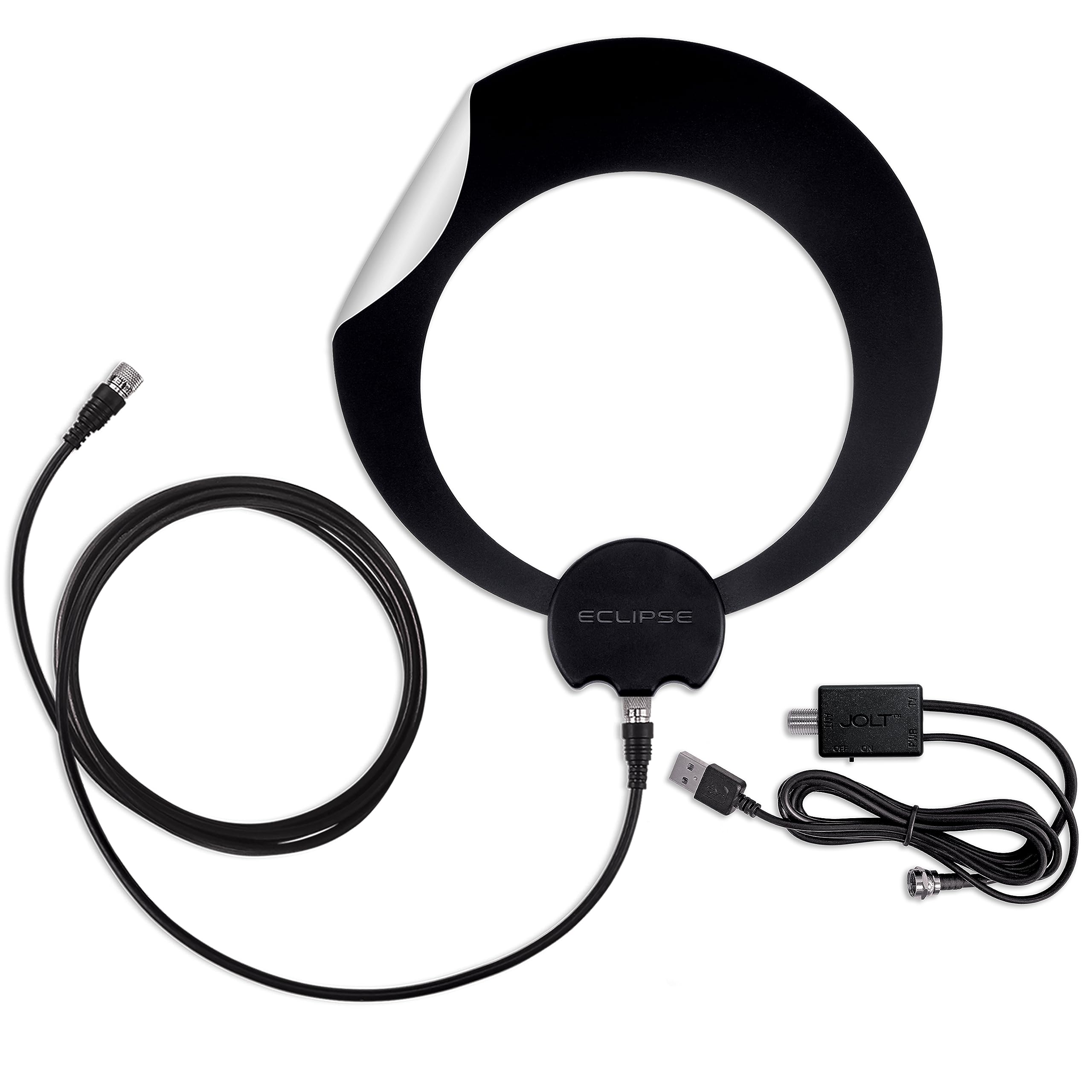
The 1.6-ounce panel that dominates Manhattan rooftops.
At just 1.6 ounces and measuring 10.1″ H x 8.6″ W x.04″ D, the Eclipse is the lightest and most compact antenna on this list. Its compact Jolt Switch is an 18 dB USB in-line amplifier — the dB number tells you how much signal boost you get — and you can switch it off and on as needed. The signature patented loop element uses a premium paper-thin design that’s reversible and paintable.
This is an excellent urban antenna, with owners in Manhattan reporting it keeps all ~101 channels without even needing to rescan. It’s built for NEXTGEN TV, 4K, 8K UHD, and Full HD 1080p, and requires no internet. The multi-directional UHF element delivers the same reliable reception from both sides, which matters when you can’t control which direction your window faces.
The critical operating note is counterintuitive: when you’re very close to broadcast towers, you should NOT use the USB amplifier. Over-amplification near strong signals causes dropouts. Buyers 46 miles from DC towers report pulling in NBC, ABC, and Fox with a tight coaxial connection. The one performance caveat is that its 50+ mile claim is optimistic in practice — one owner found it barely picked up anything beyond 10 miles.
City dweller’s friend: the featherweight build and 18 dB toggle amp make it ideal for apartments where wall space and signal strength are both tight.
Set expectations: the 50+ mile range is optimistic; it shines within 30 miles of towers.
8. Mohu Leaf Plus

The paint-any-color leaf that vanishes into your wall.
The Mohu Leaf Plus is the most decor-friendly amplified antenna here. Its reversible black or white design can be painted to match your wall, and at 10″H x 11.5″W x.04″D it’s thin enough to hide behind a picture frame. The FirstStage amplification is integrated right at the antenna base, which reduces pixelation by boosting the signal before it travels down the cable.
It’s rated for a 60-mile range and handles multi-directional UHF and Hi-VHF from both sides. The box includes the antenna, a 12-foot detachable coax cable, a USB power injector, hook-and-loop tabs, and push pins — everything you need without a trip to the hardware store. It works with Full HD 1080p, 4K, 8K UHD, and NEXTGEN TV depending on your coverage area.
Owners in LA suburbs report cutting cable and finding 35 channels with a stable, excellent picture. The one quirk: some found removing the amplifier actually added a channel, which is the classic over-amplification issue when towers are close. Picture quality is the trait buyers praise most, but channel count and functionality are genuinely mixed by location.
Its strengths
- Paintable reversible design blends into any room
- FirstStage amp at the base cuts pixelation
- 60-mile range
- Everything included — no extra cost for mounting
What’s location-dependent
- Amplifier can overload if towers are very close — try removing it
- VHF performance is weak; this is mainly a UHF antenna
Pick this if: looks matter and you want a paint-to-match panel with a solid 60-mile range.
Think twice if: your target channels are mostly VHF, since the flat design struggles with those longer wavelengths.
9. Winegard FlatWave FL5500A
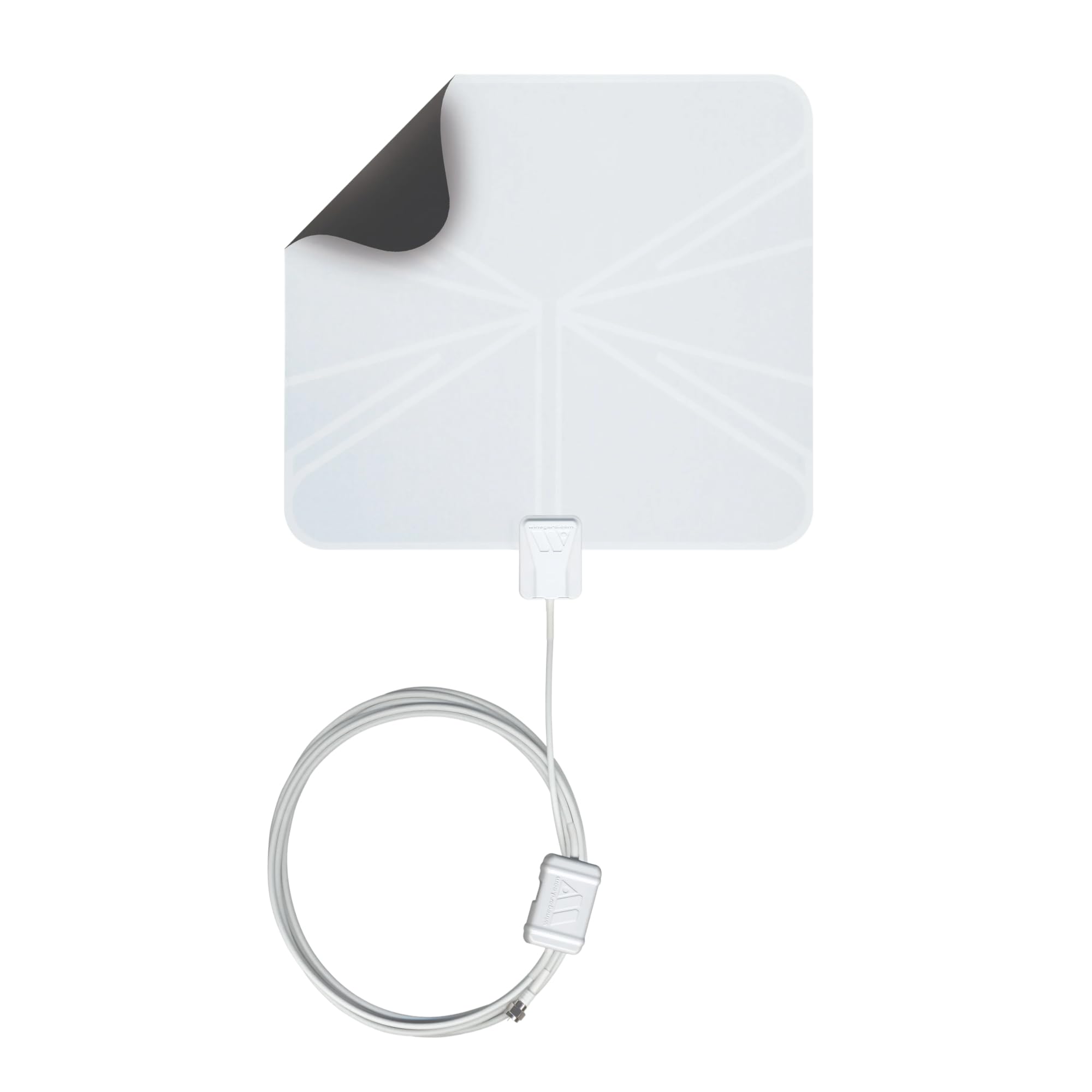
A 12-year-old design that still outperforms the new arrivals.
Owners mention using the same unit for 12 years in a window, behind a shade, with no issues. The dual-color ultra-thin panel picks up VHF and UHF at up to 60 miles, and the Winegard app guides you through the setup process.
Placement makes the difference. Buyers describe a systematic method: check tower locations, get a clear line of sight, then move the antenna in 1-inch increments vertically and horizontally to find the balance. One owner 30 miles from towers placed it on a south window and pulled in 138 channels, including VHF ABC and FOX, with crisp reception. The built-in amplifier needs no external switch—it just works.
The two honest caveats are the permanently attached coax cable — you can’t swap in a 90-degree adapter — and the slight variability in reception as seasons change. It connects to NextGen TV, smart TVs, and streaming devices, and it’s built on decades of Winegard engineering with American design and manufacturing.
The trusted veteran: with 12 years of owner history and 138-channel reports, this is the safest long-term bet on the list.
One binding limit: the fixed coax cable means no right-angle adapter if your TV port is awkwardly placed.
Understanding the Specs
Maximum Range (Miles)
This is the advertised distance to the broadcast tower under ideal conditions — a clear line of sight with no trees, hills, or walls in the way. In real homes, that number is usually cut by half or more. Use it as a relative comparison between antennas, not an absolute promise. If two antennas are rated 50 and 65 miles, the 65-mile one will generally hold a signal better at moderate distances too, because it has more gain headroom.
The Amplifier (Built-In vs Jolt Switch)
The amplifier boosts weak signals so your TV tuner can lock them in. Some are built into the flat panel and powered by a USB cable — simple but always active. Others use an in-line switch like the Jolt Switch that lets you toggle the boost on and off. That switch matters because too much amplification near strong towers can overload the tuner and cause dropouts. If you’re within about 10 miles of towers, you often want the amplifier off.
FAQ
Will an amplified indoor antenna work in an apartment building?
Why do I get fewer channels than the range claims suggest?
Should I turn the amplifier off if I live close to the towers?
What is the difference between UHF and VHF reception?
Can I paint over my indoor TV antenna?
Do I need a digital converter box for my old TV?
Is a longer coaxial cable better for an indoor antenna?
How often do I need to rescan for channels?
Can an amplified antenna work in a rural area far from towers?
Final Thoughts: The Verdict
For the majority of shoppers, the amplified indoor tv antenna winner is the SHERRIVA Amplified Digital Antenna because its 65-mile range plus USB-powered amplifier delivers the strongest real-world reception across the lineup, even in remote Montana. If you want the proven flexibility of a Jolt Switch for fringe-area hunting, grab the ClearStream Flex. And for the most decor-friendly, paint-to-match panel with a 60-mile range, the Mohu Leaf Plus is the one to reach for.
How We Picked
We do not accept paid placement. Every pick is matched to a real buyer and a real use-case; we do not hands-on test units.
Sources & Methodology
Specifications: manufacturer listings and product documentation. Review insights: verified customer reviews, as of August 2026. Pricing: not shown on this page (it changes often); check the current price via the retailer link.
As an Amazon Associate, Gadgets Feed earns from qualifying purchases. This does not affect which products we feature.