
Our readers keep the lights on and my morning glass full of iced black tea. As an Amazon Associate, I earn from qualifying purchases.
Specs are compiled from manufacturer listings and verified buyer reviews and can change over time — please confirm the key details on the product page before buying.
Basement mold is a stubborn problem because the air down there is damp and often stale, and a regular fan just moves the musty smell around. A basement purifier continuously extracts mold spores and odors, leaving the air fresh instead of musty. This guide focuses on three large-room purifiers with true HEPA filters that are strong enough for the job, and it explains which specs actually matter when you are shopping.
I’m Min — the founder and writer behind Gadgets Feed. This guide is built by comparing the manufacturers’ published specifications and the patterns across verified customer reviews, so you get each pick’s real strengths and trade-offs instead of marketing spin.
You’ll see how coverage area, filter type, and noise level decide whether a unit fits your basement, and which model earns the title of the best air purifier for basement mold based on its filtration and real-world owner feedback.
Our Picks at a Glance
How To Choose The Best Air Purifier For Basement Mold
Basements are larger, damper, and more prone to musty odors trapped in fabric and concrete than living rooms. A bedroom purifier often underperforms in a basement, so prioritize airflow, filter quality, and odor control over particle-only specs.
Match the coverage to your actual square footage
Every purifier lists a maximum area it can handle, usually based on cleaning the air a few times per hour. Measure your basement and look for a unit whose coverage is comfortably larger than that number, because a machine working at its limit will run harder and louder to keep up. A larger coverage margin means more efficient mold spore removal.
True HEPA is the floor, not the ceiling
For mold, choose a true HEPA filter that captures particles down to 0.3 microns, the size range of mold spores and dust. But a HEPA filter alone won’t fix a musty smell. Look for a filter with an activated carbon layer, which absorbs the chemical compounds that cause odors, leaving the basement smelling neutral instead of just filtered.
Noise and running cost matter for 24/7 use
A basement purifier often runs around the clock, so a machine that’s whisper-quiet at low speed and energy-efficient is a practical pick. If the unit has a smart sensor, it can automatically ramp up when it detects particles from a hobby project or a damp day, then slow down when the air is clean, which saves power and reduces noise.
Quick Comparison
| Model | Best For | Coverage | Filter Type | Weight | Amazon |
|---|---|---|---|---|---|
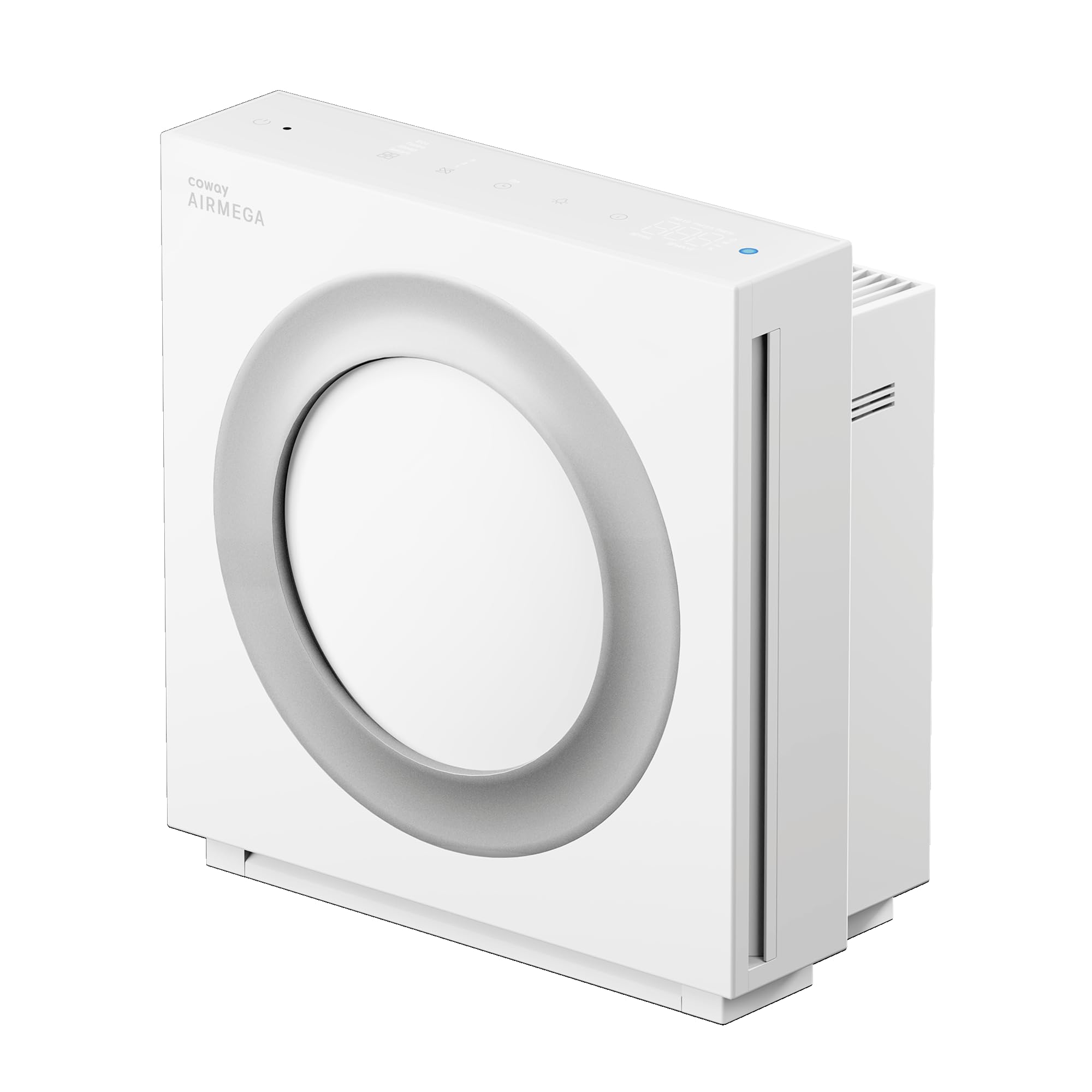
| COWAY Airmega Mighty2★ Best Overall | Smart automation and quiet operation | 1,800 sq ft | HEPA & Active Carbon | 15.2 pounds | Amazon |
| BLUEAIR Blue Pure 211i Max | Maximum square footage per hour | 3,235 sq ft | HEPASilent dual filtration | 16 pounds | Amazon |
| Alen 35i BreatheSmart | Sleep-friendly pink noise operation | 1,400 sq ft | H13 HEPA | 10 pounds | Amazon |
In-Depth Reviews
1. COWAY Airmega Mighty2
Our pick — over 4.5★ from 28,500+ verified ratings; the strongest balance of quality and price.
The smart-sensing workhorse that clears a basement and then quietly tucks itself away — no babysitting required.
If your basement needs constant attention, this is the pick that does the thinking for you. The Mighty2 cleans spaces up to 1,800 sq ft in 60 minutes, and its laser sensor detects particles in real time and shows the air quality as a number on the display. Set it to Smart Mode and it adjusts airflow on its own, switching to Eco-Mode when the air is clean and dropping to a whisper-quiet 19 dB in Sleep Mode when the room darkens, so it won’t disturb you if the basement doubles as a bedroom or office.
For mold and musty smells, the filtration stack is the real story: a washable pre-filter catches the big dust, then a 2-in-1 HEPA & Active Carbon Max2 filter traps up to 99.97% of particles as small as 0.3 microns while absorbing volatile organic compounds and fumes. Buyers report it “rapidly clears wildfire smoke in large NYC apartment; sensor red→blue in ~5 min,” which tells you how fast this thing can turn a polluted room around. The pre-filter slides out without opening the front cover, and the display tells you exactly when to wash it or swap the Max2 filter, removing the guesswork from maintenance.
What wins people over is the build quality and the quiet operation — the two most-praised aspects by a wide margin. It also runs at a maximum of just 56W, consuming 20% less energy than the previous model, which matters when a purifier is on all day. The one honest trade-off is the odor-removal results, which some owners find mixed, so if you are dealing with a truly pungent old basement, you may want the carbon-heavy filter option rather than the standard one.
Why It Earns the Top Spot
- Laser sensor with real-time numerical air quality display
- Whisper-quiet 19 dB sleep mode for overnight use
- Washable pre-filter cuts long-term running costs
- 3-year limited manufacturer warranty
What to Weigh Up
- Odor removal gets mixed feedback from some owners
- Sleep mode button is poorly labeled, per a few reports
Reach for this if: you want a self-managing purifier with a responsive sensor and low running noise for a large basement.
Look elsewhere if: your basement has an extreme, persistent odor that needs aggressive carbon filtration as the top priority.
2. BLUEAIR Blue Pure 211i Max

The coverage king that pushes more clean air in an hour than any other pick on this list.
If your basement is more of a full walk-out level or an open-plan space, this Blueair model is built for sheer volume. It cleans rooms up to 674 sq ft in 12.5 minutes and up to 3,235 sq ft in one hour — a 2.3x coverage gap over the Alen 35i’s 1,400 sq ft, making it the strongest option for very large or high-ceiling basements where air sits stagnant. Its HEPASilent dual filtration captures dust, pollen, wildfire smoke, pet dander, and mold particles, so it is genuinely aimed at the mold problem, not just general dust.
It is also the smartest in terms of remote control. Built-in air quality sensors adjust the fan automatically, and the Blueair mobile app lets you check air quality, change settings, and track filter life from anywhere — handy for monitoring the basement before you head downstairs. The 360° air intake pulls air from all sides, and the minimalist Scandinavian design means it won’t look out of place even in a finished basement. Owners mention the unit has an AHAM Verified CADR of 450/452/435 cfm, an official measure of how fast it cleans smoke, dust, and pollen, which backs up the bold coverage claims.
On noise, owners describe it as unbelievably quiet on low and medium speeds, with the max setting getting loud but being genuinely useful for clearing wildfire smoke fast. The build quality is the most-praised aspect, and the app scheduling plus the ability to dim or turn off the lights make it easy to live with. The main caveats are that the WiFi setup requires your home network password, the unit is heavy to move at 16 pounds, and some owners feel the price is steep for what it delivers.
Standout Metric: it beats the rest on raw coverage — 3,235 sq ft per hour versus the COWAY’s 1,800 sq ft, so for a sprawling basement it moves more air, faster.
The Catch: at 16 pounds and with a footprint of 14.4 x 14.4 x 22.7 inches, it is bigger and heavier than the Alen, so moving it between rooms takes effort.
Best for: large, open basements where maximum air turnover in an hour is the priority and you want app-based control.
Think twice if: your space is compact or you plan to shift the unit often, since the weight and size make it a set-it-down-and-leave-it machine.
3. Alen 35i BreatheSmart
The featherweight that doubles as a sleep aid, filtering mold while it hums a soft pink noise.
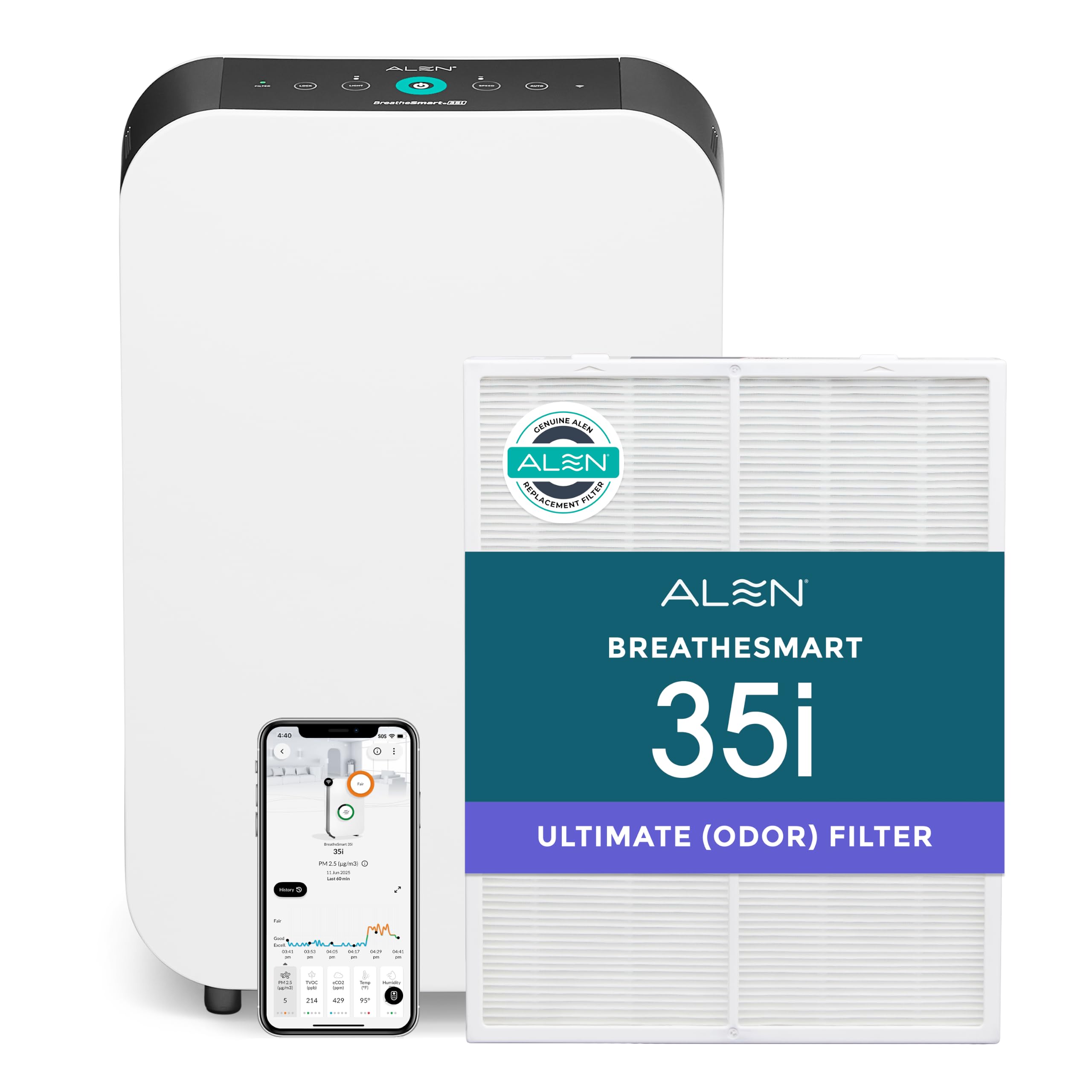
If your basement is actually a guest suite or a home office where you rest, the Alen 35i brings something the others don’t: sleep enhancement. Its ultra-quiet operation emits pink noise, a sound profile that emphasizes lower octave frequencies, and SleepScore Labs validated its pink noise in a peer-reviewed study to improve sleep.. At 10 pounds and 7.6 x 13 x 20.6 inches, it is noticeably lighter and more compact than the Blueair’s 16 pounds, so it slips into tighter corners and is easier to relocate.
Filtration is serious despite the compact size. The included H13 HEPA filter captures particles as small as 0.3 micron, which is finer than the 0.3-micron standard, and it absorbs heavy household odors, chemicals, allergens, dust, mold, and germs at the molecular level. The coverage is 1,400 sq ft, which trails the Blueair’s 3,235 sq ft by a 2.3x margin, but it still comfortably handles a standard basement. The SmartSensor adjusts fan speed based on air quality with color-coded feedback: blue rings mean excellent air, purple rings mean high particle presence, so you get a quick visual read on the air.
Owners praise the effectiveness of the air cleaning and the quiet operation, with the pink noise specifically helping people sleep better. The recurring gripe is value for money, as some buyers find it expensive, and filter replacements are pricey — one household with two dogs reports needing a new filter every 4-6 months. There is also a rare dissenting voice that found no dust reduction after six months, though the overwhelming consensus is positive on performance.
What Impresses
- H13 filter grabs particles down to 0.3 micron
- Pink noise operation enhances sleep quality
- Lightest pick at 10 pounds, easy to move
- Runs 24/7 at a daily energy cost of just a few cents.
What Gives Pause
- Filter replacements are expensive and may be needed every 4-6 months
- Coverage of 1,400 sq ft is the smallest of the three
Choose it for: a basement bedroom or office where quiet, sleep-friendly operation matters more than raw square-footage coverage.
skip it if: you have a very large basement needing max air turnover, since the coverage falls short of the other two picks.
Understanding the Specs
CADR and Coverage Area
CADR, or Clean Air Delivery Rate, measures how fast a purifier removes smoke, dust, and pollen from a room, with higher numbers meaning faster cleaning. Coverage area is the square footage a unit can handle, usually assuming around two air changes per hour. For a basement, pick a unit whose coverage comfortably exceeds your room size so it doesn’t have to run at maximum speed all day.
HEPA Filter Grades
True HEPA filters trap particles down to 0.3 microns, which is where most mold spores and dust sit. Some units like the Alen use an H13 grade that goes further, catching particles as small as 0.3 micron. Look for a filter that layers activated carbon on top of HEPA — the carbon absorbs the musty odors that HEPA alone cannot, which is critical for basement smell.
FAQ
Will an air purifier actually get rid of basement mold?
What CADR rating do I need for a basement?
Can I use a basement air purifier in a bedroom too?
How often do I need to replace the filter?
Will a purifier remove the musty smell in my basement?
Is a smart air purifier worth it for a basement?
How much does it cost to run an air purifier 24/7?
What size air purifier do I need for a large basement?
Final Thoughts: The Verdict
For the majority of shoppers, the air purifier for basement mold winner is the COWAY Airmega Mighty2 because its laser sensor, quiet 19 dB sleep mode, and washable pre-filter make it the most self-sufficient and cost-effective daily companion for a musty basement. If you want maximum air turnover for a very large space, grab the BLUEAIR Blue Pure 211i Max, which cleans up to 3,235 sq ft in an hour. And for a basement bedroom or office where rest matters, the Alen 35i adds sleep-friendly pink noise to serious H13 filtration.
How We Picked
We do not accept paid placement. Every pick is matched to a real buyer and a real use-case; we do not hands-on test units.
Sources & Methodology
Specifications: manufacturer listings and product documentation. Review insights: verified customer reviews, as of August 2026. Pricing: not shown on this page (it changes often); check the current price via the retailer link.
As an Amazon Associate, Gadgets Feed earns from qualifying purchases. This does not affect which products we feature.