
Our readers keep the lights on and my morning glass full of iced black tea. As an Amazon Associate, I earn from qualifying purchases.
Specs are compiled from manufacturer listings and verified buyer reviews and can change over time — please confirm the key details on the product page before buying.
Choosing a 2 meter mobile radio means deciding how far you need to talk, not just what fits in your car. The big fork in the road is power output — 20 watts keeps you on local repeaters, while 50 to 80 watts pushes your signal deep into the countryside or across a valley. This guide breaks down the specs that actually decide your range, the programming headaches to expect, and which radios earn their place on your dash.
I’m Min — the founder and writer behind Gadgets Feed. This guide is built by comparing the manufacturers’ published specifications and the patterns across verified customer reviews, so you get each pick’s real strengths and trade-offs instead of marketing spin.
Before you pick a 2 meter mobile radio, know this: your antenna and mounting position matter more than the radio itself. But the right transceiver gives you a clean, reliable foundation for every contact you make — start with a solid unit and you build the whole station around it.
Our Picks at a Glance


How To Choose The Best 2 Meter Mobile Radio
The 2 meter band — 144 to 148 MHz — is where most new ham radio operators start, because it carries clear FM voice over repeaters that dot the landscape. Your choice depends on power, band coverage, and how much programming patience you have.
Power output versus real-world range
More watts mean a louder, more reliable signal into a repeater, but they do not mean infinite range. A 20-watt radio will comfortably hit repeaters within 30 miles under good conditions, while 50 to 80 watts adds a meaningful margin in rolling terrain or when you are running a less efficient antenna. The trade-off is heat — higher power needs bigger heatsinks or louder fans to stay cool.
Single band versus dual band
A pure 2 meter radio keeps the controls simple and often delivers more power for the price, because it only has to cover VHF. A dual band rig adds UHF (70cm), which is useful for hitting repeaters that only operate on 440 MHz or for talking to handhelds on your local club frequency. If you only ever use 2 meters, a single band keeps the menu shorter.
Programming: front panel or computer
Every modern mobile radio stores hundreds of channels, and typing 200 of them in by hand will test your patience. Most of these radios work with CHIRP, a free programming tool, but you need the right cable and often a driver install. Radios that ship with a programming cable in the box save you a separate purchase and a lot of frustration on day one.
Quick Comparison
| Model | Best For | Power Output | Bands | Channels | Amazon |
|---|---|---|---|---|---|
| Yaesu FT-2980R★ Best Overall | Maximum legal VHF power | 80W | VHF | 200 | Amazon |
| QYT KT-8900Best Budget Pick | Budget dual band in a tiny case | 20W | VHF/UHF | 200 | Amazon |
| AnyTone AT-778UVBest Value Dual Band | Value dual band with big display | 25W | VHF/UHF | 200 | Amazon |
| Retevis RT95 | First-time mobile operators | 25W | VHF/UHF | 200 | Amazon |
| BTECH UV-25X2 | Compact vehicle installs | 25W | VHF/UHF | 200 | Amazon |
| AnyTone AT-778UVII | Fanless dual band operation | 25W | VHF/UHF | 200 | Amazon |
| TYT TH-8600 | Waterproof outdoor mounting | 25W | VHF/UHF | 200 | Amazon |
| BTECH UV-50X2 | High power with aftermarket audio | 50W | VHF/UHF | 200 | Amazon |
| Radioddity DB50 | Detachable faceplate installs | 50W | VHF/UHF | 758 | Amazon |
| Icom IC-2730A | Premium dual watch performance | 50W | VHF/UHF | 1052 | Amazon |
In-Depth Reviews
1. Yaesu FT-2980R
Our pick — over 4.5★ from 250+ verified ratings; the strongest balance of quality and price.
The pure 2 meter powerhouse that reaches out where lesser radios fade.
The FT-2980R is built for operators who prioritize maximum VHF range above all else. The FT-2980R pushes 80 watts of RF power on the VHF band — the most on this list — through four selectable levels of 80/30/10/5 watts, so you can dial down to a polite 5 watts for close, quiet contacts and crank up when the terrain turns rough. A massive heatsink handles that heat without a cooling fan, which means no whirring noise in the cabin on a long trip.
Its 80W output delivers the longest reach in this lineup. Buyers report a clear 100+ km desert contact with a friend, and the receiver is praised as excellent, with a loud 3 watts of audio output that cuts through road noise. The large 6-digit backlit LCD keeps channel names readable in glare, and the 200 memory channels give serious operators room to store every repeater in their region.
Owners consistently praise its rock-solid build quality. — it is described as rock solid, built like a tank, and equally at home in a truck, a UTV, or as a base station on a desk. The DTMF direct access microphone is included, and the interactive programming menu covers details like wide or narrow deviation selection. Weighing 4.2 pounds and spanning 7.3″D x 6.3″W x 2″H, it is a hefty unit compared to the compact QYT KT-8900 below — a 2.3x weight gap — so plan your mounting spot accordingly.
Why it dominates
- 80W of VHF power, the highest in this lineup
- Fanless operation with a massive heatsink
- CTCSS and DCS encode/decode built in, plus WX severe weather alert
What to weigh
- Single band only — no UHF coverage here
- 4.2 pound weight and large chassis need real mounting space
- Owners recommend RT Systems software for easiest programming
Grab this if: you want the most powerful legal VHF signal for hunting camps, desert runs, or base station work where distance beats compactness.
Look elsewhere if: you need UHF repeaters or a radio that disappears into a small console.
2. QYT KT-8900
A palm-sized dual bander that hides anywhere and still talks real miles.
Size is the headline here. The KT-8900 measures just 1.9″D x 5.7″W x 7.5″H and weighs 1.8 pounds — a full 2.3x lighter than the Yaesu FT-2980R above — so it slips into a glove box, under a seat, or onto a motorcycle without hogging the cabin. Despite the mini case, it delivers 20 watts on both VHF and UHF with narrow or wide band selection.
The real-world reach impresses for the price. One owner hit a repeater 31 miles out on 2m using a DIY antenna, though 70cm range dropped to 0.75 miles in the same setup — a reminder that antenna and terrain steer your actual coverage. The radio includes a free programming cable, and it supports CHIRP software, though the frequency range locks in via a password from QYT that CHIRP cannot change.
Value for money is what owners praise most, calling it a great backup or emergency radio and an excellent starter rig once you get it programmed. The catch is heat management: it heats up quickly during normal transmissions, and the cooling fans run loud and engage fast. The version with more channels and a slightly larger footprint — the QYT 980 — runs cooler, but it costs more, so budget-first buyers still land here.
Compact strengths
- 1.8 pound chassis fits tight vehicle installs
- 20W output with dual band and quad watch standby
- Free programming cable included in the box
Budget trade-offs
- Runs hot; fans are loud and engage fast
- Frequency range locked via QYT password, not in the manual
- CHIRP programming can be finicky
Reach for this if: you need a cheap dual band radio for a car, bike, or emergency kit and you are comfortable with a short learning curve.
Think twice if: you will run long transmissions where continuous heat build-up will annoy you.
3. AnyTone AT-778UV
The 25-watt dual bander owners quietly call ham radio’s best kept secret.
This radio earns the “best kept secret” nickname because it delivers a genuine 25W/15W/5W on both VHF and UHF for a mid-range price, with a full alloy body that doubles as the heat radiator. The 180-degree rotatable TFT LCD display lets you angle the screen to match your mounting, and the built-in speakers live in both the radio and the microphone for clear audio from either spot.
Range stories here are strong. Owners mention connecting to repeaters over 30 miles away, and one long-time base station user reports full quieting on repeaters within 25 miles at just 12.4V. The sound quality earns the most praise by far, with clean transmit audio that gets perfect signal reports from other operators. It complies with FCC Part 15B and Part 97 rules, and the FCC ID is T4K-778UV.
Programming is the honest friction point. CHIRP works well here, but the manual lacks descriptions of some settings — for example, dual watch appears on screen as “RDW” with no explanation. The frequency up and down buttons sit on the mic side rather than the top, which makes one-hand mobile operation a little awkward. None of it stops owners from calling it an excellent budget mobile ham radio with a loud, readable display.
Where it shines
- 25W output on both bands with an alloy heat-radiating body
- Rotatable TFT display adapts to any mount
- CHIRP-supported with an easy learning curve
Minor gripes
- Manual omits setting descriptions, so expect some trial and error
- Mic-side frequency buttons hinder one-hand driving use
- Menu is versatile but takes time to master
Best suited for: the operator who wants proven dual band performance and a bright screen without paying a premium.
Not ideal for: anyone who expects a detailed manual to walk them through every menu.
4. Retevis RT95

A first-timer friendly dual bander that programs painlessly and feels solid in hand.
New operators get the warmest welcome here. The RT95 supports CHIRP from the start, and the supplied data cable worked on the first try with no errors for owners — no driver battles, no head-scratching. It also has a VFO mode that lets you change frequencies directly from the radio for around 90% of operations, so you are not lost when the computer is off. The 180-degree rotatable display pairs with a built-in cooling fan for stable high-power runs.
At 25W on both VHF and UHF, it has enough punch to hit repeaters up to 25 miles away at high power, and the compact 6.42 x 4.88 x 1.54 inch frame weighs about the same as two handhelds. Owners describe the audio as great, with many reports of good transmit quality, and the price-to-build balance earns consistent praise. The upgradeable mic gain lets you boost weak voices, though cranking it too high adds background noise — the manual advises adjusting it to match your environment.
Its rugged construction, straightforward programming, and bright outdoor-readable display win over new operators. The recurring detail is that factory band limits of 144-146MHz on VHF can be expanded via YouTube guides for those who want the full 144-148MHz range. For a first mobile rig or a compact base station, it is hard to miss with this one.
First-radio verdict: the RT95 removes the two biggest beginner frustrations — cable setup and programming — and backs it with clean 25W audio in a compact, rugged shell.
The only homework: check your band limits early and expand them via firmware if you need the full 2 meter range.
5. BTECH UV-25X2

A compact 25-watter that guards your ears with full-time audio security.
Its full-time audio guard makes it the top pick for operators prioritizing stable, protected receive audio. The UV-25X2 runs a full-time audio guard that keeps received audio stable and safe, making it a stand-out choice for anyone who wants consistent, protected sound on the road. It delivers 25 watts on VHF and UHF, with a compact body that owners say is perfect for vehicle installation — a common sight on dashboards and center consoles.
Owner reviews rate its audio quality as the best in this lineup. Sound quality is the most-praised aspect by a wide margin, and the radio includes an RJ45 microphone port with a K1 audio adapter, giving you access to a huge range of aftermarket audio accessories. It can operate with either 144 MHz or 430 MHz as the main band while monitoring up to 3 other frequencies simultaneously, so you can watch a few channels at once without missing traffic.
The honest limitation is programming — it is CHIRP-supported and generally easy, but a notable share of owners flag setup hiccups, and the soft rubber knobs tend to slip or fall off with heavy use. As a base station paired with a J-pole antenna, customers note hitting repeaters 50 miles out, some even at 5 watts with line-of-sight. For the price, the 25 watts, compact size, and audio flexibility make it a strong mobile or desk companion.
Audio-first choice: the UV-25X2 pairs full-time audio guard with a K1 adapter ecosystem — the best pick if aftermarket speakers and mics matter to you.
Watch for: soft rubber knobs that slip, and a programming step that rewards a patient afternoon with CHIRP.
6. AnyTone AT-778UVII
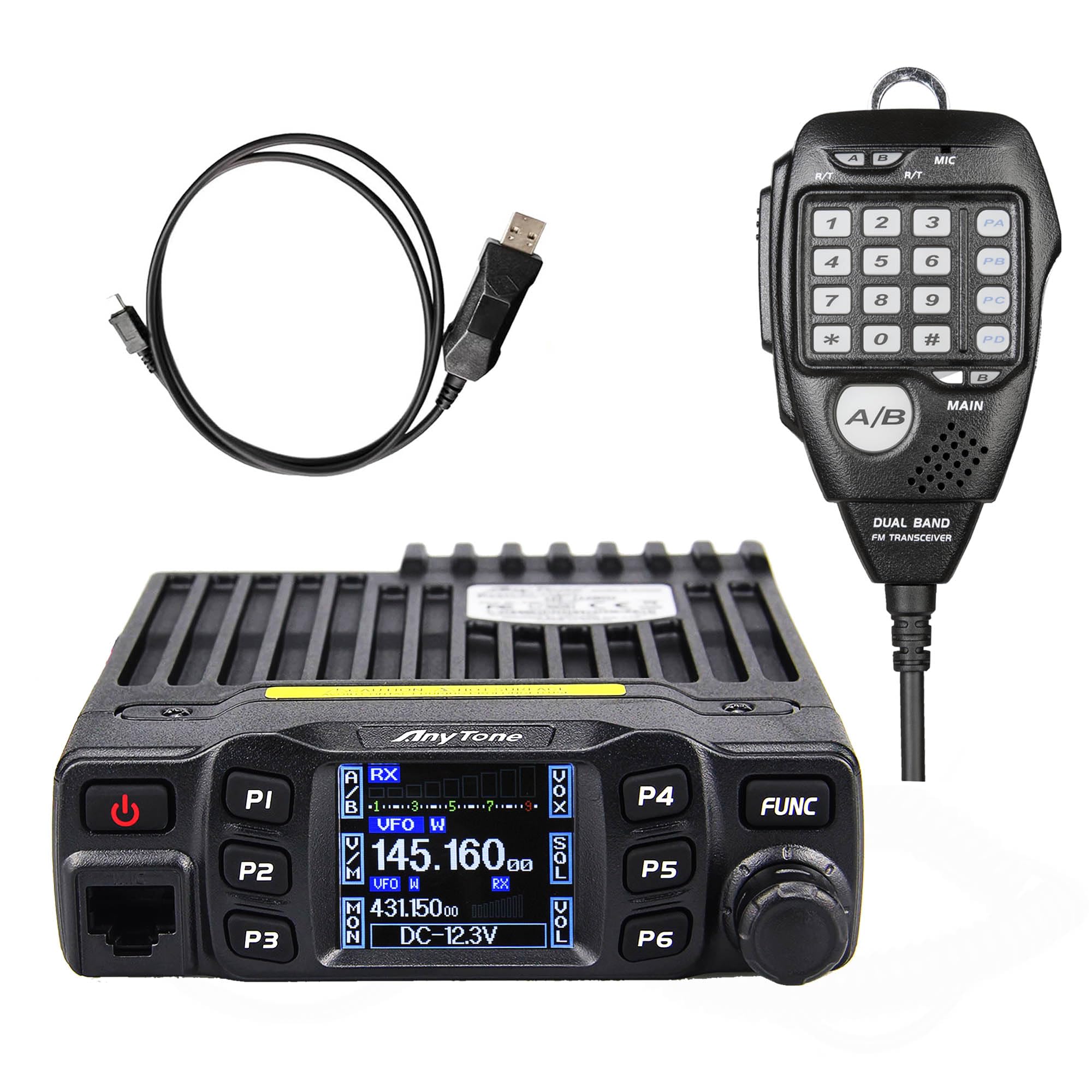
Silence in the cabin, thanks to a hefty heatsink and no cooling fan at all.
Its fanless heatsink design eliminates cabin noise entirely. The AT-778UVII runs completely fanless, relying on a hefty heatsink to handle 25W/15W/5W of output, and owners confirm it stays cool without overheating even through a full evening of repeater traffic. The color TFT display is bright and clear, and the size — 4.9″W x 6.4″D x 1.5″H — fits neatly into most vehicle interiors.
Its audio quality earns the most praise from owners. Sound quality is the most-praised aspect by a large margin, described as clear as a bell, and the built-in speakers in both the radio and microphone make it easy to hear in a moving car. Reviewers point out clear contacts on repeaters 40 miles away with an indoor slim jim antenna in an improve area, and the included programming cable works perfectly with CHIRP — a smooth setup for a new licensee.
The trade-offs are small but real. There is no dedicated volume or squelch knob — you press a button first, which risks changing the channel while driving. The manual is poorly written, the main flaw owners flag, and the P1-P6 programmable keys can feel confusing until you map them in software. Mic gain is adjustable via the native software for clearer audio, and owners who use it as a base station confirm it holds its own against pricier Yaesu and Icom units.
Quiet strengths
- Fanless heatsink cooling keeps the cabin silent
- Bright color display with 180-degree rotation
- Included cable programs cleanly with CHIRP
Setup snags
- Poorly written manual is the main complaint
- No dedicated volume or squelch knobs while driving
- P1-P6 keys are best configured via software
Choose this for: quiet operation, a bright display, and a fan-free dual band radio that still runs cool.
skip it if: the thought of pressing a button before adjusting volume on the road bothers you.
7. TYT TH-8600

The IP67 weatherproof dual bander built for motorcycles and open-air rigs.
Weather is no obstacle here. The TH-8600 carries a super IP67 dust and waterproof rating, meaning it shrugs off rain, mud, and spray — a genuine edge for motorcycles, ATVs, off-road vehicles, or boat mounts where a standard radio would fear the elements. It delivers 25W/20W of output across VHF and UHF, and the full color screen with P1-P4 programmable keys keeps controls at your thumb.
Owners praise the brick-like build and loud speaker and mic audio, with one boat-mounted user noting it works great despite constant moisture exposure. The measured output came in at 21.5W, close to the rated 25W, and the 200 channels with CTCSS/DCS, DTMF, and priority channel scanning cover the essentials. The included programming cable works with Windows 10, though you do need a driver install.
The honest friction is programming — it is described as slightly challenging, typical for amateur radios, and it is not CHIRP-compatible, so you rely on the OEM software and front-panel entry. Owners also note the frequency range can be modified for Ham and GMRS service via a button-hold boot procedure, handy for dual-service users. For anyone mounting a radio where dust and water are part of the job, this is the one to reach for.
Weatherproof winner: the IP67 rating plus a solid, brick-like chassis make the TH-8600 the clear choice for motorcycles and off-road vehicles.
Plan around: OEM-only programming and a driver install — no CHIRP shortcut here.
8. BTECH UV-50X2

Fifty watts of dual band punch with the widest aftermarket audio support around.
Power and audio flexibility meet in the middle here. The UV-50X2 delivers a full 50 watts on VHF and UHF, putting it in the high-power tier alongside radios that cost considerably more. Its RJ45 microphone port comes with a K1 audio adapter — the most common accessory jack in the market — which means you can wire in almost any aftermarket speaker, headset, or external audio gear you already own.
Range and clarity back up the wattage. Shoppers say strong signal quality with communication possible over 20 miles away, and one base station user reaches repeaters 40+ miles out with a good antenna. The 144 MHz or 430 MHz main band monitors up to 3 other frequencies at once, and you can set it for simultaneous VHF-VHF or UHF-UHF listening. The fan runs quiet, and the speaker delivers clear audio with a custom display you can tweak.
Quality is the most-praised aspect here by a huge margin, with owners calling the build first-class and the value strong for a 50W dual bander. The honest cautions: some units have failed in extreme cold — two reports mention units smoking after cold starts at 29°F in a Jeep — and the mic connector sits near the volume knob where it risks damage. The tiny 4-line screen can be hard to read for older eyes, and the radio is not waterproof, so treat it as an indoor or temperate-climate tool.
Power plus audio
- 50W output with a K1 audio adapter for class-leading accessory choice
- Quiet fan and first-class build quality
- Clear audio with 40+ mile repeater reach reported
Honest cautions
- Some units failed in extreme cold, per a pair of reports
- Mic connector near the volume knob risks damage
- Tiny 4-line screen is hard to read for some
Best for: the operator who wants real 50W range and already owns aftermarket audio accessories.
Think twice if: you operate in freezing temperatures or need a waterproof housing for a wet vehicle mount.
9. Radioddity DB50

A detachable faceplate 50-watter that mounts anywhere your cabin allows.
Installation freedom is the defining move here. The DB50’s detachable front panel lets you position the control head somewhere visible and tuck the main body under a seat or in a console, making it ideal for tight vehicle interiors where a fixed mount will not work. It pushes a full 50W on VHF and UHF, and owners confirm strong, clear audio with excellent signal reports.
The channel count is the headline spec — 758 channels, far beyond the 200 most rivals offer, with VFO and CH modes for quick switching between tuned frequencies and presets. It also covers more than just 2 meters, receiving UHF, VHF, Air band, 1.25m, and 350MHz, so it doubles as a scanner for aviation and public service traffic. Buyers report it works with Winlink Vara FM via a Digirig interface, adding a digital mode path.
Programming is the learning curve. CHIRP only handles the first 35 channels, so the Radioddity software is the superior route for full access to all 758 channels and power-level settings. Owners note you need that software to open up the full channel count and to fix out-of-box quirks like TX OFF and squelch 0. An occasional unit arrives with a faulty microphone, though support has been responsive with replacements. No cigarette lighter cable is included, so plan your power wiring.
Detachable-faceplate star: the DB50 solves awkward cab installs with a remote head and still brings a hefty 50W and 758 channels to the table.
Budget a learning session: the Radioddity software is the key to open up the full channel count and sanitizing default settings.
10. Icom IC-2730A

The brand-name 50-watter that monitors two bands at once with legendary receiver clarity.
True simultaneous receive is the differentiator here. The IC-2730A monitors VHF/VHF or UHF/UHF frequencies at the same time, so you can listen to a 2 meter net while watching a UHF repeater — a genuine dual-watch capability that cheaper radios only fake. It delivers 50 watts on both VHF and UHF, and the large white backlight LCD is easy to see at a glance, day or night.
Owner reactions are emphatic. It is described as the best ham unit in 70 years of operating, with one long-time operator calling it one of the best sounding hot receivers and transmitters they have used. Signal and audio clarity get top billing, and the optional VS-3 Bluetooth headset adds wireless convenience — a rare feature in this category. One owner hit a 42-mile repeater at just 15 watts, a strong sign of a sensitive receiver. With 1052 channels, it stores more than enough for any region.
The premium price brings premium expectations, and the accessories test that patience. Icom does not include the faceplate mounting bracket or adapters — those are expensive extras sold separately, the most common gripe. The menu navigation can feel confusing, and the fan is loud but effective. Still, for the operator who wants a proven, sensitive, accurate radio from a top-tier brand, this is the end of the search.
The premium edge
- True simultaneous VHF/VHF or UHF/UHF receive
- 50W output with a large, easy-to-see LCD
- Optional Bluetooth headset support
The premium catch
- Faceplate bracket and adapters sold separately and pricey
- Menu navigation has a learning curve
- Fan is loud, though effective
Buy it for: a sensitive, accurate receiver and true dual-band monitoring in a name you can trust for decades.
Budget for extras: the mounting bracket and adapters push the real cost above the sticker.
Understanding the Specs
Power Output (Watts)
This is the RF power your radio transmits, and it directly influences how reliably your signal reaches a repeater or another station. A 20-watt radio handles local repeaters well, while 50 to 80 watts adds margin for hilly terrain or weak antennas. More power creates more heat, so fanless radios like the Yaesu FT-2980R lean on massive heatsinks to stay cool.
Dual Watch and Dual Band
Dual band means the radio transmits and receives on both VHF (2 meters) and UHF (70cm), giving you access to more repeaters. Dual watch, sometimes called dual receive, lets the radio monitor two frequencies at once. The Icom IC-2730A does this truly on VHF/VHF or UHF/UHF, while many budget radios offer a form of watch that shares the receiver.
FAQ
Do I need a license to use a 2 meter mobile radio?
What is the real difference between 20W and 50W on 2 meters?
Will a dual band radio work if I only use 2 meters?
What is CHIRP and why do so many reviews mention it?
How far can a 2 meter mobile radio actually transmit?
What antenna should I pair with my 2 meter mobile radio?
Can I use a 2 meter mobile radio as a base station at home?
What is the difference between CTCSS and DCS?
Is a detachable front panel worth paying for?
How many channels do I really need in a mobile radio?
Final Thoughts: The Verdict
For most buyers, the 2 meter mobile radio winner is the Yaesu FT-2980R because 80 watts of fanless VHF power with rock-solid build quality makes it the undisputed range king for pure 2 meter work. If you want dual band flexibility with a rotatable display on a budget, grab the AnyTone AT-778UV. And for a weatherproof radio that survives motorcycles, boats, and open-air rigs, the TYT TH-8600 is the one to reach for.
How We Picked
We do not accept paid placement. Every pick is matched to a real buyer and a real use-case; we do not hands-on test units.
Sources & Methodology
Specifications: manufacturer listings and product documentation. Review insights: verified customer reviews, as of August 2026. Pricing: not shown on this page (it changes often); check the current price via the retailer link.
As an Amazon Associate, Gadgets Feed earns from qualifying purchases. This does not affect which products we feature.