
Our readers keep the lights on and my morning glass full of iced black tea. As an Amazon Associate, I earn from qualifying purchases.
Specs are compiled from manufacturer listings and verified buyer reviews and can change over time — please confirm the key details on the product page before buying.
When you’re trusting a 100 ft rope with your boat, tree swing, or cargo, the real question is simple: will it snap? You’ll find the best 100-foot ropes for anchoring, rigging, crafts, and heavy outdoor work here — and you’ll learn why a thicker line isn’t always the stronger one.
I’m Min — the founder and writer behind Gadgets Feed. This guide is built by comparing the manufacturers’ published specifications and the patterns across verified customer reviews, so you get each pick’s real strengths and trade-offs instead of marketing spin.
From salt-proof anchor lines to natural jute twine for crafts, here are the best options for a 100 ft rope for almost any job you can tie.
Our Picks at a Glance


How To Choose The Best 100 Ft Rope
Before you pick a rope, decide what it has to survive: salt spray, sun, heavy tension, or just looking rustic. Each material handles these differently.
Pick the fiber that matches your job
Nylon stretches under load, making it the best shock absorber for anchors and towing. Polyester barely stretches, so it keeps tension for rigging and hanging. Polypropylene floats, which is handy for water rescue or swim lines, but it can be slippery. Natural jute and manila look great but belong to lighter, decorative tasks.
Read the breaking strength, not the thickness
A 3/8-inch rope can snap at anywhere from 1,500 to 4,000 pounds depending on how it’s built. Always check the rated breaking load — the force that snaps the rope — and keep it well above your heaviest use. Never compare two ropes by diameter alone.
Braided vs. twisted construction
Braided ropes are smoother, hold knots better, and resist abrasion, making them ideal for winches and pulleys. Twisted ropes are classic, cheap, and great for decoration, but they can unravel at the cut ends and are weaker for the same diameter. For heavy lifting, braided wins.
Quick Comparison
| Model | Best For | Material | Diameter | Breaking Strength | Amazon |
|---|---|---|---|---|---|
| MARINE SYSTEM 3/8★ Best Overall | Small boats under 16 ft | Polypropylene | 0.38 in | 1,565 lb | Amazon |
| HOKINETY 3/8Rigging Power | Arborist & rigging | Polyester | 0.38 in | 3,500 lb | Amazon |
| Young Marine 3/8Deep-Water Pick | Boats up to 27 ft | Nylon | 0.38 in | 4,035 lb | Amazon |
| Better Boat 3/8 | Premium anchor duty | Nylon | 0.38 in | 4,035 lb | Amazon |
| QNR 1/4 | UV & sun exposure | Polyester | 0.25 in | 980 lb | Amazon |
| Xpose Safety 1/4 | High-visibility safety | Polypropylene | 0.25 in | 1,250 lb | Amazon |
| PerkDecor 8mm | Crafts & gardening | Jute | 0.31 in | — | Amazon |
| DEDU Manila 3/4 | Heavy rustic decor | Manila | 0.75 in | ~600 lb | Amazon |
| XiangGuanQianYing 3/4 | Nautical look & swings | Manila / Jute | 0.75 in | 1,000 lb | Amazon |
In‑Depth Reviews
1. MARINE SYSTEM 3/8 Inch Anchor Line
Our pick — over 4.5★ from 600+ verified ratings; the strongest balance of quality and price.
A soft, floatable anchor line that won’t fight you on the winch.
For small boats under 16 feet, this polypropylene line gives you a strong, easy-to-handle anchor rope. It holds up to a 1,565 lb breaking load (the force needed to snap it), so it won’t let go when your boat tugs at anchor. The 3/8-inch diameter (0.38 inches) gives you a thick, confident grip on a trailer winch, and it stays flexible for its whole life, so it coils and stows without stiffening into a stubborn mess.
The included stainless steel thimble and shackle mean you don’t have to buy extra hardware or learn to splice an eye. It floats, which is a real bonus if you ever drop it overboard. Buyers report it’s “great quality of rope for the small fishing boat and trailer” — the thing everyone raves about is the toughness, with 36 owners singling out quality and 23 more praising durability in salt weather.
Stretch is the honest trade-off here. Some owners love the give, but others find it too stretchy for their taste, so skip it if you need zero-elasticity rigging. For a modest anchor line that arrives ready to use, it’s tough to top.
What Wins Boat Owners Over
- Stainless thimble and shackle pre-attached
- Floats and stays flexible for easy stowing
- Rated for 1,565 lb breaking load
Reports To Weigh
- Stretchiness is a mixed bag among owners
- Rated only for boats under 16 feet
Reach for it if: you run a small fishing boat or trailer and want a ready-to-use anchor line with hardware included.
Look elsewhere if: you need a non-stretch line for permanent rigging — the give will annoy you.
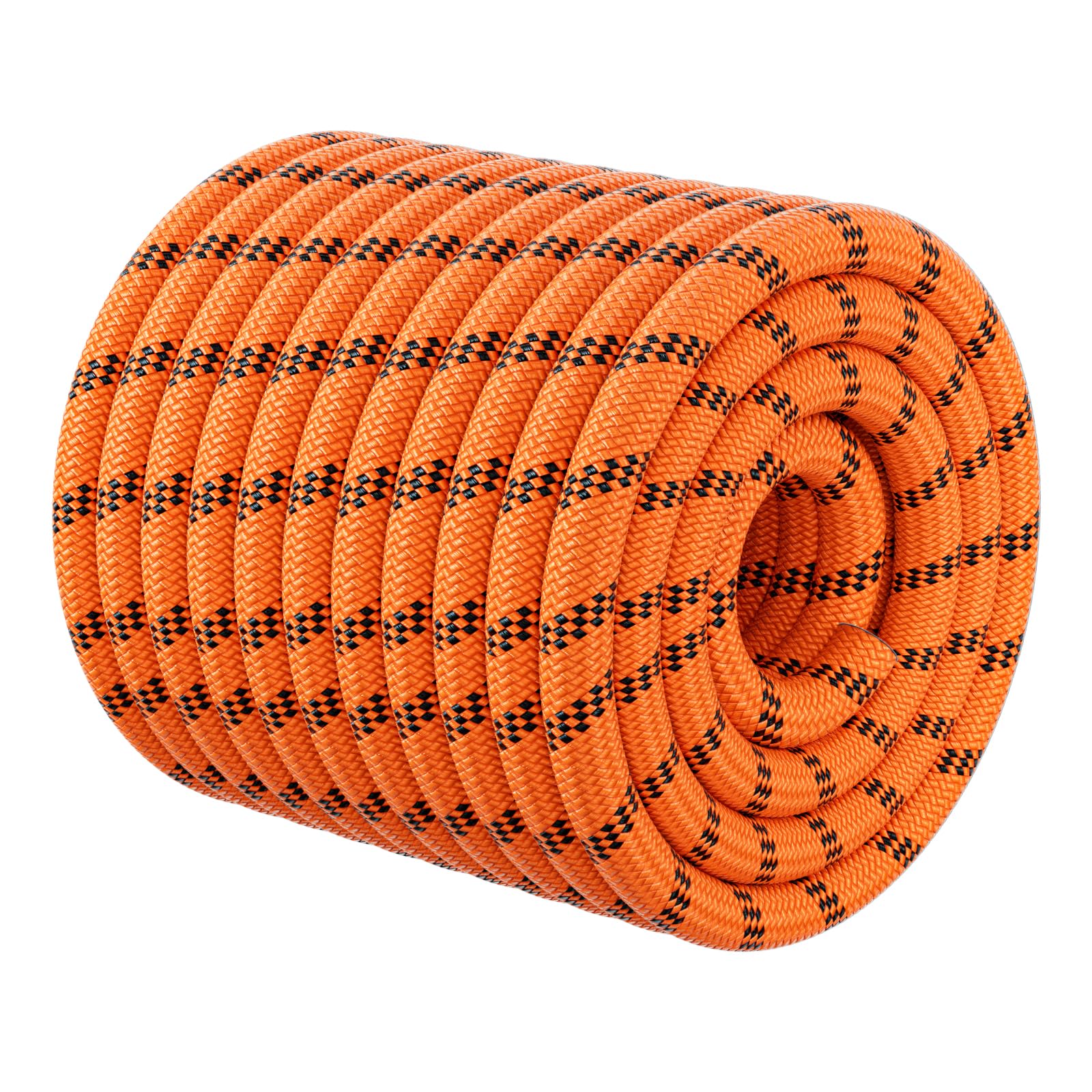
2. HOKINETY 3/8 x 100 ft Double Braided
A serious 3,500 lb rope built for branches, logs, and tree work.
This orange double-braided line is the one you grab when pulling tree branches down or dragging logs out of a creek. Its 3,500 lb breaking strength (the load at which it finally snaps) is more than double what the MARINE SYSTEM line above offers, so it handles heavier pulls without failing. The 48-strand outer braid gives it exceptional abrasion resistance, so it won’t fray when you drag it across rough bark and rock.
Owners have put it through several seasons of rain and report it survives beautifully. The quality is the thing everyone raves about, with 51 buyers calling it out as top-notch and 37 more praising its durability. It’s been used for rope swings, halyards, and even knot-practice training classes — a versatility that shows in the feedback.
Flexibility is a slight mixed bag: it’s not super stiff, but some note it tightens up as you close a knot. That’s a minor quibble for a rope this strong. Just remember it’s not life-safety rated for climbing, so treat it as a heavy-duty utility line, not a harness rope.
A genuine workhorse: the 3/8-inch diameter and 48-strand construction make this the strongest-feeling pick for rough outdoor pulling, and the rain-tested durability backs it up.
Who it beats: any twisted or single-braid rope for raw pulling power and abrasion resistance.
Who it doesn’t: climbers needing a certified life-safety line — this isn’t rated for that.
3. Young Marine 3/8 Nylon Double Braided Anchor Line
Nylon’s stretch soaks up wave shock for boats up to 27 feet.
Where the MARINE SYSTEM line stops at 16-foot boats, this nylon double-braid steps up for vessels up to 27 feet. Nylon’s natural elasticity absorbs the jerking pull of waves on an anchor, which is exactly what you want in open water. It’s rated at a hefty 4,035 lb breaking strength — the snap point — and feels soft and light while staying surprisingly durable.
Buyers call the quality “superhero of the maritime world,” and the marine-grade stainless thimble adds chafe protection at the attachment point. Quality is the leading praise, with 48 owners calling it out, and it’s praised as easy to roll up for storage. It’s a confident step up from the polypropylene line if your boat needs more holding power.
Here’s the honest catch: durability gets mixed feedback, with a few owners reporting fraying after heavy use. Nylon is tough, but rubbing against rough bottoms will wear any line. For most boaters, the strength and shock absorption far outweigh that risk.
The upgrade pick: double the breaking strength of the budget line — 4,035 lb vs 1,565 lb — plus nylon’s superior shock absorption for bigger water.
Choose this if: you boat in open water and want an anchor line that absorbs wave shock instead of snapping.
pass on it if: you only need a light trailer line — the extra strength is overkill.
4. Better Boat 3/8 Double Braided White Nylon

A polished nylon anchor line with a reflective thread for nighttime visibility.
This navy-blue line matches the Young Marine on raw strength — both carry a 4,035 lb breaking load — but adds a few premium touches. A reflective thread woven into the rope boosts visibility at night, which is a genuinely useful safety feature when you’re hauling anchor in low light. The pre-spliced stainless thimble is professionally whipped, reducing chafe where the rope bends around the anchor.
Owners praise the tight weave and the smooth feel on the hands, noting it coils well and handled a full summer of use without issues. Quality is the leading praise at 38 mentions, and the construction earns its own spotlight at 8. It’s a family-owned American brand that clearly sweats the details.
The one wrinkle in the feedback: a lone report of blue dye bleeding out on first use. That appears to be an outlier rather than a pattern, and picking the white version sidesteps the question entirely. If you want the smoothest, most finished anchor line here, this is it.
The finished product: the reflective thread and professionally whipped thimble make this feel a cut above, even at the same 4,035 lb rating as the Young Marine.
Best for: boaters who want a premium, chafe-resistant anchor line with a safety-minded reflective touch.
Consider the white: if dye-bleed worries you, the white version removes that single complaint entirely.
5. QNR 1/4 Black Polyester Utility Rope

A low-stretch polyester line that shrugs off years of direct sun.
If your rope will live outside in the sun, this 1/4-inch polyester line is the specialist. Polyester resists UV damage far better than nylon or polypropylene, and owners confirm it lasts for years outdoors. It’s rated at 980 lb max break strength — the load that would snap it — and its low stretch makes it ideal for amateur radio antenna support, where keeping steady tension is everything.
That’s a real pattern in the feedback: it’s a favorite among ham radio operators for antenna rigging. Durability is the leading praise at 31 mentions, with minimal stretch coming in as a separate positive at 12. Made in the USA, it knots easily and holds up to the elements.
The 1/4-inch diameter (0.25 inches) is noticeably slimmer than the 3/8-inch marine lines above — that’s a 52% gap in thickness — so it’s not for heavy anchoring. Also, the “solid braid” has a fibrous core rather than a fully solid one, which is a minor technical surprise, not a flaw.
Why It Lasts
- High UV and abrasion resistance for sun-drenched spots
- Low stretch keeps antenna and rigging tension steady
- Made in the USA
Size Reality
- Thinner 1/4-inch build limits it to lighter tasks
- Not for heavy anchors or towing
Grab it for: outdoor securing, antenna support, or any job where sun exposure and steady tension are the main concerns.
Pass it up for: heavy marine anchoring — you want the 3/8-inch lines for that.
6. Xpose Safety 1/4 Yellow Polypropylene Rope

A bright yellow floater you can spot across moving water.
This 1/4-inch polypropylene rope is built to be seen. The bright yellow finish stands out in low light, making it a solid choice for marking swim zones, securing loads on a truck, or any safety application where visibility matters. It floats, so it stays on the surface even in moving water, and it won’t stretch or sag while holding tension.
The 1,250 lb line weight — the breaking force — is respectable for the slim diameter, and its resistance to rot, moisture, and chemicals makes it fine for extended outdoor use. Quality leads the praise at 40 mentions, with value for money second at 16. Owners have used it for everything from tying down grill covers to general boating chores.
Two honest notes: it’s slippery, so some knots need extra care to hold, and a few owners mention fraying under rough use. The striking color and floating ability make it worth the trade-off for safety-minded buyers.
Built to be spotted: the bright color and floating design make this the pick for swim lines and safety marking, even if it’s slim at 0.25 inches.
Reach for this if: you need a visible, floating line for water safety or load securing.
Think twice if: you need knot security under heavy load — the slippery polypropylene can work loose.
7. PerkDecor 8mm Jute Rope
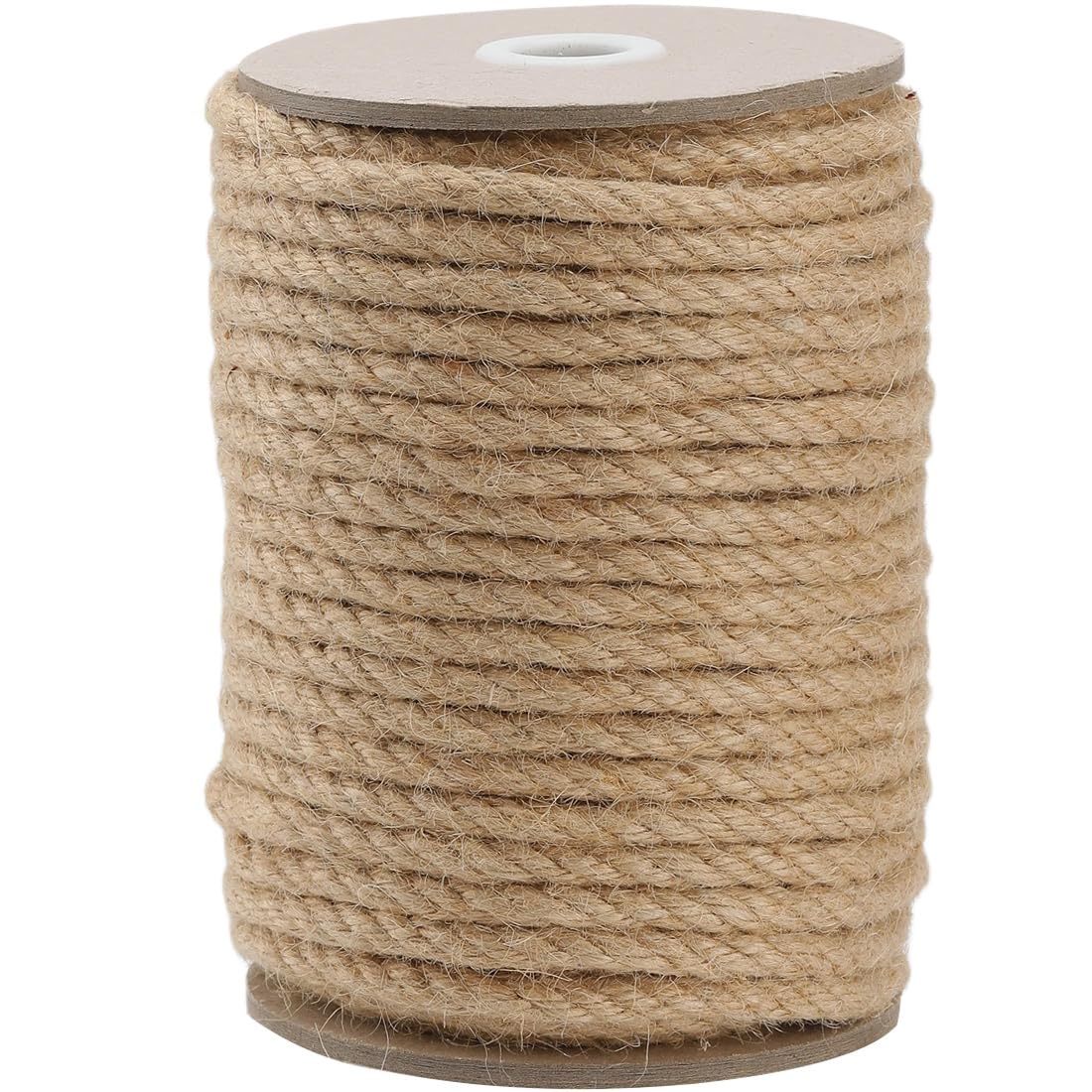
A soft natural jute twine that ties up gifts, trellises, and cat toys.
This 8mm jute twine is the creative one of the bunch. Made from natural fibers, it’s soft on the hands, emits no strong odors, and works across crafts, gift wrapping, gardening, and even cat scratching posts. It’s compostable, which is a nice bonus for garden use — owners tie up vegetables on trellises with it and toss the ends in the compost bin.
Durability leads the praise at 42 mentions, with versatility second at 30. Owners have used the full 100 feet for graduation party decorations, kitten toys, and photo displays. The flat roll stays put, and the consistent color adds an organic, rustic look to any project.
The mixed notes: some find the 8mm thickness perfect, while others expected a bit more girth. A few mention a mild odor, though most report none at all. Tape the center hole when you start to prevent unraveling, and you’re set.
One spool, endless jobs: the versatility is the story here — 30 owners call it out — spanning crafts, gifts, and garden tying in a single roll.
Perfect for: crafters, gardeners, and gift-wrappers who want a natural, soft twine that ties well.
Not for: heavy lifting — this is decorative and light-duty by design.
8. DEDU Manila 3/4 x 100 ft

A thick, rustic manila rope that dresses up docks and porches.
At a chunky 3/4-inch thick, this 4-strand twisted manila rope is the visual showpiece of the list. It’s the classic nautical look — owners have wrapped it around the base of a Mariner boat and dressed up lake house signs. The natural hemp fiber is air-dried and processed without sharp bark chips, so it’s soft enough for easy knotting.
Quality is the overwhelming theme here, with 69 owners calling it out — the highest count on this list. Versatility follows at 15, with buyers using it for rope swings, railings, and dock decor. The weight limit sits around 600 lbs for this 3/4-inch size, so it can handle a hanging swing, just not heavy towing.
Durability is the honest mixed note: some owners mention two years of weather exposure, while others saw breakage after two months. Natural fiber simply doesn’t match synthetics in outdoor longevity. Also, expect to tape the cut ends to prevent unraveling. This is a looks-first rope.
The best-looking rope here: quality takes the crown at 69 mentions, but treat it as a decorative and light-duty line, not a long-term weather warrior.
Choose this for: nautical decor, dock railings, tug-of-war, and rustic crafts where the thick natural look matters.
Look elsewhere for: years of outdoor exposure — synthetic lines last far longer in the elements.
9. XiangGuanQianYing 3/4 in x 100 ft Twisted Manila Rope

A versatile natural rope that climbs trees and wraps cat posts.
This 3/4-inch twisted manila rope splits the difference between the DEDU above and a utility line. Rated to a 1,000 lb maximum tension load, it’s actually stronger than the DEDU’s 600 lb weight limit, while keeping that natural, rustic look. The fibers are soft and flexible, with no greasy smell or hard burrs, making it pleasant to handle.
Appearance leads the praise at 21 mentions, with versatility close behind at 17. Owners have used it to wrap cat trees, build kid climbing ropes with Flemish eye splices, and dress up wood beam ceilings. It’s pliable enough for knots and holds up to a wide range of indoor and outdoor projects.
The durability question mirrors the DEDU: some say it lasts years, others report breakdown after three years of exposure. There’s also a single note about a strong smell on arrival, though most report it smells fresh. This is a flexible, good-looking natural rope with more strength than its looks suggest.
More muscle than it shows: the 1,000 lb tension rating beats the DEDU’s 600 lb limit, making it the smarter pick for a natural rope with actual workload.
Best for: rustic decor plus light-to-moderate duty like swings, cat trees, and nautical accents.
Mind the scent: a rare few found the smell strong, so air it out if you’re sensitive to natural fibers.
Understanding the Specs
Breaking Strength
Breaking strength is the load in pounds at which a rope snaps, and it’s the single most important safety spec. You want a breaking strength well above your heaviest expected load — a 1,565 lb line is fine for a small boat anchor, but a 4,035 lb line is what you want for bigger water or heavier towing.
Material Matters
Nylon absorbs shock for anchors, polyester holds tension for rigging, polypropylene floats for water rescue, and natural jute or manila suits decor only.
FAQ
What size rope do I need for my boat anchor?
Will a polypropylene rope float in water?
Is a thicker rope always stronger?
How long will a natural jute or manila rope last outdoors?
Why does my twisted rope unravel at the ends?
What is the difference between braided and twisted rope?
Can I use a natural jute rope for a rope swing?
What does low stretch mean for my rigging?
Will salt water damage my anchor rope?
How do I know if a rope is safe for climbing?
Final Thoughts: The Verdict
For the majority of shoppers, the 100 ft rope winner is the MARINE SYSTEM 3/8 because it’s a ready-to-use anchor line with stainless hardware and floatable, flexible handling at a value-friendly price. If you need raw pulling power for tree work, grab the HOKINETY double braid — its 3,500 lb rating is more than double the budget line’s. And for bigger boats up to 27 feet, the Young Marine nylon line brings a 4,035 lb breaking strength that soaks up wave shock on open water.
How We Picked
We do not accept paid placement. Every pick is matched to a real buyer and a real use-case; we do not hands-on test units.
Sources & Methodology
Specifications: manufacturer listings and product documentation. Review insights: verified customer reviews, as of August 2026. Pricing: not shown on this page (it changes often); check the current price via the retailer link.
As an Amazon Associate, Gadgets Feed earns from qualifying purchases. This does not affect which products we feature.