
Our readers keep the lights on and my morning glass full of iced black tea. As an Amazon Associate, I earn from qualifying purchases.
Specs are compiled from manufacturer listings and verified buyer reviews and can change over time — please confirm the key details on the product page before buying.
You want eyes on your front door, your baby’s room, and your backyard — without paying a security company forever. The real challenge is choosing between battery-powered freedom, wired reliability, and the features that matter most for your home. This guide ranks the best At Home Camera System options based on real-world owner experiences, not just specs.
I’m Min — the founder and writer behind Gadgets Feed. This guide is built by comparing the manufacturers’ published specifications and the patterns across verified customer reviews, so you get each pick’s real strengths and trade-offs instead of marketing spin.
Choosing an at home camera system starts with three decisions: how sharp you need the video, where you’ll store it, and how much wiring you can tolerate. Each pick below is backed by clear footage and honest owner feedback, so you can choose with confidence.
Our Picks at a Glance


How To Choose The Best At Home Camera System
Before you click buy, you need to answer three questions: where will the cameras go, do you mind running cables, and are you willing to pay a subscription forever? Your answers will determine which system truly enhances your safety without causing frustration.
Indoor, Outdoor, or Both?
An indoor-only camera like the Tapo C100 is rated for rooms — it won’t survive rain on your porch. For outdoor placement, check the Ingress Protection (IP) rating, which tells you how well it resists dust and water; IP65 means it shrugs off rain and snow. If you want one system to cover the nursery and the driveway, look for a kit that’s explicitly rated for indoor and outdoor use.
Battery Freedom vs Wired Reliability
Wire-free cameras run on rechargeable batteries, so you can mount them anywhere — a fence, a shed, a garage — with zero drilling for power. The catch is charging them, and battery life shrinks fast in high-traffic zones where motion triggers recordings all day. Wired systems (like Power over Ethernet, or PoE, which sends power and data over one network cable) never need charging but require running cables to each camera. Many buyers pick battery for flexibility and wired for the spots where constant recording matters.
The Monthly Fee Decision
Some brands lock their best features — like person detection and cloud playback — behind a subscription. Others, like Tapo, eufy, and Reolink, let you record to a microSD card or a base station with no monthly cost at all. If you want to avoid recurring fees, choose a system with local storage on hardware you own.
Quick Comparison
| Model | Best For | Video Resolution | Storage | Power Source | Amazon |
|---|---|---|---|---|---|
| Tapo C100 (4-Pack)★ Best Overall | Budget indoor coverage | 1080p FHD | microSD up to 512GB | Wired (outlet) | Amazon |
| GMK 4-PackBest Value | Outdoor value, no wiring | 2K 3MP | microSD or Cloud | Battery (rechargeable) | Amazon |
| eufyCam C35 (4-Cam)Smartest No-Fee Pick | No-fee smart AI indoors/outdoors | 2K (HD) | HomeBase Mini (up to 1TB) | Battery (rechargeable) | Amazon |
| Arlo Pro (6th Gen) 4-Cam | Wide-angle 2K with smart alerts | 2K HDR | Cloud (subscription) | Battery (swappable) | Amazon |
| Swann MaxRanger4K Solar (2-Cam) | Long-range rural properties | 4K Ultra HD | Base station 64GB (expandable 512GB) | Solar + battery | Amazon |
| Blink Outdoor 4 (5-Cam) | Long battery, Alexa homes | 1080p HD | Cloud (free trial) or USB via Sync Module | AA lithium (2-year) | Amazon |
| Hiseeu 4K PoE (8-Cam) | PTZ tracking, 24/7 recording | 5MP HD (4K NVR) | 3TB HDD built-in | Wired (PoE) | Amazon |
| eufy SoloCam E42 (4-Cam) | Solar-powered 4K, no fees | 4K UHD | HomeBase 3 (16GB, expandable) | Solar + battery | Amazon |
| Reolink RLK16-1200D8-A | Maximum coverage, pro-grade | 12MP UHD | 4TB HDD built-in | Wired (PoE) | Amazon |
In-Depth Reviews
1. Tapo 1080P Indoor Security Camera, C100 (4-Pack)
Our pick — over 4★ from 27,500+ verified ratings; the strongest balance of quality and price.
A crowd-pleasing indoor camera that covers four rooms with no monthly fees.
For covering bedrooms, a nursery, or a living area on a budget, this kit gives you four cameras, each capturing crisp 1080p FHD (Full High Definition, 1920×1080 pixels) video with a 117-degree field of view — wide enough to see most of a room from a corner. Parents get a standout feature: built-in baby crying detection sends an instant push notification with no extra fee, so it doubles as a baby monitor. Night vision reaches 40 feet, letting you check on a sleeping kid or a dark hallway without turning on a light.
Storage is where this system wins for budget buyers: you can pop in a microSD card up to 512GB for free local recording, or subscribe to Tapo Care for cloud. Setup is genuinely easy, and it works with Amazon Alexa and Google Assistant for voice control on an Echo Show or a TV. Owners praise its build quality and value, with one even catching an intruder on the first night.
The main drawback is connectivity: buyers report frequent Wi-Fi disconnects and occasional random stops. Also, one owner found it doesn’t want to work well with Google Home as advertised; the app links and the camera shows up, but the live stream says unavailable. It relies on 2.4GHz Wi-Fi, which is standard for budget cams but can be crowded in dense apartment buildings.
Owners love
- Clear 1080p day video and excellent 40-ft night vision
- Free microSD storage up to 512GB, no subscription needed
- Baby crying detection included at no extra cost
Know before buying
- Wi-Fi disconnects are the most-discussed reliability gripe
- Google Home integration is flaky for some users
- Wired power means placing it near an outlet
Reach for these if: you want four indoor cameras for the price of one premium unit and refuse to pay monthly fees.
Think twice if: your Wi-Fi is weak or you need a system you can mount outdoors.
2. GMK 4 Pack Cameras System, Wireless Outdoor, 2K Video
Wire-free outdoor eyes with 2K clarity and a siren that scares off intruders.
Renters or anyone who dreads drilling will appreciate this 4-pack: each camera sits on a stable base or mounts with screws, and there are zero power cables because they run on rechargeable batteries. The 2K 3MP (3-megapixel) sensor delivers notably sharper video than 1080p, and color night vision plus infrared modes show vivid detail even in pitch black. A 3.3mm focal length lens gives a wide-angle view, ideal for a front door, backyard, garage, or driveway.
Battery life is the headline here: up to 3,000+ motion triggers on a single charge, with 1-6 months of standby time, and a full recharge takes just 6-8 hours. The smart PIR motion detection (which senses heat changes to spot movement) pushes instant alerts to your phone, and you can set custom zones to ignore the street. If someone lingers, the intelligent alarm flashes white lights and fires a siren — a real deterrent, not just a recording. It’s rated IP65 weatherproof, so rain, snow, and heat won’t stop it, and you can even run it plugged in for high-traffic spots thanks to hybrid power support.
Setup is genuinely speedy — owners mention connecting all four cameras in about 5 minutes and getting the whole kit installed in roughly an hour. The VicoHome app manages all four feeds, offers free microSD storage or encrypted cloud, and includes a 7-day free trial of advanced AI features for new users. What owners praise most is the overall quality and how easy it is to set up from the start.
The mixed feedback centers on battery life and connectivity — some find the battery drains quicker than expected in busy zones, and like all 2.4GHz-only cameras, it won’t use 5GHz Wi-Fi. One owner uses it to watch their chickens from a property and loves the clear view, which says a lot about its range and reliability for everyday monitoring.
Solid all-rounder: the free-storage 2K clarity and siren give it a huge edge over budget 1080p battery cams.
Reality check: keep it on 2.4GHz Wi-Fi and expect to charge high-traffic cams more often than the 3,000-trigger claim suggests.
Pick this if: you want outdoor coverage without running cables and like the idea of a built-in siren.
skip it if: your property needs constant 24/7 recording — battery cams record on motion, not continuously.
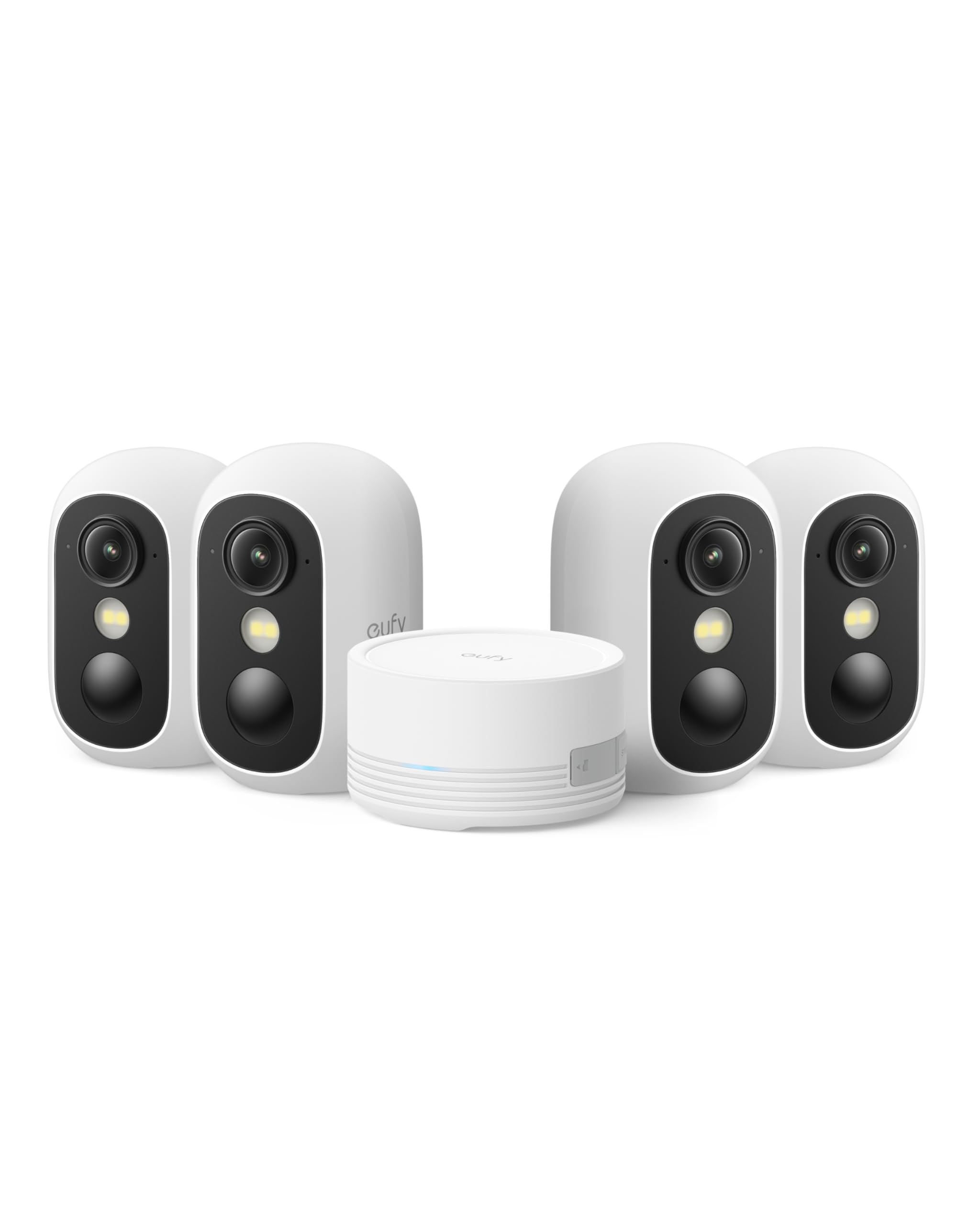
3. eufy Security eufyCam C35 4-Cam Kit
A magnetic, screw-free system that remembers faces and never asks for a subscription.
This system suits people who want smart-home brains without paying a monthly fee. The included HomeBase Mini is the hub that open up AI features like Facial Recognition and Cross-Camera Tracking — so the camera can tell you it’s your spouse at the door, not just “motion detected.” All of that comes with zero monthly fees; your one-time purchase covers cloud-free local storage, AI, and battery replacement costs. Spotlight-free color night vision reveals faces and license plates in total darkness without lighting up your yard.
Installation is the most painless of any system here: the powerful magnetic base snaps onto any metal surface or sits on a flat table — no drill, no damage, indoors or out. The camera records to the HomeBase Mini, which is expandable up to 1TB of centralized indoor storage, and also has its own microSD slot for direct local recording up to 256GB. Owners rave about the reliability, clear video, and wide lenses that show good coverage — one retired buyer who calls herself “not great at technology” found it very easy to set up and connect to Wi-Fi.
The AI detection is genuinely useful: it recognizes people, vehicles, pets, and activity zones, and you can set it to alert only for what matters. Battery life draws mixed feedback — one owner gets 3 months per charge, while another needs a recharge every 2.5 to 4 weeks depending on clip length. Motion detection is strong enough that it can spot movement up to 75 feet away, per owner reports.
The trade-off to know: this camera is not compatible with the HomeBase 2, so it’s a fresh ecosystem, not an upgrade to an older eufy setup. It connects on 2.4GHz Wi-Fi, which is solid for reliability but won’t take advantage of 5GHz speeds. For a household that hates subscriptions, this packs a lot of intelligence into one tidy kit.
Smart without the fees: facial recognition and cross-camera tracking are typically subscription features — here they’re built in.
Battery note: expect to recharge every few weeks to a few months depending on how busy your zones are.
Go for it if: you want AI smarts and free local storage in a clean, drill-free package.
Look elsewhere if: you’re trying to expand an older eufy HomeBase 2 system — it won’t connect.
4. Arlo Pro Wireless Security Camera 2K HDR (6th Gen) 4-Cam

The 160-degree wide-angle 2K system with auto-tracking zoom that follows the action.
If one camera must watch a whole driveway or a long backyard, field of view is everything — this Arlo stretches to a 160° panoramic view with 2K HDR (High Dynamic Range, which balances bright and dark areas so faces stay clear in harsh light). It sends alerts for a person at your door or a vehicle in your driveway, plus AI-generated event captions so you can search footage with keywords instead of scrubbing through hours. The auto zoom with motion tracking locks onto movement and zooms up to 12x to keep the subject in frame.
This is also the emergency-ready option. The app has a built-in trigger to contact police, fire, or medical services tied to the camera’s location, with pre-filled details for faster response. The battery is rechargeable and swappable — you can keep a spare charged and swap it in seconds rather than waiting for a full charge cycle. It connects via dual-band Wi-Fi and plays nicely with Alexa, Apple Home, Google Home, Samsung SmartThings, and IFTTT for voice control and automation routines.
Owners consistently praise the crisp 2K HDR images and how easy the app makes monitoring from anywhere. One buyer bought Arlo again after a previous system and remains very happy, noting the sharp video and reliable motion alerts. The 160° field of view gets special mention for capturing more of the yard than the old system did.
The catch is the subscription model: live streaming and basic alerts work without a plan, but advanced features like 60-day video history and AI detection require a paid Arlo Secure plan after the trial. The swappable battery is convenient, but reliability and battery life draw mixed comments — and occasionally a unit arrives dead, which is frustrating in a 4-pack. Also, the magnetic mounts need a drill for permanent installation, which some owners find awkward.
Why owners stay
- Sharp 2K HDR video with a huge 160° view
- Swappable battery means near-zero downtime
- Works with every major smart-home platform
Be aware
- Best features sit behind the Arlo Secure subscription
- Permanent mounts require drilling
- Quality-control hiccup: occasional dead unit in a pack
Best all-around outdoor pick if: you want premium video and wide coverage and accept paying for the advanced cloud features.
Not for you if: the idea of another monthly subscription makes you want to skip this brand entirely.
5. Swann MaxRanger4K Solar 2-Camera Kit
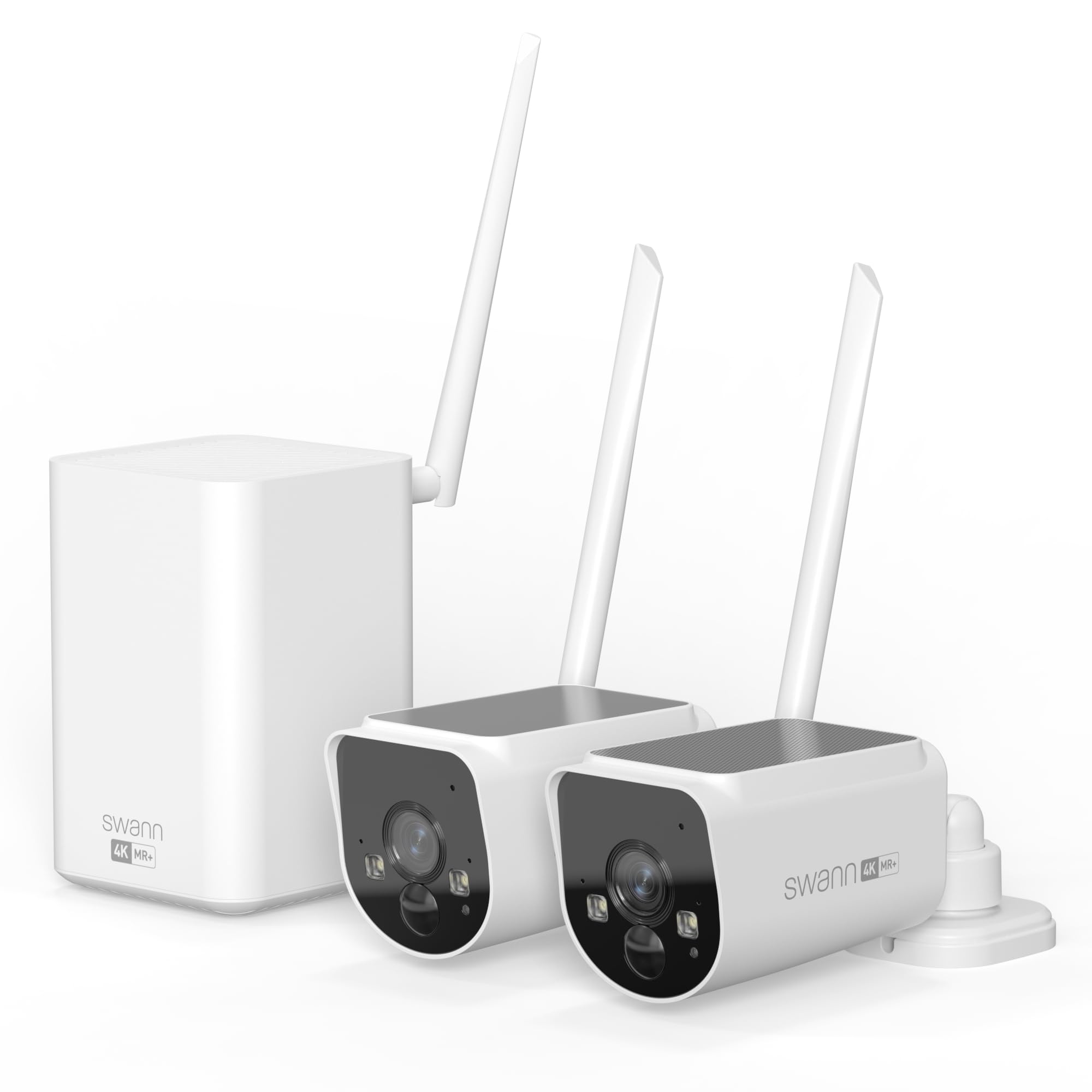
The solar 4K pair built for huge yards where normal Wi-Fi simply won’t reach.
If you have a long driveway, a rural property, or outbuildings far from the house, this is the system engineered for your problem. It runs on 900MHz Wi-Fi HaLow — a long-range wireless standard that delivers up to 2,000ft (600m) of open-air range and 650ft (200m) typically, covering roughly 20 times the area of standard Wi-Fi. Owners verify this in the real world: one reports excellent long-range connectivity 500+ feet through trees, which is exactly what a normal camera can’t do. Integrated solar panels and rechargeable batteries keep it powered continuously, so placement is truly wire-free with no downtime for charging.
The video is 4K Ultra HD with Night2Day color night vision, sensor spotlights, and long-range infrared for clear day-and-night protection. Swann’s True Detect+ AI senses heat, motion, people, and vehicles, and it can trigger alerts, spotlights, sirens, and two-way audio to stop a threat early. One owner found the PIR/AI detection reliably picks up people and vehicles at around 100 feet, which is impressive for a battery-powered unit.
Storage is local and fee-free: the included base station has a 64GB MicroSD card (expandable to 512GB) for up to 12 months of rolling recordings, plus optional cloud backup through the Swann Security App. The kit comes with two 4K solar cameras and a base station for monitoring multiple areas simultaneously. Buyers find installation straightforward, with good clarity and color, and one switched from a NightOwl system and calls these “quite nice.”
The honest downsides: night vision gets mixed feedback, with some wanting it stronger, and the system does not support current browsers, which is a compatibility annoyance for desktop viewing. Reliability is split — some report great performance while others have had hardware failures like a flickering spotlight or a dead night vision unit within months. Owners also note missing conveniences like adjacent-camera activation and notification suppression. This one shines brightest on big, spread-out properties where range beats everything else.
Range king: no other system here reaches 2,000ft of open-air Wi-Fi, and the solar panels keep it running free.
Know the limits: night vision could be punchier, and browser support is outdated — plan to use the app.
Choose this if: you have acreage, outbuildings, or a long driveway that standard cameras can’t cover.
Pass if: you’re a city dweller with a small yard — you’d pay for range you don’t need.
6. Blink Outdoor 4 – 5 Camera System

Five wire-free cameras that run up to two years on AA lithium batteries with Alexa on tap.
This is the system for the “low-maintenance” homeowner who has an Alexa ecosystem. The headline is the two-year battery life — the included AA lithium batteries keep each camera powered for up to two years, which is the longest on this list by a huge margin. That means no climbing ladders to recharge; you swap AAs occasionally and move on. It’s a 5-camera kit with 1080p HD live view, infrared night vision, and crisp two-way audio, all managed from the Blink app. Set up takes minutes per camera, and customers note the whole kit installed in about an hour.
The smart-home integration is the real draw. Stream video on an Echo Show, get instant alerts, control security features by voice, and talk to people hands-free through Alexa. Enhanced motion detection uses dual-zone sensing (which checks two areas before alerting) to cut down on false triggers, and you can set privacy zones. Footage stores in the cloud with a free 30-day trial of the Blink Subscription Plan, or you can back it up locally using the included Sync Module 2 and a USB drive — no recurring fee required.
Owners find the day and night video quality excellent for the price, and the app stitches multi-camera events smoothly so you can follow a person across cameras in one view. The motion sensitivity is adjustable, and reviewers point out minimal false triggers after tuning. It’s also significantly cheaper than comparable Ring or Nest systems.
The recurring gripe is battery life in high-traffic areas — some shoppers say replacing batteries every 2-3 weeks on cameras that face busy streets, which makes them expensive to run constantly. Physical access for resets is a known annoyance: if a camera drops offline, you often need to remove the battery to power-cycle it, which you can’t do remotely. Reliability and connectivity get mixed-to-negative feedback in the review pool, with some cameras randomly stopping. If you want a truly hands-off camera, keep it in low-traffic zones.
What stands out
- Two-year AA battery life is class-leading
- Free local storage via Sync Module 2 and USB
- One of the deepest Alexa integrations available
What to watch
- Busesy areas drain batteries fast — sometimes weeks, not years
- Offline cams need a physical battery pull to reset
- Advanced person detection needs the paid subscription
Right for you if: you live in Alexa and want cameras that barely need charging for years.
pass on it if: your cameras will face constant traffic — you’ll be swapping batteries far too often.
7. Hiseeu 4K PoE Security Camera System with 8 5MP PTZ Cameras
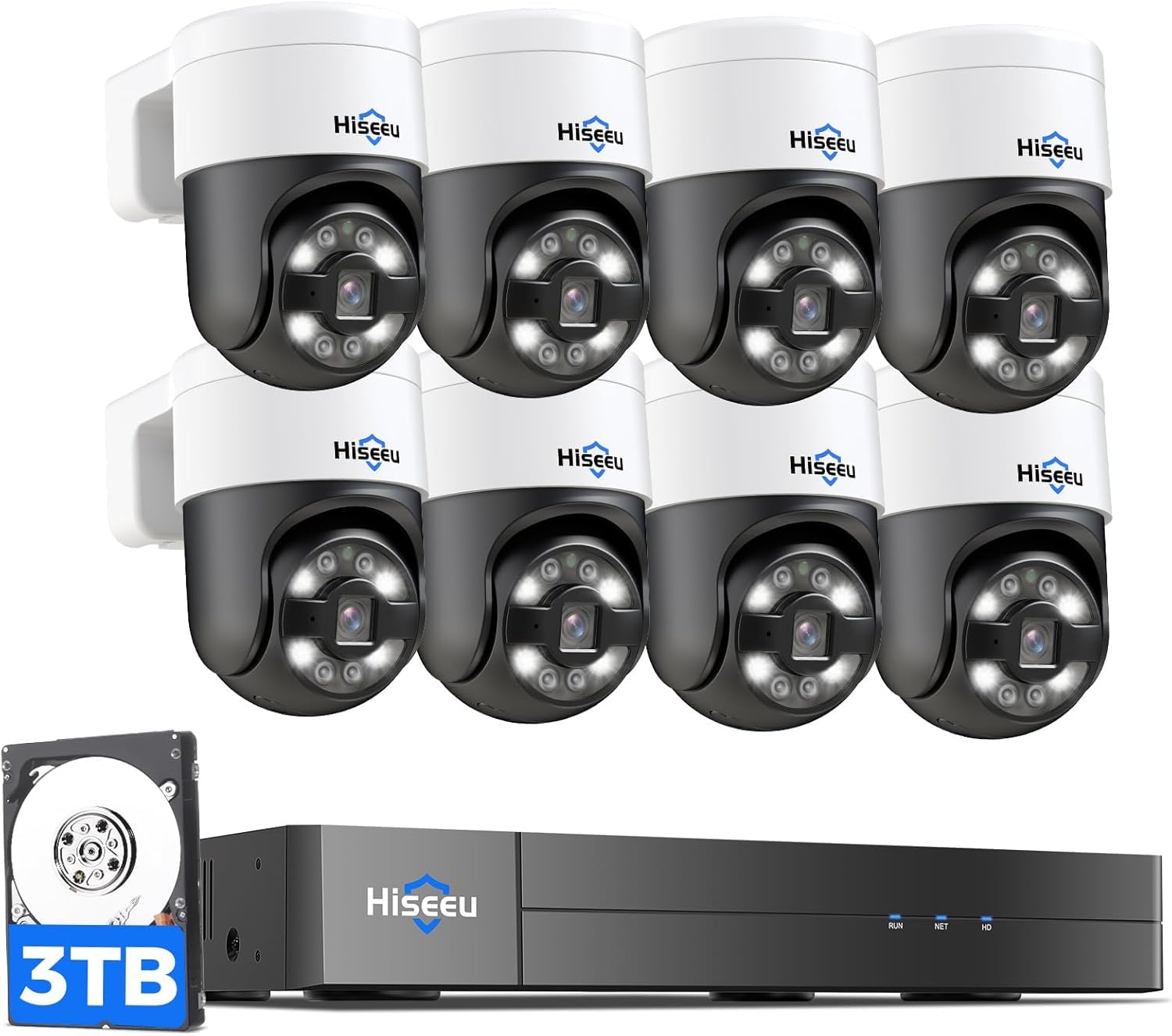
Eight PTZ cameras that physically turn and track people, recording 24/7 to a 3TB drive.
This is the pro-grade system for anyone who wants active cameras, not passive recorders. Each of the 8 cameras has a wide 300° pan and 90° tilt range with smart human auto-tracking — meaning the camera physically follows a moving person to reduce blind spots. On a long driveway or around a farm, that’s the difference between catching a face and catching an empty frame. The cameras capture 5MP HD video, and the included NVR (Network Video Recorder, the box that stores footage) is 4K-compatible. Built-in color night vision keeps things clear even in low light.
Wiring is simpler than it sounds: standard PoE (Power over Ethernet) means one network cable powers and connects each camera — no extra power adapters and no separate power runs. The NVR has 8 built-in PoE ports and can expand up to 16 channels with an additional PoE switch. A pre-installed 3TB hard drive handles 24/7 continuous recording, and you can switch to motion-detection recording to save space. Human and vehicle detection helps cut false alarms, with instant push alerts to your phone.
Owners love the human tracking — it eliminates false alarms from animals and does a great job following movement, with smooth handoff between cameras. The color night vision is very clear, and the two-way audio lets you talk to visitors at the door remotely. It’s rated IP66 waterproof, so rain, snow, and extreme temperatures won’t stop it. Buyers consistently praise the value, noting it’s more reliable than their old systems and records around the clock with no fees.
The mixed feedback is on reliability — some buyers report cameras randomly going offline for weeks before returning. Video quality is good, though license plates can’t be read beyond 50 feet, and the app notifications can get annoying with frequent alerts. Setup involves some complex settings, and a firmware update may be needed from the start. For a serious, always-on setup with active tracking, this is a lot of hardware for the money.
Genuinely active security: the 300° pan and auto-tracking mean cameras chase the action instead of just watching one angle.
Trade-off: you’ll run one Ethernet cable per camera, and occasional offline drops are the recurring complaint.
Built for: large properties, farms, and anyone who wants cameras that move with intruders and record 24/7.
Skip if: you can’t run cables or don’t want to manage a full NVR system.
8. eufy Security SoloCam E42 4-Cam Kit, 4K Solar
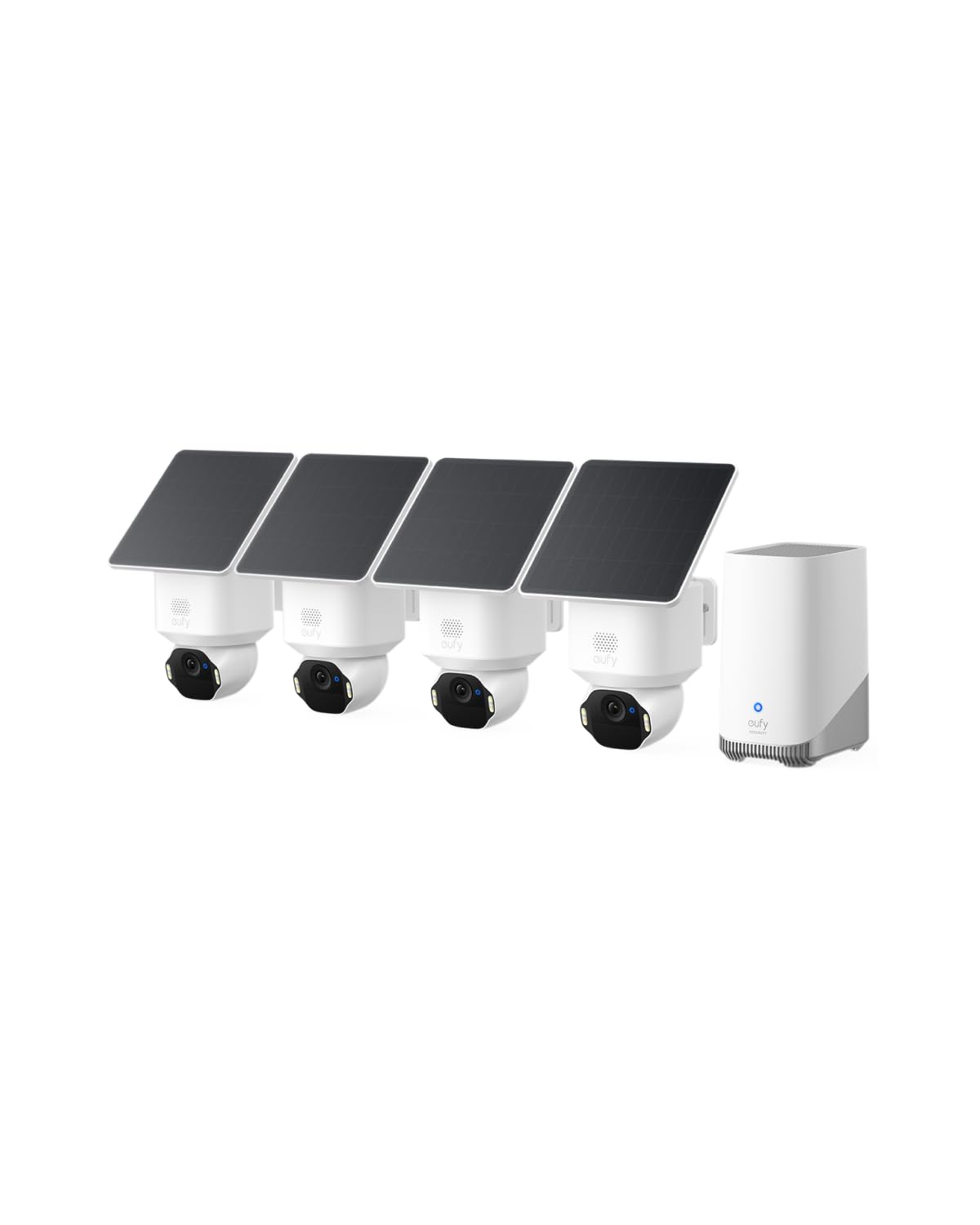
True 4K solar cameras that read license plates from 33 feet with zero monthly fees.
If video detail is your obsession, this is the sharpest battery-powered system here. The SoloCam E42 captures true 4K UHD resolution and can recognize license plates up to 33 ft (10m) away — enough to actually identify a car in your driveway. Built-in AI detects and automatically tracks people, vehicles, or important events within view, minimizing false alarms. A wide viewing angle reduces blind spots around your front porch, yard, or driveway. For deterrence, a motion-activated strobe light scares off unwanted visitors while sending you instant notifications.
The solar setup is designed to end charging anxiety. SolarPlus 2.0 technology means just 2 hours of direct sunlight daily keeps the camera fully charged for continuous, maintenance-free operation in any weather. Each camera comes with its own removable solar panel, so you can position the panel for maximum sun while aiming the camera where you need it. The included HomeBase 3 has 16GB of built-in storage (expandable up to 16TB) and supports continuous recording even during network outages, so you’re not helpless if your internet drops.
Storage is private and fee-free — support for up to 128GB of microSD per camera, or the HomeBase 3, and there are no subscription fees for the built-in AI. Owners call it one of the best systems they’ve owned, with clear day and night images and an easy-to-use app. The solar panels keep batteries fully charged for most users, and the auto-tracking is effective enough to scare off visitors. One buyer chose eufy specifically for the built-in AI with no extra charge and loves the face labeling feature.
The downsides are real but specific to heavy use. Running 24/7 live streaming can drain the battery faster than the solar panel refills it — one owner powers the front camera via USB because of this. Reliability and connectivity get mixed feedback, with some users reporting frequent offline issues that require unplugging the camera for 20 minutes to reset. The screws are soft and can strip, and you may want to add a hard drive for more recording space. For most homes, this is top-tier, but heavy users should plan for occasional resets.
The strong points
- True 4K with 33-ft license plate recognition
- SolarPlus 2.0 keeps cameras charged in 2 hours of sun
- HomeBase 3 stores footage free, even offline
The weak points
- Heavy live streaming can outpace the solar charge
- Offline issues may need a physical unplug to fix
- Soft screws make mounting finicky
Perfect if: you want maximum detail and free solar power, and you’re patient with the occasional reset.
Think twice if: you plan to live-stream cameras 24/7 — you’ll drain the batteries faster than the sun refills them.
9. Reolink 16CH 12MP PoE Security Camera System RLK16-1200D8-A
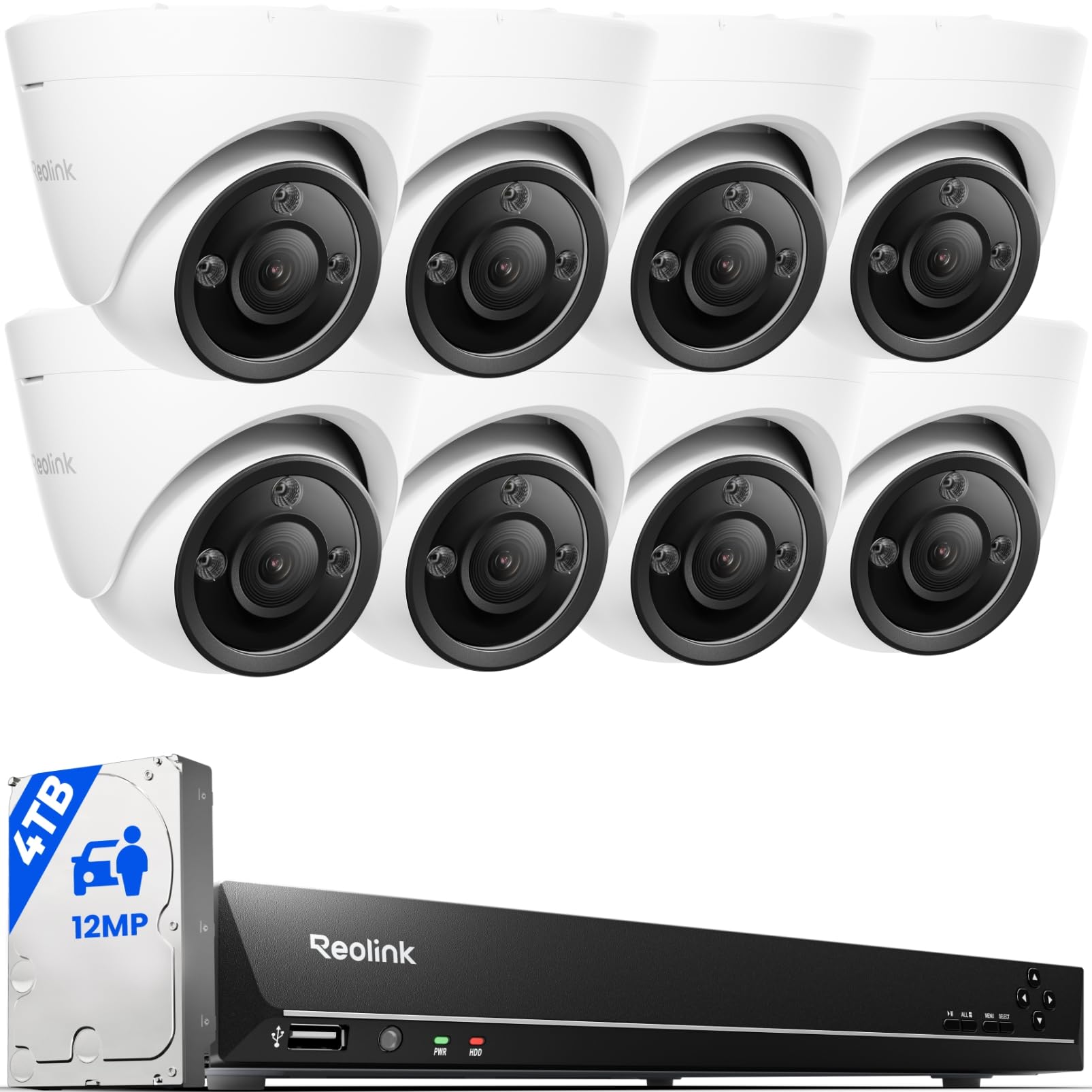
The 12MP powerhouse with 8 cameras and a 4TB drive for a full property, day and night.
This is the system you buy when you want to stop thinking about security hardware entirely. The RLK16-1200D8-A delivers a mind-blowing 12MP UHD image — the highest resolution on this list — capturing subtle details like a face, a badge, or a package label with stunning clarity. The spotlight on each camera enables full-color night vision, so you see the world in color after dark instead of grayscale IR. You can schedule the spotlight to work during certain hours and switch to IR LED mode other times, or let it be motion-activated to deter intruders alongside the siren.
These aren’t just dumb recorders. Smart detection identifies people, vehicles, and pets by their shapes, minimizing unwanted alerts from swaying trees or stray cats. Two-way talk is built into each speaker, so you can tell a delivery driver where to leave a package or warn off a stranger from your phone. The NVR gives you 16 PoE ports and expands to 24 channels total, supporting Reolink’s Wi-Fi and select battery cameras too — a system that grows with you.
Setup is the smoothest of any wired system here: PoE means one cable per camera carries both power and data, and owners mention it’s up and running in minutes. The pre-installed 4TB hard drive handles continuous recording, and one buyer notes a 4TB NVR holds roughly 5 days of 24/7 recording — they added a 6TB drive for about 12 days. Owner feedback is glowing on camera quality and image quality; a professional installer was so impressed he bought one for his own home, praising the picture quality day or night. Person and vehicle detection works better than expected, and the app handles live viewing and playback easily.
The honest caveats: the included hard drive failed within a year for one owner, though the cameras themselves remained solid. The cameras don’t lock to their mounts, so they’re easy to remove — a minor theft risk. Smart detection still throws some false alerts (a wasp or a cat), and reading a passing car’s plate is hit-or-miss. This is a serious investment, but for full-property coverage with no monthly fees, it’s the most complete system you can buy.
Why it’s the flagship
- 12MP UHD is the sharpest footage on this list
- 4TB HDD records 24/7 with no subscription
- Person, vehicle, and pet detection cuts false alerts
Consider this
- HDD reliability is a mild concern for some owners
- Cameras detach from mounts without a lock
- Major cable-running project to install
For the serious homeowner: if you want 8 cameras of 12MP clarity recording around the clock without ever paying a fee, this is the endgame.
Only if: you’re comfortable running Ethernet cables and want a system that stays for years.
Understanding the Specs
Resolution: 1080p vs 2K vs 4K
Resolution is how many pixels make up the image. 1080p FHD is the baseline — clear enough to identify a person at a normal distance. 2K (around 3MP) adds noticeable sharpness for reading faces. 4K UHD and 12MP are the top tier, letting you read license plates and small details, but they use more storage space and need stronger Wi-Fi to stream smoothly. Pick higher resolution if you need to identify intruders or vehicles; pick 1080p if you just want to see what’s happening.
Storage: Local vs Cloud vs Subscription
Your footage has to live somewhere. Local storage means a microSD card in the camera or a hard drive in a base station — you own it, and there’s no recurring fee. Cloud storage uploads clips to the maker’s servers, which usually costs a monthly subscription and keeps footage safe even if the camera is stolen. Some systems (like Tapo, eufy, and Reolink) offer free local storage, while others (like Arlo) lock their best features behind a paid plan. Decide upfront whether you’ll pay monthly, because it changes the real cost of the system.
Power: Wired, Battery, or Solar
Wired cameras (outlet or PoE) run 24/7 and never need charging, but you must place them near a power source or run cables. Battery cameras mount anywhere with no wires, but they record on motion only to save power, and you’ll recharge them every few weeks to months. Solar cameras add a small panel that keeps the battery topped up — ideal for sunny spots. High-traffic areas drain batteries fastest, so put wired cameras where there’s constant motion and battery cameras in quieter zones.
Night Vision: Infrared vs Color
Infrared (IR) night vision is the classic black-and-white view, using IR LEDs to see in total darkness; it works at long range but shows grayscale. Color night vision uses a sensitive sensor plus either a small spotlight or ambient light to show full-color footage at night — much better for identifying a vehicle’s color or a person’s clothing. Some systems mix both: full-color by default, switching to IR when you want to stay invisible. If identifying details at night matters, prioritize a color night vision mode.
FAQ
Will these cameras work without a monthly subscription?
What is a PoE camera system and do I need one?
How much battery life can I really expect from a wireless camera?
What does the field of view mean for my camera placement?
Is 2.4GHz Wi-Fi good enough for security cameras?
What is the difference between motion detection and person detection?
How do I record 24/7 instead of just on motion?
Can I use these cameras indoors and outdoors on the same system?
What is a HomeBase and do I need it?
Final Thoughts: The Verdict
For most buyers, the at home camera system winner is the Tapo C100 4-Pack because it delivers four reliable indoor cameras with clear 1080p video, free microSD storage, and a sub-dollar-per-camera value that’s hard to argue with. If you want outdoor coverage without drilling, grab the GMK 4-Pack for its 2K clarity and built-in siren. And for the smart-home enthusiast who hates subscriptions, the eufyCam C35 is the one to reach for with its facial recognition and zero monthly fees. The crowd favorite by sheer volume — 4.4 stars across 27,000+ owners — is the Tapo, and it earns that spot with dependable performance and honest value.
How We Picked
We do not accept paid placement. Every pick is matched to a real buyer and a real use-case; we do not hands-on test units.
Sources & Methodology
Specifications: manufacturer listings and product documentation. Review insights: verified customer reviews, as of August 2026. Pricing: not shown on this page (it changes often); check the current price via the retailer link.
As an Amazon Associate, Gadgets Feed earns from qualifying purchases. This does not affect which products we feature.