
Our readers keep the lights on and my morning glass full of iced black tea. As an Amazon Associate, I earn from qualifying purchases.
Specs are compiled from manufacturer listings and verified buyer reviews and can change over time — please confirm the key details on the product page before buying.
The best brace for posture support isn’t the tightest one — it’s the one you’ll actually keep wearing. You live with your spine every day, and a poorly chosen brace will end up in a drawer. This guide breaks down the real trade-offs between full-back rods, lightweight straps, and heavy-lifting belts, so you can match the hardware to your actual routine.
I’m Min — the founder and writer behind Gadgets Feed. This guide is built by comparing the manufacturers’ published specifications and the patterns across verified customer reviews, so you get each pick’s real strengths and trade-offs instead of marketing spin.
Whether your slouch comes from long desk hours, heavy lifts, or a healing injury, there’s a brace for posture support that fits your exact daily grind and level of support.
Our Picks at a Glance


How To Choose The Best Brace For Posture Support
Before you pick a brace, you need to know what kind of support your back actually needs. Most people buy for one of three reasons: they slouch at a desk, they lift heavy things for work, or they’re recovering from strain. Each scenario demands a different design, and buying the wrong style wastes your money.
Match the support style to your day
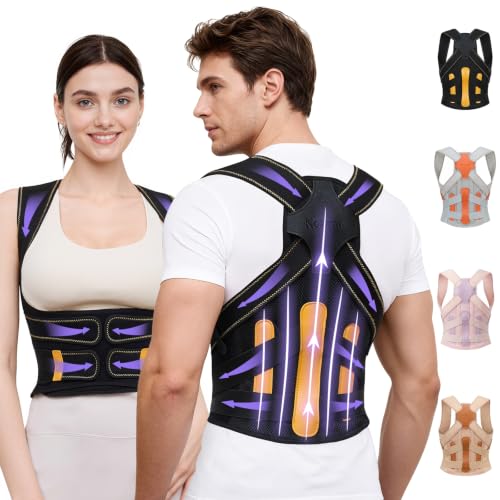
Lightweight shoulder straps pull your shoulders back to train posture — these are the ones you can hide under a shirt. Full-back braces with internal rods support your whole spine, from your neck down to your lower back, making them better for people who sit for hours and need a stronger reminder. Separate lower-back belts have their own job: they stabilize your lumbar region during heavy lifting and protect you from strain when you bend and move.
Reality check on sizing
Nearly every brace in this category runs small, and the recurring complaint across reviews is that straps are too short or the fit is one size down. Always measure your waist circumference at your belly button and compare it to the manufacturer’s size chart. If you fall between sizes, listen to the brands: they almost universally tell you to size up, especially if you have broad shoulders.
Quick Comparison
| Model | Best For | Support Style | Key Feature | Weight | Amazon |
|---|---|---|---|---|---|
| SOLOEVER Work Back Brace★ Best Overall | Heavy lifting & labor | Lumbar belt + suspenders | Double-pull tension straps | — | Amazon |
| Reatowrol Posture CorrectorBest Value | Daily desk posture | Shoulder strap | Breathable mesh | 250 g | Amazon |
| Kepwaa Full Back BraceFull-Back Support | Full spine support | Full-back rods | 5 flexible ABS rods | — | Amazon |
| VOKOKOYA Shoulder Straightener | Hunchback correction | Shoulder strap | Nylon build | 0.23 kg | Amazon |
| BraceAbility Figure 8 | Clavicle injury support | Figure-8 strap | Felt-backed pad | 3.84 oz | Amazon |
| Sparthos Back Brace | Lower back pain relief | Lumbar belt | Removable lumbar pad | 0.37 kg | Amazon |
| BraceTop Full Back Brace | All-day back support | Full-back mesh | Storage pocket | 10.88 oz | Amazon |
| Selbite Full Back Brace | Structured full-back feel | Full-back panels | Neoprene blend | — | Amazon |
| PAZAPO Lumbar Belt | Big & tall lifting | Lumbar belt + suspenders | 5 flexible support bars | 0.49 kg | Amazon |
In‑Depth Reviews
1. SOLOEVER Work Back Brace
Our pick — 4.5★ from 750+ verified ratings; the strongest balance of quality and price.
The lift-belt specialist that braces you through a full shift without rolling down.
This is the one you reach for when your job means moving, lifting, and bending all day. Its double-pull tension straps and flexible posterior stays give real, firm lower-back and abdominal support — the kind that keeps your spine stable when you handle a heavy load. Durable suspenders hold the belt in place even as you twist and turn, which matters when you’re on your feet for hours.
You get a brace that stays put and keeps you cool, thanks to the breathable fabric that works in warm warehouses. Buyers report it’s comfortable and holds its position on the body, with one owner noting his grandson — who helps with heavy lifting — found it “very comfortable” and that it “definitely helped his back.” The catch is fit: several owners say it runs one size too small and the straps are on the shorter side, so consult the sizing chart before ordering rather than guessing.
Unlike lighter shoulder-strap correctors, this one is a serious work tool, not a desk reminder. If you lift frequently or spend long hours in physical roles, this belt earns a spot in your routine. For pure posture training at a computer, a slimmer strap would serve you better.
The work-ready strengths
- Firm support for heavy lifting and construction
- Breathable fabric for all-day wear
- Suspenders keep it anchored during movement
The sizing watch-out
- Runs one size small for several buyers
- Straps can feel short on taller frames
Reach for this if: you lift, build, or move for a living and want dependable lumbar protection.
Look elsewhere if: you only need a subtle desk-posture reminder — this belt is built for labor, not lounging.
2. Reatowrol Posture Corrector
A featherweight strap that quietly straightens you at a desk all day.
At just 250 g, this is the bracket you nearly forget you’re wearing — and that’s exactly the point. It’s small and thin enough to slip under a shirt or jacket, so you can wear it in public without announcing it. The mesh fabric stops your back from getting sweaty and overheated, and it hand-washes and dries quickly for easy upkeep.
What wins people over is the posture support: it gently pulls your shoulders back and takes pressure off your neck and upper back. As buyers put it, it’s “really easy to use and works super well,” and the comfortable fit means you can keep it on all day without pinching. It works for men, women, and even teenagers, and the straps adjust to suit your frame.
Unlike the full-back rod designs, this one is a lighter nudge rather than a rigid frame. Start with 10–20 minutes a day and build up to an hour or two — that’s the recommended ramp to let your body adapt. If you sit at a computer for long stretches, this is the low-fuss fix that actually gets worn.
Best daily driver: pulls shoulders back without bulk, so you get support in a shirt-and-tie setting.
The honest limit: it corrects posture, but it won’t brace you for heavy lifting — that’s a different tool entirely.
3. Kepwaa Posture Corrector
Five internal rods give it the spine to hold you straighter than any strap.
This one takes the middle ground: it has the structure of a full-back brace with the flexibility of a strap. The 5 flexible ABS support rods stabilize both your upper and lower back, which means it can tackle slouching, neck strain, and lumbar pain in one piece. The ergonomic shape is designed to follow your natural curve without digging into your armpits, even during long wear.
The quality gets the most praise here, and it’s easy to see why — buyers describe it as a gentle but persistent reminder to keep your shoulders back and down. One owner with a compressed-vertebrae injury said it fits “very nicely” and offers “great support” compared to the bulky doctor-issued brace. It comes in 3 sizes, and the brand says to measure your waist at your belly button and size up if you’re between sizes.
It works during desk work, around the house, or while standing for long periods. A minor note: a few owners felt mild itching against bare skin, solved by wearing it over a thin T-shirt. The polyester and SBR fabric is breathable and hand-wash only.
The structured middle child: more support than a strap, less bulk than a lifting belt, ideal for all-day posture work.
Who should pass: if you want near-zero bulk under tight clothing, the simpler strap-style correctors vanish more completely.
4. VOKOKOYA Posture Corrector
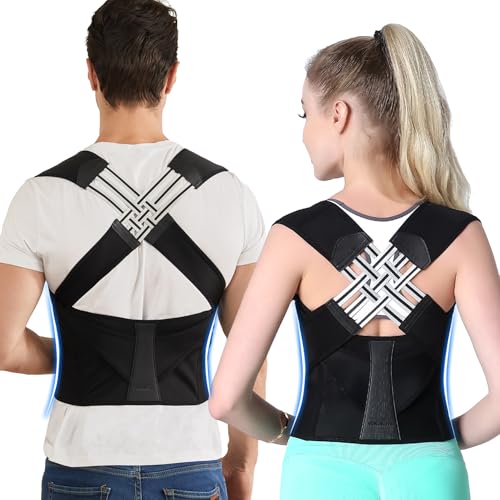
A nylon strap designed for the slight hunch that desk work carves into your frame.
This corrector targets the specific problem of hunchback from poor posture — the kind that comes from looking down at screens all day. It’s a unisex strap that works for both men and women, and it’s light enough that the brand calls it a “lazy shoulder strap” you can wear all day comfortably. The nylon material is simple and breathable, and you adjust the fit to your own body shape.
Functionality is what buyers praise most here — the brace notices a difference in posture quickly, and the quality feels solid. But sizing is the recurring sore spot: several owners mention that the medium runs small, and one buyer’s husband had to skip this model because the large wasn’t available. There’s also honest feedback that it can feel tight under the armpits for some, so measure carefully before you commit.
The guidance is to start with 10–20 minutes a day and add time gradually. If you have a mild hunch and want a simple, low-profile strap, this fits the bill — just be prepared to order up a size. Heavier, rod-supported braces give stronger correction if your hunch is more pronounced.
Quick posture nudge: a simple, breathable strap for mild hunchback and long work hours.
Size with caution: the fit runs small, and armpit comfort is hit-or-miss based on your build.
5. BraceAbility Clavicle Support Brace

The clinical figure-8 that doubles as a posture trainer for shoulders and clavicles.
This is the specialist of the group: a figure-8 splint designed to secure your shoulders in proper position while also treating fractured clavicles and easing collarbone or shoulder injuries. It’s built with wide, padded stockinette-covered straps and a felt-backed pad, and at just 3.84 oz, it’s light enough to wear through the day and even while sleeping. The medical-grade closures make application straightforward.
Quality earns the strongest praise, and customers note real recovery wins — one used it for a severe clavicle injury and said it “immediately reduced pain” and improved arm mobility compared to a sling. It pulls your shoulders back to promote straight posture, which is why it works as both a recovery tool and a trainer. The honest catch: this is not a solo-friendly brace. Buyers consistently note it’s nearly impossible to put on or take off without a second person, and it can dig into the armpits during extended wear.
Measure just below your chest, under your sternum, and size up if you have broad shoulders or fall between sizes. If you’re recovering from a shoulder or collarbone issue and have help nearby, this is a strong pick — but for pure everyday posture correction, a strap design is far easier to manage alone.
Recovery strengths
- Genuine clavicle and shoulder injury support
- Featherlight at 3.84 oz
- Padded straps for comfort
The solo-user barrier
- Nearly impossible to put on without help
- Can dig into armpits over time
Choose this if: you’re recovering from a clavicle or shoulder injury and want a real medical-style support.
skip it if: you need an easy on-and-off daily posture brace — you’ll want a strap with a front clip instead.
6. Sparthos Back Brace

The crowd favorite for lower-back pain, with tens of thousands of owners behind it.
When a back brace has this many verified buyers — the crowd favorite here with over 68,000 ratings — it’s worth taking seriously. The Sparthos is a lumbar belt built for one thing: taking pressure off your lower back. Its adjustable lumbar pad gives extra compression right where you need it, and the vertical support stays stop the belt from rolling up as you move. At 0.37 kg, it’s substantial without being a bulky tank.
You get immediate relief when bending, twisting, and lifting, with one large-framed buyer saying it made those movements “much easier with little to no pain.” The breathable fabric works under regular clothes, so you’re not stuck looking like you borrowed a medical device. The mixed area is sizing — a few owners find the chart confusing and end up sizing up, so measure your waist and read the chart twice.
This isn’t a posture strap and it won’t pull your shoulders back. It’s for sciatica, herniated discs, and general lower-back strain. If that’s your problem, this is the strongest, most-proven option in the lineup.
The lumbar relief king: targeted lower-back compression with a removable pad for fine-tuned support.
Who should skip: if you need upper-back or shoulder correction, this belt only covers the lower spine.
7. BraceTop Full Back Brace

A full-back brace with a hidden pocket for your phone — and a heart for your posture.
This is the practical one. The new version adds a storage bag so you can carry keys, a phone, or credit cards while you wear it — a small touch that makes all-day wear genuinely easier. Its high-elastic support strip stabilizes your back, and the strip withdraws so you can adjust pressure or clean the brace without wrestling with it. The perf-elastic band gives strong tension, and the widened belt protects your waist during heavy lifts.
Quality and posture support are the biggest draws, with owners praising how easy it is to wear and how discreet it stays under shirts. It’s a “3-in-1” design that straightens your back, chest, and shoulder together, targeting humpback, kyphosis, and scoliosis. Reviewers point out it runs a little small — one owner recommends ordering a size up — and at 10.88 oz, it’s on the heavier side of posture braces.
The dense mesh back keeps you cool during long sessions, addressing the stuffiness that plagues cheaper designs. If you want full-back support with a touch of everyday convenience and don’t mind the extra heft, this one delivers.
Form meets function: full-spine support plus a pocket, so you can wear it running errands without a bag.
The trade-off: at 10.88 oz it’s heavier than strap-style options, and sizing runs small — size up.
8. Selbite Full Back Brace
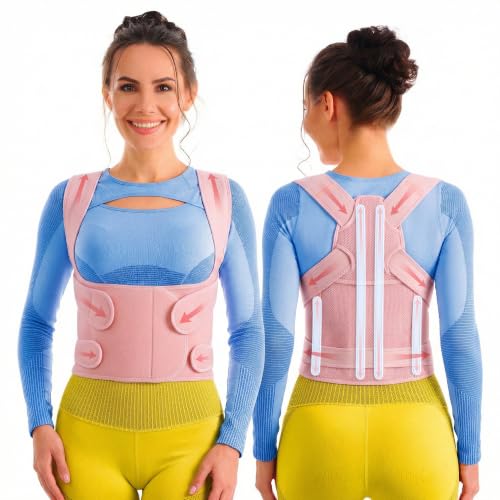
A structured full-back frame that pins your shoulders back without the pinch.
This one is for people who want real, noticeable support across the whole back — not just a gentle reminder. It uses a full-back structure with flexible support elements and adjustable shoulder and waist straps, so you control exactly how much tension you feel. The material is 70% neoprene and 30% polyester, which gives it a firm, supportive feel that stands apart from flimsy straps.
You get pain relief that owners praise most, with several noting it forced upright posture and reduced back pain after removal. One buyer described it as a “wow standout,” noting it pins the shoulders back without pinching and is easy to forget you’re wearing. The honest limit: it’s not soft, and it’s best worn over a base layer. Owners also warn it sits narrower than expected for broad shoulders and can chafe after several hours, so it’s better for shorter, consistent sessions than full workdays.
The brand is upfront that this works best in intervals — start with 15–30 minutes a day — and pairs well with loose button-up shirts. If you want structured support for desk work and light movement, this delivers; just know it’s not built for all-day grinding.
For the structured-support seeker: firm full-back panels with adjustable rods for a custom fit.
Who should hesitate: broad-shouldered users and anyone needing 8-hour comfort — this one chafes after a few hours.
9. PAZAPO Lumbar Belt
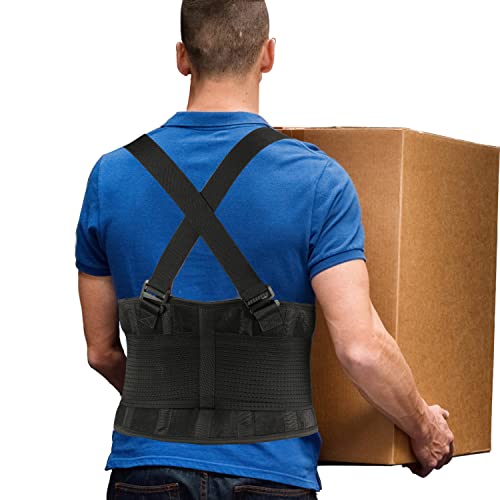
The heavy-lift belt that scales up to a 60-inch waist without giving up support.
This belt’s a neat extra is range. Sizes run from a 25–30 inch waist all the way up to a 65–76 inch fit, with the XL/XXL covering 37–45 inches — so it genuinely serves big and tall workers who struggle to find gear that fits. It packs 5 flexible support bars with an oblique arc design that hugs your lower-back curve and spreads pressure across the lumbar muscles. The double-layer build adds a soft breathable compression layer against your skin and an outer adjustable layer for tightening.
Quality and back support are what owners praise most, and the stories are convincing: one 480-lb user wore it through 9–10 hour shifts without it sliding, and another credits it with getting him through unloading a moving truck. At 0.49 kg, it’s the heaviest belt here, but that weight translates to serious stability. The honest gripe is the suspenders — several owners say they’re too short or pull the brace up, causing bunching, and a few returned it for that reason. The Velcro durability also draws mixed feedback.
The good news is the suspenders are removable, so you can ditch them and rely on the belt’s compression alone. If you’re a bigger frame doing heavy lifting, this belt will actually stay put — just budget for the possibility that the suspenders aren’t the right call for you.
The heavy-duty strengths
- Exceptional size range up to 65–76 inch waists
- 5 flexible support bars for lumbar pressure
- Stays tight during long shifts
The fit friction
- Suspenders run short and can bunch the belt
- Velcro durability gets mixed feedback
Reach for this if: you’re a bigger or taller frame doing heavy lifting and standard belts never fit right.
Think twice if: you need the suspenders to work — you may prefer to remove them and rely on compression alone.
Understanding the Specs
Support rods vs. straps
The biggest decision is structure. Flexible ABS rods — like the 5 in the Kepwaa and PAZAPO — give rigid, stable support that holds your spine in place, which is the choice for heavier correction needs. Shoulder straps like the Reatowrol simply pull your shoulders back as a training cue; they’re lighter and easier to hide but offer less forceful correction. Pick the structure that matches how much support your day demands.
Breathability and fabric
You’ll wear this for hours, so fabric matters as much as the frame. Mesh designs — like the Reatowrol and Kepwaa — prevent sweating and overheating, making them comfortable for long sessions. Neoprene blends like the Selbite give a firmer, more supportive feel but run warmer. Weight is a clue: a 250 g strap feels nearly invisible, while a 0.49 kg belt like the PAZAPO screams serious support. Choose based on how long you’ll keep it on.
FAQ
Will a posture brace actually fix my slouch?
How do I know my correct size?
Can I hide a brace under my clothes at work?
Will a posture brace help my lower back pain during heavy lifting?
What’s the difference between a figure-8 brace and a regular strap?
How long should I wear a posture brace each day?
Can a brace help with a herniated disc or sciatica?
How do I clean my posture brace?
Why does my brace feel too tight under the armpits?
Final Thoughts: The Verdict
If you want one dependable pick, the brace for posture support winner is the SOLOEVER Work Back Brace because it balances firm lifting support with breathable all-day comfort. If you want a discreet strap to fix desk slouch, grab the Reatowrol Posture Corrector. And for serious lower-back pain from sciatica or herniated discs, the Sparthos Back Brace is the one to reach for — its tens of thousands of owners have made it the proven crowd favorite.
How We Picked
We do not accept paid placement. Every pick is matched to a real buyer and a real use-case; we do not hands-on test units.
Sources & Methodology
Specifications: manufacturer listings and product documentation. Review insights: verified customer reviews, as of August 2026. Pricing: not shown on this page (it changes often); check the current price via the retailer link.
As an Amazon Associate, Gadgets Feed earns from qualifying purchases. This does not affect which products we feature.