
Our readers keep the lights on and my morning glass full of iced black tea. As an Amazon Associate, I earn from qualifying purchases.
Specs are compiled from manufacturer listings and verified buyer reviews and can change over time — please confirm the key details on the product page before buying.
Carbon monoxide in a car, RV, or camper is a danger you cannot smell, see, or taste — and by the time you feel drowsy, it is already serious. The detectors on this list split into two very different jobs: an always-on 12V alarm that guards you while you sleep in the rig, or a portable handheld monitor that shows you the exact parts-per-million (PPM) reading so you can actually find the leak. Which one you need depends entirely on if you want to be warned or want to investigate.
I’m Min — the founder and writer behind Gadgets Feed. This guide is built by comparing the manufacturers’ published specifications and the patterns across verified customer reviews, so you get each pick’s real strengths and trade-offs instead of marketing spin.
The best automotive co detector for your vehicle pairs the right sensor range with a power source that matches how you camp, drive, or work.
Our Picks at a Glance

How To Choose The Best Automotive CO Detector
Before you pick, decide your job. A fixed 12V alarm mounted on an RV wall stays on with the house battery and never needs recharging, perfect for sleeping rigs. A portable monitor with a rechargeable cell is what you carry into a garage, a boat cabin, or a tent — it shows numbers instead of just sounding.
Sensor range and type
The detection range tells you how fine a reading you get. A small handheld that reads down to 1 part per million will catch low-level exposure long before a household alarm set for 70 ppm would ever blink. The electrochemical sensor inside is what actually does the measuring; cheaper semiconductor sensors can false-alarm in humidity or near gas appliances.
Power source and placement
Hardwired 12V units run directly off the vehicle’s battery with no batteries to swap, drawing around 108mA at 12V DC. Portable models run on internal rechargeable cells or user-replaceable lithium batteries. Match the power source to the spot you plan to mount the unit — a dash, a cabinet wall, or a shirt pocket all demand different formats.
Quick Comparison
| Model | Best For | Detection Range | Power Source | Alarm Style | Amazon |
|---|---|---|---|---|---|
| Safe T Alert 35 Series Dual LP/CO★ Best Overall | RV flush-mount replacement | Propane + CO | 12V DC hardwired | Audible | Amazon |
| 7PETAL USB-C Car Charger COBest Value | Everyday charging + CO alert | CO detection | 12V plug-in | Audible | Amazon |
| Safe-T-Alert 85 Series Dual CO & LP | Slim-line RV dual alarm | Propane + CO | 12V DC hardwired | Audible | Amazon |
| MTI Marine CO Alarm | Marine / RV CO-only swap | CO detection | Battery powered | Audible | Amazon |
| TOPTES CT-913 Portable CO | Finding the source of a leak | 0–1000 ppm | 4000mAh rechargeable | Visual, audible, vibration | Amazon |
| Heiman Smart CO Detector 5-Pack | App alerts on the go | 0–5000 ppm | Battery (5-year) | Audible / visual | Amazon |
| Inspector CO Monitor | Low-level precision in harsh zones | 1–1,999 ppm | CR123A lithium | LED, audible, vibration | Amazon |
In‑Depth Reviews
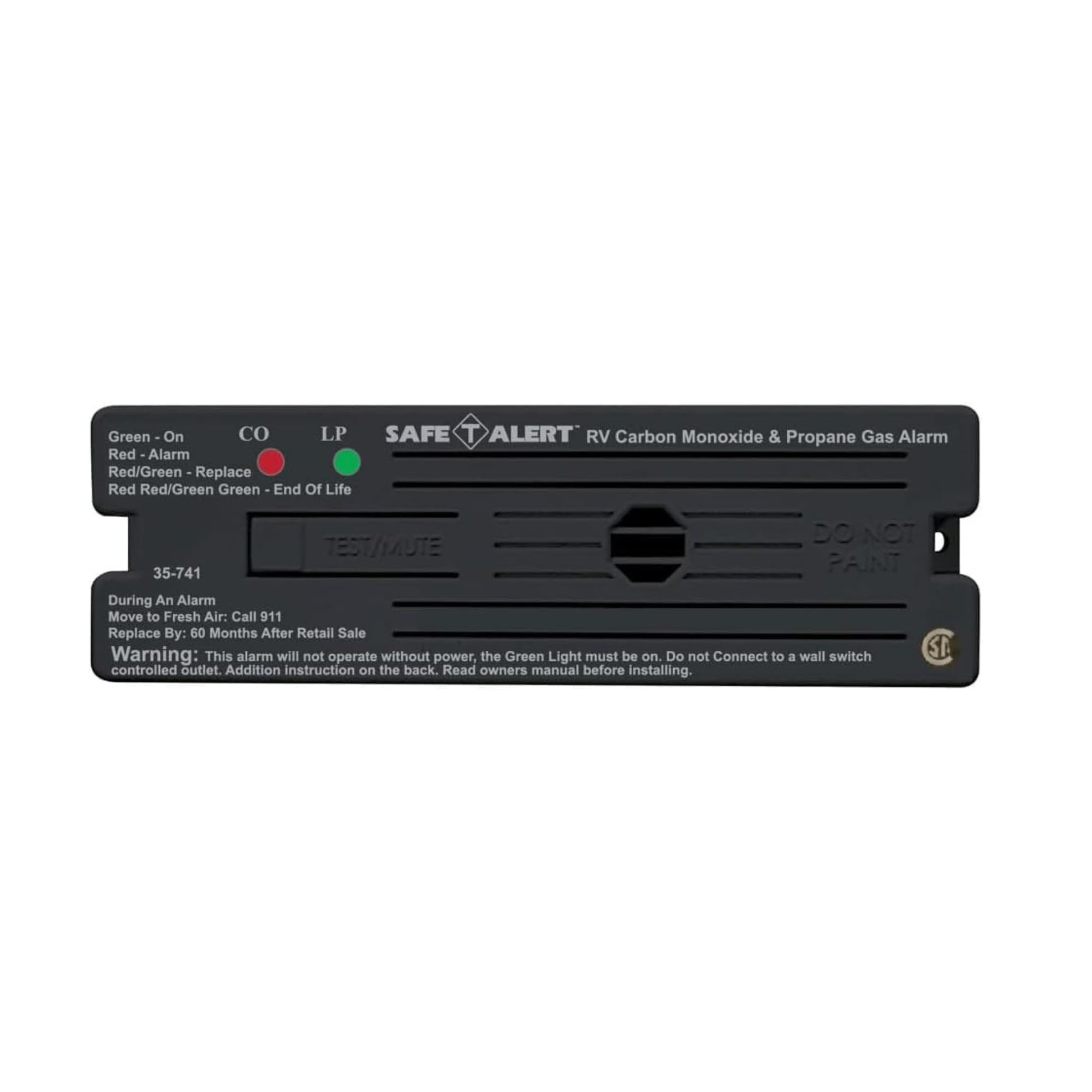
1. Safe T Alert 35 Series Dual LP/CO Alarm
Our pick — 4.5★ from 250+ verified ratings; the strongest balance of quality and price.
The RV owner’s drop-in replacement that covers both propane and CO without rewiring a thing.
If your camper already has a flush-mount propane alarm, this is the upgrade that slots straight into the same opening. It watches for both propane gas and carbon monoxide in one unit, pulling power from the 12V DC system at 108mA — no batteries to change, just reliable protection while the rig is parked. The surface-mount black housing replaces Safe-T-Alert 30-442 and most CCI Controls flush-mount propane alarms directly, so you are not cutting new holes in the wall.
The panel handles harsh conditions too, rated to operate from -40°F up to +158°F, which covers most campground seasons. Buyers report it is an exact replacement, though the fine print matters: the documentation recommends replacement five years from the manufacture date — not from when you install it. That is worth checking before you buy, since a unit that sat on a shelf is already partway through its service life.
What wins people over is how easy the swap is — “easy installation” and “works as advertised” are the recurring notes, and an owner who replaced a nine-year-old original from a 2014 fifth wheel confirmed it fit and reset properly. The honest trade-off is the price: buyers call it costly, but the confidence of one unit covering both gases at once is what keeps it the top pick.
grab this if: you want a single 12V unit that replaces an aging propane alarm and adds CO coverage in the same wall space.
check the date: this unit has a hard five-year life counted from manufacture, so a fresh one matters.
2. 7PETAL USB-C Car Charger with CO Detector
A stainless steel two-in-one that fast-charges your phone and quietly watches the air as you drive.
This is the cleverest twist on the category: a 304 stainless steel car charger that packs a carbon monoxide detector and an emergency safety hammer into the same dongle. You plug it into the 12V socket, get PD 3.0 and Quick Charge 3.0 fast charging for iPhone, Samsung, Google Pixel, and more, and keep CO monitoring running the whole trip. For a daily commuter who naps in the car or idles with the AC on, that extra watchfulness is a real comfort.
The dual ports handle two devices at once, with the current rating spanning 1.5 A, 2 A, and 3 A — enough to feed a tablet and a phone together. A pilot who flies a small GA plane shared that an iPad Pro in the USB port and an iPod in the USB-C port charged fine while the CO sensor worked in the background. The steel body is built to survive daily use, and the built-in hammer is there if you ever need to break a window to escape.
But this is the one pick where the caveats are loudest. One buyer returned a double order after the unit “heats up” following 15 minutes of use, and another reports it simply “does not work.” Those are real mixed signals, so treat this as a budget-friendly convenience that adds a layer of awareness — not as your primary, dedicated CO alarm.
reach for this: you want charging plus a basic CO guard and a window breaker in one pocket-sized accessory for everyday driving.
look elsewhere: you need a certified, dedicated CO alarm — this is an accessory, not a primary safety device.
3. Safe-T-Alert 85 Series Dual CO & LP Alarm

The slim-line dual alarm with a low profile and a trim ring that covers up old cutout gaps.
If you want the dual CO-and-propane protection of the 35 Series but prefer a sleeker look, this 85 Series runs the same idea in a new low-profile, slim design. It draws power from a 12V DC hardwired connection — no batteries to manage — and comes with a trim ring that helps tidy the mounting hole when your old alarm’s opening does not match the new flush face. The white finish blends into most RV and trailer cabinetry.
The rugged build is made for life on the road, and buyers describe the swap as a “perfect replacement for original” that was “easy install.” One owner liked having multiple mounting options so the alarm could fit different size openings left behind by the factory unit. The whole package weighs just 11.36 ounces, so it hangs on a cabinet wall without feeling bulky.
There is one thing to know before you commit: this unit bundles propane detection with CO detection, and at least one buyer paid for that combo when they already ran a separate propane detector. If you only need CO, the dual design is still excellent value when you want one fewer box on the wall — just know you are getting both gases if you need them or not.
marine grade build: RV owners who want a clean, slim dual alarm with a trim ring to hide an old mounting hole.
pricey upfront: you are buying propane plus CO in one unit, so skip it if you already have a dedicated propane detector.
4. MTI Industries Marine CO Alarm
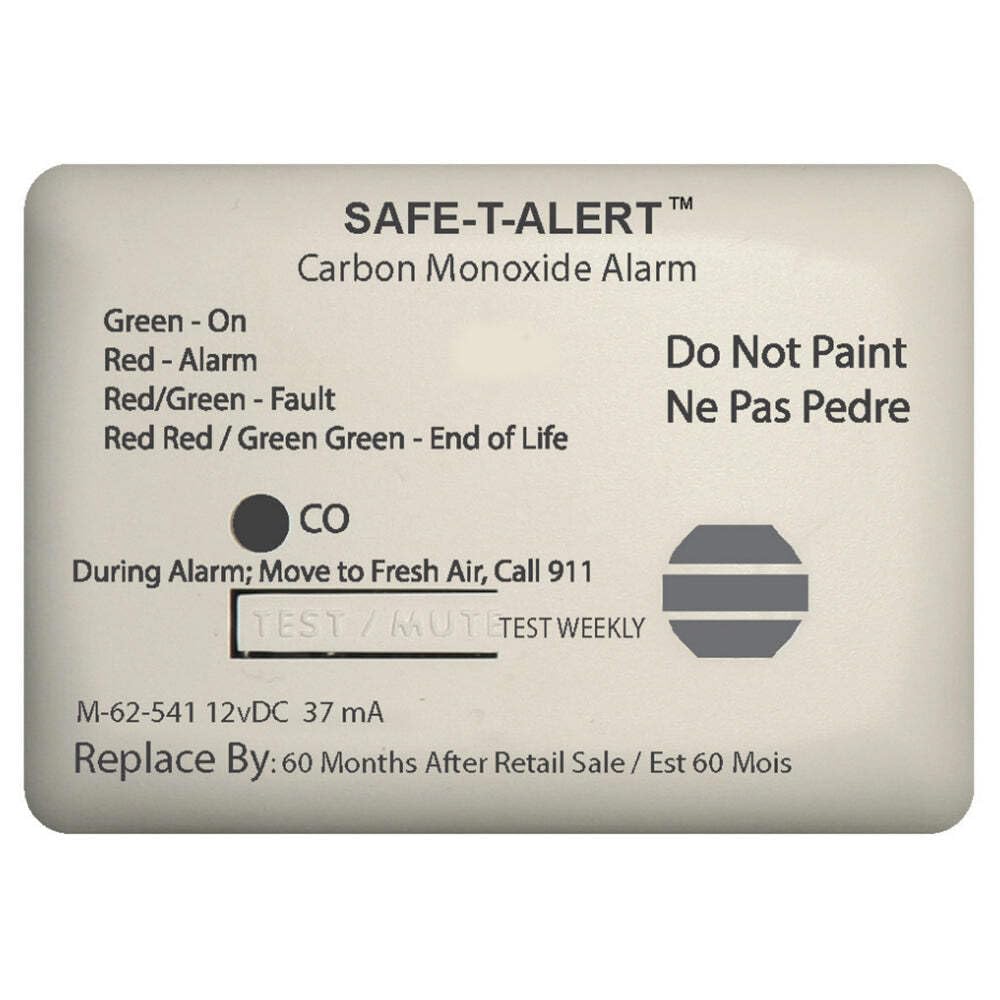
The compact CO-only alarm that swaps in battery-powered and is dead simple to install.
Sometimes you do not want to mess with 12V wiring at all — and this MTI Marine CO Alarm is the battery-powered answer. It is built as a compact unit for boats and RVs, running entirely on batteries so you can mount it on a wall, shelf, or cabinet without tapping into the vehicle’s electrical system. The white, compact housing keeps it low-profile in a cabin, and owners mention installation is straightforward with good directions.
This one is strictly carbon monoxide — no propane sensing — which makes it the cleaner pick for anyone who already has a separate LP detector and just wants CO coverage. The design is the same MTI family used in RVs, and owners describe it as an “easy install and perfect replacement,” with one noting their previous unit “lasted over 4 years” before needing a swap. Another owner specifically bought it to replace the old detector in a 10-year-old travel trailer and found the directions clear if you understand basic electrical work.
The catch is the hard five-year shelf life baked into CO sensors: about four years in, the unit “beeps non-stop until it is replaced,” as one owner found. That is normal for the technology — every detector on this list eventually ages out — but it means this is a product you buy knowing you will replace it on schedule, not run it forever.
choose this if: you want a battery-powered, CO-only alarm that installs anywhere without 12V wiring, especially for a boat or trailer.
remember: plan for a replacement around the five-year mark, when the sensor’s end-of-life beeping begins.
5. TOPTES CT-913 Portable CO Detector
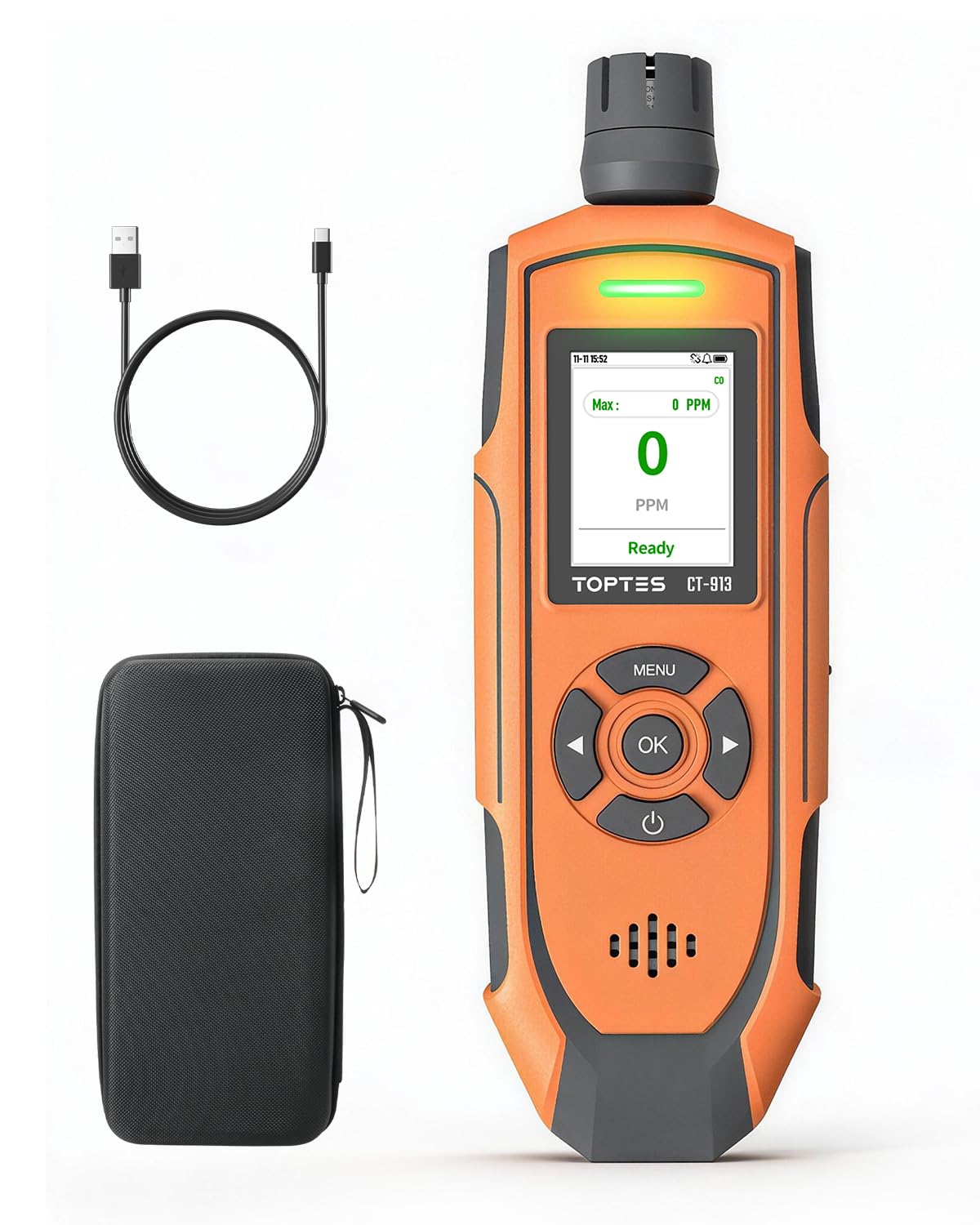
The handheld investigator that reads exact PPM values and hunts down where the CO is coming from.
This is the detector you use to find the source, not just wait for an alarm. With a 0–1000 PPM detection range and a real-time reading on a TFT color display, the TOPTES CT-913 turns your car, garage, or campsite into a measurable space — you can walk the monitor room-to-room and watch the number climb as you approach the leak. The trend graph helps you see concentration changes at a glance, which is exactly what you want when diagnosing a water heater or engine exhaust problem.
It runs on a 4000mAh rechargeable battery that delivers over 60 hours per charge, so a multi-day camping trip with a portable heater never leaves you dead. The upgraded UK DDS electrochemical sensor responds fast, and the triple alarm system — visual, audible, and vibration — fires together when preset thresholds hit, which suits noisy workshops or a tent where an audio beep alone might be missed. The durable industrial-grade ABS housing handles job-site bumps.
The review pattern is striking: owners used it to identify a water heater as the source of a nighttime alarm, and another went room-to-room with digital readings to validate existing smoke and CO detectors. The consensus is that it “paid for itself immediately” by solving a real safety issue. The only mild note is that the manual deserves a read for setup — the feature set is deep enough that you will want to know your settings before an emergency.
portable travel size
- 60+ hours from a 4000mAh charge — days of camping without a recharge
- 0–1000 PPM range with a trend graph, so you can trace a leak to its source
- Triple alarm (visual, audible, vibration) for noisy or dim environments
short battery life
- Read the manual first — the calibration and settings options take a minute to learn
- It is a portable tool, not a wall-mounted 12V alarm, so mounting is DIY
perfect for: campers, HVAC owners, and anyone who wants to pinpoint a CO source with a visible PPM number.
not for: someone who wants a permanent wall alarm they can set and forget — this is an active measuring tool.
6. Heiman Smart CO Detector 5-Pack
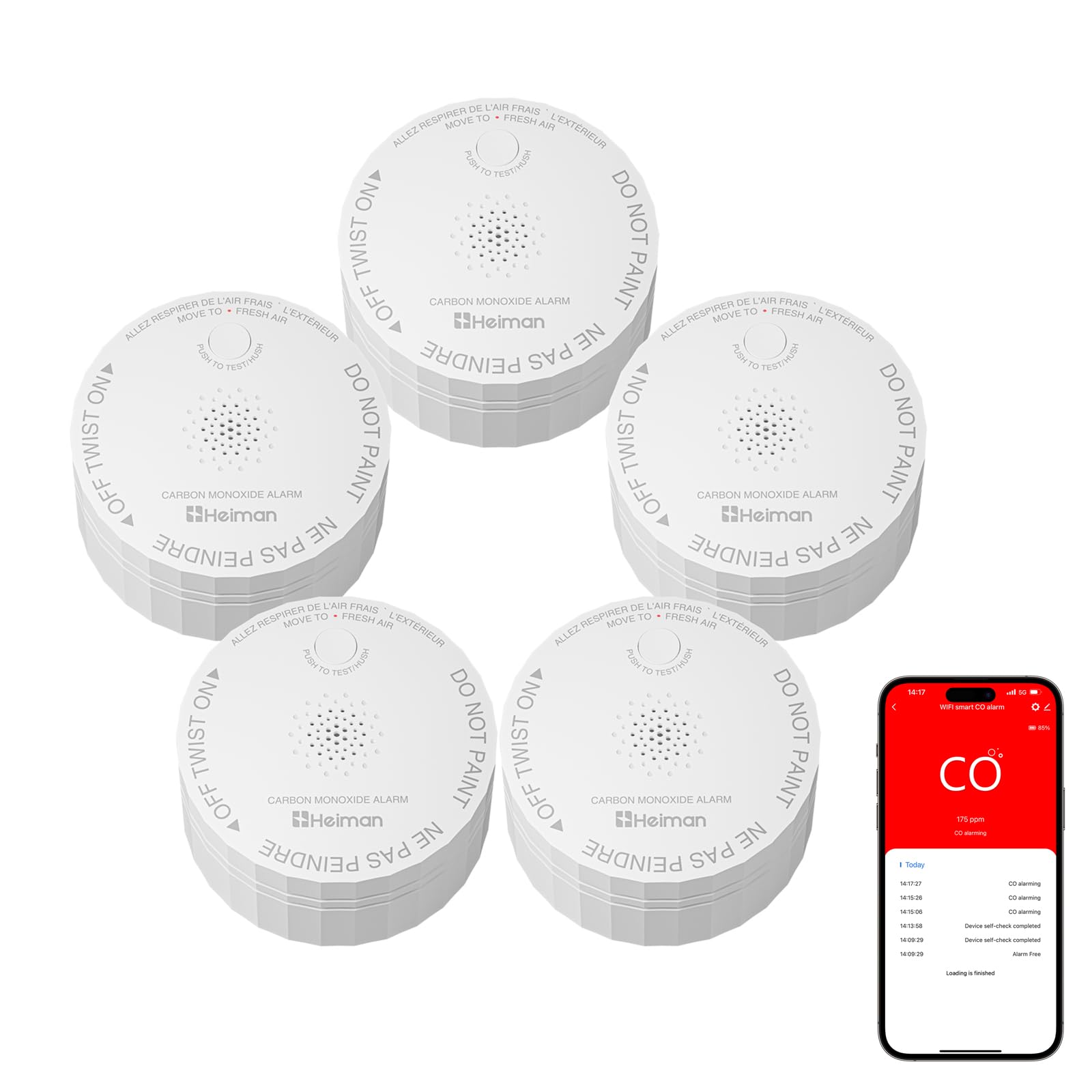
A five-pack of compact smart alarms that push CO alerts straight to your phone over Wi-Fi.
This is the pick when you want eyes on carbon monoxide from anywhere, not just when you are inside the vehicle. The Heiman detectors pair with the Tuya or Smart Life app over 2.4 GHz Wi-Fi to send real-time alerts to your phone, so you can check on a closed-up RV or tent from a hotel room or the office. Each small unit can be wall-mounted or set on a desk, and at just 2.7″D x 2.7″W x 1.4″H, it stays compact enough to toss in a duffel for travel.
The spec sheet is the strongest on this list: the sensor reads a linear response from 0–5000 ppm, carries UL 2034 certification, and the FIGARO TGS5141 sensor from Japan is built to last up to 10 years with a 5-year battery. That means no frequent battery swaps and no false alarms from humidity or rapid temperature changes — the electrochemical design keeps readings stable even in sudden weather shifts. The built-in 85 dB alarm and test button round out a genuinely complete package, and it ships with five units so you can cover the house, garage, and RV together.
Here is the honest fit-note: the reviews are genuinely split. Some owners love them — “very handy and compact,” “works great” — while others warn the Heiman Home app itself would not connect, and a separate complaint flags that these are not compatible with SmartThings without an extra hub. One owner ran one side-by-side with a known-good monitor and saw 0 ppm while the other read 50 ppm, which is a serious caution for any buyer. Bottom line: this is a solid value proposition on paper, but be ready to troubleshoot the app setup and treat any early readings with a second opinion.
choose this if: you want app-based remote alerts and multiple small detectors to scatter across a home, garage, and RV for one purchase.
pass on it if: you want a zero-fuss, certified-device-only setup — the Wi-Fi pairing and app quirks need patience.
7. Inspector CO Monitor by Sensorcon
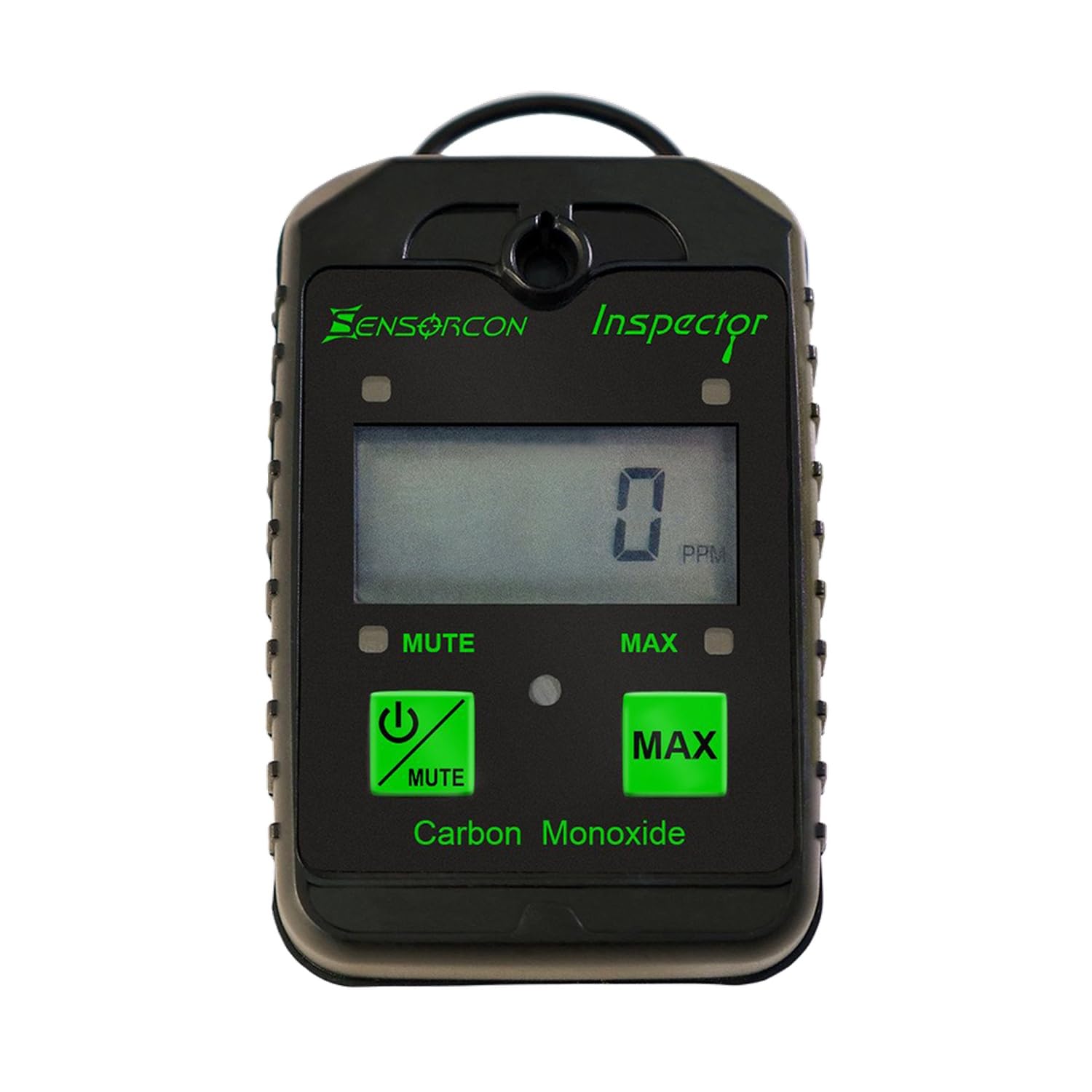
The rugged field monitor that catches CO down to 1 ppm and survives a wash-down.
For the deepest low-level detection on this list, the Inspector CO Monitor reads from 1 to 1,999 ppm — far below the 70 ppm where household alarms typically wake up. That makes it the go-to for HVAC contractors, utility workers, and anyone who wants to catch the faint early traces of a leak before they become a headache. It is built for the field with an IP67 waterproof and shockproof housing, a steel belt clip, and a lanyard loop so you can wear it hands-free all day.
The triple notification system — simultaneous visual LED, audible, and vibration — means the alarm reaches you even in a loud engine bay or a dark basement. It runs on a single CR123A lithium battery rated for up to two years of life, and the gas sensor itself is replaceable rather than throwing the whole unit away. The ETL listing under UL 913 and CSA C22.2#60079 certifies it intrinsically safe for Class I, Division 1 hazardous locations, which is the serious safety stamp field professionals actually look for.
Buyers consistently call it “well made” and “accurate,” with one EMT reporting a full year of daily carry with the original battery still going strong and alarms that respond in seconds. It detects down to 0 ppm continuously, so you can watch the number hover near zero on a clean furnace run and spike the moment something leaks. The recurring caveats are value and a missing light button — it is pricey, and owners wish it had a backlight for dark work. But for the person who needs certified, low-level precision, this is the one.
pro-grade accuracy: professionals and serious DIYers who want certified, low-level 1–1,999 ppm detection in a waterproof, waist-worn field tool.
costly sensor: it costs more and lacks a backlight button — small asks against its precision and ruggedness.
Understanding the Specs
PPM Detection Range
Parts per million is the number that tells you how concentrated the carbon monoxide is. A wall alarm typically triggers around 70 ppm, but a handheld monitor that reads down to 1 ppm lets you spot a slow leak long before it becomes dangerous. Higher maximum ranges like 0–5,000 ppm simply mean the sensor can register extreme concentrations without topping out, useful for near-source checks.
Power Source and Lifespan
12V hardwired alarms run off the vehicle battery at low drain — about 108mA — and need no battery swaps, ideal for permanent RV mounts. Portable units use either internal rechargeable cells (like a 4000mAh pack) or a replaceable CR123A lithium battery. Every CO sensor has a finite lifespan; most manufacturers recommend replacement five years from the manufacture date, not the install date, so check the label before you mount it.
FAQ
Will a 12V CO alarm work in any RV or camper?
How often should I replace my automotive CO detector?
What is the difference between a CO alarm and a CO monitor?
Do I need a detector that also senses propane?
Can I use a household CO detector in my car?
How long does a handheld CO monitor battery last?
What does UL 2034 on a CO detector mean?
Is a car charger with a CO sensor reliable enough as my only detector?
Final Thoughts: The Verdict
For most buyers, the automotive co detector winner is the Safe T Alert 35 Series Dual LP/CO Alarm because it replaces an aging propane alarm and adds CO coverage in one 12V unit with no new wiring. If you want to find the source of a leak with live numbers, grab the TOPTES CT-913 and its 0–1000 PPM readout. And for certified low-level precision in a rugged field tool, the Sensorcon Inspector is the one to reach for.
How We Picked
We do not accept paid placement. Every pick is matched to a real buyer and a real use-case; we do not hands-on test units.
Sources & Methodology
Specifications: manufacturer listings and product documentation. Review insights: verified customer reviews, as of August 2026. Pricing: not shown on this page (it changes often); check the current price via the retailer link.
As an Amazon Associate, Gadgets Feed earns from qualifying purchases. This does not affect which products we feature.