
Our readers keep the lights on and my morning glass full of iced black tea. As an Amazon Associate, I earn from qualifying purchases.
Specs are compiled from manufacturer listings and verified buyer reviews and can change over time — please confirm the key details on the product page before buying.
Your basement is one big storm away from a disaster, and the power often dies right when the rain is worst. A backup generator for sump pump duty bridges that gap, but you need to choose between a whole-house fuel generator and a battery system that takes over instantly. This guide sorts out the difference, so you know which one keeps your home dry without overspending.
I’m Min — the founder and writer behind Gadgets Feed. This guide is built by comparing the manufacturers’ published specifications and the patterns across verified customer reviews, so you get each pick’s real strengths and trade-offs instead of marketing spin.
When the power goes out, your sump pump is your first line of defense against a flooded basement. We compared fuel-run portables, battery inverters, and full backup pumps rated from 1,500 to 13,500 watts to find the best backup generator for sump pump, focusing on runtime, auto-switching, and pure sine wave output (a clean power type that protects sensitive electronics) for your family’s safety.
Our Picks at a Glance

How To Choose The Best Backup Generator For Sump Pump
Before you can pick a backup generator for sump pump use, you have to decide how long you need protection and how much noise you can tolerate. A fuel generator runs for hours as long as you refill it, while a battery system gives you hands-free minutes to hours depending on the battery size.
Battery Backup vs. Fuel Generator
A battery backup inverter sits next to your pump, charges from the wall, and switches to battery power automatically the second the grid fails. This is the set-and-forget option, perfect for short outages.
A fuel generator requires you to wheel it outside, plug in a cord, and start it during the storm. It gives you hours of continuous power but needs fuel, effort, and good ventilation.
Power Output and Runtime
Most sump pumps draw between 500 and 1,500 watts when running, but the start-up surge can be higher. You want a system rated at or above the pump’s start-up draw, and a battery with enough amp hours to cover your typical outage length.
Protection Features
Look for overload protection, low-voltage shutoff, and a pure sine wave output, which is safer for motors. A cooling fan helps the unit run longer, and a display lets you check battery health at a glance.
Quick Comparison
| Model | Best For | Output Power | Power Source | Approx. Weight | Amazon |
|---|---|---|---|---|---|
| Westinghouse 13500★ Best Overall | Whole-Home Backup | 13,500W Peak | Gas / Propane | 230 lbs | Amazon |
| VEVOR 2500WBest Value | Dual Pump Backup | 2,500W | 12V Battery | 13.8 lbs | Amazon |
| Cantonape 2000WBest Plug-and-Play | Plug-and-Play UPS | 2,000W | 12V Battery | — | Amazon |
| EGSCATEE 1500W | Quick-Switch Safety | 1,500W | 12V Battery | — | Amazon |
| Basement Watchdog CONNECT | Complete Pump System | 0.25 HP Pump | Battery Box | 12 lbs | Amazon |
| VIOPUMPO 2500W | Remote Monitoring | 2,500W | 12V Battery | — | Amazon |
| Westinghouse 4650 | Entry Fuel Generator | 4,650W Peak | Gasoline | 100.6 lbs | Amazon |
| A-iPower 5000 | Jobsite & Home | 5,000W Peak | Gasoline | 111.6 lbs | Amazon |
| WEN 3600i | Quiet, Lightweight | 3,600W Surge | Gasoline | 46 lbs | Amazon |
| Champion 4250 DF | Dual Fuel Versatility | 4,250W Peak | Gas / Propane | 79 lbs | Amazon |
| Champion 6250 | High Output Inverter | 6,250W Peak | Gasoline | 121 lbs | Amazon |
In‑Depth Reviews
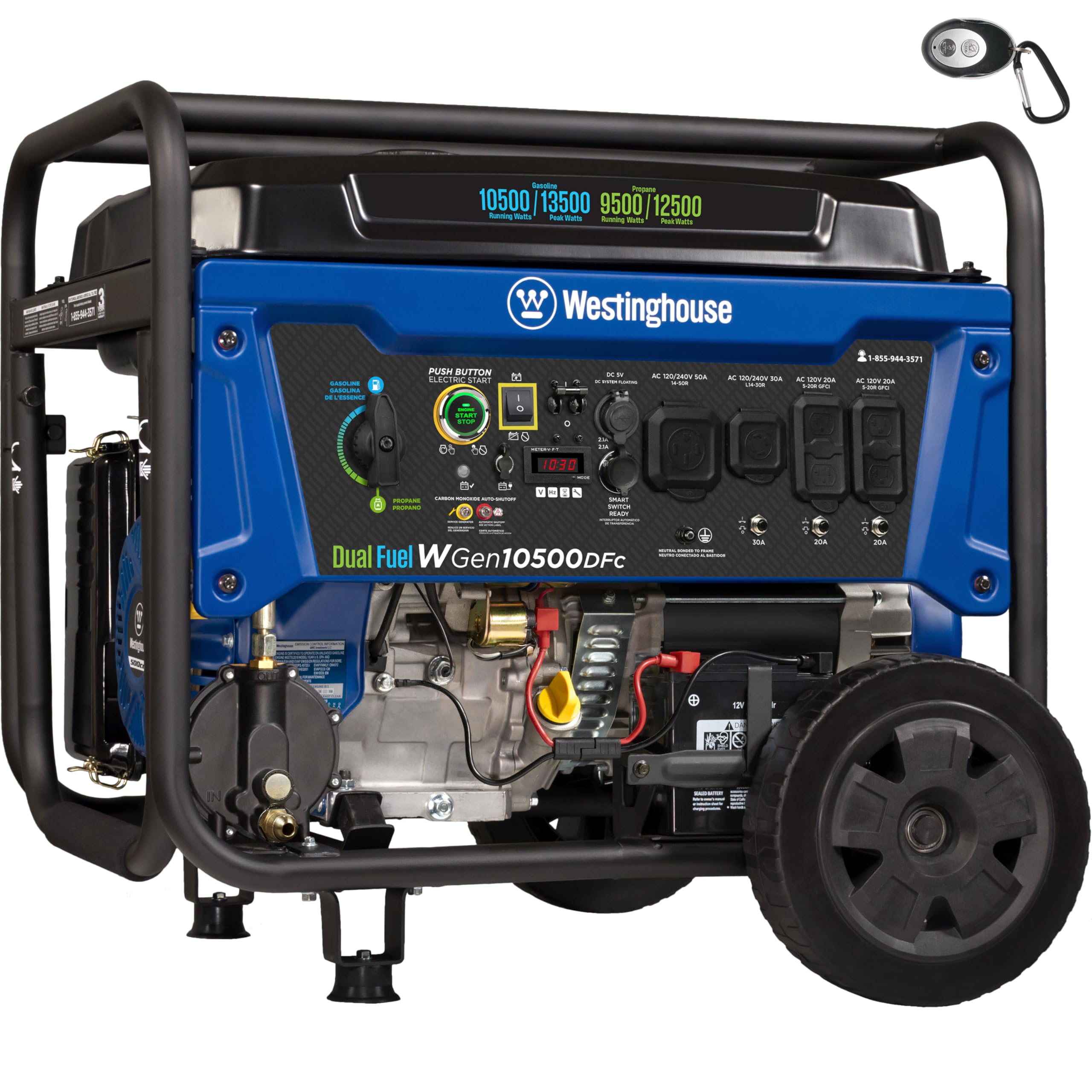
1. Westinghouse 13500 Peak Watt Dual Fuel Home Backup Portable Generator
Our pick — over 4.5★ from 400+ verified ratings; the strongest balance of quality and price.
The whole-home heavyweight that runs your sump pump, AC, and fridge at once.
This is the unit for storm-proofing an entire house, not just a pit. On gasoline it delivers 13,500 peak watts and 10,500 running watts, which is enough headroom to run a sump pump alongside your refrigerator, lights, and even three air conditioning units, as buyers report. The 500cc four-stroke engine with a cast iron sleeve is built for long-term reliability.
You get up to 19 hours of run time from a 9.5-gallon fuel tank, so it will outlast almost any multi-day outage. Starting is easy with the included remote key fob or the electric start, though a recoil pull cord is also there as backup. The dual-fuel design lets you switch to propane, which stores indefinitely and keeps the carburetor clean.
The control panel is fully loaded: two GFCI 120V household receptacles, a transfer-switch-ready L14-30R, and an RV-ready 14-50R, all with rubber covers. Owners mention it is quiet for its size, easy to assemble in about 15 minutes, and backed by a 3-year limited parts and labor warranty. The trade-off is weight, a hefty 230 pounds, so plan to keep it on a wheel kit or a permanent spot.
dual fuel giant
- Huge 13,500W peak covers an entire home
- 19-hour runtime on a single fill
- Three start methods, including a key fob
heavy and loud
- 230 lbs needs two people or a wheel kit to move
- Fuel and oil routine for every storm season
for big outages: you want one machine to power your sump pump and your whole house when the grid goes dark.
if portability matters: you need hands-free automatic start without a transfer switch install.
2. VEVOR 2500W Sump Pump Battery Backup System
An instant-switching inverter that keeps two pumps alive on battery power.
When the power fails at 2 a.m., this box takes over without you lifting a finger. The VEVOR inverter pushes a full 2,500W with a 22.7A operating current, and its dual outlets are ready to support two sump pumps at once. That automatic switch to battery power is the entire point, and owners confirm it holds the pump for several hours on a good battery.
Setup is genuinely plug-and-play with a 3-pin plug design that avoids risky wiring. The big 20A charger refills a 100AH battery in about 5 hours, which is around four times faster than a 5A charger, so you get back to full protection quickly. The high-definition LCD screen and LED lights show voltage, power, and battery level in real time.
Owners love the fast recharge and how smoothly it runs the pump, but honesty demands a fit note: reliability is the most-discussed topic, and the consensus is mixed rather than glowing. The protective features are extensive, covering overload, short circuit, overcharge, overvoltage, and overheat, plus a circuit breaker. At just 13.8 pounds, it is a featherweight compared to the 230-pound Westinghouse above, a 16.7x gap that makes wall mounting easy.
sump workhorse
- 2,500W runs two sump pumps at once
- 20A charger refills a 100AH battery in ~5 hours
- Light 13.8 lb unit with multiple safety cutoffs
noisy operation
- Reliability is the most common discussion point, and it’s split
- Battery sold separately — factor that into the cost
for constant pumping: you want a fence-sitter budget buy that protects two pumps and charges fast.
if quiet is key: you need a proven, long-haul reputation for years of storm seasons.
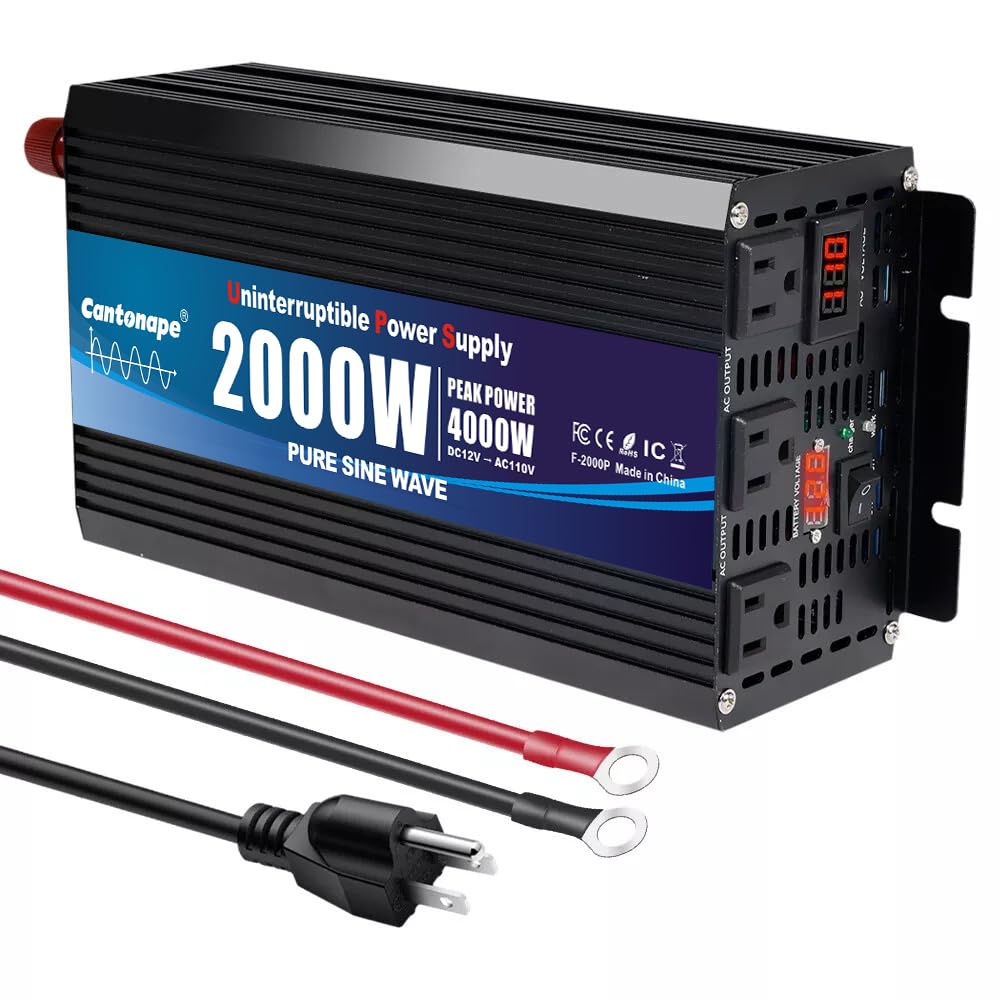
3. Cantonape 2000W Sump Pump Backup Battery System
Clean pure sine wave power that treats your pump motor like grid electricity.
This Cantonape is the answer for owners of finicky motors that hum on modified sine wave power. It produces a pure sine wave output, which is essentially a copy of the smooth utility power your pump expects, making it safe for resistive and inductive loads alike. With 2,000 watts of output, it trails the VEVOR above by a 25% margin, but that still handles a standard 1/3 or 1/2 HP pump with ease.
The built-in 20A charger fast-charges a 12V battery, and the moment the grid fails, the system auto-switches to inverter power so the pump never skips a beat. A parent bought this for a son whose basement flooded in past storms, and the relief is tangible: the pump keeps working when the power is knocked out.
Installation requires no extra wiring, just connect the AC and DC cables and plug the pump in. The LED display shows battery and AC voltage, and the built-in cooling system plus overload protector add a layer of safety. It works as a general power inverter too, running lights, phones, and monitors, and it comes with a 12-month warranty, though the battery itself is not included.
for small sumps: stress-free plug-and-play install with clean power that keeps a pump running through a storm.
if power needs grow: you need to power more than one large pump simultaneously.
4. EGSCATEE 1500W Sump Pump Battery Backup System

The 12-millisecond gap between blackout and backup that keeps water out.
Speed is the whole game here. The EGSCATEE system auto-switches from AC line power to battery in just 12 milliseconds, so your sump pump barely registers the outage. It delivers a stable 1,500 watts of pure sine wave output, enough to run three primary pumps as long as their combined current stays under 16.6 amps.
The built-in 25A charger is the fastest in this battery lineup, and it works with various battery types. Owners consistently praise the functionality, with one noting it ran continuously for six hours and another highlighting the smooth switch between AC power and battery backup. Setup takes under 20 minutes, which the owner consensus backs up as genuinely easy.
A standout is the 15-foot wired LCD remote controller, so you can mount the screen somewhere visible and check voltage, power, and battery level without climbing down to the pit. It also packs a 36W Type-C port and a 5V/3.1A USB port for charging phones, plus three AC outlets. A 12V deep cycle battery is required, and owners recommend a lithium one since it weighs about half as much and charges fully.
fast charging
- 12ms auto-switch is nearly instant
- 25A charger tops up batteries fast
- Wireless-style 15ft remote LCD panel
limited runtime
- Outlets sit close together, tight for piggy-back float plugs
- Battery cables run short, so plan placement
for quick top-ups: homeowners who want a remote status screen and the fastest possible handover from grid to battery.
for long outages: anyone needing to power heavy appliances on top of the sump pump.
5. The Basement Watchdog Special CONNECT Battery Backup Sump Pump System

A whole backup pump in a box, not just an inverter, ready for narrow pits.
Here is the different approach: instead of buying an inverter to power your existing pump, this is a complete second pump system. The copper-wound motor pumps 2,500 GPH at 0 feet of lift and still moves 1,730 GPH at a 10-foot lift, so it handles real basement depths. It includes the controller, charger, dual float switch, pump, and battery box, with the battery sold separately.
The primary job is confidence during power outages, and the owner consensus is strong on reliability and easy installation. One owner replaced a unit that lasted a full decade, and another reported the diagnostic LED lights made it easy to identify a tripped breaker. The compact pump is a genuine selling point for small or narrow sump pits where a second full-size pump simply will not fit.
A sensor monitors battery fluid levels, which matters because the battery needs distilled water every six months and replacement every few years. The WiFi connectivity is an add-on module sold separately, and customers note the alerts are one-way only, so keep that expectation in check. The plastic pump housing is actually a durability plus compared to cast iron that can corrode.
for tech users: you want a purpose-built second pump with a reliability track record that spans years.
if budget tight: you expect WiFi alerts to come in the box, since the module is extra.
6. VIOPUMPO 2500 Watt Sump Pump Backup Battery System

A wall-mountable powerhouse that runs two pumps and reports from a distance.
The VIOPUMPO packs the same 2,500W punch as the VEVOR but adds a smarter charging brain. The built-in 25A charger supports fast and trickle charging for deep-cycle lithium and AGM batteries, with overcharge protection to extend battery life. Reviewers point out the inverter charges the backup battery flawlessly and maintains correct voltage, and the instant AC-to-DC switch keeps the pump running without disruption.
The high-definition LCD remote control is the defining feature, letting you see voltage, power, and charge status from across the room. Setup needs no extra wiring, just assemble the AC and DC cables and plug the pump in. The side fixing holes allow you to lay it flat or wall mount it, which is a thoughtful touch for tidy basement installations.
One owner paired it with a Duracell marine battery and calculated a 5-6 hour runtime for a 3/4 sump pump, buying time to get home and fire up a generator. The assembly is easy and the active monitor shows battery life from a distance with zero noise from the unit itself in normal operation. The honest caveat is the cooling fan, which one owner finds noisy and frequent; the charger speed also drew a “slow” note, though the flattering battery charging feature gets repeated praise.
smart charger
- 25A charger handles lithium and AGM safely
- Wall-mount option frees up floor space
- High-definition LCD remote reads from a distance
bulky design
- Cooling fan kicks on often and can be noisy
- No battery in the box
for battery care: tech-minded owners who want a clear remote readout and flexible mounting.
if space is tight: you are sensitive to fan noise in a finished basement.
7. Westinghouse 4650 Peak Watt Portable Generator

Quiet-enough 212cc entry point that runs a pump and trailer gear for 14 hours.
If you want generator power without the whole-house price tag, this Westinghouse is the gateway. It produces 3,600 running watts and 4,650 peak watts, which is plenty for a sump pump plus a mini fridge and lights during an outage. The 212cc engine with a cast iron sleeve and both low-oil and carbon monoxide (CO) shutdown gives you a safety net that cheaper units skip.
This is the pick that owners call near-inverter quiet, even comparing it favorably to a Honda push mower in terms of noise. The 4-gallon tank delivers up to 14 hours of run time, so a night of storms is covered on a single fill. It starts easily and the readable fuel gauge takes the guesswork out of refueling.
The panel includes two household duplex receptacles, an RV-ready TT-30R, and an L5-30R 30 amp outlet. At 100.6 pounds it is heavy and needs two people to lift, but it is considerably more manageable than the 230-pound flagship Westinghouse. A mobile detailer called it the heart of his operation, starting on the first pull and signaling overload without harming equipment.
for basic needs: a budget-friendly fuel generator that covers the pump and basic essentials with a CO safety sensor.
if sensitive devices: you need the dual-fuel flexibility or 240V output of a larger unit.
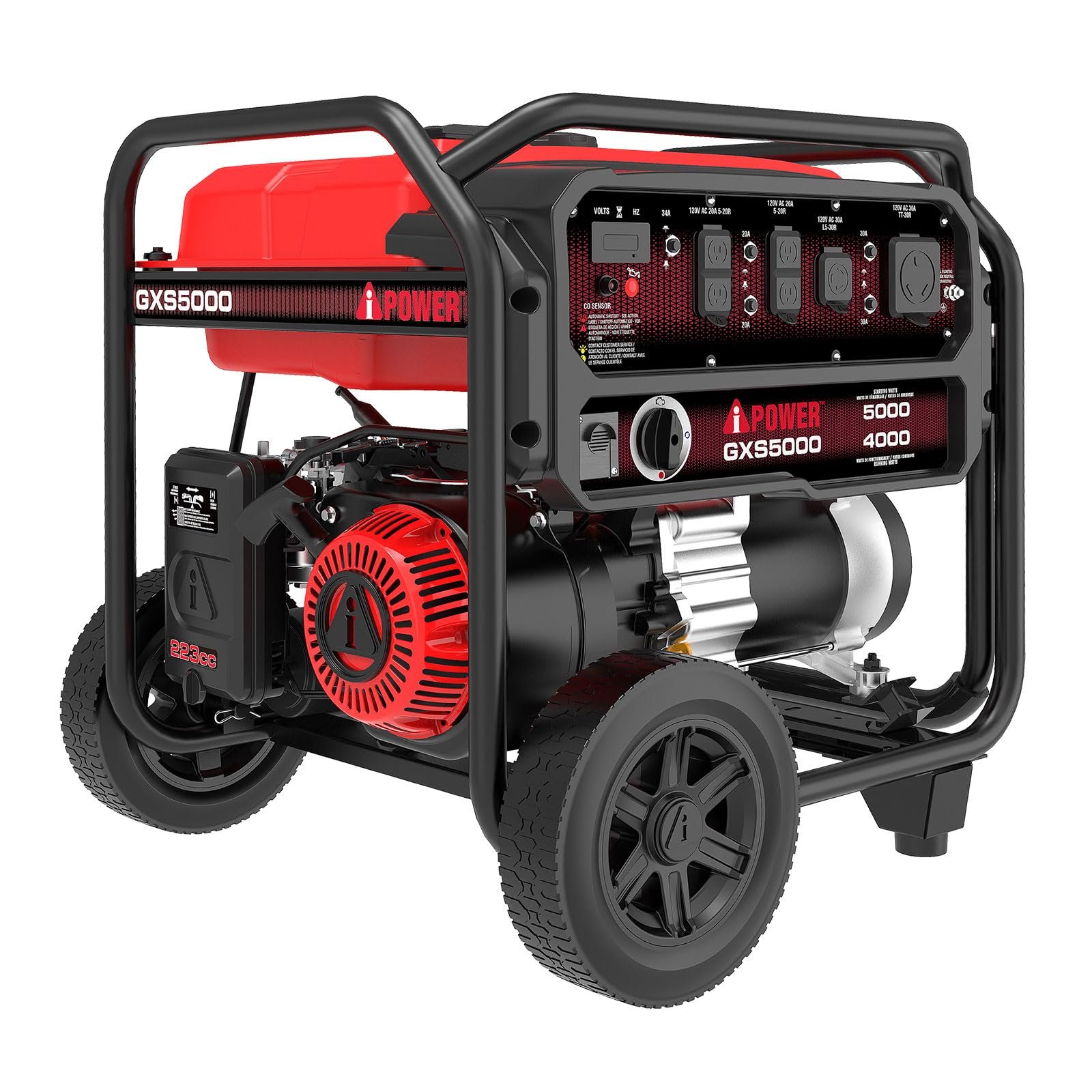
8. A-iPower 5000-Watt Portable Generator
The storm-seasoned workhorse that ran 80 straight hours through a hurricane.
The A-iPower earns its performance reputation where it counts: through real hurricane conditions. One owner ran it for 80 hours powering a fridge, a 12k BTU AC, TVs, fans, and lamps without a struggle, and another confirmed it handles a 6kW load including a 3.5-ton AC and a 2HP pump. That is exactly the kind of margin you want behind a sump pump.
At 5,000 starting watts and 4,000 running watts with a sound level of 68dB, it is a solid mid-size option. The 223cc OHV engine with a cast iron sleeve is fuel-efficient, and the 6.3-gallon tank stretches to 20 hours at 25% load. The control panel includes a CO sensor indicator light, a data center display, two duplex 20A outlets, an L5-30R, and a TT-30R.
The most-discussed positive is performance, and starting is reliable on the first pull. The noise level is the honest trade-off, with a notable group of owners finding it too loud, even though others call it reasonable. The 3-year limited warranty adds confidence, and the owner community consistently frames it as great value for its power capacity.
for job sites: you want proven hurricane-level performance that powers a pump and a whole home without breaking a sweat.
for quiet areas: noise is a dealbreaker for you or your neighbors.
9. WEN 3600-Watt Portable Inverter Generator

The 46-pound featherweight that runs a pump in silence and fits under a bunk.
For the buyer who has to physically move their generator every storm, the WEN is the relief. At just 46 pounds, it is dramatically lighter than the 111.6-pound A-iPower above, and the fully enclosed inverter design makes it whisper-quiet. Owners note it stays quiet even under 50% load and can sit compactly under a bunk or in a closet.
The 149cc engine produces 3,600 surge watts and 2,900 rated watts, which comfortably drives a sump pump plus a furnace and lights. The clean inverter power protects sensitive electronics like smartphones and laptops, so you can back up your sump pump and your phone at the same time. Run time lands around 1 gallon per 5 hours, and it starts on the first or second pull even in cold weather.
The fuel shutoff is a clever lifespan extender, burning the remaining fuel out of the carburetor before shutdown. The panel includes two three-prong 120V receptacles, a TT-30R RV outlet, a 12V DC receptacle, and two 5V USB ports, all wrapped in a three-year warranty. The occasional note is that it lacks the surge capacity for big tools, but for pump duty it is plenty.
for electronics: anyone who values a light, quiet, easy-to-store generator that still powers a sump pump.
for heavy loads: you need to run heavy 240V appliances along with the pump.
10. Champion Power Equipment 4250-Watt Dual Fuel RV Ready Inverter

Runs on gas or propane, so fuel storage problems simply disappear.
Propane is the ultimate storm-prep fuel because it stores for years without going bad, and this Champion is built around that advantage. The dual-fuel inverter runs on gasoline or propane, and owners highlight that propane avoids carburetor issues and runs about twice as long per tank. You get 4,250 starting watts and 3,500 running watts, with up to 22 hours of run time on gasoline.
The advanced digital hybrid design is 50% quieter and 20% lighter than a traditional 3500-watt generator, coming in at 79 pounds. The Economy Mode saves fuel and extends engine life, while the quiet technology holds noise to 64 dBA. For sump pump duty, that means you can run it at a reasonable hour without the whole neighborhood hearing it.
The panel is RV-ready with a 120V 30A outlet, plus two 120V 20A household outlets and a 12V DC outlet with dual USB adapter. It is parallel ready, so you can double the output with an optional kit. The starting performance is the most-discussed positive, and the noise level is the mixed caveat, with some finding it loud until broken in. A 3-year limited warranty backs it up.
for camping: preppers who want fuel flexibility and long storage life without sacrificing modern inverter quietness.
for home backup: you need a single unit to power an entire 240V home panel.
11. Champion Power Equipment 6250-Watt Portable Open Frame Inverter

Rare 240V inverter power that keeps a whole house, pumps included, running clean.
This is the rare inverter generator that delivers true 240V split-phase power, which makes it a legitimate whole-house backup rather than just a pump saver. With 6,250 starting watts and 5,000 running watts at a 69 dBA noise level, it runs a fridge, freezer, two window ACs, lights, and a water heater simultaneously, as shoppers say. The 12.5-hour run time covers a long storm night.
The open-frame inverter design is 50% quieter and 20% lighter than a traditional Champion 5000-watt generator, landing at 121 pounds. The clean power and economy mode let you confidently connect sensitive electronics, and the Intelligauge monitor displays voltage, frequency, and operating hours. Owners describe the AC output as excellent at 244V with a near-perfect sine wave.
The 240V L14-30R locking outlet is the headline, alongside two GFCI 120V duplex outlets and a 12V DC automotive port. Owners consistently frame it as a fraction of the cost of a comparable Honda, with one noting it is about one-fifth the price. The recurring notes are the need for break-in oil and a slightly cheap feel, but the reliability and performance consensus is overwhelmingly positive.
240v output
- True 240V output for whole-home panels
- 12.5-hour runtime on gasoline
- Near-perfect sine wave protects electronics
larger footprint
- 121 lbs requires a wheel kit for easy movement
- Quick-start guide has gaps; read the manual
for welders: you want 240V inverter power to back up your home, not just the sump pit.
if battery preferred: you want automatic, no-fuel backup for the pump alone.
Understanding the Specs
Pure Sine Wave Output
This is the type of electrical wave your inverter produces. A pure sine wave mimics the smooth power from your utility company, which is safest for sump pump motors and sensitive electronics. Modified sine wave can cause hum, overheating, or shortened lifespan in motors.
Amp Hours (Ah)
Battery capacity is measured in amp hours, which tells you how long the battery can deliver a certain current. A 100Ah battery paired with a 20A charger will refill in about 5 hours, and the same battery gives more runtime to a smaller pump draw. Always match the battery to your pump’s wattage.
Auto-Transfer Switch
This is the brain that detects a power outage and switches your pump from wall power to battery instantly. Superb units switch in 12 milliseconds, which is fast enough that your pump never stops. This is the defining feature that separates a true backup system from a manual generator.
Starting vs. Running Watts
Every motor needs a surge of power to start, which is the “peak” or “starting” wattage, then settles to a lower “running” wattage. A sump pump might run on 800 watts but need 1,500 to start. Your generator or inverter must cover the higher number, or the pump won’t start.
FAQ
What size backup generator do I need for a sump pump?
What is the difference between a battery backup inverter and a fuel generator?
How long will a battery backup keep a sump pump running?
Will a backup generator for sump pump need a battery included?
Is pure sine wave output really necessary for a sump pump?
Can a battery backup system power other devices besides the sump pump?
How does a dual-fuel generator help my sump pump backup plan?
What safety features should a backup sump pump power source have?
Final Thoughts: The Verdict
For most buyers, the backup generator for sump pump winner is the Westinghouse 13500 because it is the only one that powers the sump pump and the entire house through a multi-day outage, and its 4.8-star crowd reputation backs that claim. If you want automatic, hands-free protection without fuel, grab the VEVOR 2500W for its fast charging and instant switch. And for a complete second pump that fits narrow pits, the Basement Watchdog CONNECT is the one to reach for, especially if you appreciate the confidence that a pump purpose-built for backup brings.
How We Picked
We do not accept paid placement. Every pick is matched to a real buyer and a real use-case; we do not hands-on test units.
Sources & Methodology
Specifications: manufacturer listings and product documentation. Review insights: verified customer reviews, as of August 2026. Pricing: not shown on this page (it changes often); check the current price via the retailer link.
As an Amazon Associate, Gadgets Feed earns from qualifying purchases. This does not affect which products we feature.