
Our readers keep the lights on and my morning glass full of iced black tea. As an Amazon Associate, I earn from qualifying purchases.
Specs are compiled from manufacturer listings and verified buyer reviews and can change over time — please confirm the key details on the product page before buying.
The hardest part of starting out with a DSLR isn’t the camera body — it’s the lens. The kit zoom that came in the box is fine in bright sun, but it fumbles in low light and can’t melt a background into that creamy blur you see in portraits. That’s why the first upgrade most photographers make is a fast prime lens. This guide ranks the best budget-friendly glass for Canon and Nikon shooters, from a legendary 50mm to a telephoto that pulls the moon into frame.
I’m Min — the founder and writer behind Gadgets Feed. This guide is built by comparing the manufacturers’ published specifications and the patterns across verified customer reviews, so you get each pick’s real strengths and trade-offs instead of marketing spin.
You want glass that makes your photos look expensive without the price tag, and the most trusted affordable dslr lenses prove that sharpness and character don’t have to cost a fortune.
Our Picks at a Glance


How To Choose The Best Affordable DSLR Lenses
The best affordable lens for you is the one that fixes the problem you actually have with your current kit. If your indoor shots are dark and grainy, you need a wider aperture. If your kids’ soccer games look like tiny dots, you need reach. If you never take the camera off Auto, you need autofocus. Let’s walk through the three numbers that decide everything.
Focal Length and Your Camera’s Sensor
Focal length, measured in millimeters, decides how much of the scene lands in your frame. A 35mm lens gives a natural, human-eye view; an 85mm lens compresses space and flatters faces for portraits. But here’s the catch: most budget DSLRs use a smaller APS-C sensor, which crops the image. On these bodies, a 50mm lens frames like an 80mm short telephoto — great for headshots, but you’ll be stepping back for group shots. You should check your camera’s crop factor before choosing between a 35mm and an 85mm.
The Maximum Aperture (The “F” Number)
This is the single most important spec on an affordable lens. The aperture is the opening that lets light hit the sensor, and it’s written as f/1.8, f/3.5, or similar. A lower number means a wider opening, which does two things: it lets in more light for sharper handheld shots after sunset, and it creates that soft, blurred background called bokeh. A prime lens with f/1.8 or f/2 is a huge step up from a kit zoom’s f/3.5 at the wide end.
Autofocus vs. Manual Focus
This is the fork in the road. Autofocus (AF) lenses let your camera lock onto the subject when you half-press the shutter — essential for kids, pets, and anything that moves. Manual focus (MF) lenses are cheaper and often sharper for the money, but you rotate the focus ring yourself until the subject looks crisp. They are perfect for landscapes, the moon, and still life, and they are also excellent teachers of how focus actually works.
Quick Comparison
| Model | Best For | Max Aperture | Focal Length | Autofocus | Amazon |
|---|---|---|---|---|---|
| Canon 50mm f/1.8 STM (Renewed)★ Best Overall | Portraits & low light | f/1.8 | 50mm Prime | Yes (STM) | Amazon |
| Canon EF-S 18-55mm IS STMTop Performer | Quiet video & travel | f/3.5-5.6 | 18-55mm Zoom | Yes (STM) | Amazon |
| Nikon AF-S 18-140mm (Renewed)Most Versatile | One-lens travel all-rounder | f/3.5-5.6 | 18-140mm Zoom | Yes (SWM) | Amazon |
| BENOISON 85mm f/1.8 MF | Budget portrait prime | f/1.8 | 85mm Prime | No (Manual) | Amazon |
| YONGNUO YN50mm f/1.8 | Canon budget workhorse | f/1.8 | 50mm Prime | Yes (AF/MF) | Amazon |
| YONGNUO YN35mm f/2N | Nikon wide-angle prime | f/2 | 35mm Prime | Yes (AF/MF) | Amazon |
| Big Mike’s 420-1600mm MF | Moon & wildlife reach | f/8.3 | 420-1600mm Zoom | No (Manual) | Amazon |
| Meike 8mm f/3.5 Fisheye MF | Creative fun & real estate | f/3.5 | 8mm Prime | No (Manual) | Amazon |
| Nikon AF-P 70-300mm (Renewed) | Nikon telephoto zoom | f/4.5-6.3 | 70-300mm Zoom | Yes (Pulse) | Amazon |
In‑Depth Reviews
1. Canon EF 50mm f/1.8 STM Lens (Renewed)
Our pick — over 4.5★ from 750+ verified ratings; the strongest balance of quality and price.
The crowd-favorite nifty fifty that turns a basic Canon into a portrait machine.
You want portraits that look professionally lit without spending a fortune — this 50mm lens with a maximum aperture of f/1.8 is the cheapest way to get there. That aperture lets in about 11% more light than an f/2 lens like the Yongnuo 35mm below, brightening dim scenes. and blurs backgrounds into that smooth bokeh (the creamy out-of-focus area) everyone wants for portraits. It weighs just 9.6 ounces, light enough to leave on your camera all day without your neck complaining.
This version’s special feature is the stepping motor (STM) — a small motor that drives focus nearly silently, a lifesaver if you record video or shoot in quiet spaces. Buyers report it delivers “great low-light f/1.8, nice bokeh for portraits on M50,” but they also warn the 50mm on a crop-sensor body frames like an 80mm full-frame lens, too tight for vlogging or wide room shots. Focus is fast but a touch slower than a Sigma prime, and there’s no image stabilization, so you’ll want steady hands or a tripod in deep twilight.
The renewed version arrives looking and working like new, and it’s the safest first upgrade you can make. The one thing to remember: at 50mm on an APS-C body, you have to physically step back to fit more in the frame — there’s no zoom ring to save you.
Why It Wins
- Sharp images with a creamy, blurry background are the top praise by far — over 60 owners praise the lens’s sharpness and bokeh.
- Value for money is the second-most praised trait, making it a low-risk first prime.
- Small size keeps the whole camera setup compact and bag-friendly.
Know Before You Buy
- No image stabilization means shake shows up at slow shutter speeds.
- On a crop-sensor body, 50mm acts like an 80mm — too narrow for indoor group shots or vlogs.
- Autofocus is good but reported as slower than some third-party alternatives.
Grab it if: you own a Canon EF or EF-S camera and want the biggest leap in low-light portraits for the smallest outlay.
Think twice if: you mostly shoot wide indoor scenes or videos of yourself — the 50mm framing will feel cramped.
2. Canon EF-S 18-55mm f/3.5-5.6 IS STM Camera Lens
The upgraded kit lens with killer image stabilization for shake-free handheld video.
Not ready for a fixed prime? This zoom is your upgrade. Its headline feature is the Optical Image Stabilizer (a system that shifts lens elements to counter hand shake), correcting up to four stops of camera shake — owners mention sharp handheld shots at shutter speeds as slow as 1/15 sec, astonishingly slow for a lens with no tripod. That makes it the pick for travel, monuments, and any walk-around day where you don’t want to haul a tripod.
For video, the stepping motor (STM) delivers near-silent autofocus, and you can tweak focus manually even while it’s in autofocus mode. It’s compact and featherlight at just 205 grams, and it focuses as close as 0.82 ft (0.25m) across the full zoom range for basic macro-style close-ups of food or flowers. The variable aperture of f/3.5-5.6 means it lets in less light than the f/1.8 primes in this guide, so it isn’t the answer for dark concert halls.
The honest trade-offs: the plastic body feels light, and a few owners note a slightly loose manual-focus ring that rattles. This is really the perfect general-purpose “leave it on the camera” zoom, not a specialty tool.
Best all-rounder: The functionality and image quality get the most consistent praise, and its compatibility with polarizing filters makes it a landscape favorite. If you want one lens that does a bit of everything quietly, this is it.
Reach for this if: your priority is shake-free video and crisp handheld shots while traveling light.
Look elsewhere if: you shoot in very low light — the variable aperture won’t keep up with a fast prime.
3. Nikon AF-S DX NIKKOR 18-140mm f/3.5-5.6G ED (Renewed)
A single lens spanning wide-angle to telephoto, so you never swap glass on the trail.
This is the ultimate one-lens travel solution for Nikon shooters. It stretches from a wide 18mm for landscapes all the way to a telephoto 140mm for portraits and distant subjects, which means you can leave the camera bag at home and still capture the whole vacation. The Vibration Reduction (VR) system steadies handheld shots in low light, and the Extra-low Dispersion (ED) glass keeps contrast high and fringing low.
The Silent Wave Motor (SWM) drives autofocus that’s fast and quiet, and you can focus down to 1.48 feet for macro-style detail shots. Owners consistently pair it with a D7500 body and report tack-sharp results at both the 18mm and 140mm extremes. At 1.5 pounds it’s the heaviest option here, but that weight buys the rigidity of a metal mount and a build that feels far more solid than the kit zoom it replaces.
The catch with any refurbished zoom is the occasional quirk — a couple of buyers had a unit that didn’t seat smoothly on the mount — but the overwhelming pattern is that it arrives looking new and performs flawlessly. It includes all original accessories plus a 90-day warranty.
The One-Lens Case
- Lens quality is the top praise by a landslide — over 150 owners highlight its optical performance.
- Value for money and versatility both rank near the top, making it a true all-in-one.
- VR makes handheld low-light and telephoto shots far more forgiving.
The Trade-Off
- Heavier than a prime or standard zoom at 1.5 pounds.
- Autofocus is slightly audible, and a rare mount-seating quirk appears in some units.
- Vignetting (dark corners) can show at 140mm in dim light.
Pick this if: you want one lens that covers 90% of everyday shooting without ever swapping glass.
skip it if: you demand the absolute fastest aperture for night shooting — f/3.5-5.6 is a daylight lens.
4. YONGNUO YN50mm F1.8 Auto Focus Lens for Canon EF Mount

Canon’s classic 50mm personality, at roughly half the price of the name-brand glass.
Yongnuo’s first prime lens is essentially a budget clone of Canon’s own 50mm f/1.8, and it nails the essentials. It gives you autofocus and manual focus, plus a wide f/1.8 aperture that delivers clean foregrounds, nice bokeh, and much better edge-to-edge sharpness than the 18-55mm kit zoom. For beginners and hobbyists, this is the classic “first prime” experience at a price that makes experimenting painless.
Owners call it a “great 50mm staple lens for beginners” that produces clear, quality photos, and it works on bodies from the older 5D and 7D up through the T3, T3i, T5, and T5i. The honest reality: the body is plastic and cheaper-feeling than OEM Canon glass, and the focus ring can feel loose. There’s also a rare electrical quirk where the camera occasionally won’t power on with the lens attached — pulling it off and reseating it fixes it, but it’s worth knowing.
It’s the same size and function as the Canon at a fraction of the cost, which makes it the smart pick when the budget is tight and the subject is mostly still.
Bang for the buck: Lens quality and value for money are the two most-praised points, with owners calling it an “amazing bang for your buck.” The autofocus noise and plastic build are the trade-offs you accept to save the money.
Best for: a Canon shooter on a strict budget who wants autofocus and f/1.8 bokeh without paying name-brand prices.
Not ideal if: you need a rugged metal build or whisper-quiet autofocus for professional work.
5. YONGNUO YN35mm F2N Lens for Nikon DSLR Cameras

Nikon’s cheapest gateway to a wide, fast prime that’s brilliant on a full-frame body.
If you shoot Nikon, this is the wide-angle prime that opens up your framing. The 35mm focal length captures a field of view 2.4x wider than an 85mm portrait lens, making it perfect for environmental portraits, street scenes, and indoor shots where you can’t back up. The f/2 maximum aperture is a touch less open than an f/1.8 lens, but it still delivers that background-blurring look and solid low-light performance.
It’s a hit with full-frame Nikon owners — it “works and fits perfectly on my Nikon D850” with sharp results and lovely bokeh, and one owner says the performance matches their Nikon 35mm at about half the cost. The 7 aperture blades create near-circular highlights in out-of-focus areas, and the metal bayonet mount adds durability. It supports autofocus, manual focus, and live-view focusing, plus USB firmware upgrades.
The caveat is autofocus: customers note it’s slow, and it can produce soft or blurry results when the subject is moving. This is a lens for static setups, portraits, and landscape work, not for chasing fast action.
What Wins People Over
- Value for money is the single most-praised aspect — over 100 owners call it a bargain for the price.
- Functionality and photography capability both rank as positives.
- Sharp images that rival Nikon zooms, per multiple owners.
What to Expect
- Autofocus is the recurring complaint — it’s slow and noisy, with soft focus at low f-stops.
- Image quality is mixed for some, with occasional blurry results reported.
Reach for it if: you’re a Nikon shooter who wants a wide, fast prime for portraits and street scenes without spending Nikkor money.
Leave it if: you photograph moving subjects — the slow autofocus will frustrate you.
6. Nikon AF-P DX NIKKOR 70-300mm f/4.5-6.3G ED (Renewed)
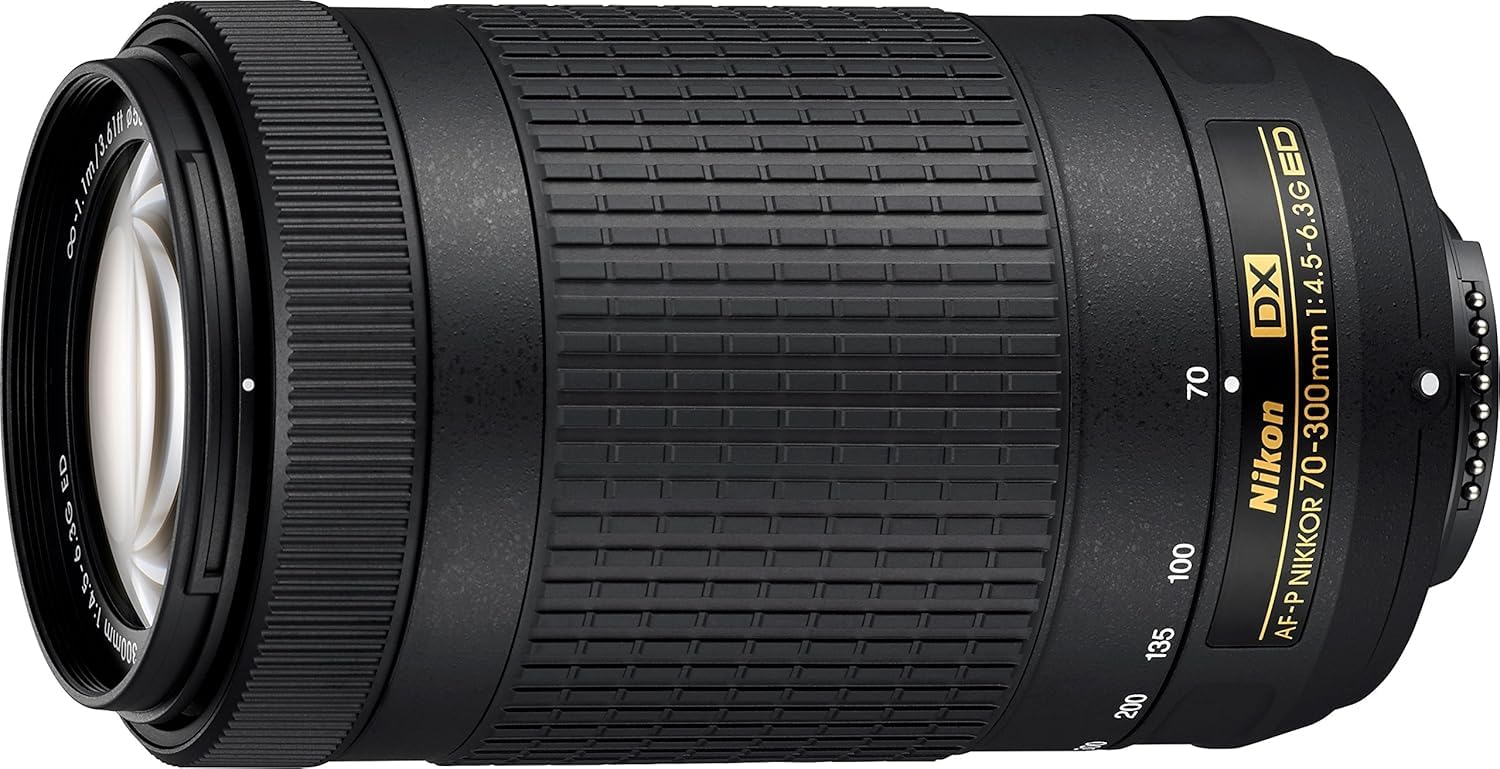
Nikon’s long-reach zoom that brings birds and distant action into sharp view.
This is the lens for when your subject refuses to come closer. The 70-300mm super-telephoto zoom pulls faraway wildlife, sports, and concerts right into your frame, and the optics stay sharp at the high end of the range — a point buyers consistently praise. The pulse motor (a stepping-motor system) drives autofocus that’s ultra-fast and near-silent, ideal for catching a bird mid-flight without spooking it.
The rounded 7-blade diaphragm produces pleasing blur in out-of-focus areas, and the Super Integrated Coating cuts flare and ghosting in backlit scenes. It’s a certified refurbished unit, so it arrives tested and looking like new, ships with all accessories and a 90-day warranty. Owners say it’s “awesome for shooting birds and other items in a distance” and that the refurbished condition is indistinguishable from new.
The one thing to check before buying: this lens is only fully compatible with specific Nikon bodies. It works fully with D5600, D5500, D5300, D3400, D3300, D500 and later models, but it is incompatible with many older bodies like the D7000, D90, and D80. Autofocus also gets mixed feedback — some report it’s slower than a brand-new unit.
Sharp at the long end: Quality and value for money top the praise, with the refurbished condition drawing special mention. Just verify your Nikon body is on the compatible list before ordering.
Best for: Nikon shooters with a D3xxx or D5xxx series body who want affordable telephoto reach for wildlife and sports.
Avoid if: you own an older Nikon like the D90 or D7000 — this lens will not autofocus on those bodies.
7. BENOISON 85mm f/1.8 Portrait Lens for Canon (Manual Focus)

A dedicated portrait prime that teaches you focus while delivering buttery bokeh.
This is the lens for portrait lovers on the tightest budget. At an 85mm focal length it’s a true portrait specialist — it compresses facial features flatteringly, makes half- and full-body shots easy, and with the large f/1.8 aperture it melts backgrounds into that gorgeous, shallow depth-of-field blur. Reviewers point out “sharp photos even for amateurs,” which is the whole point of an 85mm: it flatters the subject and hides a messy background.
Here’s the honest catch you must know before buying: this is a manual focus lens only. There is no autofocus at all — you rotate the focus ring yourself until the eyes are crisp. Owners are emphatic about this: “Don’t leave a bad review cause you wanted it to auto focus – it won’t do that.” For beginners it’s actually a fantastic teacher, and for pros it’s a lightweight, pocketable second lens. But if you shoot moving kids or pets, manual focus will frustrate you.
It’s designed purely for Canon EF and EF-S DSLR bodies, so it won’t fit EF-M or RF mirrorless mounts without an adapter. Some shoppers say it doesn’t fit a Canon M50 mark ii, so double-check your mount.
Why Portrait Shooters Love It
- Quality is the top praise by far, with buyers calling the optics “really impressive.”
- Picture quality and value for money are both positively reviewed.
- Easy to use and a great starter lens for learning manual focus.
Know the Limits
- No autofocus whatsoever — it’s manual focus only, and the aperture ring is manual too.
- The build is lightweight, which some find a minor con.
- Compatibility is mixed — it will not fit Canon M50 mark ii or mirrorless mounts.
Ideal for: a patient beginner or a pro who wants a cheap, sharp 85mm for posed portraits and street photography.
Pass on it if: you need autofocus for anything that moves — this lens demands a steady hand and a still subject.
8. Meike 8mm f/3.5 Ultra Wide Angle MF Fisheye Lens for Canon EF

A manual fisheye that warps the world into a 200-degree circle of creative fun.
Forget normal photography — this lens is about having fun with your camera. The 8mm fisheye delivers an enormous 200° field of view, so it captures everything in front of the lens with a dramatic barrel distortion that turns streets, skateparks, and real-estate interiors into something eye-catching. It’s sharp in the center and, on an APS-C crop body, shows no vignetting — the dark corners that plague some fisheyes.
Owners describe it as a “favorite for goofy stuff” and praise the solid metal build, smooth focus ring, and clicky aperture. It works well in low light and brings creative depth to macro and landscape shots. Because it’s manual-only, you need to enable “M mode” or “Release without lens” in your Canon camera’s settings, and it’s best for static subjects — moving ones are hard to keep focused.
One quirk: on full-frame bodies it produces a circular, vignetted image rather than filling the frame, which can be a fun artistic choice or an annoying limitation depending on your taste. At 590 grams it’s solidly built, but you’re buying it for the effect, not for everyday versatility.
Pure creative tool: Quality and image quality are the most-praised aspects, with owners loving the absence of tunnel vision and the option to remove the hood — rare for a fisheye.
Get this if: you want the cheapest way to experiment with fisheye distortion for street art, skate videos, or interior shots.
pass on it if: you need a practical everyday lens — this is a specialty effect tool, not a workhorse.
9. Big Mike’s 420-1600mm f/8.3 HD Manual Telephoto Zoom Lens for Canon

Monster telephoto reach that brings the moon’s craters and distant wildlife into frame.
If you’ve ever wanted to photograph the moon’s surface, a distant bird, or a faraway landmark, this is the budget way to do it. The lens covers a massive 420mm to 800mm range, and the included 2X teleconverter doubles it to a staggering 1600mm. Owners have used it to capture sharp moon shots and even a water tower 9.6 miles away — with a tripod, of course.
It’s completely manual — manual zoom and manual focus, with no autofocus and no image stabilization built in. That means a sturdy tripod is non-negotiable for sharp results, especially at the long end. At 1.7 pounds it’s a hefty piece of glass, and the f/8.3 aperture needs plenty of daylight, so this is strictly a bright-weather lens. Buyers report some chromatic aberration (color fringing) and note it’s not powerful enough for detailed planet shots.
The big caution: compatibility is inconsistent. Several owners mention it works on a Canon Rebel T5 or T7 perfectly, but one owner says it wouldn’t fit their advertised-compatible 80D. Check your exact body and consider the return window before relying on it.
The Reach Advantage
- Owners praise its fantastic value for moon and terrestrial photography.
- Sharp results on a tripod, with great bird and wildlife captures.
- Manual zoom and focus give precise control once you practice.
The Real Trade-Offs
- No autofocus and no image stabilization — a tripod is required for usable shots.
- Mixed compatibility, with some Canon bodies reporting fit issues.
- Quality and value receive genuinely mixed feedback, so expectations matter.
Perfect for: patient hobbyists who want to photograph the moon, birds, or distant scenery on a tripod.
Not for: anyone expecting autofocus, handheld shooting, or guaranteed fit on every Canon body.
Understanding the Specs
Maximum Aperture (f-stop)
The f-number tells you how wide the lens opening can go. Lower numbers like f/1.8 mean a wider opening, which lets in more light and creates that soft blurry background called bokeh. For indoor shots and portraits, a wide aperture is the biggest quality leap you can make on a budget.
Focal Length & Crop Factor
Focal length in millimeters decides how much scene you see. Most budget DSLRs use an APS-C sensor that crops the frame, so a 50mm lens acts like an 80mm lens, and a 35mm acts like a 50mm. If you want a “normal” everyday view, pick a focal length around 35mm on a crop body.
FAQ
What does the f-number like f/1.8 actually mean for my photos?
Will a Canon EF lens fit my Canon camera body?
Is a 50mm lens good for portraits on a crop-sensor DSLR?
What is the difference between autofocus and manual focus lenses?
Will a Nikon 70-300mm lens work on my older Nikon DSLR?
Do budget lenses work with full-frame camera bodies?
What is a teleconverter and does it affect image quality?
Why are my manual focus photos always slightly blurry?
Is it worth buying a renewed or refurbished lens?
What is image stabilization and do I need it?
Final Thoughts: The Verdict
For most Canon shooters, the affordable dslr lenses winner is the Canon EF 50mm f/1.8 STM because it pairs the classic portrait look with quiet autofocus at a price that’s hard to argue with. If you shoot Nikon and want one lens for everything, grab the Nikon AF-S 18-140mm for its wide-to-telephoto range. And when the subject is the moon or distant wildlife, the Big Mike’s 420-1600mm delivers reach you simply can’t get elsewhere on a budget.
How We Picked
We do not accept paid placement. Every pick is matched to a real buyer and a real use-case; we do not hands-on test units.
Sources & Methodology
Specifications: manufacturer listings and product documentation. Review insights: verified customer reviews, as of August 2026. Pricing: not shown on this page (it changes often); check the current price via the retailer link.
As an Amazon Associate, Gadgets Feed earns from qualifying purchases. This does not affect which products we feature.