
Our readers keep the lights on and my morning glass full of iced black tea. As an Amazon Associate, I earn from qualifying purchases.
Specs are compiled from manufacturer listings and verified buyer reviews and can change over time — please confirm the key details on the product page before buying.
If you are bonding cinder blocks, capstones, or a wood gate to a block wall, the adhesive you pick decides whether you fix it once or re-fix it every spring. The right glue handles wet, frozen, and rough surfaces without shrinking, so your project stays put for years instead of failing after one freeze-thaw cycle. This guide breaks down which construction adhesives actually earn their keep on block and masonry, and which ones you should leave on the shelf.
I’m Min — the founder and writer behind Gadgets Feed. This guide is built by comparing the manufacturers’ published specifications and the patterns across verified customer reviews, so you get each pick’s real strengths and trade-offs instead of marketing spin.
Whether you are capping a retaining wall or anchoring a fastener into masonry, the right adhesive for cinder blocks holds through weather, weight, and years of hard use.
Our Picks at a Glance

How To Choose The Best Adhesive For Cinder Blocks
Cinder block is porous, rough, and often sits outdoors in weather, so a general-purpose glue will peel off in a season. You need a construction-grade adhesive built for masonry, and the choice depends on four things: bond strength, waterproofing, cure time, and the shape the glue comes in.
Match the adhesive type to the job
Polyurethane-based adhesives expand slightly as they cure, which lets them grip into the rough pores of a block. That makes them the strongest general choice for bonding wood, metal, or stone to concrete. Chemical anchoring resins are a different tool — you drill a hole, inject the resin, and set a bolt or rebar into it. If you are hanging a heavy fastener on a block wall, you want the resin; if you are capping a wall or gluing panels, you want the polyurethane.
Read the cure time before you start
Most adhesives here set in 30 seconds to 30 minutes but take a full 24 hours to cure. That means you can position a capstone quickly, but you should not load weight onto the joint for a full day. A few specialty formulas cure in as little as 10 minutes, which matters when you are anchoring something that needs to hold fasteners immediately.
Check the weather resistance
Outdoor block walls face rain, freezing temperatures, and expansion as materials heat and cool. Look for an adhesive that is explicitly waterproof and flexible. A rigid glue will crack as the block and the capstone expand at different rates, while a flexible one absorbs that movement.
Quick Comparison
| Model | Best For | Type | Full Cure | Pack Size | Amazon |
|---|---|---|---|---|---|
| Loctite PL Premium (6-Pack)★ Best Overall | Heavy multi-material bonding | Polyurethane | 24 hours | 6 cartridges | Amazon |
| Titebond TiteGrab PlusBest Value | Fast-grab versatile projects | Advanced polymer | 24 hours | 1 cartridge | Amazon |
| Gorilla Heavy Duty (2-Pack) | Quick-hold squeeze tube jobs | Hybrid adhesive | 24 hours | 2 tubes | Amazon |
| Somafix Fast-Curing Anchor | Anchoring bolts and rebar | Polyester resin | Minutes | 1 cartridge | Amazon |
| Sika AnchorFix-1 | Subfreezing anchoring work | Acrylic resin | 24 hours | 1 cartridge | Amazon |
| Loctite PL500 (6-Pack) | Landscape caps and pavers | Polyurethane gel | 168 hours | 6 cartridges | Amazon |
| Loctite PL500 (Case of 12) | Large wall and capstone jobs | Adhesive tubes | 24 hours | 12 tubes | Amazon |
In-Depth Reviews
1. Loctite PL Premium Polyurethane Construction Adhesive (6-Pack)
Our pick — over 4.5★ from 6,500+ verified ratings; the strongest balance of quality and price.
The polyurethane powerhouse that bonds a wood gate to concrete block and holds like it was welded.
If you need one adhesive that handles everything on a block project — wood, concrete, stone, metal, ceramic, even PVC — this is the crowd favorite, and for good reason. It is a one-component polyurethane gel that the maker rates at 3 times as strong as ordinary construction adhesives, so it often outlasts the materials it joins. The standout proof: a wood gate fixed to concrete block held so firmly that a boot glued to a 2×4 had to be sawed off to separate them.
It works in conditions that stop other glues cold. The formula is waterproof, applies directly to wet and frozen surfaces, and cures in cold temperatures without shrinking. It sets in 30 minutes and fully cures in 24 hours, and because it is paintable with no strong solvent odor, it suits interior and exterior jobs alike. One owner used it to seal tiny cracks in a media blast cabinet and found it held better than silicone.
The honest trade-off is the mess. This is a sticky, gel-like adhesive that stains skin, so gloves are non-negotiable. The nozzle can flow fast and the tube tends to clog after one use, which is why the six-pack makes sense — you get 6 cartridges for the price of a couple of singles, so clogging one tube does not stall your project.
What wins people over
- Adhesive quality is the top praise — over 370 owners call it out for strength
- Effectiveness follows close behind, with 290 buyers noting it simply works
- Holds on wet and frozen surfaces without shrinking
- Durable enough for heavy permanent bonds
What to plan around
- Gel is messy and stains skin — wear gloves
- Nozzle clogs after a single use, so the 6-pack is the practical buy
- Full 24-hour cure means no heavy load for a day
Reach for this if: you want the strongest, most weatherproof all-rounder for bonding anything to block — the 4.6-star crowd favorite across 6,000+ owners is the easiest recommendation in this list.
Look elsewhere if: you hate messy application and want a cleaner, less aggressive grab for light indoor trim work.
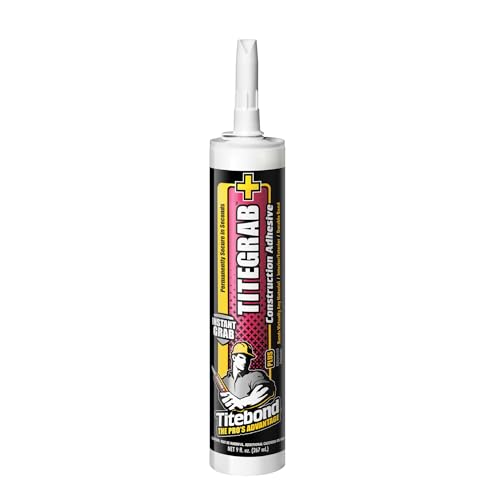
2. Titebond TiteGrab Plus Construction Adhesive 9 Oz
The cost-conscious grab that sticks tile, trim, and block fast without demanding bracing.
This advanced polymer formula is built around one idea: instant grip. It grabs materials immediately, which cuts the need for bracing and fasteners on vertical jobs — a real time-saver when you are lining up capstones or backsplash tile. The creamy, high-solids formula extrudes smoothly for precise control, and it bonds virtually any porous or non-porous surface, from wood and concrete to marble, foam board, and painted finishes.
Buyers report it is the only product they use for kitchen and bathroom renovations, calling it “easy to apply. Not messy. Dries quickly. Lasts forever.” The instant grab is also forgiving: on ceiling tiles, you get about 2 to 3 minutes of working time to slide pieces into alignment before it dries. It is weather-resistant and won’t shrink or become brittle over time, which matters on exterior block work.
The catch is smooth, non-porous surfaces. Super sticky as it is, it “definitely does not like smooth surfaces” — so on polished or sealed materials, expect a weaker hold. It also comes as a single 9 oz cartridge, a much smaller quantity than the six-packs on this list, so factor that in for bigger walls.
What makes it a value pick
- Instant grab reduces bracing and fasteners on vertical work
- Buyers highlight the price as the standout feature
- Easy, clean application with a smooth extruding formula
- Waterproof and won’t shrink or get brittle
Where it falls short
- Effectiveness is mixed in reviews — some find it weak on smooth surfaces
- Drying out in the tube is a recurring frustration
- Single cartridge only, so large projects need multiple orders
Grab it if: you want a budget-friendly, fast-grabbing adhesive for tile, trim, and general block bonding and you like a clean application.
Pass it by if: your work involves smooth, sealed, or non-porous materials that need serious grip.
3. Gorilla Heavy Duty Construction Adhesive (2-Pack)
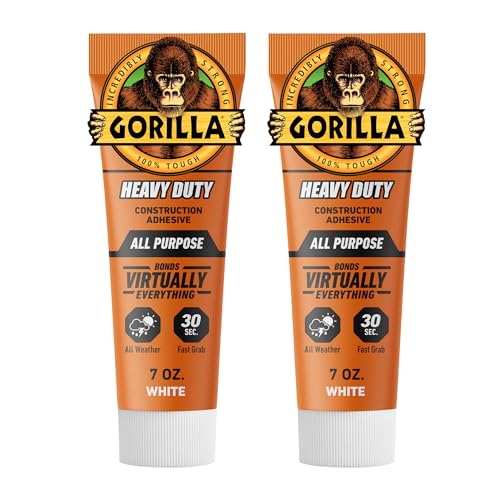
The squeeze-tube special that grabs in 30 seconds and fills gaps while it cures.
This is the one you want when you need a heavy-duty hold but you do not want to haul out a caulk gun. It comes in a 7 oz squeeze tube — two of them — and it holds in just 30 seconds despite being heavy-duty. The hybrid formula works as a gap-filling adhesive caulk, so it bridges small voids between a block and a capstone instead of just coating the surface.
Owners mention it is “very thick and very tacky right out of the tube,” which is exactly what you want for re-attaching vinyl floor tiles over rough concrete after a proper clean. It bonds subfloor, masonry, landscaping, brick, tile, metal, decks, drywall, and wet surfaces, and it is paintable for any finish. The waterproof formula holds up outdoors, where most of this list lives.
The trade-off is the thickness itself — you really have to squeeze, and the paste-like consistency means it does not flow into tight spots on its own. Some owners find the hold weaker than expected on certain items, and the white paste finish is not clear, so it shows on visible seams. One buyer was “disappointed” on strength and said they would not buy it again, but the majority report a solid, durable bond.
Why it earns its spot
- Bonding strength is the top praise — 17 owners call it out
- Holds in just 30 seconds, so no long bracing
- Gap-filling action bridges voids in rough concrete
- Waterproof and paintable for indoor and outdoor
The honest limits
- Very thick paste demands a strong squeeze
- Adhesion is mixed on some surfaces — prep matters
- White paste shows on visible joints
Choose this if: you want a no-gun, quick-grab adhesive for repairs and gap filling on masonry, tile, and wet surfaces.
skip it if: you need a clear, invisible adhesive or a formula that flows easily into tight cracks.
4. Somafix Fast-Curing Anchoring Adhesive
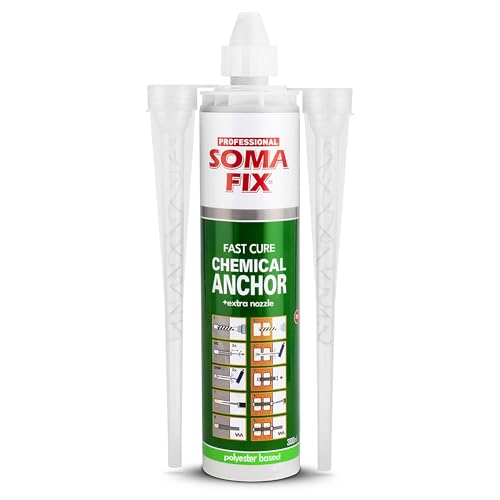
The fast-curing polyester resin built to anchor threaded rod and rebar into solid masonry.
This is a different tool from the construction adhesives above — it is a chemical anchoring system, not a surface glue. You drill a hole, clean it, inject the resin, and insert the fastener before it cures. That makes it the right pick when you need to bolt something heavy to a block wall or cement floor with real load-bearing confidence.
Customers note it “cured super fast and has held strong,” with one using it to secure threaded rod into a cement floor to bolt down a tire changing stand. The fast-curing polyester formula sets in about 10 minutes, and the kit includes an extra mixing nozzle so you can do multiple applications without downtime between jobs.
The catch: once the two resin compounds touch in the nozzle, the end can solidify, so you may not get full use of the cartridge later. The instructions are in non-English, though the application steps are simple enough to follow — and it does not work on hollow block without a mesh sleeve inserted first.
What earns the praise
- Effectiveness is the top point — 20 owners call it out
- Cures in about 10 minutes for fast installation
- Extra nozzle included for multiple applications
- No expansion pressure, so it won’t crack surrounding block
What to know before drilling
- Resin can solidify in the nozzle between uses
- Non-English instructions on the cartridge
- Hollow block requires a mesh sleeve for a solid hold
Use it when: you are anchoring bolts, rebar, or threaded rod into solid concrete or masonry and you need the bond to set fast.
Pick something else if: you are bonding surface-to-surface pieces like capstones rather than setting fasteners into drilled holes.
5. Sika AnchorFix-1 High Strength Anchoring Adhesive

The subfreezing-friendly acrylic resin that anchors railing, rebar, and dowels year-round.
If your block project happens in cold weather — a railing install in late fall, rebar set before a winter pour — this is the adhesive engineered for it. Sika’s AnchorFix-1 is rated for subfreezing temperatures, so it cures reliably when other resins slow down or fail. The 10.1 fl oz cartridge comes with a self-mixing nozzle, giving you consistent material without extra tools or a separate mixing step.
Owners describe it as “unbelievably strong when set,” and it was “perfect for anchoring an awning.” The fast-setting formula works for bolts, pins, rebar, and dowels in concrete and masonry, and the kit includes two mixing tubes so you can do a couple of separate jobs without losing product to a clogged nozzle.
The honest caveat: performance is genuinely split. Some reviewers point out it sets in under 45 seconds and flakes off metal like plaster, ruining drilled holes, while others find it rock-solid. The recurring practical notes are that it needs a quality caulk gun and that you waste roughly a third of a tube on leftovers, so plan the job before you start.
Where it shines
- Sets in minutes for quick anchoring tasks
- Self-mixing nozzle means no extra tools
- Two mixing tubes included for multiple jobs
- Works in subfreezing temperatures for winter work
Where results vary
- Strength is mixed in reviews — some find it flakes off metal
- Some batches set in under 45 seconds, too fast for positioning
- Wastes about a third of the tube per job
Reach for it if: you anchor fasteners in cold outdoor conditions and want a self-mixing resin with a trusted brand name.
Think twice if: you need predictable working time — the set speed varies between batches and can catch you off guard.
6. Loctite PL500 Landscape Block Adhesive (6-Pack)

The premium landscape adhesive that locks capstones down through freeze, rain, and heavy use.
This is the specialty pick designed specifically for landscaping — installing the final course of cap on block walls and setting cement paving stones. The formula is exterior-grade, heavy-duty, and premium, and its defining trait is flexibility: it compensates for the different expansion rates of dissimilar materials, so a concrete cap moving at a different rate than the block below won’t shear the bond apart.
Construction professionals vouch for it hard. One industry veteran admits to initial doubts about how well it would work outdoors, then ordered it twice more for other projects, calling it “Superior to anything I have used prior.” The 6-pack gives you six 10 oz cartridges, and the gel form works under a variety of moisture and temperature conditions, from sub-freezing to improve heat, on dry, wet, or frozen materials.
The trade-off is the long cure. Full cure takes 168 hours — a full week — versus 24 hours on most others here, so you cannot load weight onto your caps quickly. And as a 6-pack at the same price as the general-purpose Loctite PL Premium, it is a specialist buy, not a versatile one.
Why it leads for landscape
- Made specifically for capstones and paving stones
- Flexible bond handles expansion of dissimilar materials
- Works on dry, wet, or frozen surfaces in extreme temps
- Praised by construction pros as superior to other adhesives
The longer timeline
- Full cure takes 168 hours — a full week of no loading
- Specialist formula, not a general-purpose all-rounder
- One owner received only half the order (refunded)
Buy it for: capping retaining walls, securing block walls, and setting pavers where freeze-thaw movement is a real risk.
Avoid it if: you need a quick turnaround — the week-long full cure will stall your project.
7. Loctite PL500 Landscape Block Adhesive (Case of 12)

The 12-tube case that makes short work of long retaining walls and capstone runs.
When your project is a whole wall rather than a single cap, this case of 12 tubes is the quantity you actually need. Each tube holds 10 fluid ounces, totaling 120 ounces across the case — enough to cap a long retaining wall without running to the store mid-job. The 12-pound case is the heavy-duty option for serious landscaping work.
Shoppers say it is “very powerful” and the go-to for “cementing a block wall permanently.” It is particularly effective bonding irregular surfaces and bridging gaps between surfaces, which is the reality of rough capstone work. The formula works for Allen Block caps and other retaining wall systems, and buyers report it is the industry standard adhesive — with one noting they are “not sure they work any better than this” compared to pricier alternatives.
The honest notes: apply it sparingly until you get used to how it squishes out, because it is powerful and can make a mess. And if you try to squeeze fast, the tubes can burst out the pack — slow, steady pressure is the trick. It fully cures in 24 hours, much faster than the 6-pack version.
Why it’s the big-job pick
- Functionality is the top praise — 16 owners call it out
- 12 tubes cover large retaining wall projects
- Bridges gaps between irregular surfaces
- 24-hour full cure gets the job done fast
Handle with care
- Tubes can burst if you squeeze too fast
- Very powerful — apply sparingly at first
- Durability is mixed in some owner reports
Reach for the case if: you are building or capping a full wall and want enough adhesive on hand to finish in one go.
Buy a smaller pack if: you only need a few caps — 12 tubes is a lot of adhesive to store between projects.
Understanding the Specs
Polyurethane vs. resin anchor
A polyurethane construction adhesive bonds surface-to-surface, expanding slightly into the pores of a block for grip. It is the right tool for capping walls and gluing panels. A chemical anchoring resin is injected into a drilled hole to set a bolt or rebar — it is for load-bearing fasteners, not surface bonding. Pick based on what you are actually attaching.
Set time vs. full cure time
Set time is how fast the adhesive grabs, so you can stop holding it in place. Full cure time is how long until it reaches maximum strength and can take real load. Most adhesives here set in 30 seconds to 30 minutes but take 24 hours to cure. A few resins cure in minutes. Never load weight onto a joint before full cure.
Waterproof and cold-weather ratings
Outdoor block walls face rain and freezing. A waterproof adhesive will not break down with moisture, and one rated for cold application will still cure when the temperature drops. The flexibility matters too — block and capstone expand at different rates, so a rigid glue cracks while a flexible one absorbs the movement.
Pack size and cartridge count
A single 9 oz or 10 oz tube handles a small repair or a few caps. A 6-pack or 12-tube case is for whole walls. Polyurethane tubes also clog after one use, so buying multiples is not just about quantity — it is about having a fresh tube ready when one clogs mid-project.
FAQ
Can I use regular construction adhesive on cinder blocks?
What is the difference between construction adhesive and anchoring adhesive?
How long does adhesive take to cure on cinder blocks?
Will construction adhesive hold capstones on a retaining wall?
Can I apply adhesive to wet or frozen cinder blocks?
What is the best adhesive for anchoring bolts into hollow block?
How much adhesive do I need for a block wall project?
Is construction adhesive waterproof enough for outdoor block walls?
Final Thoughts: The Verdict
Across the board, the adhesive for cinder blocks winner is the Loctite PL Premium 6-Pack because it is 3 times as strong as ordinary construction adhesives, works on wet and frozen surfaces, and bonds virtually every material you will pair with a block wall. If you want fast-grabbing value for tile and trim, grab the Titebond TiteGrab Plus. And for capping a retaining wall or setting capstones, the Loctite PL500 is the one to reach for.
How We Picked
We do not accept paid placement. Every pick is matched to a real buyer and a real use-case; we do not hands-on test units.
Sources & Methodology
Specifications: manufacturer listings and product documentation. Review insights: verified customer reviews, as of August 2026. Pricing: not shown on this page (it changes often); check the current price via the retailer link.
As an Amazon Associate, Gadgets Feed earns from qualifying purchases. This does not affect which products we feature.