
Our readers keep the lights on and my morning glass full of iced black tea. As an Amazon Associate, I earn from qualifying purchases.
Specs are compiled from manufacturer listings and verified buyer reviews and can change over time — please confirm the key details on the product page before buying.
Stripping paint off aluminum is a distinct misery: too aggressive a stripper etches the soft metal, too gentle a gel just sits there refusing to lift anything. The right aluminum-safe stripper lifts factory coatings and re-spray layers to bare metal in minutes, not hours. This guide compares three aluminum-safe strippers on strip time, container type, and surface compatibility to help you pick the right one.
I’m Min — the founder and writer behind Gadgets Feed. This guide is built by comparing the manufacturers’ published specifications and the patterns across verified customer reviews, so you get each pick’s real strengths and trade-offs instead of marketing spin.
We focus on aerosol and brush-on solutions that won’t damage aluminum, from fast 30-minute lifters to thick professional pastes, so you can pick a reliable aluminum paint remover that matches your project scale and patience.
Our Picks at a Glance
How To Choose The Best Aluminum Paint Remover
Aluminum cares about pH and dwell time in a way steel never does. The safest remover for your metal is one that lifts the coating and stops — it should not keep eating after the paint is gone. Look for a formula that names aluminum explicitly on the label, not just “metal.”
Speed tells you the truth about strength
A 30-minute stripper is stronger and uses less product per job than a 45-minute one. Faster action reduces chemical dwell time on aluminum, minimizing the risk of etching.
Aerosol versus brush-on consistency
Aerosol cans cling to vertical surfaces, ideal for car panels and gutters that can’t be laid flat. Brush-on creams and gels sit thicker, working best on horizontal parts and detailed items like rims. Thick coats hold active ingredients longer before evaporating.
Quick Comparison
| Model | Best For | Container | Weight | Strip Time | Amazon |
|---|---|---|---|---|---|
| KLEAN-STRIP Aircraft ULTRA★ Best Overall | Fast vertical panel jobs | 15 oz aerosol | 1.26 lb | 30 minutes or less | Amazon |
| KLEAN-STRIP Professional Grade | Thick-coat paint lovers | 1 quart | 1 lb | Within 45 minutes | Amazon |
| Rust-Oleum Aircraft Remover | Wheel rims and metal finishes | 18 oz aerosol | 1.12 lb | 20 to 45 minutes | Amazon |
In‑Depth Reviews
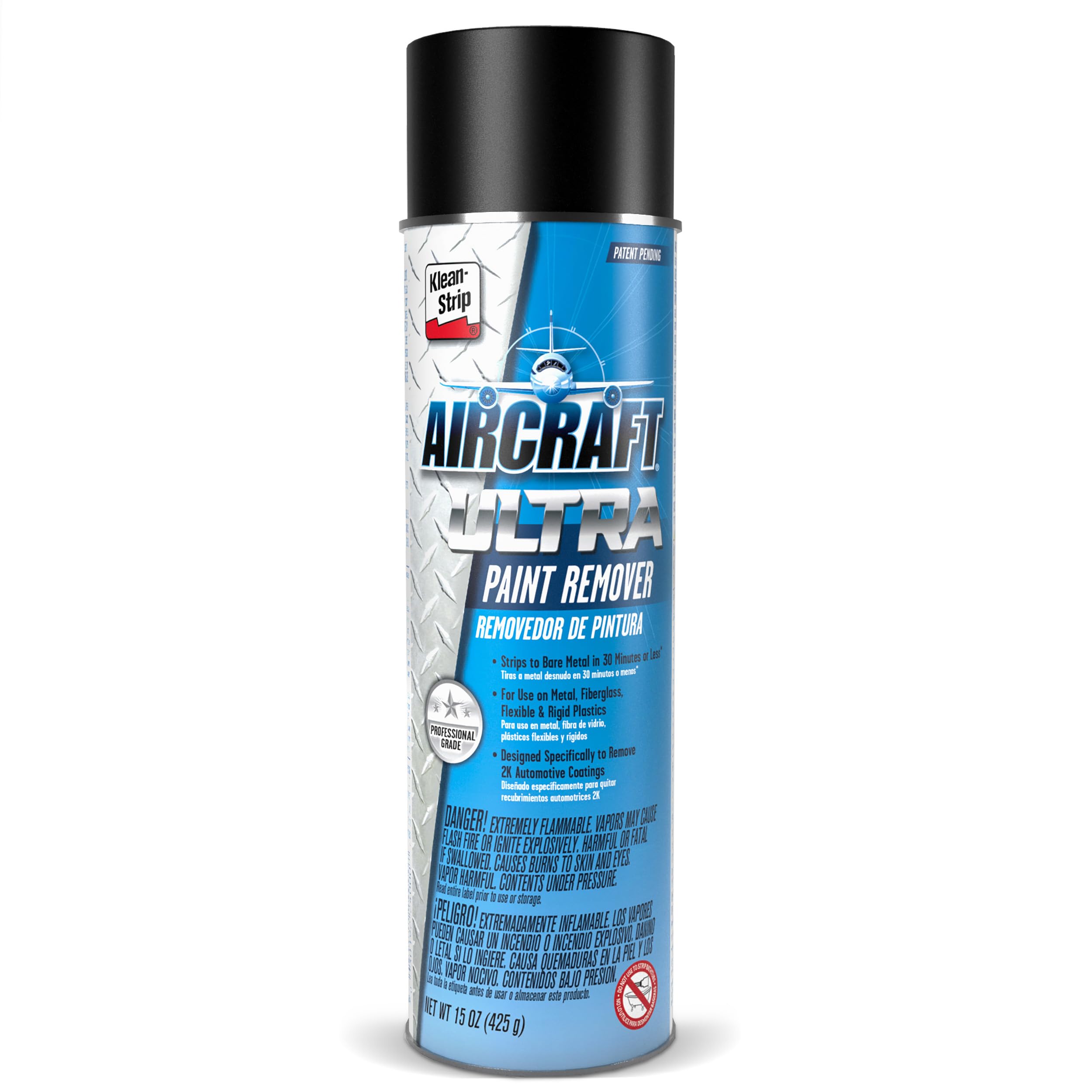
1. KLEAN-STRIP Aircraft ULTRA Paint Remover
Our pick — over 4★ from 100+ verified ratings; the strongest balance of quality and price.
The aerosol that melts stubborn coatings in half an hour and sticks to vertical panels.
You can see progress in real time with this one — the patent-pending formula visibly lifts paint as it works, and it gets to bare metal in 30 minutes or less. On a weekend project that is the difference between finishing the panel and quitting for lunch. The aerosol clings to vertical surfaces, so doors and fenders stay coated long enough to do their job instead of dripping off.
It is built for serious coatings: 2K automotive finishes, epoxies, and urethanes all yield to it, and it works across metal, fiberglass, and both flexible and rigid plastics. Buyers report it “worked great taking a few layers of chipping paint off aluminum,” noting some spots wanted a second application and minimal scraping — but calling the overall process “easy and fast.” Enamel from spray cans proved harder in one account, and the can goes quicker than a gallon jug, so you want extras or the bigger size for large jobs.
The catch is honesty about scope: this is not for bathtubs or actual aircraft surfaces, a line the maker prints right on the listing. For the workshop bench, though, “seriously the best on the market” is how one owner sums up stripping fishing jig paint before repainting.
What wins people over
- Strips to bare metal in 30 minutes or less — the fastest claim of the three
- Aerosol clings to vertical panels for hard-to-reach auto body spots
- Handles tough 2K coatings, epoxies, and urethanes on multiple surfaces
The honest trade-offs
- Enamel from aerosol cans was a struggle in one owner’s experience
- Cost-effectiveness draws mixed feedback — several found it pricey for the size
- Goes fast; multiple cans or the gallon is the plan for big jobs
The crowd favorite: reach for this when speed on vertical metal is your priority, especially auto body work where 30-minute results save your afternoon.
Know before you buy: if you are stripping enamel in bulk, budget for a second can right away.
2. KLEAN-STRIP Aircraft Paint Remover, Professional Grade

A thick brush-on paste you layer on heavy and walk away from for 45 minutes.
This one rewards patience and a generous hand — the maker tells you plainly to paint it on thick, and owners confirm that is exactly what makes it work. It strips tough 2K automotive coatings, epoxies, and urethanes down to bare metal within 45 minutes, and it names aluminum alongside metal and most plastics directly in its use list. For DIY garage work on cars, it is an honest, professional-grade companion.
It earns points where the aerosol cans cannot: a brush-on quart means you control the coat thickness yourself, and “stringer than most big box paint removers” is how one owner sizes it up against the hardware store shelf. It is patent-pending and VOC compliant in all states, which means fewer harsh chemicals and less excessive fume buildup in restricted areas.
Read the mixed experience honestly: some owners mention it does not bubble the paint even after hours, and others mention a thick yellow residue and a messier workflow. The satisfying verdict from satisfied buyers is that it “works so much better” than the regular stuff — but it is not infallible on varnish, where one account found elbow grease still won.
Thick-coat verdict: this is the pick when you want to brush on a heavy layer and let chemistry do the work, and it comes in at a lighter 1-pound jug than the 1.26-pound ULTRA aerosol above.
Know the limits: door varnish and certain finishes can beat it — verify your specific coating before committing a whole panel.
3. Rust-Oleum 352969 Aircraft Remover

A wheel-rim specialist that strips baked enamel in as little as 20 minutes.
The fastest claim of the trio lives here — 20 to 45 minutes on most coatings, and the non-methylene chloride formula is non-corrosive on metal with normal exposure time. Customers note it on wheel rims specifically: “sprays on easy, and it takes about 15 to 30 minutes to completely remove the paint off rims.” For alloy wheel refreshes and metal finishes, that is a rock-solid use case.
It removes any type of finish from metal — acrylic, lacquer, polyurethane, and baked enamel — which makes it broadly useful for automotive metal. The same own-voice consensus praises the chemistry itself: “I have used this before, but as a gel in an unpressurized can, and it never fails. This comes in an aerosol can and works just as well,” describing a foamy stream you apply twice for the best result.
The recurring pain is the delivery system, not the chemistry — spray performance is the single biggest complaint, with several cans emitting foam streams and one nozzle failing outright after seconds. The consistent workaround from owners is to brush it on instead of relying on the sprayer, which preserves the effective formula. Note the restriction: this is not recommended for fiberglass, plastic, or synthetic substrates.
The strong points
- Fastest strip claim of the group — 20 to 45 minutes on most coatings
- Non-corrosive on metal with normal exposure, protecting aluminum
- Proven on wheel rims stripping baked enamel completely
Where it stumbles
- Spray performance is the most-discussed letdown — foam streams and failing nozzles
- Not for fiberglass, plastic, or any synthetic surfaces
- Value draws negative feedback from owners who hit a defective can
Reach for this if: wheels and baked metal finishes are your project — the formula is proven there, but plan to brush it on for reliability.
Look elsewhere if: you need one can for mixed surfaces including plastics or fiberglass.
Understanding the Specs
Strip time in minutes
Strip time is the most honest measure of a stripper’s strength. A formula that lifts coatings in 30 minutes is doing more chemical work per second than one needing 45 — and faster action means less dwell time against your aluminum surface, which keeps the soft metal safe from over-etching. When you see “30 minutes or less” versus “within 45 minutes,” you are comparing real strength, not marketing.
Container type: aerosol vs quart
Aerosol cans cling to vertical surfaces, which is genuinely useful for car doors and fenders you cannot lay flat. Brush-on quarts let you control coat thickness with a brush — a heavy coat holds active ingredients longer before evaporating, which is why thick application is the #1 owner tip for paste strippers. Choose by your geometry: vertical work wants aerosol, horizontal and detailed parts want a brush.
FAQ
Will an aluminum paint remover damage the metal underneath?
Can I use an aircraft remover on my car’s paint?
What does “VOC compliant” mean for paint stripping?
How long does a can of aerosol stripper last on a big job?
What is the difference between aerosol and brush-on paint remover?
Can I strip aluminum wheels with these products?
Why does my paint remover leave a residue?
Can aircraft paint remover be used on fiberglass or plastic?
Is it safe to strip paint indoors?
Which surface finishing works best with a brush-on stripper?
Final Thoughts: The Verdict
Across the board, the aluminum paint remover winner is the KLEAN-STRIP Aircraft ULTRA because it combines the fastest 30-minute strip time with aerosol convenience that clings to vertical panels. If you want a thick brush-on paste with a compliant formula for restricted areas, grab the KLEAN-STRIP Professional Grade. And for wheel rims and baked enamel finishes where speed is the goal, the Rust-Oleum Aircraft Remover delivers — just brush it on to sidestep the nozzle complaints.
How We Picked
We do not accept paid placement. Every pick is matched to a real buyer and a real use-case; we do not hands-on test units.
Sources & Methodology
Specifications: manufacturer listings and product documentation. Review insights: verified customer reviews, as of August 2026. Pricing: not shown on this page (it changes often); check the current price via the retailer link.
As an Amazon Associate, Gadgets Feed earns from qualifying purchases. This does not affect which products we feature.