
Our readers keep the lights on and my morning glass full of iced black tea. As an Amazon Associate, I earn from qualifying purchases.
Specs are compiled from manufacturer listings and verified buyer reviews and can change over time — please confirm the key details on the product page before buying.
When the lights go out, the first question isn’t “if” you need a generator—it’s “which one can keep the fridge, the AC, and the Wi-Fi running at the same time without waking the whole street. A 10,000-watt class machine is the size that actually backs up a whole home, not just a single room. This guide sorts the quiet inverter models from the brute-force workhorses, so you can match the right one to your house, your fuel, and your nerves.
I’m Min — the founder and writer behind Gadgets Feed. This guide is built by comparing the manufacturers’ published specifications and the patterns across verified customer reviews, so you get each pick’s real strengths and trade-offs instead of marketing spin.
You have to weigh fuel type, noise, and how sensitive your electronics are before committing to a 10000 watt generator that fits your home and budget.
Our Picks at a Glance

How To Choose The Best 10000 Watt Generator
Choosing a generator this size is a serious purchase, so it pays to get the basics right. The most important decision isn’t brand—it’s the type of power output, which decides whether your sensitive gadgets survive an outage.
Inverter vs. Conventional Generators
The biggest fork in the road: inverter models produce “clean” power with low Total Harmonic Distortion (THD), which is a measure of how smooth the electricity is. This makes them safe to plug laptops, TVs, and other sensitive electronics into directly. Conventional open-frame models are louder and produce “dirtier” power, but they are typically lower in cost and can be just fine for powering tools, fridges, and lights.
Peak vs. Running Watts
Every generator has two numbers. Peak watts (also called surge or starting watts) is the burst needed to start a motor, like a central AC compressor or a well pump. Running watts is what the unit produces continuously. If your home needs 8,000 watts to run steadily but 11,000 to start the AC, you need a generator that provides both.
Fuel Choice and Run Time
Gasoline gives you the maximum power output, but it goes stale and is hard to store for long emergencies. Propane and natural gas last longer on the shelf and burn cleaner, but they lower your peak power slightly. A dual-fuel or tri-fuel model gives you the flexibility to burn whichever is available when a storm hits.
Quick Comparison
| Model | Best For | Power Output | Fuel Type | Run Time | Amazon |
|---|---|---|---|---|---|
| Westinghouse iGen12000DFc★ Best Overall | Quiet whole-home + electronics | 12,000W peak / 9,000W run | Gasoline & Propane | 19 hrs @ 25% load | Amazon |
| Green-Power GPG10000EWBudget Champion | Budget home backup | 7,500W running | Gasoline | 9 hrs @ half load | Amazon |
| WEN DF1100XBest Dual Fuel Value | Dual fuel on a budget | 11,000W surge / 8,300W run | Gasoline & Propane | 8.5 hrs @ half load | Amazon |
| DuroStar DS13000MX | High output for less | 13,000W | Gasoline & Propane | — | Amazon |
| Pulsar G12KBN-SG | Long runtime, big tank | 12,000W peak / 9,500W run | Gasoline & LPG | 12 hrs @ half load | Amazon |
| Westinghouse WGen12500 | High power + USB ports | 12,500W peak / 9,500W run | Gasoline | 12 hrs on 6.6 gal | Amazon |
| Pulsar GD10KBN | Portable inverter value | 10,500W | Gasoline & Propane | — | Amazon |
| DuroStar DS13000MXT | Tri-fuel flexibility | 13,000W | Gas / Propane / NG | — | Amazon |
| DuroMax XP13000HXT | Natural gas home power | 13,000W | Gas / Propane / NG | Up to 48 hrs on NG | Amazon |
| DuroMax XP10000E | Simple, powerful value | 10,000W start / 8,000W run | Gasoline | — | Amazon |
| AIVOLT 11250W | Quiet 50A backup | 11,250W start / 9,000W run | Gasoline & Propane | 19 hrs | Amazon |
| GENMAX GM15000ET | Massive output + ATS | 15,000W peak / 11,000W run | Tri-Fuel | 10.56 gal tank | Amazon |
| Champion 201417 | Quiet inverter + cold start | 11,000W start / 9,000W run | Gasoline & Propane | 15 hrs on gasoline | Amazon |
In‑Depth Reviews
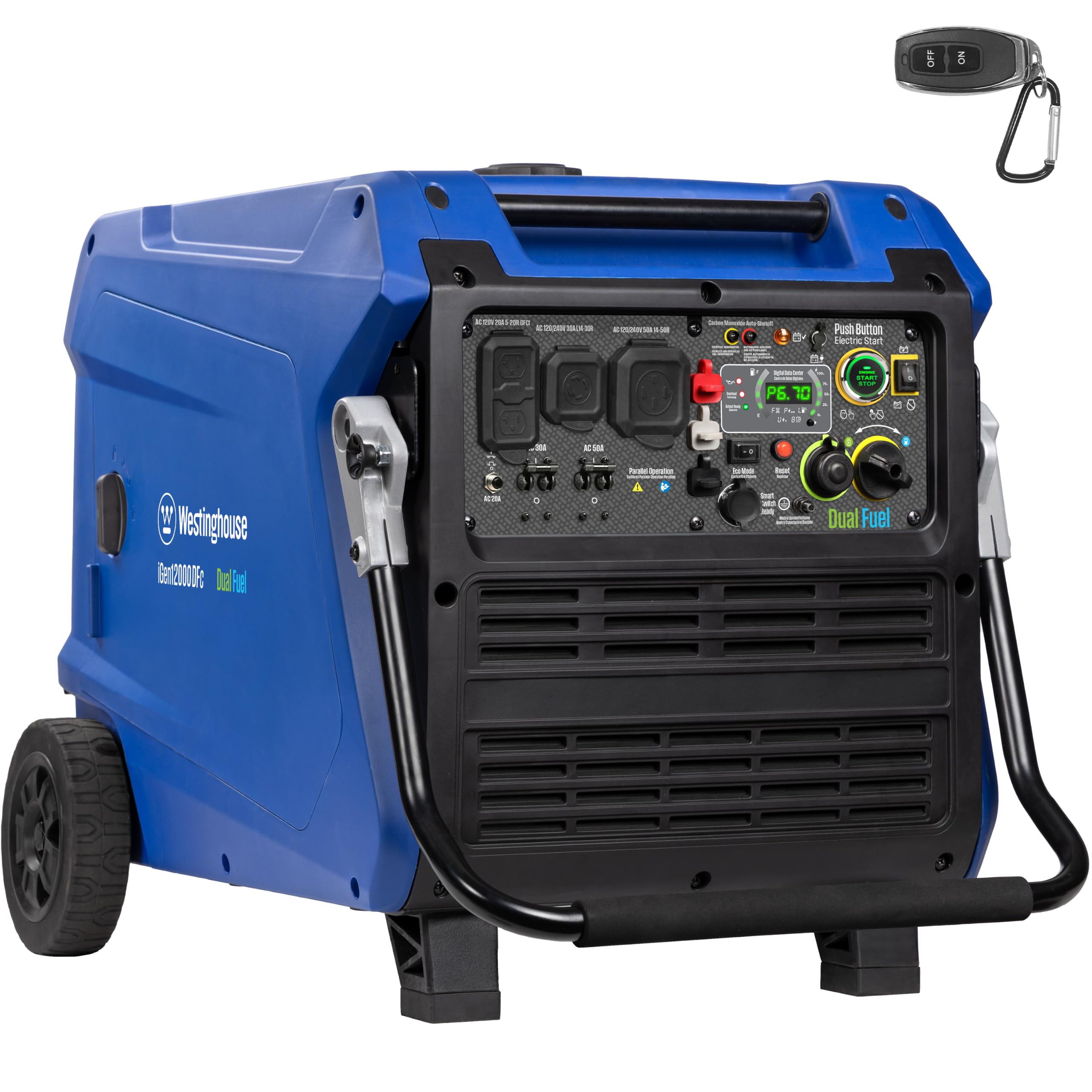
1. Westinghouse 12000 Peak Watt Dual Fuel Portable Inverter Generator
Our pick — over 4.5★ from 650+ verified ratings; the strongest balance of quality and price.
The quiet, clean-power inverter that runs your whole house without buzzing your electronics.
This is the pick for anyone who wants one machine for both a home outage and sensitive gear. Because it’s an inverter with low Total Harmonic Distortion (THD) — meaning the electricity comes out smooth and steady — it is safe to plug your TV, computer, or phone chargers straight into it. On gasoline it delivers 12,000W peak and 9,000W running, and on propane it delivers 11,000W peak and 8,100W running.
The standout number here is the run time: up to 19 hours at 25% load on a 7.9-gallon fuel tank. That is a full day-plus of fridge, lights, and a furnace without refueling. It is also genuinely neighborhood-friendly, humming along as low as 64 dBA (about the level of normal conversation). Owners consistently rave about the remote start key fob and how it “ran all my equipment with no problem.”
The one trade-off is its bulk: at 187.4 pounds, this is a two-person lift out of the truck, though it rolls on a flat-free tire. The inverter tech also costs more upfront than an open-frame of the same wattage. But if you want clean, quiet, whole-home power that is transfer-switch ready with a 50A outlet, this is the one to beat.
Why Owners Love It
- Ultra-quiet inverter operation that is safe for laptops and TVs
- 19-hour runtime on a 7.9-gallon tank
- Remote start with key fob and easy assembly
What to Consider
- Heavy at 187.4 pounds; plan for a two-person lift
- Propane regulator fittings can arrive loose
Reach for this if: you want the quietest, most electronics-safe whole-home backup with the longest runtime in this lineup.
Think twice if: you need maximum raw wattage for the lowest price and don’t have sensitive electronics.
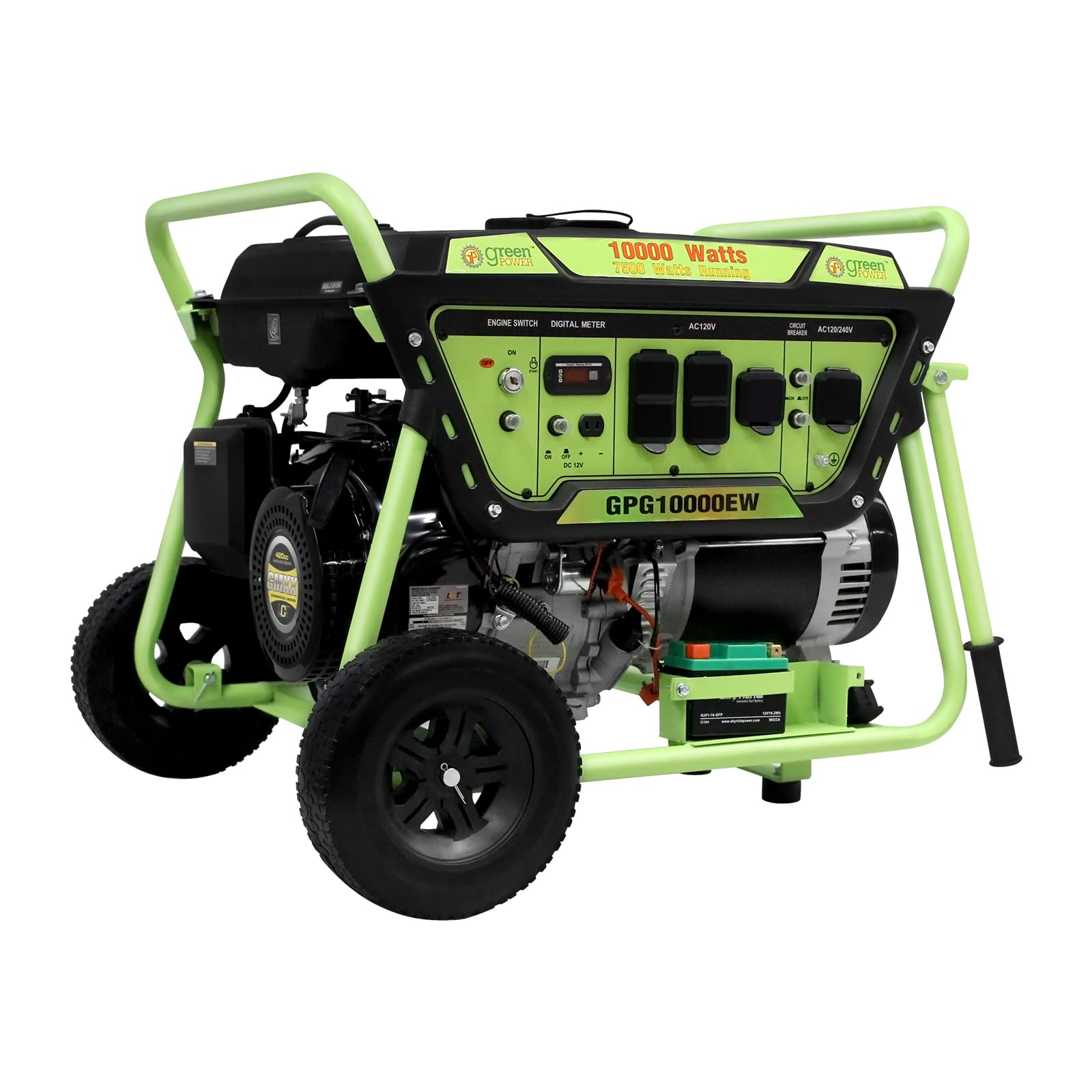
2. Green-Power America 10000 Watt Gasoline Powered Generator
The no-frills workhorse that fires up on the first pull for a fraction of the price.
If your priority is dependable power at the lowest entry cost, this Green-Power model is a smart starting point. It is a conventional open-frame generator rated at 7,500 running watts, driven by a 420cc 15HP LCT engine that is EPA certified. It won’t produce the same clean electricity as an inverter, so keep it pointed at fridges, lights, and power tools rather than expensive computers.
The 6.6-gallon tank gives you a 9-hour runtime at half load, which is enough for a night of essentials. Buyers report it “started on the first try and it ran great.” It rolls on 10-inch solid wheels with fold-away handles, and a low-oil auto shutoff protects the engine. Assembly is quick, though you’ll want a hand lifting it before the wheels are attached.
It’s note this 420cc engine is smaller than the 457cc in the Westinghouse inverter above, so it carries less reserve for big motor starts. The recurring owner gripe is oil consumption under heavy load—if you push it hard, plan to check the oil at every refill. This is a solid emergency backup, not a daily driver.
Best for budget buyers: a reliable, easy-starting gasoline generator for lights and appliances during an outage.
The honest catch: open-frame power means louder operation and less protection for sensitive electronics.
3. WEN DF1100X 11000-Watt Electric Start Portable Generator
A dual-fuel machine that switches fuels with a dial, giving you options when gas runs scarce.
WEN’s big generator earns its place by making fuel choice easy. A simple selection dial switches between gasoline (11,000 surge watts and 8,300 running watts) and propane (9,500 surge and 7,500 running). That flexibility is a lifesaver in a long outage when stations are dry but propane tanks are still full.
The 457cc 4-stroke OHV engine starts with the turn of a key, and the included 6.6-gallon tank delivers up to 8.5 hours at half load. It comes with a CO Watchdog shutdown sensor for safety, plus a transfer-switch-ready NEMA L5-30R twist-lock and a 50A NEMA L14-50R receptacle for serious home hookups. The wheel kit and 47-inch LPG hose are in the box.
Owners who ran it through hurricane season report it “pretty much ran his whole house during the last storm.” At 213.8 pounds, it’s a hefty beast, so leave it where you plan to use it. The included manual is notably well-written, which helps with the initial setup and break-in.
Why it stands out: the fuel dial and CO watchdog make it a flexible, safe workhorse.
Who it suits: homeowners who want propane backup without paying inverter prices.
4. DuroStar DS13000MX 13,000-Watt Dual Fuel Portable Generator

The beefy 500cc bruiser that runs a 3-ton AC without breaking a sweat.
DuroStar brings 13,000 watts of raw capacity to the table, powered by a 500cc 4-stroke engine. The push-button electric start fires it up instantly, and owners confirm it handles serious loads—One owner reported running their entire home including a 3-ton AC unit. The dual-fuel selector makes it easy to switch between gasoline and propane at the front-facing panel.
The all-metal construction and steel frame are built for harsh weather and heavy use. It’s transfer-switch ready with a 50A heavy-duty outlet, so you can back up the whole panel. A CO Alert sensor automatically shuts the unit down if dangerous fumes are detected, which is a meaningful family-safety feature.
The consensus is that it’s “quiet” for its class and easy to assemble from the start. It’s a big machine, so plan on a hand truck for delivery day.
Its Strengths
- 13,000W capacity handles central AC and appliances
- Push-button start with remote control included
- Rugged steel frame built for outdoor conditions
Its Limits
- Open-frame design is louder than an inverter
- Large footprint needs dedicated storage space
Best for: homes with big motor loads like central AC and well pumps where raw surge power matters most.
Not ideal if: you need whisper-quiet operation or clean power for sensitive computers.
5. Pulsar G12KBN-SG Heavy Duty Dual Fuel Generator

The marathon runner with an 8-gallon tank that powers a house for 12 straight hours.
Long outages test a generator’s stamina, and the Pulsar G12KBN-SG answers with the biggest fuel tank in this comparison. Its 8-gallon tank delivers up to 12 hours of continuous operation at half load on gasoline. Owners confirm the real-world math, with One owner reported a 16-hour stretch on a single tank while powering a 2,600-square-foot home including AC.
Power output is strong: 12,000 peak watts and 9,500 rated watts on gasoline, dropping to 10,800 peak and 8,550 rated on LPG. The 457cc single-cylinder OHV engine starts electrically, and the powder-coated frame shrugs off weather. Six outlets provide ample room for plugging in appliances, tools, and devices.
The trade-off is an honest one—noise gets mixed feedback. Some owners find it quieter than comparable models, while others call it loud. It also benefits from a proper break-in period with several oil changes. If runtime and raw capacity top your list, this is a proven, reliable choice.
The big selling point: 12-hour runtime on an 8-gallon tank keeps you powered through the night.
What to know: noise is a matter of taste; treat the break-in period seriously.
6. Westinghouse 12500 Peak Watt Home Backup Portable Generator

A dependable open-frame workhorse with remote start and two USB ports for modern gadgets.
This is a gasoline-only generator that delivers 9,500 running watts and 12,500 peak watts—plenty of headroom for a whole house. The headline convenience is the remote start key fob, alongside electric and recoil start options. It runs up to 12 hours on a 6.6-gallon tank with a built-in fuel gauge.
The outlet selection is genuinely versatile: two GFCI 120V household receptacles, a transfer-switch-ready 120V L14-30R 30A, an RV-ready 120/240V 14-50R 50A, and two 5V USB ports for charging devices directly. Every outlet has rubber covers. The 457cc engine uses a cast iron sleeve for longevity and includes automatic low-oil and CO shutdown.
Owners mention it ran their house for 80 hours without issues. and it rolls easily despite its 212-pound weight. It’s an open-frame unit, so expect conventional generator noise. The recurring minor complaint is the wheels can loosen over time—worth checking on occasion.
The appeal: high peak watts plus USB ports in a rugged, well-built package.
Who it’s for: homeowners who want proven Westinghouse reliability at a mid-range price.
7. Pulsar GD10KBN 10500W Dual Fuel Portable Inverter Generator
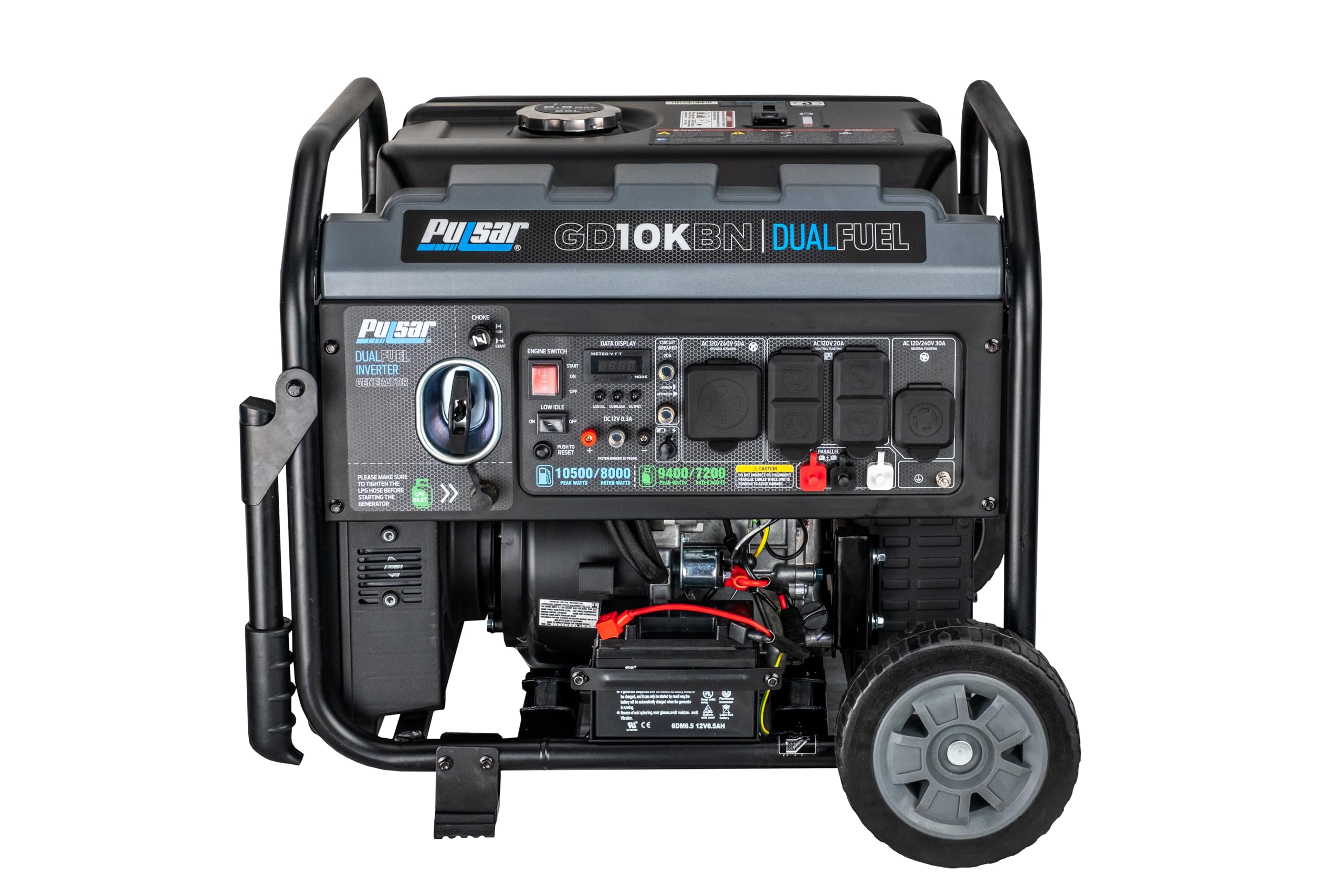
An inverter that combines clean power, dual fuel, and a 312cc engine at a tempting price.
This Pulsar inverter is the budget gateway into clean power. It runs on gasoline or propane, and its inverter design means stable voltage that’s safer for your gadgets. The digital multimeter displays voltage, frequency, total hours run, and hours until recommended maintenance—so you always know the machine’s health at a glance.
You can plug your RV straight into the 15-50R outlet (a standard 50-amp receptacle) for campgrounds and tailgates, and it still runs household basics like lights, appliances, and central A/C during an outage. Overload and short-circuit protection shut things down safely if something goes wrong. At 125 pounds, it’s about 75 pounds lighter than the 200+ pound machines above, so you can move it without a crew.
The honest caveat is noise—owners are split, with some describing it as “loud as a B52 taking off” while others find it acceptable. The reliability is solid, with buyers reporting it starts every time. It’s a good value for those who want inverter clean power without the premium price tag of the top pick.
Its niche: a lighter, more portable inverter for RV and home use at a value price.
Before you buy: understand that this inverter isn’t as hush-quiet as the premium models.
8. DuroStar DS13000MXT 13,000-Watt Tri Fuel Portable Generator
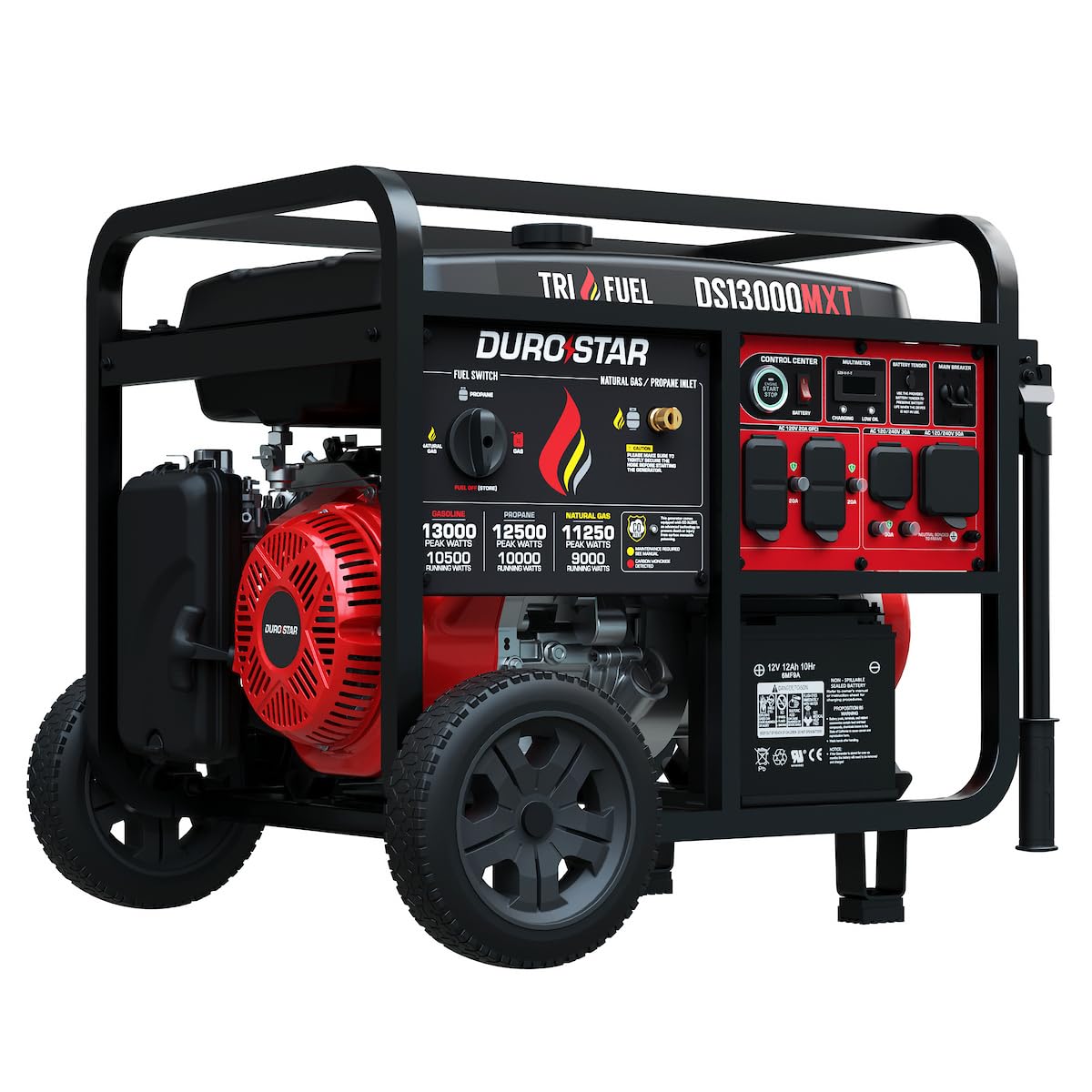
The tri-fuel technician that taps your home’s natural gas line for unlimited backup power.
If you have natural gas at your house, this DuroStar is a compelling choice because it can run on gasoline, propane, or natural gas. That means you can connect it to your home’s gas line and never worry about storing fuel cans. The 500cc engine delivers 13,000 watts of power, keeping a whole home running during a storm.
The fully loaded power panel includes a push-button start, a fuel selection knob, and a transfer-switch-ready 50A outlet. A CO Alert system shuts the generator down automatically if harmful fumes are detected. It comes with a 15-foot natural gas hose, propane regulator, and remote control in the box.
Customers note it “runs their 20ft food truck easily” and One owner powered an entire house for 72 hours on gasoline, refilling every 12 hours. The one caution from buyers: keep an eye on the oil drain plug placement near the wheel. For food truck owners, RVers, and homeowners with NG access, this tri-fuel flexibility is a standout.
The advantage: natural gas connectivity means unlimited, shelf-stable fuel for long outages.
Watch out for: the oil drain plug location—routine checks are worthwhile.
9. DuroMax XP13000HXT 13,000-Watt Tri Fuel Generator
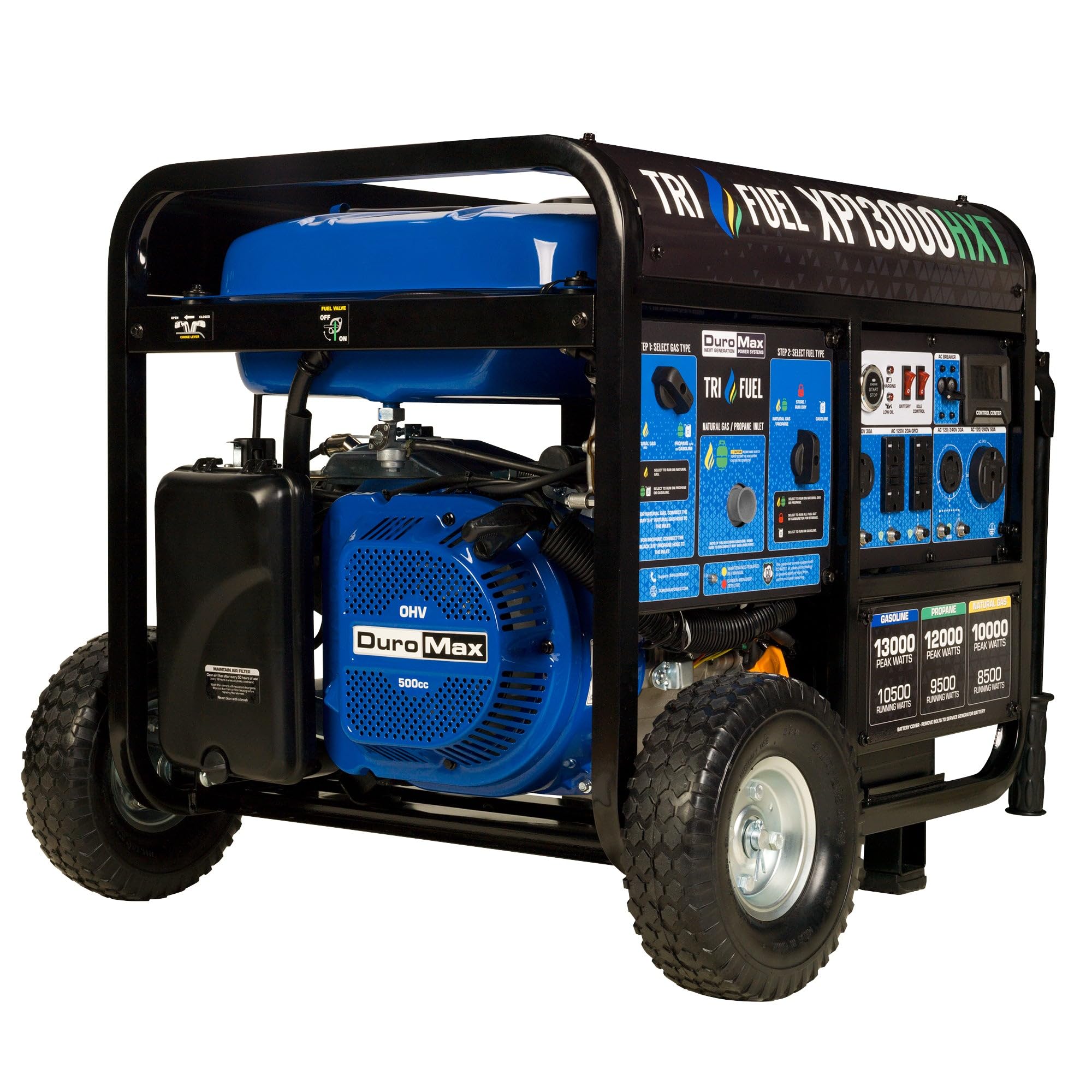
The 500cc tri-fuel powerhouse that runs a house for up to 48 hours on natural gas.
DuroMax’s premium tri-fuel machine is built for homeowners who want the ultimate fuel flexibility. It runs on gasoline, propane, or natural gas—the latter being a massive advantage for continuous backup. One owner reported running it on natural gas for 48 hours straight. With 13,000 watts from a 500cc OHV engine, it powers entire homes with ease.
The push-button start and remote start let you fire it up from a distance. The front-facing interface lets you switch fuel types in seconds, and a transfer-switch-ready 50A outlet means you can connect it directly to your home panel. It includes a 15-foot natural gas hose, propane regulator, and remote control.
What wins people over is the combination of power and flexibility—buyers call it a “beast of a unit” that powers the whole house. The manufacturer’s customer service gets high marks, with one owner noting a missing part was shipped within 3 days. The battery needs a monthly run to stay healthy, and it’s not quiet. For a permanent backup solution on natural gas, this is top-tier.
Why It’s a Premium Pick
- Tri-fuel operation, ideal for natural gas home hookup
- Powerful 500cc engine with 13,000W output
- Remote start and responsive customer service
Keep in Mind
- Semi-loud operation under load
- Battery needs regular maintenance runs
Best for: homeowners with a natural gas line who want continuous, run-forever backup power.
Think twice if: you need whisper-quiet operation or only plan to use it a few times a year.
10. DuroMax XP10000E 10,000-Watt Gas Powered Generator

The proven 439cc gas unit that ran for 77 straight hours through Hurricane Irma.
This is a generator with a serious track record. One owner in South Florida ran it for 77 continuous hours through Hurricane Irma, powering their entire home including central AC and neighbors’ appliances. That kind of real-world endurance is hard to argue with. The 439cc OHV DuroMax engine delivers 10,000 starting watts and 8,000 running watts.
Its MX2 technology is a standout feature: you can generate both 120V and 240V simultaneously, or switch to 120V only for full power from each receptacle. That flexibility is handy for running high-amperage tools on one circuit. It’s EPA and CARB approved for all 50 states, and the electric start has proven reliable over two years of ownership.
At 210 pounds, it’s heavy and needs two people to move. There’s no 50A receptacle on the unit itself—just a plug—so check your hookup needs. It’s not a quiet inverter, but reviewers point out it’s “quieter than smaller units” and runs about 10 hours at medium load. For straightforward, dependable gasoline power, this is a battle-tested choice.
The track record: hurricane-tested reliability over 77 continuous hours.
The trade-off: heavier build and no 50A receptacle on the unit.
11. AIVOLT 11250W Dual Fuel Inverter Generator
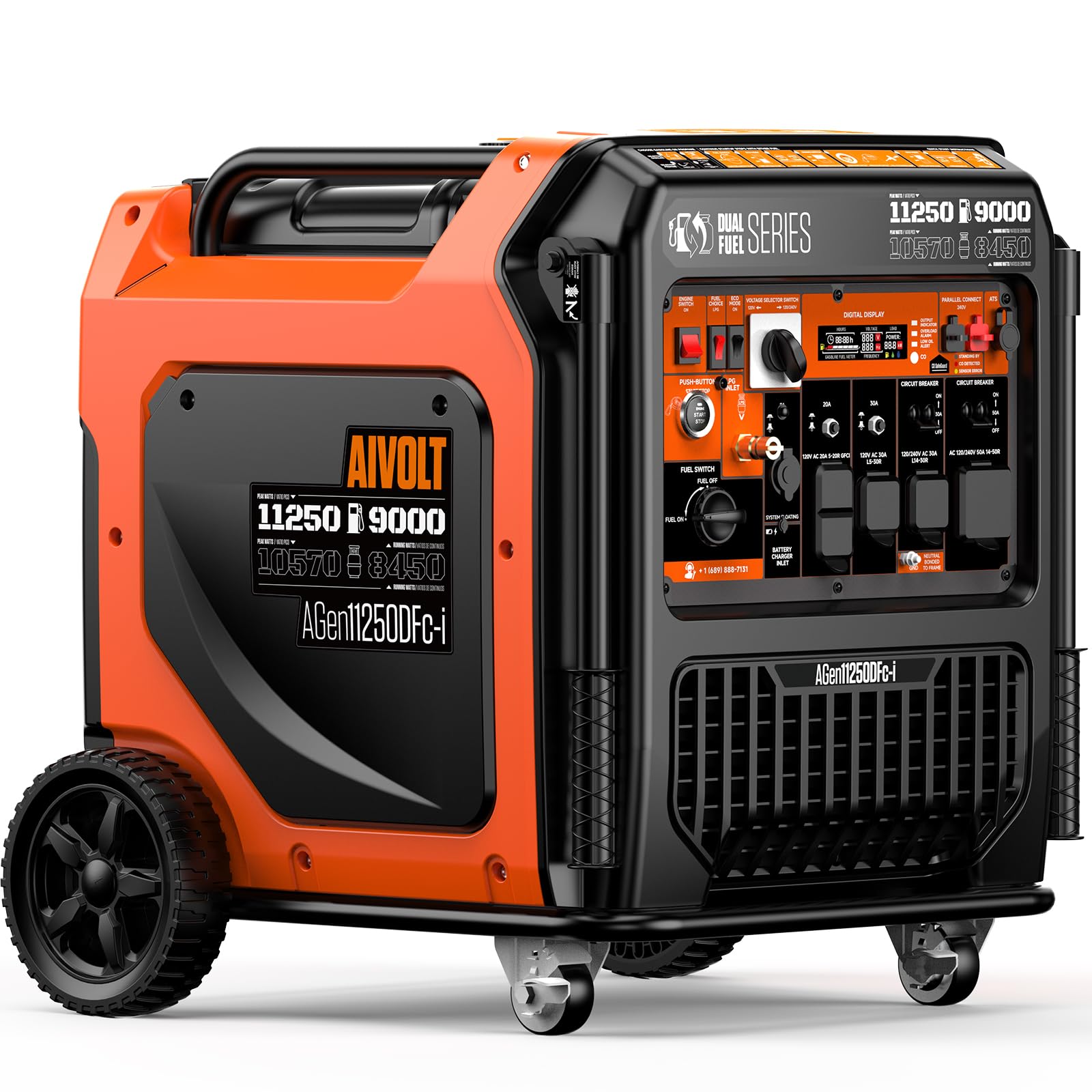
The copper-wound quiet inverter that whispers at 60 dBA while powering your whole house.
Noise matters when you’re running a generator overnight, and the AIVOLT is one of the quietest in this lineup at just 60 dBA at 23 feet—quieter than normal conversation. It delivers 11,250 starting watts and 9,000 running watts on gasoline, and 10,570 starting and 8,540 running on propane. The 100% copper windings motor runs cooler and is rated for 500+ hours of service.
A heavy-duty 50-amp outlet makes it RV-ready and ATS-compatible, so you can connect it to a home transfer switch without rewiring. The 7.1-gallon tank provides up to 19 hours of runtime, and the remote fob starts it from up to 80 feet away—no more trudging out in the rain. The Total Safety Guard system includes CO auto shutoff, low-oil protection, and overload protection.
Owners appreciate its compact size for camping and its ability to run a rooftop AC on propane all night. The mixed feedback centers on power output—some say it’s “less than advertised”—and occasionally tricky starting. It’s also note oil isn’t included. For a quiet, feature-rich 50A inverter, this is a strong mid-premium pick.
The standout: 60 dBA noise level and 19-hour runtime make it ideal for overnight backup.
The caveat: some shoppers say the real-world output doesn’t always match the sticker.
12. GENMAX 15000W Tri-Fuel Portable Generator
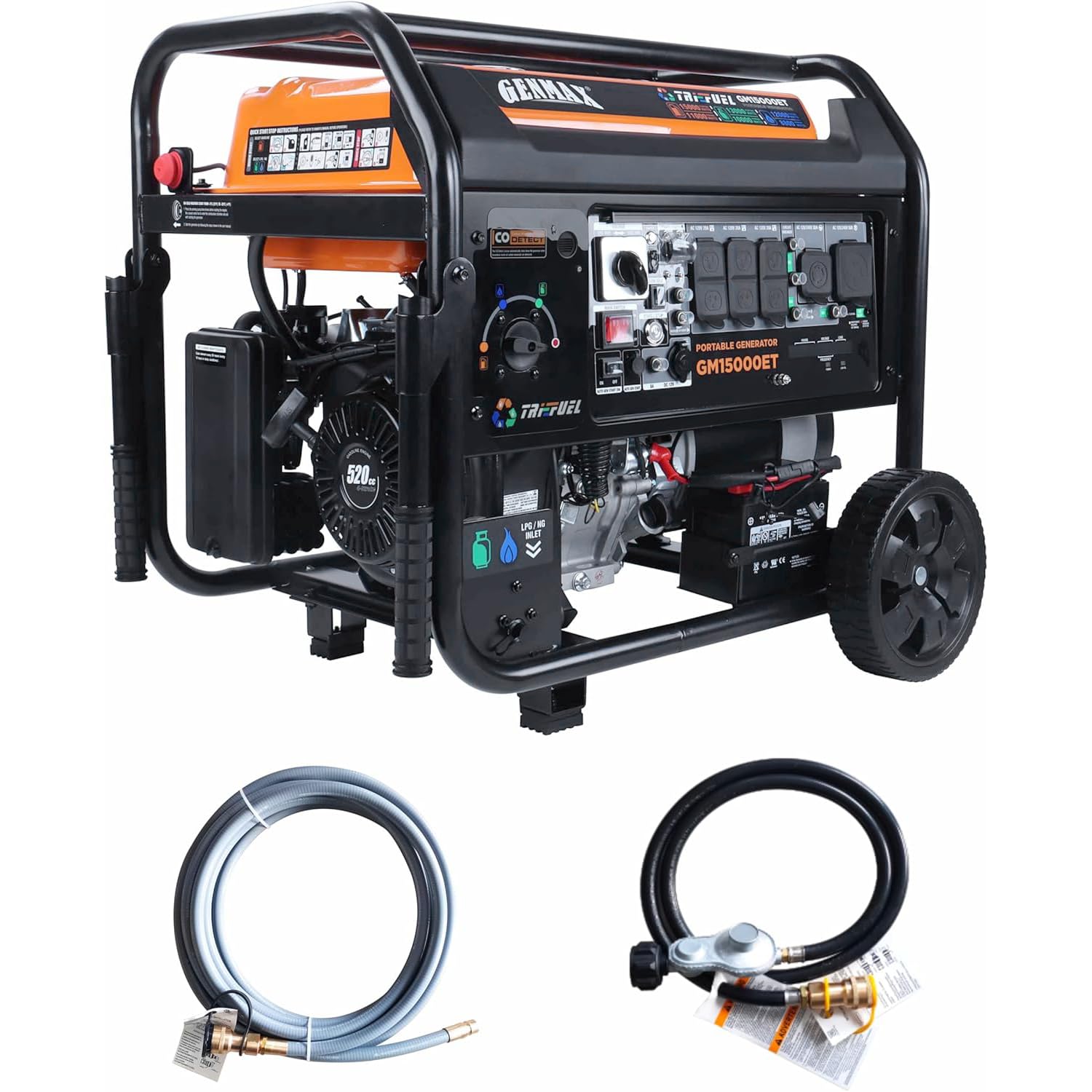
The 15,000-watt giant with a 10.56-gallon tank built for construction sites and whole homes.
If you need the absolute maximum wattage, the GENMAX GM15000ET delivers 15,000W peak and 11,000W running. Its capacious 10.56-gallon fuel tank is the largest in this comparison, and the tri-fuel capability lets you switch between gasoline, LPG, and natural gas. It’s built tough with 1.25-inch frame tubes, designed for long-term durability.
Start-up options are comprehensive: one-button electric start, remote start, recoil pull-start, and a 2-wire automatic start/stop mechanism for solar battery setups. The intelligent control panel includes a digital display, a DC cigarette lighter outlet for charging batteries, and a voltage transfer switch that can output full power at 120V. A built-in CO detection system prioritizes safety.
The quirky LED flexible rope light illuminates the panel at night, and stays lit for 30 seconds even when the unit is off. Owners say it operates a 1,600-square-foot home including AC or furnace simultaneously. The support package is strong with a 3-year warranty and free lifetime technical support. However, one buyer found the CO sensor “makes this generator useless” for enclosed shed use, causing shutdowns—so keep it in open air.
Its Power
- Massive 15,000W peak output for heavy loads
- Tri-fuel plus 2-wire ATS for solar setups
- Large 10.56-gallon fuel tank
Its Quirks
- CO sensor can’t be disabled, frustrating for enclosed use
- Heavy at 242.5 pounds
Best for: welders, large homes, and construction sites needing the biggest surge capacity.
Serious caveat: the non-bypassable CO sensor means outdoor use only.
13. Champion Power Equipment 11,000-Watt Dual Fuel Inverter Generator
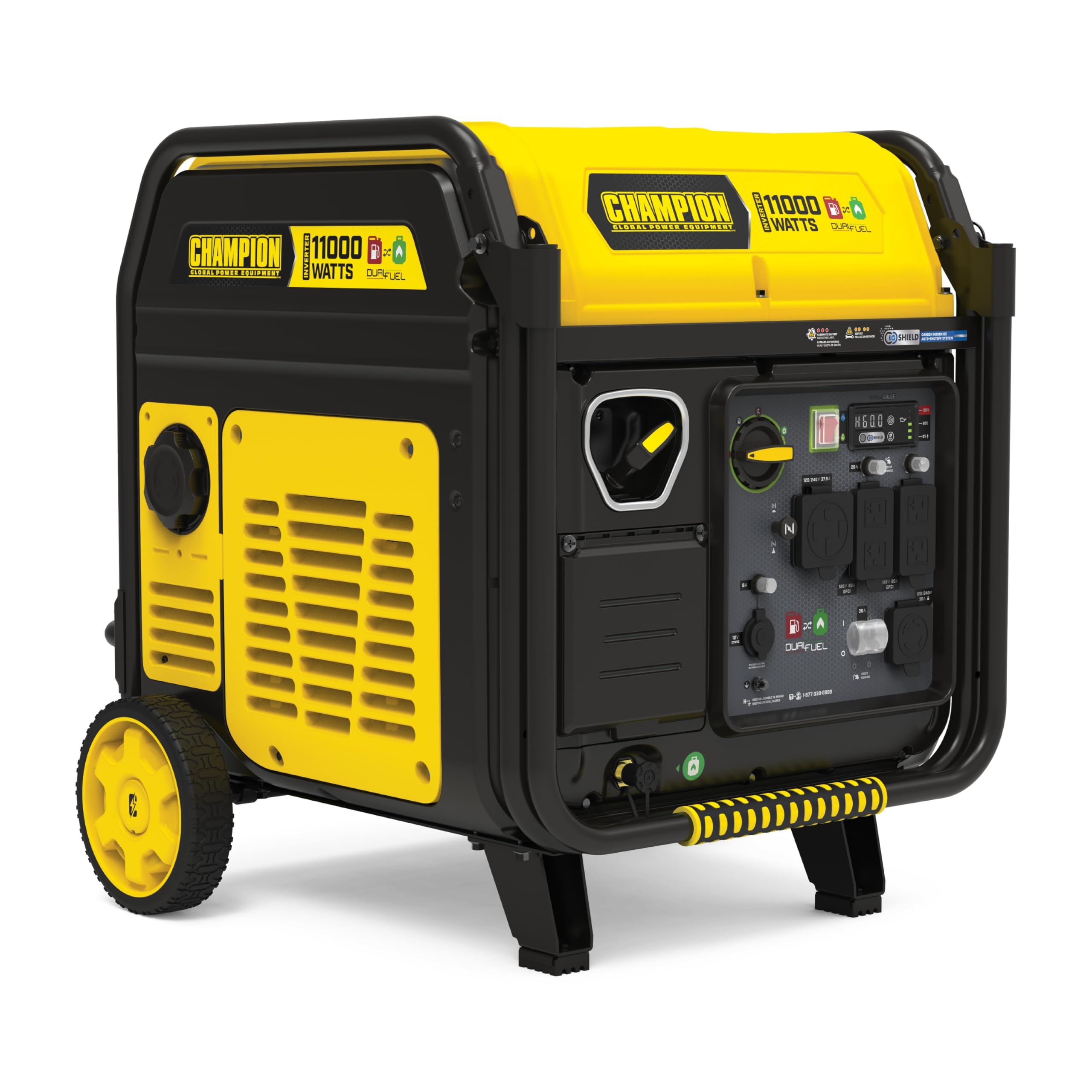
The premium quiet inverter with Cold Start Technology that never leaves you stranded in winter.
Champion rounds out the list with a premium dual-fuel inverter that prioritizes quiet, safe power. It delivers 11,000 starting watts and 9,000 running watts on gasoline, plus 11,000 starting and 8,100 running on propane. The noise level is a remarkably low 64 dBA from 23 feet, making it one of the quietest in its class—a fact owner’s confirm, calling it “a lot quieter” than older conventional generators.
The 459cc engine features built-in Cold Start Technology, so it fires up easily in freezing temperatures. It includes a CO Shield carbon monoxide auto shutoff system. You get up to 15 hours of run time on a full tank of gasoline, which is excellent for overnight security. The outlet panel includes two 120V GFCI duplex outlets, a 120/240V 30A locking outlet, a 120/240V 37.5A outlet, and a 12V outlet.
Buyers report the propane start is easy and the stable voltage and frequency (the electrical output that keeps devices running smoothly) protect your electronics. The 3-year limited warranty with free lifetime technical support is one of the strongest in this guide. At 205.1 pounds, it’s heavy, but owners mention the wheels make it manageable. If you want a premium, quiet inverter that starts in cold weather, this is the one to pick over the lighter 125-pound model above when you need more power.
Why it’s premium: quiet 64 dBA operation plus Cold Start Technology for winter reliability.
The final word: a top-tier inverter for those who demand clean power and easy cold starts.
Understanding the Specs
Total Harmonic Distortion (THD)
THD measures how smoothly the generator produces electricity. Low THD (typically under 5%) means the power is clean and stable, like what comes from your wall outlet. This makes it safe for sensitive electronics like computers, TVs, and medical devices. Conventional generators often have higher THD, which can cause buzzing or damage to delicate circuits over time.
Peak vs. Running Watts
Peak watts (or surge watts) is the short burst of power needed to start a motor—think of an air conditioner compressor or a water pump. Running watts is the continuous power the generator sustains. A fridge might run on 600 watts but spike to 2,000 when the compressor kicks in. Always check the peak number meets your largest appliance’s starting needs.
Decibels (dBA)
dBA measures noise level. Generators typically range from 60 dBA (normal conversation) to 75+ dBA (loud vacuum cleaner). Inverter models are usually quieter, often 64-68 dBA, while open-frame units can hit 70+ dBA. If you plan to run it near neighbors or overnight, prioritize a lower dBA figure.
Transfer Switch Ready
A transfer switch safely connects yourgenerator to your home’s electrical panel, letting you power hardwired circuits like your furnace or well pump. A generator with a 50A outlet (NEMA 14-50R) is typically required to connect to a transfer switch or interlock kit. This setup is safer than extension cords because it prevents backfeeding electricity into the grid, which endangers utility workers.
Dual Fuel vs. Tri-Fuel
Dual-fuel generators run on gasoline and propane. Tri-fuel adds natural gas as a third option. Gasoline offers maximum wattage but goes stale. Propane lasts indefinitely on the shelf and burns cleaner. Natural gas provides unlimited runtime if connected to your home’s line. The trade-off is that gas and NG both slightly lower peak wattage compared to gasoline.
FAQ
What size generator do I need to run a whole house?
Is a 10000 watt generator enough to run a house?
Can I run a 10000 watt generator on propane?
How long can a 10000 watt generator run continuously?
Is an inverter generator better than a conventional one?
What is the difference between starting watts and running watts?
Can a 10000 watt generator run a central air conditioner?
What does CO sensor and CO Shield mean on a generator?
Can a 10000 watt generator run on natural gas?
How much noise does a 10000 watt generator make?
Final Thoughts: The Verdict
For the majority of shoppers, the 10000 watt generator winner is the Westinghouse iGen12000DFc because it combines quiet inverter operation, fuel efficiency, and a 19-hour runtime in a single package. If you want dual-fuel flexibility at a lower price, grab the WEN DF1100X. And for the maximum surge capacity to run central AC or a well pump, the DuroStar DS13000MX is the one to reach for.
How We Picked
We do not accept paid placement. Every pick is matched to a real buyer and a real use-case; we do not hands-on test units.
Sources & Methodology
Specifications: manufacturer listings and product documentation. Review insights: verified customer reviews, as of August 2026. Pricing: not shown on this page (it changes often); check the current price via the retailer link.
As an Amazon Associate, Gadgets Feed earns from qualifying purchases. This does not affect which products we feature.