
Our readers keep the lights on and my morning glass full of iced black tea. As an Amazon Associate, I earn from qualifying purchases.
Specs are compiled from manufacturer listings and verified buyer reviews and can change over time — please confirm the key details on the product page before buying.
The 3.5mm microphone is a video and podcasting workhorse, but it’s easy to get wrong. You want a mic that makes your voice clear, natural, and hiss-free, whether clipped to a collar or plugged into a camera. We’ve shortlisted the nine best so you can skip spec-sheet reading and buy with confidence.
I’m Min — the founder and writer behind Gadgets Feed. This guide is built by comparing the manufacturers’ published specifications and the patterns across verified customer reviews, so you get each pick’s real strengths and trade-offs instead of marketing spin.
From wireless clip-ons to studio-grade lapel mics, these are the best 3.5mm microphone options that deliver clear audio without breaking your workflow.
Our Picks at a Glance


How To Choose The Best 3.5mm Microphone
Before you buy a 3.5mm microphone, you need to know which of two types fits your setup. Simple wired lapel mics plug straight into your device’s headphone jack, while wireless systems send audio from a tiny transmitter on your shirt to a receiver you plug in. Your choice depends on how much you move around and whether your phone or camera even has a headphone jack.
Check the Plug First: TRS vs TRRS
Not all 3.5mm plugs are the same. A TRS plug (three metal bands) works with cameras and recorders, while a TRRS plug (four bands) is what iPhones, Android phones, and laptops expect. Many wired mics include a mode switch for this exact reason, so match the mode to your device or grab a cheap adapter.
Wired or Wireless: Match It to Your Scene
A wired lavalier like the BOYA BY-M1S gives you a reliable, battery-free signal over a long cable. A wireless system like the Hollyland Lark M2 frees you from the cable entirely, which is a lifesaver when your subject is moving around a venue. If you are doing talking-head videos at a desk, the cable saves money; if you are filming a wedding, go wireless.
Quick Comparison
| Model | Best For | Connection | Pickup Pattern | Battery Life | Amazon |
|---|---|---|---|---|---|
| Hollyland Lark M2★ Best Overall | Wireless vlogging | 3.5mm & USB-C | Lavalier | 40 hours | Amazon |
| Shure MVLPremium Pick | Phone & tablet video | 3.5mm TRRS | Omnidirectional | — | Amazon |
| Rode RODELink LAVStudio Lock | Locking wireless packs | 3.5mm Locking | Omnidirectional | — | Amazon |
| RØDE Lavalier II | Broadcast & film | 3.5mm Locking | Omnidirectional | — | Amazon |
| Sony ECM-LV1 | Stereo ambience | 3.5mm Jack | Omnidirectional | — | Amazon |
| BILIWAL Wireless | Multi-device budgets | 3.5mm, USB-C, Lightning | Lavalier | 14 hours (solo) | Amazon |
| Pyle Headset | Live performance | 3.5mm / 1/4″ | Omnidirectional | — | Amazon |
| weishan 2-Pack | Sennheiser systems | 3.5mm Locking | Omnidirectional | — | Amazon |
| BOYA BY-M1S | Budget wired | 3.5mm TRRS | Omnidirectional | — | Amazon |
In‑Depth Reviews
1. Hollyland Lark M2 Wireless Microphone
Our pick — over 4.5★ from 400+ verified ratings; the strongest balance of quality and price.
The clip-on that weighs less than a coin and records like a studio mic.
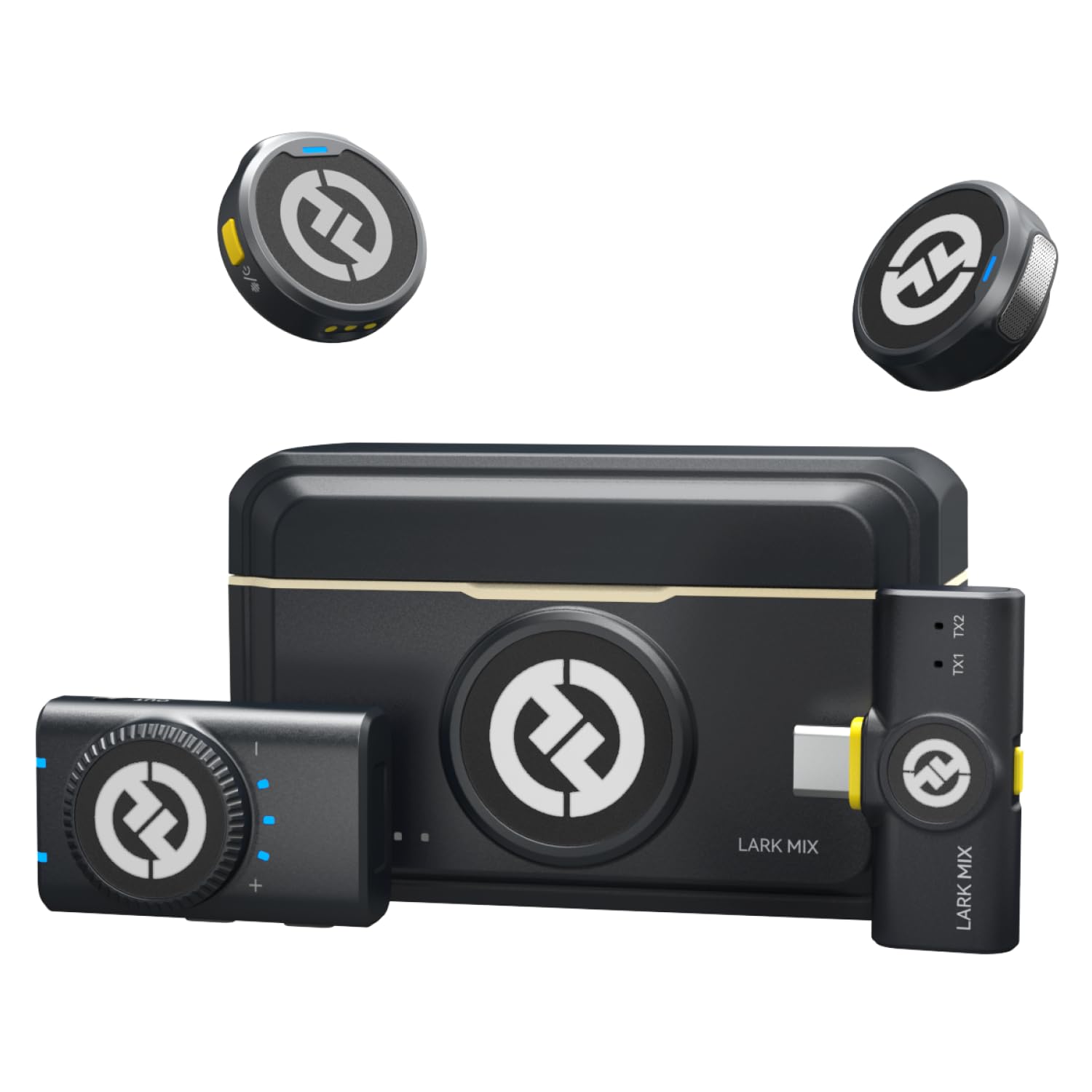
You will barely notice the Hollyland Lark M2 on your collar, and that is the point. Each 9g transmitter captures 48kHz/24-bit audio that holds up outdoors. A 70dB signal-to-noise ratio keeps hiss out, and a 115dB maximum SPL handles loud laughs without distortion.
A full charge delivers 10 hours of use, and the charging case adds two more charges for a 40-hour total. The receiver connects to your camera through the 3.5mm audio jack, and you can switch between mono and stereo right on the unit. Buyers report it pairs instantly from the start, with the transmitters and receiver already linked at the factory.
A yellow button on the transmitter toggles noise cancellation, which owners say tames wind and crowd chatter for outdoor shoots. The kit is generous too, with two transmitters, a camera receiver, a USB-C receiver, and a pair of windscreens in the box.
What wins people over
- Wireless range reaches 1,000ft/300m line of sight.
- Tiny 9g transmitters vanish on clothing
- 40-hour total battery with the charging case
Small trade-offs
- Occasional wind noise creeps in without the windscreen
- Stereo mode only works via the 3.5mm camera connection
Your best bet if: you shoot mobile video, vlogs, or interviews and want broadcast-quality voice without a cable getting in the way.
A fair caution: it is a premium price, so if you only record at a desk, a wired mic will do the job for far less.
2. Shure MVL Lavalier Microphone
The mini lapel mic that brings studio-grade voice to your phone or tablet.
Sony may have the word “compact,” but the Shure MVL is the one you will forget is clipped to your shirt. It is built around a proven Shure RF/GSM interference protection system, so you will not hear random buzzes or clicks from your phone’s radio signals. That matters when you are recording right next to the very device doing the recording.
It is a plug-and-play tool: the 3.5mm TRRS connector goes straight into an iPhone, tablet, or laptop with a jack, and the attached 1.3m cable gives you room to gesture. The metal housing and the included windscreen, mount, and carrying pouch make it feel like a piece of serious kit. Owners find it picks up quiet voices with ease, which is a gift for dictation or soft-spoken interview subjects.
The honest catch is that sound quality has drawn some mixed reactions, with a few noting it can be quiet from the start until you add gain. It also prefers devices with a headphone jack, so newer iPhones will need a Lightning adapter. For the build quality and the interference shielding alone, it earns its premium spot.
Where it shines: the interference protection is the quiet hero here — no more phone buzz ruining a take.
Fair warning: the attached cable is on the delicate side, so pack it carefully and avoid tension at the plug.
Reach for this if: you record dictation, voice notes, or talking-head clips on a phone or tablet and want a name you can trust for clean audio.
Look elsewhere if: you need a long cable or a budget that stays under the premium line — this one is about precision, not price.
3. Rode RODELink LAV
The pro lapel that locks in and refuses to break mid-shoot.
The Rode RODELink LAV is built for people who cannot afford a mic failure. Its locking TRS connector screws firmly into the RODELink wireless range and any recorder with a 3.5mm locking input, so the cable will not yank loose during a recording. Inside, a discreet 4.5mm omnidirectional capsule picks up sound from all directions, which is forgiving when you cannot place the mic perfectly on talent.
Durability is the headline here. The cable is reinforced with Kevlar, designed to survive the rough and tumble of a real shoot, and it ships with a foam pop shield and a mounting clip with built-in cable management. Owners mention it fixed their crackly original mic problems during livestreams, delivering clean, artifact-free audio that beats the stock mic hands down.
The recurring gripe is the locking nut, which is not secured to the wire and can slide off and get lost if you are not careful. It is also not a budget item, and some find it pricey for a single lavalier. But if your wireless transmitter relies on a locking connection, this is the partner it wants.
Built for the field
- Kevlar-reinforced cable shrugs off rough handling
- Locking connector stays put on RODELink packs
- Omnidirectional capsule forgives imperfect placement
Handle with care
- Locking nut is loose and easily lost
- Short cable may need an extension for mixer use
Grab this for: a wireless mic pack with a locking input, or any shoot where a loose cable would be a disaster.
skip it if: you just need a basic phone mic — the locking feature only helps when your recorder has the matching thread.
4. RØDE Lavalier II

The flat-cable lav that vanishes on camera while sounding broadcast-clean.
If you want the microphone to disappear, the RØDE Lavalier II is the master of disguise. Its ultra-low-profile design pairs a compact mounting clip with a flat cable that lies flat under clothing, so there is no visible bump ruining your shot. The omnidirectional polar pattern with a flat frequency response means voices come through natural and uncolored, which is exactly what broadcast engineers want.
You get a genuinely premium accessory kit in the box: a pop filter, a mini furry windshield, a mic clip, coloured ID rings to tell multiple mics apart, and a zip case. Buyers who switched from cheaper brands report a massive upgrade, with crisp audio and dramatically less wind noise at highway speeds on a motorcycle. The locking 3.5mm connector keeps it snugly attached to a Wireless GO II or AI-Micro, though it may not work directly with phones and cameras.
The trade-off is compatibility. This is a specialist tool for wireless systems, not a universal plug-into-anything mic, and a few units have arrived dead or with loose connections. The sound quality is praised most by far, but treat the first connection carefully and power devices off before plugging in.
The headline: a flat cable and low-profile clip that make you look professional without trying.
Think about: compatibility first, since it is happiest paired with RØDE wireless gear rather than a phone jack.
Best for: filmmakers and podcasters who already own RODE wireless gear and need discreet, broadcast-grade voice capture.
Not for: quick phone recordings — you would need the right wireless receiver to make it sing.
5. Sony Compact Stereo Lavalier Microphone ECM-LV1

The pocket-size Sony that grabs real stereo depth, not just a flat mono track.
Most lavaliers record in mono, but the Sony ECM-LV1 captures true stereo ambience. That means a nature walk or a crowded room sounds three-dimensional, with your voice still crisp and warm on top. Its omnidirectional pickup and wide frequency range make it sensitive enough for soft voices, which is why owners call it a step up from the built-in camera mic for headshot videos.
It runs on plug-in power, so there are no batteries to juggle, and the included windscreen tames outdoor gusts. The 360-degree rotation clip lets you angle the mic any way you need, which is a small detail that makes a real difference on a moving subject. Owners note it works from the start with a PS5 for streaming chat, which is a nice bonus for gamers.
The consistent complaint is the short cable, which usually forces a cheap extension purchase, and the volume can be quiet until you boost gain in software. The build also feels light, so treat it gently. For the price, though, it is the rare stereo lav that fits a 3.5mm jack.
Why owners stay
- True stereo capture adds depth to recordings
- Plug-in power means no batteries ever
- 360-degree clip adapts to any angle
The catch
- Short cable will likely need an extension
- Output can be quiet until you raise gain
Choose it for: ambient-rich recordings like nature video or interviews where a room’s atmosphere matters.
Pass on it if: you want a long cable or a louder out-of-the-box signal — this one rewards a little tweaking.
6. BILIWAL Wireless Lavalier Microphone
The budget wireless that speaks iPhone, Android, and camera in one receiver.
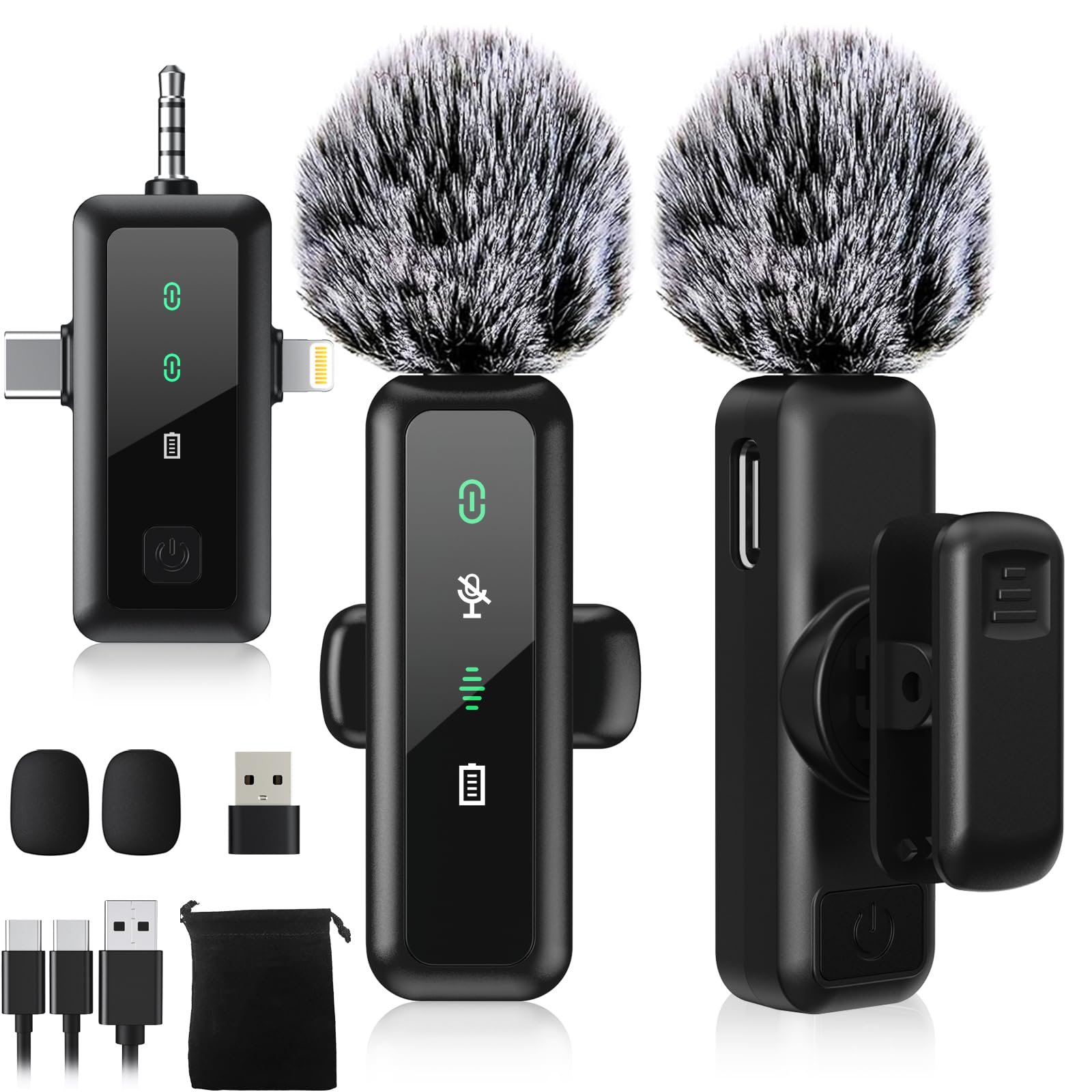
The BILIWAL Wireless is the shape-shifter of this list. Its single 3-in-1 receiver carries a USB-C plug, a Lightning plug, and a 3.5mm jack, so one kit covers an iPhone, a modern Android, and a mirrorless camera. The LED display on the receiver shows status at a glance, and the whole thing is true plug-and-play — no apps, no pairing menus.
Battery life is a genuine highlight. You get up to 14 hours of recording in solo mode or 7 hours in dual mode, and you can charge your phone while recording so a long stream does not die mid-sentence. Three audio modes live on the button: noise reduction for noisy rooms, reverb to thicken vocals in small spaces, and mute for between-takes chatter.
The fair warning is that experiences vary — some customers note flawless recording on cameras, while others hit connection snags. The included accessories are generous, with two mics, two wind muffs, and a storage bag in the box. If you juggle multiple devices and want one cheap kit to cover them all, this is the one.
Why it stands out: the 3-in-1 receiver is the cheapest way to cover both phone camps and a camera with one purchase.
Keep in mind: reliability gets mixed reports, so test it with your specific device before a big shoot.
Grab it if: you switch between an iPhone, an Android, and a camera and want one budget wireless system for all three.
Think twice if: your recordings are mission-critical — the occasional mixed review means it is safer as a backup.
7. Pyle Double Over-Ear Headset Microphone

The hands-free headset that keeps your voice crisp while you move and gesture.
When your hands need to be free — for a sermon, a fitness class, or a DJ set — a lapel mic is not enough. The Pyle headset wraps over both ears with a metal frame that stays comfortable even over glasses or a hat, and its beige flesh-tone color makes it nearly invisible on stage. The omnidirectional condenser delivers crisp vocals without the “huffing” you get from cheap headsets, and the 2kΩ output impedance pairs with a wide range of mixers and transmitters.
It connects via a 3.5mm plug and includes a 1/4″ adapter, so it walks straight into a studio mixer or a body-pack transmitter. Owners have replaced far more expensive lavs with it for church speaking and find the presence clearer. It works with a laptop through a TRRS splitter, and the 1.2m cable gives you reasonable reach.
The durability story is mixed, which is the honest catch. It is lightweight and somewhat delicate, so treat it as a dependable workhorse rather than an indestructible tank — several owners simply buy multiples because the price is so low. It also needs a powered 3.5mm jack, so a plain headphone port will not drive it.
Performance value
- Clear vocal reproduction that beats built-in mics
- Universal fit over glasses and hats
- 1/4″ adapter included for mixers
Built light
- Fragile build demands careful handling
- Needs plug-in power from the connected device
Reach for this if: you speak, teach, or perform hands-free and want a near-invisible mic that boosts vocal clarity.
Look elsewhere if: you need a rugged everyday mic — this one is light on purpose and prefers gentle use.
8. weishan 2-Pack Lavalier for Sennheiser

The budget twin pack that fits Sennheiser packs and out-sounds the originals.
If you run a Sennheiser wireless system, this two-pack is the spare-mic solution you did not know you needed. It is built for the EW100, EW300, EW500, SK100, SK300, SK500, EK100, EK2000, and G1/G2/G3 series, plus the EWD1, SK D1, ME2, ME3, and ME4, with a 3.5mm locking jack plug that screws in tight. It also fits Tascam DR-10L and Zoom F2 gear with a 1/8 inch screw interface.
The sound punches above its budget class. Owners who tested it against a Sennheiser ME2 found it brighter and crisper in vocal ranges, with a more sturdy build and a thicker cable. The gold-plated 3-pole TRS tip (a standard three-conductor audio plug) keeps impedance low, so your recordings stay clean. The metal clip holds firmly to a lapel, and a threaded aluminum windscreen stays put, unlike cheap foam that slides off.
The included clips run stiff, and the cable length is a bit short at 1.5 meters, but for a two-pack at this price, it is the definition of a smart backup. Just confirm your transmitter’s connector — the locking thread is essential for it to seat correctly.
Why owners buy two
- Sounds brighter than a Sennheiser ME2 at a fraction of the cost
- Threaded windscreen and gold plug boost durability
- Two mics cover a backup slot and a main
Small quirks
- Included clips are stiff to open
- Short 1.5m cable limits placement
Best for: Sennheiser pack owners who want a rugged, great-sounding spare lav without paying brand-name prices.
Not for: phone or camera direct recording — this is a wireless-pack specialist.
9. BOYA BY-M1S Professional Lavalier

The 19.7-foot cable that lets you roam a stage without a wireless budget.
The BOYA BY-M1S solves a problem most budget mics ignore: reach. Its 19.7ft (6m) shielded cable means you can clip the mic to a speaker and let the recorder sit across the room, which is perfect for interviews, live broadcasts, and lectures. The updated omnidirectional capsule captures sound from a full 360-degree range, so the mic does not need perfect aiming to sound good.
It is also a two-device chameleon. The 3.5mm 4-pole TRRS output has a switch for “camera” mode and “smartphone” mode, so one mic covers a DSLR, camcorder, laptop, or phone. The metal enclosure feels sturdier than the price suggests, and the included foam windscreen helps outdoors.
The value-for-money verdict is genuinely split. Many owners call the sound excellent for the price and love the long cord, but a few found it unusable on modern phones without buying a separate adapter, and the foam slips off easily. It works best when you match the mode switch to your device and remember that newer iPhones need a Lightning-to-3.5mm adapter.
What you get
- Enormous 19.7ft cable for wide room coverage
- Dual camera and smartphone modes in one mic
- Metal body offers surprising durability
Know before you buy
- Modern iPhones need a separate Lightning adapter
- Foam windscreen slips off too easily
Pick this up if: you need maximum cable reach on a tight budget and record to a camera or older phone.
Move on if: you are on a modern iPhone — that extra adapter purchase eats into the savings.
Understanding the Specs
Omnidirectional Pickup
An omnidirectional capsule captures sound equally from every direction, not just straight ahead. That is ideal for a lapel mic because it keeps your voice consistent as you turn your head, and it forgives slightly off-center placement. The alternative, a cardioid pattern, rejects side noise but demands careful aiming.
TRS vs TRRS Connectors
A 3.5mm plug has metal bands that carry different signals. TRS (three bands) is standard for cameras and recorders, while TRRS (four bands) adds a microphone channel for phones and laptops. Getting this wrong is the most common reason a new mic “doesn’t work” — match the mode or use an adapter.
FAQ
Why is my 3.5mm microphone not working with my phone?
What is the difference between TRS and TRRS plugs?
Do I need a wireless microphone or is a wired one fine?
What does omnidirectional mean on a microphone?
Can I plug a 3.5mm microphone into an iPhone or Android?
How long does a wireless microphone battery last?
What is plug-in power and why does my mic need it?
Are the weishan mics compatible with my Sennheiser wireless pack?
Is a 3.5mm microphone better than USB?
Final Thoughts: The Verdict
For most people, the 3.5mm microphone winner is the Hollyland Lark M2 because it pairs a featherlight 9g transmitter with 40 hours of battery and genuinely clean audio. If you want a premium wired mic for your phone or tablet, the Shure MVL brings interference protection that keeps recordings buzz-free. And if you need to roam a stage or cover a wide room on a budget, the BOYA BY-M1S offers a 19.7-foot cable that no wireless system undercuts.
How We Picked
We do not accept paid placement. Every pick is matched to a real buyer and a real use-case; we do not hands-on test units.
Sources & Methodology
Specifications: manufacturer listings and product documentation. Review insights: verified customer reviews, as of August 2026. Pricing: not shown on this page (it changes often); check the current price via the retailer link.
As an Amazon Associate, Gadgets Feed earns from qualifying purchases. This does not affect which products we feature.