
Our readers keep the lights on and my morning glass full of iced black tea. As an Amazon Associate, I earn from qualifying purchases.
Specs are compiled from manufacturer listings and verified buyer reviews and can change over time — please confirm the key details on the product page before buying.
Picking a 4K mini projector feels like a math test: native versus pixel-shifting, ISO lumens versus ANSI lumens, and a contrast ratio you need a calculator to appreciate. The real question is whether it stays watchable in daylight and still delivers crisp detail after sunset. This guide separates the models that deliver real-world brightness and sharpness from those that only look good on paper.
I’m Min — the founder and writer behind Gadgets Feed. This guide is built by comparing the manufacturers’ published specifications and the patterns across verified customer reviews, so you get each pick’s real strengths and trade-offs instead of marketing spin.
You want a mini projector that stays watchable in daylight and delivers true 4K detail, not just a compact box that washes out after sunset. These picks tackle the two complaints owners raise most: usable brightness and genuine 4K sharpness. 4k mini projector options here pair portability with picture quality for everyday living rooms.
Our Picks at a Glance
How To Choose The Best 4K Mini Projector
Think of a mini projector as a compromise machine. The goal is finding the model where the compromises hurt least for your specific room and habits. You are trading a permanent TV panel for a portable image, so prioritize the specs that matter most for where you will actually watch.
Brightness Is the Real Gatekeeper
Lumens determine whether your picture washes out in daylight or stays vivid at night. A projector rated at 1,300 lumens works acceptably with lights dimmed, while a 2,600-lumen model holds its own in a brighter room. If you plan to watch mostly after sunset, lower brightness is tolerable; if daytime viewing matters, push your budget toward the higher-lumen options.
Contrast Ratio Shapes Depth
Contrast ratio tells you how deep the blacks can go relative to the brightest whites. A 1,000,000:1 ratio produces noticeably richer shadow detail than a 5,000:1 panel, which can look grayish in dark scenes. Laser projectors tend to lead here, which is why the premium picks cluster around triple-laser light engines.
Throw Distance Changes Room Fit
Short-throw projectors sit close to the wall and still produce a large image, which suits small spaces. Standard-throw models need more distance to fill the same screen size, so measure your room before choosing. A short-throw model fills a 100-inch screen from six feet, while a standard-throw unit needs roughly ten feet of clearance.
Quick Comparison
| Model | Best For | Brightness | Contrast | Smart OS | Amazon |
|---|---|---|---|---|---|
| Hisense M2 Pro★ Best Overall | Overall balance | 1300 lumens | 5000:1 | Vidaa OS | Amazon |
| JMGO N1S 4KColor King | Color accuracy | 1700 lm | 1000000:1 | Google TV | Amazon |
| XGIMI Elfin FlipTravel Pick | Travel & design | 1600 lm | 20000:1 | Google TV | Amazon |
| NEBULA Cosmos 4K SE | Smart features | 1800 lm | 400:1 | Google TV | Amazon |
| LG CineBeam S | Ultra-short throw | 500 lm | 450,000:1 | webOS | Amazon |
| LG CineBeam Q | Compact design | 500 lm | 1,500,000:1 | webOS | Amazon |
| BenQ X500i | Gaming | 2200 lm | 3000:1 | Android TV | Amazon |
| Hisense C2 Pro | High brightness | 2600 lm | High | VIDAA OS | Amazon |
| Nebula X1 | Ultra-bright cinema | 3500 lm | 5000:1 | Android 14 | Amazon |
In-Depth Reviews
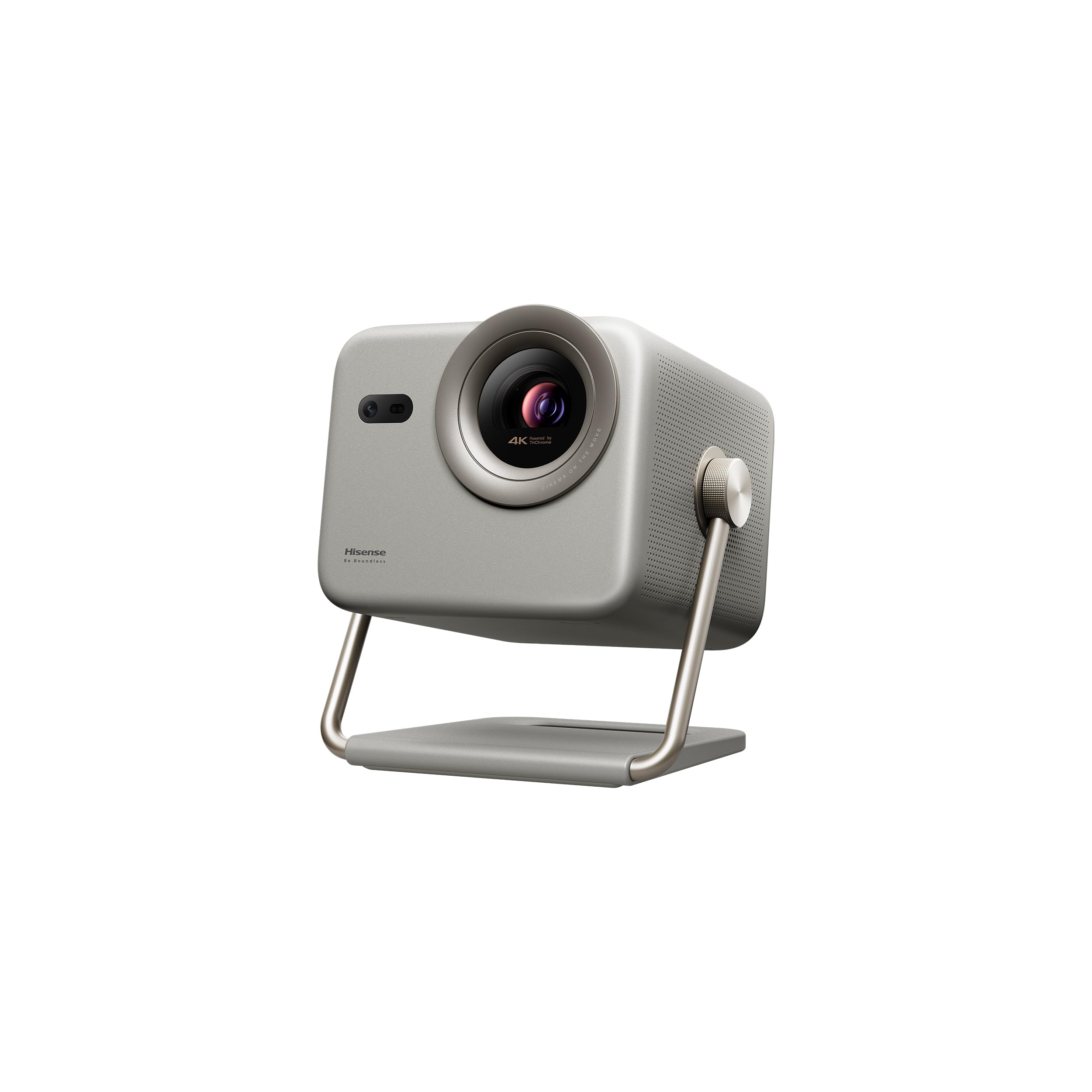
1. Hisense M2 Pro
Our pick — over 4.5★ from 80+ verified ratings; the strongest balance of quality and price.
The all-rounder that pairs a ceiling-swinging gimbal with genuinely loud, room-filling sound.
You get a sharp picture, strong built-in speakers, and a gimbal that rotates 360° horizontally and 135° vertically — so you can aim it at a wall or up at the ceiling without moving the base. Owners call it the best projector they’ve owned, and one buyer says the jump from a standard LCD model feels dramatic.
Brightness hits 1300 ANSI lumens, which holds up in a dimmed room and looks indistinguishable from a TV in full darkness. The 4K AI Upscaler converts lower-resolution content up to 4K, and the auto keystone plus optical zoom handled a 120-inch image from 11.5 feet away, per owner reports. The auto-magic adjustment system — obstacle avoidance, eye protection, and screen adaptation — removes nearly all fiddling.
The 5000:1 contrast ratio is mid-pack rather than class-leading, so blacks aren’t as deep as the laser heavyweights. For a portable unit with this feature set and sound quality, though, the trade-off is easy to accept. If you want one machine that does movies, gaming, and casual streaming without external speakers, this earns its spot at the top.
Everyday winner: The combination of auto-adjustment, gimbal flexibility, and surprisingly strong audio makes this the pick that feels complete right from the start.
Honest limit: The contrast ratio trails the premium laser models, so hardcore home-theater fans may want more depth in dark scenes.
Why it wins: Owners consistently praise the picture, the audio, and the auto-adjustability, calling it worth every dollar.
Who should skip: If deep black levels are non-negotiable, the JMGO N1S offers a higher contrast ratio for a similar lifestyle use case.
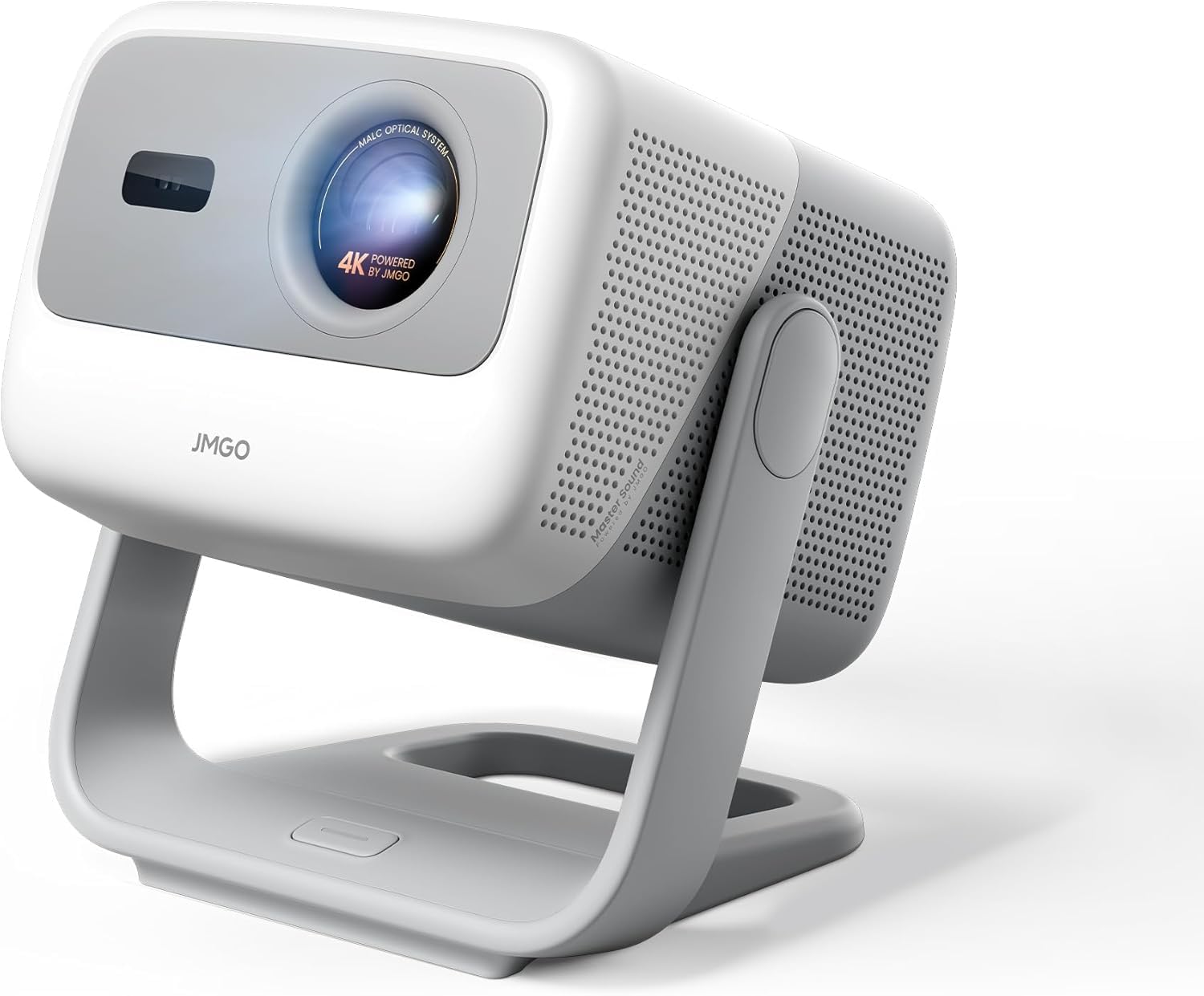
2. JMGO N1S 4K Upgrade
The triple-laser specialist that eliminates the rainbow effect and delivers a 1,000,000:1 contrast ratio.
Buyers report this is bright — 1100 ISO/1375 ANSI lumens in practical terms — compact, and fitted with a 1/4-20 mount that makes tripod or ceiling rigging easy. The pure RGB triple laser removes the color wheel entirely, which means no rainbow artifacts, and the 110% BT.2020 and 151% DCI-P3 color coverage push reds and greens far beyond typical LED projectors.
At just 4.4 lbs, it travels well, and the integrated gimbal rotates 127° vertically for one-handed angle changes. Native Netflix 4K comes pre-loaded via Google TV, and the dual 10W Dolby Audio speakers deliver 360° surround. The 17ms latency and HDMI 2.1 make it genuinely capable for gaming, not just movies.
The catch is brightness expectation: a few owners found it too dim for anything but a dark room, and Google TV can lag. Owners mention the projector is highly recommended for portable use but that it thrives after sunset rather than in daylight. If color accuracy and a room-darkening routine are your priorities, this is the one.
What wins people over
- Ultra-high contrast ratio for deep, rich blacks
- Exceptionally wide color gamut with pure laser light
- Native Netflix 4K without an external streaming stick
Where it asks for compromise
- Best results in a dark or very dimly lit room
- Built-in speakers are decent but not overpowering
- No optical zoom or lens shift for flexible placement
Reach for it if: color fidelity and contrast depth are your top priorities and you watch mostly after dark.
Look elsewhere if: you need a bright daytime performer — the Hisense C2 Pro nearly doubles the lumen output.
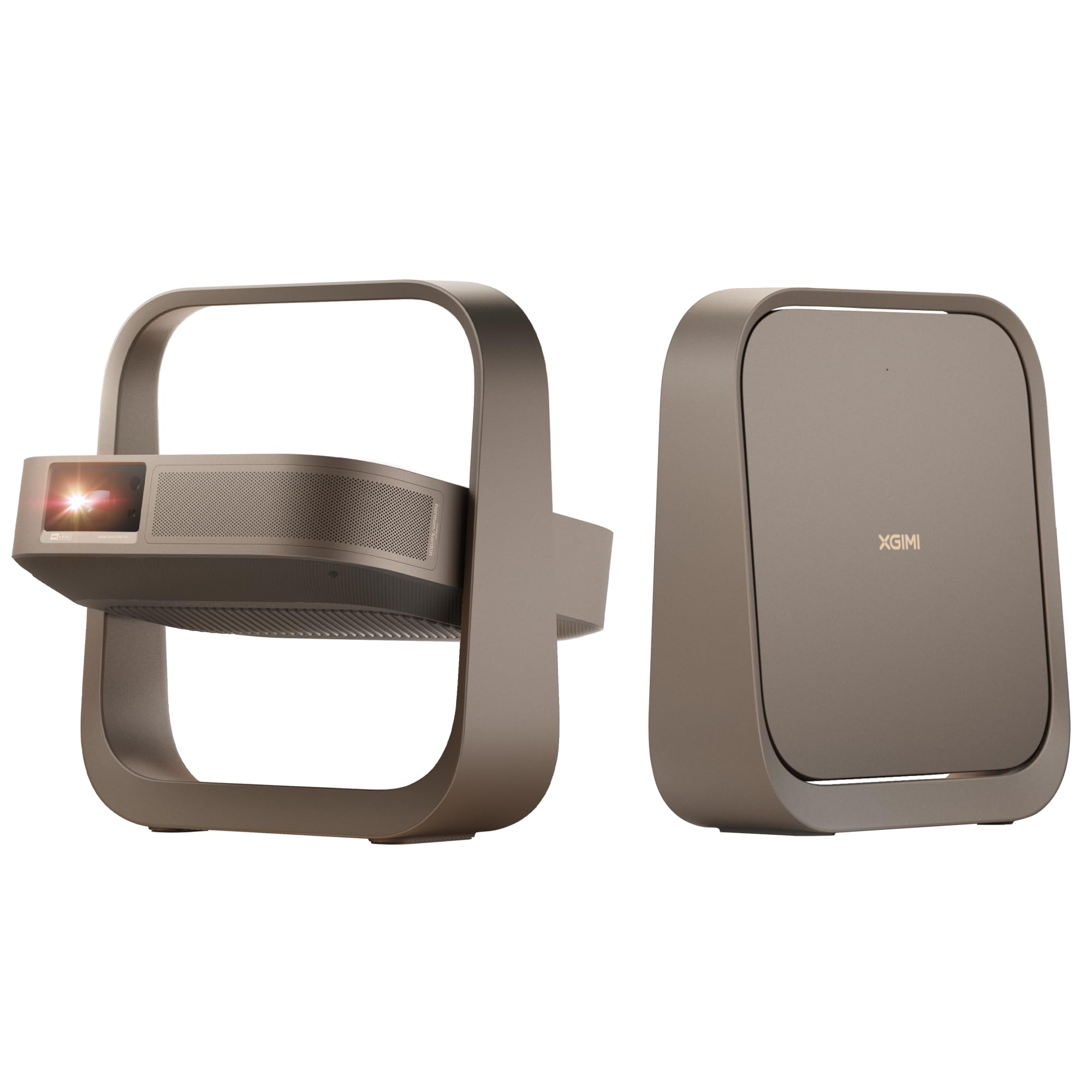
3. XGIMI Elfin Flip 4K
A book-sized powerhouse whose dual Harman Kardon speakers fill a room without a soundbar.
Priced as a premium travel projector, the Elfin Flip measures just 9.7″L x 3.1″W x 10″H, yet delivers sharp native 4K RGB laser imagery. Owners praise its portability, moving it easily between rooms, and the built-in adjustable stand that eliminates the need for a separate mount. The fast Google TV interface with Netflix built in means you power on and play.
The dual Harman Kardon speakers produce crisp highs and deep bass, removing the need for external audio in most casual setups. The auto focus and keystone correction beat older sibling models, per owner comparisons, and the optical zoom adds placement flexibility. It runs cool after sustained use and keeps the fan quiet.
One honest caveat: a few owners measured it noticeably dimmer than the 1600 lumens advertised, so daytime viewing in bright rooms will wash out. It also requires AC power — there’s no internal battery for true outdoor portability. If you want a premium compact that sounds great, this fits the bill; if brightness is king, look to the higher-lumen picks.
Compact performer: The form factor and built-in Harman Kardon audio make this the best pick for moving between rooms or taking on trips.
Brightness reality: Expect to watch in dimmed light; a few owners found the real output below the 1600-lumen claim.
Best for: travelers and casual viewers who prioritize portability and sound over maximum brightness.
Not ideal if: you plan to watch in a bright living room during the day — the NEBULA Cosmos 4K SE adds 200 more lumens.
4. NEBULA Cosmos 4K SE

The handle-toting HybridBeam that combines LED and laser for 1,800 ANSI lumens of versatility.
What sets the Cosmos 4K SE apart is the HybridBeam light engine, blending LED and laser sources to reach 1,800 ANSI Lumens with 1.07 billion colors. Owners praise the picture quality as breathtaking at night and still bright enough indoors with indirect light. The built-in carrying handle makes it genuinely portable — customers note hauling it to parties and watching on a 100-inch image with auto keystone even off-center.
Google TV with 4K Netflix built in means no dongle required, and the IEA 4.0 intelligent setup handles autofocus, keystone, and obstacle avoidance automatically. The Dolby Vision support adds HDR punch, and owners note the image surpasses a 70-inch TV in a dark room. The sound is loud enough for small to medium parties, per multiple reports.
The recurring honesty note: the built-in Android interface runs slower than a dedicated Roku, and a rare long-term owner reported recalibration quirks after months of use. For most buyers, the auto keystone and focus work quickly and reliably on off-white walls. If you want a smart, bright, portable projector with a handle, this is the value pick.
The thing everyone raves about
- 1,800 ANSI lumens of brightness for day and night viewing
- Carrying handle makes it genuinely travel-friendly
- Google TV with 4K Netflix built in
Where it trips up
- Android interface feels slower than dedicated streaming devices
- Autofocus occasionally needs a moment to lock on
Who it suits: families and party hosts who want a bright, portable projector with minimal setup fuss.
Who might pass: perfectionists who demand flawless autofocus every single time — occasional recalibration is part of the trade-off.
5. LG CineBeam S PU615U
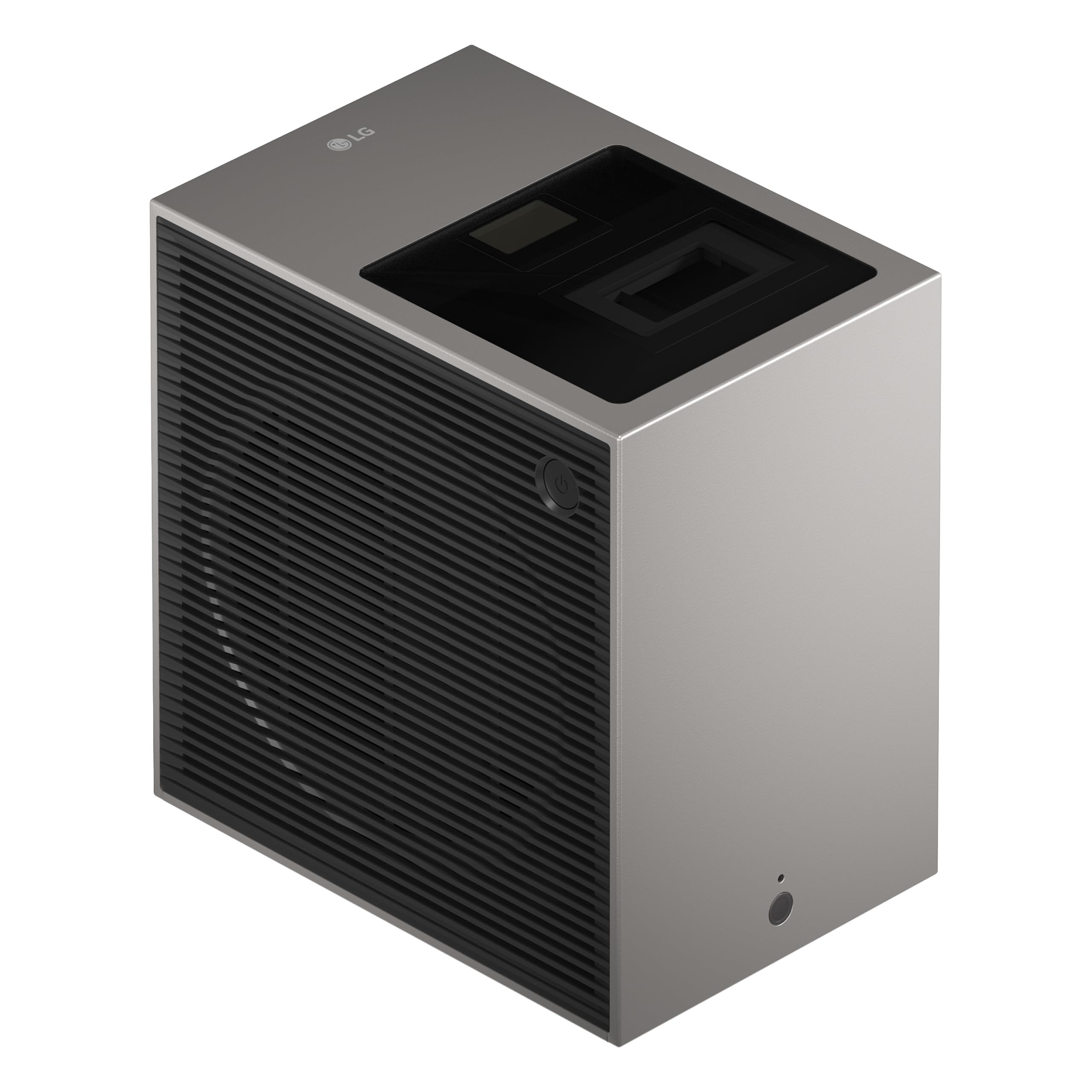
The ultra-short throw that projects 100 inches from just inches away — perfect for cramped apartments.
If your room cannot accommodate a standard projector’s throw distance, the CineBeam S solves it with ultra-short throw projection, displaying 40 to 100 inches from mere inches away. The triple laser engine delivers up to 154% DCI-P3 color gamut and a 450,000:1 contrast ratio, producing rich tones and deep blacks. It fits into any space at just 4.3″ x 6.3″ x 6.3″.
Built-in stereo speakers with Dolby Atmos surround you in spacious audio, and the compact design is easy to move room to room. Owners who paired it with an Apple TV and iPhone found it impressive once set up, and the screen flip feature allows rear placement for flexible room layouts.
The honest trade-off: at 500 ANSI lumens, this is a dark-room-only performer, and the smart interface draws real criticism — owners describe the auto adjust as finicky and the remote as sluggish. Several chose to bypass the built-in OS entirely with a streaming stick. If you need a big image in a tiny space and accept the software quirks, this delivers; if you want a snappy smart experience, look to the Hisense M2 Pro instead.
Space hero: No projector on this list beats it for squeezing a 100-inch image out of a shoebox-sized room.
Software friction: The auto-adjustment and remote frustrate owners enough that many recommend an external streaming device.
Best for: apartment dwellers and awkward spaces where any other projector physically won’t fit.
skip it if: you want a smooth built-in smart experience or plan any daytime viewing — 500 lumens demands darkness.
6. LG CineBeam Q HU710PB

A 3-pound cube with a rotating handle that doubles as a ceiling-aiming stand — design meets function.
The CineBeam Q is tiny at 5.5 inches long and just over 3 inches wide, yet it’s a true 4K UHD projector with a 120-inch screen capability. Its defining feature is the 360-degree rotating handle: swing it up to carry the 3-pound unit, or swing it down to tilt the image toward a ceiling for a celestial skyscape. The 3-channel RGB laser delivers up to 154% DCI-P3 color gamut with impeccable accuracy.
Owners describe the visual experience as remarkable, with stunning clarity and vivid colors, and praise the heat management — no overheating even after extended runs. Auto screen adjustment and auto focus mean you place it and play. WebOS streams from Netflix, Prime Video, Disney+, and YouTube, while Apple AirPlay 2 and Screen Share let you cast from phones.
The known compromises: 500 ANSI lumens means it’s not for daytime viewing in well-lit rooms, the built-in speaker is weak, and the remote is genuinely frustrating. Enthusiasts call it a keeper but pair it with a Bluetooth speaker — the Q supports Dual Audio Output to connect two devices simultaneously. If design and portability outweigh brightness, this is a standout.
Design marvel: The rotating handle and half-a-GameCube size make it the most distinctive, travelable design here.
Sound caveat: The built-in speaker is the weak link; a Bluetooth speaker or soundbar transforms the experience.
Reach for it if: you want a beautiful, tiny, premium laser projector and already own a Bluetooth speaker.
Look elsewhere if: you need loud built-in audio or bright daytime images — the Hisense M2 Pro delivers both.
7. BenQ X500i

The short-throw gaming weapon with response times as quick as 4ms at 1080p@240Hz.
Built for gamers first and home theater second, the X500i hits a 4.2ms low latency mode with up to 240Hz refresh, making fast-paced FPS feel buttery smooth. The short throw design — 0.69 to 0.83 with digital zoom — throws a 100-inch image from about 6.5 feet, ideal for small gaming spaces or a garage setup. At 2200 ANSI lumens, it’s bright enough for most lit rooms.
Reviewers point out the picture quality is exceptional for both gaming and movies, with a short throw that fills a 150-inch screen from 8 feet 3 inches. The auto-recognition of PS5 and Switch switches into the right gaming mode automatically, and the 4LED light engine offers a 30,000-hour lifespan — no bulb changes, ever. Android TV built-in supports Netflix, Prime, and YouTube with AirPlay and Chromecast casting.
The caveats are sparse but real: the built-in speakers are mediocre (use external audio), and HDMI 2.0 lacks the next-gen 2.1 spec some competitors offer. Owners also note the image is best in a dark room despite the brightness. For a competitive gamer who wants a big screen without a projector’s usual input lag, this is the specialist pick.
Built for competition
- Ultra-low 4.2ms latency for responsive gaming
- Short throw fits small spaces with huge images
- 4LED engine means no bulb replacement
Gamer trade-offs
- Built-in speakers are weak — plan for external audio
- No HDMI 2.1 for next-gen console features
Who it beats: every lifestyle projector here on raw gaming responsiveness — 4.2ms latency versus 17ms on rivals.
Who it doesn’t suit: movie purists who want Dolby Vision and deep laser blacks rather than gaming speed.
8. Hisense C2 Pro

The 2,600-lumen triple-laser giant that stays vivid even with the lights on.
The C2 Pro is what you pick when brightness is non-negotiable. At 2600 ANSI lumens, it displays well even in lit rooms, and owners confirm it handles moderate light without washing out. The triple laser light source delivers 110% BT.2020 color coverage with △E≈0.9 accuracy, and the 2000:1 native contrast keeps blacks deep. The 1.67x optical zoom means you can enlarge the image without losing resolution or brightness.
Sound by JBL with DTS certification delivers deep bass and clear mids, while the 360° horizontal and 135° vertical gimbal adjusts easily between wall, screen, or ceiling. Gamers get up to 240Hz refresh for zero-stutter play, and the IMAX Enhanced plus Dolby Vision certification delivers studio-level color. Shoppers say it rivals projectors costing twice as much.
The one real limitation: it needs more throw distance than some rivals to fill a 100-inch screen in a small space. Owners also note daytime blacks aren’t as deep as night viewing. But with a 65-inch to 300-inch projection range and this brightness, it’s the most flexible premium option here.
Bright-room boss: At 2600 ANSI lumens, this is the pick that keeps looking good when the sun is up and curtains are open.
Space note: You need more room-to-wall distance than ultra-short-throw models to hit the biggest screen sizes.
Who it suits: anyone who watches in a bright living room or wants a single projector that handles both movies and competitive gaming.
Who might pass: small-space users who can’t spare the throw distance — the ultra-short-throw LG CineBeam S fits better.
9. Nebula X1

The brightest pick here at 3,500 ANSI lumens, with a 14-element all-glass lens for edge-to-edge 4K sharpness.
The Nebula X1 is the flagship that refuses to apologize for its price. At 3,500 ANSI lumens, it’s the brightest unit on this list, delivering a clear image even in ambient light and shining in outdoor settings. The custom 14-element all-glass lens maintains sharpness across a 300-inch projection with no color fringing or edge softness — a claim owners back up with reports of a bright, sharp 90-inch image.
Dolby Vision brings the contrast that streaming services encode, and the ISF-calibrated color accuracy reproduces frames as the filmmaker intended. The 6-blade iris delivers a native 5,000:1 contrast, enhanced to 56,000:1 dynamic via NebulaMaster technology. A TÜV Rheinland certification verifies brightness, color accuracy, contrast, and blue light levels — so long sessions don’t strain your eyes.
Buyers report the picture quality is gorgeous, with great motion handling and impressive built-in speakers for a projector. The honest caveats: a 60Hz input limit, a remote that owners find frustrating, and a manual color calibration needed on some units to achieve the best image. Some have also noted a visible rainbow effect depending on content. Update the firmware immediately, as it expands the Dynamic Contrast engine to 5 levels for deeper blacks.
The cinema experience
- 3,500 ANSI lumens for daylight and outdoor viewing
- ISF-calibrated color with Dolby Vision support
- 14-element all-glass lens keeps edges sharp at 300 inches
The premium compromises
- 60Hz input limit caps high-refresh gaming
- Manual calibration needed on some units for best color
- Remote design frustrates owners
Standout mic-drop: 3,500 ANSI lumens plus a 56,000:1 dynamic contrast ratio puts this a class above every other pick here.
The single caveat: Expect to spend time with calibration and firmware updates before the image reaches its full potential.
Understanding the Specs
ANSI vs ISO Lumens
Lumens measure brightness, but not all ratings are equal. ANSI lumens is the industry standard for projectors, measured across a grid of points on screen. ISO lumens is a similar metric but can vary between manufacturers. A single ISO lumen doesn’t always equal a single ANSI lumen, so compare like-for-like where possible.
Contrast Ratio
Contrast ratio is the difference between the brightest white and the darkest black a projector can show. A higher ratio, like 1,000,000:1, means deeper blacks and more shadow detail in dark scenes. Lower ratios around 500:1 can look grayish in dark movie scenes, which is why laser projectors dominate the premium tier.
Native vs Pixel-Shifting 4K
Native 4K means the imaging chip physically has 3840 x 2160 pixels. Pixel-shifting displays 1080p rapidly and shifts it to simulate 4K. Native 4K is sharper, but good pixel-shifting can look nearly identical to most viewers. Check the display type — DLP projectors often use pixel-shifting, while some laser models are true native 4K.
Throw Ratio
Throw ratio is the distance from the projector to the screen divided by the screen width. A standard throw of 1.0 to 1.5 needs more room, while ultra-short throw models can sit inches from the wall. Short-throw projectors like the BenQ X500i throw a 100-inch image from about 6.5 feet.
FAQ
Is a native 4K mini projector better than a pixel-shifting one?
How many lumens do I need for daytime viewing?
What does contrast ratio actually mean for movie watching?
Will a mini projector work in a small apartment?
How long do laser projectors last compared to lamp projectors?
Do I need a separate streaming device like a Roku or Fire Stick?
What is the rainbow effect in projectors?
Can I play video games on a mini projector?
Is the built-in speaker good enough, or do I need a soundbar?
Do I need a special screen or can I use a wall?
Final Thoughts: The Verdict
For most buyers, the 4k mini projector winner is the Hisense M2 Pro because it delivers the rare combination of strong built-in audio, a 360° gimbal, and genuinely helpful auto-adjustment in a portable frame. If you want color accuracy and deep contrast for dark-room cinema, grab the JMGO N1S 4K with its 1,000,000:1 ratio. And for bright-room viewing that refuses to wash out, the Hisense C2 Pro at 2,600 lumens is the one to reach for.
How We Picked
We do not accept paid placement. Every pick is matched to a real buyer and a real use-case; we do not hands-on test units.
Sources & Methodology
Specifications: manufacturer listings and product documentation. Review insights: verified customer reviews, as of August 2026. Pricing: not shown on this page (it changes often); check the current price via the retailer link.
As an Amazon Associate, Gadgets Feed earns from qualifying purchases. This does not affect which products we feature.