
Our readers keep the lights on and my morning glass full of iced black tea. As an Amazon Associate, I earn from qualifying purchases.
Specs are compiled from manufacturer listings and verified buyer reviews and can change over time — please confirm the key details on the product page before buying.
Choosing a 12V deep cycle marine battery means picking between lithium and lead-acid. Lithium costs more upfront but weighs far less and lasts through many more charge cycles. Lead-acid is cheaper, heavier, and simpler, often with AGM (absorbed glass mat) internals that never need water. Your choice depends on your trolling motor’s thrust, how often you fish, and whether your back or your wallet complains first.
I’m Min — the founder and writer behind Gadgets Feed. This guide is built by comparing the manufacturers’ published specifications and the patterns across verified customer reviews, so you get each pick’s real strengths and trade-offs instead of marketing spin.
From featherlight lithium to heavy-duty AGM, these are the best 12V deep cycle marine battery options for keeping your trolling motor and electronics running all day.
Our Picks at a Glance
How To Choose The Best 12V Deep Cycle Marine Battery
The first question to answer is what will drain it. Trolling motors, fish finders, and live wells pull steady power over hours, which is exactly what a deep cycle battery is built for. A starting battery delivers a quick burst to crank an engine and then gets recharged immediately — using one for trolling ruins it fast.
Lithium vs. AGM vs. Flooded
Lithium LiFePO4 packs are the lightest and last the longest, often rated for thousands of deep cycles before they fade. AGM (absorbed glass mat) lead-acid batteries are sealed, spill-proof, and maintenance-free, but weigh far more for the same capacity. Flooded lead-acid is the cheapest but needs water checks and can leak if tipped — rarely the best choice on a moving boat.
Match Amp-Hours to Your Motor
The capacity in amp-hours (Ah) tells you how long the battery can deliver a set current. A 100Ah battery can theoretically run a motor drawing 10 amps for around 10 hours, though real conditions cut that down. A 50Ah battery is a good fit for a modest 55lb thrust motor on short trips, while anglers running a 70lb+ motor all day usually want 100Ah or more.
The Weight That Matters
A lithium 100Ah battery typically weighs around 22 pounds, less than half of a similar AGM unit that often tops 60 pounds. That difference affects how your boat sits in the water, how fast it planes, and how hard it is to haul in and out of a pickup. If you lift your battery after every trip, weight matters as much as capacity.
Quick Comparison
| Model | Best For | Capacity | Voltage | Weight | Amazon |
|---|---|---|---|---|---|
| Litime 12V 100Ah Bluetooth★ Best Overall | Tech-savvy anglers who want monitoring | 100 Ah | 12.8 V | 22.2 lbs | Amazon |
| Newport 12V 50Ah AGMBudget Champion | Budget one-hand carry for short trips | 50 Ah | 12 V | 32 lbs | Amazon |
| yeagulch 12V 100AhWeight Saver | Lightweight trolling with a fast charge | 100 Ah | 12.8 V | 21.6 lbs | Amazon |
| yeagulch 12V 150Ah | Big reserve for cruisers and solar | 150 Ah | 12.8 V | — | Amazon |
| Mighty Max ML100-12 | Solar and cabin power on a classic budget | 100 Ah | 12 V | — | Amazon |
| WEIZE 12V 100Ah Group 31 | Heavy-use dual roles and high discharge | 100 Ah | 12 V | 63 lbs | Amazon |
| WEIZE Group 31M Dual Purpose | Starting a big outboard plus deep cycling | 110 Ah | 12 V | 67.5 lbs | Amazon |
| Power Queen 12V 100Ah | Premium lithium for sailboats and RVs | 100 Ah | 12.8 V | 24.3 lbs | Amazon |
| VMAX MR127 12V 100Ah | Big AGM power for heavy 55-86lb motors | 100 Ah | 12 V | 68 lbs | Amazon |
| Redodo 12V 100Ah | Proven long-haul value for trolling | 100 Ah | 12.8 V | 22 lbs | Amazon |
| Litime 12V 200Ah Self-Heating | Cold-weather RV and off-grid power | 200 Ah | 12.8 V | 44.1 lbs | Amazon |
In‑Depth Reviews
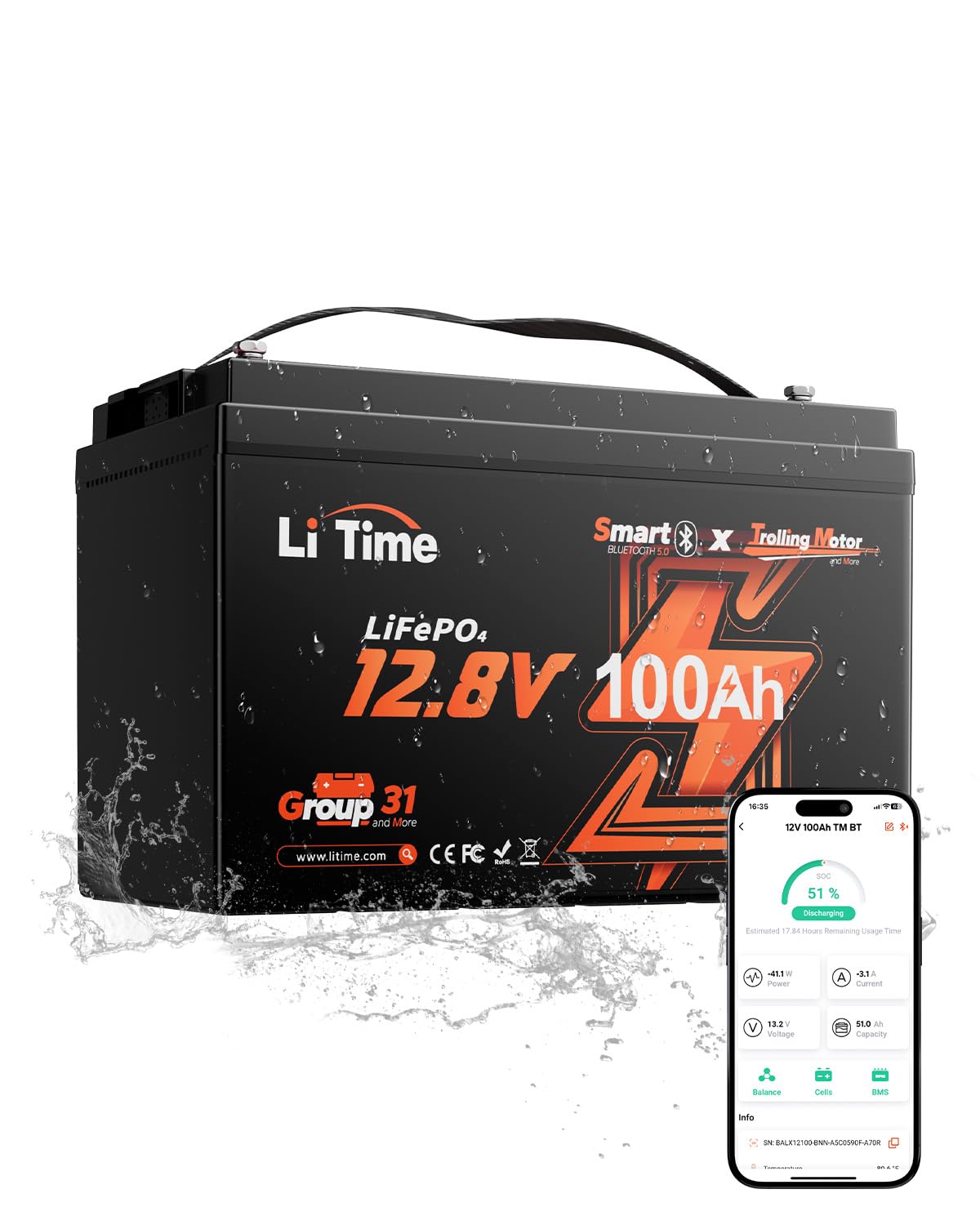
1. Litime 12V 100Ah Trolling Motor LiFePO4 Battery
Our pick — over 4.5★ from 600+ verified ratings; the strongest balance of quality and price.
The featherweight lithium that talks to your phone and quietly doubles your run time.
This is the pick anglers keep coming back to. The battery packs 100 amp-hours of capacity in a standard Group 31 footprint, but weighs just 22.2 pounds — light enough that owners say they can lift it with one finger. That is less than half the weight of a comparable lead-acid unit, so your boat sits higher and handles more nimbly.
The standout feature is Bluetooth monitoring that auto-connects in seconds. From your phone, you can check battery status, control discharge, and run system checks. Owners running Minn Kota trolling motors report it runs all day with SpotLock engaged — as one buyer puts it: “Runs my Minn Kota trolling motor all day with trolling and SpotLock on a 16.5’ SmokerCraft deep-v side console fishing boat.”
A smart low-temperature cutoff stops charging below 32°F and discharging below -4°F, backed by 20+ protections. The IP65 waterproof and salt-resistant build handles harsh marine air. And the 5-year warranty backs the 4000-deep-cycle rated lifespan.
trolling torque leader
- Bluetooth app shows cell balance, BMS health, and self-heating status
- 22.2 lbs replaces multiple heavy acid batteries
- 4000+ deep cycles at full discharge for years of service
weighty install
- App requires frequent sign-ins, which some find annoying
- Needs a lithium-compatible charger to activate the system
- Not meant for starting motors
onboard power: you want a phone app to monitor your battery and hate hauling 60-pound lead bricks around the dock.
garage duty: you are starting an engine — this is a trolling and accessory battery, not a starter.
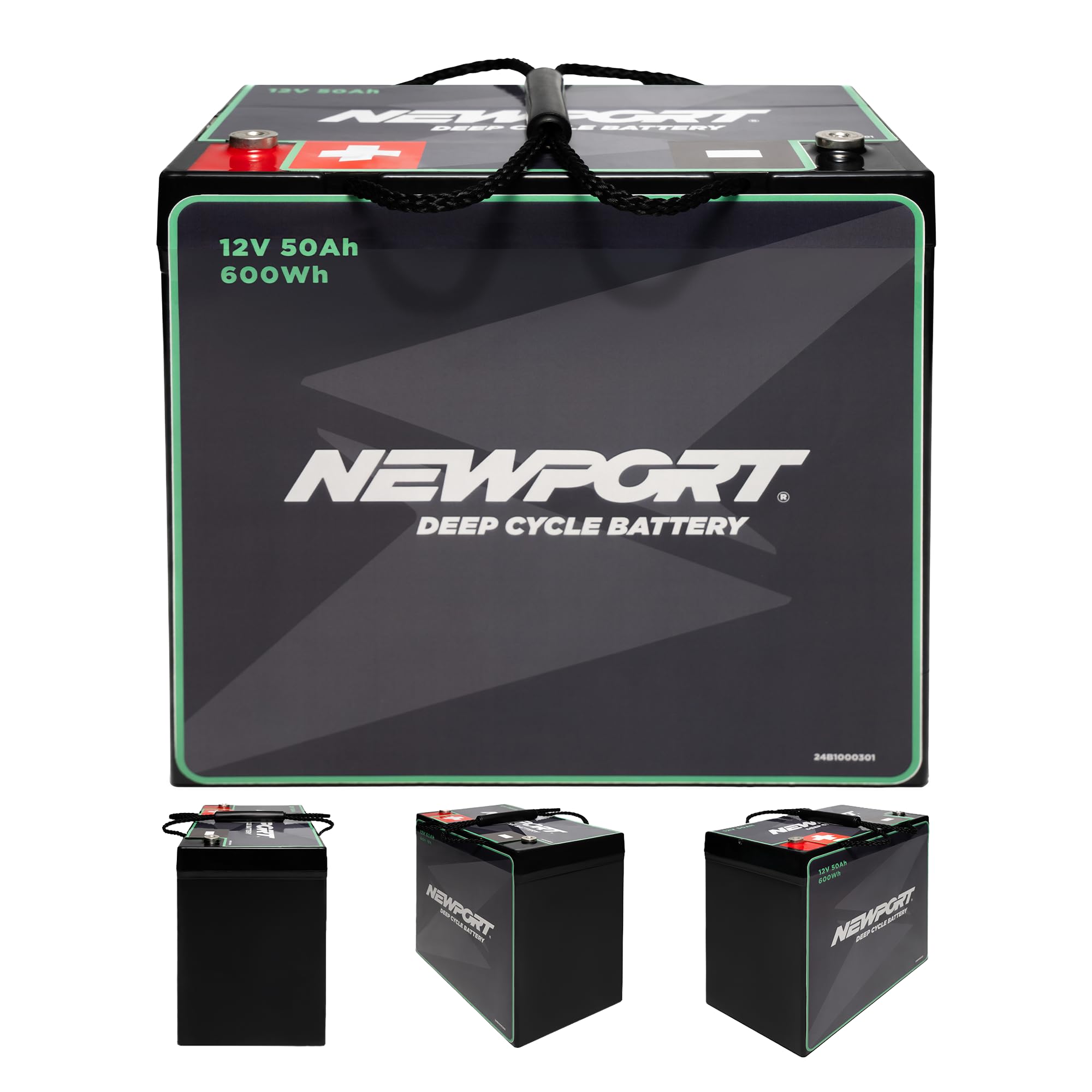
2. Newport 12V 50Ah Deep Cycle AGM Marine Battery
A 32-pound sealed lead-acid that fits one hand and holds a charge for days.
If you want a no-maintenance lead-acid without the bank-breaking cost of lithium, this is the one. It is a sealed AGM (absorbed glass mat) battery, which means it is leak-proof, spill-proof, and never needs water checks. At 32 pounds, owners say it is a genuine one-hand carry — much easier to haul to the boat than heavier flooded units.
With 50 amp-hours at 12 volts, it is built for trolling motor duty. Buyers report 4+ hours on a 55lb trolling motor at moderate speeds with stable voltage and no sag. The build feels solid and sealed, and it is completely maintenance-free.
There is one honest trade-off: it has no charge indicator, so you will need an external meter to check state of charge. The recurring buyer note is that an occasional unit can ship without terminal bolts, so check the box before you head to the ramp.
lightweight AGM pick: a maintenance-free AGM that delivers reliable power for a 40-55lb motor without the lithium price tag.
half the capacity: budget for a separate meter and a quick bolt check on arrival.
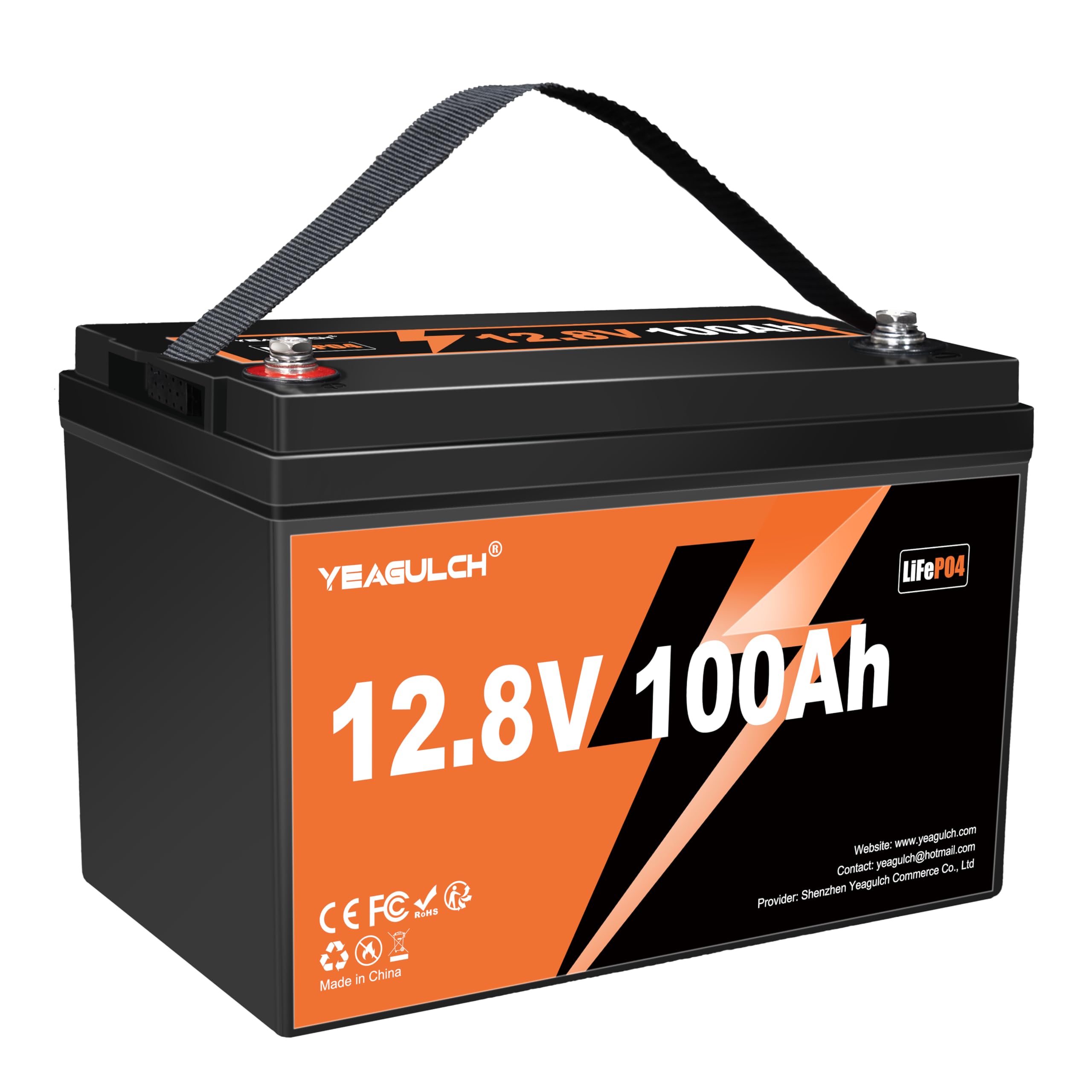
3. yeagulch 12V 100Ah LiFePO4 Battery Group 31
A 100Ah lithium that shaves two-thirds of the weight off your transom.
This battery nails the core promise of lithium: 100 amp-hours at 12.8 volts in a 21.6-pound package. That is roughly a third of the weight of comparable lead-acid batteries, which owners feel immediately when they pick it up. The higher voltage also gives a small speed boost on some trolling motors — owners mention a 10% bump.
It runs on a 100A BMS (battery management system, the onboard computer that prevents overcharge, over-discharge, and shorts). On the water, it has powered an 80lb trolling motor on a 10-foot pontoon for multiple outings per charge, and ran a fridge and security system for hours in a hot garage.
The honest fit note: the maker does not recommend it for high-power trolling motors exceeding 700W, so check your motor’s draw. And the battery comes with a note that some units may need a top-post conversion kit for certain wiring setups.
starter swaps: anglers with a 70lb or lighter trolling motor who want lithium lightness without the premium-brand markup.
critical loads: your trolling motor pulls more than 700W — this one is not rated for that draw.
4. yeagulch 12V 150Ah LiFePO4 Battery 100A BMS
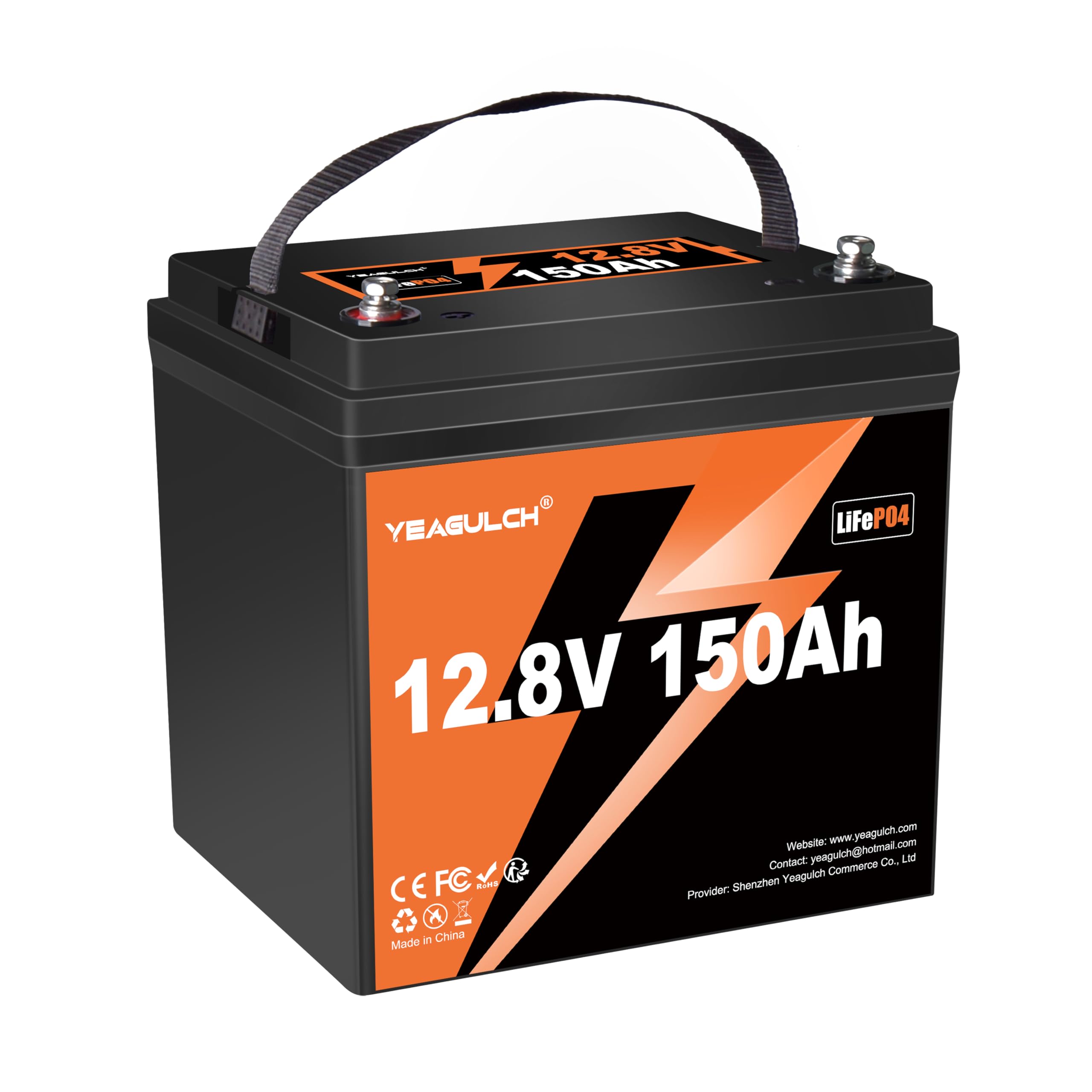
A 150Ah power bank that keeps the trolling motor and the cabin lights running all trip.
When 100Ah is not quite enough, this 150Ah lithium steps in. It is built to be run hard — the integrated 100A BMS shields against overcharge, over-discharge, short circuits, and overheating. A low-temperature cutoff stops charging at 32°F and a high-temperature cutoff stops it at 149°F, protecting the cells in harsh conditions.
Owners have used it as a main trolling battery, pulling a pontoon around a lake all week and finishing at half charge. On the solar side, it charges fully in roughly half a day through a charge controller and has held full power after six months of regular use.
The trade-off is that there is no Bluetooth, so you monitor it through a shunt or the charger itself. It is also not for starting gasoline engines — keep it for trolling, RV, and solar duty.
big amp-hour bank: 150Ah of reserve for heavy trolling or solar storage, protected by a full 100A BMS.
bulky footprint: no app monitoring, so budget for a battery monitor if you want live status.
5. Mighty Max Battery 12V 100Ah SLA Deep Cycle

A proven SLA workhorse for solar sheds and trolling motors that is heavy but dependable.
This is the classic sealed lead-acid (SLA) deep cycle battery that has been trusted for years. It is a 12V 100Ah Group 27 unit that is UL certified and maintenance-free — you mount it in any position, and it resists shocks and vibration. Its AGM spill-proof construction means no acid leaks in your boat or shed.
On a trolling motor, it runs 8+ hours and still has 35% charge left, outperforming older batteries that died in 4-6 hours. For off-grid use, it has powered a fridge, computers, LED lights, and a fan — one owner ran a 32″ TV and Roku on a 500W inverter for 4 hours with just 1% drain.
The catch is weight and longevity. This is a heavy lead-acid, and while performance reviews are strong, long-term battery life is genuinely mixed — some owners see years of service, others see earlier fade. It is a classic value pick, not a lifetime solution.
trickle use: you want a proven, low-cost 100Ah battery for trolling, solar, or emergency backup without lithium complications.
daily cranks: it is heavy and lead-acid longevity varies — treat it as a solid value, not a forever battery.
6. WEIZE 12V 100Ah Deep Cycle Group 31 Battery

A 100Ah AGM with a massive 1150A discharge ceiling for high-current demands.
This sealed lead-acid Group 31 battery is built for applications that need a sudden surge of power. Its 1150A max discharge current drives trolling motors, generators, wheelchairs, and scrubbers. The maintenance-free and spill-proof AGM design means no water checks and no leaks.
Owners have used it in parallel banks for serious backup power — four of these paired with a 2000W inverter powered 120V outlets, fans, and a garage door. For an RV, a pair handled a 700W inverter running a crock pot and TV for two years off-grid with no issues.
The trade-off is weight at 63 pounds. It is a heavy lifter, so plan your back accordingly. Its 3% self-discharge rate keeps it charged when sitting between trips.
cranking plus cycle: an AGM that handles big draws and long cycles, ideal for backup and heavy trolling.
hefty chassis: at 63 pounds this is a two-hand job, unlike a 22-pound lithium.
7. WEIZE BCI Group 31M Dual Purpose AGM Battery
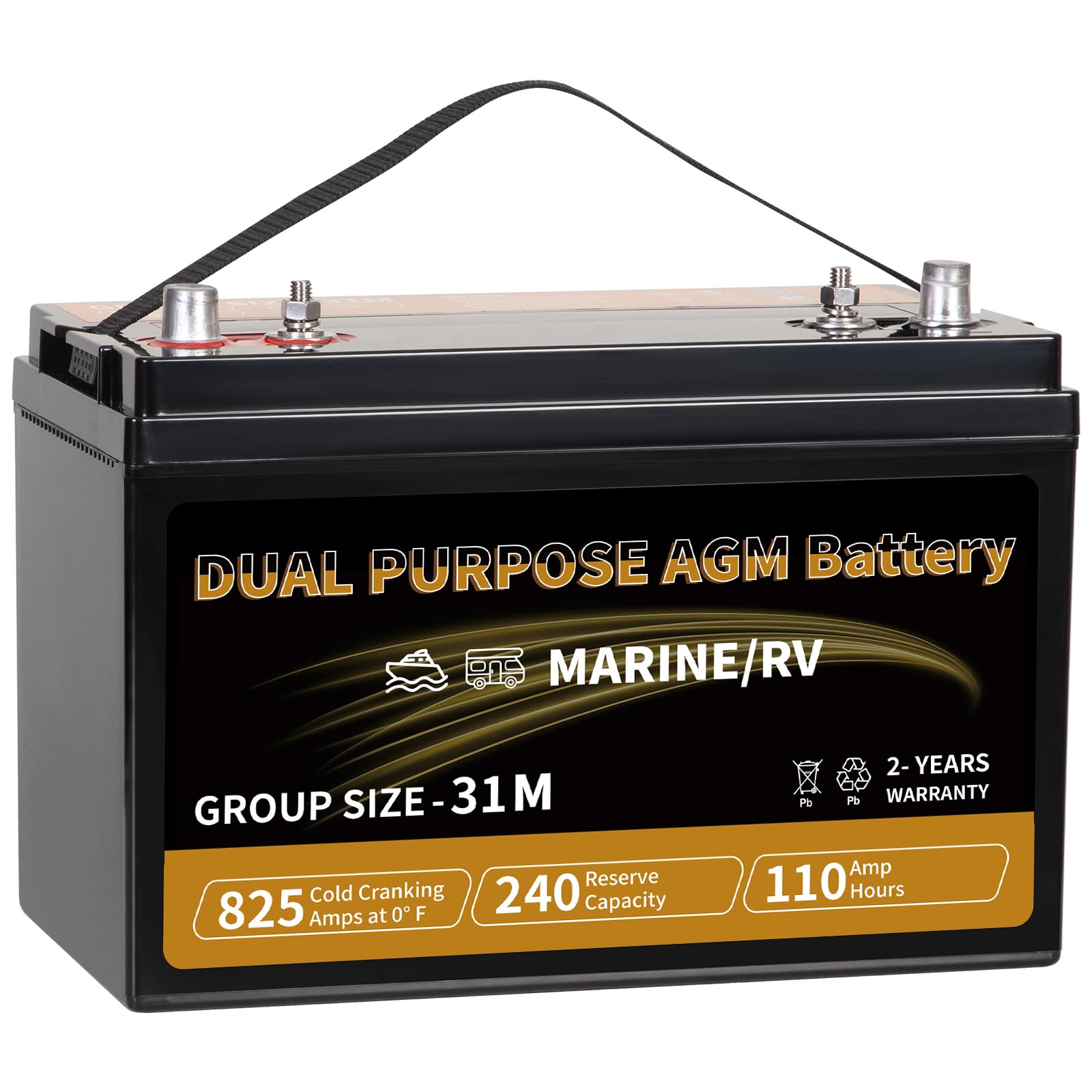
One battery that starts a big outboard and still runs the trolling motor all day.
Most batteries force you to choose between starting power and deep cycling. This dual-purpose AGM does both. It delivers 825 cold cranking amps (CCA) and 240 reserve capacity, plus 110 amp-hours of deep cycle capacity. Owners have used it to start an 8.1L big block easily.
The AGM construction is nearly maintenance-free and vibration-resistant, with 20x more vibration resistance than flooded batteries — a real plus on a boat bouncing through chop. It charges up to five times faster than flooded batteries at a constant 14.4V, so it is ready between trips.
The trade-off is weight at 67.5 pounds. And like any lead-acid, battery life is mixed in the long term — some see full service, an occasional one arrives with a defective cell. The 2-year warranty helps cover that risk.
mixed use: boaters who want one battery to crank a big engine and still run electronics, saving space and wiring.
pure trolling: weight is your priority — this is a 67.5-pound unit, and you may prefer a 22-pound lithium for dedicated trolling.
8. Power Queen 12V 100Ah LiFePO4 Battery Group 31
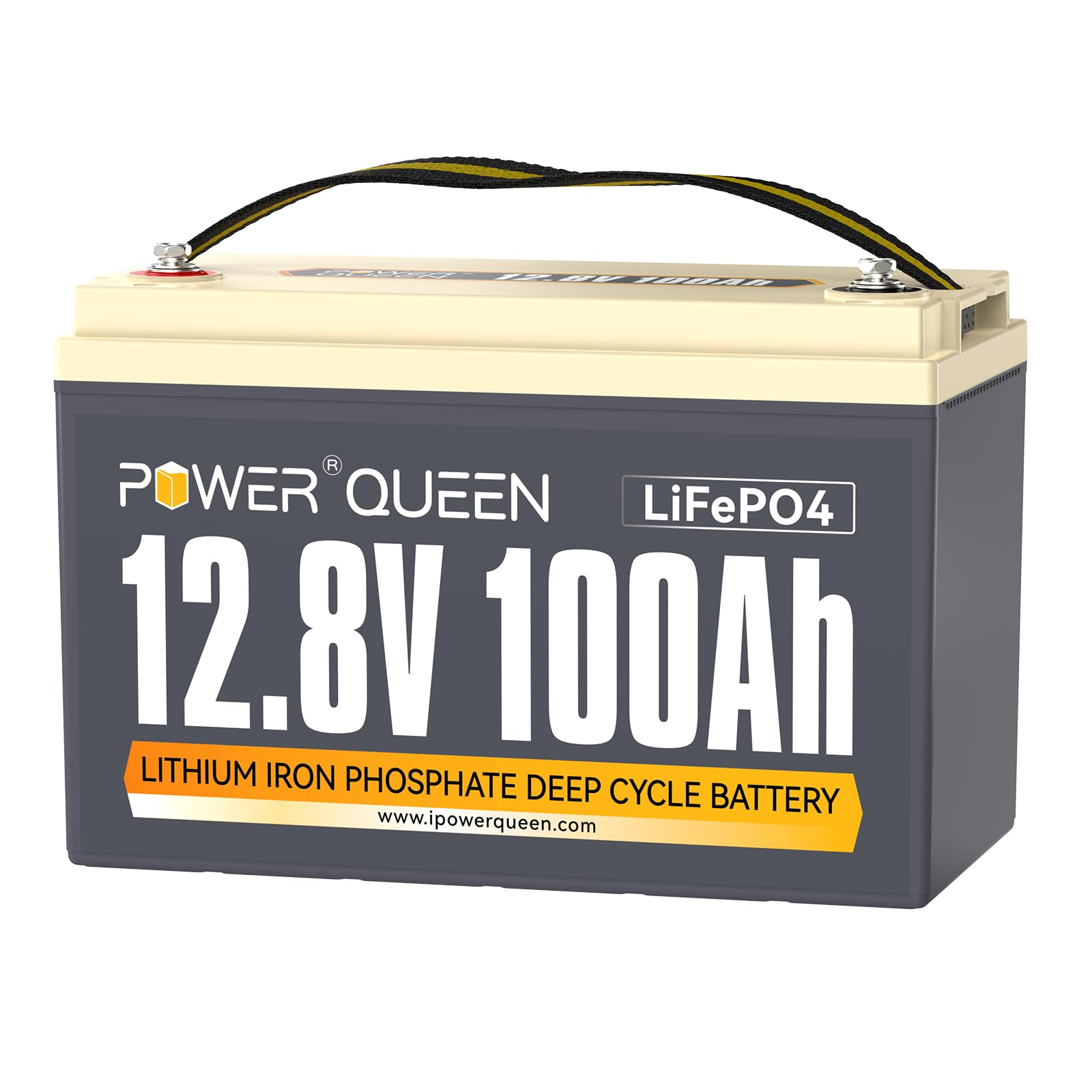
A top-tier lithium with Grade-A cells and a 100A BMS that runs your whole boat setup.
This is the premium lithium choice for owners who want consistent power and proven reliability. Built with Grade-A LiFePO4 cells, it delivers stable voltage across 1280 watt-hours of stored energy — that is a lot of trolling time. A 100A BMS protects against overcharge, over-discharge, short circuits, and overheating.
Sailboat owners run three of these side by side and report solid build quality, with one testing it at 102Ah of actual capacity. For a guitar and PA setup, it powered a 300-watt guitar and 85-watt PA system for six hours straight. The 24.3-pound weight makes it easy to carry and install compared to lead-acid.
The one honest note: battery life reports are mixed — most see long runtimes, but a few units have failed early. The brand steps in with responsive support in those cases. Overall, it is a top-tier pick for serious boaters.
reliable cells: Grade-A cells and a full BMS make this a set-and-forget power source for sailboats and RVs.
premium price: a small number of units fail early, but support is responsive and the weight savings are huge.
9. VMAX MR127 12V 100Ah AGM Deep Cycle Battery

A heavy-duty AGM that powers a 55lb trolling motor all day and still has reserve.
This Group 27 AGM is a favorite among serious trollers who want raw lead-acid power. It delivers 100 amp-hours and is built with a high-porosity electrolyte suspension system that fully absorbs and contains the acid — no silica gels or contaminants. Heavy-duty lead-tin grids add extra performance and service life even after repeated deep discharges.
Owners run a 55lb Minn Kota for 6 hours a day, recharge every other day, and rarely drop below half charge. One rig with two of these in series for an 86lb thrust motor trolled for 4 hours with voltage dropping only from 26.4V to 24.2V, showing no strain. The carrying handles are a welcome touch for a 68-pound battery.
The honest trade-offs: it is heavy, and value opinions are mixed at this price point. Avoid draining it fully — owners found that heavy discharge can confuse some chargers. Handle it as a premium lead-acid, and it will serve you well.
off-grid basics: anglers with 40-86lb trolling motors who want dependable AGM power and don’t mind the weight.
power hungry: you plan to drain it to empty often — this battery prefers partial discharges.
10. Redodo 12V 100Ah LiFePO4 Battery Group 31
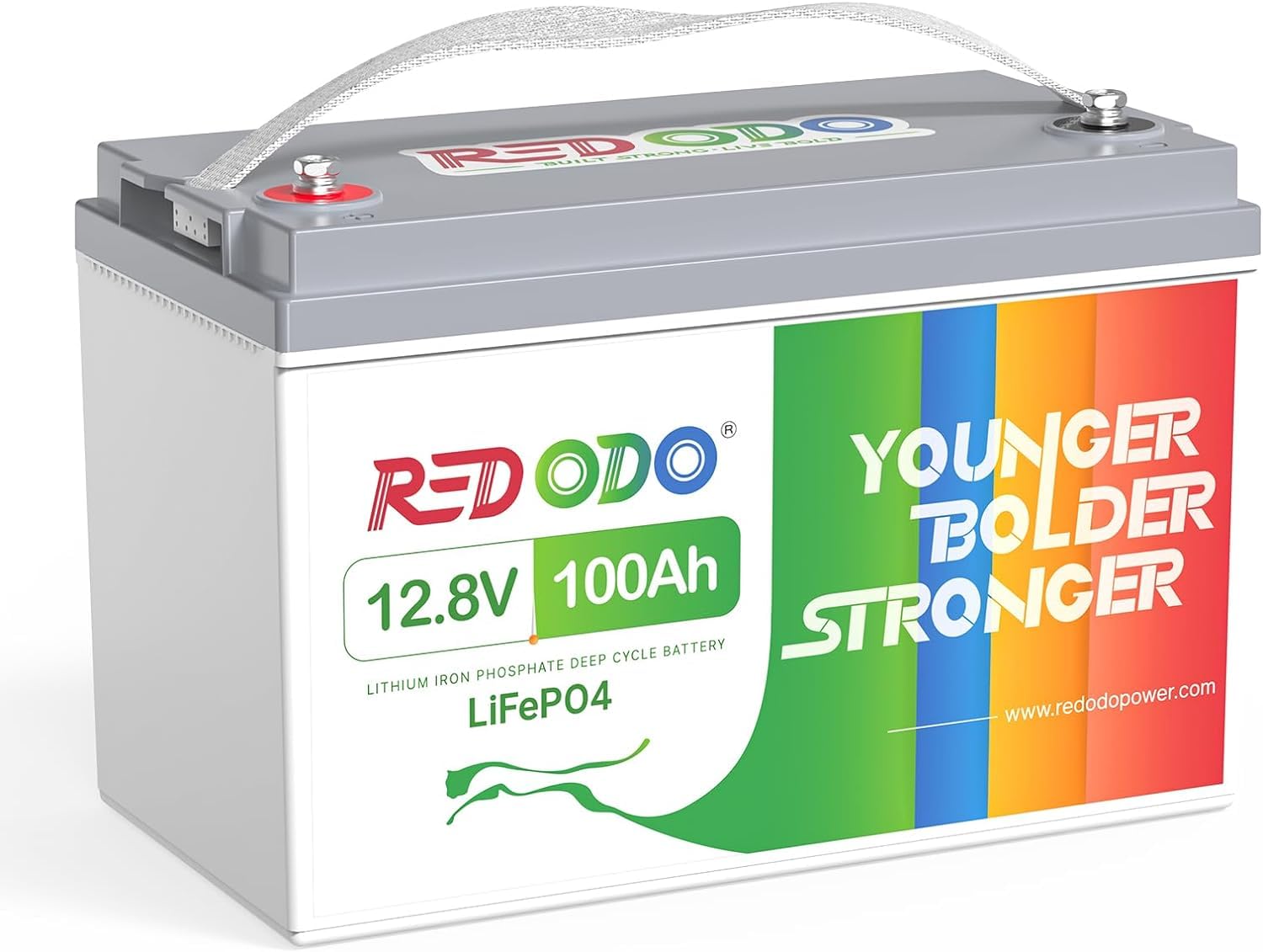
The 22-pound lithium that thousands of owners trust for year after year of trolling.
This is the lithium battery with a massive owner base for good reason. At 22 pounds and 13 x 6.77 x 8.43 inches, it is 60% lighter and 5% smaller than lead-acid, fitting a standard Group 31 box. The 100A BMS protects against the common failure points: overcharge, over-discharge, over-current, short circuit, and high temperature.
Customers note real capacity above the rated 100Ah, with one van-dweller measuring 105Ah. It runs a 30-70lb thrust trolling motor all day, and the 3% self-discharge rate means it holds its charge for months between trips. Its 10-year lifespan and 4000-15000 cycle rating make it a long-term investment.
It is not a starter battery, and it is not for golf carts. But for trolling and off-grid power, the Redodo has proven itself to a massive community of owners over years of use.
proven performer: thousands of owners back this 22-pound lithium for consistent, long-lasting trolling power.
plain feature set: it is for deep cycling, not starting engines — pair it with a starter battery if you need both.
11. Litime 12V 200Ah Plus Self-Heating LiFePO4 Battery

A 200Ah giant that warms itself to charge in freezing weather and powers a whole RV.
This is the answer for cold-weather boaters and RV owners. It has auto self-heating that turns on when the charging temperature drops below 41°F and stops at 50°F — no manual work needed. It can charge down to -4°F and operate between -4°F and 140°F, so winter camping does not kill your power.
With 200 amp-hours of capacity, this is serious power. Owners run their entire RV off it — one replaced two 80Ah lead-acid batteries and went on a 4-day off-grid trip finishing at 55% charge. It fits 30-70lb thrust trolling motors and powers marine gear without downtime.
The trade-off is size and weight at 44.1 pounds. It is also a large unit, and buyers warn to measure your battery box before ordering — you may need a bigger one to fit this. The 5-year support and 24/7 online help add confidence.
cold climates: cold-climate RV and off-grid owners who need 200Ah of reliable, self-warming power all winter.
compact boats: this is a big 44.1-pound unit — confirm your battery box fits before you buy.
Understanding the Specs
Amp-Hours (Ah)
This tells you the total energy reserve. A 100Ah battery delivers 100 amps for one hour, or 10 amps for 10 hours. For trolling motors, bigger is better if you fish long days, but it also means more weight and cost. Match it to your motor’s draw and how long you are on the water.
Voltage and the BMS
Most marine batteries are 12V, but lithium packs often sit at 12.8V, which can give a slight speed boost to trolling motors. The BMS (battery management system) is the onboard computer in lithium batteries that prevents overcharge, over-discharge, and shorts — it is the safety net that keeps the cells healthy.
FAQ
What is the difference between a deep cycle and a starting marine battery?
How many amp-hours do I need for my trolling motor?
Can I use a lithium battery to start my boat’s engine?
Why is a lithium battery so much lighter than AGM?
Is a 12V battery the right voltage for my setup?
What does the BMS do and why does it matter?
How long does a deep cycle marine battery last?
Can I hook up multiple batteries for more capacity or voltage?
Do I need a special charger for a lithium battery?
Will a 100Ah battery run my trolling motor all day?
Final Thoughts: The Verdict
For most boaters, the 12v deep cycle marine battery winner is the Litime 12V 100Ah because it combines the featherweight 22.2-pound lithium build with a Bluetooth app that makes monitoring easy — and it outlasts lead-acid by thousands of cycles. If you want a pure value trolling battery that thousands of owners trust, grab the Redodo 12V 100Ah. And for cold-weather RV or off-grid use where freezing is a real threat, the Litime 12V 200Ah Self-Heating is the one to reach for.
How We Picked
We do not accept paid placement. Every pick is matched to a real buyer and a real use-case; we do not hands-on test units.
Sources & Methodology
Specifications: manufacturer listings and product documentation. Review insights: verified customer reviews, as of August 2026. Pricing: not shown on this page (it changes often); check the current price via the retailer link.
As an Amazon Associate, Gadgets Feed earns from qualifying purchases. This does not affect which products we feature.