
Our readers keep the lights on and my morning glass full of iced black tea. As an Amazon Associate, I earn from qualifying purchases.
Specs are compiled from manufacturer listings and verified buyer reviews and can change over time — please confirm the key details on the product page before buying.
If you want to heat a drafty garage, a workshop, or a whole home without relying on an imported appliance, the shortlist below is where you start. The real question isn’t whether to buy American-made — it’s which type of heat, from a 500-watt wall panel to a 120,000-BTU radiant beast, actually matches the square footage you’re trying to warm.
I’m Min — the founder and writer behind Gadgets Feed. This guide is built by comparing the manufacturers’ published specifications and the patterns across verified customer reviews, so you get each pick’s real strengths and trade-offs instead of marketing spin.
If your bedroom stays chilly at night or your garage feels like a freezer in winter, you want a heater that warms the space fast without spiking your electric bill. This guide to american made space heaters covers picks that can heat a room in 30 minutes, with energy use kept in check.
Our Picks at a Glance

How To Choose The Best American Made Space Heaters
To pick the right heater, you need to match its heat output to your room size and check what your home’s electrical system can handle. Here are the three decisions that matter most.
Match wattage to the space you need to warm
Wattage is the raw muscle of an electric heater. A 500-watt panel is perfect for a small bedroom or bathroom, while a 5,700-watt unit can turn a freezing 2-car garage into a workable space in minutes. The bigger the room, the more watts you need — so measure your space before you shop.
Check your electrical setup before buying
Most plug-in heaters run on standard 120-volt outlets, but high-output units need 240-volt circuits with a dedicated breaker. A 5,700-watt unit draws 23.8 amps, which means a 30-amp breaker with the right gauge wire. If you’re not comfortable with electrical work, plan for a licensed electrician.
Choose the heating method that matches your comfort
Fan-forced heaters blow air directly and warm a room fast, but they make noise. Convection heaters run silent and keep a steady temperature without blowing dust. Radiant heaters warm objects and people directly, which makes them great for large open spaces like shops and garages.
Quick Comparison
| Model | Best For | Heat Output | Coverage | Weight | Amazon |
|---|---|---|---|---|---|
| KING KBP2406★ Best Overall | Large garages & workshops | 5,700 watts | Large spaces | 24 pounds | Amazon |
| Envi Plug-in PanelBest Value | Bedrooms & small rooms | 500 watts | 150 sq. ft. | — | Amazon |
| Cadet Toe Kick | Bathrooms & kitchens | 1,000 watts | 175 sq. ft. | 8 pounds | Amazon |
| EnviMAX 220V | Large rooms & living spaces | 1,000 watts | 300-350 sq. ft. | 12.3 pounds | Amazon |
| Fahrenheat FHP1500T | Breezeways & mid-size rooms | 1,500 watts | 150-200 sq. ft. | — | Amazon |
| SUNFIRE Radiant | Shops, barns & large garages | 120,000 BTUs | 2,800 sq. ft. | 120 pounds | Amazon |
In‑Depth Reviews
1. KING KBP2406 Multi-Wattage Compact Unit Heater
Our pick — over 4★ from 150+ verified ratings; the strongest balance of quality and price.
The 5,700-watt brute that turns a freezing garage into a workshop in 15 minutes
If you have a large garage, shop, or porch that needs serious heat quickly, the KING KBP2406 earns its spot because its 5,700-watt output delivers roughly 11 times the heat of a typical 500-watt plug-in panel. That power shows in real use: Buyers report warming a 2-car garage plus a 10×10 area to about 60°F, and insulated spaces climbing from freezing to 60°F in 15 minutes, then past 70°F shortly after..
The defining spec here is the amperage — 23.8 amps on a 240-volt circuit. That means you’ll need a 30-amp breaker and the right wire gauge, and there’s no cord included, so plan for a junction box and some basic electrical work. It’s a bigger install commitment, but owners describe wiring it with 10/2 cable and a 30A 2-pole breaker in under two hours. The fan is quiet for the output, the cast-iron motor is built to last, and the whole unit weighs 24 pounds of heavy steel construction. A re-wireable wattage setting lets you tailor the power to your room, and a built-in thermostat (with adjustable range from 40°F to 80°F) means it runs itself once set.
One caveat worth knowing: early production units had thermostats that could stick on, creating an overheating risk — but the manufacturer shipped free replacements, and after swapping, owners mention temperature control within 1.5°F with no sticking. The durability trade-off shows up in the data as mixed, but the overwhelming majority of owners find it heats fast, stays quiet, and is well worth the money. Customers note it “Heats 2-car garage plus 10×10 area to ~60°F; easy install, re-wireable wattage; after 3 years still great.”
Why it dominates garages
- Massive 5,700W output warms large spaces in minutes
- Quiet operation for a fan-forced unit of this size
- Re-wireable wattage and adjustable thermostat 40°F-80°F
- Built with heavy steel and a cast-iron motor
The real commitments
- Needs a 240V circuit with a 30A breaker — not plug-and-play
- No cord included; junction box required
- 24-pound weight makes ceiling mounting a two-person job
Grab this for: anyone with a large uninsulated garage, workshop, or 3-season porch who wants serious heat fast and doesn’t mind a one-time electrical upgrade.
Look elsewhere if: you want a plug-in unit for a small bedroom — this needs 240V wiring and way more power than a 150 sq ft space needs.
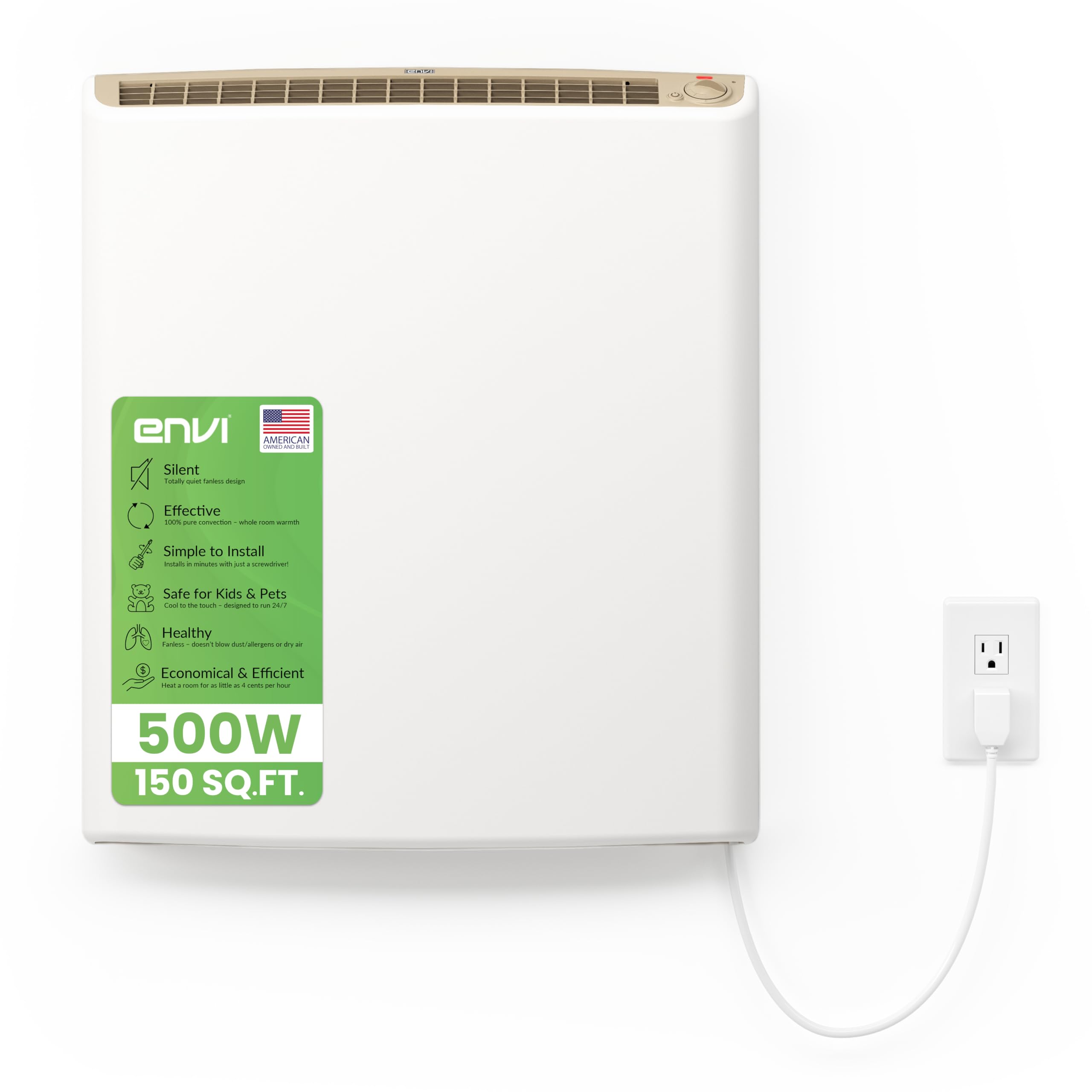
2. Envi Plug-in Electric Panel Wall Heater
A whisper-quiet 500-watt panel that keeps bedrooms warm without a single moving part
This Envi panel is the answer for anyone who wants quiet, low-energy warmth in a bedroom, bathroom, or office without the roar of a fan heater. It draws just 500 watts at 4.17 amps — a fraction of the 23.8 amps the KING unit pulls — so you can run several on the same circuit without tripping a breaker. The patented fan-less “Stack Convection” design means zero moving parts, completely silent operation, and an auto-dimming power light that won’t disturb sleep.
Its slim profile is just 2.25 inches deep, mounting flush on the wall to clear floor clutter, and it runs at a cool 90°F on the surface with a wall-sense sensor that cuts power if it’s removed. Owners have run multiple units as the sole heat source for an entire 1860s three-story home, keeping it at 66-67°F in single-digit outdoor temps with R13 insulation. Others use a single unit to lift a 15-ft camper 20°F above outside temperature, and it works fine with a WiFi smart outlet for app control. The thing everyone raves about is how quiet it is — you genuinely forget it’s on.
What wins people over is the performance-to-wattage ratio, but the honest fit note is heat coverage. At 500 watts, it’s ideal for small spaces — and it cannot be expected to warm a large room. One owner found it raised an 8×12 bathroom only 2°F over 3.5 hours, which is exactly the wrong use case.. It’s a supplemental or small-room heater, not a garage thaw-er. The heat output is the most-discussed point in reviews because it depends entirely on room size; keep it under about 150 sq. ft. and it performs beautifully.
Why it disappears into your wall
- Completely silent with no fan or moving parts
- Ultra-low 500W draw won’t trip breakers
- Safe cool-touch 90°F surface with wall-sense shutoff
- Slim 2.25-inch profile reduces floor clutter
Who should skip it
- Only warms small spaces around 150 sq. ft.
- Thermostat is imprecise for exact temperature control
- Not a fast heat-up — it’s gentle and steady
Perfect for: bedrooms, nurseries, home offices, and camper owners who want safe, silent, low-wattage warmth running 24/7.
Wrong buyer: anyone expecting to heat a large open room or garage — the 500W output simply isn’t enough for that job.
3. Cadet Electric Toe Kick Heater

The 3.5-inch-tall under-cabinet heater that tucks warmth into bathrooms and kitchens
When you have zero wall or floor space to spare but a cold bathroom floor, this Cadet toe-kick heater slides into the recess under your cabinets. It needs only 3.5 inches of height, so it fits the toe-kick space beneath vanities, stairwells, and hearths — a niche no other heater on this list can fill. A 1,000-watt element paired with a quiet squirrel-cage blower pushes about 32 cfm of warm air across the floor, delivering up to 3,412 BTU of heat to take the chill off a space up to 175 square feet.
At just 8 pounds, it’s the lightest unit here by a wide margin — compare that to the KING at 24 pounds, which is a 3x gap in weight. That lightness makes install easy, and the powder-coated black steel housing resists wear with no sharp edges. The included card to keep the unit warm comes with a catch: this heater has no built-in thermostat, so you’ll pair it with a separate line-voltage thermostat to control temperature. Owners love that it’s easy to install and warms a large bathroom well, with one noting the fan noise is a minor trade for the real warmth it delivers. “Best unit for your money. Easy to install and works great. We have a large bathroom.”
The honest caveat is quality control. Most owners find it simple and reliable — one replaced an identical Cadet that had run for about 15 years in an RV — but a rare unit arrived with a melted coil and sparks from the grill, which is alarming when it happens. That’s a small slice of the experience, but it’s worth knowing if you’re installing this where you can’t easily monitor it. It’s UL-listed for safety and backed by a 2-year warranty..
Warmth where nothing else fits
- Fits the 3.5-inch toe-kick recess under cabinets
- Pushes 32 cfm of warm air across the floor
- Lightweight 8-pound steel build, easy install
- Covers up to 175 sq. ft. of room
The trade-offs
- Need a separate thermostat — not included
- Fan noise is audible (though owners call it manageable)
- Quality control can vary unit to unit
Made for: kitchens, bathrooms, and stairwells where wall or floor space is tight, and the buyer wants hidden, unobtrusive heat.
Think twice if: you want a plug-and-play heater — this needs a separate thermostat and a hardwired install.
4. EnviMAX 220 Volt Hardwired Panel Heater
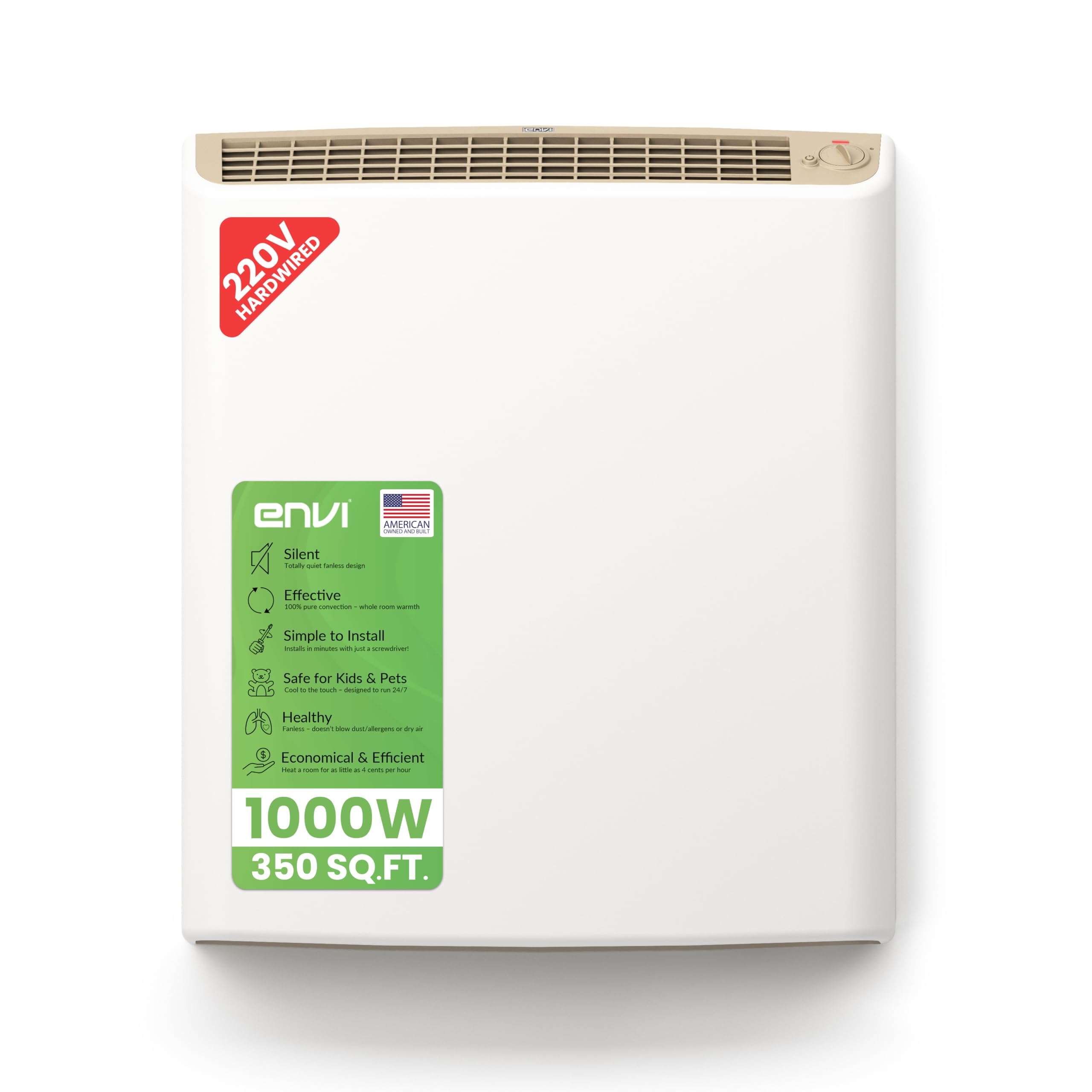
A hardwired 220-volt panel that warms large rooms silently while staying cool to the touch
For a large living room, insulated garage, or open kitchen-living combo, the EnviMAX offers the quiet of a convection panel with real power. It doubles the output of the 500-watt Envi on this list to 1,000 watts, covers 300 to 350 square feet, and runs on a 220-volt hardwired circuit drawing 4.5 amps. Owners in a 220 sq ft room keep it at 68°F with the thermostat halfway in 40°F weather, and one found it heated a large living room-kitchen combo faster than their old 3,000-watt fan unit..
The design stays true to what made the smaller Envi popular: fan-less “Stack Convection” for dead-silent operation, a cool-to-the-touch 90°F surface, and a wall-sense sensor that cuts power if the heater is removed. At just 3 inches thin and 12.3 pounds, it mounts flat on the wall with a simple two-minute install that needs no contractor. The auto-dimming power light makes it bedroom-friendly, and the maker backs it with a 3-year warranty. Owners specifically praise the build quality and the well-written manual — the thing a lot of hardwired heaters get wrong.
The mixed note is heat distribution. Some owners find it warms the whole room evenly with no cold spots, while others report the heat stays right around the unit and the wall above gets hot while the rest of the bathroom stays cool. That’s the nature of convection — it needs time and a reasonably insulated space. It’s slower to initially warm a room than a 1,500-watt fan heater, but it holds temperature quietly without blowing dust. This is a steady, even heater for an insulated room, not a fast blast for a drafty space.
Silent power for big rooms
- 1,000W output covers 300-350 sq. ft.
- Dead-silent with no moving parts
- Cool 90°F surface with wall-sense shutoff
- Slim 3-inch profile, hardwired for reliability
Read this first
- Needs a 220V hardwired circuit — not plug-in
- Slower initial warm-up than fan-forced units
- Heat may cluster near the unit in poorly insulated rooms
Choose this for: a large insulated room where you want an invisible, silent heat source running 24/7 — and you already have 220V available.
skip it if: you’re renting or want a portable plug-in heater; the hardwired 220V requirement makes this a permanent install.
5. Fahrenheat FHP1500T Hydronic Baseboard Heater

A liquid-filled hydronic baseboard that spreads even, radiant heat through a breezeway
The Fahrenheat stands apart with its liquid-filled hydronic element, which warms a sealed liquid inside the unit so it radiates heat evenly across a room instead of blasting hot air from a fan. At 1,500 watts over a 58-inch span, it covers 150 to 200 square feet — enough for a breezeway, sunroom, or mid-size bedroom. It plugs into a standard outlet (no hardwiring needed) and the built-in smart thermostat turns itself on and off to hold your set temperature automatically.
This is the second Fahrenheat an owner has bought, and it warmed a breezeway quickly with gentle, even heat that never feels like it’s drying the air the way fan heaters do. Because there’s no fan, it’s quiet and doesn’t circulate dust. The hydronic liquid holds heat after the unit cycles off, which means steadier warmth and less frequent cycling. Owners in the northeast rely on it to keep a lower level comfortable through rough winters — just plug in, set the temperature, and let the thermostat manage the rest. It draws 12.5 amps.
Reliability is the most-discussed aspect, and it’s mixed. The majority of owners find it works great and delivers good heat, but a smaller group reports units that stopped working after a week or produced very little heat even at full power. Assembly quality also varies — one unit arrived with the face louver loose and a dead pilot light on the switch. These feel like quality-control slips on an otherwise good design, so it’s worth checking your unit on arrival and using the warranty if anything looks off. The heat itself, when it works, is excellent for the coverage size.
Even heat, no fan roar
- Hydronic liquid spreads heat evenly without a fan
- Plugs into a standard 120V outlet
- Built-in smart thermostat auto controls temperature
- Quiet, gentle warmth that holds after cycling off
Before you commit
- Quality control varies — units can arrive with assembly flaws
- Some reviewers point out very little heat if a unit is faulty
- Slower to heat a room than forced-air units
Best for: a breezeway, sunroom, or mid-size room where you want quiet, even radiant heat without the dust-blowing of a fan unit.
Not for: large open spaces or anyone who wants instant blast heat — the hydronic design heats gradually and steadily, not fast.
6. SUNFIRE Radiant Heater 120,000 BTUs

A 120-pound radiant giant built in Wisconsin that thaws 2,800 square feet of shop
For a pole barn, warehouse, or a shop where electric heaters can’t come close to cutting it, the Sunfire is a totally different animal — a liquid-fuel radiant heater pushing 120,000 BTUs over up to 2,800 square feet. It runs on diesel or kerosene from a 14-gallon tank at a flow rate of 0.85 GPH for diesel and 0.78 GPH for kerosene, giving you roughly 16 hours of continuous heat before refueling. Shoppers say a 5°F rise in a 3,600 sq ft shop with 16-ft ceilings in under 15 minutes..
Unlike forced-air torpedo heaters that blast hot air, radiant heat warms objects and people directly, and it’s not affected by wind, so it works indoors and out. Made in Janesville, Wisconsin, it’s backed by a 2-year bumper-to-bumper warranty with free lifetime phone support from USA-based techs. At 120 pounds and roughly 32 inches deep, this is the heaviest unit here by far — one owner calls it a forklift job when the tank is full — so it’s a permanent fixture in a shop, not a portable heater you move around.
What wins owners over is the clean burn and performance: The maker builds it to burn 99% of fuel pure, so most users report no CO detected and no lingering smell.. The mixed notes are the odor level with kerosene (diesel runs cleaner) and the noise, which is quieter than torpedo-style units but louder than propane or electric. There’s a tip-over switch and a built-in flame sensor that shuts the unit down and runs a post-purge cool down if the flame goes out. It’s expensive, but for large heated spaces, owners call it a super buy that retains heat long after cycling off.
Serious heat for serious spaces
- 120,000 BTUs covers up to 2,800 sq. ft.
- 16-hour run time on a 14-gallon tank
- Burns 99% of fuel pure with no CO detected
- Tip-over switch and flame sensor for safety
Know before you buy
- 120 pounds — extremely heavy when full
- Kerosene can leave a noticeable odor
- Louder than electric or propane units
- Uses liquid fuel, so ventilation matters
Built for: shop owners, farmers, and anyone heating a large garage or pole barn who needs massive BTU output and doesn’t want to babysit an electric circuit.
Reconsider if: your space is under 1,500 sq ft or you want to avoid liquid fuels entirely — this is overkill for a small garage.
Understanding the Specs
Wattage vs. BTU
Wattage is how electric heaters measure raw power output. For a rough sense of scale, 1,000 watts equals about 3,412 BTUs — so a 1,000-watt Cadet delivers 3,412 BTU while the Sunfire’s 120,000 BTUs is a completely different league. Match these numbers to the square footage you need to heat: small rooms around 150-200 sq ft work with 500-1,500 watts, while big garages and shops need thousands of watts or tens of thousands of BTUs.
Amperage and Voltage
Amperage tells you how much electrical current a heater draws, and it determines what circuit you need. A 500-watt Envi draws just 4.17 amps and plugs into any standard 120V outlet. The 5,700-watt KING draws 23.8 amps and needs a 240V circuit with a 30-amp breaker — a job for an electrician if you’re not experienced. Always check amperage before buying so you don’t trip breakers or overload wiring.
FAQ
What does “American made” actually mean for these heaters?
How do I choose between a fan-forced and a convection heater?
Will a 500-watt heater keep my bedroom warm?
Can I plug these heaters into a regular wall outlet?
What size heater do I need for a 2-car garage?
Is it safe to run a space heater all night?
What’s the difference between hydronic and radiant heat?
Do these heaters dry out the air or blow dust?
Final Thoughts: The Verdict
For most people, the american made space heaters winner is the KING KBP2406 because its 5,700-watt output and proven garage performance make it the most capable electric unit here. If you want silent, low-wattage warmth for a bedroom, grab the Envi Plug-in Panel. And for a huge shop or pole barn, the SUNFIRE Radiant is the one to reach for. The Envi leads with 4.1 stars across 3,200+ owners, but the KING scores higher at 4.3 stars across 160 ratings, showing even more owner satisfaction..
How We Picked
We do not accept paid placement. Every pick is matched to a real buyer and a real use-case; we do not hands-on test units.
Sources & Methodology
Specifications: manufacturer listings and product documentation. Review insights: verified customer reviews, as of August 2026. Pricing: not shown on this page (it changes often); check the current price via the retailer link.
As an Amazon Associate, Gadgets Feed earns from qualifying purchases. This does not affect which products we feature.