
Our readers keep the lights on and my morning glass full of iced black tea. As an Amazon Associate, I earn from qualifying purchases.
Specs are compiled from manufacturer listings and verified buyer reviews and can change over time — please confirm the key details on the product page before buying.
You want real Wi-Fi without a cable company, a phone line, or a contractor drilling through your walls — just drop in a SIM card and you’re online. That promise matters most where it’s hardest to keep: a rural home, an RV parked under trees, a construction trailer, or a property where the only “broadband” is a spotty hotspot on your phone. The hard part isn’t finding a router that takes a SIM; it’s finding one that holds a signal, survives the weather, fails over when your main line drops, and doesn’t fight your carrier. This guide cuts through the spec-sheet noise to show you which 4G LTE routers actually solve those problems for real people, and which hidden trade-offs to watch for before you buy.
I’m Min — the founder and writer behind Gadgets Feed. This guide is built by comparing the manufacturers’ published specifications and the patterns across verified customer reviews, so you get each pick’s real strengths and trade-offs instead of marketing spin.
Before you buy, know this: Amazon’s search often returns flexible matches, so not every pick below is the exact model number you typed — the nearest same-type router that serves the same purpose is what you’ll find. Here, we’ve focused on 9 routers that share the two non-negotiables every 4G router needs: real 4G LTE support and a SIM card slot for cellular data. From there, the differences between them come down to speed, coverage, build quality, and how much control you want. Below, we’ve picked the best 4G Router for every situation, from an RV that moves every week to a business that never wants to go offline.
Our Picks at a Glance


How To Choose The Best 4G Router
Buying a 4G router feels like buying any other networking gear until the SIM card goes in and nothing happens. That’s usually a carrier compatibility problem, not a router problem. Before you worry about Wi-Fi speeds or antenna gains, you need to know which networks the router is certified to work with in North America.
Carrier Certification Comes First
The biggest mistake beginners make is assuming a “4G LTE” label means it works with every carrier. It doesn’t. Some routers carry official certification for AT&T and T-Mobile, others are designed for a specific network, and a few are truly open. If you’re on a smaller carrier like Mint Mobile or Google Fi, which ride on T-Mobile’s network, a T-Mobile-certified router usually works. But AT&T has stricter IMEI rules — many buyers find an AT&T SIM works only if the router is on their approved list. Check what your carrier supports before you buy, not after.
Dual-SIM Isn’t What You Think It Is
Many premium routers advertise “dual SIM,” but almost all of them use single-standby failover. That means they hold two SIM cards and automatically switch to the second if the first drops — they do not combine two connections for more speed. If you need simultaneous use of two lines, you need a model that explicitly says “dual active,” not just “dual SIM.” For most people, failover is the feature they actually want: it keeps you online when one carrier goes down.
LTE Category Determines Your Ceiling
The LTE category tells you the maximum speed the modem can physically handle, which sets a cap on your real-world downloads. A Cat 4 modem tops out around 150 Mbps on a perfect connection, while a Cat 12 modem can aggregate multiple bands (a trick called carrier aggregation) for much higher speeds. If you’re in a strong urban signal area, the higher category matters. In a rural area with one weak bar, the bottleneck is the signal itself — no modem category fixes that. That’s where external antennas come in.
External Antennas Beat Drops and Calls to Support
If your property gets poor signal, look for a router with detachable SMA antenna ports. Adding a directional Yagi or panel antenna aimed at the nearest cell tower is the single most effective upgrade for rural setups. Multiple buyers report signal bars jumping from 1 to 4 after adding an external antenna, and some routers even let you lock onto specific bands to hold a stable connection. If you’re committed to living on cellular internet, antenna support isn’t optional — it’s the difference between frustration and reliability.
Quick Comparison
| Model | Best For | Data Transfer Rate | Wi-Fi Standard | SIM Slots | Amazon |
|---|---|---|---|---|---|
| MOFINETWORK MOFI6500★ Best Overall | Business & rural setups | 3.4 Gbps | Wi-Fi 6 | 2 (Failover) | Amazon |
| GL.iNet GL-E750V2 MudiBest for Travel | Portable travel | 433 Mbps | Wi-Fi 5 | 1 | Amazon |
| Teltonika RUTX11Top Performer | Industrial & RV failover | 300 Mbps | Wi-Fi 5 | 2 (Auto Failover) | Amazon |
| GL.iNet GL-XE3000 Puli | 5G-ready backups | 3000 Mbps | Wi-Fi 6 | 2 (Single Standby) | Amazon |
| GL.iNet GL-X2000 Spitz Plus | Fast 4G & RV use | 2402 Mbps | Wi-Fi 6 | 2 (Single Standby) | Amazon |
| Teltonika RUT956 | Industrial automation | 300 Mbps | Wi-Fi 4 | 2 + eSIM | Amazon |
| NETGEAR Orbi LBR20 | Whole-home mesh | 1200 Mbps | Wi-Fi 5 (AC2200) | 1 | Amazon |
| Cudy LT500 Outdoor | Outdoor & farms | 150 Mbps | Wi-Fi 5 (AC1200) | 1 | Amazon |
| GL-X750V2 Spitz | Budget backup WAN | 750 Mbps | Wi-Fi 5 (AC750) | 1 (Micro) | Amazon |
In‑Depth Reviews
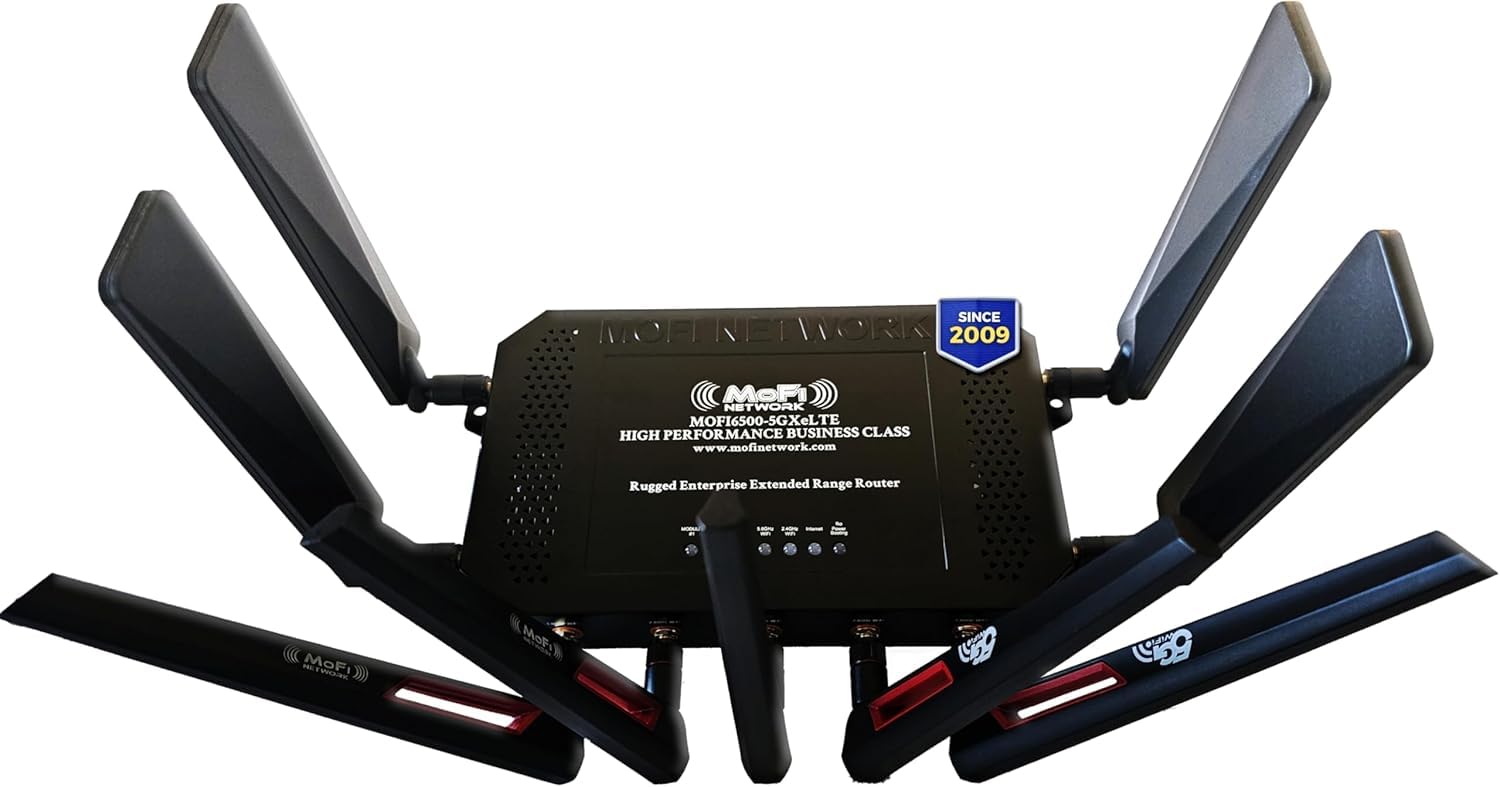
1. MOFINETWORK MOFI6500-5GXeLTE-RM520-HP
Our pick — over 4★ from 850+ verified ratings; the strongest balance of quality and price.
The business-class workhorse that turns rural dead zones into a two-building Wi-Fi zone.
If you’re done paying for cable and want one box that ends the “buffering in the barn” problem for good, this is the router to anchor your whole setup. Inside a rugged full metal case with detachable antennas sits a modem that handles both 5G and 4G LTE at up to 3.4 Gbps — a transfer rate that dwarfs every other pick on this list. That metal housing isn’t just for looks; it’s there to dissipate heat so the unit stays reliable through years of constant use, and buyers running full-time RVs confirm it survives the road.
What wins people over is the sheer device quality — it’s the thing owners single out more than anything else. Setup is straightforward for most: people report swapping a SIM straight out of a Verizon hotspot and getting instant, stable Wi-Fi across two buildings, with one owner solving their rural two-building connectivity problem entirely. The advanced interface locks onto bands 3, 5, 13, and 66 in New Jersey, and programmable periodic reboots help keep weak-signal connections alive. It’s beginner-friendly from the start, yet offers expert-grade features like band locking and upgradable firmware for advanced users.
The catch is worth knowing before you buy. The dual SIM function here is failover only — it switches between cards automatically, but it doesn’t use both connections simultaneously unless you buy the special DUAL model. Performance and signal strength get the most mixed feedback overall: some owners get strong reception with an added antenna, while others in worse coverage areas struggle. It also has known incompatibility with AT&T for some users, so if AT&T is your only option, check that detail first. And because it’s the premium pick of this group, you’ll pay for that quality.
Built to last: The full metal construction and detachable antennas are made for permanent installation, not desk flimsiness.
Honest limit: Dual SIM means automatic failover, not simultaneous bonding on the standard model.
Reach for this if: you need a permanent, high-performance cellular backbone for a home, farm, or RV that demands reliability over everything else.
Look elsewhere if: you’re on AT&T or need dual-SIM speed combining — verify carrier compatibility and your need for a DUAL model first.
2. GL.iNet GL-E750V2 MUDI 4G LTE Portable Travel Router
A pocket-sized router that turns one SIM into a secure private Wi-Fi bubble for trips and backup.
If your router needs to live in a backpack, not a server rack, the Mudi is built exactly for that life. It’s compact at 5.7 x 3.1 x 0.9 inches and weighs 285g, but the standout is the built-in 7000mAh battery that delivers up to 8 hours of use — enough to keep your laptop and phone online through a workday in a cafe or a layover. It also serves as a power bank in a pinch, able to charge your other devices. This is the only pick in the lineup genuinely designed to travel with you globally.
Its 285g weight and 7000mAh battery make it a true travel companion, providing secure, private Wi-Fi for work, maps, and email on the go. Security is a core feature, with built-in OpenVPN and WireGuard support and a customized DNS server, plus WireGuard speeds up to 50Mbps and OpenVPN up to 10Mbps for protected browsing. The storage is expandable up to 1TB microSD, and it supports GL.iNet’s physical eSIM card, letting you switch between operators and countries without swapping physical cards.
The honest trade-off here is a slower start and a middling long-term story. Boot time is slow — it isn’t instant-on when you flip the switch — and it only supports 4G data, not 5G. The battery life gets as much mixed feedback as it does praise, with one long-haul user reporting that after a year, the older chipset bottlenecked performance and the battery weakened. If you’re a digital nomad who needs this for a multi-day project, the 8-hour battery and potential for slow boot times are real fit notes to weigh.
The case for it
- 8 hours of use from a 7000mAh battery you can charge your phone from
- WireGuard speeds up to 50Mbps keep your browsing private on public networks
- Expandable to 1TB microSD with a USB 2.0 port for on-the-road storage
The fit checks
- Boot time is slow, so expect a pause before you’re online
- It’s 4G-only — no 5G, and 4G speeds depend heavily on your signal
Best for the traveler: who wants one SIM-powered secure connection for a laptop and phone in a package that fits a backpack pocket.
Not for the power user: who needs 5G speeds or instant-on connectivity from a permanent home setup.
3. Teltonika RUTX11 Industrial 4G LTE Cat 6 Router
The industrial-grade router that picks the strongest carrier for you on the road.
For an RV or a business that can’t tolerate dead air, the RUTX11 is the strongest 4G performer in this list. It’s built on LTE Cat 6 technology, which uses carrier aggregation to combine multiple bands for a faster, more stable connection than standard Cat 4 routers — a spec that matters the moment you’re streaming video or running cameras. The rugged aluminum housing is designed for demanding environments, and the dual SIM slots automatically fail over to whichever carrier has the better signal or speed, so you don’t pick your network — it picks itself.
It’s the networking-savvy owner who loves this box. Buyers describe it as a powerful cellular modem that matches the performance of far pricier enterprise gear, with an OS described as sturdy and well-built. The included antennas give a solid signal boost, and for RV users with two SIMs, the auto-failover is a standout feature. One owner pairing a Verizon and Google Fi SIM gets automatic failover based on signal strength and speed — exactly the reliability they wanted. Setup is simple for those comfortable with networking, and it’s been called a perfect fit for both travel and fixed backup use.
The trade-off is a quality-control concern that surfaces for a small minority. While most owners mention flawless operation, a few have had units malfunction within six months and found poor support from Amazon and the seller. It’s a real risk to weigh on a higher-priced industrial device. Also worth knowing: the startup passwords are printed on the device label, and a hard reset requires holding the reset button until 5 LEDs above SIM2 light up — details that trip up first-time users who expect a consumer plug-and-play experience.
Enterprise-grade brains: 4 Gigabit Ethernet ports and dual-band Wi-Fi 5 make this a serious wired-and-wireless hub.
Watch the quality lottery: most units are flawless, but a few arrive with defects and support is thin.
Who it beats: any consumer router trying to juggle two carriers in an RV — the auto-failover and Cat 6 speeds lead the way.
Who it doesn’t: plug-and-play casual buyers who want no learning curve and no chance of a dud unit.
4. GL.iNet GL-X2000 Spitz Plus 4G LTE CAT 12 Wi-Fi 6 Dual-SIM Router
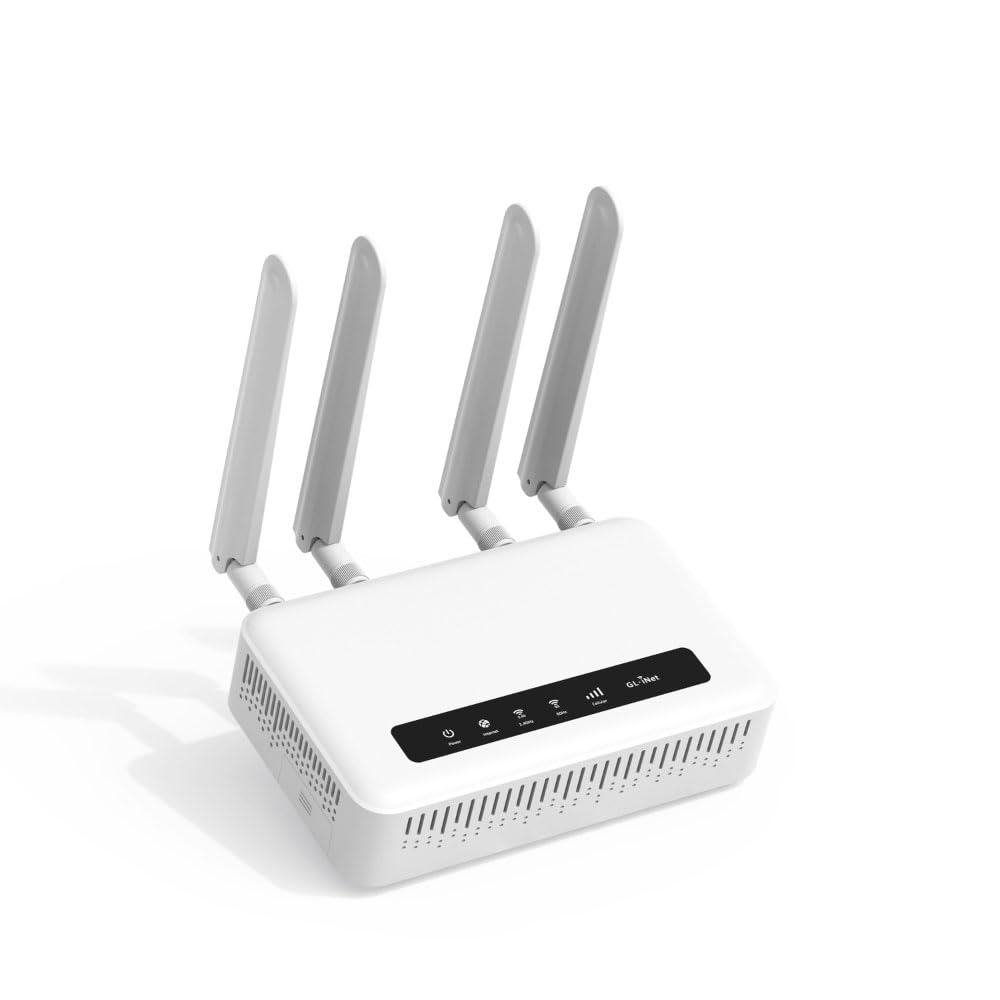
A Cat 12 powerhouse that pulled a strong 20Mbps signal out of a one-bar Maine forest.
If you’re in a spot where the signal is weak but you still want the fastest possible 4G, the Spitz Plus is the router to get. It uses the CAT 12 modem standard with DL 3CA technology — that’s three-carrier aggregation, meaning it pulls three separate cellular bands at once to boost download and upload speeds. That raw capability translates to real-world results: in rural Maine with a weak 1-bar signal, customers note an improvement to a strong, stable 20Mbps connection. It’s AT&T and T-Mobile certified, and it spreads that connection through fast Wi-Fi 6 speeds of up to 574Mbps on 2.4GHz and 2402Mbps on 5GHz.
Performance is the thing owners praise most, and the setup follows close behind — most people are up and running fast, even on AT&T SIMs through the GL.iNet app. The unit features four interchangeable SMA connectors so you can attach multiple external antennas to grab a stronger signal, and it pairs with a heavy aluminum build that feels built to last. It’s a versatile multi-WAN router too, meaning it supports Ethernet, Repeater, Cellular, and Tethering connection types with load balancing and failover, making it an excellent cellular backup to a Starlink or wired connection.
The one clear miss for owners is the hardware’s reliability in certain conditions. While the majority are thrilled, there are reports of it failing to maintain a connection with AT&T even in areas where the signal is strong, with the SIM not recognized after multiple setups. It also lacks an active WAN indicator light, so you can’t quickly glance to see if the cellular link is up. If you’re all-in on a single strict carrier, verify it’s the certified network (AT&T or T-Mobile) before committing, as the Spitz Plus is NA-only.
Why it leads
- Cat 12 three-carrier aggregation turns weak rural signals into usable Wi-Fi
- 4 external SMA antenna ports mean serious upgrades for dead zones
- Multi-WAN failover lets it back up Starlink or wired internet smoothly
The checks
- Some AT&T users report dropped connections and SIM recognition issues
- No indicator light tells you at a glance if the cellular link is alive
Get it if: you’re on AT&T or T-Mobile in a fringe-coverage area and want the best chance of pulling real speed out of a weak signal.
skip it if: you need guaranteed carrier compatibility beyond the big two, or you refuse to troubleshoot a finicky connection.
5. GL.iNet GL-XE3000 Puli AX 5G Router with Dual SIM and 6400mAh Battery
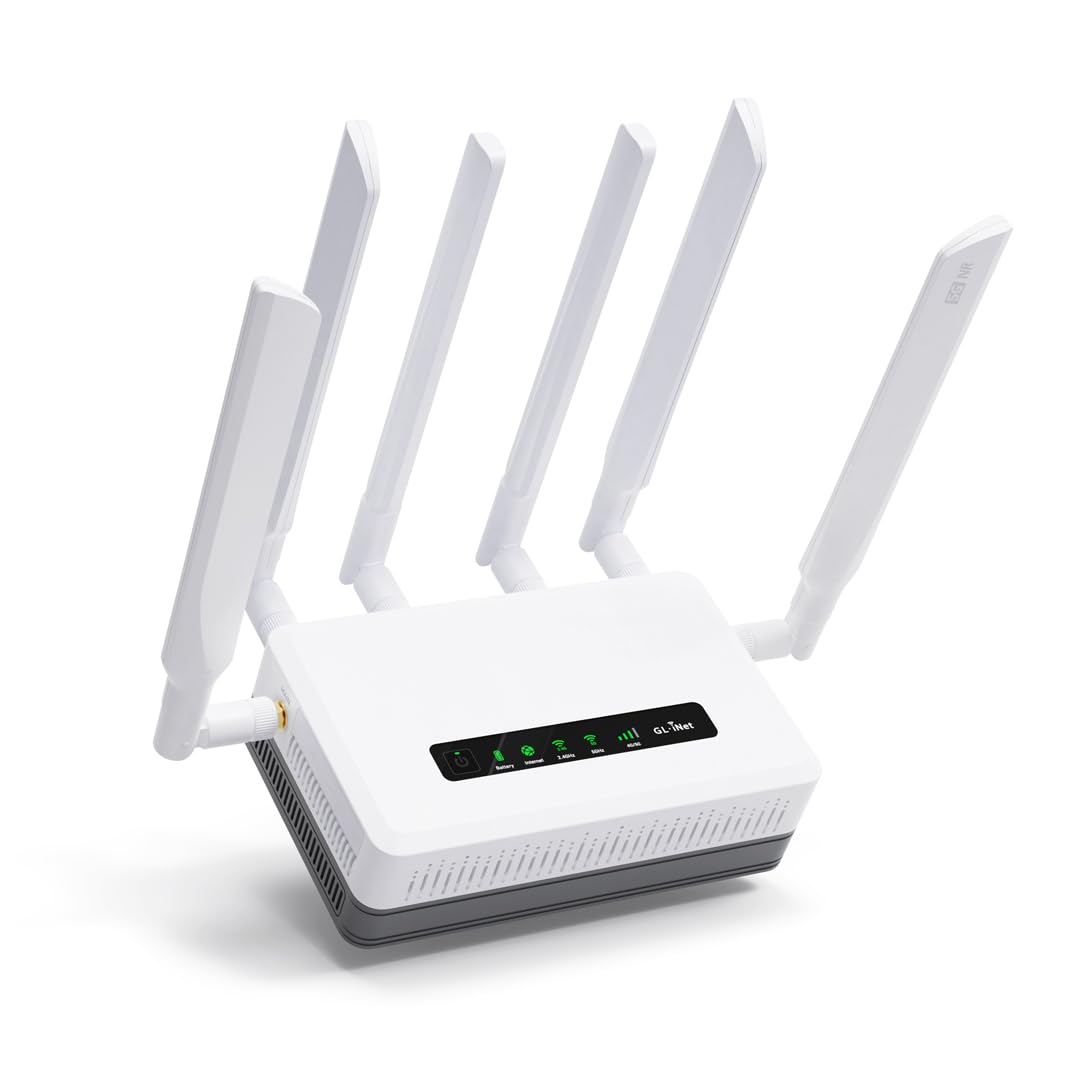
A 5G-ready router with a built-in battery that keeps your office online through a blackout.
If a power outage can’t be allowed to kill your internet, the Puli AX has your back with a hidden superpower: a built-in 6400mAh battery that delivers up to 8 hours of uninterrupted connectivity. The 6400mAh battery keeps the router online for up to 8 hours during power outages, a critical feature for construction sites, events, and home offices. Owners back this up with real scenes — a battery backup that lasted hours during an outage and kept everything online. Underneath that battery is a true 5G router capable of up to 3000 Mbps total Wi-Fi 6 speed, with full fallback to 4G LTE.
Owners praise the Puli AX’s performance, crediting the built-in 4×4 omnidirectional antenna for strong signal in poor-coverage areas. One owner measured 120Mbps in a poor-signal area and saw it climb near maximum with an external antenna attached. It’s a multi-WAN device too, supporting Ethernet, Repeater, Cellular, and Tethering with load balancing and failover, and it runs on customizable OpenWrt firmware with more than 5,000 ready-made plug-ins. It’s portable enough to throw in a backpack, though at 761g it’s noticeably heavier than a phone.
The setup has a quirk worth mentioning: the dual SIM slots share a single IMEI, which caused initial SIM recognition problems for some owners until tech support helped sort it out. Speeds are excellent once it’s running, but the initial configuration can involve a bit of a fight. If you’re choosing between this and the Spitz Plus above, the Puli’s battery is the clear differentiator — the Spitz Plus is a pure wall-powered unit, while this one keeps humming through power cuts.
Storm-proof workhorse: 8 hours of battery-backed 5G means your connection survives the lights going out.
Setup friction: the single-IMEI dual-SIM arrangement can confuse initial SIM detection.
Best for field teams and remote offices: that need a secure, temporary Wi-Fi bubble that survives both weak signals and power losses.
Think twice if: you want a simple out-of-the-box SIM install with zero configuration drama.
6. NETGEAR Orbi 4G LTE Mesh WiFi Router (LBR20)

A mesh router that blankets a 2,000 sq ft home with fast LTE — cables be damned.
This is the pick for the family that wants their existing home internet to feel normal, just without a wired ISP behind it. The LBR20 is a mesh Wi-Fi system with a 4G LTE modem built in, covering up to 2,000 square feet and 25 devices with combined speeds up to 2.2Gbps. The mesh part is the key advantage here — unlike a single-box router, it’s designed to distribute a consistent signal across the whole house, and it’s certified to work with AT&T, T-Mobile, and Verizon, which is rare flexibility. Reviewers point out it working with Arlo cameras over LTE and delivering download speeds reported as 4 times faster than their old cable connection.
Owners praise the LBR20’s solid build quality and straightforward setup, which covers a 30x60ft house plus 50-100ft outside. One owner describes a solid little device with a large range that easily covers a 30x60ft house plus 50-100ft outside. It’s genuinely reliable for smart home gear — an important detail in a world of finicky Wi-Fi gadgets. With 2 x 1G Ethernet ports, you can wire in game consoles and streaming players directly, and the Orbi app makes management simple. NETGEAR Armor security and Smart Parental Controls add a layer of protection across connected devices.
The catch is that some of the most valuable features come with strict requirements. It needs a Nano SIM from your carrier and activation of a compatible BYOD data plan — and the setup can be genuinely challenging for non-technical users, with owners noting you’ll need the correct APN settings (like APN=RESELLER for PureTalk) that aren’t always obvious. The reliability gets mixed feedback overall, with some users reporting failover that takes over 3 minutes to kick in and occasionally requires a restart to reconnect. If your main connection rarely drops, this is a fantastic primary router. If you need it as a smooth failsafe, test that switch-over before you rely on it.
What shines
- Mesh design covers 2,000 sq ft and 25 devices without dead spots
- Certified on AT&T, T-Mobile, and Verizon — the broadest carrier support here
- Wired 2x1G Ethernet ports handle consoles and streaming boxes directly
What to watch
- Setup demands correct APN details that aren’t always documented
- Failover can take over 3 minutes and sometimes needs a manual restart
Reach for it if: you want a proper mesh system to replace cable with LTE across a whole house, and you’re comfortable digging up APN settings.
Pass on it if: you need a brick-solid automatic failover for a business — this one is a home-first device.
7. Teltonika RUT956 Industrial 4G LTE Cellular Router, Dual SIM with eSIM

An industrial IoT hub that talks to machines, not just laptops.
If your router needs to talk to industrial equipment — not just phones and PCs — the RUT956 is the specialist that speaks the right language. It’s an industrial-grade cellular router with 4G LTE and fallback to 3G, and it’s equipped with RS232 and RS485 serial interfaces for integration with industrial machinery, plus built-in GNSS for location tracking. That means it’s not just an internet box; it’s a connectivity hub for remote IoT systems — owners use it for exactly that, calling it perfect for remote and local IoT setups. It’s compatible with AT&T, Verizon, and T-Mobile, and it supports dual SIM with eSIM as well as automatic failover.
For industrial IoT integrators, the RUT956’s RS232/RS485 ports and GNSS make it a versatile connectivity hub. It’s designed for remote, mobile, and industrial applications where a consumer router just won’t cut it. Teltonika RMS enables remote monitoring, configuration, and troubleshooting, and the advanced networking and VPN capabilities keep your connection secure. The catch is that this isn’t consumer territory. Setup is notably complex — one owner describes it as feature-rich but not easy, with static routes that are challenging to configure and firmware that required incremental upgrades from versions over two years old. The SIM slots also require unscrewing the backplate to access, so this is not a tool for the casual user.
There are also some real reliability concerns in the feedback. Two shoppers say serious issues: one unit stopped working entirely after 6 weeks, and another arrived with just one LTE antenna instead of the expected set. The stock antennas have also been called weak compared to the MOFI4500’s. If you’re a networking professional who knows exactly what you’re doing, this is a powerful, secure tool. If you’re not, the complexity and the occasional quality-control miss make this a hard sell for a home setup.
Perfect for pros: RS232/RS485 ports and GNSS make it a hub for industrial IoT, not just home Wi-Fi.
Not plug-and-play: complex setup, screw-access SIM slots, and a few reports of DOA units or missing antennas.
This is for the integrator: who needs a secure, remotely manageable link for industrial equipment in the field.
Steer clear if: you just want home Wi-Fi — the setup is a steep cliff for a casual buyer.
8. GL-X750V2 (Spitz) 4G LTE VPN Router

A cheap, reliable backup WAN that keeps your network alive when the fiber drops.
Not everyone needs a 5G powerhouse — sometimes you just need a router that quietly sits there and catches you when your main internet falls over. That’s exactly the role the Spitz V2 nails. It’s a budget-friendly 4G LTE router with a micro SIM card slot that transfers the cellular signal to dual-band Wi-Fi at 300Mbps on 2.4G plus 433Mbps on 5G. It’s AT&T certified and compatible with T-Mobile, making it a legitimate emergency backup solution for a home office. Buyers report using it as a backup WAN with a Google Fi data SIM on T-Mobile’s network, calling it easy to set up and smooth in its failover.
Owners praise the Spitz V2’s user-friendly setup, a rarity for an OpenWrt-based router, with clean menus and SMS support. The user interface is genuinely user-friendly, with SMS support and clean menus, and it comes with OpenVPN and WireGuard pre-installed and compatible with 30+ VPN service providers. Storage is expandable via a microSD slot of up to 128GB and a USB 2.0 port. It’s remarkably light at just 86 grams, so it’s easy to stash in a go-bag. At this price, the value for money is what owners mention second most — it’s a strong contender that replaces pricier enterprise failover gear without the subscription fees.
The catch is carrier compatibility — it’s very carrier-dependent. T-Mobile (and its MVNOs like Mint) is plug-and-play, while AT&T and Cricket users report IMEI and SIM headaches. There’s no automatic band selection either, so you’ll need to manually change bands when you travel. And the one serious warning in the reviews: avoid upgrading the firmware on stock units running version 3.104, as some owners have bricked two units trying. It’s also slower than its pricey siblings — the average 4G speed here is 15-20Mbps, which is fine for backup duty but not a primary connection.
Perfect backup brain: pre-installed WireGuard and OpenVPN, expandable storage, and smooth failover from a tiny 86g box.
Carrier caution: T-Mobile is easy; AT&T and Cricket are a gamble, and firmware updates on old stock are risky.
Reach for this if: you want a cheap, reliable safety net for your wired connection and you’re on a T-Mobile-based network.
Look elsewhere if: you need real speed for a primary connection or you’re locked into AT&T and can’t accept configuration fiddling.
9. Cudy Outdoor 4G LTE AC1200 Wi-Fi Router, IP65, PoE, LT500 Outdoor

A weatherproof POE-powered router that bolts to a pole and beams 4G across a large property.
If you need Wi-Fi where the weather is hostile and the power outlet is far away, the LT500 Outdoor is built for that exact spot. It’s powered by 24V Passive PoE, which means a single Ethernet cable carries both power and data — you can mount this thing high on a pole and run one cable to a PoE injector inside. It’s a 4G LTE Cat.4 router delivering 150 Mbps download via a single Nano SIM, and it covers outdoor spaces up to 100 meters with AC1200 dual-band Wi-Fi 5.
Owners praise the LT500 Outdoor’s reliability, noting it delivers exactly the advertised performance and signal boost. One owner used it to solve cheap cabin internet, noting the setup is easy and the IMEI is changeable for cheap phone plans, which is a huge money-saver. The outdoor mount itself provides a real signal boost: owners measure +20dB RSRP over a phone (that’s a measure of signal power) and another +10dB just from the outdoor mount. With PoE, it powered a 50-foot CAT6 run without issue. It also works as a Cudy Mesh main node, meaning you can add AP units to extend coverage wirelessly across a huge property.
The honest trade-offs are speed and some build-quality concerns. It’s only Cat.4, so it tops out at 150 Mbps, and the weatherproofing isn’t perfect from the start — one owner added O-rings and tape to beef it up. The LAN controls are basic, the wall mount is weak, and the included Ethernet cable is short and folded. There’s also a dissatisfied owner whose unit failed after about a month with no support forthcoming. For a budget outdoor solution, it’s a solid value — but check the mesh and mounting details before you commit to a permanent install.
What you gain
- IP65 weatherproofing and -40 to 65C range for true outdoor mounting
- 24V Passive PoE powers the router over a single Ethernet cable
- IMS support
- Rain and dust aren’t a problem for this unit
The catches
- Cat.4 caps speeds at 150 Mbps — fine for cabins, not for a primary home
- Weatherproofing may need DIY reinforcement, and the wall mount is weak
Best for the property owner: who needs reliable outdoor coverage for a farm, campsite, or worksite without running long power lines.
Not the right tool if you need high speeds for a whole family or a waterproof setup with zero DIY tinkering.
Understanding the Specs
LTE Categories Explained
You’ll see “Cat 4” or “Cat 12” next to 4G routers, and it’s the single biggest speed indicator in the spec sheet. LTE category is a standard that defines the maximum theoretical download speed a modem can handle. A Cat 4 modem tops out around 150 Mbps, which sounds fast but is rarely reached in real life — in weak signal it might be 15-20 Mbps. A Cat 12 modem uses a trick called three-carrier aggregation to pull multiple cellular bands at once, which can multiply that real-world throughput in good conditions. If you’re in an area with strong signal, a higher category means faster downloads. If your signal is weak, the category matters far less than the antenna — no modem can fix no signal.
Dual-SIM vs. Failover
Many premium routers advertise “dual SIM,” but it’s worth reading the fine print: almost all of them use single-standby failover. That means the router holds two SIM cards but uses one at a time, automatically switching to the second if the first drops its connection. This is a superb feature for reliability, because it means if your primary carrier has an outage, the router flips to your backup. What it doesn’t do is combine both connections to double your speed. If you need simultaneous, bonded use of two lines, you need a model that explicitly says “dual active” — and those are rare and expensive. For almost everyone, automatic failover is the feature that matters.
FAQ
Will any 4G router work with my AT&T SIM card?
What is the real difference between a Cat 4 and a Cat 12 router?
Does dual SIM mean I get double the internet speed?
How do I know if an external antenna will help my weak signal?
Can a 4G router replace my home broadband entirely?
What does the MIMO or carrier aggregation term mean on the spec sheetWhat does the MIMO or carrier aggregation term mean on the spec sheet?Carrier aggregation is a technology that lets a modem pull together multiple separate cellular bands at once, which increases speed and reliability — it’s the core feature of Cat 12 and higher modems. MIMO (Multiple Input, Multiple Output) means the router uses multiple antennas to send and receive data simultaneously, which improves throughput and range. Both are good signs of a capable modem, but they only help if your carrier and location support them.Is a 4G router worth it for RV and travel use?It can be, especially if you want a consistent, private Wi-Fi network instead of relying on your phone’s hotspot. The MOFINETWORK MOFI6500 has owners using it full-time in RVs for two years, and the GL.iNet GL-E750V2 Mudi is designed specifically as a portable travel router with a built-in 7000mAh battery for up to 8 hours of use. Just check that the router supports the carrier you use on the road, and consider a model with external antenna ports if you camp in weak-signal areas.Why do some routers fail to connect even with a strong signal?The most common cause is carrier incompatibility — the router isn’t certified or whitelisted for your specific carrier, so it gets rejected even with full bars. Another cause is incorrect APN settings, which some owners had to manually configure on the NETGEAR Orbi LBR20. Rarely, a unit can arrive with a defect, but carrier compatibility is the first thing to rule out.What is a good fallback router for a home office?The GL-X750V2 (Spitz) is an excellent budget fallback because it’s cheap, easy to set up, and works smoothly as a backup WAN with Google Fi or Mint Mobile SIMs on T-Mobile’s network. For a faster, more feature-rich backup, the GL.iNet GL-X2000 Spitz Plus adds Cat 12 speeds and Wi-Fi 6, and owners use it as a cellular backup for Starlink with automatic failover.What’s the difference between a travel 4G router and a full-size one?A travel router prioritizes portability and battery life over raw performance. The GL.iNet GL-E750V2 Mudi weighs 285g with a 7000mAh battery and is built to fit in a backpack. A full-size router like the MOFINETWORK MOFI6500 is heavier, has a rugged metal case for heat dissipation, and is designed for permanent installation with higher throughput. Choose based on whether your router needs to move with you or sit in one place.?
Final Thoughts: The Verdict
For the majority of shoppers, the 4g router winner is the MOFINETWORK MOFI6500 because it combines business-class build quality, 5G-ready speeds, and dual-SIM failover into a single rugged box that owners trust for years of full-time use. If you want blazing-fast 4G performance with Wi-Fi 6 in a slightly more portable form, grab the GL.iNet GL-X2000 Spitz Plus. And for a travel companion that fits in a backpack and keeps you online for 8 hours on battery, the GL.iNet GL-E750V2 Mudi is the one to reach for.
How We Picked
We do not accept paid placement. Every pick is matched to a real buyer and a real use-case; we do not hands-on test units.
Sources & Methodology
Specifications: manufacturer listings and product documentation. Review insights: verified customer reviews, as of August 2026. Pricing: not shown on this page (it changes often); check the current price via the retailer link.
As an Amazon Associate, Gadgets Feed earns from qualifying purchases. This does not affect which products we feature.