
Our readers keep the lights on and my morning glass full of iced black tea. As an Amazon Associate, I earn from qualifying purchases.
Specs are compiled from manufacturer listings and verified buyer reviews and can change over time — please confirm the key details on the product page before buying.
A marine battery is the difference between a reliable start and a long paddle home. Match the battery chemistry and capacity to your specific boating needs. Choosing between lithium and AGM, or cranking and deep cycle, directly affects your trolling motor runtime and electronics reliability.
I’m Min — the founder and writer behind Gadgets Feed. This guide is built by comparing the manufacturers’ published specifications and the patterns across verified customer reviews, so you get each pick’s real strengths and trade-offs instead of marketing spin.
Whether you’re chasing bass with a trolling motor or need reliable cranking power for a weekend cruiser, this breakdown of the best marine batteries gives you clear-headed picks based on real-world performance and owner experience.
Our Picks at a Glance
How To Choose The Best Marine Batteries
Before you buy, you need to match the battery to the job. A starting battery delivers a quick burst of high current to crank an outboard. A deep cycle battery provides steady, long-lasting power for trolling motors and electronics. Many boaters need a dual-purpose battery that does both, but the trade-off is usually some compromise in each role.
Chemistry: Lithium vs. AGM vs. Flooded
Lithium (LiFePO4) is the modern favorite because it offers nearly all of its rated capacity and weighs far less than lead-acid—often about a third of the weight for the same amp-hours. AGM (absorbent glass mat) batteries are sealed, leak-proof, and maintenance-free, making them a strong mid-range choice. Flooded lead-acid is the budget option but requires venting, watering, and regular upkeep.
Capacity and Cranking Power
Amp-hours (Ah) tells you how much energy the battery stores for running trollers and electronics. Cold cranking amps (CCA) measures how much burst power it delivers to start an engine in cold weather. If you run a serious trolling motor, you want high Ah; if you’re starting a big outboard, you need CCA. A dual-purpose unit splits the difference.
Quick Comparison
| Model | Best For | Capacity | Voltage | Weight | Amazon |
|---|---|---|---|---|---|
| Litime 165Ah LiFePO4★ Best Overall | Dual-purpose cranking & electronics | 165 amp-hours | 12.8V | 33.5 lbs | Amazon |
| Newport 12V 50AhBest Value | Budget deep cycle trolling | 50 amp-hours | 12V | 32 lbs | Amazon |
| yeagulch 100Ah LiFePO4Top Performer | Value lithium deep cycle | 100 amp-hours | 12.8V | 21.6 lbs | Amazon |
| DJLBERMPW 100Ah LiFePO4 | Versatile 30-70lb trolling | 100 amp-hours | 12V | 23 lbs | Amazon |
| WEIZE 100Ah AGM | Budget AGM deep cycle | 100 amp-hours | 12V | 63 lbs | Amazon |
| VEVOR 100Ah AGM | Heavy-duty backup & power | 100 amp-hours | 12V | 61 lbs | Amazon |
| LiTime 50Ah Trolling | Lightweight kayak trolling | 50 amp-hours | 12V | 11.3 lbs | Amazon |
| Weize Group 31M AGM | Dual purpose high CCA | 110 amp-hours | 12V | 67.5 lbs | Amazon |
| Power Queen 100Ah | Reliable lithium for electronics | 100 amp-hours | 12.8V | 24.3 lbs | Amazon |
| Interstate Group 31M | Trusted cranking & deep cycle | 100 amp-hours | 12V | 64.5 lbs | Amazon |
| OPTIMA 34M BLUETOP | Premium cranking with reserve | 50 amp-hours | 12V | 38.4 lbs | Amazon |
In‑Depth Reviews
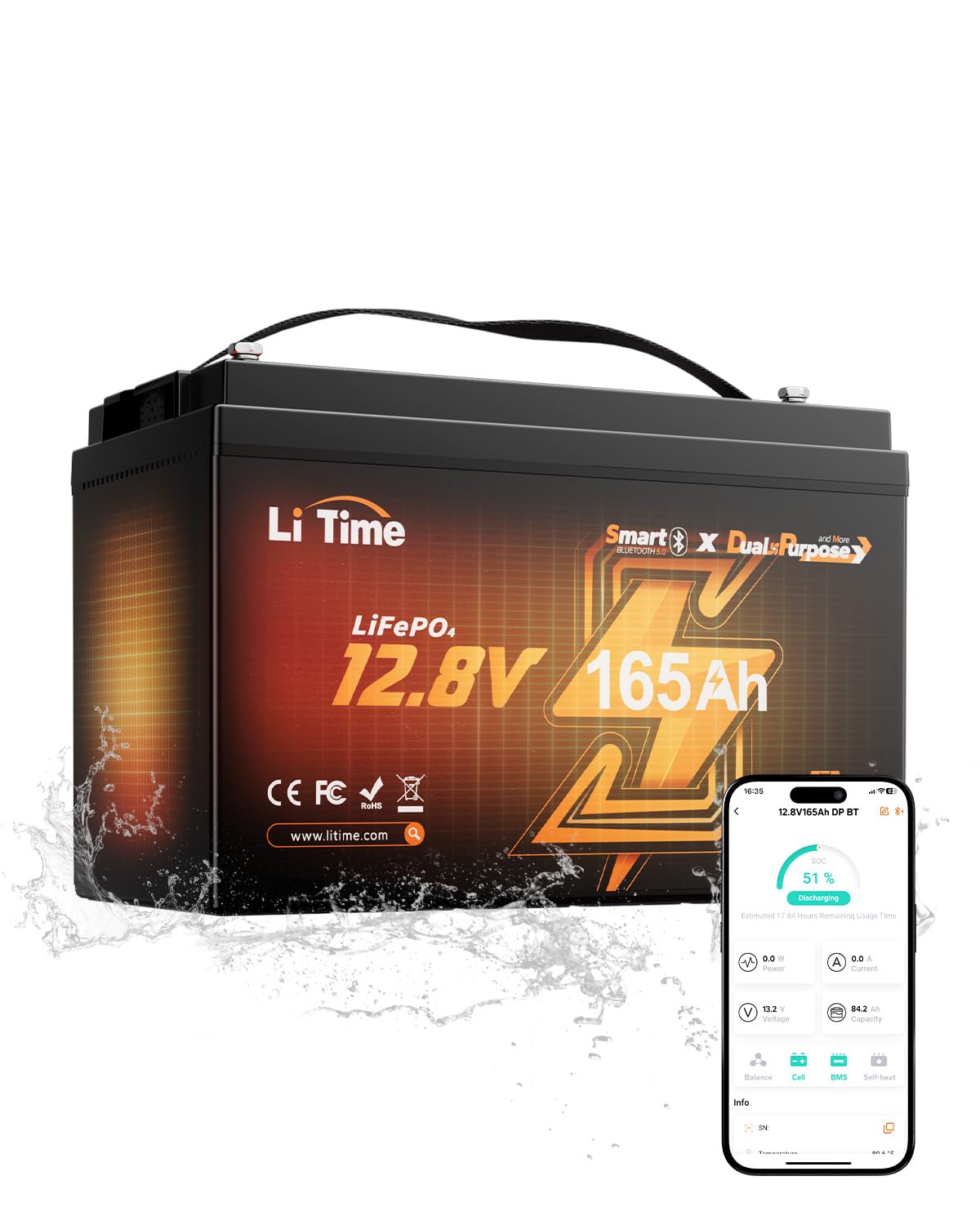
1. Litime 12V 165Ah Dual Purpose Marine Cranking LiFePO4 Battery
Our pick — over 4.5★ from 600+ verified ratings; the strongest balance of quality and price.
The do-everything lithium that replaces two heavy lead batteries with 1200 CCA of cold-start muscle.
This dual-purpose battery delivers both starting power and long run time. It throws 1200 CCA at cold engines while storing 165 amp-hours—enough to run a 12-volt fridge for 12+ hours, according to owner reports. At 33.5 pounds it delivers 2112Wh of energy, which is roughly 3.5 times what a 12V 100Ah lead-acid holds, at half the weight.
Its self-heating technology enables charging in freezing temperatures. When temps drop below 32°F, it warms itself to 50°F so charging still works; below -4°F it stops discharging entirely to protect the cells. Buyers report it pairs beautifully with a 24V trolling motor setup, holding 72% charge after 4 hours in heavy wind while recharging fast. Unlike the Newport’s sealed lead-acid, this unit communicates with your phone via Bluetooth so you can check state of charge without guessing.
The main trade-off: it’s not for every outboard. The maker clarifies it won’t work with Yamaha motors or LiveScope fish finder chargers, and it’s not compatible with outboards lacking voltage regulators. It also carries a 5-year warranty, which signals confidence in the chemistry. For a serious angler or cruiser running heavy electronics, this one eliminates the second battery entirely.
The Big Wins
- 1200 CCA cold cranking for reliable starts
- 165Ah capacity powers fridge and electronics for 12+ hours
- Self-heating keeps charging alive in freezing temps
- Bluetooth app monitors battery health from your phone
What To Note
- Not compatible with Yamaha outboards or LiveScope chargers
- Premium-tier investment requires matching charger
The smart upgrade: If you run a trolling motor plus fish finders and a fridge, this dual-purpose lithium replaces two batteries and saves real space.
Know before you buy: Confirm your outboard has a voltage regulator, or this battery won’t play nice with it.
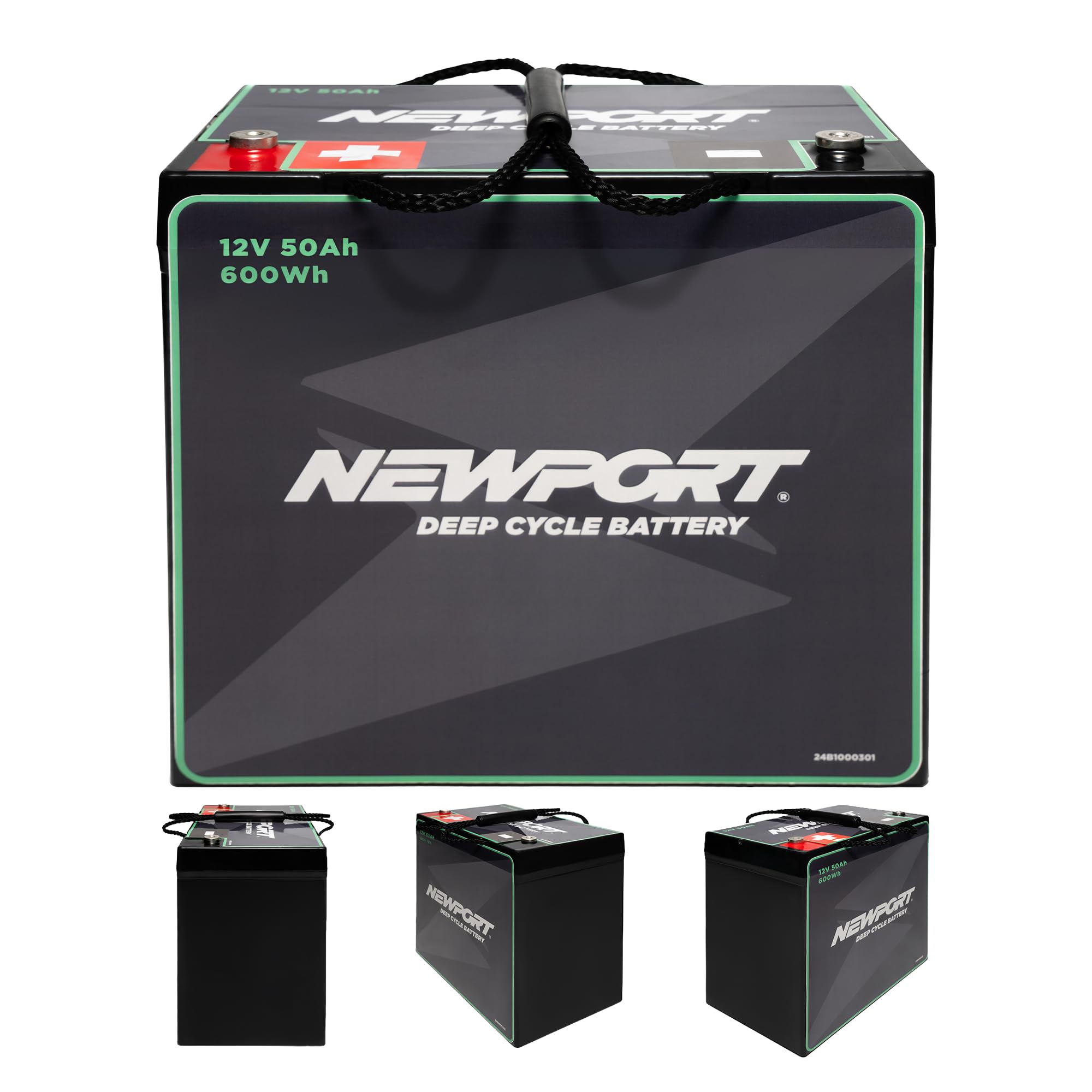
2. Newport 12V 50Ah Deep Cycle Heavy-Duty AGM Marine Battery
A 32-pound sealed AGM that gives you one-hand portability and 4+ hours on a 55lb trolling motor.
Here’s a battery that proves you don’t need lithium to get real performance. The Newport is a sealed AGM deep-cycle unit that weighs just 32 pounds—light enough to carry with one hand, which owners highlight as a huge plus over traditional flooded batteries. At 50 amp-hours, it’s built for a day of trolling, not weekend-long electronics marathons.
Buyers running a 55lb trolling motor report a stable 4+ hours of use without heat buildup, a sign of solid sealed construction. The 12-volt output stays reliable while it works, and the maintenance-free design means no watering or spill concerns. There’s no built-in charge indicator though—you’ll need an external meter to know your state of charge, a small inconvenience for the price.
It lacks a charge indicator, and some units arrive missing terminal bolts. For an angler with a small jon boat or kayak who wants proven AGM reliability without the lithium investment, this is the sensible pick. It’s also been pressed into service as a sump-pump backup on land, proof of its versatility.
The sensible bet: A lightweight, sealed AGM that delivers dependable trolling power and easy handling for the money.
One thing to know: Plan on buying an external voltmeter since there’s no built-in charge display.
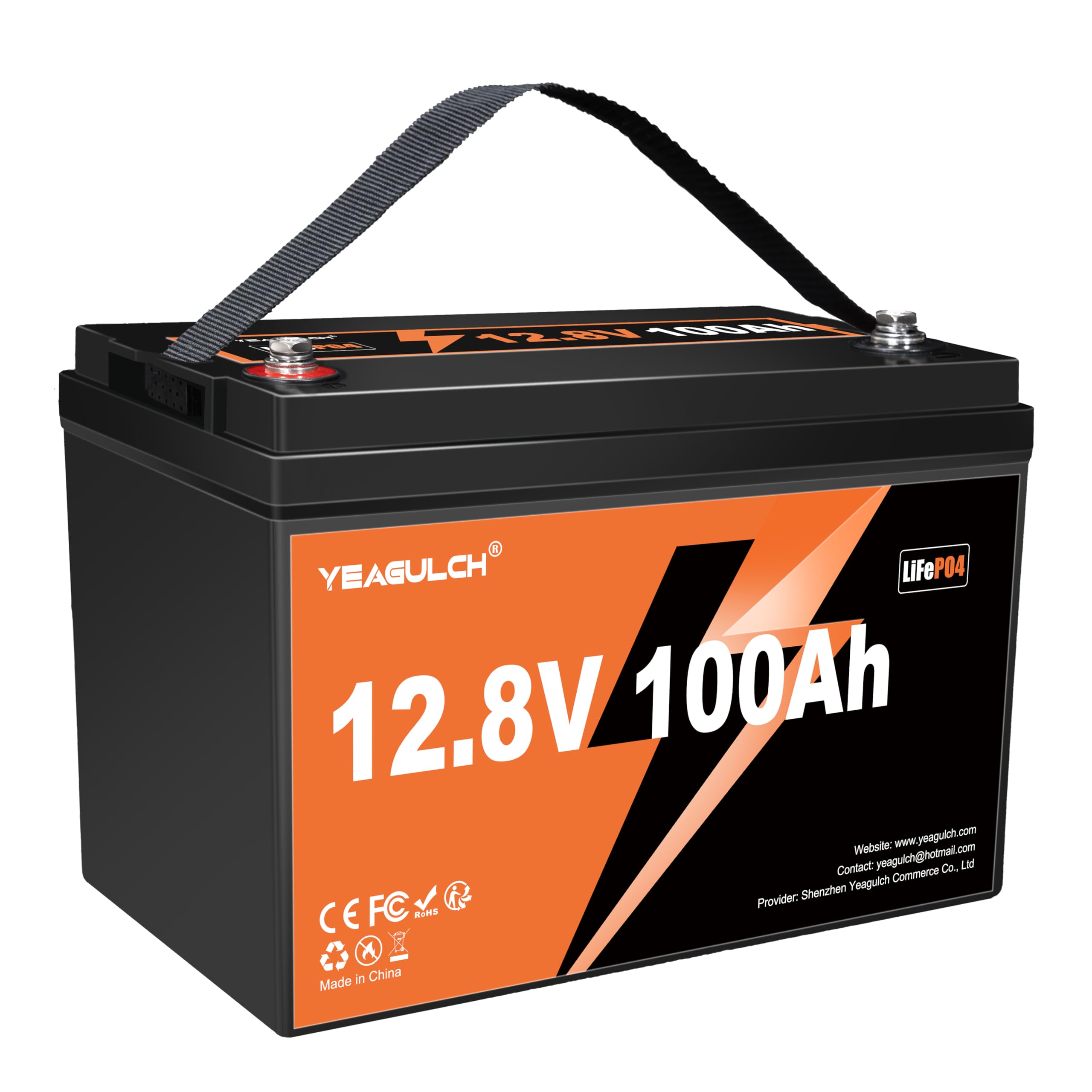
3. yeagulch 12V 100Ah LiFePO4 Lithium Battery (Group 31, 100A BMS)
Lithium power that weighs 21.6 pounds, delivers 95% usable capacity, and gives a 10% speed boost.
For the angler upgrading from lead-acid, this Group 31 lithium battery is a revelation. Weighing just 21.6 pounds—about two-thirds lighter than comparable lead-acid—it’s easy to move and install. It offers up to 95% capacity utilization, meaning you can actually use nearly all of the 100 amp-hours, unlike lead-acid where you’re advised to stay above 50% to avoid damage.
Owners running an 80lb trolling motor on a pontoon report a noticeable 10% speed boost from the extra voltage and 4+ outings per charge while also powering bilge pumps and accessories. The battery handles a 12.8V discharge at 100A with a flat curve, so you don’t see the voltage sag that plagues flooded batteries as they deplete. It also supports up to 4 units in series or parallel, so you can build a 48V system later.
The recurring advice is to avoid pairing it with high-power trolling motors over 700W. Some buyers also note you’ll need a top-post kit for a 4-way splitter. With a lifespan rated up to 10 years and over 4,000 cycles at full discharge, the math favors lithium if you boat regularly.
The performance jump: Noticeably lighter and faster than lead-acid, with the full 100Ah usable.
The guardrail: Skip this if your trolling motor exceeds 700W, and budget for a top-post adapter.
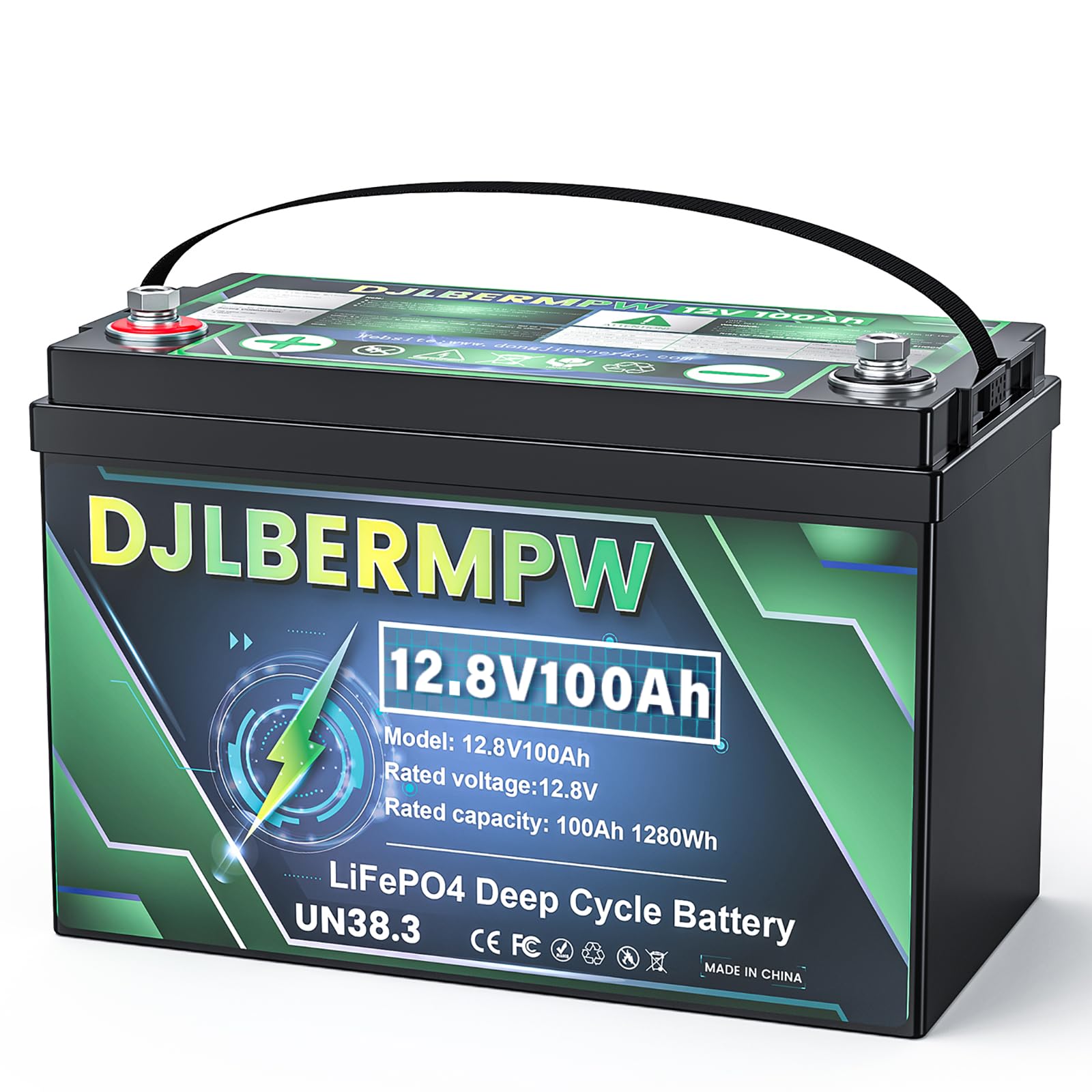
4. DJLBERMPW 12V 100Ah LiFePO4 Battery (Built-in 100A BMS)
An IP66-rated lithium that outfits trolling motors, golf carts, and off-grid solar with 23 pounds of clean power.
If your marine battery needs to do more than run a troller, this is the workhorse. The DJLBERMPW is rated IP66 waterproof—meaning it shrugs off spray and splashes—making it a natural fit for 30-70lb trolling motors on open decks. At 23 pounds, it’s roughly a third the weight of a lead-acid equivalent, and it’s 35% smaller, so it slides into tight compartments.
The 100A BMS provides full protection against overcharging, over-discharging, over-current, overheating, and short circuits, with a low-temperature cut-off for cold mornings. Owners mention solid results in golf cart conversions—three units swap out roughly 330 pounds of lead-acid—and the 5-year after-sales service includes quick feedback within 24 hours. It’s also rated for up to 15,000 cycles at 60% depth of discharge.
The mixed feedback centers on battery life consistency: many report flawless use for 8+ months, but a few note units that stopped charging around the 8-month mark. That’s worth weighing against the 5-year warranty. For a boater who also runs a solar setup or an off-grid cabin, this one battery spans all those worlds.
Why It’s A Keeper
- IP66 waterproof rating fits exposed marine decks
- 100A BMS guards against every common failure
- 23 lbs for easy handling and install
The Watch-Out
- Mixed long-term reports on units around the 8-month mark
- Only extend up to 4 units in series or parallel
Reach for it if: You need one battery that powers a trolling motor, kayak cart, and solar backup without complaint.
Look elsewhere if: You plan to run more than four of these together or need a pure starting battery.
5. WEIZE 12V 100Ah Deep Cycle Battery (Group Size 31, Sealed Lead Acid)

A tough 63-pound AGM with 1150A max discharge that reliably runs LED lighting and vent fans for 20+ hours.
Here’s the budget deep-cycle that doesn’t cut corners on capacity. The WEIZE is a sealed lead-acid AGM with 100 amp-hours and a max discharge current of 1150A, making it a strong power source for trolling motors, generators, and even electric wheelchairs. Customers note it ran 18 interior LED lights and 3 vent fans for over 20 hours without recharging—impressive endurance for the money.
It’s maintenance-free and spill-proof, which buyers with employees or rental fleets appreciate since there’s no water to check. The dimensions (12.99 x 6.73 x 8.43 inches) mean it drops into standard Group 31 trays, and it’s a direct replacement for popular models like the Renogy 100Ah. The 3% self-discharge rate means it holds a charge during off-season storage.
At 63 pounds, this is undeniably heavy, and some owners flag that as the main downside. It’s not a battery you’ll casually move around, so plan a permanent spot. For a cabin, off-grid shed, or a boat where weight isn’t the enemy, this delivers dependable power without the lithium price tag.
The value pick: Massive 100Ah endurance and a 1150A burst for a budget-friendly price.
Fair warning: At 63 pounds, it’s a “set it and strap it down” battery, not a portable one.
6. VEVOR 12V 100Ah AGM Marine Rechargeable Battery (800A Current)

A no-maintenance AGM engineered for winches and sump pumps, with an 800A burst for demanding starts.
This VEVOR is for the boater who also needs a reliable power station for heavy gear. It’s an AGM deep-cycle battery storing 100 amp-hours with a maximum discharge current of 800A within 5 seconds—enough kick to run a winch that pulls tree stumps, which is exactly how some owners use it. The UL certification adds a layer of confidence about the build.
You get a battery that needs almost no upkeep: the AGM design (a type that seals the acid inside, so you never add water) means no electrolyte top-ups and minimal maintenance, a clear step up from flooded batteries. Owners using it on boats report it holds a charge and lasts a good while, and it works smoothly as an inverter backup for a sump pump during outages. The dimensions (13.0 x 6.7 x 8.4 inches) fit standard marine trays, so it drops into your existing setup without modifications.
The critical note: VEVOR specifies this is an energy storage battery, not for starting engines—so don’t swap out your cranking battery with it. The 27.7 kg (61 lb) weight is substantial, so it’s a “place it and forget it” unit. For off-grid solar arrays, UPS systems, or a boat with a dedicated starting battery, this is a solid mid-range AGM.
The dependable workhorse: A maintenance-free 100Ah AGM that takes on winches, pumps, and off-grid loads.
Don’t misuse it: This is an energy storage battery, not for car or boat ignition starting.
7. LiTime 12V 50Ah Trolling Motors LiFePO4 Lithium Battery
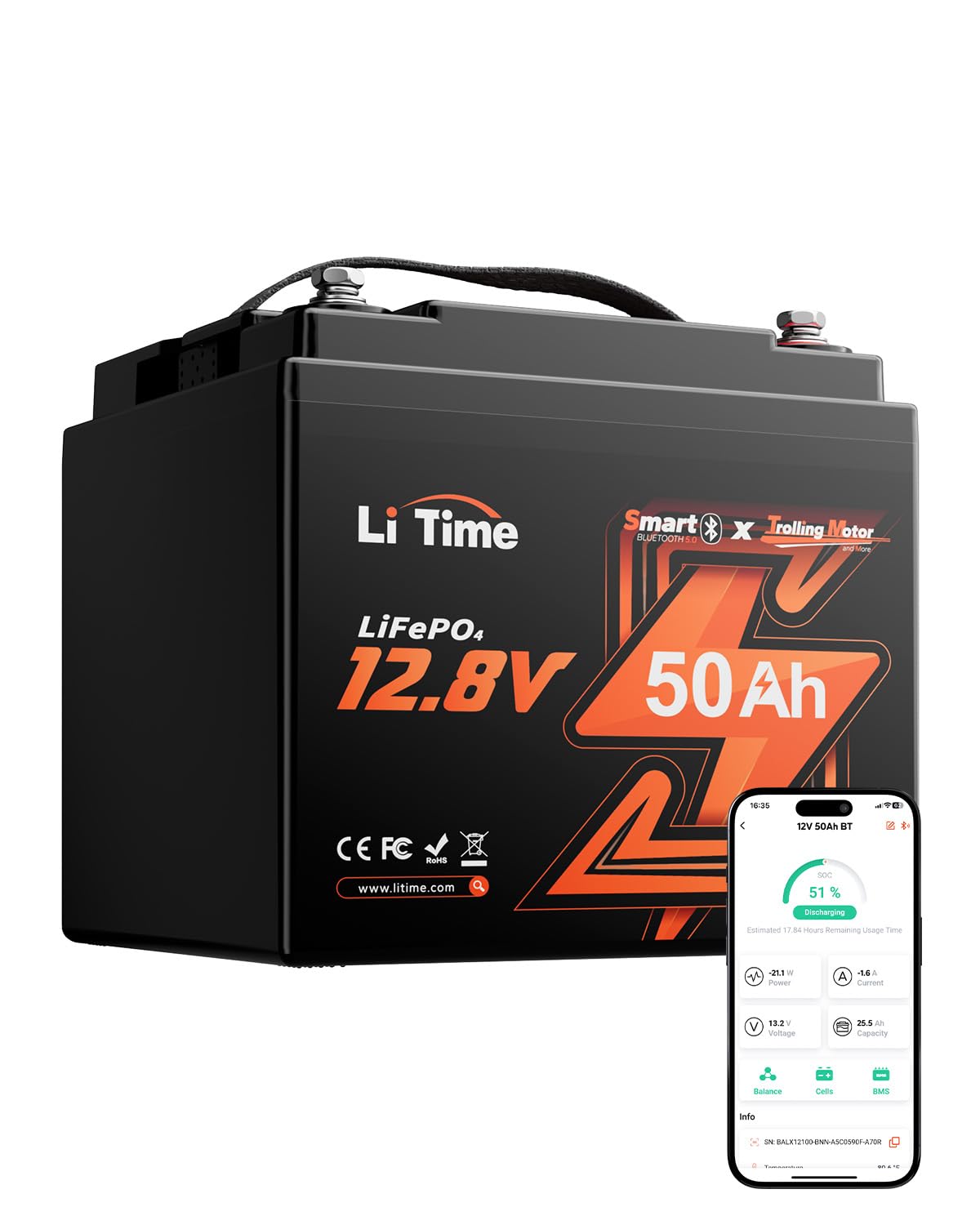
The 11.3-pound lithium that runs a kayak trolling motor all day and still has 37% charge left after two days.
For kayak anglers, weight is everything, and this battery nails it. The LiTime 50Ah weighs just 11.3 pounds—about a sixth of a comparable lead-acid—making it easy to stow in a hull. Owners running a Minn Kota Enduramax 55 report two full days of fishing with 37% power remaining, thanks to the 640W high energy density and EV-grade cells.
The Bluetooth 5.0 connectivity is a standout feature, letting you monitor battery status right from your phone via the LiTime app—no pairing required. A 50A BMS guards against over-charging, over-discharging, and short circuits, while the low-temp cut-off stops charging in cold conditions to protect cells. Owners also note it lost only 8% charge over 5 months of winter storage, so it’s ready when you are.
One owner reported a DOA unit that the seller refunded and replaced quickly, and the replacement worked flawlessly—a reminder that lithium can arrive faulty but warranty support matters. Note that this is an energy storage battery, not a starting battery for gas outboards. For fishing kayaks and small craft, this is the premium lightweight choice.
The Magic Here
- 11.3 lbs for easy kayak portability
- Bluetooth app tracks capacity in real time
- All-day runtime with reserve for a second day
Keep In Mind
- Not for starting gas outboards—storage only
- Requires lithium-activation charger for first use
Perfect for the paddler: If you fish from a kayak or small boat, this is the lightest way to run electronics all day.
Buyer’s note: Make sure your charger is lithium-compatible before your first fill-up.
8. Weize BCI Group 31M Dual Purpose AGM Battery (240RC, 825CCA)
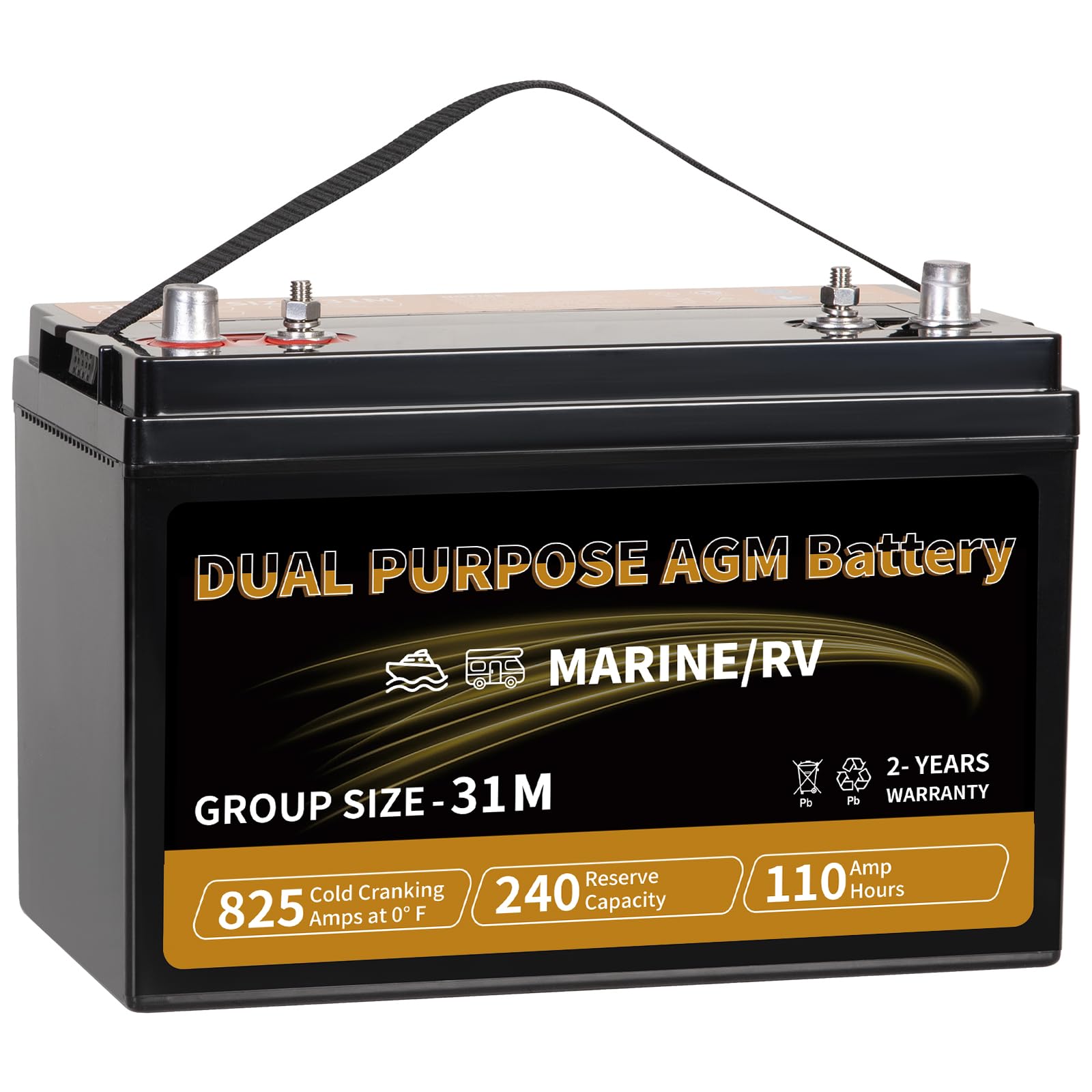
A dual-purpose AGM that starts an 8.1L engine easily and still deep-cycles for marine electronics.
This Weize is the legitimate two-in-one for boaters who need both cranking muscle and deep-cycle endurance. It packs 825 CCA and 110 amp-hours into a Group 31M case, and it uses AGM technology with 2x more cycle life than traditional flooded marine batteries. Owners have used it to start an 8.1L big-block engine without hesitation, which speaks to the punch it delivers.
The quick-charge capability is real—it can charge up to five times faster than convention, so you spend less time at the dock. It’s also engineered with 20x more vibration resistance than flooded batteries, which matters when you’re pounding through chop. With a 240 reserve capacity (the minutes it can deliver 25 amps before dropping), it keeps electronics running long after the engine is off.
Battery-life feedback is mixed, with some units failing to hold a charge. At 67.5 pounds, it’s a heavy install, so bring help. The 2-year warranty provides some safety net. For a dual-purpose AGM that starts big motors and powers the house bank, this is a strong contender.
Built For Both Jobs
- 825 CCA starts large outboards and big blocks
- 110Ah capacity for extended electronics use
- 20x vibration resistance for rough water
The Heavy Side
- 67.5 lbs makes installation a two-person job
- Mixed reports on long-term charge retention
The heavy hitter: Match it with a large outboard and a house load, and it handles both without flinching.
skip it if: You need a featherweight lithium for a kayak—this is pure lead-acid heft.
9. Power Queen 12V 100Ah LiFePO4 Battery (Group 31, 1280Wh)
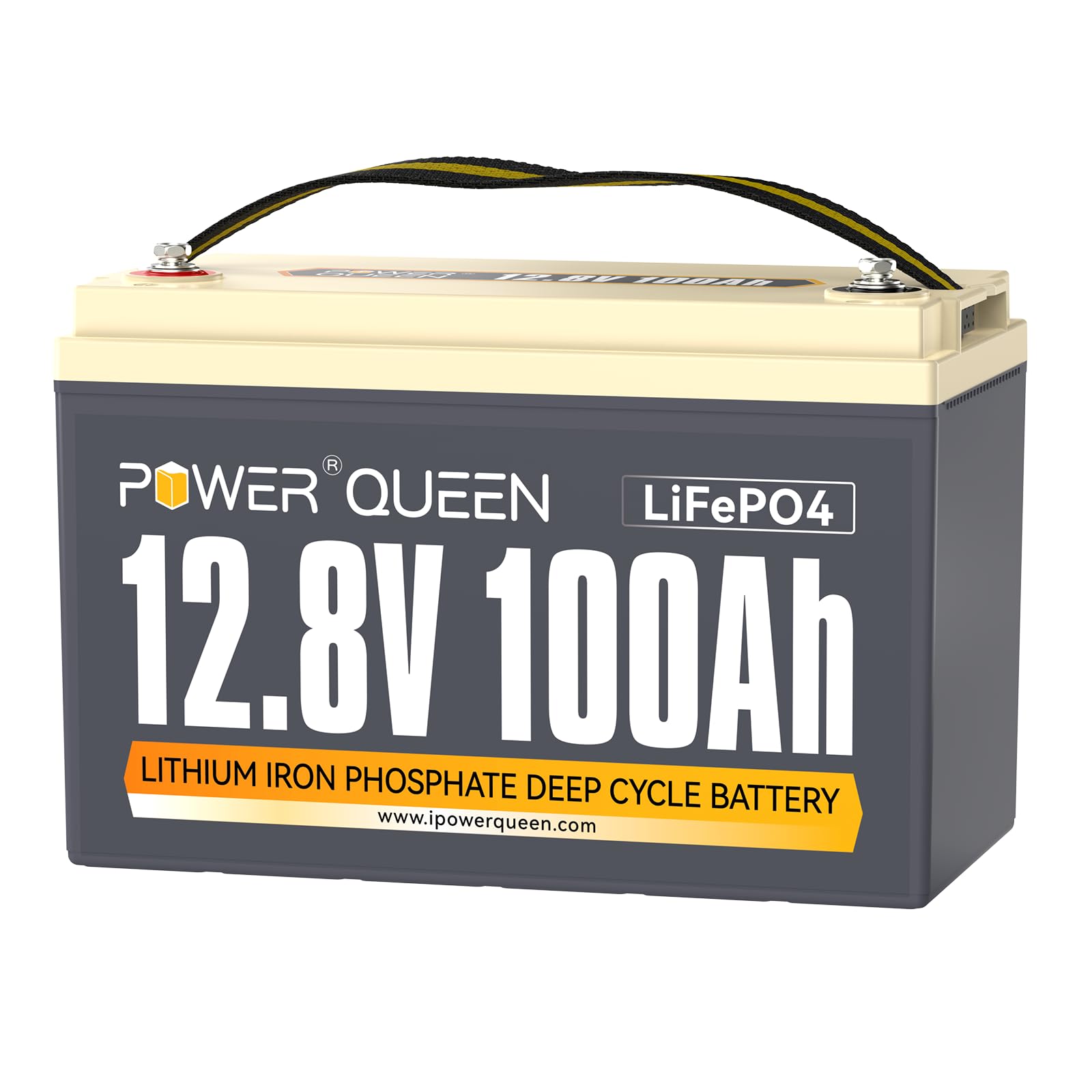
A 24.3-pound lithium that ran a full angling setup for three straight days without a voltage drop.
The Power Queen has earned its reputation as the reliable lithium for serious electronics. It’s a Group 31 battery rated at 100Ah with 1280Wh of energy, weighing just 24.3 pounds—about a third of lead-acid. Owners running trolling motors, two Garmin units, and a Livescope report it holds a load for three full days, starting the day at 13.2V and ending around 13.0V without sag.
The 100A BMS protects against overcharge, over-discharge, and short circuits, and Grade-A LiFePO4 cells deliver stable voltage. At 100Ah, it tested at an impressive 102Ah from a full charge on a sailboat, confirming the capacity is honest. The low 3% self-discharge rate means it’s ready after winter layup, and it supports up to 4S4P configurations for larger systems.
The mixed feedback centers on a few units that died after 4 days of heavy use, though the seller proactively contacted buyers to resolve issues—sign of decent support. There’s also a minor complaint about the 6mm terminal bolts risking cross-threading. For a reliable lithium that runs everything without drama, this is a top-tier pick.
The no-surprise lithium: Delivers honest 100Ah capacity with rock-solid voltage for electronics.
The minor friction: Watch that you don’t cross-thread the 6mm bolts, and use an adapter kit for some brackets.
10. Interstate Batteries Marine/RV Battery 12V 100Ah (825CCA Group 31M AGM)

A pure-lead AGM from a 70-year brand that starts your motor and powers your trolling rig simultaneously.
Interstate brings decades of battery credibility to the Group 31M form factor. This dual-purpose AGM delivers 825 CCA for cranking and 100 amp-hours of deep-cycle power, designed to start your outboard and run your trolling motor whether the engine is on or off. The pure, non-alloy lead construction extends service life to 2x that of conventional alloy AGMs and 3x that of flooded batteries.
Reviewers point out the 64.5-pound unit works great in RVs with 4 batteries in parallel and outperforms original batteries “many times over” on boats. It’s built with thick plates so it can be recharged repeatedly without losing capacity, and the brand says it’s engineered to be “Interstate tough” against rugged marine conditions. The 2-year manufacturer warranty adds confidence, so you are covered if it fails early.
The main issue is sizing—it needs to fit your tray, and some returned it for incorrect dimensions. A few noted arrival damage, though the second unit came better packaged. For boaters who trust a household name and want proven AGM reliability, this is a safe, premium pick.
The trusted staple: A dual-purpose AGM with real cranking power and long deep-cycle life from a 70-year brand.
Check the fit: Measure your battery tray first—this is a Group 31M, and sizing errors are the most common reason for returns.
11. OPTIMA Batteries 34M BLUETOP Sealed AGM Starting Battery

A 38.4-pound SpiralCell AGM with 100-minute reserve that lasted one owner a full decade on deck.
The OPTIMA BLUETOP is the prestige choice for boaters who want cranking reliability above all. It delivers 800 CCA and is rated at 50Ah (C20), but its real a neat extra is the SpiralCell technology—99.99% pure lead wound into spirals that deliver more power and outlast conventional flat-plate batteries. Shoppers say it holds a charge for months when disconnected, and one left it in service for 10 years before replacing it out of caution, not failure.
The 100-minute reserve capacity means it can run bilge pumps and electronics for a solid stretch even if the engine is off. It’s dual-purpose, so it handles deep cycling and starting, and it’s maintenance-free. The dual SAE and 5/16″ stainless steel stud posts give you flexible hookup options. At 38.4 pounds, it’s relatively svelte for a starting battery.
Some buyers report it won’t hold a charge under load, and opinions on battery life and value are split. There’s also a caution about checking the manufacturing date—some units shipped can be older stock. For a boater who prioritizes bulletproof starting power and doesn’t mind a premium price, this is the icon to consider.
The Icons
- 800 CCA with SpiralCell tech for confident starts
- 100-minute reserve for extended electronics
- Holds charge for months in storage
Reality Check
- Some report charge-holding issues under load
- Check the manufacturing date on arrival
The premium purist: If you want a maintenance-free cranker that’s proven to last a decade, this is the gold standard.
Think twice: If you need deep-cycle capacity for heavy trolling, the 50Ah rating is bettered by the lithium picks above.
Understanding the Specs
Amp-Hours (Ah)
This tells you how much energy the battery stores. Think of it as the fuel tank size for your electronics. A 100Ah lithium battery gives you roughly double the usable runtime of a 100Ah lead-acid, because lithium safely discharges to about 95% while you’re told to keep lead-acid above 50% to avoid damage. For a trolling motor, more Ah means more hours on the water.
Cold Cranking Amps (CCA) & Reserve Capacity (RC)
CCA measures the burst of power available to start a cold engine—the higher the number, the stronger the cranking punch. Reserve capacity (RC) tells you how many minutes a battery can deliver 25 amps before dropping voltage, which is a proxy for how long it can run your electronics if the engine dies. A dual-purpose battery balances both, but you trade a bit of each for convenience.
FAQ
What is the difference between a cranking battery and a deep cycle marine battery?
How long will a 100Ah lithium marine battery last?
Can I use a lithium battery to start my outboard motor?
Is an AGM battery better than a flooded lead-acid marine battery?
What size battery do I need for a 55lb or 70lb trolling motor?
Can I connect multiple marine batteries together?
How do I store a marine battery over the winter?
Is it worth paying more for a lithium marine battery?
Final Thoughts: The Verdict
The crown goes to the marine batteries leader, the Litime 165Ah, because it’s the rare dual-purpose lithium that delivers 1200 CCA for starting and 165Ah for electronics, killing the need for a second battery. If you want a featherweight for kayak fishing, grab the LiTime 50Ah. And for the budget-conscious AGM buyer who values proven reliability, the WEIZE 100Ah AGM remains a dependable workhorse. Decide what your boat needs more—cranking burst, deep-cycle endurance, or the lightest way to carry power—and the right pick is clearer than ever.
How We Picked
We do not accept paid placement. Every pick is matched to a real buyer and a real use-case; we do not hands-on test units.
Sources & Methodology
Specifications: manufacturer listings and product documentation. Review insights: verified customer reviews, as of August 2026. Pricing: not shown on this page (it changes often); check the current price via the retailer link.
As an Amazon Associate, Gadgets Feed earns from qualifying purchases. This does not affect which products we feature.