
Our readers keep the lights on and my morning glass full of iced black tea. As an Amazon Associate, I earn from qualifying purchases.
Specs are compiled from manufacturer listings and verified buyer reviews and can change over time — please confirm the key details on the product page before buying.
If you are working with small sample volumes in a lab, filtering culture media at home, or sterilizing sensitive solutions, the difference between a usable result and a failed one often depends on a single measurement: 0.22 microns. A filter at this size traps bacteria, mold, and fine particles that larger-pore filters simply wave through. The trick is picking the right membrane material and diameter so fluid actually flows instead of clogging on the first drop.
I’m Min — the founder and writer behind Gadgets Feed. This guide is built by comparing the manufacturers’ published specifications and the patterns across verified customer reviews, so you get each pick’s real strengths and trade-offs instead of marketing spin.
If you need a sterile polyethersulfone (PES) filter for protein work or a reusable PTFE one for solvent filtration and mycology, these are the best 0.22 micron filter options that deliver consistent results without the guesswork.
Our Picks at a Glance
How To Choose The Best 0.22 Micron Filter
After you know the pore size is 0.22 microns, the real decisions come down to membrane material, diameter, sterility, and pack count. Each choice directly affects whether your filter works for your specific liquid and volume.
Membrane Material: PES vs PTFE
The membrane type is the single most important spec after pore size. Polyethersulfone (PES) is naturally hydrophilic (it wets out instantly without pre-wetting), gives high flow rates, and has very low protein binding — so you lose less of your precious sample stuck to the filter. This makes PES the right choice for aqueous solutions like buffers, culture media, and protein samples. Polytetrafluoroethylene (PTFE) is hydrophobic (it repels water) and is chemically resistant to strong acids, bases, and organic solvents. You use PTFE when filtering solvent-based samples or sterile gases. PTFE filters need pre-wetting with alcohol before water will pass through.
Diameter: 13mm vs 25mm vs 33mm
The filter diameter determines how much surface area the liquid has to push through. A 33mm filter has a larger surface area compared to a 25mm filter (33mm vs 25mm) and a 13mm filter (33mm vs 13mm). More area means faster flow and less pressure required from your syringe — but it also means more dead volume (liquid left behind in the filter housing), which matters if you are working with very small volumes measured in microliters. For filtering less than 2 mL, a 13mm or 25mm filter wastes less sample. For larger volumes up to 10 mL or when you want faster throughput, 33mm is the better choice.
Sterile vs Non-Sterile
If you are filtering biological samples, media for cell culture, or anything that must remain free of microbes, you need a filter that was sterilized at the factory — usually by gamma irradiation. These come individually sealed and maintain sterility until opened. Non-sterile filters are fine for tasks like solvent cleanup, HPLC sample prep, or mycology air exchange, but you must autoclave them yourself if sterility is required. Some PTFE filters are labeled “autoclavable” which means you can sterilize them in a pressure cooker or autoclave and reuse them.
Quick Comparison
| Model | Best For | Membrane | Diameter | Weight | Amazon |
|---|---|---|---|---|---|
| Membrane Solutions PES 33mm★ Best Overall | Budget-friendly sterile PES 10-pack | PES | 33 mm | 2.82 oz | Amazon |
| Biomed Scientific PES 25mmTop Performer | Reliable no-leak sterile filtration | PES | 25 mm | 2.4 oz | Amazon |
| Locofiltr PES 33mm | High-throughput large-volume PES | PES | 33 mm | 2.08 oz | Amazon |
| SimPure PES 33mm | Home lab user clarity tests | PES | 33 mm | — | Amazon |
| Adamas PTFE 13mm 100-pack | Bulk PTFE for mycology LC | PTFE | 13 mm | 4.5 oz | Amazon |
| Biomed Scientific PTFE 25mm 100-pack | Solvent & aggressive chemical filtration | PTFE | 25 mm | — | Amazon |
In‑Depth Reviews
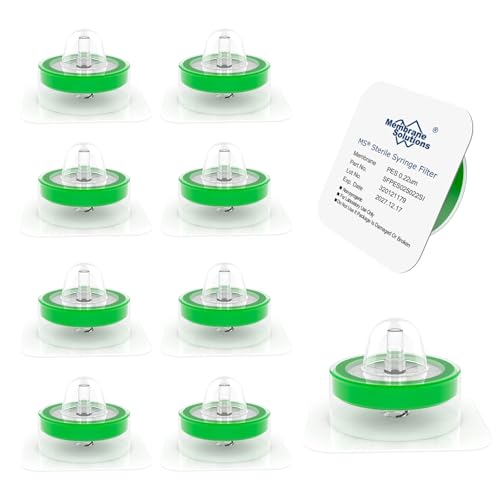
1. Membrane Solutions Syringe Filter Sterile PES 33mm 0.22um 10 Pack
Our pick — over 4★ from 800+ verified ratings; the strongest balance of quality and price.
A solid, widely-trusted sterile PES filter that does the job across hundreds of labs and home setups.
With over 800 ratings and a 4.3 average, the Membrane Solutions PES 33mm has the largest review sample in this lineup — meaning you get a well-tested picture of what works and what doesn’t. The 33mm diameter PES membrane is certified under ISO 9001 and uses a threaded interface (female luer lock) that reviewers point out “locks onto any lock lure device nicely.” This filter is individually gamma irradiated and carries a 5-year shelf life from the manufacture date, with the batch code printed for expiry tracking. It is designed for aqueous samples: buffers, proteins, culture media, and additives.
Shoppers say it is “good quality, filters approx 4g of compound before clogging” — a useful real-world throughput number if you are filtering powders dissolved in solution. However, a small batch of defective filters made it past QC in the past: one reviewer noted a batch where it was “impossible to push oil through, used 30 filters, even caulking gun failed.” The seller sent free replacements that worked, but the incident shows that individual filter consistency is less rigorous than the 100% integrity-tested Biomed Scientific picks. For routine lab work and home hobby filtration this is a reliable choice, but for irreplaceable samples the extra confidence of a fully tested filter might be worth the small price bump.
What makes it popular
- Over 800 reviews confirm consistent performance across many use cases
- 5-year shelf life from manufacture with batch code tracking helps inventory management
- Threaded female luer lock creates a secure, leak-resistant syringe connection
One documented issue
- A small number of batches had defective filters that would not pass liquid, though seller replaced them
Who it fits: labs and home users who filter aqueous solutions regularly and want a widely-tested, affordable sterile filter in a convenient 10-pack.
Who needs more: anyone filtering a single irreplaceable sample who needs 100% certified-perfect integrity on every filter.
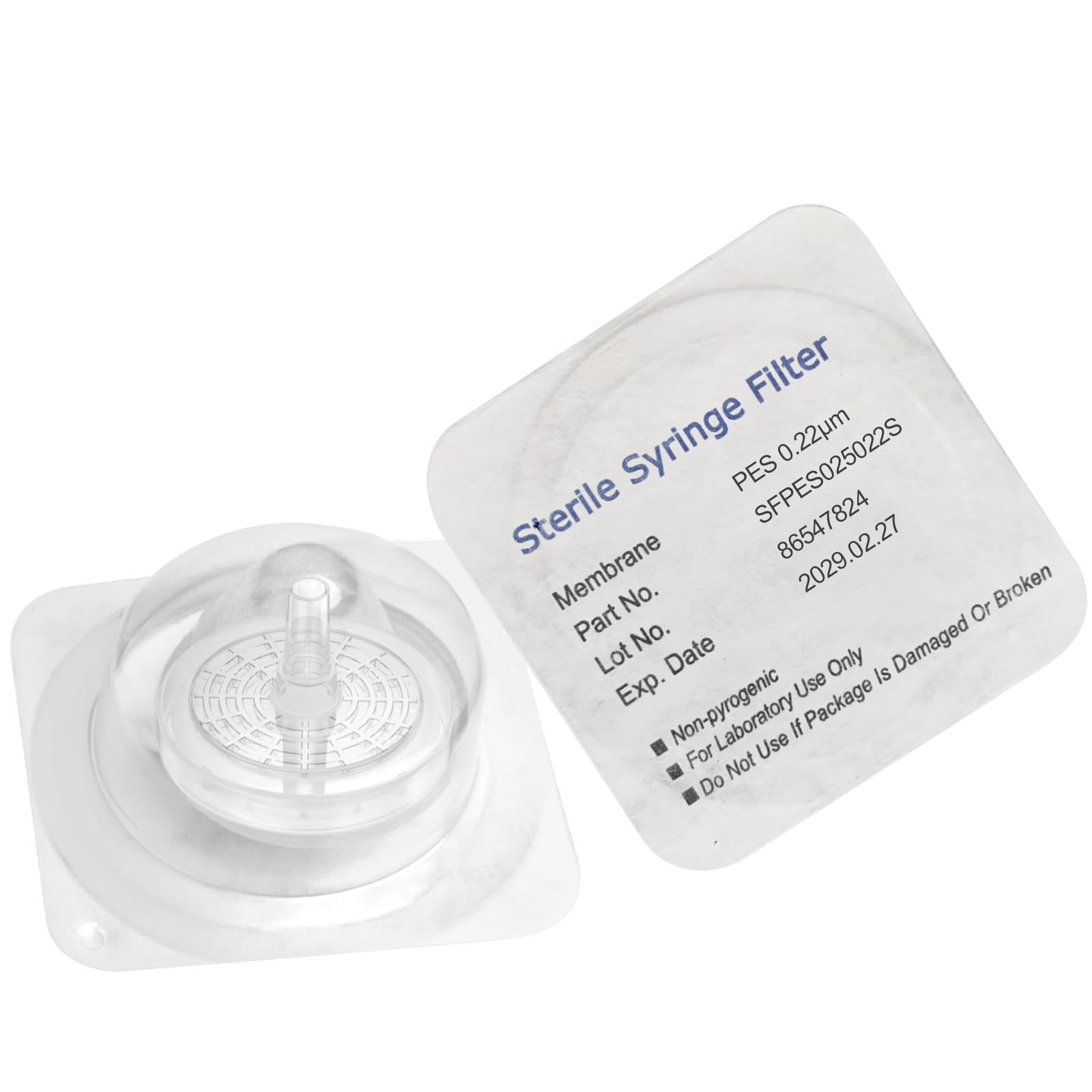
2. Biomed Scientific Sterile Syringe Filters PES 25mm 0.22um 10/pk
The tightly sealed 25mm PES filter that flat-out refuses to leak or fail mid-squeeze.
When you need to guarantee that every drop of your tissue culture media or biological fluid passes through a sterile 0.22um barrier without blowouts, this is the standard to measure against. These Biomed Scientific filters are 100% integrity tested and gamma irradiated individually, so you know each sealed package is sterile when you open it — no guessing whether a box was compromised in storage. At 25mm diameter, this filter hits the balance between fast flow and low dead volume, which is exactly right for the 1 mL to 10 mL syringe volumes you typically handle in sterile filtration.
Buyers report “no issues, no leakage, and no filters that failed to allow liquid to pass through” — a consistency record that matters when you are processing multiple samples. The PES membrane is certified non-pyrogenic and biologically safe, and each filter carries its own expiry date on the package for easy QC tracking. Unlike some budget brands, the seal between the membrane and the polypropylene housing is tight enough to handle firm pressure from a 5 mL syringe without the joint weeping.
One thing to note: at 25mm diameter this is a middle ground size. The 25mm still leaves a bit of liquid trapped in the housing — if you are filtering under 1 mL of a very expensive peptide, you would get less waste from a 13mm filter.
Why it earned the top slot
- 100% integrity tested per filter — zero-leak track record backed by real buyers
- Individually gamma-irradiated and labeled with expiry dates for lab traceability
- Certified non-pyrogenic meets bio safety requirements for tissue culture
One trade-off to know
- 25mm diameter can hold back some sample volume; switch to 13mm for sub-1mL peptide doses
Your best bet when: you want zero-leak sterile filtration from a brand that stands behind each individual filter with integrity testing and a clear expiry date.
Consider another if: you work with very small (<1 mL) volumes and need to minimize sample loss in the filter housing.
3. Locofiltr PES Syringe Filters 33mm 0.22um Sterile 10 Pack

The 33mm PES filter that moves liquid fast with an integrated pre-filter to fight clogging.
If you routinely push larger volumes — 10 mL or more of buffers, media, or additives — this filter from Locofiltr actually makes the job faster instead of turning your wrist into an endurance test. The 33mm membrane gives you a larger surface area than a 25mm filter (33mm vs 25mm), and at 2.08 ounces it is notably lighter than the 2.82-ounce Membrane Solutions 33mm pack, which means less dead weight on the syringe tip. But the real upgrade here is the built-in PP pre-filter layer that catches larger particles before they reach the main 0.22um membrane, so you get fewer clogs and more throughput per filter.
The PES membrane is naturally hydrophilic — no pre-wetting needed — and the manufacturer claims ultra-low protein binding to minimize the amount of your sample that gets stuck in the membrane rather than passing through. That claim matters if you are filtering protein solutions or peptides. Owners mention that it is a “quality product” but that it “leaves a lot of peptides and liquid in the filter” — a side effect of the 33mm diameter’s larger internal dead volume. If your total sample is only a few milligrams, the 33mm size will trap more of it than a smaller filter would.
The female luer lock inlet and male luer slip outlet create a leak-tight connection that customers note holds well under pressure. Each filter is gamma irradiated and manufactured in an ISO Class 8 cleanroom with ISO 9001:2015 certification.
Best features
- Integrated PP pre-filter doubles clog resistance compared to standard single-layer membranes
- Larger 33mm surface area delivers notably faster flow for 5-10 mL volumes
- Lightweight polypropylene housing (2.08 oz) reduces strain during extended use
Know before you buy
- The 33mm housing traps noticeable residual liquid, making it less ideal for very small sample volumes
Reach for this when: you routinely filter 5-10 mL aqueous solutions and want a pre-filter that keeps you pushing without constant clogging.
Look elsewhere if: you are working with under 2 mL of expensive sample and can’t afford the liquid retention.
4. SimPure Sterile Syringe Filter PES 0.22um 33mm 10 Pack

The 33mm PES filter that comes with a clean bill of health from personal-home clarity testers.
SimPure builds their 0.22um PES filter with the same basic specs as the Membrane Solutions pack — 33mm diameter, hydrophilic PES, sterile from gamma irradiation — but adds a specific certification that might matter more to you than you think: each lot of membrane is certified by HPLC Extractable Test, meaning the filter itself won’t leach chemical contaminants into your sample. This matters for analytical work where even tiny background signals ruin your results. The filter also meets USPBiological Reactivity test for Class VI Plastics, the highest biocompatibility standard for medical-grade plastics.
Buyers in the home-lab community love how visibly effective this filter is. One buyer mentioned “i tested flour in water and the water came out clear!” — a quick practical test that confirms the 0.22um pores trap fine particulates. On the practical side, the 33mm diameter gives you fast flow, but reviewers warn “not to exert too much pressure or the filter will explode/burst and spray everywhere.” That is true of any syringe filter pushed past its pressure limit, but it is worth repeating here: go slow and steady, not forceful.
Note that this filter is not capable of sterilizing a solution on its own — it is supplied sterile, but using it on a non-sterile syringe in a non-sterile environment will re-contaminate the liquid. Sterile packaging only protects the filter membrane itself.
Standout details
- HPLC Extractable Test certification means minimal chemical leachates for clean analytical results
- Meets USP Class VI Plastics standard — the most stringent biocompatibility benchmark
- Home users report clear visual results even with simple contamination tests
Handle with care
- Excess syringe pressure can burst the filter housing — always push slowly and steadily
Reach for it if: you do analytical HPLC prep or any work where filter leachates could ruin your results, and you want the USP Class VI certification as backup.
Pass on it if: you just need basic sterile filtration and don’t need the extra biocompatibility and extractable-test certification.
5. Adamas-Beta Syringe Filter PTFE 13mm 0.22um 100 Pack

The bulk PTFE filter that survives autoclave cycles and fits neatly onto liquid culture jars.
If you are doing mycology work — liquid cultures, spawn jars — or filtering harsh organic solvents, you want a hydrophobic PTFE membrane, not a water-loving PES one. This 100-pack from Adamas-Beta gives you 100 PTFE filters with a 13mm diameter at a cost that works out to pennies each. The PTFE membrane withstands autoclave and pressure cooker cycles multiple times, so you can sterilize these filters yourself and reuse them across multiple batches. Buyers confirm “I use these for Liquid Cultures and Spawn Jars” and report “they provide enough gas exchange for my 1 pint LCs.”
The 13mm diameter is a deliberate choice for this use case: it screws onto standard female luer lock syringes but takes up very little space on injection ports or jar lids. The smaller size also means less dead volume — important when you are filtering the small volumes typical of liquid culture transfers. One potential catch: these are non-sterile, so you must autoclave them before using them on sterile projects. The hydrophobic PTFE membrane will not wet out with water on its own; you need to pre-wet it with a small amount of alcohol to break the surface tension before aqueous solutions will pass through.
Why it is a cult favorite
- 100 filters in one box — a high volume-to-price ratio for frequent users
- PTFE membrane withstands multiple autoclave cycles, making each filter reusable
- 13mm compact size leaves almost no dead volume for small samples
Workflow adjustment
- Non-sterile from the start — requires autoclaving before sterile use
- Hydrophobic PTFE needs an alcohol pre-wet before water will pass through
Who it is built for: mycology hobbyists and solvent filterers who work with small volumes, need many filters, and don’t mind autoclaving and pre-wetting.
Look elsewhere if: you need ready-to-use sterile filters straight from the package with no prep required.
6. Biomed Scientific Syringe Filter PTFE 25mm 0.22um Non Sterile 100 Pack

The 25mm PTFE powerhouse that handles the harshest chemicals without breaking down.
When your application demands broad chemical compatibility — strong acids, bases, organic solvents, anything in the pH range of 1 to 14 — the PTFE membrane in this Biomed Scientific filter is chemically inert enough to handle it without degrading or leaching. The 25mm diameter gives you a larger surface area than the 13mm PTFE option above, which means faster flow when you are filtering larger solvent volumes for HPLC sample prep or environmental analysis. Each filter has a female luer inlet and male luer slip outlet, and the polypropylene housing is welded to the membrane for a seal that won’t leak solvent.
Buyers in the mycology community confirm these filters work great as gas exchange ports: one owner reported “if you are doing your own LC grain spawn for your mycology projects, then you will want these gas exchange ports for healthy mycelium growth.” The hydrophobic nature of PTFE makes these ideal for sterile air filtration — they let oxygen in and carbon dioxide out while blocking airborne contaminants. However, these are non-sterile, meaning you must autoclave them before use in sterile work. One reviewer found “a little dirt in the tip” on one filter, but easily cleared it with a paper clip. At 100 per pack, the value is tough to top for high-volume applications.
Core strength
- PTFE membrane resists aggressive solvents, acids, and bases across the full pH 1-14 range
- 25mm diameter provides faster flow than 13mm while staying compact enough for most syringe work
- Widely adopted by mycology and chemistry communities for gas exchange and solvent filtration
Check before use
- Non-sterile packaging means you must autoclave or sterilize before sterile applications
- Occasional debris in tip reported — inspect each filter before installing
Choose this if: you regularly filter aggressive chemicals or use syringe filters for mycology gas exchange and want a chemically inert PTFE membrane in a bulk 100-pack.
Pick a sterile option if: you cannot autoclave your own filters and need ready-to-use sterility straight from the package.
Understanding the Specs
Pore Size — Why 0.22 Microns
The 0.22 micron pore size is the industry standard for sterilizing filtration because pores at this size are smaller than the diameter of most bacteria (typically 0.5 to 5 microns) and yeast cells (1 to 5 microns). A 0.45 micron filter, by contrast, can let some smaller bacteria (like Brevundimonas diminuta) pass through, so for sterile work you always want the 0.22um rating. For basic particle removal or clarification where sterility is not needed, 0.45 microns offers faster flow. For sterile biological samples, stick to 0.22 microns.
Membrane Chemistry — PES vs PTFE
Polyethersulfone (PES) membranes are hydrophilic (water-loving), which means they wet out instantly when an aqueous solution touches them — no pre-wetting needed. PES also has naturally low protein binding, which keeps more of your sample molecules in solution rather than stuck to the membrane. Polytetrafluoroethylene (PTFE) is hydrophobic (water-fearing) and chemically resistant to almost everything. Use PTFE for solvents, strong acids/bases, and gas filtration. For water-based solutions that go through PTFE, you need to pre-wet the membrane with a few drops of 70% ethanol or isopropyl alcohol to break the surface tension.
FAQ
Can I reuse a 0.22 micron syringe filter?
Is a 0.22 micron filter the same as a 0.22 um filter?
Can a 0.22 micron filter remove viruses?
How much liquid can one 0.22 micron syringe filter handle?
Does filter diameter affect sample retention?
Can I use a PES filter with organic solvents?
Will a 0.22 micron filter fit any syringe?
How should I store unused 0.22 micron filters?
What does “hydrophilic membrane” mean for a 0.22 micron filter?
Is 0.22 microns small enough for HPLC sample filtration?
Final Thoughts: The Verdict
Across the board, the best 0.22 micron filter overall is the Biomed Scientific 25mm PES because it combines 100% integrity testing, gamma-irradiated sterile packaging, and a 25mm diameter that balances flow speed with minimal sample retention — all backed by reviews confirming zero-leak performance. If you need fast throughput for larger aqueous volumes and want an extra pre-filter to fight clogging, grab the Locofiltr 33mm PES. And for high-volume mycology or solvent filtration where chemical resistance matters most, the Adamas-Beta PTFE 13mm 100-pack gives you the best per-filter value for non-sterile, autoclavable work.
How We Picked
We do not accept paid placement. Every pick is matched to a real buyer and a real use-case; we do not hands-on test units.
Sources & Methodology
Specifications: manufacturer listings and product documentation. Review insights: verified customer reviews, as of July 2026. Pricing: not shown on this page (it changes often); check the current price via the retailer link.
As an Amazon Associate, Gadgets Feed earns from qualifying purchases. This does not affect which products we feature.