
Our readers keep the lights on and my morning glass full of iced black tea. As an Amazon Associate, I earn from qualifying purchases.
Specs are compiled from manufacturer listings and verified buyer reviews and can change over time — please confirm the key details on the product page before buying.
You order 1/0 AWG wire for a car amp, a battery move, welding leads, or a solar or marine setup, and the cable shows up too stiff to bend around a corner, or the copper strands slide around inside a loose jacket, or the length runs short of what the page promised. This guide covers eight 1/0 gauge cables and names the job each one suits.
I’m Min — the founder and writer behind Gadgets Feed. This guide is built by comparing the manufacturers’ published specifications and the patterns across verified customer reviews, so you get each pick’s real strengths and trade-offs instead of marketing spin.
You are about to see heavy copper cable split by what it really does well: flexibility, strand count, insulation type, amp rating, and how much length you actually get. Every pick below is judged on published specs and verified owner reviews, not marketing copy. Every pick on this list is a genuine 1/0 AWG cable, so the only question left is which one fits your 1/0 awg wire job.
Our Picks at a Glance

How To Choose The Best 1/0 AWG Wire
1/0 AWG is a big cable — roughly the thickness of a fat marker pen — and at this size the copper type, the strand count, and the jacket decide whether your install goes smoothly or turns into a wrestling match. Here is what actually matters, in the order it bites you.
Copper type: OFC versus CCA
Oxygen-Free Copper means the conductor is pure refined copper all the way through. CCA means Copper-Clad Aluminum — an aluminum core with a thin copper skin around it. Aluminum carries less current than the same thickness of copper, so a CCA cable has to be bulkier to move the same amps. Copper is also heavier and pricier, which is exactly why budget cables reach for the aluminum shortcut.
Strand count and flexibility
Strand count is simply how many thin copper threads are twisted together inside the jacket. A cable built from hundreds of fine strands bends around tight corners and resists cracking from vibration far better than a stiff few-strand cable. If you are routing through a crowded engine bay or behind a trunk panel, strand count is the number that saves your knuckles.
Jacket material and temperature range
The outer jacket comes in PVC, rubber, and EPDM (a rubber compound built to shrug off heat, oil, and moisture). A jacket rated from -58°F to +221°F keeps its grip in an engine bay that bakes in summer and freezes in winter. A cheap stiff jacket cracks under that swing, and a cracked jacket means exposed copper and corrosion.
Amp rating and run length
Every cable lists a maximum current in amps, and some list a distance qualifier — a cable rated for 285 amps up to 50 feet, for example. The longer the run, the more voltage you lose along the way, which is why a 20-foot battery feed and a 3-foot jump cable are not always handled by the same gauge. Match the amp rating to your load and the length to your vehicle.
Quick Comparison
| Model | Best For | Conductor | Length | Max Current | Amazon |
|---|---|---|---|---|---|
| EWCS 1/0 Gauge Premium Extra Flexible Welding Cable 600 Volt Combo Pack★ Best Overall | All-round welding and battery work | Pure copper, 30 gauge stranding | 10 ft each, red and black | 600 V rating | Amazon |
| KnuKonceptz Kolossus Flex Kable OFC 0 Gauge Power WireTop Performer | Flexible pure-copper power runs | Tinned Oxygen-Free Copper, 5145 strands | Pre-cut length options | 375 A | Amazon |
| Kimbluth 1/0 Gauge Battery Cable Copper Wire, 3FT Red + 3FT BlackBest Value | Short battery jumps and grounds | 99% pure OFC copper, multi-strand | 3 ft each, red and black | 600 V rating | Amazon |
| KnuKonceptz Bassik 1/0 Gauge AWG Primary Automotive Battery Power/Ground Wire | Budget amplifier feeds | Copper-Clad Aluminum, multi-strand | 25 ft, black | 200 A | Amazon |
| Spartan Power Welding Lead & Car Battery Cable, 1/0 AWG, 10 Foot, Red | DIY bulk cable builds | Pure copper, 1026 strands, EPDM jacket | 10 ft, red | 600 V rating | Amazon |
| Shirbly 1/0 Gauge Battery Cable, 10FT Red + 10FT Black Pure Copper Wire | Longer red-and-black pair runs | Pure copper OFC, 1703 strands, EPDM jacket | 10 ft each, red and black | 600 V rating | Amazon |
| TEMCo 1/0 Gauge AWG 20 Ft Red Flexible Pure Copper Welding Cable | Long single-run welding leads | Annealed 30 gauge OFC, 975 strands | 20 ft, red | 285 A | Amazon |
| GEARit 1/0 AWG OFC Wire Set, 25 ft Each Red/Black Battery Cable | Full-system car audio and marine runs | Stranded Oxygen-Free Copper | 25 ft each, red and black | 100 A | Amazon |
In‑Depth Reviews
1. EWCS 1/0 Gauge Premium Extra Flexible Welding Cable 600 Volt Combo Pack
Our pick — over 4.5★ from 650+ verified ratings; the strongest balance of quality and price.
Fine 30 gauge copper stranding that bends through tight engine bays and still carries 600 volts.
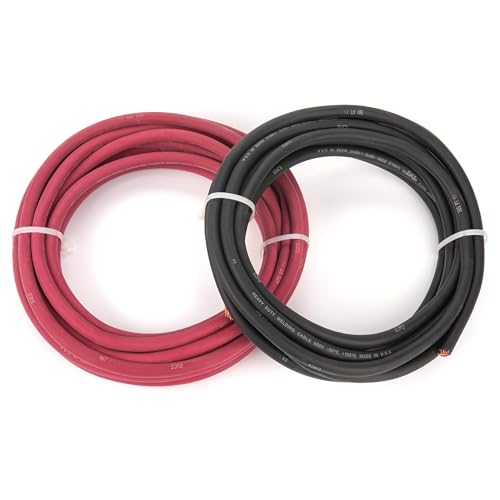
This is the pick for anyone who wants one cable that handles welding leads, battery relocation, and high-load DC projects without a second thought. The conductor is pure copper built from fine 30 gauge stranding, and the jacket is made to shrug off sunlight and water. You get a matching pair — 10 feet of red and 10 feet of black — rated to 600 volts and sold in a single 2-count pack.
What wins people over is the flexibility. It is the trait owners bring up more than any other, and you feel it the moment you try to route this through a crowded engine bay or curl it behind a trunk panel. It ships as a coil, and the insulation cuts cleanly without fraying the copper underneath. In the same breath, the function is rated right up there — this cable handles battery relocation, trunk mounting, and heavy DC loads without complaint.
The honest trade-off is length. Buyers running welding leads consistently wish for longer runs, and one puts it bluntly: you will want more feet for the kinds of jobs this cable is happiest doing. The other thing to know is that it is one cable per color, not a pair you can split in every direction — plan your positive and ground runs before you cut. For everything from a Big 3 upgrade to a custom battery cable, this is the one to start with.
What earns the top spot
- Fine 30 gauge copper stranding bends through tight spaces without kinking
- Sunlight and water resistant jacket suited to outdoor and engine-bay use
- Combo pack gives you red and black in one purchase for clean positive and ground runs
- Rated to 600 volts, so it covers welding, battery, and DC projects
What to plan around
- Long-run users will want more length than the combo provides
- Ships as a coil, so it needs a little straightening before routing
Made for: the buyer who wants one flexible, pure-copper cable for welding leads or a battery relocation and values bendability above all else.
Think twice if: your job needs long continuous runs — the included lengths will not reach, and you will want to size up.
2. KnuKonceptz Kolossus Flex Kable OFC 0 Gauge Power Wire Copper Cable Red 1/0 AWG
5145 tinned OFC strands — the highest count on this list — for the softest bends here.
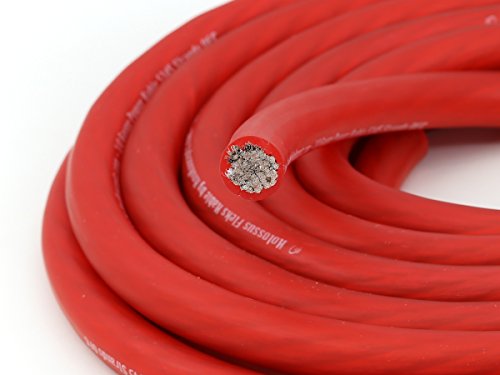
If you want the most bendable pure-copper power wire here, this is it. The conductor is built from 5145 strands of tinned Oxygen-Free Copper, and that tin coating is a protective barrier between the copper and the air, which is what keeps the wire from oxidizing over time. It carries a maximum current rating of 375 amps and a maximum voltage of 1000 volts of direct current, so it is built for demanding 12-volt runs — car audio, solar, marine, and truck installs alike.
This cable carries a 375-amp rating, so it can feed a heavy load without overheating, and it comes in several pre-cut lengths so you can order exactly what your run needs. The EWCS combo above carries a 600-volt rating instead. Owners call it true to size, real 1/0 AWG, and beautifully insulated. The ultra-flex jacket is a soft-touch PVC (a flexible plastic coating) that bends through tight spaces and holds up against abrasion, oil, and extreme temperatures. Strand-count-wise, it is the highest here by a wide margin.
Here is the catch that keeps it out of the top slot for some buyers. A few owners running long distances report the copper strands sliding a little inside the jacket — it went from snug to slightly loose. That is an assembly and quality-control quirk rather than a performance problem, and it does not show up in short, cut-to-length sections. If your run is long and continuous, inspect the jacket fit when it arrives; if it is short and bendy, this cable is a pleasure.
Why people keep coming back: the flexibility is the standout — owners describe bending it into tight curves and running it under carpet without a fight, and the value-for-money reputation runs a close second.
The one thing to check: on very long runs, give the jacket a feel when it lands to confirm the copper is seated snugly.
Reach for this if: you are chasing the softest, most flexible pure-copper cable for short custom runs and want tinned strands for long-term durability.
Look elsewhere if: you need a single long unbroken length, since the tinned build occasionally lets strands loosen inside the jacket.
3. Kimbluth 1/0 Gauge Battery Cable Copper Wire, 3FT Red + 3FT Black
A 3-foot red-and-black OFC pair for battery jumpers and ground straps.
The wire is genuinely well made — buyers single out its quality more than any other trait, and it is 99% pure OFC copper sheathed in a PVC jacket that resists oxidation, gasoline, battery acid, and abrasion. Each cable spans 3 feet in red and black, giving you 6 feet of total copper, and the build handles temperatures from -40 to 105°C and operating voltages up to 600V. It is the pair you grab for a short battery jumper, a ground strap, or a tight high-power hookup.
Where it separates from the pricier picks is in stiffness. This is a multi-strand cable meant for shorter runs, and the jacket is stiffer than the soft silicone-style wire some buyers picture. The wire works perfectly fine for a routing job with gentle bends, but it will resist you on super tight turns. Buyers also note it is not quite as thick as some competing 1/0 cables, though not by much, and terminals still crimp down snugly on 1/0 lugs.
The value is the headline here. This is a budget-friendly way to get a genuine pure-copper 1/0 pair without paying premium-tier prices, and owners upgraded their truck and Jeep grounds and reported great results right out of the gate. Just measure first — 3 feet is a short run by design, and if your project needs more reach you will be sizing up.
Where it delivers
- 99% pure OFC copper, so current flows without the CCA compromise
- PVC jacket resists gasoline, battery acid, and abrasion
- Handles -40 to 105°C and up to 600V
- Short 3-foot red and black pair for jumpers and grounds
Worth knowing upfront
- Stiffer than soft silicone-style wire, so tight bends need extra patience
- Slightly thinner jacket than some rivals
- 3-foot runs are short — measure before you buy
Ideal pick for: the budget-minded installer doing short battery jumps, grounds, or compact high-power hookups who wants real copper without the premium tag.
Hold off if: your run is long or your bends are brutally tight — this stiffer cable wants room to breathe.
4. KnuKonceptz Bassik 1/0 Gauge AWG Primary Automotive Battery Power/Ground Wire Cable – Black 25 Feet
25 feet of true 0 gauge CCA cable at a budget price, rated 200 amps.
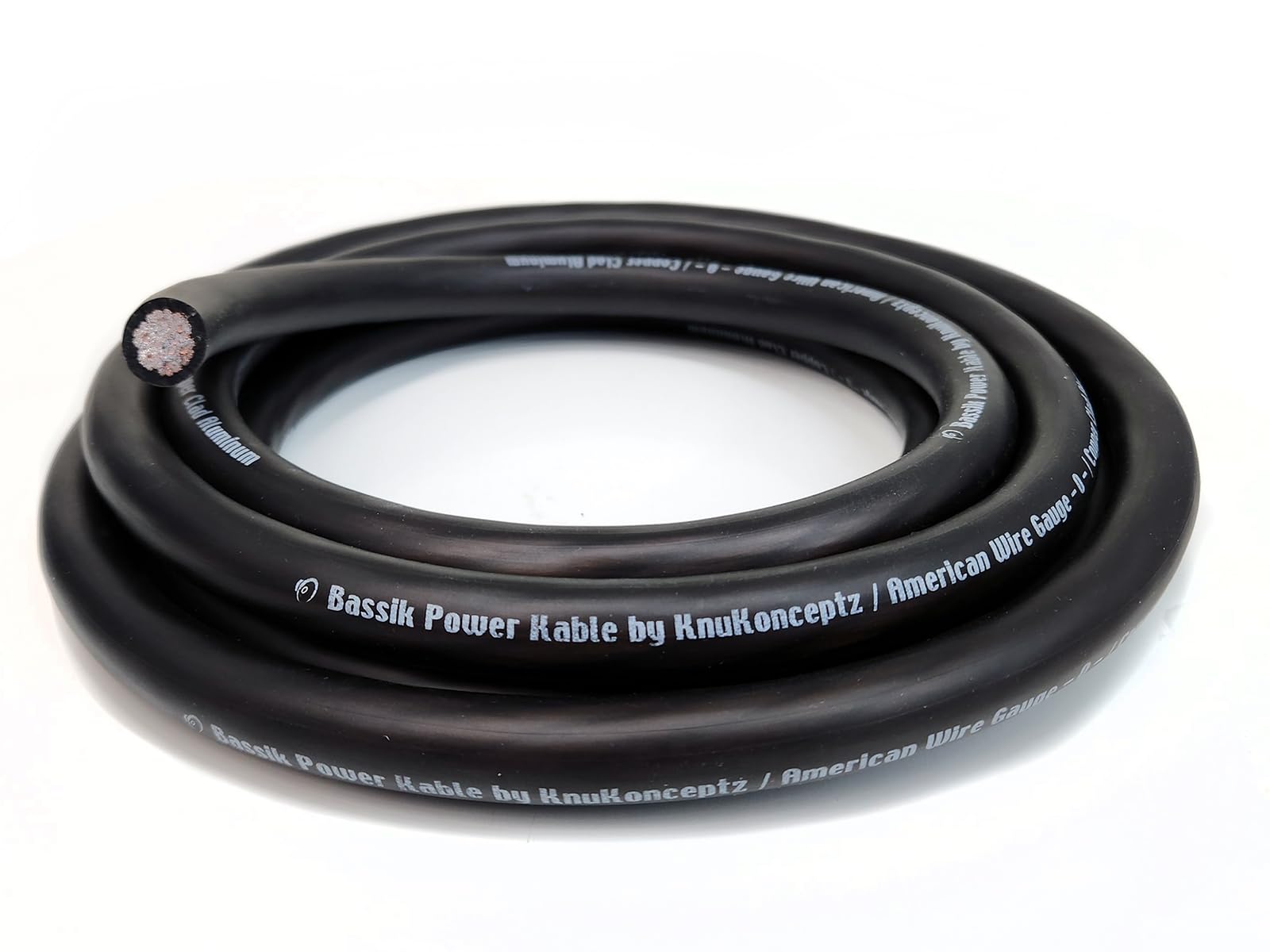
Here is the entry-level way to get 25 feet of true 0 gauge cable for an amplifier feed or a battery relocation. This one is built from Copper-Clad Aluminum, meaning an aluminum core wrapped in copper, which keeps the price down and the weight light. It is rated at a maximum current of 200 amps and is available in pre-cut lengths so you can match your run. For a first amp install or a budget grounding job, it does the work.
Buyers lean on its quality and its flexibility hardest. It routes easily through a vehicle and curves around tight runs without a fuss, and owners relocating a battery to the trunk report it doing exactly what they needed. Order the correct length for your application and this single black cable covers your power or ground side cleanly.
The trade-off is honest and specific: this is CCA, not pure copper, and that means less current capacity for the same thickness than an OFC cable gives you. If you are pushing big power or a long run, step up to a pure-copper pick like the KnuKonceptz Kolossus above. If you are wiring a modest amplifier or a straightforward battery run and want the most feet for your money, this is a smart, lightweight choice.
What it gets right
- True 0 gauge that meets AWG standards for the gauge
- 25 feet in a single run, available in several pre-cut lengths
- Flexible jacket routes easily through the vehicle
- 200 amp rating handles common amplifier and battery feeds
The compromise
- Copper-Clad Aluminum moves less current than pure copper at the same size
- Single color only — you will need a second cable for a matching pair
Snag this for: a modest amplifier or battery run where length and budget matter more than maximum current capacity.
Skip past it if: you are pushing heavy current over a long run — pure copper is worth the step up here.
5. Spartan Power Welding Lead & Car Battery Cable – 600 Volt, 1/0 AWG, 10 Foot, Red

A 10-foot red bulk run of 1026-strand pure copper in an EPDM jacket, ready to cut and terminate.
This is for the buyer who wants raw material rather than a finished assembly. It starts as the same cable Spartan Power uses for its own cables, built from 1026 strands of pure copper in a 10-foot red length. The EPDM jacket resists heat, abrasion, tear, moisture, and oil, and it includes paper separators that make stripping the cable easier when you are terminating your own ends.
The temperature range is the real story — this cable shrugs off conditions from -58°F to +221°F, so it stays pliable in a freezing engine bay and does not soften in summer heat. Owners describe it as pure copper rather than CCA, with flexibility that makes it easy to run, and they consistently call it a great value for genuine 1/0 wire. It works for batteries, solar, and starter cables, and a buyer using it for a “big 3” upgrade reported it doing the job perfectly.
The one thing to note is a recurring gripe about the insulation: opinions split on the thickness, and some owners find the cable runs a touch smaller than the size they expected. It does not affect performance for most installs, but if you are particular about a fat, bulky jacket, this is the trade-off. For DIY cable builders who want US-made pure copper they can trim to fit, it earns its spot.
Why DIY builders like it: the value-for-money consensus is the strongest signal here, backed by durability that owners expect to last several years.
Worth knowing: the jacket thickness draws divided opinions, and some buyers report the size runs on the smaller side.
Best match for: the DIY builder cutting and terminating their own leads from a 10-foot red bulk run.
Another route if: you want a pre-made pair with a color-matched ground cable, or you prefer a noticeably chunky jacket.
6. Shirbly 1/0 Gauge Battery Cable, 10FT Red + 10FT Black Pure Copper Wire

A full red-and-black pair with the highest strand count you will find in a matched set.
This is the pick for anyone who wants both the positive and ground side in one box, each 10 feet long, with plenty of copper and a jacket built for tough conditions. The conductor is fully annealed pure copper made from 1703 strands of 0.2mm copper wire, wrapped in a solvent-resistant EPDM rubber sheath. It is rated to 600 volts and handles temperatures from -58°F to +221°F, while resisting most solvents and holding up against fire.
Both this pack and the EWCS combo at the top of this list give you 10 feet of red and 10 feet of black, but the Shirbly pack adds a higher strand count and a rubber EPDM jacket (a weather-resistant rubber coating) that stays soft and bends into any shape at will. Owners call it solid, well-made cable that cuts easily and crimps well, and the accuracy of the size on the measured gauge earns consistent praise. It also suits a wide range of jobs — automotive, solar, and generator wiring all fall within its reach.
The only snag buyers hit is length. A fair number report needing more than 10 feet for their specific application, which is simply a matter of planning. Measure your run before you order — if you are wiring a full trunk-mounted battery relocation end to end, you may need the longer options. For a shorter matched red-and-black pair, this is a premium-quality pick.
The build quality is the draw: this is the trait owners praise most, with flexibility close behind — the soft EPDM sheath bends into any shape you need.
Measure first: 10 feet per color is generous for many jobs but short for full trunk relocations.
For you if: you want a matched red-and-black pure-copper set with a soft, solvent-resistant EPDM jacket for a moderate-length run.
Consider other options if: your installation spans a full vehicle — you will likely want more than 10 feet per side.
7. TEMCo 1/0 Gauge AWG 20 Ft Red Flexible Pure Copper Welding Cable

Twenty feet of single-run copper for the long welding leads nobody else reaches.
When your job needs one long, continuous run rather than a short pair, this is the cable that answers. It gives you 20 feet in red, built from an annealed 30 gauge Oxygen-Free Copper conductor with 975 strands. It is rated to 600 volts and carries a maximum current of 285 amps up to 50 feet, so it holds its rating across real working distances. The outer diameter lands at 0.526 inches, and it stays flexible from -58°F to +221°F.
The strand count is lower than the Shirbly pair above — 975 against 1703 — but this is a single long run, and the flexibility still earns heavy praise from owners. They describe it as a legit 1/0 cable that routes easily, bends without fighting, and clamps down cleanly. One owner running subwoofers reported it staying cool under load, and another who bought it repeatedly praised how easy it is to feed, bend, and clamp. The EPDM jacket resists cuts, tears, abrasion, water, oil, grease, and flame.
The honest catch is packaging. The cable can arrive wound on a tight spool, and owners mention having to work the curls out before routing it, so budget a little straightening time. That is a shipment detail, not a cable flaw. For a long battery or starter run, a winch lead, or a full set of welding cables, this is a top performer for long single runs.
Why long runs love it
- 20 feet in a single red run — the longest single length on this list
- Annealed 30 gauge OFC conductor with 975 strands
- Rated 285 amps up to 50 feet and 600 volts
- EPDM jacket resists cuts, tears, water, oil, grease, and flame
Small thing to expect
- Can ship on a tight spool that needs straightening before routing
- Lower strand count than the highest-flex picks here
Pick it when: you need one long, continuous 20-foot run for welding leads, a starter cable, or a winch feed.
Look past it if: you want a pre-straightened reel or a matched red-and-black pair from the start.
8. GEARit 1/0 AWG OFC Wire Set, 25 ft Each Red/Black Battery Cable

Fifty total feet of oxygen-free copper for the install that swallows whole systems.
This is the kit for a full-system build that needs serious length on both sides. You get 25 feet of red and 25 feet of black — 50 feet total of stranded oxygen-free copper — for battery power and ground runs, car audio, marine, or inverter use. The color-coded jackets make it easy to keep positive and ground runs straight, and the soft-touch flexible jacket bends through engine bays, trunks, panels, and amp racks. It is rated up to 105°C, and it carries a maximum current of 100 amps.
The 100-amp rating is the lowest on this list beside the budget CCA pick, so this set is about coverage and length rather than raw current headroom. Where it shines is convenience: cut each 25-foot cable to the exact length you need, and you have enough copper to handle a whole harness in one purchase. Owners describe it as stranded OFC that is easy to cut, strip, and terminate, with a flexibility that makes routing pleasant. It is a solid fit for RV battery wiring, marine systems, winch runs, and diesel go-between setups between batteries.
This is the priciest pick here, and owners call that out directly — but the ones who bought it say the quality justifies the outlay, whether they were wiring an amplifier or a pair of diesel batteries. If you want maximum feet of real OFC copper (oxygen-free copper, a purer copper that carries current better) in one go, this is your set. If your goal is a small run, a shorter, lower-cost option will do the same job.
Where it earns its place
- 50 feet total — 25 feet red and 25 feet black — of stranded OFC
- Soft-touch flexible jacket routes through bays, trunks, and amp racks
- Color-coded for clean positive and ground organization
- Rated up to 105°C for hot automotive environments
The honest trade-off
- 100 amp rating is modest for the heaviest current loads
- Highest-quality tier pricing that owners acknowledge is steep
Suits you if: you are wiring a full system — car audio, RV, marine, or inverter — and want 50 feet of real OFC copper in one matched purchase.
Overkill if: your project is a short run, or you need more than 100 amps of continuous current.
Understanding the Specs
OFC vs CCA conductor
OFC stands for Oxygen-Free Copper — pure refined copper with the oxygen removed during the refining process so it conducts reliably and resists corrosion. CCA stands for Copper-Clad Aluminum — an aluminum core with a thin copper layer, which is lighter and cheaper but carries less current for the same thickness. At 1/0 AWG the difference matters most on long runs and heavy loads, since you either buy more copper or accept less headroom.
Strand count and flexibility
Strand count is the number of thin copper threads twisted into the conductor — 975, 1026, 1703, or 5145 strands, depending on the build. More, finer strands mean the cable bends more easily and handles vibration better without cracking. That is why a 5145-strand cable can be tied in knots while a stiff low-strand cable resists every tight bend in your engine bay.
Maximum current rating
Maximum current tells you the most amps the cable is rated to carry — 100A, 200A, 285A, and 375A are all realistic numbers at this gauge. Some cables also tie that rating to a distance, like 285 amps up to 50 feet, because a long run loses more voltage than a short one. Match the rating to your load, and remember that a longer run may need a bigger margin.
Jacket material and temperature range
The jacket is what protects the copper from heat, moisture, chemicals, and physical wear. EPDM is a rubber compound built to resist heat, oil, and moisture, while PVC is a stiffer plastic jacket that still handles battery acid and gasoline. Look for a temperature range like -58°F to +221°F if the cable lives in an engine bay that swings between hot summers and freezing winters.
FAQ
Is 1/0 AWG wire the same as 0 gauge?
Can I use CCA wire instead of pure copper?
How much length do I need for a battery relocation?
What does the amp rating on 1/0 wire actually tell me?
Why does strand count matter for a 1/0 cable?
Is it safe to cut and re-terminate these cables myself?
Will 1/0 wire fit standard 1/0 lugs and terminals?
What is the difference between PVC and EPDM jackets on battery cable?
Can I use welding cable for car audio and battery wiring?
Does 1/0 wire get hot under heavy load?
Final Thoughts: The Verdict
For most people wiring a battery, amp, or welding setup, the 1/0 awg wire winner is the EWCS Premium Extra Flexible Welding Cable combo — 10 feet each of red and black, pure copper with fine 30 gauge stranding (tiny strands that make the cable bend easily), and sunlight- and water-resistant insulation that bends where you need it. If you want the highest strand count and tinned copper for a super-flexible short run, grab the KnuKonceptz Kolossus Flex Kable. And for a full-system build with 50 feet of oxygen-free copper on both sides, the GEARit 1/0 AWG OFC Wire Set is the one to reach for. Match the amp rating to your load and the length to your run — that pairing is what makes a 1/0 AWG install go smoothly the first time.
How We Picked
We do not accept paid placement. Every pick is matched to a real buyer and a real use-case; we do not hands-on test units.
Sources & Methodology
Specifications: manufacturer listings and product documentation. Review insights: verified customer reviews, as of September 2026. Pricing: not shown on this page (it changes often); check the current price via the retailer link.
As an Amazon Associate, Gadgets Feed earns from qualifying purchases. This does not affect which products we feature.