
Our readers keep the lights on and my morning glass full of iced black tea. As an Amazon Associate, I earn from qualifying purchases.
Specs are compiled from manufacturer listings and verified buyer reviews and can change over time — please confirm the key details on the product page before buying.
You want your engine to fire up fast on a freezing morning, not slow-crank and leave you stuck. A 1/0 AWG cable (about as thick as a Sharpie marker) carries the 200–300A your starter, inverter, winch, or car audio amp draws — but only if the copper inside is real, the lugs are sealed, and the jacket bends without a fight. Three things separate a cable that works from one that frustrates you: strand count, metal purity, and whether the terminals come crimped and sealed or loose in a bag.
I’m Min — the founder and writer behind Gadgets Feed. This guide is built by comparing the manufacturers’ published specifications and the patterns across verified customer reviews, so you get each pick’s real strengths and trade-offs instead of marketing spin.
Wire gauge tells you the thickness; strand count and copper purity tell you whether it works in the real world. That is why every pick below was judged on what is actually inside the jacket, not what the listing promises. Here is how the picks stack up in this guide to the 1/0 battery cable.
Our Picks at a Glance


How To Choose The Best 1/0 Battery Cable
Buying 1/0 cable is not about picking the longest roll or the brightest jacket. It is about matching the conductor, the lugs, and the length to the job — a battery relocation, an inverter feed, a winch run, or a car audio power wire. Get those three right and the cable bolts in once and stays out of your way.
OFC copper versus CCA — the biggest fork in the road
OFC (oxygen-free copper) is solid copper all the way through the strands. It carries current with less resistance and less heat, and it is what you want for starter cables, inverters, and any run where big amperage flows continuously. CCA (copper-clad aluminum) wraps a thin copper skin over an aluminum core. It is lighter and cheaper and works fine for moderate car audio and accessory runs, but the manufacturer of one CCA kit here openly recommends switching to OFC for main starter cables and extreme high-power use. Buy CCA for budget car audio and accessory runs; buy OFC for starter cables and inverter feeds.
Strand count and flexibility
Two cables can both say “1/0 AWG” and feel completely different. The difference is strand count — more, finer strands bend more easily around corners. One cable here uses 1703 strands of 0.2mm wire; another packs 4753 strands of 0.12mm. A high strand count is what lets a thick cable thread through a firewall grommet or round a tight battery tray without kinking. If your install path is tight, high strand count matters more than jacket color.
Lugs, heat shrink, and corrosion protection
The connection points are where cables fail. A closed-end lug (a sealed barrel rather than an open tube) keeps moisture, acid, and road salt away from the copper inside. A tin coating over the lug adds corrosion resistance for outdoor and marine use. And 3:1 dual-wall adhesive heat shrink tubing — which shrinks to a third of its size and glues itself to the cable — forms a waterproof seal where the jacket ends. Skip any of the three and you will be re-terminating the cable within a year.
Quick Comparison
| Model | Best For | Conductor | Strands | Length | Amazon |
|---|---|---|---|---|---|
| WindyNation 1/0 AWG Red + Black (2 ft)★ Best Overall | Short battery and inverter leads | Pure copper (OFC) | Fine stranded | 2 ft (Red + Black pair) | Amazon |
| Shirbly 1/0 AWG Flexible Cable (1.5 ft pair)Most Flexible | Tight-space replacements | OFC pure copper | 1703 | 1.5 FT Red + 1.5 FT Black | Amazon |
| Spartan Power Welding Lead 1/0 AWG (5 ft Red)Best For DIY Builds | DIY custom-length builds | Pure copper, EPDM jacket | 1026 | 5 ft Red | Amazon |
| Kimbluth 1/0 Gauge Copper Wire (3 ft pair) | General automotive power runs | 99% pure copper (OFC) | Multi-strand | 3 ft Red + 3 ft Black | Amazon |
| Taukealugs 1/0 Battery Cable CCA (40 ft kit) | Full audio/RV installs on a budget | Copper-clad aluminum (CCA) | Multi-strand | 40 ft total (20 ft + 20 ft) | Amazon |
| Ruikarhop 40FT 1/0 CCA Cable Kit | Budg-Best-for-value long runs | CCA | 1 | 40 ft total (20 ft + 20 ft) | Amazon |
| WindyNation 1/0 Welding Kit (10 ft + lugs) | Inverter and battery backup builds | Pure copper, EPDM jacket | High strand count | 10 ft Black + 10 ft Red | Amazon |
| Conext Link 25 FT 1/0 AWG Ground Wire | Long power and ground runs | Tinned OFC copper | 4753 | 25 ft | Amazon |
| GEARit 1/0 AWG OFC Wire (25 ft Red) | Custom car audio and Big 3 builds | Oxygen-free copper | 10 | 25 ft | Amazon |
In‑Depth Reviews
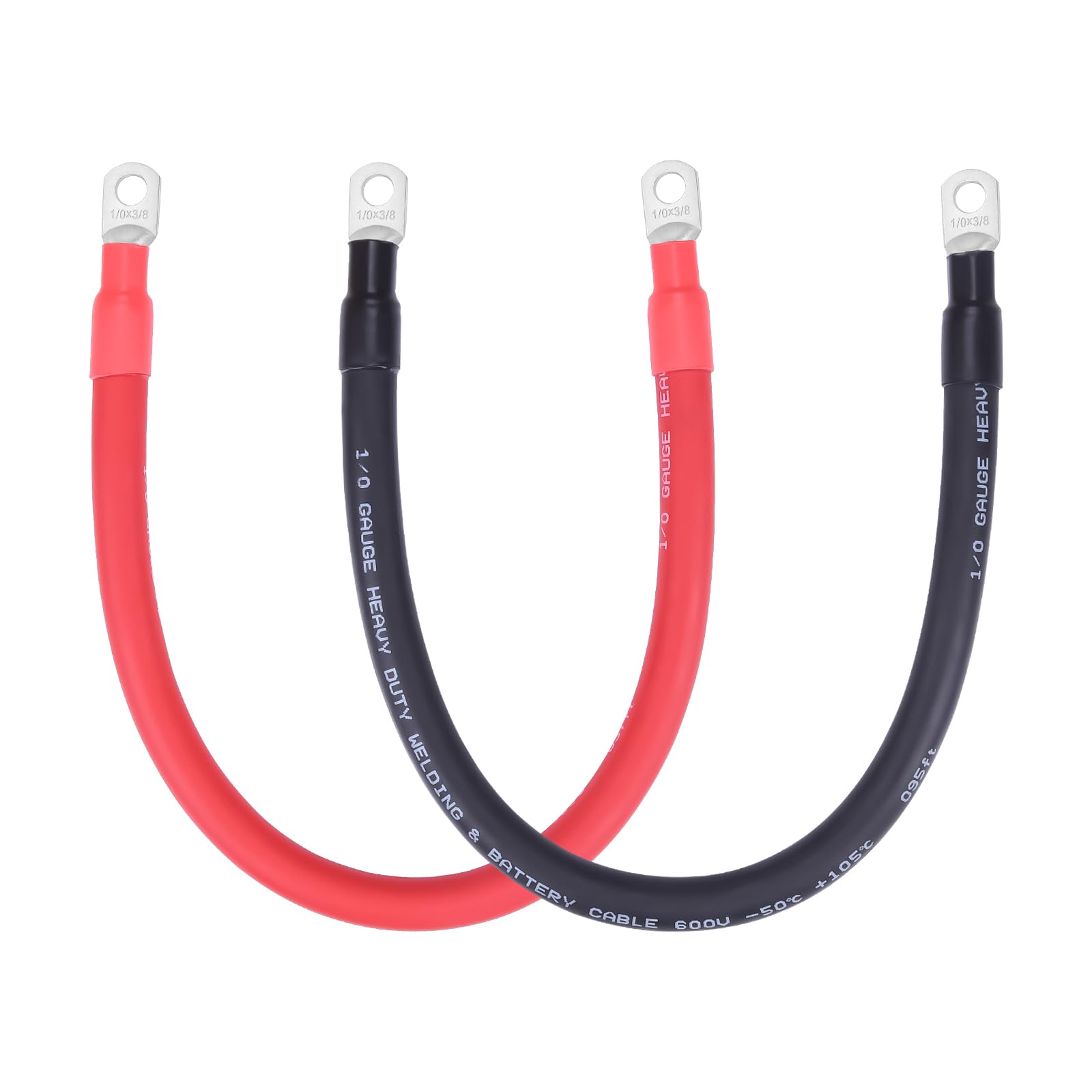
1. WindyNation 1/0 AWG Red + Black Pure Copper Battery Inverter Cables (2 ft, 3/8 in Lugs)
Our pick — over 4.5★ from 900+ verified ratings; the strongest balance of quality and price.
A pre-made short-jumper pair that arrives crimped, sealed, and ready to bolt on.
This is the pick for anyone who needs premium 1/0 cables without touching a crimper. You get one black and one red cable, each 2 feet long, with 3/8-inch tinned copper lugs already closed-end sealed and finished with polyolefin heat shrink. That ready-to-bolt format is why the pair is the crowd favorite here — 4.7 stars across 900+ ratings — and why quality is the thing owners praise most, followed closely by functionality.
WindyNation uses fine-stranded pure copper for the conductor, which keeps resistance low in high-amperage jobs. The tinned lug (a thin tin coating over the copper) fights corrosion, which matters most on marine and outdoor installs. One buyer here put the pair to work as extra ground straps on a 1969-style classic to cure a hot-start fault — a real-world use case these short jumpers fit perfectly. Another points out the value angle: at this price they are cheaper than making the same cables yourself from raw wire and separate lugs.
Two feet is short by design — this is a jumper and inverter lead, not a trunk-run cable. If you are relocating a battery to the back of a car, jump to the longer picks further down. The other honest note from the review pages is durability, where a small handful of buyers wonder out loud about long-term strand fatigue under constant vibration. That is a rare gripe, not a pattern, but it is worth knowing if your install sees heavy movement. As one owner warned, put a circuit breaker inline for safety on any full battery-replacement job.
What buyers rave about
- Quality is the #1 thing owners cite — well over 90 reviews single it out above any other trait
- Arrives crimped, sealed, and heat-shrunk — bolt-on ready, no tools needed at the lug
- Tinned closed-end 3/8″ lugs resist corrosion for marine and outdoor use
- Fine-stranded pure copper stays flexible for routing between connection points
Where it asks you to plan around it
- 2 ft is a jumper length — too short for battery relocation runs
- Only 3/8 in lugs both ends — check your stud size before ordering
Bolt-on ready for you if: you need premium pre-made short leads for an inverter feed, ground strap, or battery top-jumper and want zero assembly.
Order the long version instead if: your battery lives in the trunk — the 2 ft length will not make it, so look at the 10 ft or 25 ft kits below.
2. Shirbly 1/0 AWG Flexible Battery Cable with 3/8″ Terminals — OFC Pure Copper (Red + Black 1.5 FT Pair)
The short-jumper option built from 1703 fine strands of 0.2mm OFC copper — the most flexible 1/0 cable in this lineup.
Where the WindyNation pair above uses a general fine-strand build, the Shirbly cable is defined by a real number: 1703 individual strands of 0.2mm oxygen-free copper, wrapped in solvent-resistant EPDM rubber. That is 66% more strands than the 1026 in the Spartan Power pick below, and it is exactly why owners describe this cable as more flexible than they expected for a 1/0 gauge. In a tight engine bay or a jammed amp rack, that extra strand count is the difference between a cable that threads through and one that kinks.
You get both ends already crimped with 3/8-inch (M10) tinned copper lugs, so you can bolt them straight to your battery and starter without buying a crimper. Each cable also includes 3:1 dual-wall adhesive heat shrink — tubing that shrinks to a third of its size and glues itself to the jacket, unlike cheaper 2:1 tubing that can slide off. The conductor is rated to 600 volts and holds up from -58°F to +221°F, so it survives both a Minnesota winter and a hot engine bay. One owner reports the cable handled a 3-inch bend radius without complaint, and electric fireplace replacement is a common real-world use. Quality is the top thing buyers single out, with value-for-money right behind it.
The catch is the length again: 1.5 feet per cable is deliberately short, so this is a jumper and equipment-lead cable rather than a trunk run. A recurring note in these pages is a slightly premium ask for a very short pair, so if you need length, the 10 ft and 25 ft kits further down give you more wire per dollar of reach. For a tight, short connection where flexibility is the whole game, this is the pick.
The flexible-cable math: 1703 strands of 0.2mm oxygen-free copper in an EPDM rubber jacket, crimped 3/8″ tinned lugs at both ends, and 3:1 adhesive heat shrink in the box — that is a spec sheet that reads like a premium build in a short 1.5 ft pair.
The right cable for tight installs: if you are routing 1/0 through a cramped bay or amplifier rack and want pre-crimped, sealed lugs without touching a tool.
Know before ordering: 1.5 feet per cable is a single short run, so pair two to make a battery-to-ground set.
3. Spartan Power Welding Lead & Car Battery Cable — 1/0 AWG, 5 Foot, Red
Bulk single-conductor wire from Reno, Nevada — 1026 pure copper strands and an ultra-flexible EPDM jacket for people building their own cables.
If you crimp your own lugs and want to buy by the foot, this is the wire to build around. Spartan Power gives you 5 feet of single red conductor made from 1026 strands of pure copper in a 600-volt-rated cable, wrapped in an ultra-flexible EPDM jacket that shrugs off heat, abrasion, tear, moisture, and oil. It is the flagship of the made-in-USA line the company builds daily in Reno, and it arrives as bare wire so you terminate both ends your way.
The jacket is where DIY builders win: thin paper separators under the casing make stripping the insulation quick and clean, which saves real time when you are cutting multiple runs. Buyers describe the wire as flexing like a wet noodle and easy to run, and it is genuine pure copper — one owner explicitly notes it is OFC, not CCA. Reviewers used it for car audio big 3 upgrades with solid power flow and no complaints about connectivity. Value for money is the most-cited positive here, with durability and flexibility tied right behind it.
Two honest caveats show up in this listing’s pages. The insulation thickness draws mixed feelings — some like the thick, tough jacket, and a few would prefer it thinner. And a small number of buyers report the wire running slightly smaller than the advertised gauge. Neither is a dealbreaker, but if you are sizing to a tight conduit, buy a little extra sheath room. One buyer’s red order shipped black by mistake and was swapped fast — the cable itself arrived top quality.
Worth it for the jacket alone: the paper-separated EPDM outer layer strips easily and takes abuse, and the conductor is pure copper rather than CCA — a genuine 1026-strand 1/0 wire rated to 600 volts.
For DIY shops building a “big 3” upgrade or terminating their own inverter cables with proper lugs, this is the wire to buy in bulk.
Reach for this if: you crimp your own lugs and want USA-made 1/0 wire with a durable, easy-to-strip jacket.
Think twice if: you need pre-terminated bolt-on cables — this arrives as bare wire, so factor in buying lugs and a crimper separately.
4. Kimbluth 1/0 Gauge Battery Cable Copper Wire, 3FT Red + 3FT Black

A middle-of-the-road red-and-black pair with a stiff-but-workable PVC jacket and honest 99% copper inside.
Kimbluth’s 3-foot pair is a solid three-foot solution for auxiliary power, ground blocks, and light DIY builds. The conductor is stated as 99% pure copper (OFC), twisted from multiple 0.256mm strands, inside a 90 mil PVC jacket rated from -40 to 105°C and up to 600 volts. Quality is what most owners single out, and functionality is a clear second — the pair just works for what it says it will do.
Compare it against the Shirbly 1.5 ft pair above: this one is 6 feet of total wire (3 red + 3 black) versus the Shirbly pair’s 3 feet combined, so you get twice the length in the box. The PVC jacket is stiffer than the EPDM rubbers used on the Shirbly and Conext Link picks, but buyers still describe it as flexible and easy to route through a truck build. One owner used the pair for an auxiliary power and ground block on a 2002 F250 and finished with a bit left over — a good sign on a 3-foot run.
The most common honest note on this listing is length, where a couple of owners mention the roll came up short of the marketed number. Length is mixed in the review data rather than positive, so measure your run before you cut. And the PVC jacket has a bit of a synthetic smell compared to the solvent-resistant EPDM rubbers, which is normal but worth knowing if the install lives inside a cab. For light-to-moderate residential and automotive power runs, this is a fine everyday pick.
Solid reasons buyers picked it
- 99% pure copper (OFC) — real copper, not copper-clad aluminum
- 6 feet total (3 ft red + 3 ft black) for longer auxiliary runs than most short pairs
- 90 mil PVC jacket resists oxidation, battery acid, and abrasion
- Rated to 600 volts and 105°C — flexible enough to route around a truck frame
Worth knowing before you cut
- Length reads as mixed in the reviews — a few owners say it measured short
- PVC jacket is stiffer and more synthetic-smelling than the EPDM rubber jackets elsewhere here
Your everyday 3-foot pairing: a red-and-black copper pair that covers light automotive, auxiliary, and ground-block jobs while staying affordable.
Consider a different pick if: you need a continuous 15 ft run — this pair tops out at 6 feet of total wire.
5. Taukealugs 1/0 Battery Cable — 0 Gauge CCA Wire with Lugs, 40 FT
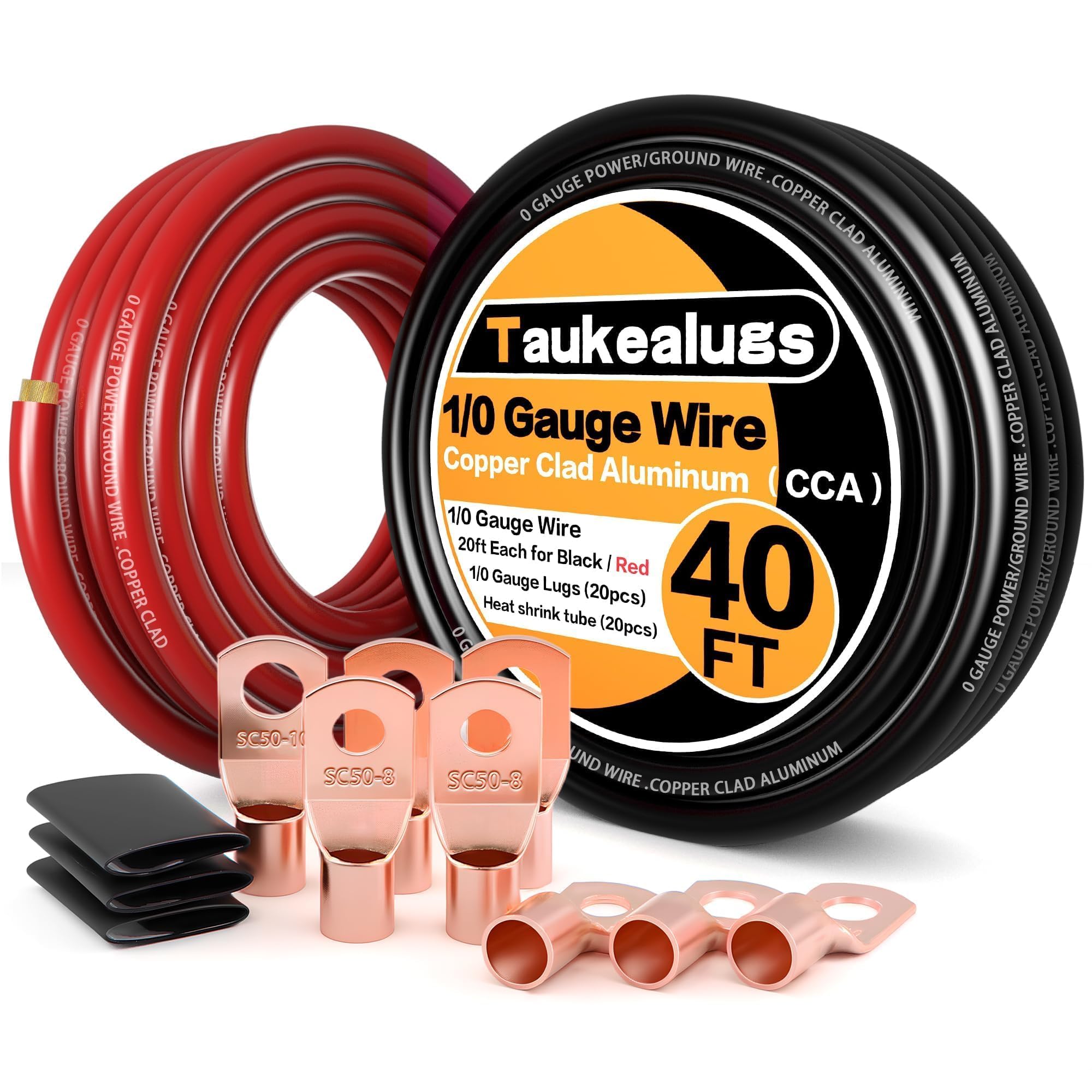
A 40-foot all-in-one starter kit — soft PVC jacket, pure copper lugs, and heat shrink, all in one box.
For a single-package install, Taukealugs strips the guesswork: 40 feet total of 1/0 gauge CCA wire (20 ft red + 20 ft black), 10 heavy-duty pure copper lugs, and 20 pieces of 3:1 adhesive-lined heat shrink. Everything you need for a battery relocation, car audio, or full RV feed arrives together. Functionality is the top thing owners call out in reviews, and the kit does exactly what it says on the label.
Be clear on what you are buying, because it is the biggest fork in this whole category: the conductor is CCA (copper-clad aluminum), not OFC. That means less conductor weight, easier routing, and a lower cost — but the manufacturer’s own product notes recommend stepping up to OFC for a main engine starter cable or extreme high-power competition use. CCA is at its best for amp feeds, RV power, solar inverters, and accessory runs where ultimate current flow is not the goal. The soft PVC jacket stays flexible for tight spaces, resists oil and abrasion, and carries the cable up to 221°F/105°C.
Two practical notes from the review pages. A mild number of buyers question value for money — the kit is premium-priced for a CCA build, so know that going in. And one owner flags that the included lugs come in two sizes, so eyeball the hole diameters before crimping. The 250A rating and pure copper lugs are honest wins, and the VW-1 flame rating means the jacket self-extinguishes if it ever catches. If you want maximum current for an engine starter, buy the OFC kits further up; if you want a full CCA install kit in one click, this fits.
The all-in-one angle: 40 feet of 1/0 gauge wire plus 10 pure copper lugs and 20 pieces of 3:1 heat shrink tubing — a box that gets an entire amp or RV install wired without a second order.
Made for one-box installs: the RV builder, car audio installer, or solar-inverter hobbyist who wants a full CCA kit with lugs and shrink in the box.
Rethink it if: you need it for an engine starter or extreme current — the CCA wire suits accessory and amp runs, not main starter duty.
6. Ruikarhop 40FT 1/0 Battery Cable CCA — 0 Gauge Wire with Lugs

Red and black 0 AWG cable in bulk, matched lugs and shrink included — meant for long runs on a tight budget.
Ruikarhop’s kit is the budget route to a long 1/0 CCA pull: 20 ft red plus 20 ft black (40 ft total), matched lug terminals, and 3:1 heat shrink tubing, all rated to 250A. The red and black jackets give you clear polarity ID, and the PVC sheath is described as elastic and impact-resistant with resistance to abrasion, oil, and high temperatures. Functionality is the top positive here, with value-for-money a very close second — owners routinely note they got twice the cable for a fraction of the price of premium OFC.
One thing to be crisp about before you buy: this is CCA (copper-clad aluminum — a thin copper skin over an aluminum core), not pure copper. That trade-off is the source of the listing’s main gripe. A recurring review theme notes the wire gauge is not true AWG — the buyer’s own comparison puts 1/0 here closer to a 2 AWG equivalent — and that the tinned coating adds more heat and loss than pure copper at high current. Those points matter most on solar or AC-inverter runs where current never stops. Owners who used it for RV battery relocation are happy; owners who pushed it too hard for high amperage are the ones who flag the amperage rating. Buy it for car audio, RV, or trailer wiring and it delivers; buy it for a starter or continuous inverter feed and it will not.
A few practical touches round it out: the included lugs crimp well for a solid connection (one buyer found their hydraulic crimper strained against the thickness), and the insulation holds up for its price class. If budget is the ceiling and you need 40 feet of wire, this or the Taukealugs kit are the two obvious choices here. Just know you are choosing aluminum-core economy, not copper.
Why the value pick earns its spot
- 40 ft total (20 ft red + 20 ft black) — twice the reach for a fraction of the cost of OFC
- Included matched lugs and 3:1 heat shrink, ready to crimp
- Rugged flexible PVC jacket with clear red/black polarity ID
- Rated to 250A — plenty for car audio, trolling motor, and light trailer wiring
Read the fine print first
- CCA, not pure copper — the buyer’s own comparison puts it closer to a 2 AWG equivalent than true 1/0
- Amperage reads as negative in the review data for high-current solar and AC-inverter use
Yes if: you need 40 feet of 1/0 wire for car audio, RV, or trailer work and want to stay in economy territory.
No if: you are wiring solar or an inverter for continuous high current — that is where the aluminum core gives up ground, so look to the OFC picks instead.
7. WindyNation 1/0 AWG Welding Battery Pure Copper Flexible Cable (10 ft Red + 10 ft Black) with Tinned Copper Lugs and Heat Shrink
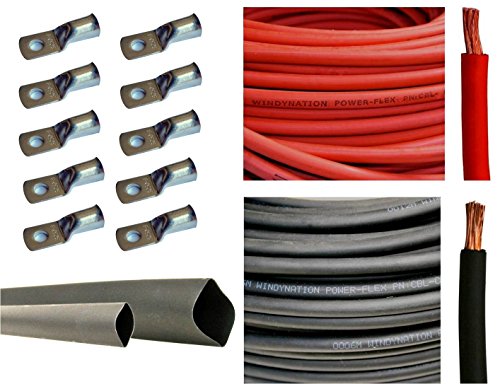
A full inverter-grade kit: 20 feet of pure copper, 10 tinned lugs, and 3 feet of heat shrink in one box.
For the longest runs in this lineup that still ship as a single purchase, WindyNation bundles 10 feet of black plus 10 feet of red 1/0 pure copper cable, 10 tinned copper cable lugs, and 3 feet of black heat shrink tubing rated to 600 volts and up to 125°C. That is 20 feet of run plus every terminal you need, no separate shopping list. Quality is the top positive here, with flexibility far and away the second most-cited trait — and the strand count is high enough to bend around a firewall without fighting back.
Every spec here is built for real battery work: the cable is fully annealed pure copper per ASTM standards, the lugs are pure copper tinned for corrosion resistance with a flared barrel for easy cable entry, and the closed-end design keeps moisture and acid out. One owner pushed this wire to 3000 watts on a 24-volt battery backup system and reported no complaints. Another used it for lead-acid and lithium-iron packs feeding DC-to-AC inverters running ACs, heaters, and hot plates on trips and outages — a heavy real-world workload this kit was designed to handle.
The catch buyers should know: this is bare cable and separate lugs, so you supply your own crimper or solder setup, and the review pages warn that there are no spare lugs if you botch a crimp. Buy an extra pair or two if you are new to crimping. One buyer also flagged that the 3/8-inch lug holes are oversized for 5/16-inch studs, which you can re-drill with a Unibit if needed. Otherwise, for a 20-foot inverter or backup-battery install in pure copper, this kit lands a compelling combination of reach and quality.
The 20-foot inverter package: pure annealed copper cable, 10 tinned closed-end lugs, and 3 feet of 600V heat shrink in one box — everything a long inverter run needs except the crimper.
If your install spans multiple feet between batteries and an inverter, this is the cleanest single-purchase path in the list.
Built for you if: you are wiring an inverter, battery bank, or 20-foot power run in pure copper and want lugs and shrink included.
One thing to head off: the lug count is exactly 10 with no spares — order extras if you are new to crimping 1/0 cable.
8. Conext Link 25 FT 1/0 AWG Full Gauge Battery Power Cable — Frost Blue OFC Copper
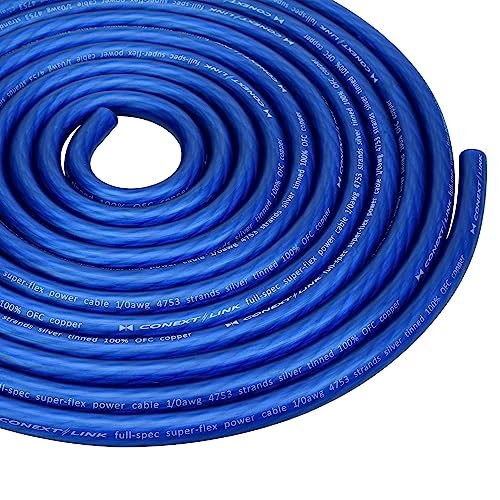
4753 individual strands of tinned OFC copper — the highest strand count in the lineup and the most flexible 1/0 long run here.
Conext Link’s 25-foot single continuous length leads this list on one number: 4753 individual copper strands at 0.12mm. No other cable here packs that many fine strands, which is exactly why owners call it the most flexible 1/0 gauge wire they have used, better than most OFC cables at bending around corners and firewalls. The conductor is 100% tinned oxygen-free copper in a PVC jacket, and it resists heat, oil, chemicals, and abrasion while keeping resistance low. Quality is the leading trait reviewers cite, with flexibility behind it.
This is the pick for a serious single-run install — a rear-battery relocation, a long amp feed, or a big-power ground run that has to snake through a full-size vehicle. One owner ran it from the battery all the way to the trunk of a 2001 Tahoe with a couple of feet left over, feeding a 3000 watt rms amp. Another used it in a Colorado for a dual-amp setup and a big 3 upgrade. The full 1/0 American Wire Gauge is the real thing, not a nominal 0 gauge that measures undersized.
The catch is a physical one: this is a fat, soft-shielded cable, and the review pages flag two things. First, no outer-diameter spec is given, so measure your routing clearance before committing. Second, the shielding is soft enough that it can be nicked with a careless blade guard, so treat it gently around sharp sheet metal. Also worth planning: as one continuous 25-foot run, you will be cutting to length, not trimming a pre-made pair — so have your lugs and crimper ready. For a big single-run install in genuine tinned OFC, this is the reach champion here.
The case for the tinned-OFC long run
- 4753 strands of 0.12mm tinned oxygen-free copper — the highest strand count here for maximum flexibility
- One continuous 25 ft length — enough for a full battery-to-trunk run in a big vehicle
- Resists heat, oil, chemicals, and abrasion with low electrical resistance
- Full 1/0 AWG — not a nominal gauge measured undersized
Plan ahead for these
- No outer-diameter spec given — measure your routing clearance first
- Soft shielding can be nicked by sharp edges — route away from sheet metal
- Bare single-conductor wire — you supply lugs and a crimper
Leads on flexibility: the run to grab when your 1/0 needs to snake through a long, tight path and you want genuine tinned OFC copper.
Caveat to weigh: no outer-diameter spec is published, and the soft jacket wants careful routing around sharp edges.
9. GEARit 1/0 AWG OFC Wire, 25 ft Red 0 Gauge Battery Cable for Car Audio
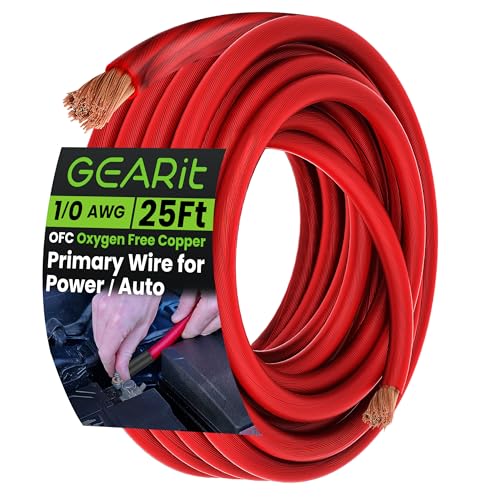
Bulk oxygen-free copper in a single 25-foot red run — sized for amp racks, battery relocations, and Big 3 upgrades.
GEARit’s pick is the bulk-wire option for a serious custom install: 25 feet of red 1/0 AWG oxygen-free copper, rated to 300A, and sold as bare wire so you cut exactly the length you need. The soft-touch jacket bends easily through engine bays, trunks, panels, and amp racks, and the stranded wire strips and terminates cleanly. Quality is the top thing owners praise, with value-for-money right behind — buyers describe it as the premium wire without the boutique-shop markup.
Where does it fit against the two CCA kits above? Those are your budget-run picks; this is the genuine OFC step up. GEARit’s own listing positions the wire for amplifiers, subwoofers, car radio power, battery connections, grounding, and Big 3 upgrade runs when your system calls for true 1/0 AWG copper. Rated to 105°C / 221°F and able to handle 300A continuously, it is a natural fit for a diesel dual-battery link or a high-power amp feed. It also holds up as RV battery wiring, marine, inverter, and winch power when 0 gauge matches the equipment.
The trade-offs are the ones inherent to the class: it is bare wire with no lugs or heat shrink in the box, and the 25-foot roll is one red length — add your own black cable for the return leg. A note in the review pages points out the conductor’s rating is a maximum for the wire, not a guarantee for whatever the ends are connected to, so size your fuse to your equipment. And the 10-strand figure differs from the higher-count picks up top, so if maximum flexibility inside a tight conduit is the priority, compare strand counts before locking in. For premium bulk OFC with ample reach, this is the capstone of the list.
Premium bulk-OFC read: 25 feet of oxygen-free copper in a single red run, 300A-rated and built for amp feeds, Big 3 upgrades, and battery relocations where you cut your own length.
Worth the premium if: you are building a high-power car audio or dual-battery system and want one long OFC red run from a single roll.
Keep in mind: this is bare wire — you provide the black return leg, lugs, heat shrink, and crimper separately.
Understanding the Specs
AWG and 1/0 sizing
AWG stands for American Wire Gauge — the standard way to describe how thick a wire is, where a smaller number means a fatter conductor. 1/0 AWG (sometimes written 0 gauge or “one-ought”) is one of the thickest gauges you will wire by hand, and it is the size you step up to when you need to move serious current over a short distance with minimal voltage drop. Buyers should watch for listings that say “1/0” but quietly deliver a thinner equivalent — one CCA kit here draws a buyer comparison noting its wire measures closer to a 2 AWG equivalent than true 1/0, which matters if current handling is the whole point.
OFC versus CCA — where each one belongs
OFC (oxygen-free copper) is solid copper all the way through the strands, so it carries current with lower resistance and produces less heat under load — what you want for starter cables, inverters, and continuous high-current jobs. CCA (copper-clad aluminum) wraps a thin copper layer around an aluminum core. It is lighter and cheaper, which makes it a fit for car audio and accessory runs, but the manufacturer’s own notes on the CCA kits here recommend stepping up to OFC for main starter cables and extreme high-power use. Match the metal to the job: OFC for starter and inverter feeds, CCA for amp and accessory runs.
FAQ
Is 1/0 the same as 0 gauge?
Will a 3/8 inch lug fit my battery stud?
How long can I run 1/0 battery cable before voltage drops?
Do I need OFC or is CCA good enough?
What gauge wire do I need for a 250 amp load?
Can I use welding cable for a battery cable?
How many strands should a 1/0 cable have?
Is 1/0 battery cable hard to cut and terminate?
What is 3:1 heat shrink and does it matter?
Can I use a 1/0 cable to jump-start another car?
Final Thoughts: The Verdict
For most buyers, the 1/0 battery cable winner is the WindyNation 1/0 AWG Red + Black Pair (2 ft) because it delivers premium fine-stranded pure copper and factory-crimped, tinned, sealed lugs that bolt on without tools. If maximum flexibility in a short run is what you need, the Shirbly 1.5 ft pair packs 1703 fine OFC strands in an EPDM jacket with 3:1 heat shrink in the box. For a 20-foot pure-copper install with lugs and tube included, reach for the WindyNation 10 ft kit. And for a genuine long run of premium tinned OFC, the Conext Link 25 ft ground wire leads on strand count with 4753 individual copper threads. Whichever you pick, match the metal to the job, check your lug hole size, and consider stepping up from the CCA kits to an OFC cable if your install will run continuous high current.
How We Picked
We do not accept paid placement. Every pick is matched to a real buyer and a real use-case; we do not hands-on test units.
Sources & Methodology
Specifications: manufacturer listings and product documentation. Review insights: verified customer reviews, as of September 2026. Pricing: not shown on this page (it changes often); check the current price via the retailer link.
As an Amazon Associate, Gadgets Feed earns from qualifying purchases. This does not affect which products we feature.