
Our readers keep the lights on and my morning glass full of iced black tea. As an Amazon Associate, I earn from qualifying purchases.
Specs are compiled from manufacturer listings and verified buyer reviews and can change over time — please confirm the key details on the product page before buying.
Letting a 1-1/16 inch drill bit spin in the chuck is the fastest way to wreck both the bit and your hole. This size is big enough that the wrong shank wastes your evening, and small enough that people keep buying the wrong one. So here is the short answer: pick a bit by the shank and the point style that match the material in front of you.
I’m Min — the founder and writer behind Gadgets Feed. This guide is built by comparing the manufacturers’ published specifications and the patterns across verified customer reviews, so you get each pick’s real strengths and trade-offs instead of marketing spin.
Shank, point angle, and material decide everything at this diameter. The rest is wood and metal waiting to be cut, which is exactly what this look at the best 1 1/16 drill bit sorts out for you.
Our Picks at a Glance

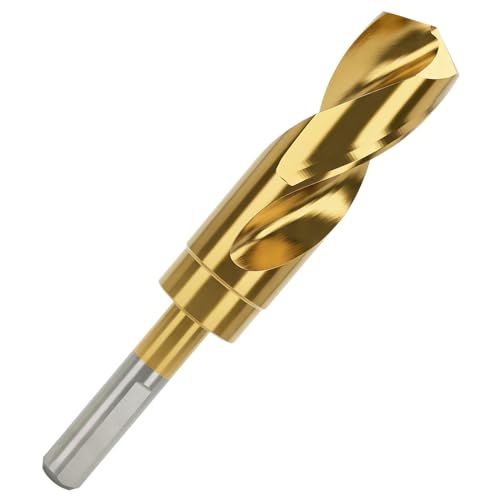

How To Choose The Best 1 1/16 Drill Bit
A 1-1/16 inch bit is a quarter-inch-class jump above the biggest common jobber size, which is why so many of them come with a shank smaller than their cutting end. Match the shank to your drill, then match the cutting end to the material. Get those two right and the rest is feed pressure.
The shank decides whether your drill can even hold it
A standard hand drill chuck usually tops out at half an inch. That is why a bit this wide often ships with a reduced shank — a half-inch stub with three flat faces ground into it. The flats bite into the chuck jaws so the bit cannot spin under load. If you plan to run the bit in a hand drill or a drill press, you want that three-flat reduced shank. If you own a magnetic drill press, look for a three-quarter inch Weldon shank instead, which is a round shank with flats machined in for a set screw.
The point angle changes how the bit behaves when it touches down
A 118 degree point is the traditional angle and it cuts aggressively if you steady the drill. A 135 degree split point is a shallower, self-centering tip that resists wandering across the surface, so curved or polished steel feels less like a chase. A Forstner bit works differently again: it has a sharp center point and a flat-bottomed rim, so it drops a clean, flat hole in wood instead of a pointed one.
Match the steel to the metal you actually drill
Plain high-speed steel handles aluminum, wood, and mild steel well. M2 high-speed steel is the common step up for the same jobs. M35 with five percent cobalt is made for harder stock like stainless. None of it survives an overheated bit for long, so use cutting fluid on metal and clear the chips often.
Quick Comparison
| Model | Best For | Bit Type | Point Angle | Shank | Amazon |
|---|---|---|---|---|---|
| Forstner Drill Bit Black Shark Forged Steel★ Best Overall | Clean flat holes in hardwood | Forstner, 3 flutes | Center point | Reduced cylindrical, 3-flat | Amazon |
| Greycore Tools 1-1/16 Inch Reduced Shank Drill BitTop Performer | One clean hole in steel or wood | Twist, spiral flute | 118 degrees | 1/2″ 3-flat reduced | Amazon |
| Vearter HSS M2 Twist Drill BitMost Versatile | Portable drilling across materials | Twist, parabolic flute, 2 flutes | 118 degrees split point | 1/2″ reduced shank | Amazon |
| KEENTECH Carbide-Tipped Annular Cutter | Many holes in steel plate | Carbide-tipped annular, 2 flutes | Triple-edge | 3/4″ Weldon | Amazon |
| Kolvoii TCT Annular Cutter | Fast cuts in stainless and hard steel | Carbide-tipped annular | Triple-edge | 3/4″ Weldon | Amazon |
| Drill America KFD3F Contractor Drill Bit | Everyday iron and steel jobs | Twist, 2 flutes | 135 degrees split point | 1/2″ 3-flat reduced | Amazon |
| Drill America DWC Series Annular Cutter | Magnetic drill press work on frames | Annular cutter, spiral flute | — | 3/4″ Weldon | Amazon |
| uxcell M35 5% Cobalt Drill Bit | Hardened and stainless stock | Twist, 2 flutes | 135 degrees split point | Reduced shank | Amazon |
| DKIBBITH Bridge Construction Reamer | Aligning and enlarging pre-drilled holes | Reamer, 5 spiral flutes | Tapered point | 1/2″ round, 3 sides | Amazon |
In‑Depth Reviews
1. Forstner Drill Bit Black Shark Forged Steel for Woodworking Size:1-1/16 in
Our pick — over 4.5★ from 150+ verified ratings; the strongest balance of quality and price.
The woodworker’s bit that drills a flat-bottomed hole so clean you could seat a dowel in it by eye.
If your work is cabinets, furniture, or anything where a hole has to look deliberate, this is the one. It’s a Forstner bit with three flutes — the flutes being the spiral channels that carry chips up and out of the hole — and it’s forged from high-speed steel in Austria rather than ground from a bar. Weight is 3.2 ounces and cutting diameter is 1.06 inches.
What wins people over is the finish it leaves behind. It doesn’t tear out in hardwood and plywood, and it bores dense stock like oak and maple without the burning smell that dull bits produce. It also holds true in a handheld drill, not just a drill press, so you can use it the way most people actually work. A three-flat reduced cylindrical shank gives the chuck jaws something to bite.
The honest catch is deep holes. Chips need clearing as you go, or the bit gets hard to pull back out of the cut. Because the flutes are short, you’re removing it often, and one bit covers one size. There’s also a small value grumble from people who find it costly versus a generic bit, but the hole quality settles that argument for anyone doing finish work.
What It Nails
- Flat-bottomed holes with no tear-out in hardwood, MDF, and plywood
- Works in a handheld drill, not only a drill press
- Holds its edge after many borings and takes heat without distorting
Where It Asks More Of You
- Deep holes need the bit withdrawn often to clear chips
- One bit, one size — no second diameter in the box
- Finish quality costs more than a generic wood bit
Right for: furniture and cabinet makers who judge a hole by its edges.
Look past it if: you’re drilling steel — a Forstner is a wood-only tool.
2. Greycore Tools 1-1/16 Inch Reduced Shank Drill Bit, 1/2″ 3-Flat Shank
The single bit to grab when you need one clean hole and don’t want a set you’ll never open again.
The Greycore arrives as one bit in a 1-1/16 by 6 inch size, with a half-inch three-flat reduced shank that keeps it from slipping in a keyed or keyless chuck. It’s the most direct rival to the Vearter above: Greycore gives you one bit while the Vearter ships two, and Greycore trades the plain HSS body for high-speed steel with an industrial titanium coating for added heat resistance.
Sharpness and accuracy are the headline. The 118 degree cutting head and ground edges leave clean holes with little walking, and it takes metal, iron, aluminum, wood, and plastic without complaint. What buyers talk about most is quality, with functionality right behind it — the recurring line is that this bit feels as heavy and as accurate as a premium-brand equivalent, and it holds up to a run of holes in 3/16 steel.
Durability is where reviews split. Most people find it sturdy, but a few report one breaking almost immediately, which usually points to too much feed pressure in a hand drill. The reduced shank lets you mount a bit wider than your chuck’s rated size — that’s a fit trick, not a license to lean on it, and keyless chucks especially will complain.
The case for it: one coated bit that covers wood, plastic, and mild steel without buying a set, and it holds a half-inch chuck securely thanks to the three-flat shank.
The caveat: don’t overpower the reduced shank in a keyless chuck, and drive it with steady pressure rather than force.
Take this one: the weekend metalworker who drills a handful of holes and wants them right the first time.
Step up instead if: you want a spare in the drawer — the Vearter’s two-pack solves that in one order.
3. 1-1/16” HSS M2 Twist Drill Bit with Round Shank, 118° Split Point
Two bits in a blister pack that turn a hand drill into a bridge between home repair and shop work.
Vearter sells this as a double blister pack with two bits, and that’s the sharpest contrast in this group — it’s a two-pack where the Greycore above is a single, and its parabolic flute design moves chips out fast enough to keep heat from building. Total length runs 6 inches, working length 3 inches, and the shank necks down to half an inch so a portable chuck can lock onto it.
The 118 degree split point is built to bite immediately rather than skate around the surface, and the tapered web behind the tip adds strength so the bit resists breakage. The gold oxide finish is a coating that fights corrosion and cuts friction, which in turn runs the bit cooler. Materials span steel, copper, aluminum, brass, zinc alloy, cast iron, wood, PVC, ABS, nylon, and composites — broad enough that one bit covers most of a garage’s jobs.
Functionality is the strong point and it’s not close. One buyer bored clean holes into a bowling ball to fit an interchangeable thumb, matching what a pro shop bit does for a fraction of the cost. Sharpness and quality draw more divided replies, though — some owners find it cuts like butter while a few ran into a bit that dulled early on hard plate. Feed it slow, keep oil on it, and it behaves.
The strong half: a five-material-plus cutter with a parabolic flute that clears chips, plus a second bit in the box as backup.
Where it splits: cutting edges don’t hold up on everything equally — treat the second bit as a spare for the tough jobs, not a guarantee.
A good fit for: anyone who wants two chances at a wide range of materials from one order.
Think twice if: your whole job is stainless — the cobalt bit lower down is the better-matched tool.
4. Kolvoii TCT Annular Cutter 1‑1/16″ Diameter x 1‑3/8″ Depth, Mag Drill Bit
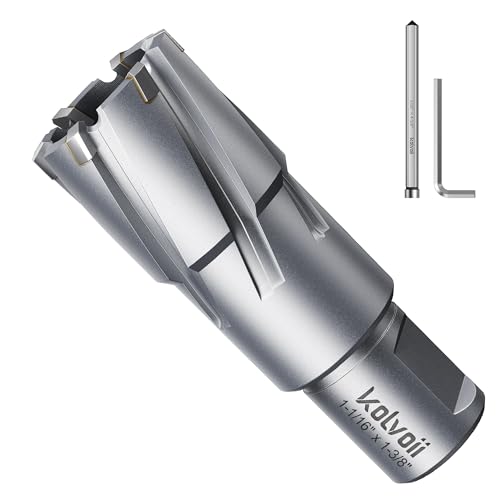
A hole saw that leaves the center behind, so a mag drill eats through plate instead of chewing it.
Annular cutters work like a hollow punch: the teeth cut a ring and the solid slug falls out, which means far less material to remove than a twist bit turning the whole 1-1/16 inch diameter into chips. This one is carbide-tipped, cuts a 1-1/16 inch diameter to 1-3/8 inch deep, and mounts on a three-quarter inch Weldon shank that fits most magnetic drill presses from Dewalt, Hougen, Alfra and similar brands.
Speed is the whole pitch. The three-edge design spreads cutting force evenly, which cuts heat and vibration at the same time, and maker figures put it at three to five times the pace of a standard HSS twist bit in stainless, iron, and hard steel. A pilot pin and hex wrench come in the case. One 4.6-star tool with a following behind it, and the standout evidence is drilling straight through a solid 2 inch steel rod at slow speed with frequent lubrication.
Two things to know before you buy. It is not meant for steel plate harder than 300 HBW, including wear-resistant grades like AR400 and AR500 — one owner found that out when a tooth snapped off on a second cut in AR500 with a bit of chatter. And it must run in a magnetic drill press, not a hand drill. Use cutting fluid rather than water, keep the feed steady, and it stays sharp far longer.
The speed argument: a carbide-tipped annular that removes a ring instead of a full cylinder, which is why it cuts stainless and iron faster than a twist bit of the same size.
The material limit: hardened plate above 300 HBW, including AR400 and AR500, is outside its design window, and its carbide teeth chip under chatter.
Built for: the magnetic-drill-press owner cutting stainless, iron, or mild plate in volume.
Not your tool if: you only have a hand drill, since the Weldon shank needs a mag base.
5. KEENTECH Carbide-Tipped Annular Cutter 1-1/16″ Diameter x 1-3/8″ Depth

Twenty holes in half-inch mild steel and the cutting edges still look new.
The KEENTECH is a 1-1/16 inch diameter carbide-tipped annular cutter with a 1-3/8 inch cutting depth and a three-quarter inch Weldon shank that fits Alfra, Evolution, DeWalt, Vevor, Zelcan, and Hougen magnetic drills. It takes a pilot pin from the start. Where the Kolvoii is built for stainless and hard steel, this one spans carbon steel, stainless, cast iron, and tough alloys — the wider net of the two.
Cutting performance is the loudest story here, and the numbers back it: 20 holes in half-inch mild steel, with and without cutting fluid, left the carbide teeth looking new. Another owner ran it as a sacrificial bit on a lathe through two-inch-thick steel fittings and it still cut like new after multiple passes, though the holes came out slightly rough inside. It also holds up in stainless and cast iron, and it comes with a pilot pin in the box.
The divided note is durability at the teeth. Most owners get long life, a few sheared teeth under harsh use — which is the same failure mode carbide cutters show everywhere when a mag drill chatters. What keeps this honest is the fit: it needs proper clamping, a steady feed, and cutting fluid rather than water. Respect those and it earns its spot near the top of this crowd.
Why It Holds Its Rank
- 20 holes in 0.5″ mild steel with no visible tooth wear
- Cutting performance covers carbon steel, stainless, and cast iron
- Pilot pin and Weldon shank included, ready to load
What To Watch
- Carbide teeth don’t survive chatter from an unsecured mag base
- Cutting fluid matters more than water here
Worth your money if: you drill mixed steel on a magnetic press and want one cutter that covers the range.
Skip past if: you cut nothing but hardened plate — the Kolvoii is the pick aimed at that job.
6. uxcell 1-1/16″ Drill Bit 1/2″ Reduced Shank 3-Flat M35 5% Cobalt HSS

The cobalt bit you reach for when the steel fights back and plain HSS won’t finish the hole.
M35 high-speed steel with five percent cobalt is the headline, and it’s the reason this bit sits in this spot. Cobalt raises the hardness of the cutting edge, so it keeps going in materials that blunt regular bits — alloy cast iron, stainless, and hardened stock. The 135 degree split point ties into that, giving the tip self-centering behavior and a shallower angle that suits hard metal and lowers the odds of chipping the cutting edge.
The finish is a black-and-gold coating that resists corrosion and wear, the two things that end a drill bit’s life first. It’s a reduced shank with three flats, so a half-inch chuck can hold it. Materials listed include steel, alloy cast iron, stainless, iron, copper, aluminum alloys, cast iron, plastics, and wood. The bit fits the same pattern as the Greycore and Drill America reduced-shank twist bits — same half-inch three-flat mount, different steel underneath.
What buyers report is that it does stainless well. One owner drilled through 3/8 inch 316 stainless with no trouble. The caution comes under pressure: durability shows up as a weak point, with the edge chipping when it’s pushed too hard in tough stock. The fix is already suggested in the maker’s own tip — pilot a smaller hole first, use the right coolant, and let the bit cut at a speed it can handle rather than forcing it.
Where it wins: five percent cobalt and a 135 degree split point make this the right bit for stainless, chromoly, and alloy irons that chew up standard HSS.
Where it asks patience: the edge can chip if you feed it too hard in tough metal — pilot, lubricate, and ease the pressure.
Made for: the metalworker who drills stainless and hardened alloys that eat ordinary bits.
Look elsewhere if: your material is soft and forgiving — the titanium Greycore covers that cheaper.
7. Drill America 1-1/16″ Reduced Shank High Speed Steel Black & Gold Contractor Drill Bit
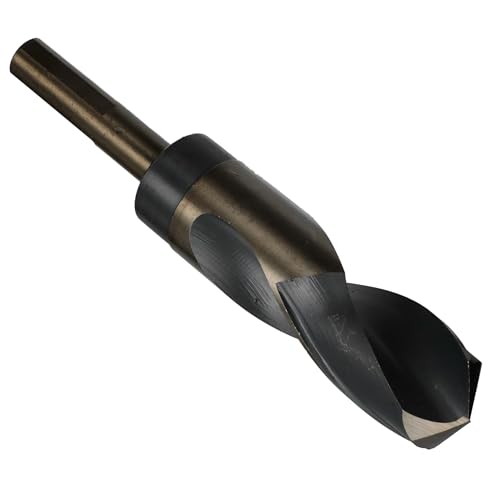
The contractor-grade standby that shows up coated in oil, ready to work, and keeps its edge hole after hole.
Drill America builds this from M1 high-speed steel with a 135 degree split point, a 3 inch flute length, a 6 inch overall length, and a half-inch three-flat reduced shank that won’t spin in the chuck. That 135 degree tip is the key difference from the Vearter above — it self-centers and cuts thrust, so it won’t go walking across a smooth surface the way a conventional 118 degree bit can.
It arrives in a plastic tube case coated lightly in oil to keep it clean, and owners notice. It has drilled clean holes through 2×12 lumber for running cable without splitting the wood, was worked free-handed into soffit with no trouble, and took on drilled-out front spindles for a bump-steer kit. Reports also show it’s effective on irregular surfaces like tapered spindles because the split point centers itself. This is the deepest review pool in the whole list, and the consistency of the working reports is why it earns this spot.
The mixed signals are worth naming. Sharpness has some owners finding it dull from the start and others finding it ready-to-go, and value draws similar split feelings — the usual “you get what you pay for” versus “great price for the size”. Durability is largely there, though a few report one breaking on first use. Buy it for the sizing and the geometry, not as a guarantee against user error.
Why It Earns Its Rank
- 135 degree split point self-centers and resists walking
- Ships oiled in a plastic tube case, ready to use
- Handles wood, spindles, and frame work across a range of jobs
Where Reviews Split
- Some units arrive dull while others are sharp out of the tube
- Keeps its edge for dozens of holes, not hundreds
The pick for: anyone who wants a durable, self-centering bit for mixed iron-and-steel jobs.
Steer away if: you’re cutting stainless — the uxcell cobalt is the better-matched steel.
8. Drill America 1-1/16″ X 1″ High Speed Steel Annular Cutter with Pilot, DWC Series

The frame-cutting annular that plows through truck and bus steel, then looks untouched on the third hole.
This is a plain high-speed steel annular cutter with a three-quarter inch Weldon shank, a pilot pin included, and a 1-1/16 inch cutting diameter at 1 inch depth. It mounts on most magnetic drill presses and cuts a clean ring instead of boring the whole diameter, which is why it goes through a semi truck frame without slowing. It’s simple, straightforward, and preferred by crews that run the same job all day.
What it does best is plow through the kind of steel that scares a hand drill. Owners use it to open holes in bus and truck frames for hitches and accessories, and the reports read the same way — eight holes through a bus frame and the cutter doesn’t look dulled at all, or three bought for a magnetic drill where one has done all the work and still looks new. That durability under repetition is the reason it sits in this crowd even at a higher tier.
The honest flag is that high-speed steel is not carbide, so it dulls faster in the wrong hands. You need steady pressure and clean material — never force it against hard or interrupted steel or the edge goes early. The maker is explicit that it works with a magnetic drill press only, not a standard hand drill or drill press, so a smaller drill won’t hold it. Feed it correctly and it lasts; lean on it and it doesn’t.
The best of it: heavy-duty HSS annular that clears a stack of frame holes on a mag drill without losing its edge.
The reality check: it’s plain HSS rather than carbide, so it holds up beautifully in mild steel and wears early in hardened stock or at the wrong feed.
Suits you if: you run a magnetic drill press on frames, hitches, and structural steel.
One to skip if: your only drill is a hand drill — this cutter needs a mag base to work.
9. DKIBBITH 1-1/16″ Bridge Construction Reamer Drill Bit, M2 HSS Taper Chucking Reamer

Not a drill bit at all, this is the tool that makes two misaligned holes line up so the bolt slides through.
Bridge reamers solve a different problem than the twist bits above: they widen and true up a pre-drilled hole so a bolt or rivet seats cleanly. This one is 1-1/16 inch, built from M2 high-speed steel, and carries five long right-hand spiral flutes — the flutes that pull debris out as you go. The shank is a half-inch round with three sides, so the chuck can’t spin it, and the tip is tapered with a safe stop so it finds its way into an imperfect hole and halts when the cut is done.
The three-flat shank is the smart detail. It keeps the reamer from spinning under load, which is the classic failure when you ream a frame without flats to grip. The tapered tip lets it enter a hole that isn’t perfectly round, which is exactly the case when rust and paint have shifted two frame members out of line. It cuts steel, aluminum, brass, copper, iron, nickel, plastic, and PVC. Functionality is what earns it the space — it does the job it was bought for, most of the time without drama.
The trade-off is honesty worth repeating: this is not a general-purpose hole-maker and it doesn’t pretend to be. It reams a hole that already exists. And on durability, the reports divide — plenty of owners get exactly what they paid for, but a few bent the shaft within the first minute by leaning on it too hard. Ease up on the feed and it does its work; force it and it pays you back in frustration.
The best of it: five spiral flutes and a three-sided round shank that let it align and enlarge pre-drilled holes without slipping.
The reality check: it’s a reamer, not a drill bit — it won’t open a hole from nothing, and it bends if you load the shaft like a bit.
A natural for: frame and structural work where two pre-drilled holes have to line up for a bolt.
Look past it if: you need to drill a fresh hole — start with a twist bit or annular cutter instead.
Understanding the Specs
Shank type: reduced, Weldon, and round
A reduced shank is a stub of shank smaller than the cutting diameter, and on 1-1/16 inch bits it’s usually half an inch with three flat faces. That lets a standard half-inch chuck hold a bit that would otherwise be too wide, and the flats keep it from spinning. A Weldon shank is the annular-cutter version — a three-quarter inch round shank with flats machined in for a set screw on a magnetic drill press. A round shank is the plain version you’d see on a reamer, sometimes with a flat or three for grip.
Point angle and flute count
A 118 degree point is a classic general-purpose tip that cuts aggressively once it bites. A 135 degree split point is flatter and self-centering, so it resists walking in curved or polished steel. Flute count changes how much chip room you get: two flutes leave a deep channel for metal chips, while a three-flute wood bit like a Forstner clears faster but cuts a different kind of hole. More flutes on a reamer mean more cutting edges and steadier tracking.
Bit material: HSS, M2, and M35 cobalt
High-speed steel is the baseline alloy for drilling bits and holds up well in aluminum, wood, and mild steel. M2 is the same family with a slightly tougher chemistry and is common in quality twist bits and reamers. M35 with five percent cobalt is the version aimed at harder stock — the cobalt raises the edge’s heat and wear resistance so it keeps cutting in stainless and alloy irons. The trade-off is that none of them like to be overheated.
Annular versus twist versus Forstner
A twist bit bores the full diameter, turning the entire hole into chips. An annular cutter cuts only an outer ring and leaves a solid slug in the middle, so it moves through plate faster. A Forstner bit has a sharp center point and a flat rim for a flat-bottomed wood hole and it isn’t meant for metal. Pick the shape that matches your material and hole type, then match the shank to your drill.
FAQ
Will a 1-1/16 inch drill bit fit my half-inch hand drill chuck?
What is the difference between a 118 degree and a 135 degree point?
Can I use a Forstner bit in metal?
Do I need cutting fluid when using a 1-1/16 inch bit on steel?
How do I keep a large bit from walking on smooth steel?
When should I use an annular cutter instead of a twist drill bit?
What is a bridge construction reamer used for?
Is M35 cobalt better than M2 high-speed steel?
Why do some 1-1/16 inch bits break on the first use?
How long should a 1-1/16 inch bit last?
Final Thoughts: The Verdict
For most people, the 1 1/16 drill bit worth owning is the Fisch Black Shark Forstner — if you’re drilling wood, nothing else here leaves the hole edges as clean or cuts dense stock like oak and maple as smoothly. If your work is metal, the Greycore covers mild steel, iron, aluminum, wood, and plastic in one titanium-coated bit with a half-inch three-flat shank thatholds a standard chuck. And for hard stainless and alloy stock, the uxcell M35 cobalt bit is the one built for the fight, with five percent cobalt and a 135 degree split point behind it.
Those three cover wood, general metal, and hard metal. If your job is volume drilling on a magnetic press, the KEENTECH annular cutter is the value pick of that group — 20 holes in half-inch mild steel left the cutter looking new. And if you’re lining up pre-drilled holes for bolts on a frame, only the DKIBBITH reamer does that job; the rest are hole-makers, not hole-fixers.
Match the shank to your drill first, then the bit type to your material, and this size stops being a gamble. Buy once, feed it steady, keep it lubricated.
How We Picked
We do not accept paid placement. Every pick is matched to a real buyer and a real use-case; we do not hands-on test units.
Sources & Methodology
Specifications: manufacturer listings and product documentation. Review insights: verified customer reviews, as of September 2026. Pricing: not shown on this page (it changes often); check the current price via the retailer link.
As an Amazon Associate, Gadgets Feed earns from qualifying purchases. This does not affect which products we feature.