
Our readers keep the lights on and my morning glass full of iced black tea. As an Amazon Associate, I earn from qualifying purchases.
Specs are compiled from manufacturer listings and verified buyer reviews and can change over time — please confirm the key details on the product page before buying.
You already know the socket you own is too fat for that recessed water heater anode rod — that’s why you’re here. A 1-1/16″ socket has one job: crack a stubborn, awkwardly-placed nut loose without rounding it, stripping it, or snapping the tool. What separates a clean removal from a rounded nut is wall thickness, steel alloy, and impact rating. This guide sorts nine of them by those exact traits, so you can grab the right one on the first try instead of the third.
I’m Min — the founder and writer behind Gadgets Feed. This guide is built by comparing the manufacturers’ published specifications and the patterns across verified customer reviews, so you get each pick’s real strengths and trade-offs instead of marketing spin.
Some of these are forged for 600 ft-lb impact wrenches, while others are built thin enough to slip into a recessed RV anode opening. Let’s find the right 1 1/16 socket for the job sitting in your garage right now.
Our Picks at a Glance


How To Choose The Best 1 1/16 Socket
A 1-1/16″ socket is a single-purpose tool — it exists to fit one specific size of nut or bolt head, and the fasteners it targets are almost always the awkward ones. Anode rods, mower blade bolts, excavator locking bolts, lug nuts. That means the buying decision is not about brand loyalty; it is about whether the socket physically reaches the fastener, survives the torque, and holds its grip.
Wall Thickness Gets You Into Recessed Openings
This is the number one reason people buy a second socket after the first one failed. A water heater anode rod often sits down inside a recessed well, and a standard-thickness socket — no matter how strong — simply will not drop in far enough to reach the hex head. A thin-wall design solves that by shaving metal off the outer body so the socket slips past the surrounding collar. If you have already tried a socket that “wouldn’t fit,” you do not need a stronger socket; you need a thinner one.
Steel Alloy Determines What the Socket Survives
Look for two steel types on the label. Chromium-Vanadium (Cr-V) is the standard alloy for hand tools and general impact use, and it handles plenty of torque in the sizes you will find here. Chrome Molybdenum (Cr-Mo) is the tougher option, forged specifically for high-torque impact wrenches where a lesser socket can crack. If you are running a corded or cordless impact gun on a rusted nut, Cr-Mo gives you more margin. If you are hand-turning an anode rod with a breaker bar, Cr-V is more than enough.
Deep or Shallow — Match It to the Fastener
A deep socket reaches nuts that sit on a long protruding stud, which is why deep sockets dominate for lug nuts and mower blade bolts. A shallow socket, by contrast, gives you a shorter overall body, which helps in tight or restricted spaces where there is no room behind the nut. Pick deep for a nut on a long protruding stud, shallow for a recessed nut with no room behind it.
6-Point Versus 12-Point Grip
A 6-point socket has six flat contact surfaces and grabs the flat sides of a hex nut, not the corners. That matters enormously on a rusted or rounded fastener, because corner contact is what strips a nut. A 12-point socket is easier to start at an awkward angle but contacts corners, so it is the wrong tool on a stubborn or already-damaged fastener. Every socket on this list is 6-point for that reason.
Quick Comparison
| Model | Best For | Wall Style | Drive / Length | Material & Finish | Amazon |
|---|---|---|---|---|---|
| TEKTON SID23027★ Best Overall | High-torque impact work | Deep, 50BV30 Cr-V | 1/2″ drive / 3.08″ | 50BV30 Cr-V, Manganese Phosphate | Amazon |
| DEWALT DW22952Top Performer | Recessed water heater anode rods | Deep, thin-body | 1/2″ drive / 5.5″ | Steel, Painted | Amazon |
| OEMTOOLS 22369Best for Tight Spaces | Tight, recessed openings | Shallow, thin-wall | 1/2″ drive / 1.06″ | Steel, Chrome | Amazon |
| CRAFTSMAN CMMT15859 | Anode rods on a budget | Shallow, 6-point | 1/2″ drive / 1.27 cm | Alloy Steel, Black Oxide | Amazon |
| Meccion 1-1/16″ Impact | Rusty lug nuts and bolts | Deep, Cr-Mo | 1/2″ drive / 7.8 cm | Cr-Mo Steel, Phosphate Black | Amazon |
| TIGHTSPOT IS12S1-116IN6 | Everyday automotive lug work | Shallow, thin-wall | 1/2″ drive / 6.88 oz | Cr-V Steel, Manganese Phosphate | Amazon |
| Performance Tool W32034 | General repair and anode jobs | Shallow, 6-point | 1/2″ drive / 2.88 oz | Cr-V Steel, Nickel Chrome | Amazon |
| Performance Tool W32334 | Oil pressure sensors and odd nuts | Deep, 6-point | 1/2″ drive / 8.8 oz | Cr-V Steel, Nickel Chrome | Amazon |
| GEARWRENCH 84511N | Impact-rated water heater work | Standard, 6-point | 1/2″ drive / 1.06″ | Cr-Mo Steel, Black Oxide | Amazon |
In‑Depth Reviews
1. TEKTON 1/2 Inch Drive x 1-1/16 Inch 6-Point Impact Socket | SID23027
Our pick — over 4.5★ from 3,000+ verified ratings; the strongest balance of quality and price.
A 50BV30 Cr-V impact socket built to take 600 ft-lb from a 1/2″ impact wrench.
If your 1-1/16″ job involves a powered impact wrench and a fastener that has been rusted solid for a decade, this is the socket that keeps showing up in that conversation. It is forged from 50BV30 Chromium-Vanadium steel — an alloy chosen for hardness and shock resistance — and wrapped in a corrosion-resistant manganese phosphate coating that keeps rust off the tool itself. The deep body means it reaches nuts sitting on long protruding studs, the exact situation you hit on mower blade bolts and truck suspension hardware.
The design details are where it earns its keep. A radiused corner inside the socket applies force to the flat sides of a hex nut rather than the corners, which is the difference between loosening a rusted nut and rounding it into a useless circle. The interior well extends the full length of the socket, so even a partially-threaded fastener gets proper engagement. Two separate size markings — a high-visibility laser etch plus a permanent stamp — mean the label survives years of greasy hands and shop-floor abuse.
You get a socket that keeps working when you push it hard. Owners use it with high torque, and they say it shows no wear. One buyer ran it repeatedly on a 600 ft-lb impact wrench “without any issues.” Another used it to break loose a zero-turn mower’s blade bolts that “took a lot to break those loose,” and the socket “took it like a champ.” It also fits your impact gun: smooth inside walls and a detent pin hole (a small hole that locks the socket onto the anvil) let it grip both friction-ring and detent-pin anvils, so it works with the impact gun you already own.
Where This Socket Earns Its Spot
- 50BV30 Cr-V steel forged for impact wrench use, not just hand turning
- Radiused corners grip the flat sides of fasteners to prevent round-off
- Fits both friction-ring and detent-pin anvils for broad tool compatibility
- Dual laser and stamped size markings survive heavy shop use
The Honest Trade-Offs
- Its deep body and full-thickness wall will not slip into a deeply recessed anode opening
- A dedicated thin-wall socket is the better pick if reach is your real problem, not torque
Grab this one if: you are driving a 1/2″ impact wrench onto rusted, high-torque fasteners and want the durability numbers other owners keep confirming.
Look elsewhere if: your nut is buried in a narrow recessed well where a slimmer socket is the only thing that physically fits.
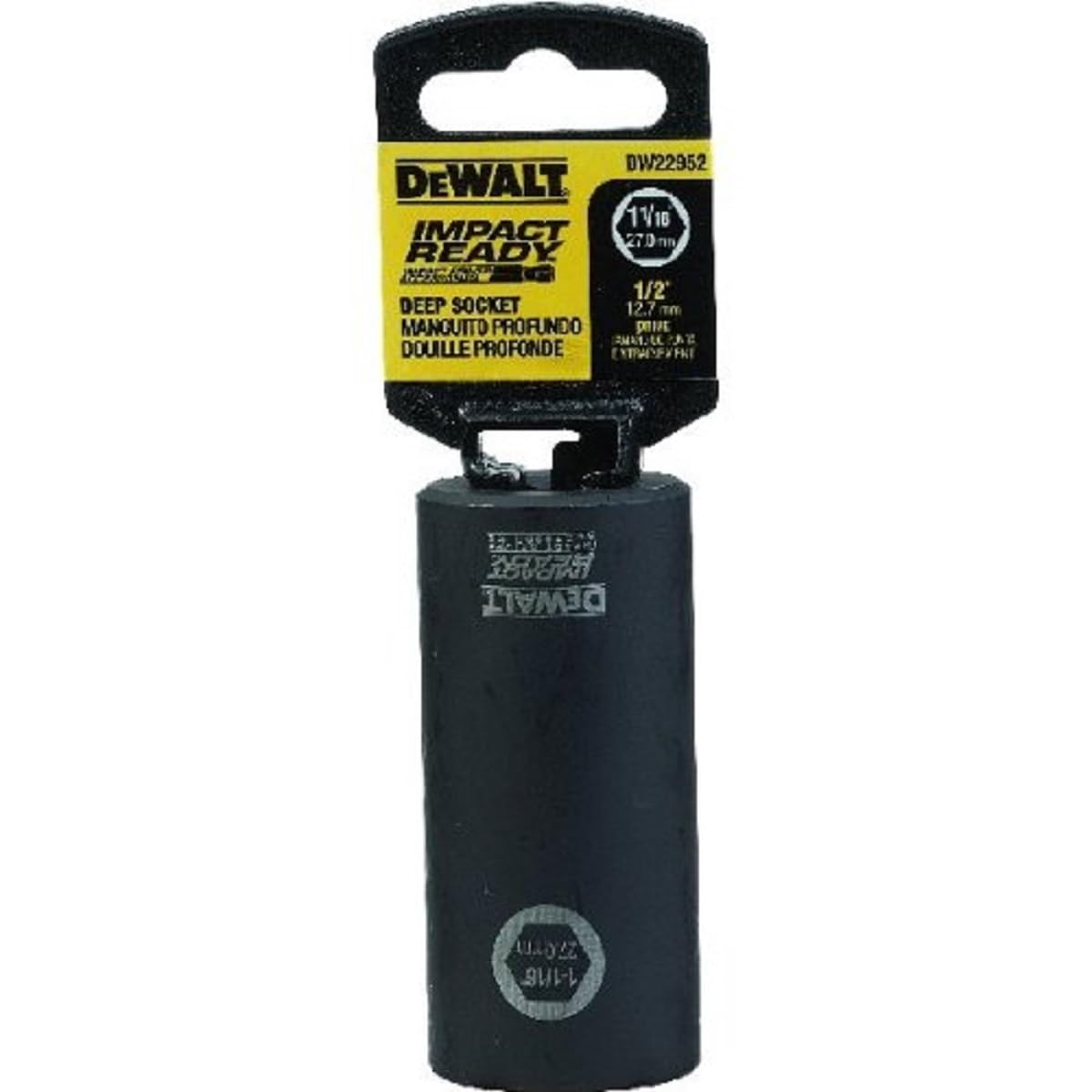
2. DEWALT DW22952 1-1/16-Inch IMPACT READY Deep Socket for 1/2-Inch Drive
The long, lean specialist built to reach a recessed anode rod deeper than a standard socket ever could.
This is the socket people reach for after their first attempt failed on a water heater. It is a deep, impact-ready design with a thinner-than-standard body, and that length is the whole point — a full 5.5 inches, giving it serious reach into a recessed well. Compare it to the OEMTOOLS 22369 above and the difference is stark: 5.5 inches versus 1.06 inches of socket, and 12 ounces versus 5.6 ounces. Those two numbers describe the same trade you are making every time — this one reaches deep, the thin-wall short ones slip into tight collars.
The functional details back up the water heater reputation. Recessed corners distribute torque across the flat sides of the hex head rather than digging into the corners, which is exactly how you avoid mangling a rusted anode rod nut. Large laser-etched markings stay legible so you can confirm the size without squinting. And because it is impact-ready, it is built to be driven by a corded or cordless impact driver, which matters when the fastener you are chasing has not moved in years.
Buyers keep coming back to how long it lasts. The most common job is a stuck water heater anode (the rod inside a water heater that attracts rust). Owners who could not move the rod with a hand socket wrench say they got it loose with an impact wrench and a socket adapter, working in short bursts, and the socket showed no wear afterward. It also opens a rusted water heater anode tube with ease, and its grip is strong enough that it does not slip off the head. The fair limitation: some modern water heater brands put the anode head so far down a narrow recess that even this socket’s reach runs out. That is a physical limit of the heater, not the tool.
Made for: RV and home water heater anode rods, plus any deep-set nut that a short socket cannot reach.
Think twice if: your heater uses an especially narrow, deeply recessed anode design where even a long thin body bottoms out before it grips.
3. OEMTOOLS 22369 1-1/16 Inch SAE Socket
When the anode head is sunk in a depressed collar, this slim short socket is the one that actually drops in.
Picture the frustration: your first socket was strong enough but too fat to seat on a recessed anode head. This OEMTOOLS socket exists to fix exactly that. It is a thin-wall, shallow-length design — just 1.06 inches long and 5.6 ounces — so it slides past a surrounding trim collar that a chunkier socket cannot clear. Where the DEWALT above wins on reach, this one wins on slimness, and for a collared recess the slimness is what gets you a bite at all.
The ergonomics are considered, not an afterthought. Knurling sits where your fingers naturally grip, so you can spin the socket onto a nut by hand before you swing the wrench. Straight knurling also tells you at a glance that it is an SAE size, and a deep marking keeps the size readable. A chrome finish resists corrosion and wipes clean easily. It is 6-point, so it grips the flat sides of the hex rather than the corners, which protects a rusted anode nut from rounding.
Buyers praise how well it fits and works. The standout story is a water heater upgrade gone wrong: one owner bought a 1-1/16″ socket for an old heater, then found the new heater’s anode head recessed so deeply that the original socket would not fit. This thin-wall replacement “worked perfectly.” Owners also use it on a Ryobi electric impact to handle anode rods quickly, and they note it has a nice satin finish and stays sturdy under the moderate torque an anode job demands. But expect the size question to come up. This is a thin-wall socket, and a few buyers with deeply recessed openings still find the sizing surprising. If clearance is your whole reason for buying, measure your recess before ordering.
Reach for this if: your anode head sits inside a narrow, collared recess and a fatter socket physically will not seat.
skip it if: you need a long socket to reach a nut sitting on a protruding stud — the shallow body will not get there.
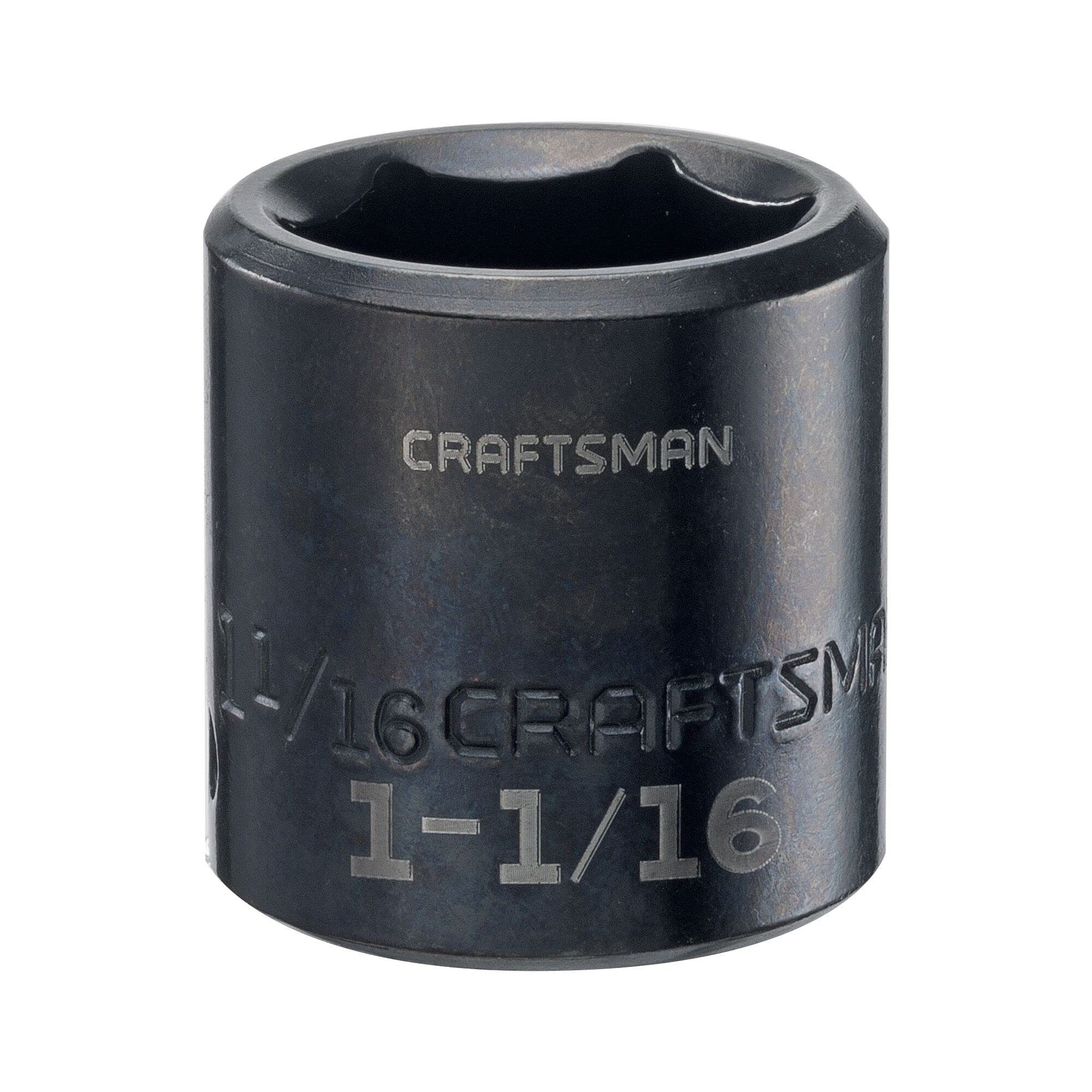
4. CRAFTSMAN CMMT15859 CM 1/2IN DRV SHALLOW SAE-1-1/16IN
A no-drama single socket for the one alternator-sized nut on your RV you touch twice a year.
Not every 1-1/16″ job needs a forged impact monster. Plenty of buyers just want one correct-size socket for a single recurring task, and this CRAFTSMAN shallow impact socket covers that cleanly. It is a 1/2-inch drive, 6-point shallow socket in alloy steel with a black oxide finish that resists corrosion. A 6-point opening applied to the fastener delivers increased torque transfer, and large markings make the size quick to confirm in a crowded toolbox drawer.
The build spec is reassuring for the money: it meets or exceeds ASME specifications, the industry standard that governs socket dimensions and strength. With only a modest number of ratings behind it, this one has far less buyer history than the front-runners here, but those who own it are not reporting drama — the pattern is simple and consistent. RV owners grab it for the water heater anode rod, confirm it is the correct size, and move on.
What surfaces again and again is the RV water heater anode job. Buyers report there are effectively two standard anode sizes and this is the larger of the two, which is the exact detail that saves a wasted order. It arrives as a single socket, so you are not paying for a whole set to get one size you need. If your task is an occasional anode swap or a similar one-off, this is a sensible, low-risk pick.
Who it suits best: the occasional DIYer with a single recurring 1-1/16″ job who wants the correct size without buying a full set.
One limitation to weigh: it is a shallow socket, so it will not reach a nut on a long protruding stud the way a deep body can.
Ideal for: RV and home water heater anode rods on a lean budget.
Not the pick for: high-torque impact work with a thick, deep-set fastener that calls for a longer body.
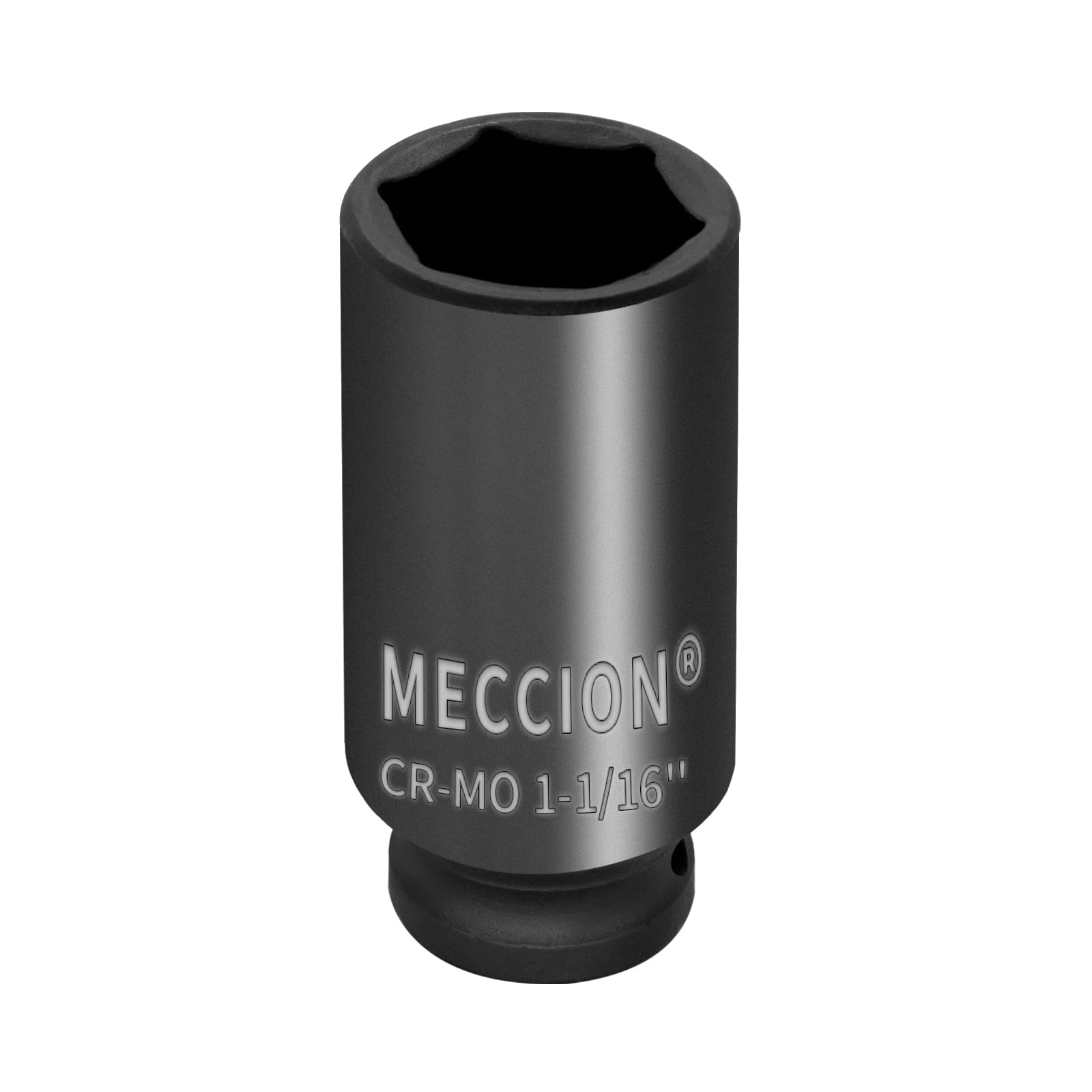
5. Meccion 1/2 Inch Drive Impact Socket 1-1/16 inch SAE, 6 Point Cr-Mo Deep Impact Socket
A Cr-Mo deep socket that treats rusty lug nuts as routine housekeeping.
Here is a socket forged from Chrome Molybdenum steel — the tougher alloy grade — heat-treated for hardness and built to take higher torque from an impact wrench. The body measures 7.8 centimeters in length, a deep profile that reaches nuts on protruding studs. A phosphate black finish gives it wear resistance, impact resistance, and rust protection, and the 6-point opening with inner deep corners is shaped to align onto a fastener quickly and seat as smoothly as possible.
Where it separates from the short thin-wall picks is the terrain it is designed for: automobile maintenance, electromechanical maintenance, and household repair. The label story is solid too — each socket carries laser-marked and permanently imprinted size labels so the marking outlasts the job. This is a socket you grab when the fastener is rusted, the wrench is powered, and you want Cr-Mo’s extra toughness doing the work.
Buyers put it through real punishment. The high point is rusty, stuck lug nuts and bolts: owners mention removing lug nuts that were resisting an electric ratchet wrench, and one describes freeing a lug nut torqued to 350 lb-ft. Ford truck owners swapping suspension parts note the sockets that used to snap under the load now let them pull the bushings without trouble. The honest caveat: fit and size draw some disagreement. For a standard 1-1/16″ application it lands correctly, but confirm your fastener is truly that size before committing, since a mismatched thread is nobody’s fault but the nut’s.
What stands out: Cr-Mo steel and a deep body give you a socket that tolerates a powered wrench on genuinely rusty hardware.
The trade-off: a full-size deep body has no place in a tight recessed collar, so thin-wall jobs still need a different tool.
Pick this for: rusty lug nuts, suspension bolts, and Ford truck maintenance where Cr-Mo toughness pays off.
Pass if: the fastener is buried in a narrow collar that demands a thin-wall body.
6. TIGHTSPOT 1/2″ Dr 1 1/16 Inch Shallow Socket, Anti-Round 6-Pt, CRV Steel

An aerospace-steel shallow socket tuned to grip a trim collar before the fastener slips.
This TIGHTSPOT socket is for the fiddly end of the 1-1/16″ spectrum. It is a shallow 1/2-inch drive socket (a socket that fits a 1/2-inch drive wrench) in Chrome Vanadium steel with a manganese phosphate finish (a coating that resists rust), weighing 6.88 ounces. The radius corner design applies force to the sides of a bolt rather than the tips, which is how it avoids rounding a stubborn head. A chamfered opening (a beveled edge) lets the socket self-align as you drop it onto the nut. The size label is both laser-marked and permanently stamped so it survives years of use.
The design brief for this one was a balance of thickness and strength for tight spaces. That puts it in the same thin-wall family as the OEMTOOLS pick, but with a radius-corner grip that leans harder into anti-round performance. If a bolt head is already partially chewed, a socket that grabs sides instead of corners is your best shot at still getting it loose.
Buyers single out quality most. The standout case is professional-grade repetition: a bus mechanic runs a socket from this family daily on Newflyer bus wheel lug nuts, and after two years of that abuse reports only a fatigue crack. That is a durability statement, not a complaint. Buyers also report a perfect fit with no slippage, and one notes it clears the trim collar around a Rheem gas water heater’s anode. The note to weigh is size: several find it is not quite as small as they expected. If you are buying it specifically for a tight recess, verify the outer dimensions against your clearance first.
Highlight: a chamfered, radius-corner opening makes it grab fasteners other sockets would round off.
Watch for: some owners find the body not as slim as they pictured, so check clearance if that is your reason for buying.
Best matched to: automotive and lug work where anti-round grip and a clean finish matter.
Look elsewhere if: you need a truly minimal-diameter body for a very tight recess and slimness is the deciding factor.
7. Performance Tool W32034 1/2 in. Drive 1-1/16 in. 6-Point Socket

The featherweight shallow socket that makes one-off jobs painless and cheap.
At just 2.88 ounces, this is one of the lightest sockets in this lineup, and that low weight comes with a light price tag too. It is a shallow 1/2-inch drive, 6-point socket in Chrome Vanadium alloy steel with a polished nickel chrome plated finish that shrugs off corrosion and wipes clean. Recessed edges reduce the risk of rounding a fastener, and a large stamping makes the size easy to spot at a glance. The 1-1/16″ size covers a spread of automotive and DIY tasks, from camper water heater anodes to general repair.
The standout practical strength here is the shallow, no-fuss profile. Because the body is short and the load it takes on a typical anode job is modest, it stays in its comfort zone on exactly the tasks most people buy this size for. A beveled mouth helps it guide onto a nut cleanly, and in real use it has come through on a thin nut under substantial torque without stripping.
Buyers reward the value and the fit. The common job is a camper water heater anode rod: owners note it is the exact size required, that it worked perfectly with no issue on quality or size, and that it saved them from buying a whole set for a single job. It is also praised for perfect fit on water heater anode removal generally. One thing to keep in mind: it is not built as a high-torque impact socket, so on a heavily rusted, high-torque fastener you would want the tougher Cr-Mo options above rather than this one.
Why Owners Keep It Around
- At 2.88 ounces it is the lightest socket on this list
- Recessed edges grip flat sides to reduce fastener rounding
- Polished nickel chrome finish resists corrosion and cleans up easily
- Large stamping makes size ID quick in a crowded toolbox
The Compromise
- Not forged as a high-torque impact socket, so it is the wrong tool for a rusted, powered-wrench fastener
- A single shallow body cannot reach a nut set on a long protruding stud
Right choice when: you have a single low-torque 1-1/16″ job like a camper anode rod and want to spend as little as possible.
Wrong choice when: you need a socket to survive repeated high-torque impact use.
8. Performance Tool W32334 1/2 in. Drive 1-1/16 in. 6-Point Deep Socket

The budget way to reach an RV anode rod or an awkward sensor with a deep body.
This is the deep-socket sibling to the W32034 above — same 1/2-inch drive, same 1-1/16″ 6-point opening, but with a longer body for reaching fasteners that a shallow socket cannot touch. It is chrome vanadium alloy steel at 8.8 ounces with a polished nickel chrome plated finish that resists corrosion, and it carries a large stamping for quick size identification. Recessed edges give a precision fit that reduces the risk of rounding the fastener.
The extra length gives you options. A deep body reaches a nut on a long protruding stud and gives you more room to clear surrounding hardware. That is why owners turn to it for water heater and camper anode rods as well as automotive and light industrial jobs. The 6-point opening (a socket with six flat sides) is shaped for a snug, secure connection on the hex head, so it applies turning force on the flats rather than chewing the corners.
What buyers like is the fit and finish. Owners confirm the 6-point design gives a snug, secure bite, and that it handled a water heater anode rod without complaint. It also proves its versatility on mechanical jobs — the socket that worked perfectly on the oil pressure sensor switch of a 2005 Jeep Grand Cherokee, where a dedicated 1-1/16″ socket was exactly what the job needed. A recurring gripe has nothing to do with the steel itself: the brittle plastic packaging can snap when opened with pliers and leave sharp edges or take extra time to pry out, so plan on opening it carefully.
Solid point: a deep body at a low-cost tier lets you reach anode rods and oil pressure sensors without a big spend.
Minor hassle: the brittle packaging can crack under a pliers pull and take a few extra minutes to open.
Suits you if: you need deep reach for an anode rod or sensor on a tight budget.
Not ideal if: the fastener sits in a narrow collar where only a shallow thin-wall body will drop in.
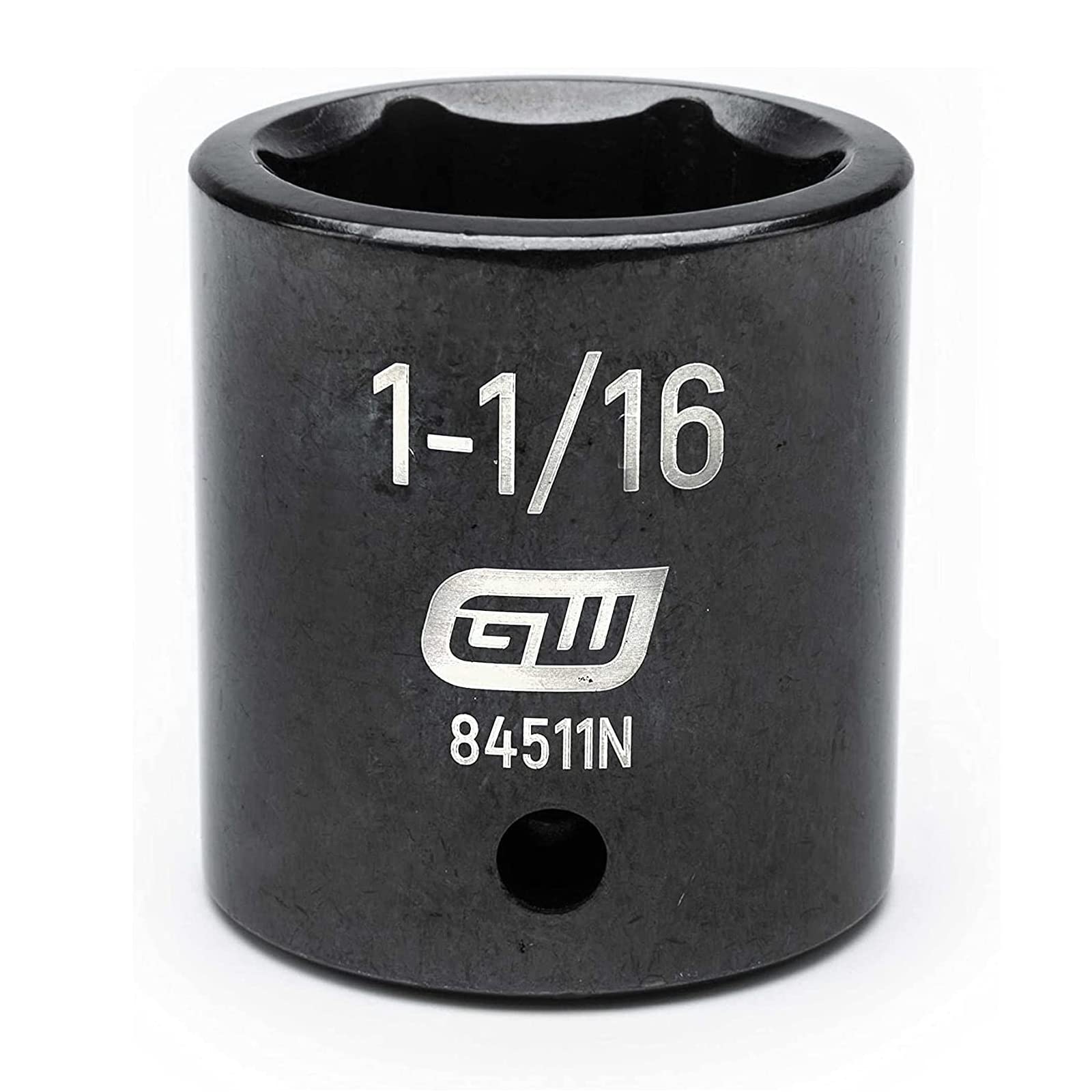
9. GEARWRENCH 1/2″ Drive 6 Pt. Standard Impact Socket, 1-1/16″ – 84511N
A standard-length impact socket in Cr-Mo steel for hot water heater anode duty.
GEARWRENCH builds this one from Chrome Molybdenum alloy steel — the tougher grade favored for impact tools — in a standard-length 1/2-inch drive, 6-point body with a black oxide finish. It measures 1.06 inches and weighs 9.44 ounces, so it is short and manageable rather than long and deep. The 6-point shape contacts the flat sides of the hex head, which protects a rusted fastener from rounding as you apply leverage.
You can think of this as the direct alternative to the OEMTOOLS pick for buyers who want an impact-rated Cr-Mo body instead of chrome. Same compact traditional length, same 6-point grip, but the steel grade is aimed squarely at impact-wrench use. That makes it well suited to hot water heater anode work and any automotive job where a powered wrench is doing the turning.
Owner feedback is straightforward and positive: it gets the anode out of a hot water heater and works great, the material reads as quality and heavy duty, and it matches the listing exactly. The finish draws its own compliments, with owners noting they like the coated look. The one recurring note is origin — a buyer who expected domestic manufacturing was mildly disappointed it is made in China, though they confirmed nothing is actually wrong with it and it works well. If country of origin is not a dealbreaker for you, this is a solid, impact-rated standard socket.
Why it earns a spot: Cr-Mo steel and a 6-point grip make it a dependable impact socket for water heater anode rods.
One fair note: it is manufactured in China, which disappointed one buyer expecting a domestic make — a consideration only if origin matters to you.
Go with this if: you want a compact, impact-rated Cr-Mo socket for water heater and automotive work.
Consider the deep picks instead if: your fastener sits on a long protruding stud and needs extra reach.
Understanding the Specs
Drive Size and Why 1/2″ Matters
The “drive” is the square hole on the back of the socket that your ratchet or impact wrench plugs into. This whole group is 1/2-inch drive, the standard size for mid-to-heavy automotive and appliance work — big enough to take real torque, small enough to fit where a 3/4-inch drive tool cannot. Every socket here fits a 1/2-inch drive tool, so the drive size is a match rather than a variable. If you already own a 1/2-inch ratchet or impact wrench, you are set.
Deep Versus Shallow Length
Length decides what a socket can physically reach. A deep socket has a longer body to reach a nut sitting on a long protruding stud, while a shallow socket has a shorter body that fits into tighter, more restricted spaces. This is why a deep socket and a shallow socket of the same size are not interchangeable for every job — the length, not the size, is often what makes or breaks the task. The picks here range from a compact 1.06-inch body up to a 5.5-inch long-reach design.
6-Point Versus 12-Point Grip
The point count describes how many contact surfaces the opening has. A 6-point socket grips the flat sides of a hex nut, which spreads force and reduces the chance of rounding off a rusted or already-damaged fastener. A 12-point socket engages corners and is faster to seat at awkward angles but is harder on worn fasteners. That is why every socket on this list is 6-point — the fasteners you use 1-1/16″ on tend to be corroded and stubborn, and side-grip beats corner-grip for those.
Steel Alloy and Impact Rating
Two steel grades show up on impact sockets. Chromium-Vanadium (Cr-V) is the general-purpose alloy used in hand tools and lighter impact work. Chrome Molybdenum (Cr-Mo) is the tougher grade forged to survive the repeated hammering of a powered impact wrench. If you are hand-turning with a breaker bar, Cr-V is more than enough. If you are running a corded or cordless impact gun on a rusted nut, a Cr-Mo body gives you the extra margin against cracking. Match the alloy to how you will actually drive the socket.
FAQ
Will a 1-1/16 inch socket fit my water heater anode rod?
What is the difference between a deep and a shallow 1-1/16 socket?
Do I need an impact-rated socket or is a regular chrome socket fine?
Why does a 6-point socket strip nuts less than a 12-point?
My socket won’t fit into the recessed anode opening — what should I do?
Is Cr-Mo steel better than Cr-V for a 1-1/16 socket?
Will a 1-1/16 inch socket work on my Ryobi or electric impact tool?
Do I really need to buy a single socket or should I get a whole set?
How do I keep a 1-1/16 socket from rusting over time?
Which 1-1/16 socket is the best all-rounder for a home garage?
Final Thoughts: The Verdict
For most people hunting for a 1 1/16 socket, the TEKTON SID23027 is the one to buy. It pairs a 50BV30 Cr-V impact body with radiused corners that grip flat sides instead of chewing them. So it holds up whether you drive it with a hand breaker bar or a powered impact wrench, and its durability record across thousands of owners keeps it at the top. If your specific problem is a recessed water heater or RV anode rod, grab the DEWALT DW22952 for its 5.5-inch thin-body reach, or the OEMTOOLS 22369 when the head is sunk inside a narrow collar and only a thin-wall body clears it. And if you simply want a low-cost single socket for one camper anode job, the Performance Tool W32034 does the job without a full set’s worth of spend.
How We Picked
We do not accept paid placement. Every pick is matched to a real buyer and a real use-case; we do not hands-on test units.
Sources & Methodology
Specifications: manufacturer listings and product documentation. Review insights: verified customer reviews, as of September 2026. Pricing: not shown on this page (it changes often); check the current price via the retailer link.
As an Amazon Associate, Gadgets Feed earns from qualifying purchases. This does not affect which products we feature.