
Nothing stops a job site faster than a kinked piece of 1½-inch conduit or a bend that misses the mark by three degrees. The difference between a professional-looking rack of pipes and a scrap bin full of ruined material often comes down to the bender in your hands. With a market flooded by manual rollers, hydraulic jacks, and combo cutter-benders, choosing the wrong tool means wasted material, wasted time, and bruised knuckles.
I’m Min — the co-founder and writer behind Gadgets Feed. I’ve spent hundreds of hours poring over test data, customer feedback, and technical drawings from every major manufacturer to isolate the exact build quality, die precision, and hydraulic force that separates a lifelong tool from a frustrating paperweight.
Whether you’re pulling wire through EMT, building a roll cage, or bending rebar for a foundation, you need a tool that won’t let you down mid-bend. My analysis of the current market has identified the contenders that deliver on the promise of a clean, repeatable curve. This is the definitive guide to finding the best 1 1/2 conduit bender for your specific work.
How To Choose The Best 1 1/2 Conduit Bender
Selecting the right bender for 1½-inch material is not simply a matter of picking the heaviest unit on the shelf. You must match the tool’s mechanical advantage, die compatibility, and stroke length to the specific pipe material — EMT, rigid steel, stainless, or copper — and the bend geometry your job demands. Overlooking the wall-thickness rating or the center-line radius will produce kinks, ovality, and scrapped lengths of expensive conduit.
Hydraulic vs. Manual vs. Roller Mechanisms
Hydraulic benders, typically leveraging a 8-to-12-ton bottle jack, deliver the force required for rigid steel and heavy-wall schedule-40 pipe without exhausting the operator. Manual lever-action benders like the Ideal Guardian work well for thin-wall EMT and smaller diameters but struggle with 1½-inch rigid. Roller benders use a crank-driven gear or screw to gradually curve the material, making them ideal for light fabrication where a sweeping radius is required rather than a tight 90-degree bend. Know your material’s yield strength before choosing.
Die Quality and Center-Line Radius (CLR)
The die set dictates whether your bend comes out smooth or crimped. Precision-machined steel or cast-iron dies with a verified CLR — typically 7 inches for 1½-inch tube — ensure that the material bends around a consistent arc. Cheap dies with oversized grooves or incorrect CLR will pinch the pipe or create a flat spot at the apex of the bend. Look for dies that are labeled with their exact radius and OD compatibility, and avoid universal dies that claim to fit multiple sizes without dedicated grooves.
Frame Rigidity and Base Stability
A bender is only as good as the frame it rides on. Thin-walled tubing frames flex under load, causing the die to walk off-axis and produce an uneven bend. Heavy-gauge steel plate construction with welded gussets and a wide base — or provisions to bolt the tool to a workbench or stand — is non-negotiable for 1½-inch material. A flimsy base that rocks during the bend cycle introduces side-loading that can damage both the bender and the pipe.
Quick Comparison
On smaller screens, swipe sideways to see the full table.
| Model | Category | Best For | Key Spec | Amazon |
|---|---|---|---|---|
| Speedway Motors 3rd Gen Hydraulic | Hydraulic | Roll cage and chassis fabrication | 8-ton jack, 1.50″ aluminum die | Amazon |
| Affordable Bender ab103 | Hydraulic | Vertical hydraulic bending | 8-ton bottle jack, die set included | Amazon |
| VEVOR Tube Roller Bender | Manual Roller | HVAC and aluminum pipe | 360° rotation, 6 dies included | Amazon |
| VEVOR Hydraulic Pipe Bender | Hydraulic | Heavy structural bends | 12-ton dead load, 6 dies ½”–2″ | Amazon |
| Mophorn 1-1/2″ Rolling Bender | Manual Roller | Square and rectangular tube | 14-gauge max, adjustable roller | Amazon |
| Ideal Guardian 74-056 | Manual Lever | EMT and apprentice training | Adjustable angle stopper 22°–90° | Amazon |
| Threlaco Rebar Bender & Cutter | Manual Lever | Rebar cutting and bending | 5/8″ max capacity, Cr-V steel | Amazon |
| Feotech 1½” Liquid-Tight Conduit | Flexible Conduit | Outdoor and EV charger runs | 50-ft, non-metallic, metal core | Amazon |
| VEVOR YP-9 Manual Bender | Manual Lever | Solid round and square bar | 7 dies 1″–3″, 32-lb unit | Amazon |
In‑Depth Reviews
1. Speedway Motors 3rd Generation Hydraulic Round Tubing Bender with 1.50 Inch Die

The Speedway Motors 3rd Gen bender is built specifically for chassis and roll-cage work, where repeatable 90-degree bends in 1.50-inch OD tubing are non-negotiable. The 8-ton hydraulic jack delivers controlled, consistent force, and the incremental marks cast directly into the aluminum die allow you to reproduce exact angles without guesswork. The entire unit weighs under 50 pounds, making it portable enough to move between a shop bench and a trailer, yet the machined steel followers and welded frame keep everything rigid under full load.
Where this bender shines is its precision out of the box. The die is machined for a 7-inch center-line radius, and users consistently report smooth, kink-free bends on mild steel tubing up to .110-inch wall and chromoly up to .096-inch wall. The jack mechanism is noticeably better quality than the generic bottle jacks found on competing units — no wobble during extension and a solid base that stays planted. The compact footprint also means you can mount it permanently or use it as a portable station.
The main limitation is the die design itself: some users measured the actual CLR at 7.5 inches rather than the advertised 7.0, so if you’re matching an extremely tight spec, verify your geometry beforehand. Additionally, the bender is limited to 90-degree bends — you won’t get a full 180-degree sweep from this unit. But for professional fabrication where every bend must land on the same mark, this is the most reliable hydraulic package in its class.
Why it’s great
- Machined aluminum die with precise incremental marks for repeatable bends
- Superior 8-ton jack with smooth, controlled extension
- Portable under-50-lb design suitable for shop or trailer
Good to know
- Actual CLR may measure 7.5″ instead of advertised 7.0″
- Limited to 90° maximum bend angle
- Additional die sizes are expensive
2. Affordable Bender ab103 1-1/2″ Hydraulic Tube Bender

The ab103 from Affordable Bender brings a vertical hydraulic configuration to the table that changes how you set up a bend. Instead of laying the bender flat, the vertical orientation lets gravity work with you — the tube stays aligned in the die groove without needing a second pair of hands. The included die set is ready out of the box for 1½-inch tubing, and Affordable Bender sells additional size dies separately, making this a modular system that grows with your needs.
Users with years of bending experience consistently praise how easy the vertical bender is to control. The 8-ton bottle jack provides ample force for 1½-inch rigid steel, and the setup time is minimal compared to horizontal counterparts. For roll-cage builders and pipe fitters who need clean, consistent 90-degree bends, the ab103 delivers without the bulk of a larger industrial unit. The return spring, however, is an aftermarket addition — the jack does not automatically retract, so you’ll need to manually relieve the pressure after each bend.
The max bend is 90 degrees, and the die’s center-line radius has been reported to run slightly larger than spec for some users, which can cause a pinch on thinner-wall material. The unit also lacks a degree pointer, so you’ll be counting pump strokes or using a protractor for precision. But for the price point, the ab103 offers a genuine hydraulic bending solution that outperforms manual benders on thick-wall material without requiring a + investment.
Why it’s great
- Vertical design improves tube alignment and setup ease
- Modular die system — additional sizes available
- Strong 8-ton bottle jack handles rigid steel
Good to know
- No return spring on the jack — manual retraction required
- Lacks degree markings or pointer on the die
- CLR may vary slightly from specification
3. VEVOR Tube Roller Bender Max 1-1/2″
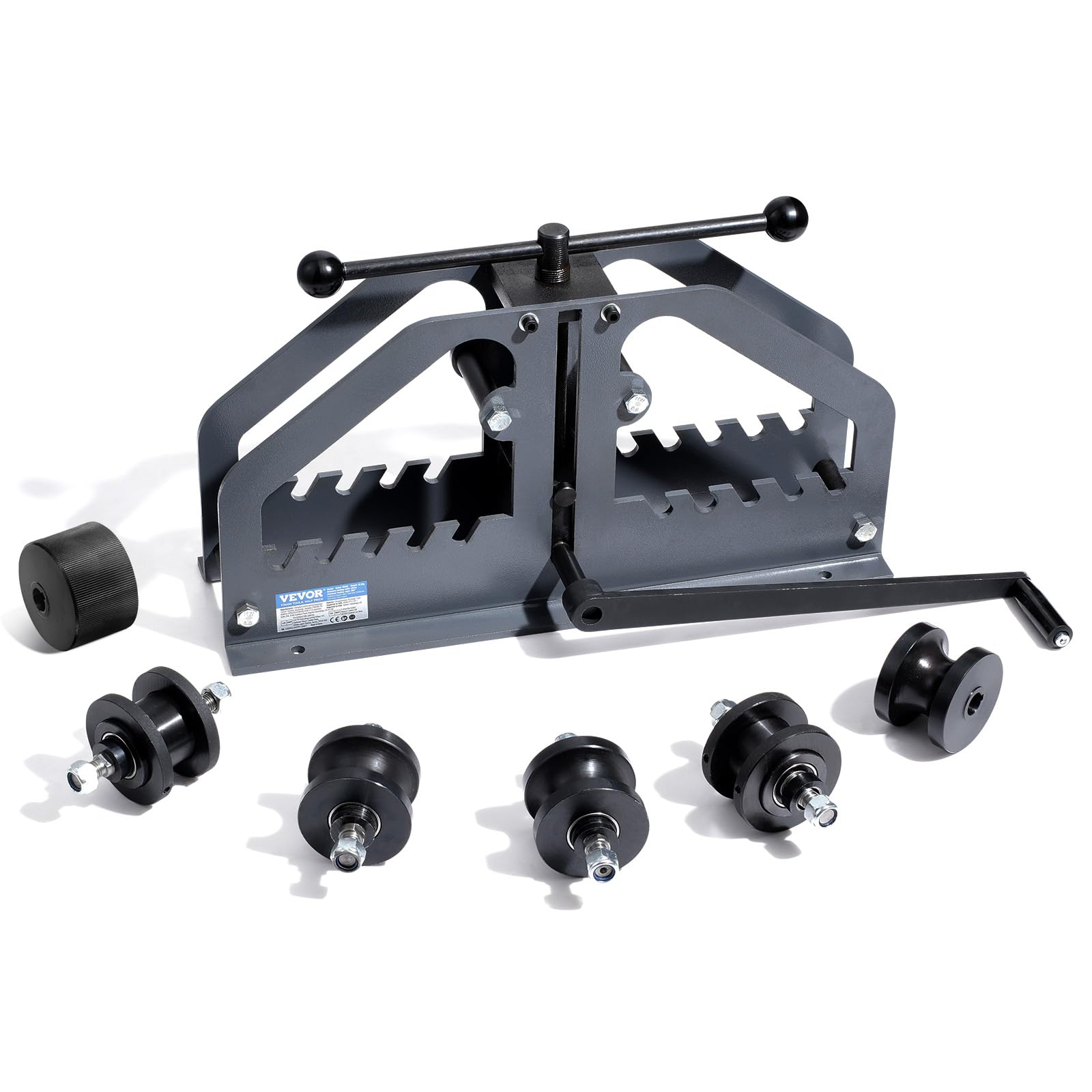
VEVOR’s tube roller bender distinguishes itself with a 360-degree bending capability that hydraulic benders simply cannot match. Where hydraulic units are capped at 90 degrees, this manual roller can produce full circles, sweeping arcs, and continuous curves in aluminum, light steel, and copper. The six included dies — three square, three round — cover the most common profiles in HVAC, auto repair, and metal furniture fabrication.
The crank-driven mechanism gives you direct tactile feedback on the bend progress, allowing you to stop at the exact moment the curve matches your template. Users have successfully rolled matching hoops for decorative gates and air-conditioning lines with minimal trial and error. The carbon steel frame is robust, though the unit absolutely must be bolted to a stand or bench — at 72 pounds, it is heavy enough to stay put during operation, but the lever forces require a solid anchor to prevent the base from walking.
The key trade-off is wall-thickness capacity. This bender is rated for low-carbon steel up to 0.08-inch and aluminum up to 0.16-inch — anything thicker will require either a hydraulic bender or a heavier-duty roller. Some users have reported that the dies need initial lubrication and a few test passes before they run smoothly. Additionally, the packaging has been inconsistent, so inspect the unit for any transit damage before your first bend. For anyone building custom curves in thin-wall tube, this is the most flexible tool in the guide.
Why it’s great
- Full 360° rotation for circles and long sweeping arcs
- Six precision dies for square and round profiles
- Manual crank gives precise, feel-based control
Good to know
- Limited to steel under 0.08″ wall and aluminum under 0.16″
- Must be bolted to a sturdy base for stable operation
- Dies may need initial break-in for smooth rolling
4. VEVOR Hydraulic Pipe Bender 12 Ton

When the job calls for bending thick-wall 1½-inch rigid steel conduit or schedule-40 pipe, the 12-ton rating on this VEVOR hydraulic bender sets it apart. Most competing units in the same price bracket max out at 8 tons, meaning they stall or struggle on heavier schedules. The adjustable rollers offer 90-to-180-degree positioning, giving you flexibility for structural railing, boiler piping, and bridge construction where standard 90-degree bends won’t suffice.
The die set covers the full range from ½-inch to 2-inch, which makes this an excellent choice for contractors who encounter multiple pipe diameters on a single site. The four-leg base provides stability on uneven ground, and the return spring system helps retract the ram after each stroke. Users report that the hydraulic action is smooth and the dies are cast with clean grooves that don’t mar the pipe surface.
Quality control has been the primary pain point. Some units have arrived with missing retaining pins or poorly drilled holes that can cause the pins to slip out under load. The customer service experience has also drawn criticism — resolving missing-part issues can take weeks. If you receive a complete unit, the performance is outstanding for the price. But budget extra time to inspect every component and, if possible, purchase through a vendor with a strong return policy.
Why it’s great
- 12-ton capacity handles thick-wall rigid and schedule-40 pipe
- Six dies cover ½” to 2″ diameters
- Adjustable rollers for 90°–180° bend angles
Good to know
- Inconsistent quality control — some units missing retaining pins
- Poor customer service response times reported
- Heavy unit at 69 lbs; needs a stable mounting surface
5. Mophorn 1-1/2″ Tubing Rolling Bender
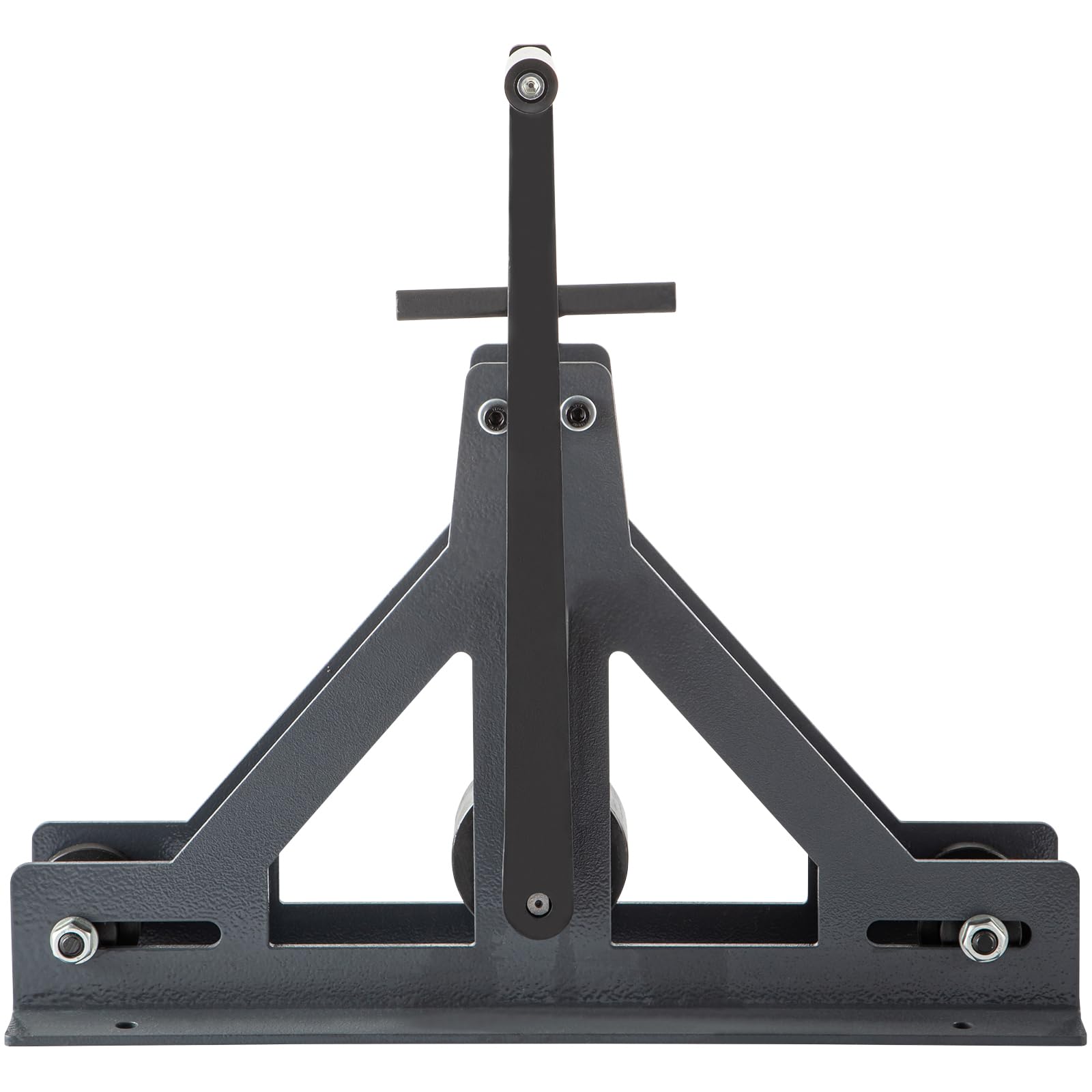
Mophorn’s rolling bender is engineered specifically for square and rectangular tube profiles — a niche that standard round-die benders cannot handle. If you’re fabricating wrought-iron gates, handrails, or furniture frames from 1½-inch square or rectangular stock, this tool fills a gap that hydraulic benders leave open. The triangular base and thickened screw rod provide the rigidity needed to prevent the tube from twisting off-axis during the roll.
The adjustable roller allows you to set the minimum radius down to 180mm for 20mm material, which gives you control over the tightness of the curve. Users bending 14-gauge 1½-inch tubing report that the tool produces acceptable arcs without significant flattening of the inside wall. The long-handle lever provides decent mechanical advantage, though the bending process is slow — this is a precision tool, not a high-volume production unit.
The build quality is where this bender demands attention. Multiple users have received units with stripped set screws, misaligned pin holes, or rollers that already show groove wear after a single tube. The handle retention mechanism has a known issue where the set screw is drilled at an angle, preventing it from locking the handle securely. Plan on spending an hour with thread taps and lubricant to get the unit working as intended. If you’re willing to perform that initial tuning, the Mophorn delivers results that justify the effort.
Why it’s great
- Purpose-built for square and rectangular tube profiles
- Adjustable roller for variable bend radius control
- Triangular base improves stability during rolling
Good to know
- Frequent out-of-box issues — stripped screws, misaligned holes
- Rollers show wear after limited use
- Requires tuning before first use
6. Ideal Electrical 1/2 in. EMT Guardian Bender with Handle (74-056)

The Ideal Guardian is the bender that changes the game for electricians running ½-inch EMT — not 1½-inch rigid — but its adjustable angle stopper deserves attention as an innovation in the conduit bending category. Where traditional benders rely on your eye and a level to hit 30, 45, or 90 degrees, the Guardian locks into the selected angle with a physical slider. This removes the guesswork for apprentices and reduces the rework rate for experienced journeymen on repetitive box offsets and saddle bends.
The ductile iron head is built to survive years on a truck bed, and the handle doubles as a straight-edge guide for marking pipe. The bend correction hole in the head allows you to fix an over-bend without scrapping the pipe, which alone can save material costs. Users with 20 years of experience report that they still prefer this bender for free-air bends and three-point saddles because the lockable angle eliminates the need for a protractor on every shot.
Because this is a ½-inch EMT bender, it is not a direct answer to the 1½-inch conduit bending question. But if your work involves mixed-diameter runs where small-radius bends are the bottleneck, adding the Guardian to your kit will accelerate your workflow on the light side of the job. Do note that the bend is not perfectly level every time — you will still need to check your work with a spirit level on critical offsets.
Why it’s great
- Adjustable angle stopper locks at 22°, 30°, 45°, 60°, or 90°
- Ductile iron head for long-term durability
- Bend correction hole reduces material waste
Good to know
- Only supports ½″ EMT — too small for 1½″ conduit
- Bends may still require leveling for perfect alignment
- Heavier than a standard aluminum head bender
7. Threlaco Rebar Bender & Cutter 2 in 1
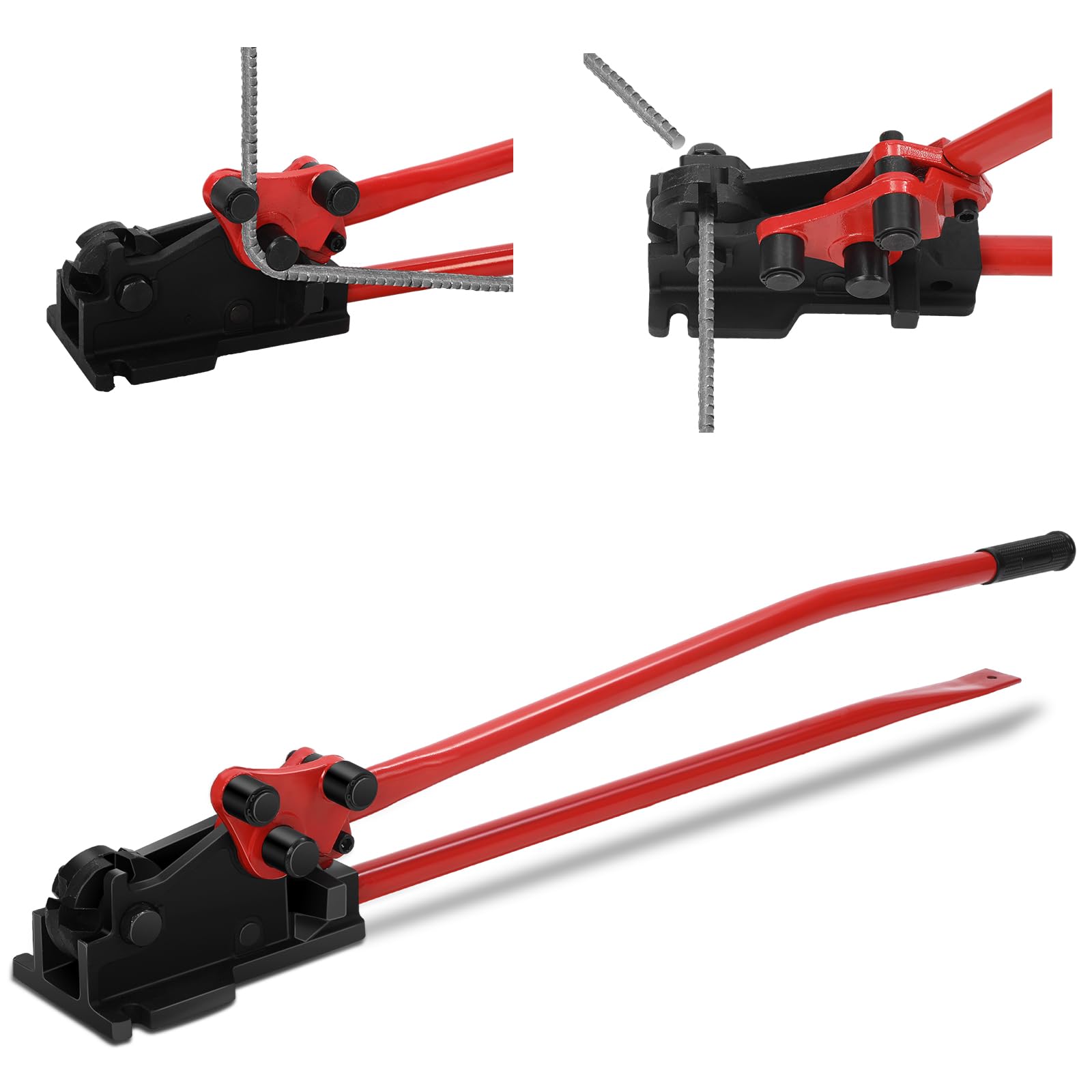
When rebar is part of your daily workflow, the Threlaco 2-in-1 eliminates the need to switch between a cutter and a bender. The chrome-vanadium steel construction and heat-treated cutting blades handle ½-inch rebar with clean cuts and 5/8-inch rebar with moderate effort. The bending mechanism uses the same lever to produce 90- or 180-degree bends, keeping the process efficient for tying cages, foundation grids, and retaining walls.
The safety chain prevents accidental loosening during operation, and the cutting mouth includes protective devices to keep your hands clear. The tool must be screwed to a 2×6 base plate for stability — the leverage required for 5/8-inch rebar will tip an unmounted unit. Users report that the tool feels well made and that the cutting performance on ½-inch (#4) rebar is excellent right out of the box.
The cutting teeth have been reported to struggle with 5/8-inch rebar, requiring considerable effort to get through. The bender is also physically demanding — repeated bending cycles will fatigue your arms, and the tool lacks a return spring or quick-release mechanism. For rebar-only jobs, this is a space-saving upgrade over carrying separate tools. For general conduit bending, however, this unit is purpose-built for reinforcement steel and will not work on EMT or rigid pipe.
Why it’s great
- Combines cutting and bending in one tool
- Heat-treated Cr-V steel blades for durability
- Safety chain and hand guards reduce injury risk
Good to know
- Cutting 5/8″ rebar is difficult
- Must be bolted to a stable base
- Physically demanding for repeated use
8. Feotech 1 1/2 Inch Flexible Conduit 50 FT Non Metallic Liquid-Tight
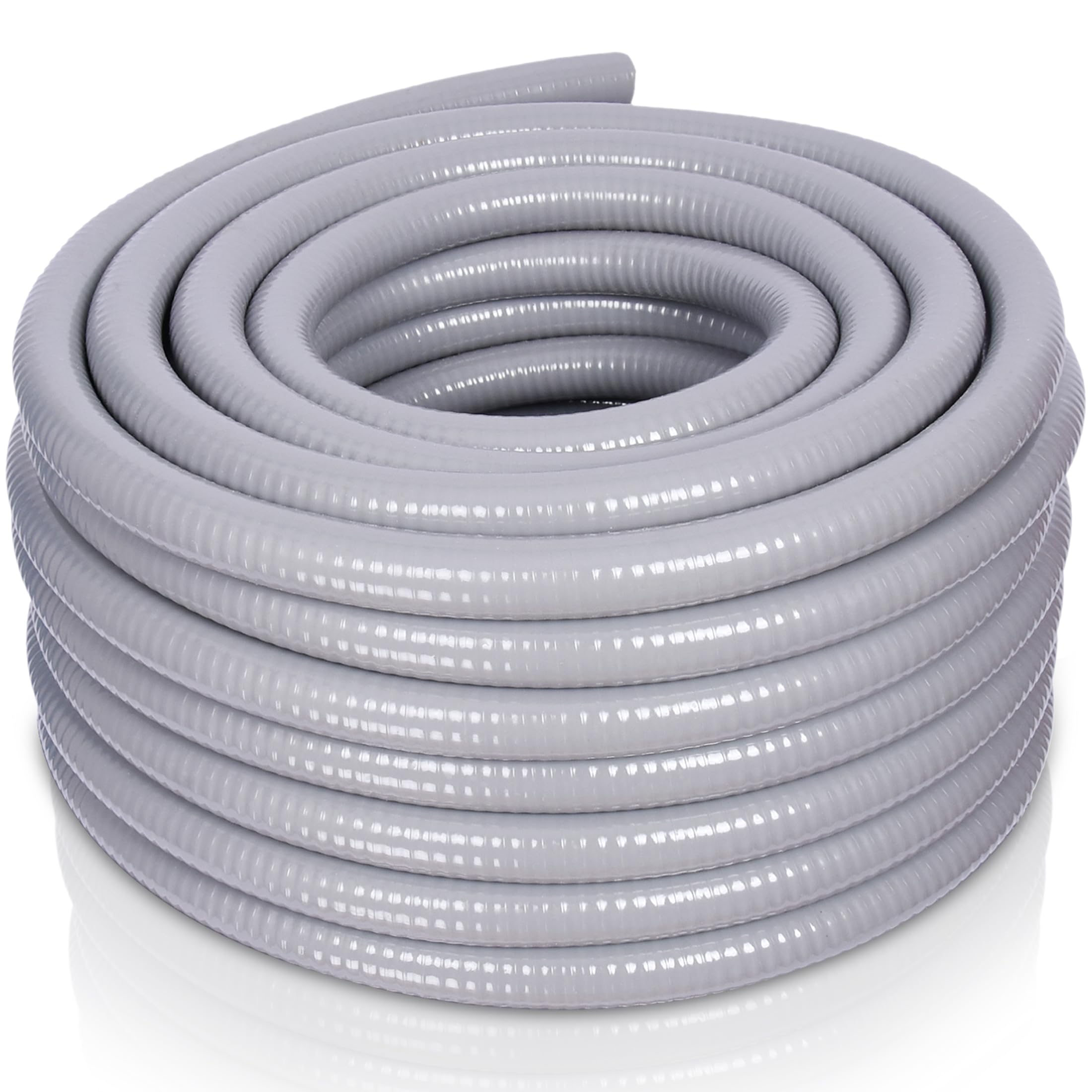
This entry is a conduit product rather than a bender, but it solves a different problem: what to use when the run cannot tolerate a rigid bend. The Feotech 1½-inch flexible liquid-tight conduit is designed for outdoor EV charger installations, transfer switch connections, and any scenario where you need to route wires around obstacles without cutting and coupling rigid pipe. The non-metallic construction is corrosion-proof, and the included connectors provide strain relief that holds up to vibration.
The flexibility allows a single person to install the run without pipe benders or threading tools — simply cut to length with a box cutter, slide the lock ring over the conduit, and hand-tighten the connector. The interior is smooth, making wire pulling easier than with metallic flexible conduit that has jagged edges. Users report that the 1½-inch size accommodates multiple conductors without binding, and the waterproof O-ring prevents moisture ingress in outdoor environments.
This is not a bending tool, so it does not replace a hydraulic or manual bender for rigid conduit. But if your job involves long outdoor runs where every bend would require a coupling and a box, the Feotech flexible conduit eliminates those labor steps entirely.
Why it’s great
- Flexible — no bender required for routing around obstacles
- Waterproof O-ring connectors prevent moisture ingress
- Smooth interior for easy wire pulling
Good to know
- Not a bender — this is a conduit product for flexible runs
- Only two connectors included in the kit
- Requires 1-3/8″ hole saw for connector mounting
9. VEVOR YP-9 Manual Bender 1” – 2“

The VEVOR YP-9 is a manual bench-top bender for solid round and square bar, not thin-wall conduit. Its primary strength is the seven included dies ranging from 1-inch to 3-inch outer diameter, making it a versatile addition to a metal workshop that works with stock material for gates, railings, and furniture. The 32-pound weight is manageable to set on a workbench, and the long handle provides the leverage needed to bend up to ½-inch round bar without a hydraulic assist.
The build quality is adequate for light-to-moderate use, with a steel frame and reinforced steel dies. Users who plan to bend ⅜-inch flat bar report that the tolerances are tight enough for professional-looking results. The ergonomic handle grip reduces hand fatigue compared to bare-metal levers, and the compact footprint means it takes up minimal bench space when not in use.
Out-of-box defects are the biggest risk here. Some units arrive with off-center pin holes, warped bases from welding heat, or flaking paint. The included manual is essentially useless — you will rely on YouTube tutorials and trial-and-error to learn the setup. Additionally, the bender has been reported to scratch tubing during the bend or retract cycle, so plan on using lubrication or protective tape for finished surfaces. For entry-level bar bending at a low cost, the YP-9 gets the job done, but expect to spend time correcting factory flaws.
Why it’s great
- Seven dies included for sizes 1″ through 3″
- Compact 32-lb design fits on a workbench
- Strong enough for ⅜″ flat bar fabrication
Good to know
- Frequent out-of-box defects — off-center pins, warped base
- Scratches tubing during bend and retract
- Manual is useless; expect to learn from YouTube
FAQ
Can a manual roller bender handle 1½-inch rigid steel conduit?
What does center-line radius mean for die selection?
Why does my hydraulic bender not have a return spring?
Final Thoughts: The Verdict
For most users, the best 1 1/2 conduit bender winner is the Speedway Motors 3rd Generation Hydraulic Bender because it combines a premium 8-ton jack, a precision-machined aluminum die, and a portable sub-50-lb frame that delivers consistent 90-degree bends for roll cages and chassis work. If you need the flexibility of continuous rolling for HVAC and decorative curves, grab the VEVOR Tube Roller Bender. And for budget-minded contractors bending mixed-diameter thick-wall pipe, nothing beats the sheer tonnage and die range of the VEVOR 12-Ton Hydraulic Pipe Bender.