
Our readers keep the lights on and my morning glass full of iced black tea. As an Amazon Associate, I earn from qualifying purchases.
Specs are compiled from manufacturer listings and verified buyer reviews and can change over time — please confirm the key details on the product page before buying.
Finding a 1 1/2 inch exhaust pipe that actually fits your generator, classic car, or boat project without rusting out in a season is harder than it should be. The real difference between a pipe you weld once and one you replace next year depends on the grade of stainless steel, the wall thickness, and the bend type — and this guide lines up the best options so you don’t waste time on thin, rusty junk.
I’m Min — the founder and writer behind Gadgets Feed. This guide is built by comparing the manufacturers’ published specifications and the patterns across verified customer reviews, so you get each pick’s real strengths and trade-offs instead of marketing spin.
You will find five very different approaches to the same 1 1/2 exhaust pipe category — from a flexible J-bend mild steel piece for small engines, to a heavy straight 38-inch stainless section for long runs, to tight 90-degree mandrel elbows and a 180-degree U-bend for complex routing.
Quick Picks
- FORTLUFT Exhaust Straight Pipe 1.50″ Stainless Steel — Best Overall
- PATIKIL 2pcs 90 Degree Mandrel Bend Elbow, 1 1/2 Inch OD Steel Exhaust — Top Performer
- Hicarer 1 Pcs 1-1/2″ OD 304 Stainless Steel Tubing 0.06″ Wall Thickness 24 Inch — Best Value
- 1.5″ Stainless 180° Mandrel Bend – 1.5D/2.25″ CLR Loose Radius – 16GA/.065″ Wall — Premium Pick
- Patriot Exhaust H7013 1-1/2″ Mild Steel J-Bend Exhaust Pipe — Budget Champion
How To Choose The Best 1 1/2 Exhaust Pipe
Picking the right exhaust pipe for your project is about matching the material and shape to where the pipe lives. You want something that won’t rot if it sees water and salt, and a bend that fits your space without kinking the flow.
Material: Stainless Steel vs. Mild Steel
304 stainless steel resists rust and lasts much longer in wet conditions like marine or outdoor generator use. Mild steel is cheaper and easier to weld but will rust quickly if it is not painted or coated — one reviewer noted their mild steel piece started showing rust after a few heat cycles. For anything that stays outdoors, pick stainless.
Bend Type: Straight, J-Bend, U-Bend, or 90-Degree Elbow
A straight pipe is simple for extending a tailpipe or replacing a rusted section. A J-bend or 90-degree elbow lets you direct exhaust away from an area — like turning a generator exhaust sideways against a wall. A 180-degree U-bend is for tight folding routes, like under a classic car. Look for “mandrel bend” in the description — that means the pipe is bent without crushing the inner diameter, so you keep full flow.
Wall Thickness and Weight
Thicker walls resist dents and last longer but are heavier. A 16-gauge pipe (about.065-inch thick) is a common durable choice that welds nicely without being too heavy. Thinner.060-inch pipes are lighter and fine for low-stress applications like furniture or a dryer vent, but they can dent easier on a car or generator.
Quick Comparison
On smaller screens, swipe sideways to see the full table.
| Model | Best For | Material | Length | Wall Thickness | Amazon |
|---|---|---|---|---|---|
| FORTLUFT Straight | Long generator runs | Stainless Steel | 38 Inches | Unspecified | $20.74Amazon |
| PATIKIL 90-Degree Elbow | Right-angle redirection | 304 Stainless Steel | 3.74 Inches | 0.06 Inches | $23.59Amazon |
| Hicarer Straight Tube | Universal fabrication | 304 Stainless Steel | 24 Inches | 0.06 Inches | $28.99Amazon |
| Stainless Bros 180-Degree | U-bend routing | 304 Stainless Steel | 6-inch Legs | 16-Gauge /.065 Inches | $31.49Amazon |
| Patriot J-Bend | Small engine exhaust | Mild Steel | Unspecified | Unspecified | $38.49Amazon |
In‑Depth Reviews
1. FORTLUFT Exhaust Straight Pipe 1.50″ Stainless Steel

The 38-inch stainless straight pipe that reaches from a generator without splicing two pieces together.
This is the longest single section on the list — at 38 inches by 1.5 inches wide, you get one continuous piece that weighs 3.1 pounds, versus the 1.5-pound 180-degree Stainless Bros bend. If you are running an exhaust extension on a generator or building a straight tailpipe, this saves you from welding multiple short sections together.
Buyers report the pipe welds easily and the finish is clean. The catch is that not all stainless is equal — one buyer mentioned that a 1.75-inch version of this pipe “rusted severely after 8 months in salt spray on boat” and said it “performs like mild steel.” That means this pipe is fine for dry or occasional wet use, but if your project lives in a marine environment, you should choose a different pick.
Longest Straight Section
- Full 38-inch length means fewer welds for long runs.
- At 3.1 pounds it feels solid and thick-walled.
- Buyers praise the value and easy welding experience.
Watch Out For
- Owners mention rust in sustained saltwater marine use.
- Wall thickness is not stated, so you cannot verify gauge.
Reach for this when: you need a long, affordable stainless straight section for a generator, car, or dry outdoor application where rust is not a daily enemy.
Look elsewhere if: the pipe will sit on a boat or near road salt — the rust reports are a real warning.
2. PATIKIL 2pcs 90 Degree Mandrel Bend Elbow, 1 1/2 Inch OD Steel Exhaust

A pair of mandrel-bent 90-degree elbows made from 304 stainless that bolt on with no fuss.
These elbows solve the common problem of generator exhaust blowing right back at you. Customers note that a single elbow redirects the exhaust of a DuroMax XP 13000 EH by 90 degrees, and that the 0.06-inch wall thickness fits standard flex pipe perfectly. Because each elbow is only 3.74 inches long, it is a compact solution that fits where a longer bend would hit a frame rail.
Reviewers point out the “exact dimensions, excellent quality” and say the pieces arrived on schedule. 304 stainless resists heat and rust far better than the mild steel Patriot pipe. The only trade-off is that at 0.06 inches thick, it is not the heaviest wall on the market, but for turning generator or vehicle exhaust, shoppers say it is more than adequate.
Precision Fit
- Mandrel bend keeps the inner diameter consistent for full flow.
- Two elbows in the pack for the price of one premium piece.
- Mirror-polished 304 stainless resists rust far better than mild steel.
Consider This
- Short 3.74-inch length may not handle very tight radius jobs.
- Wall thickness is on the thinner side at 0.06 inches.
Best suited for: anyone who needs a quick, rust-resistant right-angle turn on a generator, ATV, or gas filler neck where fit matters more than raw strength.
The real limit: if you need a longer leg or a thicker wall for a high-vibration car exhaust, look at the heavier Stainless Bros 180-degree bend instead.
3. Hicarer 1 Pcs 1-1/2″ OD 304 Stainless Steel Tubing 0.06″ Wall Thickness 24 Inch

A 2-foot straight section of 304 stainless that is polished, precise, and ready to weld.
This is a middle-ground straight pipe — longer than the PATIKIL elbow but shorter than the FORTLUFT 38-inch section. At 24 inches long with an outside diameter of 1.5 inches, it is the right size for many automotive fabrication jobs and small engine repairs. The pipe weighs 1.74 pounds and has a stated wall thickness of 0.06 inches — the same as the PATIKIL elbow, but in a straight format.
Buyers report that “the stainless-steel tube I got was nicely polished and the cuts were precise.” The polished surface reduces prep time before welding. One potential downside is that a reviewer thinks they see a weld trail inside, suggesting it may not be smooth tubing. For most exhaust uses, a visible weld seam is not a problem — but if you need a perfectly smooth pipe for a high-pressure or sanitary application, you may want to check before buying.
Solid All-Rounder
- At 24 inches it fits standard cutting and welding setups.
- Precise cuts and a polished surface save you sanding time.
- 304 stainless gives you better rust resistance than the Patriot mild steel J-bend.
Minor Caveat
- One buyer suspects a visible weld seam on the inside.
- At 1.74 pounds it is noticeably lighter and thinner-feeling than the FORTLUFT straight pipe.
Grab this for: a straightforward exhaust or fabrication project where you want 304 stainless at a mid-range price and do not need a 38-inch span.
Pass if: you need a long one-piece run (get the FORTLUFT) or need a U-bend for tight routing (get the Stainless Bros 180-degree).
4. 1.5″ Stainless 180° Mandrel Bend – 1.5D/2.25″ CLR Loose Radius – 16GA/.065″ Wall

A 180-degree U-bend in 304 stainless with a thicker.065-inch wall for high-vibration exhaust routing.
This is the heaviest-duty U-bend in the lineup. With a wall thickness of 16-gauge (.065 inches) and a 1.5D / 2.25-inch centerline radius, it is built to handle the heat and vibration of a vehicle exhaust. Owners mention using it for muffler modifications and even cutting it in half to weld together into an “S” bend for a classic car. Mandrel bending keeps the inner diameter open for unrestricted exhaust flow.
Weighing 1.5 pounds, this piece sits against the FORTLUFT 38-inch straight pipe at 3.1 pounds and the Hicarer tube at 1.74 pounds — the heavier 16-gauge wall adds durability. The trade-off is that the 180-degree shape is specialized: it is perfect for a tight U-turn routing under a vehicle, but useless if you just need a straight extension or a 90-degree elbow.
Built for Tough Routing
- 16-gauge.065-inch wall resists dents better than 0.06-inch pipes.
- Mandrel 180-degree bend with a 6-inch leg on each end is easy to weld into a custom path.
- Customers note it welds clean and the finish is high quality.
Niche Shape
- A 180-degree U-bend is not useful for straight or 90-degree jobs.
- Some reviewers point out bends are “just a touch below 180 degrees” so you may need to tweak the angle.
The right time to buy: you need a U-turn in your exhaust path under a car frame, on a hot rod, or for a muffler delete and want a thicker wall that will not crush.
skip it if: your project only needs a straight pipe or a single 90-degree turn — grab the FORTLUFT straight or PATIKIL elbow instead.
5. Patriot Exhaust H7013 1-1/2″ Mild Steel J-Bend Exhaust Pipe
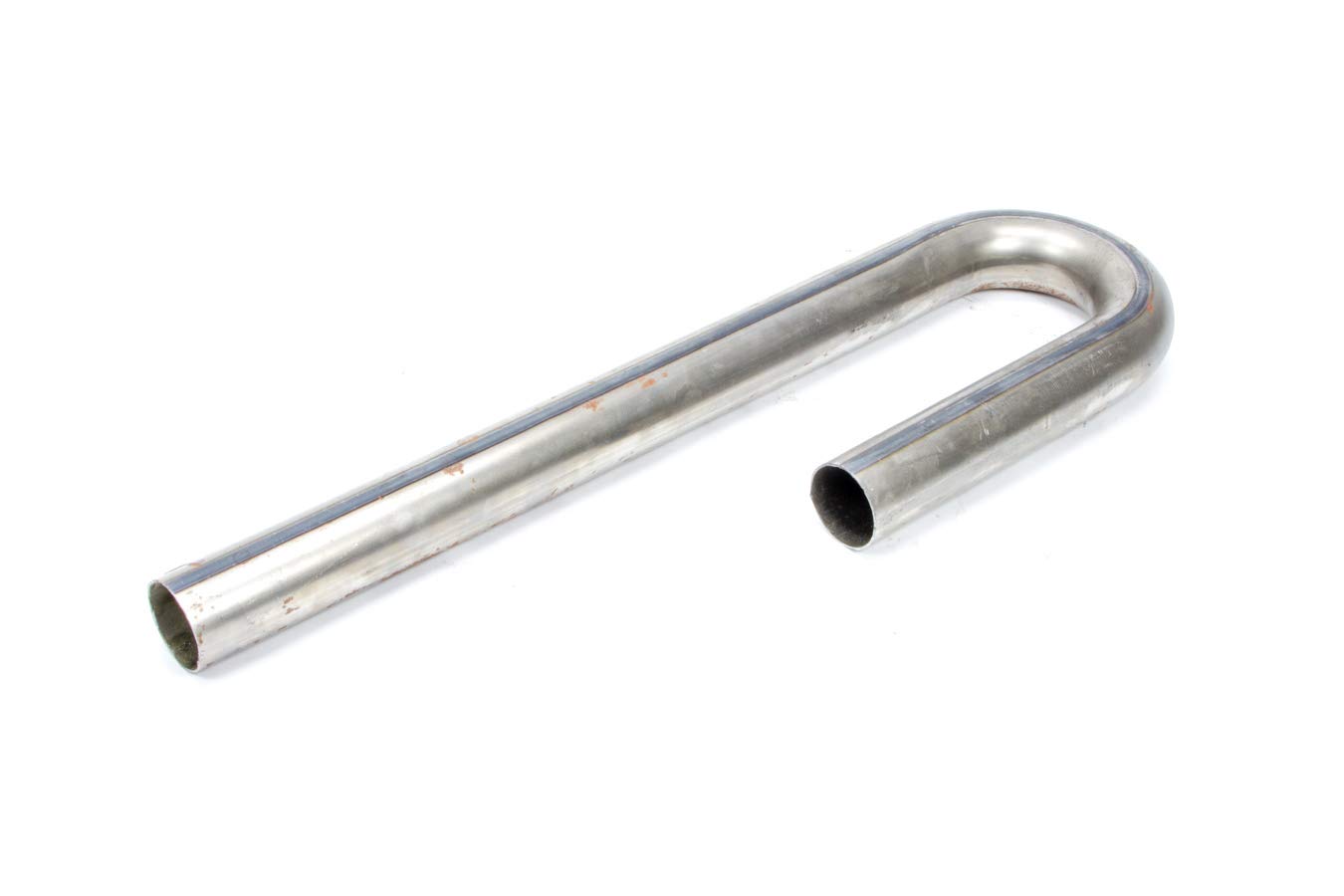
An affordable mild steel J-bend that welds easily but needs a coat of paint to survive the weather.
This is the only mild steel pipe on the list. Mild steel is cheaper and easier to weld than 304 stainless, and one owner reported it “welds good and gets some nice color after a few heat cycles” on their bike. Another used it to route their ATV exhaust around a frame rail and reported that it cut and welded fine. The J-bend shape works like a gentle hook — you can use it to make a sharp turn in small engine exhausts, lawn mower repairs, or old tractors.
Mild steel rusts quickly if left uncoated. One reviewer explicitly noted, “It’s mild steel so keep in mind it will start to rust if not coated.” Another mentioned the pipe is “super thin on the outside radius,” so you need to be careful when welding to avoid burning through. For outdoor or road-salt use, paint or powder-coat the pipe right after installation.
Easiest to Weld
- Mild steel is forgiving and welds with standard equipment.
- At a budget-friendly price, it is the cheapest 1.5-inch exhaust pipe on the list.
- Buyers praise the shape for small engine and ATV routing.
Rust Warning
- Will rust quickly if not painted or coated — buyers confirm this.
- Outer radius is thin, so welding requires a light touch to avoid burn-through.
Buy this when: you are building a quick exhaust for a lawn tractor, small motorcycle, or indoor project where the pipe will stay dry and you want to save money.
Do not buy this when: the pipe will live outdoors, on a boat, or see road salt — get a 304 stainless option like the Hicarer tube or PATIKIL elbow instead.
Understanding the Specs
304 Stainless Steel vs. Mild Steel
304 stainless steel contains chromium that forms a protective layer, so it resists rust and heat much better than mild steel — that is why three of our five picks use 304. Mild steel (like the Patriot J-bend) is easier to weld and cheaper, but it rusts quickly in rain or salt. If your pipe will sit on a generator in the backyard or under a truck in winter, pick stainless. If it is for an indoor shop project, mild steel works fine.
Mandrel Bend vs. Crush Bend
A mandrel bend uses a form inside the pipe to keep the inner diameter the same size through the curve — this prevents a restriction that hurts exhaust flow. A crush bend (which is cheaper) flattens the pipe on the inside of the curve. All of the bent pipes on this list (PATIKIL, Stainless Bros, Patriot) are mandrel bends. If you are building a performance exhaust or one that needs maximum flow, mandrel is the only choice. For just moving hot air away from a generator, a crush bend would work, but mandrel is always better.
FAQ
Will a 1.5 inch exhaust pipe fit my generator or small engine?
How do I weld stainless steel exhaust pipe at home?
What is the difference between 16-gauge and.065-inch wall thickness?
How long does a 304 stainless exhaust pipe last outdoors?
Can I use a 1.5 inch exhaust pipe for a dryer vent or HVAC?
What does “mandrel bend” mean for my project?
Will the Patriot mild steel J-bend rust if I paint it?
How do I cut an exhaust pipe to the right length?
Is a 180-degree U-bend or a 90-degree elbow better for routing exhaust?
Do I need a clamp or flange to install these pipes?
Final Thoughts: The Verdict
If you want one dependable pick, the 1 1/2 exhaust pipe winner is the PATIKIL 2-Piece 90-Degree Set because it gives you two mandrel-bent 304 stainless elbows at a budget-friendly price with a mirror-polished surface that resists rust far better than mild steel. If you need a long straight section for a generator run, grab the FORTLUFT Straight Pipe, and for a thicker U-bend routing under a vehicle, the standout is the Stainless Bros 180-Degree Bend.
How We Picked
We do not accept paid placement, and we did not hands-on test every unit. Instead, we match each pick to a real buyer and use-case by comparing the manufacturers’ published specifications against the patterns in verified customer reviews — so you get each pick’s real strengths and trade-offs instead of marketing copy.
Sources & Methodology
Specifications: manufacturer listings and product documentation. Review insights: verified customer reviews, as of July 2026. Pricing: not shown on this page (it changes often); check the current price via the retailer link.
As an Amazon Associate, Gadgets Feed earns from qualifying purchases. This does not affect which products we feature.
Product prices and availability are accurate as of the date/time indicated and are subject to change. Any price and availability information displayed on Amazon at the time of purchase will apply to the purchase of this product. As an Amazon Associate I earn from qualifying purchases.
CERTAIN CONTENT THAT APPEARS ON THIS SITE COMES FROM AMAZON. THIS CONTENT IS PROVIDED "AS IS" AND IS SUBJECT TO CHANGE OR REMOVAL AT ANY TIME.
Amazon and the Amazon logo are trademarks of Amazon.com, Inc. or its affiliates.