
A 1 1/2-inch fire hose isn’t a glorified garden hose—it’s a high-volume, high-pressure delivery system designed for moving massive amounts of water fast. The wrong choice, whether it’s a flimsy PVC lay-flat or an overbuilt single-jacket hose with mismatched threads, means leaks, bursts, or a connector that simply won’t attach to your pump or hydrant.
I’m Min — the co-founder and writer behind Gadgets Feed. I’ve spent countless hours cross-referencing pressure ratings, coupling types (NST, NH, NPT, NPSH), inner diameters, and liner materials to separate real workhorse hoses from those that fail at the crimp.
This guide cuts through the jargon to help you pick the right 1 1/2 fire hose for your specific pump, nozzle, and application — from pool backwash to industrial dewatering.
How To Choose The Best 1 1/2 Fire Hose
Before you add a hose to your cart, you need to match three things: the thread type on your pump or hydrant, the pressure your system will produce, and the hose’s flexibility and weight for your typical run length. Mismatching any one of these turns a quick job into a frustrating, leaky disaster.
Match the Thread First — NST/NH, NPT, or NPSH?
This is the single biggest point of failure in a 1 1/2 fire hose purchase. NST (National Standard Thread) and NH (National Hose) are interchangeable terms for the same thread used on most fire hydrants and pumps. NPT (National Pipe Thread) is a tapered thread common on plumbing connections, while NPSH (National Pipe Straight Hose) has straight threads. If your discharge port has NPT threads and you buy a hose with NST/NH couplings, you *must* buy an adapter. Always verify your pump’s thread type before ordering.
Pressure Ratings: Working vs. Burst
Working pressure is the maximum continuous pressure the hose can handle during normal use. Burst pressure is the point at which it will fail. A premium single-jacket TPU hose often has a working pressure of 250 PSI and a burst pressure of 750 PSI, providing a 3x safety factor. A budget PVC lay-flat hose might have a working pressure of only 90 PSI. If you are running a high-pressure trash pump, you need a hose with a working pressure well above your pump’s maximum output.
Construction: PVC Lay-Flat vs. TPU Single-Jacket
PVC lay-flat hoses are affordable, lightweight, and great for low-pressure backwash or irrigation, but they are prone to punctures and UV degradation when left in the sun. TPU (thermoplastic polyurethane) single-jacket hoses are heavier-duty, more abrasion-resistant, and hold up to higher pressures. For frequent use or demanding jobs where a blown hose means downtime, the extra cost of a TPU-lined jacket is worth it.
Quick Comparison
On smaller screens, swipe sideways to see the full table.
| Model | Category | Best For | Key Spec | Amazon |
|---|---|---|---|---|
| ZYfire 50ft | Single Jacket TPU | Highest safety margin | 750 PSI Burst / UL listed | Amazon |
| ToughAid 100ft | PU with TPU Lining | High burst 100ft runs | 1300 PSI Burst Pressure | Amazon |
| SAFBY 50ft | Single Jacket EPDM | Pro-grade durability | NPSH / NPT Couplings | Amazon |
| AKW 100ft | Single Jacket TPU | Lightweight 100ft length | 50% lighter than rubber-lined | Amazon |
| BITOTU 50ft | Single Jacket Rubber | Sturdy feel & fittings | NST/NH Brass Connectors | Amazon |
| Venussar 50ft | Single Jacket TPU | Budget fire hose entry | 450 PSI Burst / Brass NST | Amazon |
| Geowaky 100ft | PVC Lay-Flat | Low-cost backwash | 90 PSI Working / Camlock | Amazon |
In‑Depth Reviews
1. ZYfire Fire Hose 50 ft
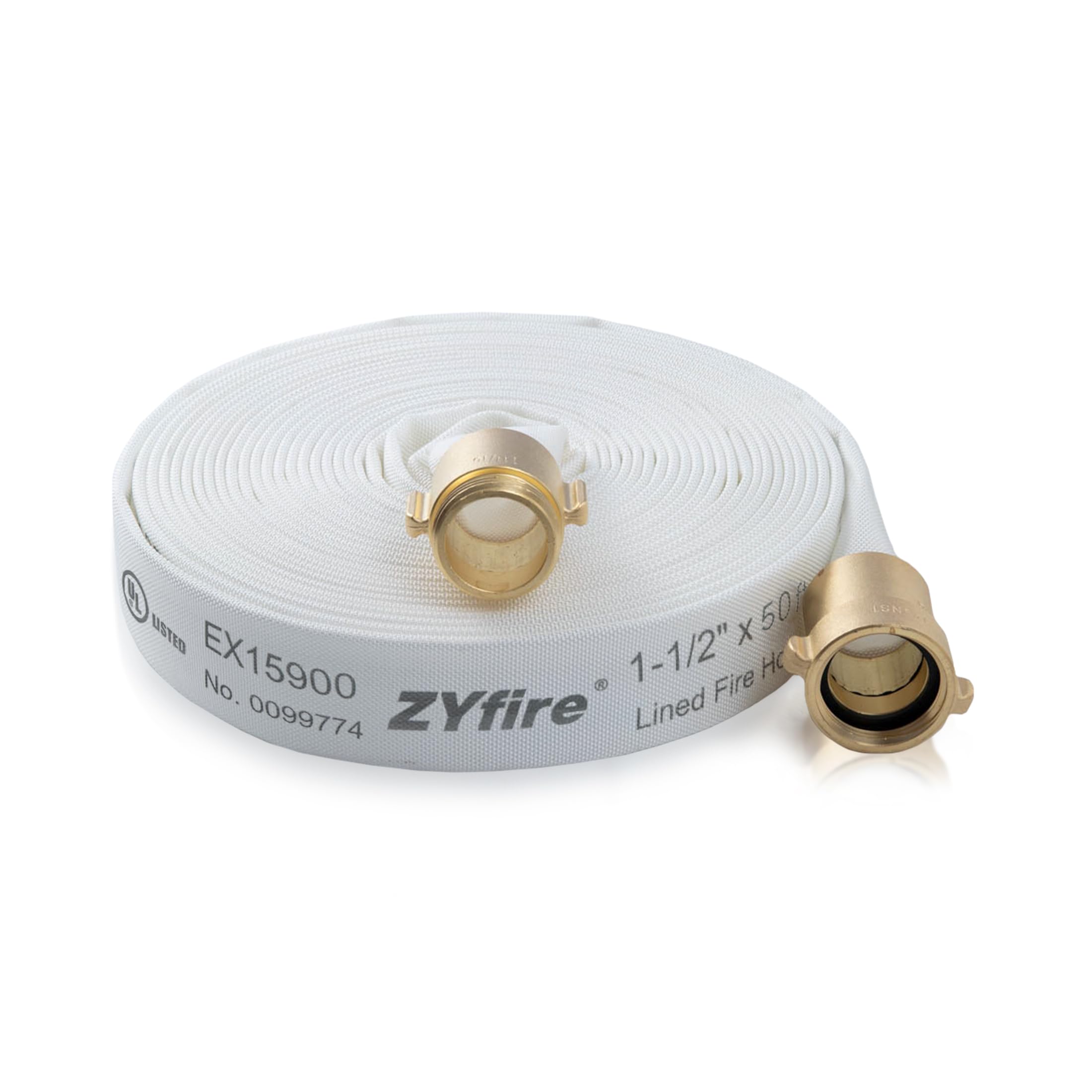
The ZYfire 50 ft hose offers the highest safety margin in our mid-range bracket with a 250 PSI working pressure and a 750 PSI burst rating. The single-jacket TPU construction with a virgin polyester outer sheath provides excellent abrasion and flex resistance, and the brass NST/NH couplings are corrosion-resistant and hold a solid seal without leaking.
Its UL, ULC, and FM certifications confirm it meets legitimate fire service standards, which is rare at this price point. The hose is surprisingly lightweight for its capacity and can be bent arbitrarily without kinking, making it ideal for tight spaces around a fire cabinet or pin rack.
Some users note the 1-11/16″ thread marking on the coupling can be confusing — it refers to the thread size on the hose end, not the fitting end — so double-check your pump’s thread type before ordering. Overall, the combination of certified safety, build quality, and reasonable price makes this the top pick for most buyers.
Why it’s great
- UL, ULC, and FM certified for fire service use
- 750 PSI burst pressure provides a 3x safety factor over working pressure
Good to know
- Coupling thread marking (1-11/16″) can cause confusion with pump compatibility
- Only 50 ft length; longer runs require ordering a separate 75 ft or 100 ft variant
2. ToughAid Upgraded Fire Hose 100 ft
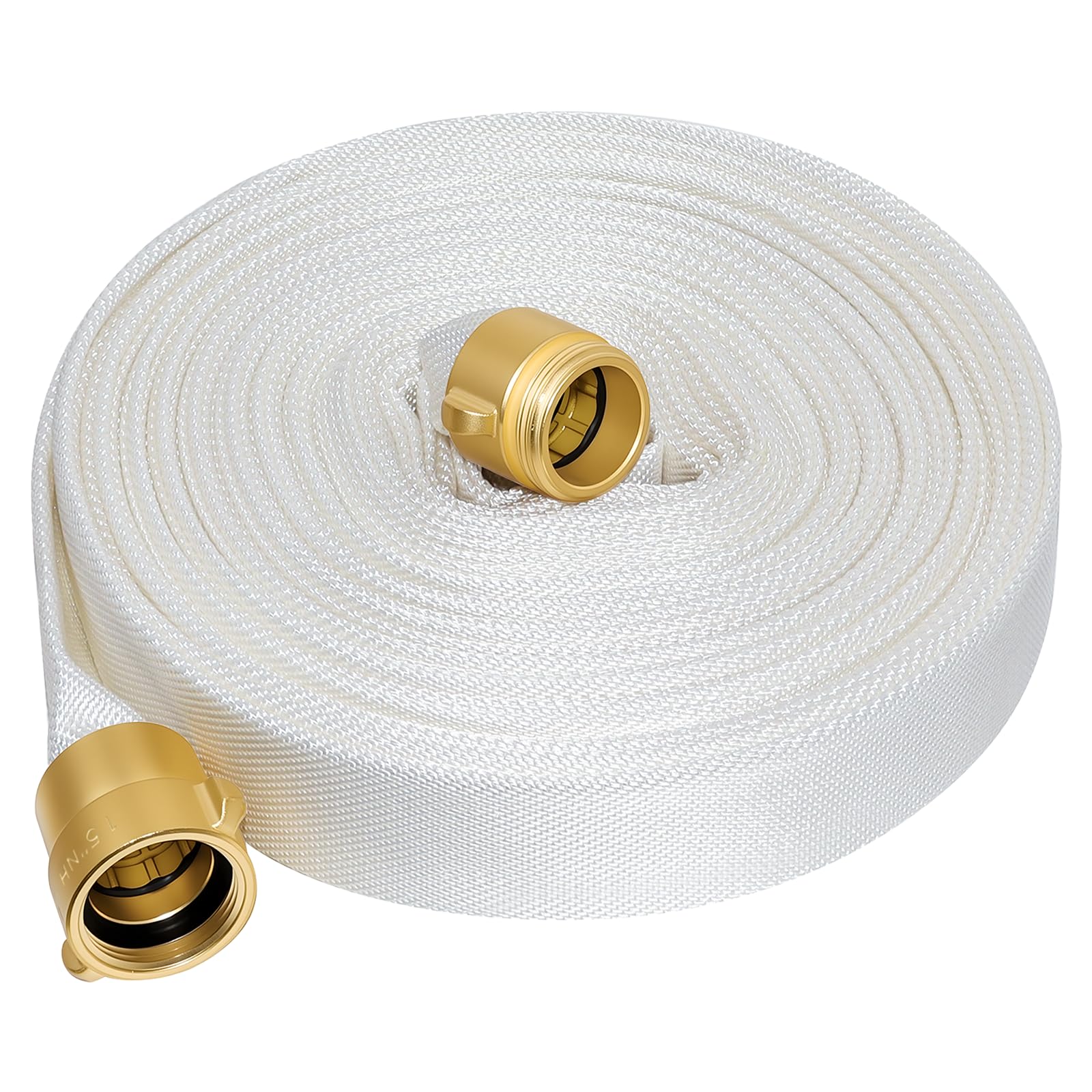
The ToughAid 100 ft hose stands out for its extreme burst pressure of 1300 PSI, which is almost double the industry standard for a single-jacket hose. The composite construction uses a TPU lining with a nylon braided layer, making it abrasion-resistant and flexible enough for a single person to drag and deploy.
Despite its 100 ft length, it weighs roughly the same as a thick 50 ft hose, which is a testament to its efficient material use. The brass NST/NH threads are well-machined and connect smoothly to standard 1.5-inch forestry nozzles and pump outlets without leaking at high pressure.
Be aware that this is a single-jacket hose — it’s tough but not invincible. A user reported that the threads require an adapter for irrigation fittings, and brass adapters can be expensive. If you need a long-run hose that can handle a powerful pump without bursting, this is a strong contender.
Why it’s great
- 1300 PSI burst pressure — highest in this comparison
- Very lightweight for a 100 ft hose, making deployment easy
Good to know
- NST/NH threads require an adapter for standard irrigation or NPT plumbing
- Some buyers report needing to confirm thread compatibility with their pump
3. SAFBY Fire Hose 50 ft

The SAFBY hose is built for buyers who need NPSH/NPT-threaded brass couplings rather than the more common NST/NH. This makes it a direct fit for many pump discharge ports that use standard pipe threads, eliminating the need for an adapter. The single-jacket construction uses a fabric outer with a robust EPDM inner liner rated at a 250 PSI working pressure.
Customers who have used cheaper blue lay-flat hoses report that this hose is noticeably more durable — no punctures after dragging it across dirt and grass, unlike the PVC alternatives that failed within a season. The brass fittings feel substantial and the threading is clean, which reduces the risk of cross-threading.
It is a 50 ft hose that weighs about 4.74 kg, making it heavier than a comparable TPU hose. The higher cost is justified if you need the NPT compatibility or if you’re replacing a cheap hose that failed repeatedly. For a homeowner ready for commercial-grade service, this hose delivers.
Why it’s great
- NPSH/NPT brass couplings for direct pump connection without adapters
- Much more puncture-resistant than budget blue lay-flat hoses
Good to know
- Heavier than comparable TPU single-jacket hoses
- Only 50 ft length available; no 100 ft option in this SKU
4. AKW Fire Hose 100 ft
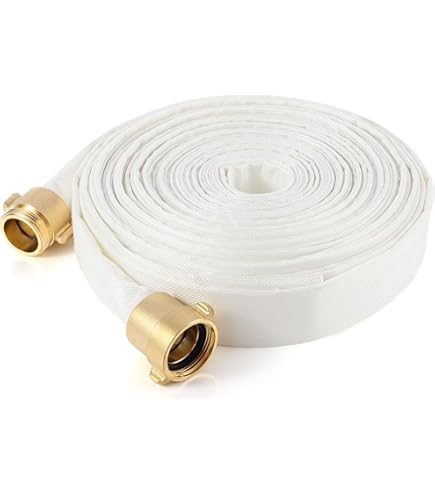
The AKW 100 ft hose is engineered for portability — it is approximately 50% lighter than conventional rubber-lined single-jacket hoses, weighing just 5.33 kg for the full 100 ft length. The single-jacket construction uses 100% filament polyester with a TPU liner, and it carries UL certification for interior firefighting use.
With a service test pressure of 250 PSI and a burst pressure of 750 PSI, it offers the same safety margin as the ZYfire, but in a longer 100 ft coil. The brass NST/NPSH expansion ring couplings are well-made and connect securely to standard fire department equipment. One buyer used it for a robotics fire mitigation system and rated the build quality in the top 5% of industrial hoses.
A small number of users report pin-sized leaks developing after several uses, so visual inspection before each job is wise. Also, since it’s so lightweight, it can be harder to keep flat on the ground without a spool. If you need a long, easy-to-carry hose for irrigation or pool filling, this is a solid pick.
Why it’s great
- Extremely lightweight for a 100 ft hose — easy for one person to deploy
- UL certified with a 750 PSI burst rating for reliable safety
Good to know
- Some users report pin-hole leaks developing after repeated use
- Lightweight design may require a spool to prevent tangling during storage
5. BITOTU Fire Hose 50 ft
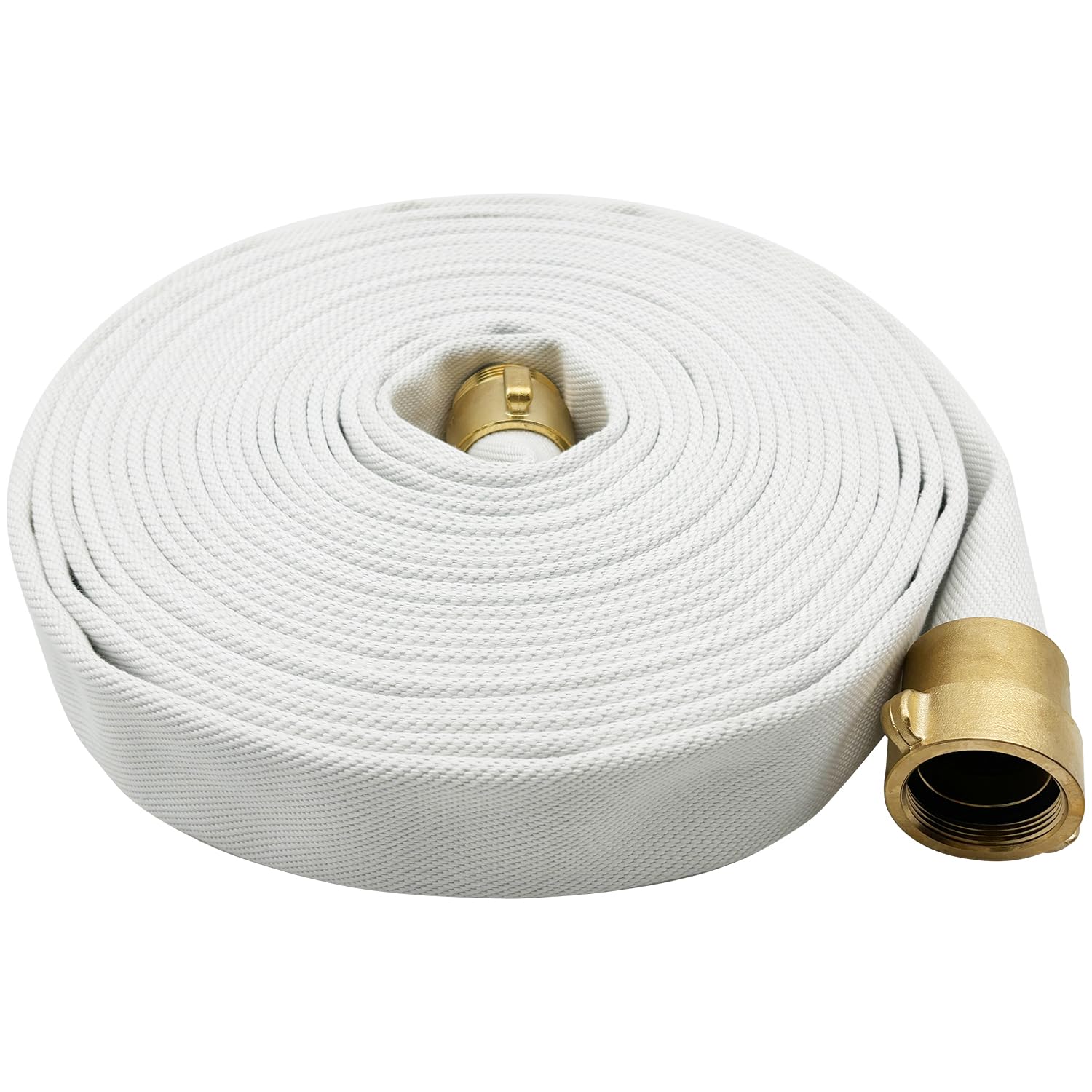
The BITOTU hose offers a sturdy canvas outer jacket with a rubber inner liner and solid brass NST/NH couplings. At 4.6 kg for a 50 ft hose, it feels dense and substantial in hand, which inspires confidence during high-volume transfer jobs. The threads are NST/NH standard, and the gaskets included in the couplings help create a leak-free seal.
Users have connected it directly to 2-inch Harbor Freight pumps and standard nozzles without issues, noting the brass fittings thread on and off smoothly. The hose is durable enough for regular irrigation work and has held up well under typical residential pump pressures without delamination or blowouts.
The main drawback is the 50 ft length — if you need a longer run, you’ll need to connect multiple sections or look elsewhere. Also, the rubber liner is heavier than a TPU liner, so this isn’t the hose you want if you’re hiking it to a distant water source. It’s a solid, no-surprises hose for stationary or short-range use.
Why it’s great
- Sturdy canvas outer with rubber liner resists abrasion and punctures
- Brass fittings thread onto standard pumps and nozzles without leaking
Good to know
- Heavier than TPU-lined hoses of the same length
- Only available in 50 ft length
6. Venussar Fire Hose 50 ft
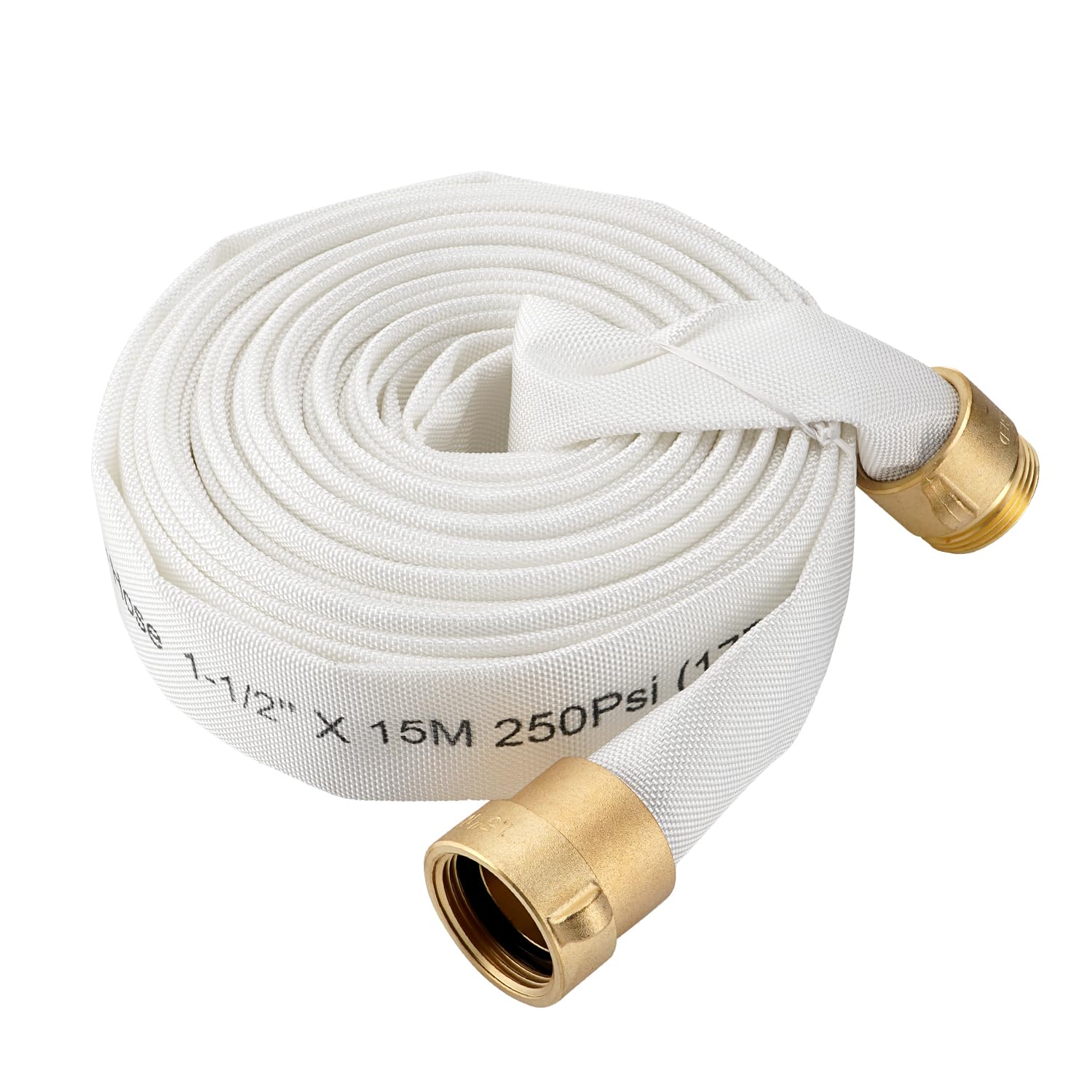
The Venussar hose is a budget-friendly single-jacket TPU option with brass NST/NH couplings and a 450 PSI burst pressure. It is designed specifically for indoor use — the manufacturer explicitly warns against storing it in direct sunlight, as UV exposure can degrade the TPU liner. For its price, it offers a solid 250 PSI test pressure and a compact, lightweight profile.
Buyers have used it successfully for cleaning dump trucks and as an emergency fire hose in hose boxes, with several reporting that it works perfectly for its intended single-use emergency role. The hose is easy to handle and the brass fittings provide a reliable connection.
However, there are some notable quality control concerns. One buyer received a hose with a pinhole leak at low pressure (under 80 PSI), and a few others received the wrong length. This hose is best suited for light-duty or emergency backup use where the demand on the hose is infrequent.
Why it’s great
- Affordable price point for a TPU-lined fire hose with brass fittings
- Compact and lightweight for easy storage and one-person handling
Good to know
- Rated for indoor use only — UV exposure will degrade the material
- Mixed reviews on quality control; some units arrive with pinhole leaks
7. Geowaky PVC Lay-Flat Hose 100 ft

The Geowaky 100 ft hose is a PVC lay-flat discharge hose — the most affordable option for moving large volumes of water at low pressure. It comes pre-assembled with aluminum camlock C and E fittings, plus an extra Type A adapter for screwing directly onto a pump’s male threaded outlet. The working pressure is 90 PSI, which is fine for pool backwash and sump pump discharge but insufficient for high-pressure trash pumps.
Users consistently report no leaks within the 90 PSI working range, thanks to the double-sided PVC coating and fiber reinforcement. The camlock system allows for quick disconnect, which is convenient when you need to break down the hose setup frequently. Several owners have used it for years to fill stock tanks and drain pools, only replacing it when UV exposure eventually causes cracking at the folds.
This hose is not suitable for applications above 90 PSI, and it is not designed for firefighting or high-pressure industrial use. For low-pressure water transfer, it delivers great value.
Why it’s great
- Very affordable 100 ft hose with camlock fittings for fast setup
- Works reliably for low-pressure backwash and irrigation without leaks
Good to know
- Limited to 90 PSI working pressure — not for high-output pumps
- PVC material degrades with prolonged UV exposure; store out of sunlight
FAQ
What is the difference between NST and NH thread types for a 1 1/2 fire hose?
Can I use a 1 1/2 fire hose with my pool pump or trash pump?
How do I store a 1 1/2 fire hose to prevent damage and kinks?
Final Thoughts: The Verdict
For most users, the best 1 1/2 fire hose winner is the ZYfire 50 ft because it combines UL-certified safety with a 750 PSI burst pressure at a fair price — a true workhorse for fire safety and high-pressure water transfer. If you need a 100 ft run with extreme burst resistance, grab the ToughAid 100 ft. And for low-pressure pool backwash or irrigation on a budget, nothing beats the value of the Geowaky PVC Lay-Flat 100 ft.