
Fighting a seized 1-1/4 inch nut in a rusted suspension link or on heavy equipment with a standard combination wrench means poor access, minimal leverage, and constant repositioning. The right 1-1/4 ratchet wrench eliminates that frustration by letting you turn fasteners without removing the tool from the fastener, reducing cycle time and saving your knuckles.
I’m Min — the co-founder and writer behind Gadgets Feed. I’ve spent countless hours cross-referencing tooth counts, swing arcs, beam lengths, and customer feedback on large-format ratcheting wrenches to separate the true workhorses from the also-rans.
This guide covers five serious contenders in the large-wrench space, comparing gear resolution, beam design, and fastener grip to help you select the best 1 1/4 ratchet wrench for your specific application.
How to Choose the Best 1-1/4 Ratchet Wrench
Selecting a 1-1/4 ratchet wrench means prioritizing access, torque delivery, and durability. The fastener is large, the loads are high, and the spaces never seem wide enough. Here are the factors that separate a frustrating tool from a lifelong companion.
Swing Arc and Tooth Count
The swing arc is the minimal handle movement needed to re-engage the next gear tooth. A 72-tooth wrench requires a 5-degree arc, while a 120-tooth design cuts that to 3 degrees. In tight engine bays or between frame rails, those 2 degrees can mean the difference between turning a bolt and having to switch to a socket setup. Higher tooth counts also produce a smoother, less notchy ratcheting feel.
Beam Length and Leverage
A 1-1/4 bolt typically needs substantial torque. A longer beam — sometimes marketed as XL or extended length — multiplies your input force at the fastener. Some wrenches are up to 25% longer than standard, giving you additional mechanical advantage. However, a longer beam also means less clearance in confined areas, so match the length to your expected working environment.
Fastener Engagement and Grip Design
Off-corner loading geometry on the box end shifts the contact point away from the corners of the fastener, where rounding typically starts. This is critical on high-torque applications. Universal spline drive further expands compatibility, letting the same wrench grip 12-point, 6-point, rounded, E-Torx, and even square fasteners. For heavy equipment with mixed hardware, spline versatility saves trips back to the toolbox.
Quick Comparison
On smaller screens, swipe sideways to see the full table.
| Model | Category | Best For | Key Spec | Amazon |
|---|---|---|---|---|
| GEARWRENCH 120XP 86448 | Premium XL Spline | Maximum versatility in tight spots | 120 teeth / 3° arc / spline drive / XL beam | Amazon |
| GEARWRENCH 90T 86956 | Mid-Range Workhorse | Professional daily use/liability | 90 teeth / 4° arc / off-corner loading | Amazon |
| Williams JHW1238NRC | Value Performer | Budget-conscious buyers / thin profile jobs | 72 teeth / 5° arc / thin profile / satin chrome | Amazon |
| DISEN 8pc Jumbo Set | Heavy-Duty Set | Farm / tractor / cement truck work | 8-piece metric & SAE / CR-V steel / roll pouch | Amazon |
| Toptul Double Socket | Specialty Spud Wrench | Ironworkers / structural steel alignment | 1-1/8 x 1-1/4 double socket / spud rod | Amazon |
In-Depth Reviews
1. GEARWRENCH 1-1/4″ 120XP Universal Spline XL Ratcheting Combination Wrench 86448
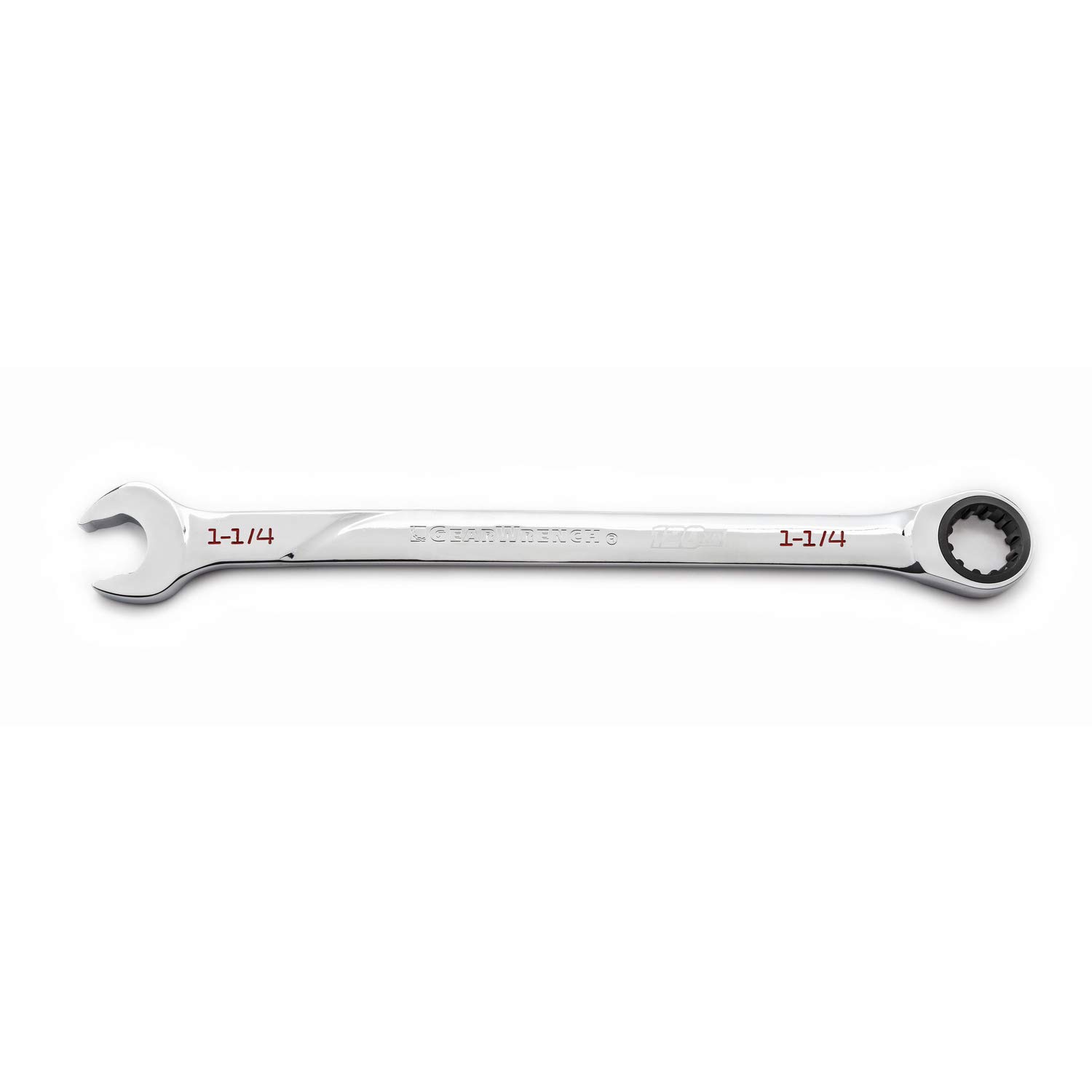
The GEARWRENCH 120XP delivers the finest gear pitch in this lineup with 120 positions and a 3-degree swing arc, letting you turn a 1-1/4 fastener in spaces where a standard wrench simply cannot swing. The universal spline drive is a genuine advantage on large equipment — one tool covers 12-point, 6-point, rounded, E-Torx, and square fasteners, drastically reducing the number of socket swaps needed in a single job.
The XL beam extends roughly 25% beyond the length of a typical 1-1/4 combination wrench, providing noticeably more leverage when breaking loose corroded hardware. Dual-direction off-corner loading on both the box and open ends further reduces the risk of rounding fastener heads, which is critical when every degree of grip matters. The ratchet mechanism itself feels very smooth and refined for its tooth count.
The only real concession is that the longer beam can be a liability in extremely confined engine compartments. For automotive, heavy equipment, and farm repair where access is moderate and fastener variety is high, this wrench is the clear frontrunner. It maintains a premium feel at a mid-range investment point.
Why it’s great
- 120-tooth mechanism provides the tightest 3° swing arc in the lineup
- Universal spline drive frees you from carrying multiple socket sizes
- XL beam adds significant leverage for stubborn fasteners
- Off-corner loading reduces fastener rounding on both ends
Good to know
- Extended length can be a drawback in very cramped spaces
- Price sits above entry-level options
2. GEARWRENCH 1-1/4″ 4 Degree Swing Arch 12 Point Ratcheting Combination Wrench 86956
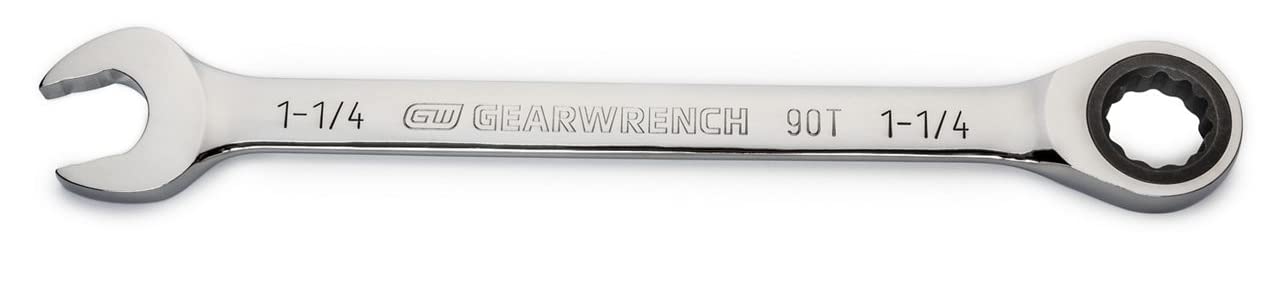
The GEARWRENCH 86956 uses a 90-tooth ratchet mechanism with a 4-degree swing arc, delivering ample angular resolution for the vast majority of automotive and equipment repairs. It strikes a near-perfect balance between tooth engagement smoothness and beam efficiency — the 13.56-inch overall length provides substantial leverage without feeling unwieldy in moderate access scenarios.
Off-corner loading is present on both the box end and the open end, a feature often reserved for higher-tier tools. This means the contact pads grip the flats of the fastener rather than the vulnerable corners, significantly reducing the risk of rounding on high-torque removal. The 12-point box end works on both 6-point and 12-point fasteners, adding practical flexibility.
Customer feedback consistently highlights the quality and professional-grade feel, though some note the wrench is slightly longer than typical for its size class. The polished chrome finish resists corrosion well. For technicians needing a dependable daily driver without paying a premium for spline compatibility, this wrench is hard to beat.
Why it’s great
- 90-tooth mechanism offers excellent smoothness and a tight 4° arc
- Off-corner loading on both ends protects fastener heads
- Lifetime warranty from a trusted pro-tool brand
- Polished chrome finish sheds grease and resists rust
Good to know
- Ratcheting action may not be as crisp as high-end truck brands
- Some users report sticky adhesive residue from retail tags
3. Williams JHW1238NRC Ratcheting Combination Wrench 1-1/4-Inch
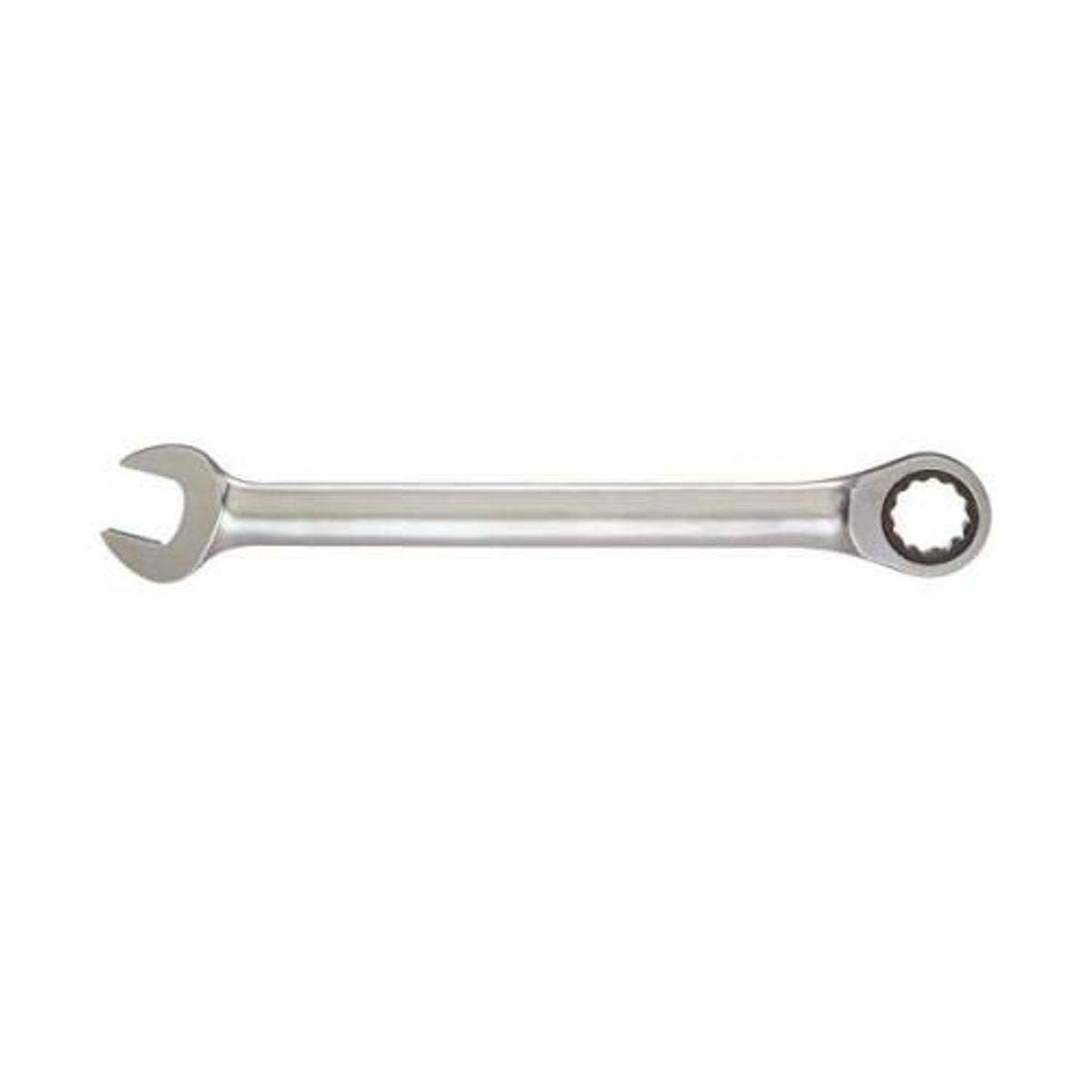
The Williams JHW1238NRC packs a 72-tooth ratchet mechanism into a deliberately thin head profile, making it the go-to option when clearance is at an absolute premium. At just over 6 ounces, it is noticeably lighter and slimmer through the head than the GEARWRENCH alternatives, which can mean the difference between sliding in between components or having to disassemble adjacent parts for access.
The high-polish satin-chrome finish cleans easily and resists surface rust during storage. The 5-degree swing arc is adequate for most fasteners but requires a bit more handle motion in tight quarters compared to higher-tooth-count models. The 12-point box end provides solid engagement, and the thin profile helps it fit where a socket and ratchet combination simply will not fit.
Some users note the Taiwan origin as a minor disappointment, but the quality control is consistent with Williams’ reputation. A few customers mention the ratchet action feels a bit notchy compared to premium domestic brands. For budget-conscious buyers who value thinness and weight savings above ultra-fine ratcheting pitch, this wrench delivers solid value.
Why it’s great
- Thin head profile fits into extremely tight clearances
- Low weight reduces fatigue during extended use
- Satin-chrome finish resists corrosion and is easy to clean
- Very affordable entry point for a single 1-1/4 wrench
Good to know
- Ratcheting action feels less smooth than higher-tooth-count designs
- Imported, not USA-made
4. DISEN 8pcs Large Wrench Set Jumbo Ratcheting Wrench Set

The DISEN 8-piece set provides a comprehensive solution for anyone who works with large fasteners regularly. It includes four SAE sizes — 1″, 1-1/16″, 1-1/8″, and 1-1/4″ — alongside their metric counterparts 24mm, 27mm, 30mm, and 32mm, all built from chrome vanadium steel with a black electrophoretic coating for corrosion resistance. The set weighs around 20 pounds total, reflecting the robust material thickness used for these large wrenches.
Each wrench uses a 15-degree offset on both the open and box ends, a practical angle for knuckle clearance against flat surfaces. The beams are notably thick and heavy, offering substantial torque capacity for farm equipment, tractor-trailers, graders, and cement trucks where leverage is essential. The roll-up pouch keeps the set organized and portable for service trucks and field work.
The main trade-off is that the heavy construction and thick heads may prevent the wrenches from fitting into very tight spaces. Some users feel the steel hardness is moderate rather than premium-tool-grade. For the price of a single premium wrench, you get a complete set covering the most common large SAE and metric sizes — an excellent value if you need coverage rather than a single ultra-refined tool.
Why it’s great
- 8-piece set covers both SAE and metric large sizes
- Chrome vanadium steel construction with corrosion-resistant coating
- Roll-up pouch keeps tools organized and portable
- Excellent value for the number of tools included
Good to know
- Thick heads and beams may not fit tight clearance applications
- Steel hardness is adequate but not premium-grade
5. Toptul Double Socket Ratchet Wrench 1-1/8 x 1-1/4 Spud/Tanker Wrench

The Toptul Double Socket Wrench takes a different approach for the 1-1/4 user — it’s a specialty spud wrench that pairs a 1-1/8 socket on one end with a 1-1/4 socket on the other, specifically designed for structural steel erection and tank work. The ratcheting mechanism lives inside the socket head, making this a compact but highly purpose-built tool for ironworkers and millwrights.
Manufactured from chrome vanadium steel with a satin finish, the wrench feels solid and heavy in hand without being overly bulky. The double-ended format eliminates the need to carry two separate wrenches for the most common structural nut sizes used with 3/4-inch common and 3/4-inch structural bolts. The spud rod end doubles as an alignment tool for drifting bolt holes into place before fastening.
The wrinkle is cost — this specialized tool sits at a premium price point for a two-function tool. Some users find the expense justified for daily professional use where round trips to the toolbox kill productivity. For ironworkers and structural fabricators, the alignment and fastening combo is genuinely valuable. For general automotive or equipment work, a standard combination wrench is more versatile.
Why it’s great
- Dual 1-1/8 and 1-1/4 sockets in one tool for structural work
- Spud rod end serves as an alignment drift for bolt holes
- Chrome vanadium steel holds up to heavy daily abuse
- Compact format eliminates carrying two separate wrenches
Good to know
- Premium pricing for a two-function specialty tool
- Limited utility outside structural steel and tank applications
FAQ
Can I use a 1-1/4 ratchet wrench with thick gloves on?
Will a 120-tooth wrench feel fragile compared to a lower tooth count?
Is a universal spline drive worth the premium over standard 12-point?
How do I maintain a large ratchet wrench in wet or muddy conditions?
Final Thoughts: The Verdict
For most users, the best 1 1/4 ratchet wrench overall is the GEARWRENCH 120XP 86448 because its 120-tooth mechanism, universal spline drive, and extended beam deliver the best combination of access, leverage, and fastener compatibility. If you need a slim profile for tight engine compartments, the Williams JHW1238NRC offers excellent value in a lightweight package. And for ironworkers and structural fabricators requiring a dual-size spud tool, nothing beats the Toptul Double Socket Wrench for speed and alignment capability on the job.