
Our readers keep the lights on and my morning glass full of iced black tea. As an Amazon Associate, I earn from qualifying purchases.
Specs are compiled from manufacturer listings and verified buyer reviews and can change over time — please confirm the key details on the product page before buying.
If you are shopping for a 1-1/4 inch router bit, the short answer is this: buy the Whiteside 1376B for bowl and tray bottoms, and pick a spoilboard or V-groove bit from the same width family when your project calls for it. Every bit here shares that 1-1/4 inch cutting diameter (the width of the cut it makes), so the real decision is shape, shank size (the diameter of the shaft that goes into your router), and how long the cutting edge runs. The guide below shows which of those three specs your work actually depends on.
I’m Min — the founder and writer behind Gadgets Feed. This guide is built by comparing the manufacturers’ published specifications and the patterns across verified customer reviews, so you get each pick’s real strengths and trade-offs instead of marketing spin.
You will see bits with 1/2 inch shanks, a few with 1/4 inch shanks, and cutting lengths that swing from half an inch all the way up to two and a half inches. Most buyers get burned by a cutting length shorter than the groove or recess they plan to cut. The picks below narrow it down for you as a practical list of the 1 1/4 router bit options worth your bench space.
Our Picks at a Glance

How To Choose The Best 1 1/4 Router Bit
Start with the router on your bench, not the profile on the screen. A bit only earns its place if the shank matches your collet (the collar that grips the bit’s stem) and the cutting length reaches the depth your project needs.
Match the shank to your collet first
A 1/2 inch shank is the stiffer option, and it sits in a 1/2 inch collet. A 1/4 inch shank is smaller and fits the lighter collet many compact routers and hobby CNC machines carry. A bit whose shank does not fit your collet is useless no matter how good its edge is. One of the picks below even ships with a 1/2 inch to 1/4 inch collet adapter so a small-shank router can drive a wider cutter.
Then check the cutting length against your depth
The cutting length is how far the edge runs up the bit, so it caps the depth of the recess you can cut in one pass. A bit with a half inch cutting length handles shallow tray bottoms and surfacing work. A bit with two and a half inches of cutting edge can drop deep into a rabate or clean out a tall dado wall. Going deeper than the edge allows just burns the wood with the bare shank.
Match the profile to the cut you want
Round-nose and bowl bits leave a smooth scoop with a flat bottom — the right call for tray recesses. Straight bits cut square walls. V-groove bits at a 90 or 120 degree angle score crisp lettering and chamfers. Spoilboard bits shave a wide, flat surface across a whole slab. Pick the profile first, then let shank size and cutting length settle which bit in that profile you buy.
Quick Comparison
| Model | Best For | Shank | Cutting Length | Profile | Amazon |
|---|---|---|---|---|---|
| Whiteside 1376B Bowl and Tray Bit★ Best Overall | Bowl and tray bottoms | 1/2″ | 1/2″ | Bowl & Tray | Amazon |
| Freud 16-108 Spoilboard Surfacing & Mortising BitBest For Surfacing | Spoilboard surfacing | 1/2″ | 1/2″ | Straight | Amazon |
| Freud 12-182 Double Flute Straight BitDeep-Cut Straight | Deep rabates and relief cuts | 1/2″ | 2-1/2″ | Straight | Amazon |
| SpeTool 120 Degree V Groove Bit | Sign making and engraving | 1/2″ | 1-1/4″ | V-Groove, 120° | Amazon |
| KEENTECH Core Box Router Bit | Round-bottom fluting | 1/2″ | 3/4″ | Core Box | Amazon |
| MAILADA Slab Flattening Bit | Slab flattening on small routers | 1/4″ | 1/2″ | Insert Carbide, 4-flute | Amazon |
| Whiteside 1376 Bowl and Tray Bit | Repeat bowl cuts | 1/2″ | 1/2″ | Bowl & Tray | Amazon |
| KEENTECH CNC Spoilboard Surfacing Bit | Big slabs and bottom cleaning | 1/4″ | 8mm | Insert Carbide, 4-wing | Amazon |
| Amana Tool 45751 V-Groove | Precision CNC lettering | 1/4″ | 15/16″ | V-Groove, 90° | Amazon |
In‑Depth Reviews
1. Whiteside 1376B Bowl and Tray Bit
Our pick — 4.5+★ from 350+ verified ratings; the strongest balance of quality and price.
The bowl-and-tray specialist that leaves a flat, smooth recess instead of a scooped mess.
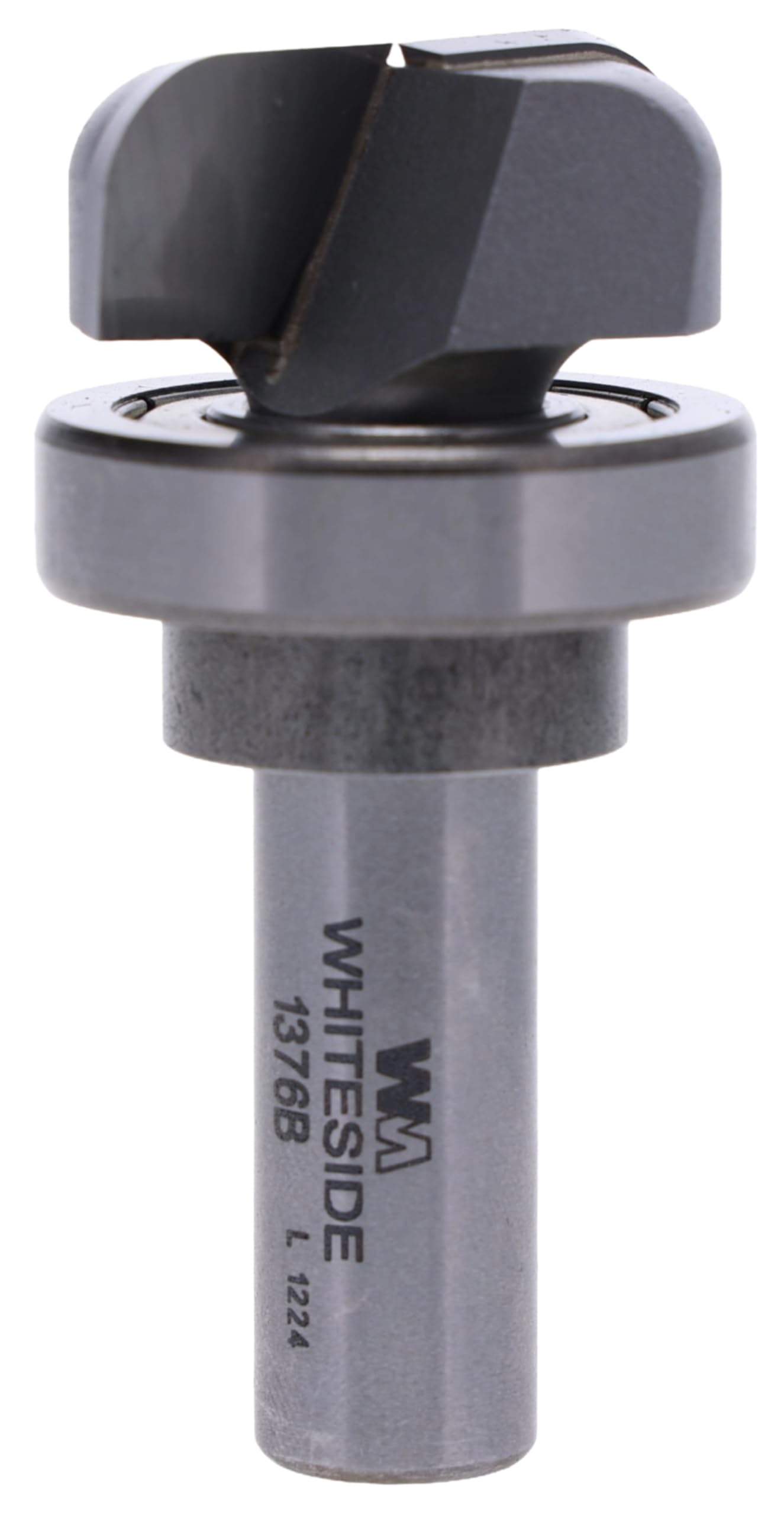
If your project is a serving tray, a catch-all dish, or a candy bowl, the shape of this bit does the work for you. It carries a 1-1/4 inch cutting diameter with a 1/4 inch radius — meaning the rounded corner has a quarter-inch sweep — and a flat bottom at the end. That flat bottom is what separates it from an ordinary round-nose bit. You get a level floor on the tray recess instead of a curved dimple that needs filler or a flattening pass later.
A bearing mounted up on the shank rides along a template so the outline follows your pattern instead of your hand. The 1/2 inch shank locks into a 1/2 inch collet, and the whole bit runs 2-1/4 inches overall. It also earns the top pick on score: 4.5+ stars across 370+ ratings, the strongest combination of score and volume in this group. What wins people over most is the quality of the cut — the largest share of buyer feedback lands there. Durability follows closely, with clean corner cuts on plywood called out and a cutting edge that holds up across repeat jobs.
The honest catch is length. A half inch of cutting length rules out deep tray walls in a single plunge — you work down in staged passes instead. That same steel body and carbide edge will chew through natural woods, composite panels, and hard plastics, but the machine matters too. It is built for hand-held routers, router tables, and CNC work alike, so nothing about the setup limits you. Just do not expect one pass to cut a deep bowl hollow.
Where This Bit Earns Its Keep
- Flat-bottom bowl and tray recess — no curved dimple to flatten afterward.
- 1-1/4 inch cutting diameter with a 1/4 inch radius for tight, tidy corners.
- Shank-mounted bearing follows a template quickly and accurately.
- Steel body keeps vibration down while the carbide edges hold their bite.
What To Plan Around
- 1/2 inch cutting length means staged passes on deeper hollows.
- Needs a 1/2 inch collet — no use on a 1/4 inch-only router.
Reach for this if: trays, bowls, and catch-all dishes are your regular build and you want a level bottom without extra sanding.
Look elsewhere if: your router only takes a 1/4 inch collet, since this bit will not seat.
2. Freud 16-108 Spoilboard Surfacing & Mortising Bit
A two-cutter surfacing workhorse that levels a spoilboard without leaving chatter ridges behind.
Slab work and spoilboard resurfacing punish a weak bit, because the cutter sweeps a wide path across the whole surface in one go. This Freud runs a 1-1/4 inch overall diameter with two cutters and a half inch of carbide height. That carbide height is the depth it can shave in one sweep. Deep center gullets throw chips out fast so the cut stays clean instead of packing sawdust into the groove.
Two details stand out for anyone nervous about a wide cutter spinning fast. It is anti-kickback, so a grab in the wood is resisted rather than yanked, and it is computer balanced for vibration-free running at speeds over 22,000 RPM. Ground carbide treated with titanium backs up the long life, and the Freud Perma-SHIELD coating adds a slick, low-friction face. Sharpness is the front-runner in buyer feedback — buyers consistently report cuts that need only minimal sanding after. One clear pass you can bring a piece down to an inch with no issues.
This is a straight-cut profile, not a profile-shaping bit, so it will not round a decorative edge. It is the bit you reach for when a panel or slab has to come dead flat before the finish work starts. A 1/2 inch shank and 2-3/8 inch overall length make it comfortable in a router table or a CNC, and the design is built for all three setups — hand-held, table, and CNC.
The flat-panel specialist: pair this with a sled or surfacing jig and the wide face sweeps clean, chip fast, and comes back up without a mark. It does the one job — flattening — better than any rounded profile bit could.
Not a shaping bit: if you want a routed decorative edge, this profile is the wrong tool; look to the bowl or V-groove picks instead.
The right buyer: anyone surfacing a spoilboard or flattening raw stock who wants anti-kickback and smooth running above 22,000 RPM.
Skip it when: you are cutting decorative profiles — a straight cut will not do that job.
3. Freud 12-182 Double Flute Straight Bit
A 1-1/4 inch cut paired with two and a half inches of reach — this one goes deep.
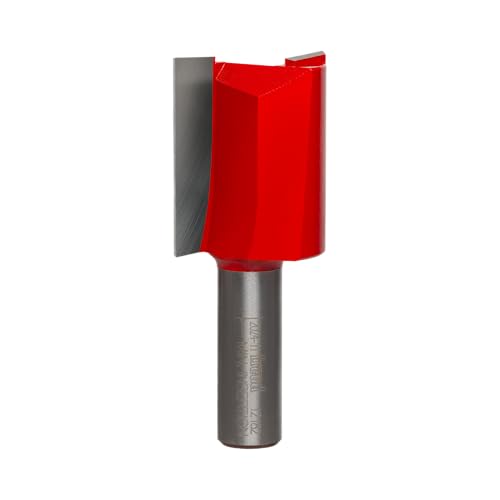
At 1-1/4 inches in diameter this is the same width family as the rest of the list, but the cutting length is what separates it. The edge runs 2-1/2 inches up the shank, and the carbide height behind it is 1-1/2 inches. Compare that to the Whiteside 1376B’s half inch of cutting length and you see the split: that bit is for shallow tray bottoms, this one is for cutting a tall wall or cleaning out a deep dado. The two flutes clear material quickly on a 1/2 inch shank.
Pieces come down without complaint — one clear pass bringing a cut down with no issues. Buyers describe the cut “like a hot knife through butter,” which matches the pair of sharp Tico Hi-Density carbide edges. It handles solid wood, plywood, and composites equally, and it runs in a CNC, a hand-held router, or a table-mounted setup. Relief cuts and dado cleanouts are where it gets used most.
The trade-off is that reach. Two and a half inches of cutting edge on a 1/2 inch shank is a lot of bit to hang off a small router, so a lighter machine will want shallow passes. It also carries the smallest body of buyer feedback in this group, so its track record is shorter than the front-runners’. That said, the performance comments it does draw are consistently warm about how cleanly it functions.
Where it wins: deep rabates, tall dado walls, and cleanouts that a half inch cutting length simply cannot reach. Feed it in stages and the two carbide flutes throw the chips clear.
Where it asks more: the long cutting edge wants a stable router and a patient feed rate.
Pick this for: cabinet and joinery work that needs depth — a tall wall, a deep relief, a dado cleanout.
Not the tool for: shallow tray bottoms where the long edge just gets in the way.
4. SpeTool 120 Degree V Groove Bit

The sign maker’s bit — a wide 120 degree V that scores deep letters and bold chamfers in one pass.
Lettering and chamfers are a different cut from anything else here, and the angle is everything. This SpeTool is ground to 120 degrees, a wide V that opens fast as it drops, with a 1-1/4 inch cutting diameter and a 1-1/4 inch cutting length. That wide angle is what gives you the bold, deep engraving passes that catch the light on a sign face. A 1/2 inch shank seats in a matching collet, and the two carbide flutes are welded on so the cut stays stable at speed.
Buyer consensus centers on the quality of the tooling, with function close behind — it is reported to work well for hand routing letters, and sharpness earns repeated praise on bold chamfers and deep engraving passes. Value is noted as a strong point too. SpeTool builds it for hardwood, plywood, softwood, oak, and MDF, and it slots into CNC setups, sign shops, and hobby benches. Sign making, lettering, and carving are all fair game.
One thing to keep in mind: a 120 degree V is wide by design, so it is not the bit for a narrow, fine-line groove. For that you would want a sharper angle — the Amana 90 degree further down this list is the tighter V. On the flip side, buy this one when bold is the brief and you want the groove broad and legible.
Why Sign Shops Reach For It
- 120 degree angle opens wide for bold, legible carves.
- 2-flute carbide cutter welded for stable cutting at speed.
- Sharp edge holds up through deep engraving passes.
- Cuts hardwood, plywood, softwood, oak, and MDF.
Limits To Know
- A wide 120 degree V is wrong for narrow, fine-line grooves.
- Needs a 1/2 inch collet.
Made for: sign makers, engravers, and hobbyists carving letters where a broad V reads clearly.
Step past it if: your cut is a fine hairline groove — you need a tighter angle than 120 degrees.
5. KEENTECH Core Box Router Bit

A three-quarter-inch-deep round nose for fluting, channels, and smooth scooped forms.
Core-box cuts make a rounded trough — the shape you want for fluted columns, decorative channels, and lettering with a soft bottom. This KEENTECH runs a 1/2 inch shank, a 1-1/4 inch cutting diameter, and a 3/4 inch cutting depth, so it carves a rounded groove the full three quarters of an inch when you push it. It slices cleanly through hardwood, softwood, plywood, MDF, particle board, laminates, and composites — burr-free is the aim on every pass.
Cutting performance is the thing buyers talk about most, and wood resistance draws steady mention alongside the value. Owners note it cutting smoothly through maple, walnut, and oak, and the design keeping the wood from scorching — a real concern when a bit lingers too long in the cut. KEENTECH bills the tungsten carbide as industrial grade with a claimed life up to ten times a standard carbide bit — a maker’s figure, not a measured result. The two flutes clear chips well and the 1/2 inch shank fits hand-held and table-mounted routers from the major brands.
What you will notice in a heavier day of routing is that the body sits shorter than the front-runners in buyer feedback, so its long-term record is thinner. For a fair share of users the value is the draw — the cut quality lands where it should without a premium price tag.
The cut quality leads: a clean, burn-free scoop through oak, walnut, and maple is what this was built for, and buyers report it delivers on exactly that.
One note on the claims: the ten-times lifespan figure comes from KEENTECH, so treat it as their claim rather than a measured result.
Best match for: fluting, round-bottom channels, and soft scoop work in hardwoods where burn is the worry.
Think twice if: you want a long proven record — the bit is newer to reviewers than the Whiteside and Freud staples.
6. MAILADA Slab Flattening Router Bit

A four-flute slab flattener that brings its own collet adapter for small-shank routers.
There is a real split in the numbers here worth calling out. This MAILADA runs four flutes, while the Whiteside 1376B carries one. Four flutes means more cutting edges sweeping the surface in a single rotation, giving a faster removal rate and a smoother finish on a wide pass — the reason this bit belongs to the slab-flattening crowd.
The package is where the value sits. You get four titanium-coated carbide inserts, all locked in place on the bit, plus a screwdriver and a 1/2 inch to 1/4 inch collet adapter. That adapter is the useful part: a router with a small 1/4 inch collet can still drive a wide 1-1/4 inch cutter. When an insert dulls you loosen the screw, rotate or swap the edge, and carry on instead of buying a new bit. The double-sided interchangeable inserts are the point of the design, and it all arrives pre-assembled.
The single 1/4 inch shank limits how hard you can lean on it compared to a 1/2 inch version, so treat heavy passes with care. Owners mention the first back-and-forth passes going well, and the surface coming out smooth and flat when the job is done. It mills hardwood, plywood, and MDF fine, and its footprint is small enough to suit a router sled as much as a full CNC bed.
Value in the box: four pre-fitted titanium-coated inserts, extra screws, a Torx screwdriver, and the collet adapter — the spare-edge setup is what keeps it running season after season.
The flex to watch: a 1/4 inch shank under a 1-1/4 inch cutter asks for gentle passes rather than deep hogging.
Worth grabbing if: your router only takes a 1/4 inch collet but you still want to flatten slabs and level spoilboards.
Look past it if: you want to hog out material aggressively — a 1/2 inch shank holds more load.
7. Whiteside 1376 Bowl and Tray Bit

The bowl-and-tray classic, with a half inch of cut and a flat seat for steady trays.
The 1376 shares the same 1-1/4 inch cutting diameter, 1/4 inch radius, 1/2 inch cutting length, and 2-1/4 inch overall length as the top Whiteside above, and same 1/2 inch shank. But it runs two flutes rather than one, which changes how the edge meets the wood. If you cut the same tray over and over, two flutes can even out the finish and carry chips away faster on each pass.
The flat-bottom bowl shape is the point of the design — an alternative to a plain round nose that leaves a level tray floor. The steel shank body adds rigidity, and the carbide edges hold up. Working range covers natural woods, composite woods, and hard plastics alike. What people come back for, mostly, is quality and sharpness — cutting through wood “like butter” is the phrase that keeps surfacing on these Whiteside bowl bits.
The one honest limit is coverage. Feedback on this specific model is narrower than on its more-reviewed sibling above, so fewer people have put this exact version through long-term duty. If you want the most-proven bowl bit, the 1376B above has the longer record. If a two-flute cut and the flat seat suit your workflow, this one earns its spot.
What Keeps It On The Bench
- Flat-bottom bowl and tray cut, no scoop to flatten later.
- Two flutes run with a steadier finish on repeat passes.
- 1/4 inch radius keeps edges tight and tidy.
- Steel shank with carbide edges for reduced vibration.
Points To Weigh
- Fewer owners have logged mileage on this exact model.
- 1/2 inch cutting length rules out deep single-pass recesses.
Suits you when: you want the bowl-and-tray cut in a two-flute version for repeat runs of the same dish.
Go another way if: you would rather buy the most-reviewed bowl bit on the list.
8. KEENTECH CNC Spoilboard Surfacing Bit
Four wings and eight millimeters of cut for leveling a whole slab in fewer passes.
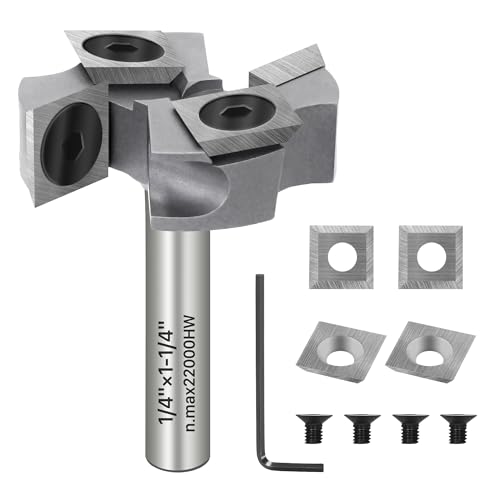
A 1/4 inch shank with a 1-1/4 inch cutting diameter, an 8mm cutting height, and a 2-1/4 inch overall length — this is a compact surfaced bit built to plane and resurface. The balanced four-wing design removes material quickly and leaves a flat, smooth face with minimal tear-out. Sixteen millimeters of wing spread counts for a lot when you are bringing down a hardwood slab before the finish goes on.
Replaceable inserts are the cost story, and this set is complete. The bit ships with four extra inserts, four screws, and a Torx wrench. When a wing dulls you rotate or swap the insert and get a fresh edge instead of replacing the whole tool. Customers note it flattening red oak slabs well and cutting clean and smooth, with the functionality winning the most praise. It fits most CNC routers, hand-held routers, and router sleds, and it will mill hardwood, softwood, MDF, plywood, and particle board. KEENTECH also offers support after the return window closes.
Because a single 1/4 inch shank drives a wide cutter, feed and depth want a light touch, and the maker’s own note to wear eye and hand protection is worth taking seriously. This is not the small-shank beginner’s first bit — it is the one you step up to when flattening becomes the main job.
A resurfacing step-up: the four-wing body and the spare inserts put aggressive flattening on a 1/4 inch shank router, which few bits of this width do.
Feed it gently: a wide cutter on a small shank rewards patience and proper protection over speed.
Fits the buyer who: already flattens slabs regularly and wants replaceable edges instead of a throwaway bit.
Hold off if: you are still learning feeds and speeds — a wide cutter on a thin shank punishes a heavy hand.
9. Amana Tool 45751 V-Groove Bit
The tight-corner V — a 90 degree point that carves clean, sharp lettering down to fifteen sixteenths.
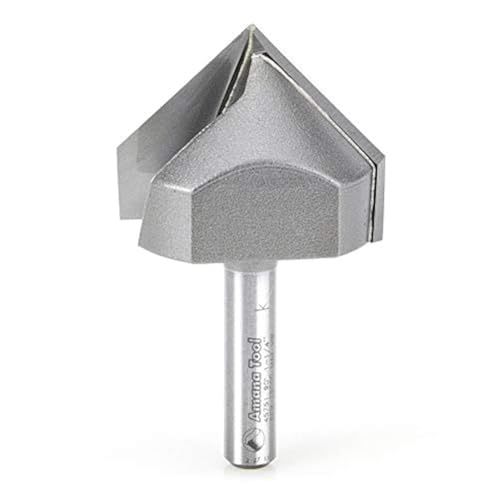
Where the SpeTool opens wide at 120 degrees, this Amana holds a crisp 90 degree point — a right-angle V for precise lettering and detail lines. It runs a 1-1/4 inch diameter, a 15/16 inch cutting height, a 1/4 inch shank, and a 2-13/64 inch overall length. That narrower angle is the reason it cuts a cleaner, tighter groove when a sign needs sharp edges rather than bold, wide channels.
The 1/4 inch shank is a good match for the smaller routers and hobby CNC tables this kind of fine detail work often runs on, and it still fits a full-size machine with the right collet. Buyers call it very sharp and report it working well in CNC machines on hardwoods, with quality leading on the balance of feedback. It is a two-flute carbide-tipped bit, and the quality of the tooling is why it sits at the premium end of this list.
The honest trade-off is the smaller cutting diameter underneath the point when compared with a full-width straight bit — as a V-groove tool it is specialized rather than general-purpose. If you cut mostly flat-bottom recesses or straight walls, this is not your everyday bit. If the cut is lettering, chamfers, or decorative grooves where the corner has to be crisp, the angle pays off.
The Case For The 90 Degree Point
- A 90 degree V cuts sharp, tight-edged lettering.
- 1/4 inch shank suits compact routers and hobby CNC setups.
- Very sharp out of the gate, per the buyer record.
- Two-flute carbide-tipped for clean multi-pass detail work.
The Honest Trade-Off
- Specialized to V-groove work — not a flat or straight bit.
- Premium-priced side of this list.
Built for: fine lettering, chamfers, and decorative grooves that demand a crisp 90 degree point on a small-shank machine.
Not for you if: your routing is mostly flat-bottom recesses and straight walls.
Understanding the Specs
Cutting Diameter (the width of the cut)
The cutting diameter is how wide a swath the bit carves in one pass — here, all of these bite across 1-1/4 inches. A wider diameter clears more wood per pass, which makes surfacing and flattening faster. The catch is a wider bit cuts a wider channel and needs more power to push through hard stock, so a wide cutter on a thin shank wants gentle feeding.
Shank Size (the stem that locks in the router)
The shank is the straight metal stem that clamps into the router’s collet. A 1/2 inch shank is thicker and stiffer; a 1/4 inch shank is slimmer and fits compact routers and hobby CNC tables. Match the shank to your collet before you buy, or the bit will not seat. Some kits include an adapter so a 1/4 inch collet can drive a wider cutter safely.
Cutting Length and Cutting Depth
Cutting length is how far the edge runs up the bit, so it caps the depth of a recess you can cut in one pass. Shorter cutting lengths suit shallow tray bottoms and surfacing; longer ones reach deep into rabates and dado walls. Going deeper than the edge allows just burns the wood with the bare shank, so always step the cut down in stages rather than plunge past the carbide.
Carbide Edges and Flute Count
The flutes are the cutting edges — one flute gives a clean scoop, two or four give faster chip clearance and a smoother wide pass. Carbide is the hard cutting material used across this list; a steel body behind it keeps vibration down. Some bits use fixed carbide edges that are sharpened back to life, while insert-style bits let you rotate or swap a dull edge without replacing the whole tool.
FAQ
Will a 1-1/4 inch router bit fit my router?
What is the difference between a bowl bit and a core box bit?
How deep can a 1-1/4 inch bit cut in one pass?
Do I need a 1/2 inch or 1/4 inch shank for slab flattening?
How long do carbide router bit edges last?
Can I use these bits on hard plastics as well as wood?
What angle V-groove bit is best for lettering?
Do I need to run a test cut before using a new bit?
Can I use a 1-1/4 inch bit in a hand-held router or only a router table?
What safety gear should I use when running these bits?
Final Thoughts: The Verdict
For most woodworkers, the 1 1/4 router bit that earns the bench is the Whiteside 1376B Bowl and Tray Bit, because its flat-bottom bowl shape and shank-mounted bearing (a guide wheel on the shaft that rides the workpiece edge) make smooth, level tray and bowl recesses repeatable job after job. If your mission is flattening slabs rather than shaping, grab the Freud 16-108 Spoilboard Bit for its anti-kickback build (a design that resists the bit grabbing and jerking the wood) and clean surface cut. And for deep joinery that a half inch cutting length cannot reach, the Freud12-182 Straight Bit is the one to reach for. Every bit here cuts a 1-1/4 inch swath, so profile and cutting length are what separate them — match the shape to your cut and the choice narrows fast.
How We Picked
We do not accept paid placement. Every pick is matched to a real buyer and a real use-case; we do not hands-on test units.
Sources & Methodology
Specifications: manufacturer listings and product documentation. Review insights: verified customer reviews, as of November 2026. Pricing: not shown on this page (it changes often); check the current price via the retailer link.
As an Amazon Associate, Gadgets Feed earns from qualifying purchases. This does not affect which products we feature.