
Our readers keep the lights on and my morning glass full of iced black tea. As an Amazon Associate, I earn from qualifying purchases.
Specs are compiled from manufacturer listings and verified buyer reviews and can change over time — please confirm the key details on the product page before buying.
Running a new gas line to a patio heater, generator, or tankless water heater used to mean threading heavy black iron pipe and struggling around corners. Flexible CSST (corrugated stainless steel tubing — a bendable metal pipe that replaces rigid threaded pipe) changes that — you get one continuous, bendable run that snakes through walls and under yards, and the real question is how much length you need and whether the fittings seal properly the first time.
I’m Min — the founder and writer behind Gadgets Feed. This guide is built by comparing the manufacturers’ published specifications and the patterns across verified customer reviews, so you get each pick’s real strengths and trade-offs instead of marketing spin.
Whether you are connecting a propane fire pit or burying a line to a detached garage, these four kits represent the best 1/2 inch flexible gas line options available for DIY installers and professionals alike.
Quick Picks
- CSST Corrugated Stainless Steel Tubing 100 Ft 1/2″ — Kinchoix — Longest Run
- 40FT Standard CSST 1/2″ Gas Line Hose — Thmxit — Best Value
- 35ft 1/2” CSST Gas Line Flexible Gas Line — Kinchoix — Balanced Reach
- 17ft 1/2” CSST Gas Line Flexible Gas Line — Kinchoix — Quick Hookup
How To Choose The Best 1/2 Inch Flexible Gas Line
Length and BTU Delivery
Every length of 1/2″ CSST has a maximum gas flow it can handle before pressure drops too low for your appliance to run correctly. A 100-foot run of 1/2″ pipe can carry roughly 100,000 BTU/hour — enough for most tankless water heaters and large grills. Shorter runs handle higher BTU loads. Always plan a few extra feet for bends and vertical rises; a line that is too short is a much bigger problem than one that is a few feet long.
Material and Jacket
The core should be 304 stainless steel (corrosion-resistant and durable). The outer jacket is usually yellow polyethylene. Some jackets are UV-resistant for exposed outdoor runs, while basic jackets work fine inside walls or conduit. If you plan to bury the line, check whether the manufacturer explicitly requires a watertight conduit — many do, and ignoring that voids any warranty.
Fittings and Installation
Most kits come with two male brass adapter fittings pre-installed. Brass resists weather and won’t rust. The tubing can be cut with a standard tubing cutter or a cutoff wheel (avoid crushing the corrugation). Look for kits that include clear instructions or video resources — buyers in the reviews consistently mention that good instructions make a DIY install much less intimidating.
Quick Comparison
| Model | Best For | Length | Weight | Material | Amazon |
|---|---|---|---|---|---|
| CSST 100 Ft Kinchoix | Longest continuous run (long garage or house-to-outbuilding) | 100 ft | 5.26 kg | 304 SS + PE jacket | $99.99Amazon |
| 40FT Thmxit Standard | Medium-length water heater or generator hookup | 40 ft | 1.81 kg | 304 SS | $49.96Amazon |
| 35ft Kinchoix | Outdoor grill or fire pit with some extra reach | 33 ft | 2.22 kg | 304 SS + rubber + brass | $43.99Amazon |
| 17ft Kinchoix | Short, direct appliance connection (range or dryer) | 17 ft | 5.26 kg (stated) | 304 SS + rubber | $31.99Amazon |
In‑Depth Reviews
1. CSST Corrugated Stainless Steel Tubing 100 Ft 1/2″ — Kinchoix
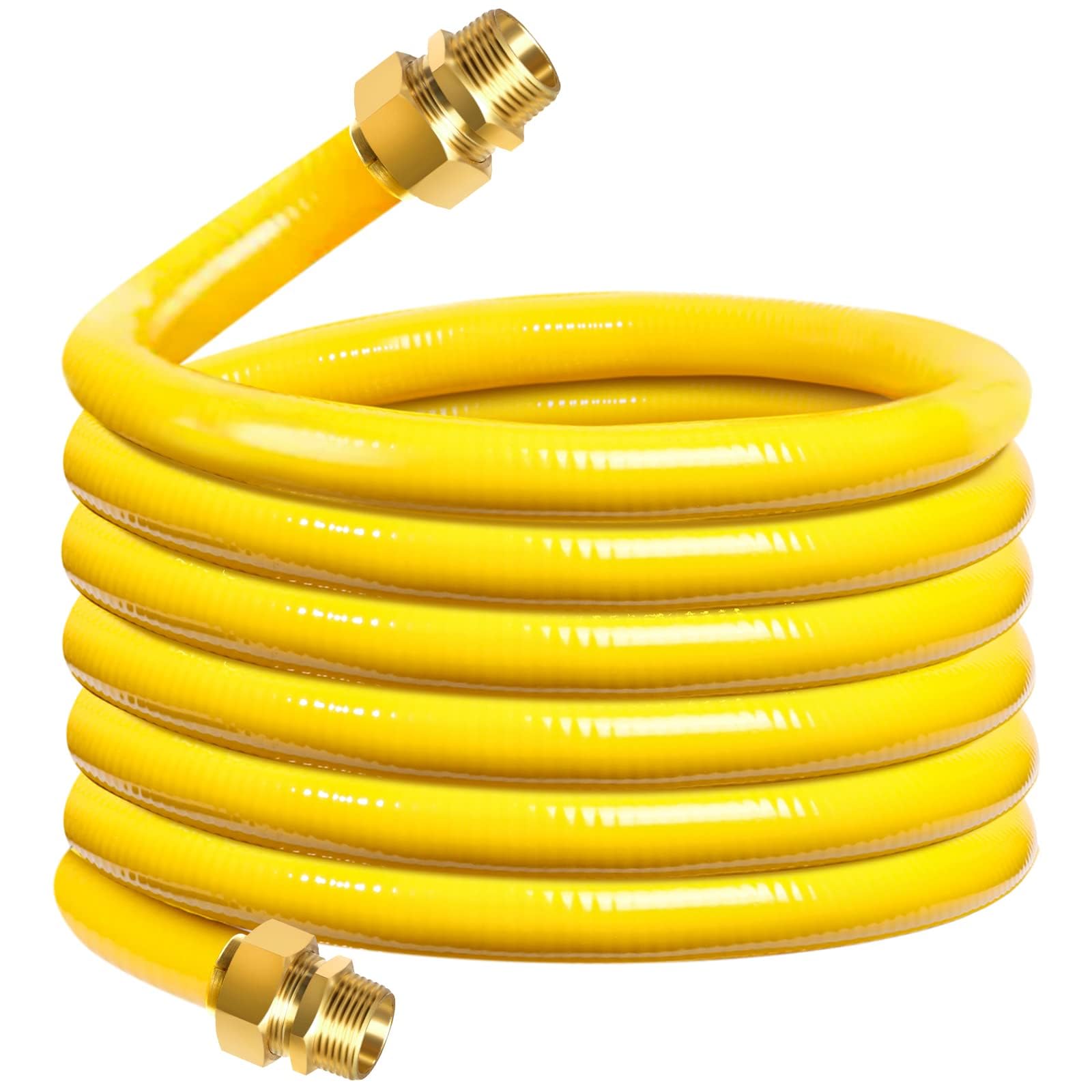
The 100-foot spool that turns a whole-house re-pipe into a single continuous pull.
If your project means running gas from one end of a basement to a garage or out to a detached building, this is the volume play that saves you from splicing multiple shorter lines together. At 100 feet and 5.26 kilograms (about 11.6 lbs), it is the heaviest option here — at 100 feet versus the 17-foot Kinchoix’s 17 feet and at 5.26 kg versus the 40-foot Thmxit’s 1.81 kg — but you get one continuous piece with no intermediate joints to leak. The core is 304 stainless steel with an inner diameter of 0.48 inches and an outer diameter of 0.63 inches, so it delivers up to 100,000 BTU/hour of flow capacity, plenty for tankless heaters, large grills, or a floor heater.
Buyers report that the line “worked great at running a gas line from a 100lb propane tank to a floor heater” and that it was “very easy to work with, very modular.” The yellow polyethylene jacket is UV-resistant for exposed outdoor sections, and the one-piece molding means no middle interfaces. One reviewer noted the ends measure closer to 3/4 pipe thread, so double-check your appliance connections. Cut it with a cutoff wheel to keep the corrugation from deforming, and you can have it leak-tested in under an hour.
The Reach Advantage
- 100-foot continuous length eliminates joints and splicing.
- Rated for up to 100,000 BTU/hour — enough for most residential appliances.
- UV-resistant yellow jacket allows exposed outdoor runs.
The Weight Trade
- At 5.26 kg it is noticeably heavier than shorter options (at 5.26 kg versus the 40-foot Thmxit’s 1.81 kg).
- Fittings are loose from the factory — tighten them securely before testing.
Perfect for: Anyone running a long single gas line from the meter to a detached garage, workshop, or far-end appliance where splicing multiple shorter lines would add leak risk.
Consider a shorter run if: Your project is under 40 feet — you will carry less weight and pay less for unused length.
2. 40FT Standard CSST 1/2″ Gas Line Hose — Thmxit
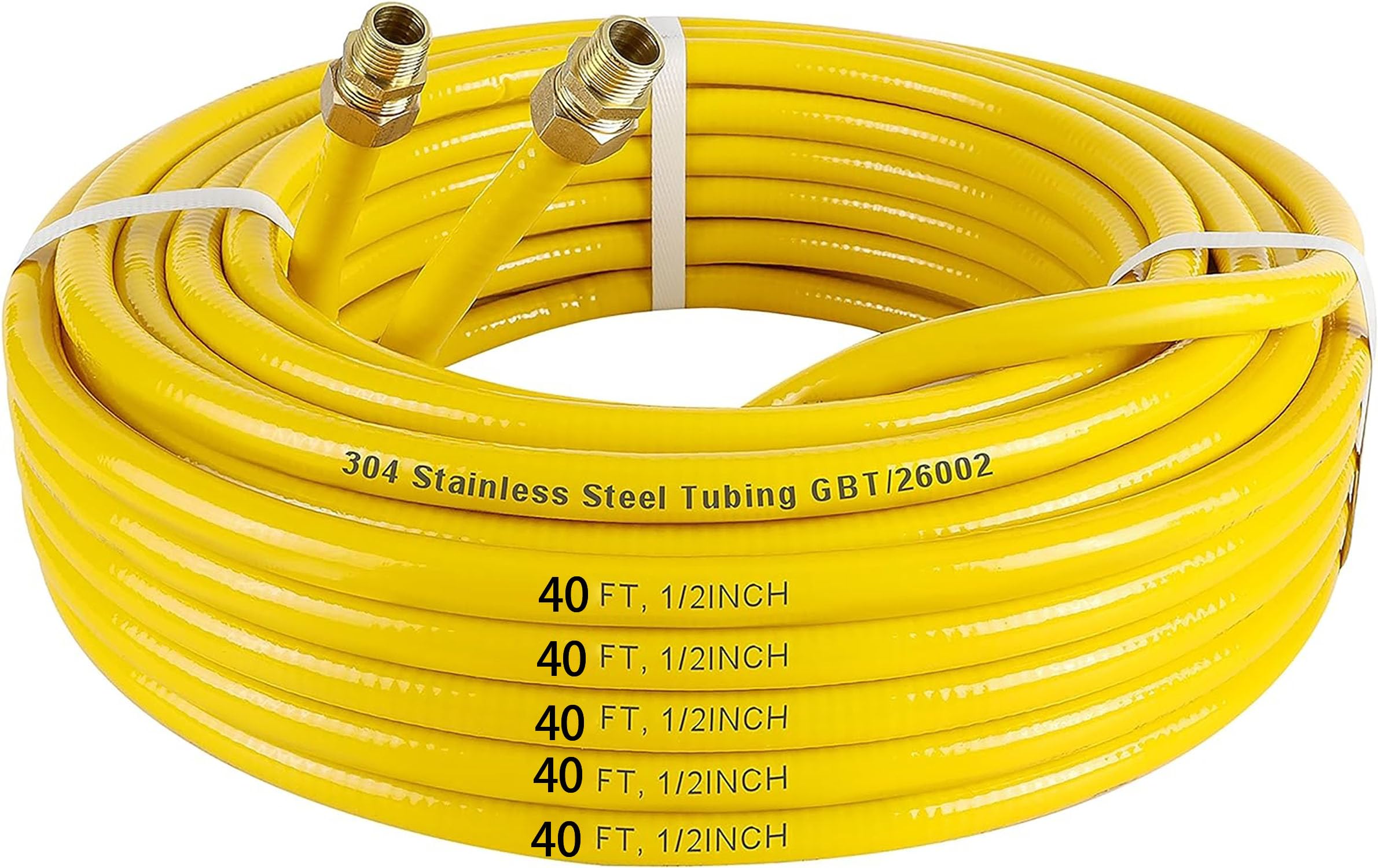
The mid-length balance that costs less than a black-pipe run and weighs nearly nothing to carry.
At 40 feet and just 1.81 kilograms (about 4 lbs), this Thmxit line is the lightest of the bunch — at 1.81 kg versus the 100-foot option’s 5.26 kg — making it easy to haul up a ladder or feed through a crawlspace without dragging a heavy coil. The 304 stainless steel core has a 12mm inner diameter and 16mm outer diameter (0.47 in / 0.63 in). The annular corrugation bends freely without collapsing the inner ID, so gas flow stays consistent around tight corners.
One buyer wrote they “ran this to a new tankless propane water heater, works great, much easier than black iron pipe or copper tubing and a whole lot cheaper.” That is the core value play here: you skip the threading, the heavy pipe wrenches, and the elbow fittings. Just be aware the manufacturer explicitly says the gas pipe should never be buried directly into the ground — it must go inside a non-metallic watertight conduit at least 1/2 inch larger than the CSST outside diameter. The kit comes with two male pipe adapter fittings, and the line can be cut down if you need a shorter exact length.
Why It Works
- At 1.81 kg it is the lightest 40-foot option — easy to maneuver alone.
- Cost-effective alternative to black iron pipe for medium runs.
- Annular corrugation keeps the inner diameter open through bends.
Install Note
- Not rated for direct underground burial — must use protective conduit.
- Buyers recommend double-checking the fitting threads before tightening (some ship slightly loose).
Best suited for: A tankless water heater, generator, or large grill that sits 20-35 feet from your gas source — enough reach without buying excess line.
Who might need more: If your appliance is over 50 feet from the supply, the 100-foot Kinchoix avoids cutting or splicing.
3. 35ft 1/2” CSST Gas Line Flexible Gas Line — Kinchoix

A 33-foot line that bridges the gap between a short appliance whip and a full-house run.
This Kinchoix model splits the difference at 33 feet (listed as 35ft in the title) and 2.22 kilograms. It uses the same 304 stainless steel bellows core and a rubber outer tube as the 17-foot version, but adds solid brass connectors at both ends for corrosion resistance. The inner diameter is 12mm (0.48 inches) and the outer diameter is 16mm (0.63 inches), matching the rest of the field. Unlike the 40-foot Thmxit, this one allows multiple installation methods including buried wall, concealed, and exposed, plus it is suitable for pre-buried gas pipes — meaning you can run the pipe before finishing drywall or concrete.
Owners mention that “this worked perfect for running a gas line from our house to our propane tank — buried it underground and ran it 70ft,” though note that a 33-foot line cannot itself span 70 feet; the reviewer likely spliced or used a longer run elsewhere. Other owners call it “easy to install and leak free” and “easy to cut, easy to seal, installed without a single leak.” The brand provides video installation resources, which buyers specifically mention as helpful for first-time CSST users.
The Versatility Edge
- Solid brass connectors resist weather better than standard steel fittings.
- Accepts buried-wall, concealed, exposed, and pre-buried installation methods.
- Video installation resources included — helpful for DIY beginners.
The Limitation
- Actual usable length is 33 feet (title says 35ft — factor that into your route planning).
- Rubber outer jacket may not be as UV-resistant as the polyethylene on the 100-foot option for long-term exposed use.
Ideal for: A medium-depth project like connecting a patio heater, pizza oven, or fire pit that sits 25-30 feet from the supply — with brass fittings that hold up outside.
Skip it for: Buried runs longer than 33 feet; the 40-foot Thmxit or 100-foot Kinchoix gives you more slack without splicing.
4. 17ft 1/2” CSST Gas Line Flexible Gas Line — Kinchoix

The short-and-sweet spool for tight appliance hookups where 20 feet is plenty of slack.
When your gas range, dryer, or grill sits just a few feet from the wall outlet, this 17-foot Kinchoix line is the minimalist pick. It shares the same 0.48-inch inner diameter and 304 stainless steel core as the longer models, but in a compact package that is easier to stash under a sink or behind an appliance. The rubber outer tube reduces the bend radius so you can snake through tight cabinet spaces without kinking. Two solid brass male fittings are factory-installed, and the line is pre-pressure-tested three times at the factory.
One buyer wrote they “buried it underground and ran it 70ft” — which is physically impossible with a 17-foot line, so either the reviewer used a longer run elsewhere or had a different product alongside it. Other users, more realistically, say it is “easy to use to get just the right length, easy to cut, easy to seal, installed without a single leak.” The biggest advantage of this short length is simply cost — you are not paying for 80 extra feet coiled up in a box that you will never use. One caution: the stated weight in the spec sheet (5.26 kg) appears to be a data error matching the 100-foot line; a 17-foot CSST run realistically weighs less than 2 kg in practice.
The Practical Fit
- Short 17-foot length ideal for stoves, dryers, and small heaters.
- Three-layer factory pressure testing reduces leak worry on install.
- Rubber jacket allows tight bends in confined cabinet spaces.
Head’s Up
- Not enough length for a garage or outdoor run beyond 15 feet.
- Weight listed in spec (5.26 kg) appears mis-copied — do not plan around it being heavy.
Grab this for: A direct line from a wall shutoff to a gas range, clothes dryer, or small propane heater that sits within 15 feet — minimal waste, minimal cost.
Look elsewhere for: Any project that needs to reach across a basement or out to a detached structure; pick the 40-foot or 100-foot option instead.
Understanding the Specs
CSST vs. Black Iron Pipe
CSST (corrugated stainless steel tubing) is a flexible gas pipe that bends around corners without cutting or threading. Black iron pipe requires threaded fittings at every turn and is much heavier to install. CSST is faster for long runs, but you must burrow it in conduit if you bury it, and it can be punctured by nails or screws — so keep it away from walls where you might hang things later.
Annular vs. Corrugated
“Annular corrugation” means the ridges run in rings around the pipe, like a vacuum hose. That design lets the tube bend without collapsing the inner diameter, so gas flows at full volume even around tight 90-degree turns. Some cheaper tubing uses helical (spiral) corrugation that can kink more easily. All four picks here use annular corrugation, which buyers in the reviews confirm bends freely without blocking flow.
FAQ
Can I bury 1/2 inch CSST directly underground?
How many BTU can a 1/2 inch flexible gas line carry?
Can I cut a CSST gas line to a shorter length?
What size fittings do these flexible gas lines use?
Is CSST safe for propane or only natural gas?
How do I test for gas leaks after installation?
Can I use 1/2 inch CSST for a gas range or stove?
How long does CSST typically last before needing replacement?
Final Thoughts: The Verdict
For the majority of shoppers, the 1/2 inch flexible gas line winner is the 40FT Thmxit Standard because it offers the best balance of reach, weight, and cost for the common gas-line jobs around a house — tankless water heaters, generators, and large grills — without paying for 100 feet you may not use. If you need a single continuous run from the house to a detached building or a far-end appliance, grab the 100 Ft Kinchoix. And for a short, direct hookup behind a gas range or dryer where 17 feet is all you need, the 17ft Kinchoix is the budget-friendly, no-fuss choice that leaves no coil wasted.
How We Picked
We do not accept paid placement. Every pick is matched to a real buyer and a real use-case; we do not hands-on test units.
Sources & Methodology
Specifications: manufacturer listings and product documentation. Review insights: verified customer reviews, as of July 2026. Pricing: not shown on this page (it changes often); check the current price via the retailer link.
As an Amazon Associate, Gadgets Feed earns from qualifying purchases. This does not affect which products we feature.
Product prices and availability are accurate as of the date/time indicated and are subject to change. Any price and availability information displayed on Amazon at the time of purchase will apply to the purchase of this product. As an Amazon Associate I earn from qualifying purchases.
CERTAIN CONTENT THAT APPEARS ON THIS SITE COMES FROM AMAZON. THIS CONTENT IS PROVIDED "AS IS" AND IS SUBJECT TO CHANGE OR REMOVAL AT ANY TIME.
Amazon and the Amazon logo are trademarks of Amazon.com, Inc. or its affiliates.