
Our readers keep the lights on and my morning glass full of iced black tea. As an Amazon Associate, I earn from qualifying purchases.
Specs are compiled from manufacturer listings and verified buyer reviews and can change over time — please confirm the key details on the product page before buying.
If you work on bikes, small engines, or electronics, you have felt the dread of snapping a bolt head or stripping an aluminum thread. A 1/4 inch drive torque wrench stops that guesswork by telling you exactly when to stop turning. This guide breaks down the seven best options, from click-type sets to beam and digital styles, so you can match a tool to your actual projects.
I’m Min — the founder and writer behind Gadgets Feed. This guide is built by comparing the manufacturers’ published specifications and the patterns across verified customer reviews, so you get each pick’s real strengths and trade-offs instead of marketing spin.
Your choice of a 1/4 inch drive torque wrench depends on what you’ll tighten: a full socket set for bike repairs, lab-grade accuracy for precision work, or a budget beam tool for occasional use. Drive size matching is flexible, so a few picks use a near-equivalent type that serves the same purpose.
Our Picks at a Glance

How To Choose The Best 1/4 Inch Drive Torque Wrench
A 1/4 inch drive torque wrench stops you from over-tightening small fasteners, like bike bolts or electronics screws. You set a target torque value, apply force, and the tool signals when you’ve reached it. The real choice depends on three mechanisms: beam, click, and digital.
Beam, click, or digital — which mechanism fits you?
A beam wrench has a simple pointer and scale that bends as you pull; it never needs calibration but requires you to watch the gauge while you work. A click wrench emits an audible click at the preset value, so your eyes stay on the fastener. A digital wrench shows the reading on a screen and often adds alarms, but it runs on batteries and needs periodic recalibration to stay accurate.
Why accuracy percentage and ratchet teeth matter more than you think
Accuracy is stated as a percentage, like ±3% or ±4%, meaning how much the actual applied torque can differ from the setting. For engine work on aluminum, that difference can be the line between a secure part and a stripped thread. Ratchet teeth count, such as 72-tooth or 90-tooth, determines the swing arc you need in a tight space; more teeth mean smaller movements to engage the next click.
Quick Comparison
| Model | Best For | Type | Torque Range | Accuracy | Amazon |
|---|---|---|---|---|---|
| Matework 27-Piece Set★ Best Overall | Complete bike toolkit | Click | 1–25 Nm | ±3% | Amazon |
| Performance Tool M195Budget Champion | Pinion preload checks | Beam | 0–80 in-lb | — | Amazon |
| ARES 70213 | Bikes and electronics | Beam | 0–80 in-lb | ±4% | Amazon |
| VEVOR 1/4-Inch | Dual-direction adjustments | Click | 20–200 in-lb | ±3% | Amazon |
| LEXIVON LX-180 | Compact DIY use | Click | 10–150 in-lb | — | Amazon |
| SUZUME Digital | Precision with readouts | Digital | 13.3–265.5 in-lb | ±2% | Amazon |
| TEKTON TRQ50402 | Lab-grade accuracy | Click | 20–200 in-lb | ±3% | Amazon |
In‑Depth Reviews
1. Matework 1/4 Inch Drive Click Torque Wrench Set
Our pick — over 4.5★ from 900+ verified ratings; the strongest balance of quality and price.
A 27-piece bike toolkit that turns a single wrench into a full maintenance station.
What wins people over is the completeness: this set bundles a 1/4 inch click wrench with Hex, Torx, 6-Point, Phillips, and Slotted sockets, plus a universal joint and a 4-inch extension bar for reaching recessed bolts. You get the 1–25 Nm range that covers seat posts, stems, derailleurs, and brakes, all in a protective storage case.
The click is the safety net: you listen for the “click” at the preset torque value, which signals stop and prevents over-torque damage. Buyers report it makes brake jobs and tire rotations easier, with a smooth 72-tooth ratchet and solid, sturdy build. The accuracy is a tight ±3% with 0.1 Nm micro-adjustment locking.
The honest trade-off is durability — occasionally a bit breaks off under heavy use, and the accuracy gets mixed feedback as some units drift out of calibration. It is a short-handled tool compared to others, which is fine for bikes but less ideal for heavy professional work.
Why it earns the top spot
- 27 pieces in one organized case
- Accurate to ±3% across its range
- 72-tooth ratchet for tighter swing arcs
Where it falls short
- Bits can break under heavy force
- Shorter than some other wrenches
Reach for this if: you want one box that handles every common bike fastener and small-engine job.
Look elsewhere if: you need a long-handled wrench for high-torque automotive work.
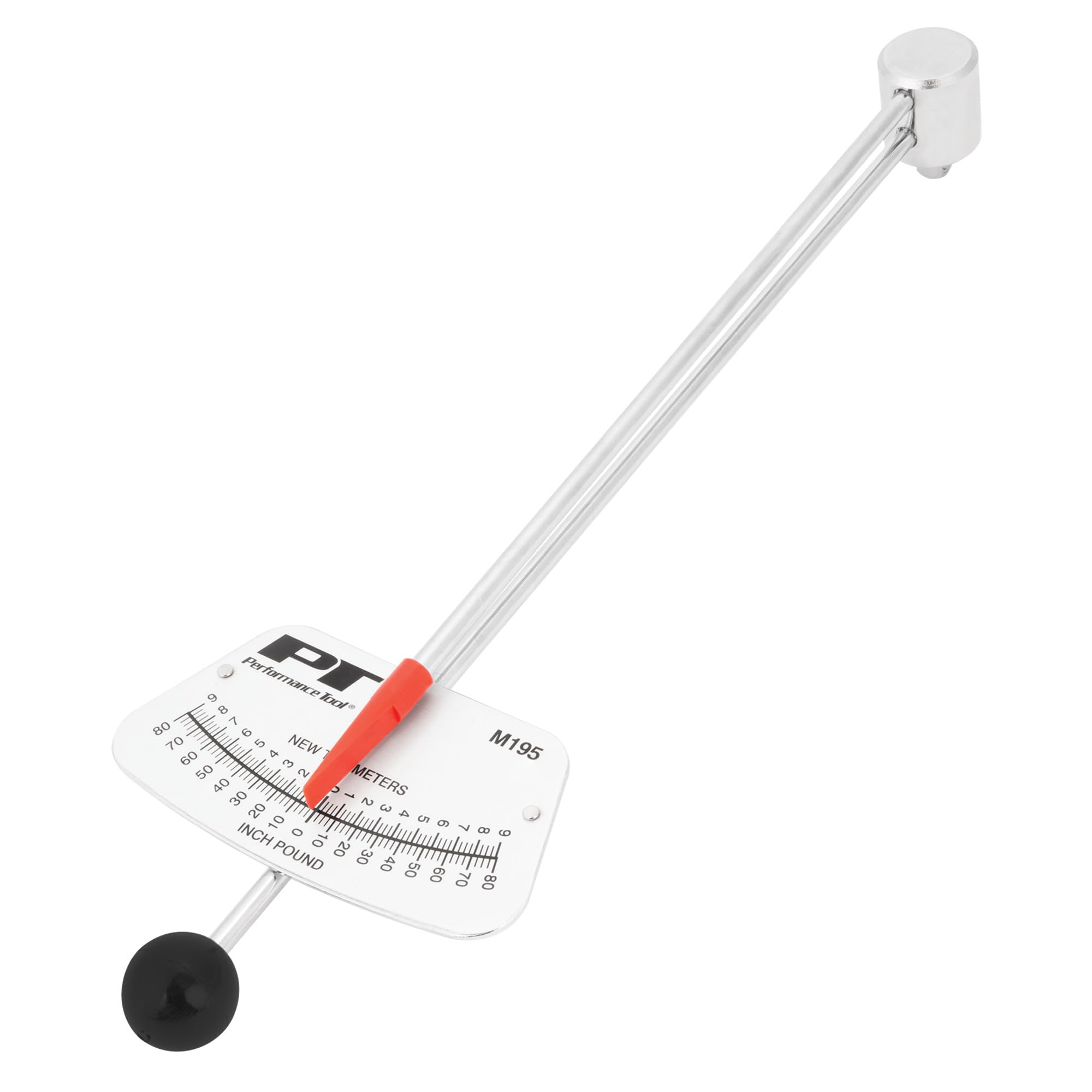
2. Performance Tool M195 Beam Torque Wrench
A featherlight beam wrench that never needs calibration, built for pinion preload checks.
This beam-style wrench is the choice when you need consistent, calibration-free accuracy at a budget-friendly price. It measures up to 80 in/lb in both clockwise and counterclockwise directions, which makes it a favorite for setting differential pinion bearing preload — a job buyers specifically mention doing with it.
The red gauge needle and bold markings make reading easy even in low light, and the ball handle helps you localize force with a secure grip. Weighing just 8.8 ounces, it is genuinely light in the hand. Since deflection beam wrenches do not wear or fatigue, accuracy stays dependable for the tool’s lifetime.
The catch is simple: you give up the audible click of a click-type wrench, so your eyes must stay on the gauge. A few owners note durability can vary, with some reporting breakage at the weld under the scale, though the majority find it reliable for its intended low-cost role.
Smart budget buy: if you only need to check low-torque settings occasionally, this does the job with zero maintenance.
Keep in mind: it is a beam tool, so it lacks the click convenience and the precision of a micrometer-style wrench.
Best for: DIY mechanics who want a cheap, accurate tool for pinion and bearing preload setups.
Not for: anyone who wants a loud click to confirm torque without watching the scale.
3. ARES 70213 Beam Torque Wrench

A reliable beam-style wrench that outshines click types for low-torque precision work.
ARES saves you from converting mid-job by pairing a dual in-lb and Nm scale on one tool. The 0–80 in/lb range reads in 2.5 in/lb increments and 0–9 Nm in 0.25 Nm increments, with an accuracy of ±4% — that’s a 33% larger accuracy gap than the Matework’s ±3% at the top of this list.
What buyers consistently praise is its versatility: bikes, motorcycles, cars, boats, and even small gearbox bearing preloads all respond well to this tool. The high-visibility markings stay readable in tough lighting, and the beam design means no calibration is ever needed. The pointer may need occasional re-zeroing, but there is no scaling drift over lifetime use.
A minor quirk some owners flag is that the pointer does not always rest exactly at zero — it is about a line off, which is easily compensated for when reading. The build quality feels solid, and the black painted finish with polished accents looks professional in any drawer.
Why it wins: the dual-scale readability and lifetime calibration-free accuracy make it a set-and-forget tool.
Watch for: the pointer offset at zero; check it before your first use.
Pick this if: you want a durable beam wrench for bikes and small gearboxes without recalibration costs.
skip it if: you prefer the convenience of a click-type wrench for repetitive jobs.
4. VEVOR 1/4-Inch Drive Click Torque Wrench

A dual-range click wrench with extension rods and a calibration certificate in the box.
VEVOR ships a calibration certificate with every wrench, confirming accuracy up to ±3%. across a 20–200 in.lb / 2.3–23 n.m range. That is tighter than most torque wrenches pre-calibrated to ±4%, and it comes with a 2-inch and a 4-inch extension pole plus a 1/2-inch to 1/4-inch adapter for wider reach.
The laser-engraved dual-range scale is the headline feature — unlike traditional printed scales, laser engraving stays clearer and more wear-resistant, so the markings do not disappear with long use. The chrome-vanadium steel body is heat-treated in six stages and chrome-plated for rust resistance.
Buyers love the audible click at the preset value and the smooth ratchet. The dual-direction design lets you work clockwise or counterclockwise, and the metal adjustment collar makes setting changes quick and stable. An occasional owner finds the white markings on orange hard to read in direct sunlight, but the case and build quality earn consistent praise.
The serious strengths
- Calibration certificate included per unit
- Laser-engraved scale resists wear
- Two extension rods boost reach
The small drawbacks
- White-on-orange markings can glare in sun
- Slightly short handle for big leverage
Reach for this if: you need a certified-accurate click wrench that works in both directions with added reach.
Consider another if: you work outdoors in bright sun and need glare-free markings.
5. LEXIVON LX-180 Inch Pound Torque Wrench

A pocket-sized click wrench with a micro-adjustment dial that fits tight engine bays.
The LX-180 is built for small spaces — at just 8.7 inches long and 13.44 ounces, it slips into areas where bigger wrenches cannot go. The 10–150 in-lb (1.1–16.9 Nm) range with 72-tooth gear dual-direction click type covers most low-torque fasteners on bikes and small engines.
What wins people over is the build quality and appearance, with a smooth handle and an adjustable collar that feels solid. The click is quieter than some but still feelable, and the electro-black coating gives it a clean, professional look. At this price point, owners have tested it against name-brand torque wrenches and found it holds up well.
The recurring gripe is the click mechanism and durability — some units report breaking within an hour or not clicking at all, though most find it reliable for DIY use. One owner noted the lock ring stuck once but was fixed by cycling through the settings. The zippered protective case keeps it safe between jobs.
Why it works: the compact body and 72-tooth ratchet make it the go-to for tight spaces at a value price.
Fair warning: the click can be subtle — verify it on a test fastener first.
Best for: home mechanics who need a small, accurate wrench for occasional low-torque jobs.
Not for: daily professional use where a tougher click mechanism matters.
6. SUZUME 1/4 Digital Torque Wrench
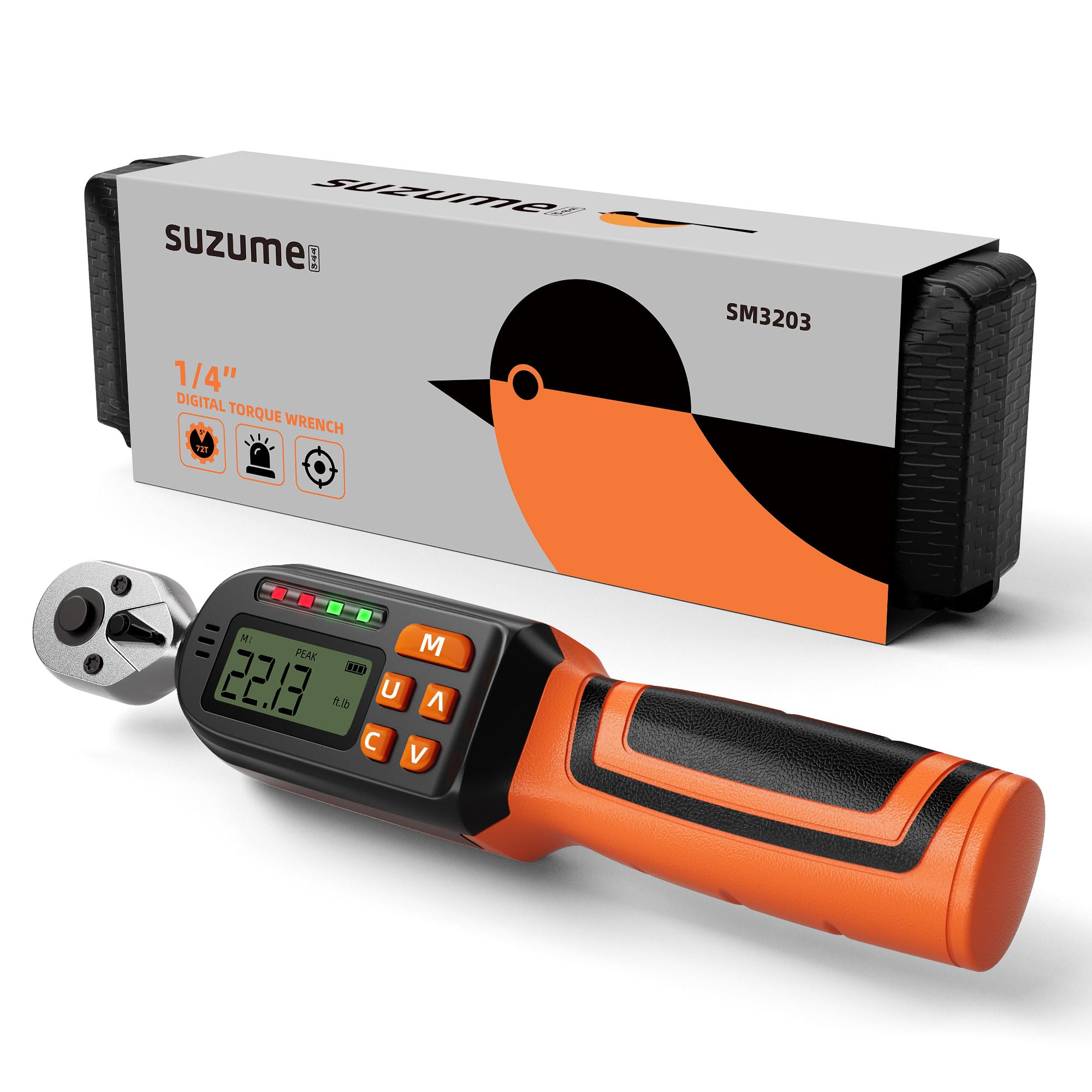
A digital torque wrench with visual and audible alarms for precision without guesswork.
If you want the tightest accuracy in this lineup, the SUZUME delivers ±2% — tested 20,000 times to meet industry standards. The digital display reads in four units (Nm, ft-lb, in-lb, kg-cm), covering a 13.3–265.5 in.lb range that suits everything from bike axles to light automotive work.
The standout feature is the dual alarm system: an audible sound alerts you when the torque value is reached, while LED lights show progress and turn from green to red as you approach the target. This makes it glove-friendly and easy to use in dim conditions. The 72-tooth reversible ratchet head with a 5-degree swing arc keeps it efficient in tight spaces.
Owners praise its accuracy and solid feel, with one noting it handled 180+ ft/lb of torque on axle nuts without issue. The data storage function records usage history for traceability. The main caveat is battery life — original batteries died quickly for some, though replacement is easy — and it is slightly long for the tightest spots.
The digital advantage
- ±2% accuracy beats click and beam types
- LED and audible alarms remove guesswork
- Four measurement units for flexibility
The digital trade-offs
- Batteries drain quickly for some owners
- Slightly long for very tight engine areas
Reach for this if: you want lab-grade accuracy with a readout you can trust for critical fasteners.
Look elsewhere if: you prefer a mechanical tool with no batteries to manage.
7. TEKTON TRQ50402 Micrometer Torque Wrench
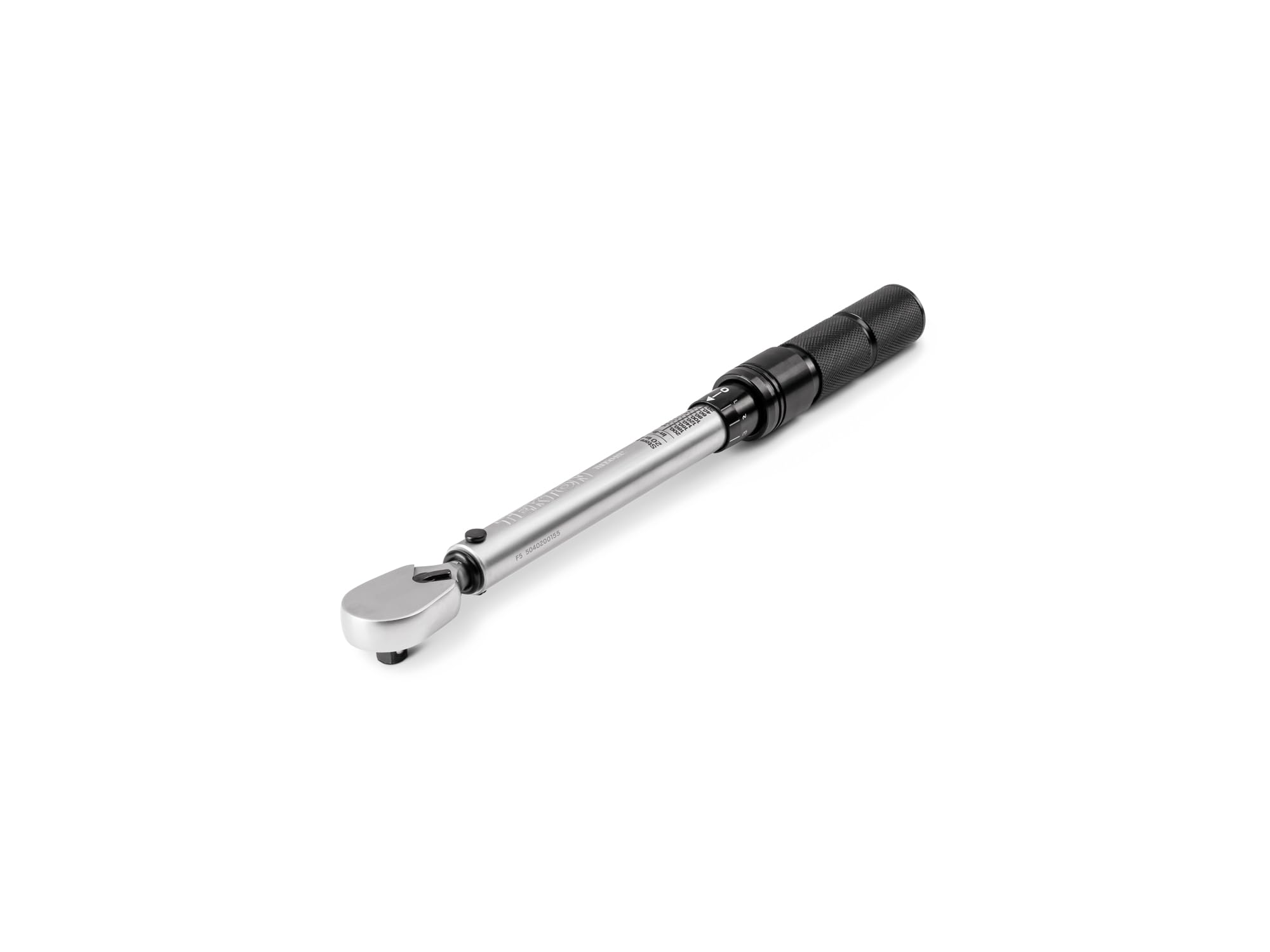
A micrometer click wrench with a serialized calibration certificate and an audible click at low torque.
TEKTON brings serious engineering to the 1/4 inch category with its 90-tooth fixed ratchet head — a single half-moon pawl keeps 9 teeth engaged at all times, so it will not skip under stress. The 4-degree swing arc reduces travel, which matters when working near a firewall or frame rail.
Accuracy is stated as ±3% for both directions, and Each wrench ships with a serialized certificate of calibration showing its actual test results.. Its ISO calibration also meets and exceeds the ASME standard. The 20–200 in-lb range covers transmission pans, valve covers, and ignition coils.
Owners consistently call the click “very audible even at 6 ft lbs” — rare for a 1/4 wrench. The satin chrome finish with high-contrast laser markings reduces glare, and the included hard case has metal hinges. At 11.68 ounces and about 10 inches long, it is lighter than the SUZUME and packs into any toolbox drawer.
Why it justifies the price
- 90-tooth ratchet with 4-degree swing
- Serialized ISO calibration certificate
- Audible click even at low settings
What to know
- Higher price than budget beam options
- Shorter handle means less leverage
Pick this if: you value certified accuracy and a durable ratchet for frequent low-torque engine work.
pass on it if: you only need an occasional wrench and want to save money.
Understanding the Specs
Torque Range and Units
A 1/4 inch drive wrench typically measures in inch-pounds (in-lb) or Newton-meters (Nm). The range tells you the lowest and highest settings; low-torque jobs like bike stems need a range starting near 1 Nm, while automotive work may need up to 200 in-lb. Lower minimums mean better precision on delicate fasteners, and matching the range to your projects prevents damage.
Accuracy Percentage
The accuracy rating, such as ±3%, describes how far the actual torque can vary from the setting. A wrench rated ±3% at 100 in-lb could deliver anywhere from 97 to 103 in-lb. For aluminum components and small fasteners, tighter accuracy matters; look for ±3% or better for critical work, and expect beam wrenches to hold accuracy without calibration.
FAQ
What is the difference between a beam and a click torque wrench?
Can a 1/4 inch drive torque wrench be used on car lug nuts?
How often should a torque wrench be calibrated?
Is a digital torque wrench more accurate than a click type?
What does a 72-tooth ratchet head mean for my work?
Should I store my torque wrench at the lowest setting?
Can I use a 1/4 inch torque wrench for electronics repair?
What is the best type of torque wrench for a beginner mechanic?
Final Thoughts: The Verdict
Across the board, the 1/4 inch drive torque wrench winner is the Matework 27-Piece Set because it combines a ±3% accurate click wrench with a full socket selection in one case, making it the most complete starter toolkit. If you want the tightest accuracy possible, grab the SUZUME Digital with its ±2% rating and LED alarms. And for certified precision with a hardened ratchet, the TEKTON TRQ50402 with its 90-tooth head is the one to reach for.
How We Picked
We do not accept paid placement. Every pick is matched to a real buyer and a real use-case; we do not hands-on test units.
Sources & Methodology
Specifications: manufacturer listings and product documentation. Review insights: verified customer reviews, as of August 2026. Pricing: not shown on this page (it changes often); check the current price via the retailer link.
As an Amazon Associate, Gadgets Feed earns from qualifying purchases. This does not affect which products we feature.