
That low-frequency hum creeping into your rig isn’t a ghost in the machine—it’s your speaker cable failing to shield the signal from electrical interference. A 1/4 inch speaker cable is the single most overlooked link in the signal chain between your amp head and cabinet, and a subpar one will rob you of punch, introduce noise, and fail right when the stage lights go up.
I’m Min — the co-founder and writer behind Gadgets Feed. I’ve spent countless hours analyzing the conductor gauges, shielding layers, and connector metallurgy that separate a clean signal from a muddy mess in this specific cable category.
This guide breaks down the best options based on real-world build quality and measurable specs, helping you find the right 1/4 inch speaker cable for your amp, PA, or studio setup without wasting money on hype.
How To Choose The Best 1/4 Inch Speaker Cable
Not all quarter-inch cables are created equal. The wrong pick introduces noise, saps high-end frequency response, or physically breaks at the connector. Here’s exactly what to check before you click “buy.”
Wire Gauge: 12 AWG vs 14 AWG vs 16 AWG
Thicker wire means lower resistance and better high-current transfer for demanding amplifiers. A 12 AWG conductor carries significantly more copper than a 14 AWG or 16 AWG, which directly translates to tighter bass response and less signal degradation over long runs. For any rig pushing more than 100 watts or running cables longer than 10 feet, 12 AWG is the safe standard. Thinner 16 AWG cables are acceptable only for short, low-wattage practice setups.
Shielding and Noise Rejection
A speaker cable operates in a high-EMI environment—near power supplies, lighting dimmers, and wireless receivers. Dual-layer or triple-layer shielding, such as a combination of oxygen-free copper braid and aluminum foil, physically blocks radio-frequency interference and electromagnetic hum. Cheap cables with a single sparse braid or no foil layer will let noise seep into your signal, especially on stages with lots of gear.
Build Quality and Strain Relief
The connector-to-cable junction is the most common failure point. Look for cables with heat-shrink tubing, over-molded plugs, or reinforced sleeves at the base of the jack. Metal or zinc-alloy connectors are vastly more durable than molded plastic and resist cracking from repeated plugging and unplugging. Braided nylon or high-grade rubber jackets add protection against kinking, cuts, and stage traffic abuse.
Quick Comparison
On smaller screens, swipe sideways to see the full table.
| Model | Category | Best For | Key Spec | Amazon |
|---|---|---|---|---|
| AA AUDIO ACCESSORY 12 AWG | Premium Mid-Range | Noise-free high-wattage rigs | 12 AWG / Triple Shield / Kevlar | Amazon |
| Cable Matters 2-Pack 12 AWG | Mid-Range Value | Dual-speaker setups on a budget | 12 AWG / Braided Jacket / 2-Pack | Amazon |
| Pig Hog PHSC10 14 Gauge | Premium | Stage durability and head-to-cabinet | 14 AWG / 9.2mm Jacket / Heat Shrink | Amazon |
| GEARit 12 AWG OFC | Premium | Lifetime-warranty peace of mind | 12 AWG / OFC / Lifetime Warranty | Amazon |
| D’Addario Classic Series | Premium | Signal transparency and brand trust | 16 AWG / Molded / Dual Shield | Amazon |
| Pro 25 Ft 12 AWG Yoico | Budget-Friendly | Long-run PA and stage monitors | 12 AWG / 25 ft / PVC Jacket | Amazon |
| Cable Matters TRS 25 ft | Budget-Friendly | Balanced connections and studio use | TRS / OFC / 25 ft | Amazon |
In‑Depth Reviews
1. AA AUDIO ACCESSORY 12 AWG Kevlar-Reinforced Speaker Cable
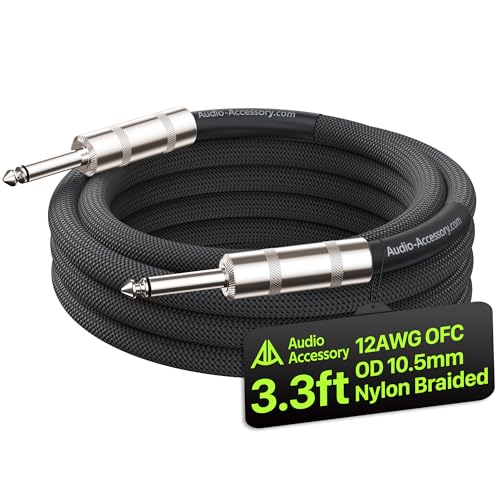
This cable attacks the two biggest pain points in the 1/4 inch speaker cable category—noise rejection and physical fragility—with a triple-layer shield that combines dual OFC braid (over 95% coverage) and a full aluminum foil wrap. The 12 AWG conductor uses 99.99% oxygen-free copper with a 3.3mm² cross-section, delivering 60% more copper than a 14 AWG cable. This translates directly to lower resistivity and cleaner high-frequency transmission, especially noticeable in high-wattage PA systems or tube amp rigs where thin cables roll off the treble.
The Kevlar-reinforced nylon braid is rated for over 50,000 bends—thirty times the durability of standard PVC cables. Hand-soldered lead-free silver solder at the joints eliminates intermittent crackling or dropout. The zinc-alloy connectors are tool-free for easy maintenance and resist the bending that kills lesser cables. At just 3.3 feet, it is purpose-built for amp-head-to-cabinet connections where a short, noise-free link is non-negotiable.
Customer feedback consistently reports the complete elimination of background hum, with one user noting that a persistent hiss from a re-capped Fender Bassman vanished instantly after switching to this cable. The dense, non-hollow construction avoids the deceptive “thick but fluffy” feel of budget cables that use cotton filler instead of actual copper.
Why it’s great
- Triple-layer shielding (dual braid + foil) kills EMI/RFI noise
- True 12 AWG OFC conductor with 60% more copper than 14 AWG
- Kevlar reinforcement for extreme bend-cycle life
Good to know
- Short 3.3 ft length limits use to head-to-cabinet connections only
- Connector is larger than standard guitar cables—confirm clearance
2. Cable Matters 2-Pack Braided 12 AWG 1/4 Inch Speaker Cable 3 ft

For guitarists running a stereo rig or PA operators who need to patch left and right channels from a mixer, this two-pack delivers genuine value without cutting corners. Each cable uses a true 12 AWG conductor and a braided nylon jacket that resists tangling and fraying far better than standard rubber-sheathed cables. The metal connectors are built with a straight housing, allowing side-by-side positioning on crowded patch bays or audio interfaces where space is tight.
The thick wire gauge is rated to handle high-wattage bass rigs and pro audio gear without introducing audible resistance. Customer reviews highlight the cable’s ability to survive constant abuse on stage, with one user noting they could “take 1,000s of watts” without degradation. The braided jacket adds a layer of physical protection that makes these cables significantly tougher than similarly priced single-pack options.
At 3 feet each, these are optimized for short jumps between components—not for long runs across a stage. The combination of 12 AWG thickness and dual-conductor packing makes them slightly stiffer than thinner alternatives, but that stiffness is a direct trade-off for the noise-free, high-current-handling performance that serious players demand.
Why it’s great
- Two cables included for stereo or multi-amp setups
- Braided jacket prevents fraying and tangling
- Straight metal connectors fit side-by-side on interfaces
Good to know
- Short 3 ft length unsuitable for floor-to-amp runs
- Braided jacket is slightly stiff until broken in
3. Pig Hog PHSC10 High Performance 14 Gauge Speaker Cable 10 ft

Pig Hog has built a reputation on no-nonsense stage-ready cables, and this 14 AWG model continues that tradition. The 9.2mm thick rubber outer jacket is noticeably more substantial than generic PVC wraps, providing genuine protection against being stepped on, dragged across stages, or pinched under amp cases. The 10-foot length offers a practical sweet spot for connecting a head sitting on a cabinet to the amp itself, or running from a pedalboard to an amp input with some slack to move.
The heat-shrink-protected connectors extend farther down the cable than most, creating an extended strain-relief collar that prevents the jack from unscrewing during heavy movement—a common failure mode for cheaper cables. While it uses 14 AWG rather than the thicker 12 AWG, the large-diameter jacket and robust construction make it more durable than many 12 AWG cables from budget brands. The rubber covering stays flexible even in cold conditions, coiling easily for transport.
User reviews consistently praise the build quality as “sturdy” and “thick,” with multiple buyers switching to Pig Hog after cheaper cables failed at the connector. The trade-off is that the extended heat-shrink collar protrudes noticeably from shallow jacks, so verify your amp’s input recess depth before buying.
Why it’s great
- Thick 9.2mm rubber jacket for heavy-duty stage abuse
- Heat-shrink protected connectors prevent jack unscrewing
- Flexible outer jacket coils easily for storage
Good to know
- 14 AWG conductor delivers less copper than 12 AWG options
- Extended heat-shrink collar may not fit recessed jacks
4. GEARit Professional 12 AWG OFC Speaker Cable 10 ft
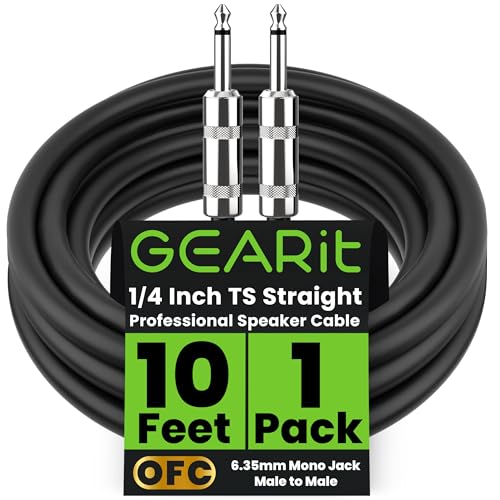
GEARit builds its 12 AWG cable around oxygen-free copper conductors and nickel-plated connectors, aiming for a neutral, low-capacitance signal path that preserves the original sound of your amplifier. The heavy-duty flexible rubber jacket is pliable enough to route through tight rack spaces without kinking, yet tough enough to survive regular on-the-road use. The 10-foot length gives enough reach for pedalboard-to-amp connections or running from a mixer to a powered speaker in smaller venues.
The standout feature here is the lifetime warranty. If the cable develops noise, a connection fails, or the tip breaks, GEARit replaces it without hassle. Several customer reviews confirm this firsthand, with one user reporting a defective end after a year and receiving a new cable promptly. That kind of backing removes the risk of buying a cable that might fail during a gig. The nickel plating on the connectors resists corrosion better than standard brass, maintaining a clean contact over years of use.
A minority of users report issues with the tips breaking off, which suggests that while the cable body is robust, the connector metal may not be as hardened as zinc-alloy alternatives. The lifetime warranty mitigates this concern, but it is worth noting for players who are exceptionally rough on their gear.
Why it’s great
- Lifetime warranty provides long-term peace of mind
- OFC conductors for low-capacitance clean signal
- Pliable rubber jacket resists kinking and coils neatly
Good to know
- Connector tips can break under extreme abuse
- Warranty replacement requires contacting seller directly
5. D’Addario Accessories Classic Series Speaker Cable 10 ft

D’Addario (formerly Planet Waves) brings decades of accessory manufacturing experience to this Classic Series cable. It uses 16 AWG wire, which is thinner than the 12 AWG and 14 AWG options on this list, but the company’s In=Out Technology focuses on low capacitance and dual-layer shielding to maintain signal purity over shorter distances. The molded plugs offer integrated strain relief that prevents the cable from separating from the connector at the most common failure point.
The dual shielding layers reject background noise effectively, making this a solid choice for practice amps, home studio monitor connections, and low-wattage guitar rigs where extreme current handling isn’t required. The flexible PVC jacket is lightweight and easy to route, and the straight-to-straight connector design fits standard jacks without issue. D’Addario’s manufacturing quality control is among the highest in the industry, and the cable feels consistent out of the box.
The 16 AWG conductor is the main limitation. For a high-wattage bass rig or a long PA run, the thinner wire will introduce measurable resistance and potential high-frequency roll-off. This cable is best suited for players whose primary concern is brand reliability and noise rejection on a modest system, not maximum current headroom.
Why it’s great
- Dual-layer shielding for quiet operation in home/studio
- Molded plugs provide robust strain relief
- Reputable brand with consistent manufacturing quality
Good to know
- 16 AWG gauge limits high-wattage and long-run applications
- Not as physically rugged as 12 AWG braided competitors
6. Yoico Pro 25 Feet 12 AWG 1/4 to 1/4 Speaker Cable

When your amplifier is across the room from your speaker cabinet, you cannot cheat physics with a thin wire. This Yoico cable gives you 25 feet of genuine 12 AWG copper, which maintains low resistance over distance and prevents the volume drop and treble loss that thinner cables suffer on long runs. The heavy PVC jacket is soft enough to coil without fighting you, yet tough enough to survive being tugged, stepped on, and dragged across stages during load-in and load-out.
The connectors feature a spring-loaded “Quick Lock” latching system designed for high-current applications like stage monitors, subwoofers, and house speakers. The black-and-blue color coding on the connectors helps identify left and right channels in a stereo PA setup. Users report minimal signal degradation even at the full 25-foot length, and the cable works well for children’s theater productions, live sound reinforcement, and other scenarios where gear is far apart.
The trade-off for the long length is that the PVC jacket provides basic protection compared to the braided nylon or Kevlar-reinforced options. It resists cuts but will not survive the same abuse as a braided cable. For permanent installs or careful users, this is a non-issue; for touring musicians who throw cables into a bin nightly, a braided jacket is worth the upgrade.
Why it’s great
- 25-foot length with true 12 AWG for long-distance runs
- Quick Lock latching system holds securely in high-vibration environments
- Soft PVC jacket coils easily without memory
Good to know
- PVC jacket offers less cut/abrasion protection than braided
- No foil shielding—less noise rejection than triple-shielded cables
7. Cable Matters Premium Braided Balanced 1/4 Inch TRS Cable 25 ft

This Cable Matters cable steps into a slightly different subcategory: it is a TRS (Tip-Ring-Sleeve) balanced cable rather than the standard two-conductor TS (Tip-Sleeve) cable used for most amp-to-speaker connections. If you are running a balanced output from an audio interface to a powered studio monitor, or connecting a mixer to a headphone amp, the TRS configuration rejects common-mode noise over longer distances with far greater effectiveness than an unbalanced TS cable.
The cable uses oxygen-free copper conductors with overall copper braided shielding to protect against electromagnetic interference. The braided jacket resists kinking and lays flat, making installation clean in studio racks. At 25 feet, it provides enough reach for a control-room-to-live-room connection or for patching distant monitors without hum. The gold-plated tips on the connectors resist oxidation and maintain a clean electrical contact over years of use.
Critical distinction: this is not a TS speaker cable. Do not use it to connect an amplifier head to a speaker cabinet—the unbalanced nature of a speaker cable requires a dedicated TS connector. This TRS cable is for balanced line-level signals only. It is a premium option for studio and PA applications where balanced connectivity is required, and it delivers noise rejection that budget unbalanced cables cannot match.
Why it’s great
- TRS balanced design cancels noise over long cable runs
- Braided jacket resists kinking and lays flat in racks
- OFC conductors and gold-plated tips for clean signal transmission
Good to know
- TRS connector is NOT compatible with standard amp-to-speaker TS jacks
- Balanced use only—requires matching TRS ports on both devices
FAQ
Can I use a regular guitar cable as a 1/4 inch speaker cable?
Does a thicker 12 AWG cable actually sound better than a 14 AWG cable?
Do I need a balanced TRS cable for my powered studio monitors?
What does the outer jacket material affect in a speaker cable?
Final Thoughts: The Verdict
For most users, the 1/4 inch speaker cable winner is the AA AUDIO ACCESSORY 12 AWG because its triple-layer shielding and Kevlar reinforcement solve the two biggest real-world problems—noise rejection and physical durability—at a mid-range price that undercuts pro-tier brands. If you need two cables for a stereo setup or value-packed short patches, grab the Cable Matters 2-Pack 12 AWG. And for long-distance PA runs where resistance matters, nothing beats the Yoico Pro 25 ft 12 AWG.