
ABS, PETG, PLA, silk blends — the 1.75mm filament market has splintered into specialized chemistries that each demand different heat profiles, enclosure requirements, and post-processing expectations. Picking the wrong material for your print job means failed adhesion, brittle layers, or a spool that clogs halfway through a 30-hour build.
I’m Rikta — the co-founder and writer behind Gadgets Feed. I spend my days cross-referencing dimensional tolerances, heat deflection temperatures, and real-world print speeds to separate the filaments that deliver on their claims from the ones that only look good in marketing photos. (And Homer 🐱 curled up on the spool box, tail draped over the ABS label like he owns the material science.)
This guide breaks down the top performers across ABS, PETG, PLA, and specialty blends, helping you match the right polymer to your printer and your project. Whether you need impact resistance for functional parts or a glossy finish for display models, finding the best 1.75 mm 3d printing filament starts with understanding how each material behaves in your specific setup.
How To Choose The Best 1.75 Mm 3D Printing Filament
The 1.75mm diameter is the de facto standard for desktop FDM printers, but the filament material determines everything from nozzle temperature to bed adhesion. Matching the polymer to your project’s mechanical requirements and your printer’s capabilities is the first step toward consistent results.
Match Material to Use Case
ABS and its variants (ABS+, high-speed ABS) offer superior impact resistance and heat tolerance — ideal for functional prototypes, automotive brackets, and parts exposed to direct sunlight. PETG sits between PLA and ABS, providing good layer adhesion with less warping than ABS, making it suitable for outdoor mounts and waterproof enclosures. PLA and specialty silk PLA are easier to print and produce cleaner surface finishes, perfect for display pieces, toys, and decorative models that don’t require high thermal or mechanical stress.
Check Dimensional Tolerance
A tight diameter tolerance — typically ±0.02mm for premium filaments, ±0.03mm for mid-range options — ensures consistent extrusion across the entire spool. Wider tolerances cause under-extrusion on narrow sections and over-extrusion on thick spots, ruining fine details and dimensional accuracy. The best filaments also use precise winding patterns to prevent tangling mid-print.
Evaluate Heat Requirements
ABS requires a heated bed (90-110°C) and an enclosed chamber to prevent warping and layer separation. PETG prints well at 70-80°C bed temperature with an open frame, though an enclosure still helps with larger parts. PLA runs at 50-65°C bed temperature and needs no enclosure at all. If your printer lacks a heated chamber, ABS may suffer from edge curling, making PETG or PLA the safer choice.
Quick Comparison
On smaller screens, swipe sideways to see the full table.
| Model | Category | Best For | Key Spec | Amazon |
|---|---|---|---|---|
| eSUN High Speed ABS+ | ABS+ | High-speed functional prints | Print speed 50-300 mm/s, 1KG spool | Amazon |
| Polymaker PETG Black | PETG | Durable, warp-free outdoor parts | Heat deflection temp up to 70°C | Amazon |
| FLASHFORGE PETG Pro | PETG Pro | Low-warp, semi-transparent models | Tolerance ±0.02mm, 1KG spool | Amazon |
| Creality ABS Black & White Bundle | ABS | Large engineering builds, 2-pack value | 2 x 1KG spools, impact resistant | Amazon |
| JAYO ABS Filament Black | ABS | Functional prototypes, mechanical parts | Tolerance ±0.03mm, 1KG spool | Amazon |
| LANDU Silk Tri-Color PLA | Silk PLA | Decorative, glossy gradient prints | Tolerance ±0.02mm, 1KG spool | Amazon |
| SUNLU PLA Bundle 8 Colors | PLA | Color variety, small projects, AMS use | 8 x 250g spools, tolerance ±0.02mm | Amazon |
In‑Depth Reviews
1. eSUN High Speed ABS+ Filament 1.75mm Blue
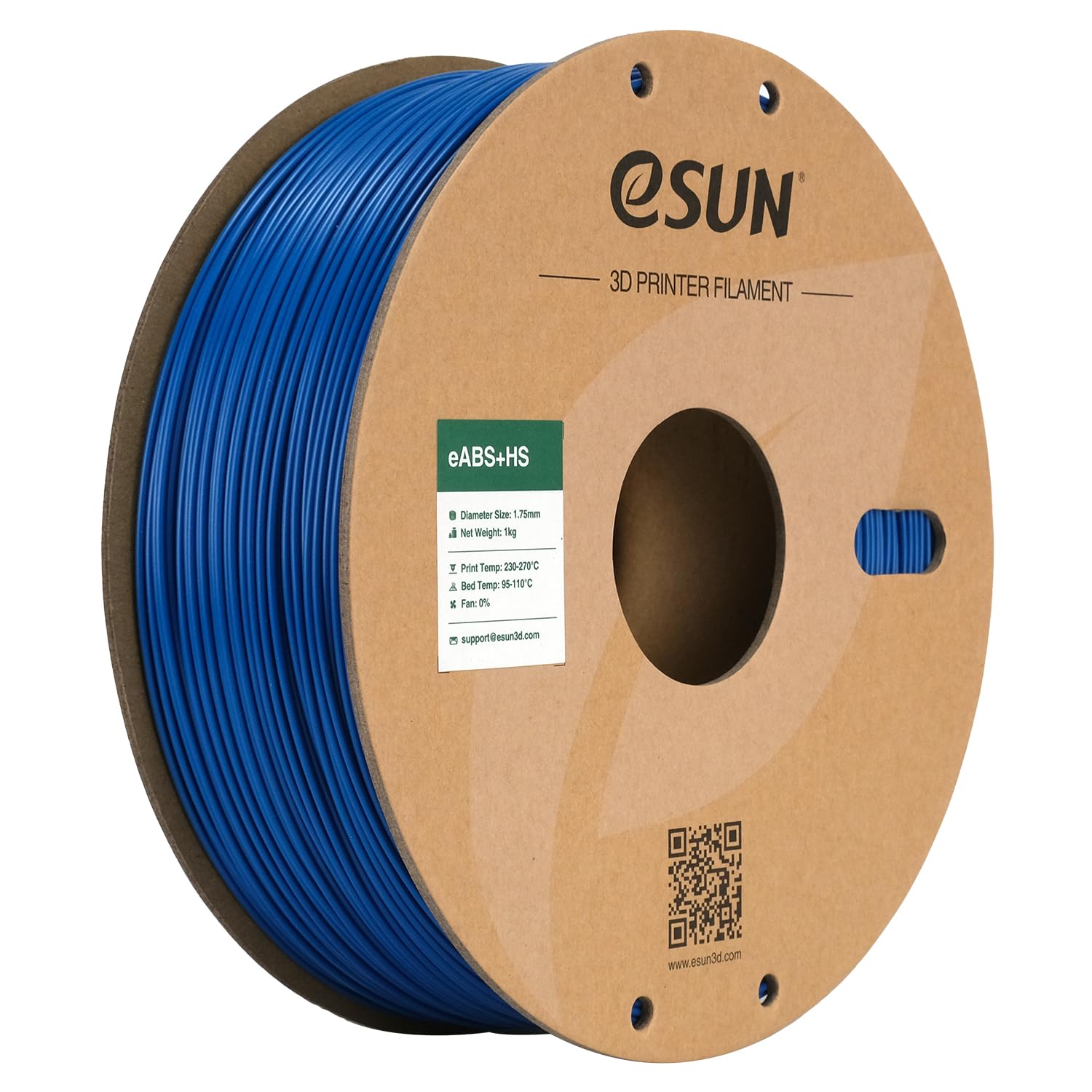
The eSUN High Speed ABS+ is engineered for printers that push beyond standard speeds — it maintains dimensional integrity at 300mm/s without the layer shifting or delamination that plagues standard ABS. Users report successful calibration flow tests up to 30mm³/s, with crisp detail retention even on small text features. The enhanced ABS+ formula reduces cracking and warping on large-area prints, a common pain point with traditional ABS.
Layer adhesion is notably strong, with reviewers citing consistent extrusion across multi-hour builds and minimal stringing when using the recommended temperature range. The blue color is vibrant and consistent across the full 1KG spool, with no discoloration or bubble formation during high-flow conditions. The vacuum-sealed packaging maintains moisture control out of the box.
Acetone polishing remains available for a smooth post-process finish, making this filament suitable for both functional prototypes and aesthetic display models. It pairs well with enclosed printers like Bambu Lab X1C, Voron 2.4, and Creality K1 series. Ventilation is still recommended due to ABS’s inherent styrene odor, though the high-speed formulation produces fewer fumes than standard ABS.
Why it’s great
- Reliable up to 300mm/s without layer lines
- Exceptional interlayer adhesion reduces warping on large prints
- Acetone polishable for a smooth finish
Good to know
- Requires an enclosed printer and ventilation
- Nozzle temperature needs tuning for optimal high-speed flow
2. Polymaker PETG Black 1.75mm 1kg
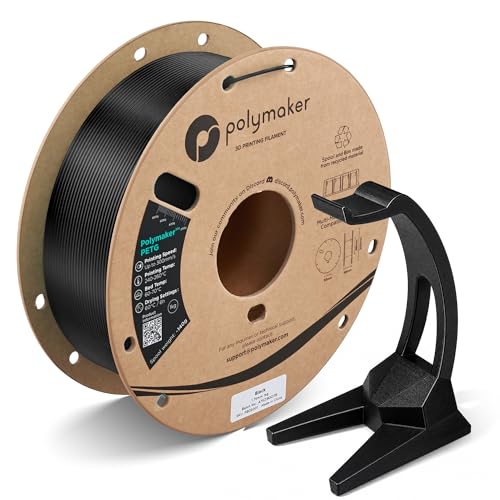
Polymaker’s updated PETG formula prioritizes high-speed performance without sacrificing the material’s hallmark toughness and UV resistance. The new high-speed formulation allows print speeds up to 300mm/s while maintaining excellent interlayer bonding — a rare achievement for PETG, which typically struggles with layer adhesion at elevated speeds. First-time PETG users report printing as easily as PLA, with almost no stringing using generic profiles.
The heat deflection temperature of 70°C makes this filament suitable for brackets, jigs, outdoor mounts, and other functional parts that experience moderate thermal loads. The black color (hex code #070908) is deep and consistent, with a slight gloss that hides layer lines well. The spool is neatly wound and vacuum-sealed, with the end of the filament taped for seamless spool switching in AMS systems.
Reviewers highlight the warp-free nature of this PETG — even on open-frame printers, edge curling is minimal compared to other PETG brands. The recyclable cardboard spool is a thoughtful environmental touch. Drying before use is still advised for optimal results, though the material is less hygroscopic than standard PETG.
Why it’s great
- High-speed capable without layer adhesion trade-offs
- Warp-free printing on open-frame machines
- AMS-ready with taped filament end
Good to know
- Best results with a spool dryer before long prints
- Glossy finish may not suit all aesthetic preferences
3. FLASHFORGE PETG Pro Filament 1.75mm Black

FLASHFORGE’s PETG Pro targets the gap between ABS and PLA, offering low shrinkage with higher impact strength than standard PETG. The material exhibits excellent transparency when printed in thin layers, making it a strong candidate for lampshades, diffusers, and display items where light transmission matters. The hydrophobic nature of this PETG Pro reduces the need for sealed storage, though vacuum-sealed packaging ensures first-print quality.
Dimensional accuracy holds at ±0.02mm, with advanced CCD diameter measurement during production enforcing consistent flow across the entire 1KG spool. Users report zero brittleness when using a spool dryer with the AMS, and minimal stringing when the nozzle temperature is dialed in around 245°C. The black variant has a subtle metallic sparkle in certain lighting — reviewers note the color may be darker than product photos suggest.
Layer adhesion is robust enough for mechanical parts such as brackets and enclosures, while the low warping risk makes it viable for large-format prints on printers with heated beds. The 1-year warranty from FLASHFORGE adds confidence for volume buyers. Compatibility with Bambu X1C, Flashforge Adventurer 5M, and other enclosed systems is confirmed by user reports.
Why it’s great
- Excellent low-warp behavior for large parts
- Hydrophobic formula reduces storage hassle
- Good semi-transparency for lighting projects
Good to know
- Color may differ slightly from product images
- Best performance with AMS and spool dryer
4. Creality 2 kg Black & White ABS Filament 1.75mm
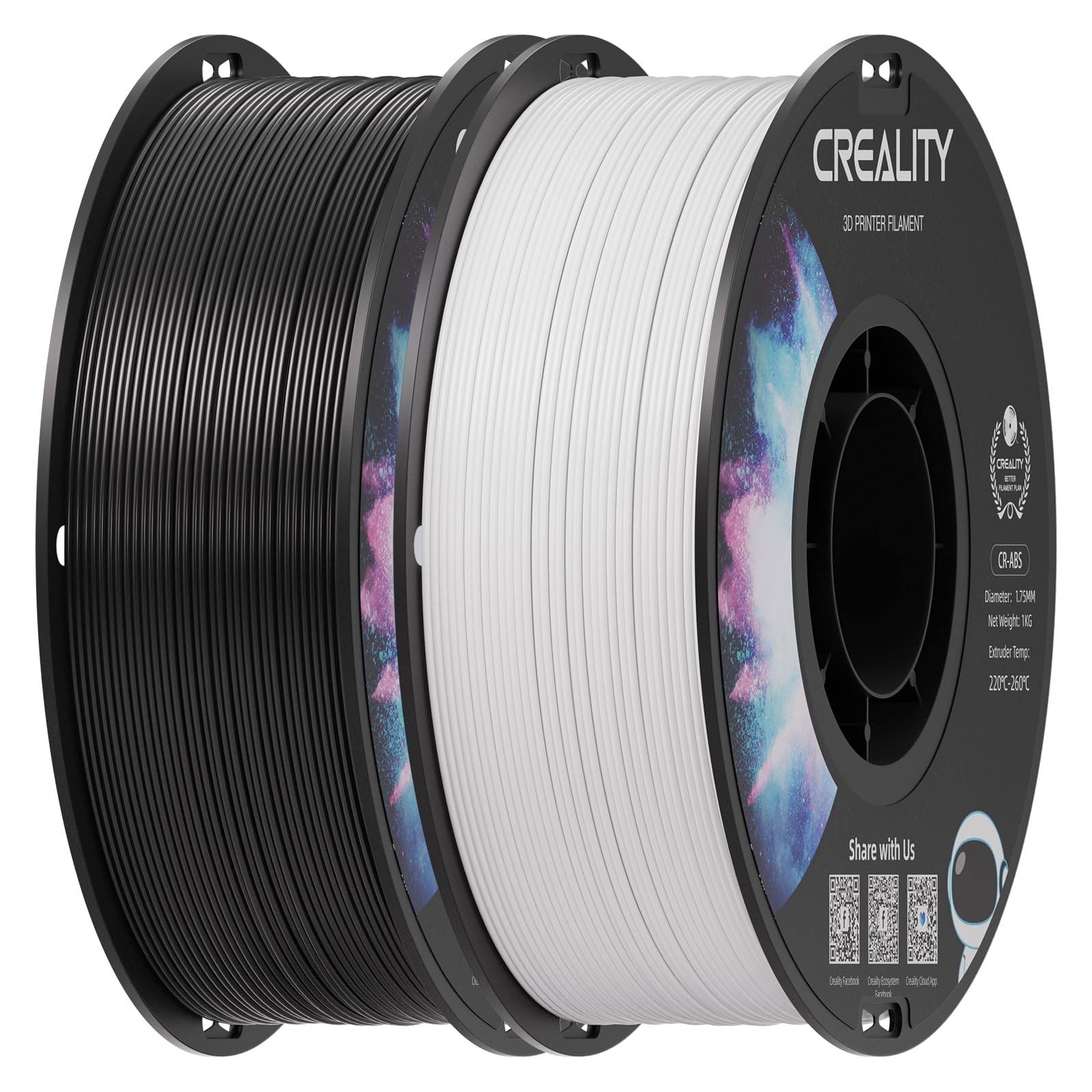
Creality’s CR-ABS formula focuses on improving the classic ABS pain points: layer separation, warped edges, and splitting on large builds with sharp corners. The engineering-grade ABS exhibits strong impact resistance and heat tolerance, making it suitable for demanding applications like structural brackets, vibration-prone assemblies, and snap-fit components. The bundle includes one black and one white 1KG spool, offering two high-contrast colors for prototyping and final parts.
The material flows smoothly through Creality’s own printers and is compatible with most FDM machines equipped with a heated bed and enclosure. Reviewers note that the filament prints well at 240°C nozzle and 80°C bed, producing parts that feel less brittle than PLA and have a slight flexibility that helps with press-fit joints. The “non-toxic” claim should be taken with context — ABS always produces some styrene fumes, so ventilation remains important.
Dimensional stability is strong, with minimal shrinkage compared to standard ABS. The 12-month after-sales support from Creality is a practical bonus for new users. The packaging advises storing the filament in a dry, cool environment away from direct sunlight, which is standard for all ABS materials.
Why it’s great
- Two popular colors in one economical bundle
- Improved large-print warping behavior
- 12-month manufacturer support
Good to know
- Requires enclosed printer and ventilation
- Warping possible without a heated chamber
5. JAYO ABS Filament 1.75mm Black 1kg
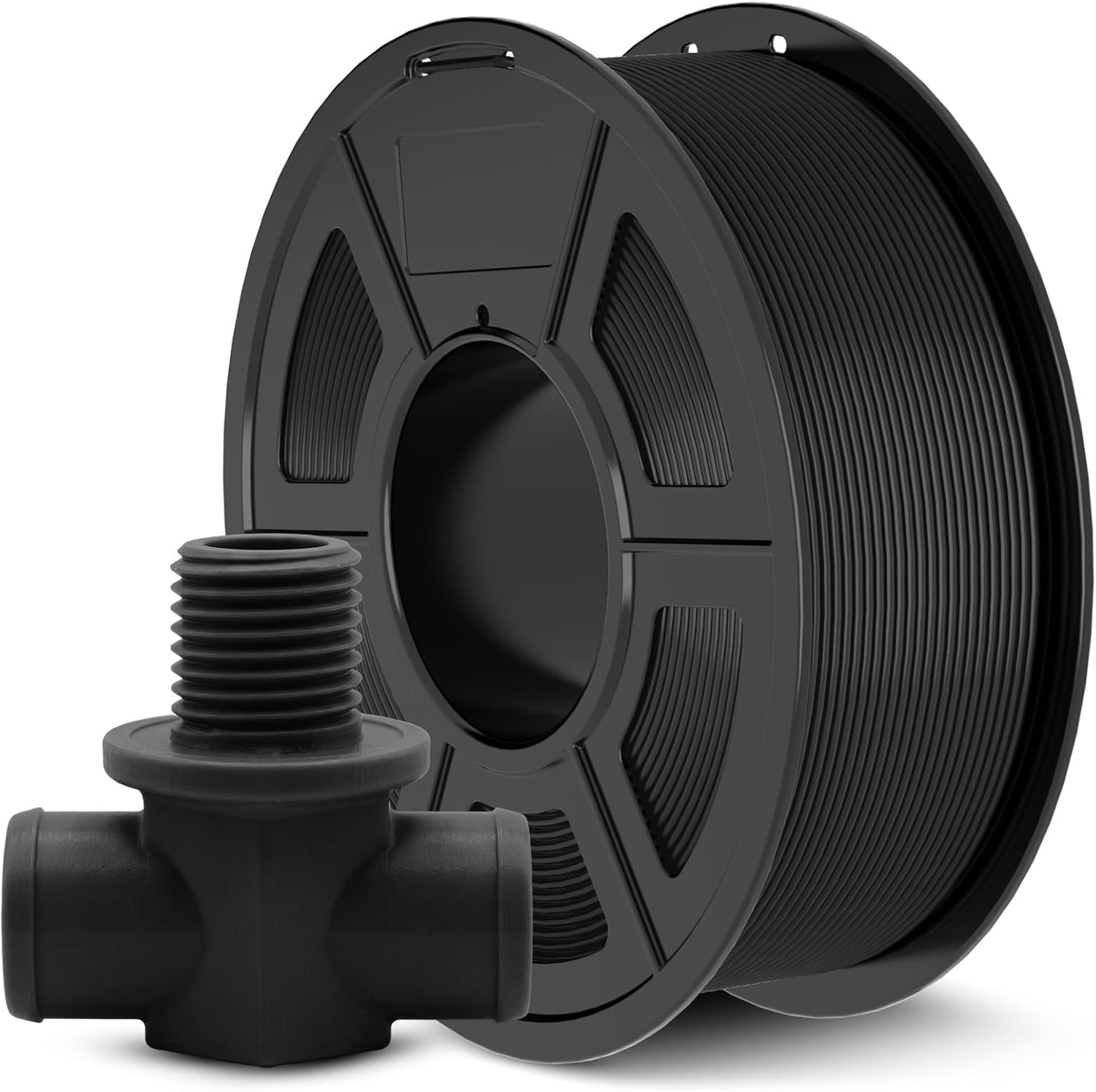
JAYO’s ABS filament delivers reliable performance for functional prototyping and mechanical parts at a budget-friendly price point. The ±0.03mm diameter tolerance is adequate for most FDM printers, though users seeking ultra-fine detail work may prefer a tighter tolerance. Hot deformation rating of 90°C allows the material to withstand moderate thermal loads without softening.
Print quality is consistent across the spool when used within the recommended temperature envelope. Reviewers praise the strong bed adhesion and easy printability — one user compared its performance favorably to Polymaker and Overture on an Elegoo Centauri Carbon. The black color is deep and uniform, with good opacity even on thin-walled sections. The vacuum-sealed packaging with desiccant helps maintain dryness from factory to first print.
A small number of users reported brittle spools that broke during unwinding, suggesting batch inconsistency in the manufacturing process. This risk is lower with brands that have tighter quality control, but JAYO’s price-to-performance ratio remains competitive. The filament works well on enclosed printers with a heated bed and is suitable for brackets, housings, and other non-decorative functional parts.
Why it’s great
- Solid layer adhesion for functional parts
- Good bed adhesion straight out of the package
- Competitive price for ABS prototyping
Good to know
- Some reports of brittle spools or inconsistent batches
- Fumes require ventilation despite claims
6. LANDU Silk Tri-Color PLA Filament 1.75mm 1Kg

The LANDU Silk Tri-Color PLA combines red, blue, and green into a single 1.75mm filament, producing a gradient effect that shifts color as the viewing angle changes. The silk texture delivers a polished, glossy finish straight off the build plate — no sanding or coating needed. This makes it ideal for decorative sculptures, cosplay props, jewelry, and any project where visual impact matters more than mechanical strength.
The ±0.02mm tolerance is tight for a specialty filament, ensuring consistent color transition without clogging. Users report excellent print quality at 205°C nozzle and 50°C bed, with the tri-color effect appearing evenly across layers. The material produces minimal stringing when printed at moderate speeds, and layer adhesion is strong enough for thin-walled decorative objects that don’t bear structural loads.
The spool is neatly wound to prevent tangles, and the packaging is standard for PLA — no vacuum seal, but the material is less hygroscopic than PETG or nylon. Reviewers note that batch consistency can vary slightly, with some spools handling faster speeds better than others. The silk finish is more susceptible to scratches than matte PLA, so handling printed parts with care is recommended.
Why it’s great
- Stunning tri-color gradient without post-processing
- High-gloss silk finish straight from the nozzle
- Tight tolerance for reliable color transitions
Good to know
- Susceptible to scratching; handle finished parts carefully
- Batch inconsistency may affect high-speed printing
7. SUNLU PLA Filament 1.75mm Bundle, 8 Rolls 250g
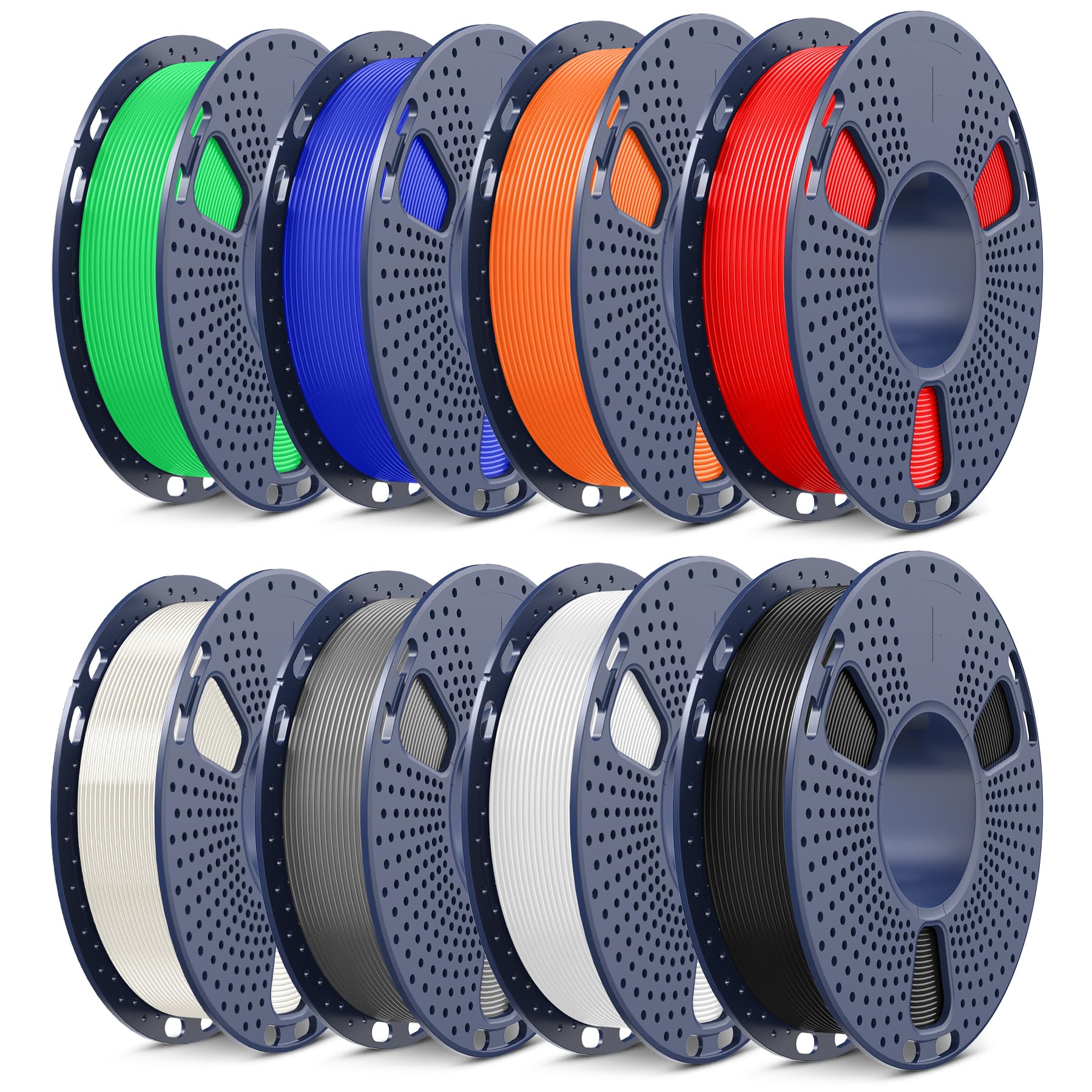
The SUNLU PLA 8-roll bundle offers 2kg of filament spread across black, white, grey, transparent, red, Klein blue, sunny orange, and green. Each 250g spool is compact enough for small projects, color testing, and multi-material prints without committing to a full kilogram of a single color. The 250g spools are compatible with AMS systems when using a printed adapter, though some users find them too small for the standard AMS hubs.
Print quality is consistent across all eight colors, with the ±0.02mm tolerance ensuring reliable extrusion. The recommended nozzle temperature of 200-210°C and bed temperature of 50-65°C align with standard PLA profiles, so the bundle works out of the box on most FDM printers. Users praise the smooth feeding, minimal warping, and absence of clogs across multiple prints. The transparent PLA is particularly useful for light pipes and diffusers.
The 250g spools run out more quickly than full-size rolls, so this bundle is better suited for prototyping, multi-color samplers, and small decorative pieces than for large functional builds. Some users transfer the filament to 1KG spools for better AMS feeding. The vacuum-sealed packaging keeps each roll dry, and the neat winding prevents tangles during printing.
Why it’s great
- Eight colors in one bundle for design flexibility
- Tight tolerance ensures clog-free printing
- Compact spools ideal for small projects and AMS
Good to know
- Small spools may require adapter for AMS use
- 250g per roll runs out quickly on larger prints
FAQ
What is the ideal nozzle temperature for 1.75mm ABS filament?
Is 1.75mm PETG harder to print than PLA?
Can I use silk PLA filaments in my AMS?
What does the ±0.02mm tolerance actually mean for my prints?
Final Thoughts: The Verdict
For most users, the best 1.75 mm 3d printing filament winner is the eSUN High Speed ABS+ because it combines the strength and heat resistance of ABS with a formulation designed for modern high-speed printers, all while reducing the warping and cracking that typically plague the material. If you want warp-free performance without an enclosure, grab the Polymaker PETG — it prints nearly as easily as PLA with significantly better thermal properties. And for color experimentation and small decorative projects, nothing beats the SUNLU PLA Bundle — the eight-color variety lets you test ideas without committing to full-kilogram spools.