
Our readers keep the lights on and my morning glass full of iced black tea. As an Amazon Associate, I earn from qualifying purchases.
Specs are compiled from manufacturer listings and verified buyer reviews and can change over time — please confirm the key details on the product page before buying.
Stubborn car grime and caked-on driveway stains need two things: high pressure and a serious flow of water to blast it all away. A 1.8 GPM automotive high flow pressure washer kit delivers exactly that, pairing enough gallons-per-minute to rinse soap off a whole car quickly with nozzles and a hose so you can start cleaning the moment it arrives. This guide breaks down three kits that all hit that 1.76 max GPM mark, so you can match the right one to your driveway, your garage space, and your cleaning list.
I’m Min — the founder and writer behind Gadgets Feed. This guide is built by comparing the manufacturers’ published specifications and the patterns across verified customer reviews, so you get each pick’s real strengths and trade-offs instead of marketing spin.
When you pick a 1.8 gpm automotive high flow pressure washer kit, you are really deciding how fast you rinse, how hard you blast stains, and how easily you can drag it around your yard. The flow rate (GPM) controls rinse speed, the PSI controls stain-stripping power, and the wheels and weight control portability.
Our Picks at a Glance
How To Choose The Best High-Flow Pressure Washer Kit
Before you buy, understand that “high flow” means a steady 1.76 max GPM (gallons per minute) of water moving through the gun. That flow carries dirt away after the pressure breaks it loose, and it is what separates a quick car rinse from a slow, frustrating one. All three washers below share that same peak flow, so your real decision depends on pressure, portability, and the extras included.
Match the PSI to your dirt, not your ego
Max PSI tells you how hard the water hits the surface. A 2100 max PSI unit is plenty for cars, patio furniture, and light mildew on siding, while a 3000 max PSI machine tears through old driveway stains and years of buildup. Think about your worst cleaning job first — if you have never touched a neglected concrete pad, a mid-range PSI saves you money without losing usefulness.
Look at wheels, weight, and the cord before you commit
A 36.8-pound washer with 10-inch wheels rolls across a lawn easily, but a 17-pound unit with 5-inch wheels is what you grab for a tight one-car garage. Both have a 35′ GFCI cord (a cord with a built-in safety shutoff), so reach is rarely the limit. The deciding factor is how far you will drag it and over what terrain.
Quick Comparison
In-Depth Reviews
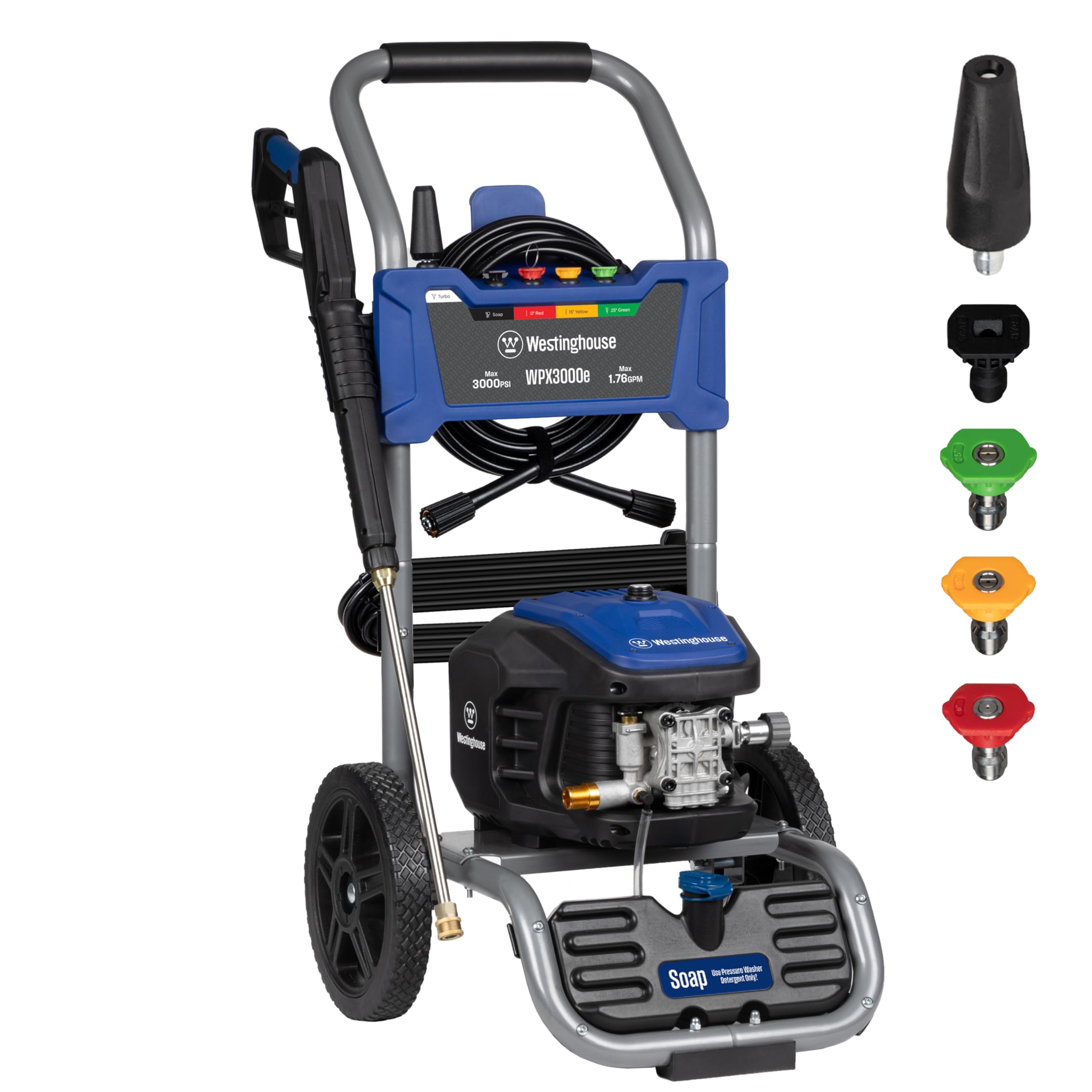
1. Westinghouse WPX3000e Electric Pressure Washer
Our pick — over 4.5★ from 3,000+ verified ratings; the strongest balance of quality and price.
The heavyweight that brings gas-style power to an electric outlet, built for the dirtiest concrete and siding.
Reach for this kit when your driveway looks more like a construction site than a surface. It blasts out 3000 max PSI (pounds per square inch) and 1.76 max GPM at the lowest pressure, which beats the ePX3050’s 2100 max PSI by a wide margin — a 43% jump in raw pressure you feel the second you pull the trigger on a stained garage floor. The rated output of 2600 PSI and 1.1 GPM still leaves plenty of authority for routine car washes and fence cleaning.
Mobility is where this machine surprises people. Owners call it “compact and well-built,” with large wheels that roll smoothly over grass and gravel. and those high-profile 10″ never-flat wheels (wheels that cannot go flat) roll over a lawn without sinking in. The 25′ super-flex hose and 35′ GFCI cord give you a long working radius, and the.45 gallon soap tank means you can foam a car without dragging a separate bottle around. The 5 quick-connect nozzles (0°, 15°, 25°, soap, and turbo) cover everything from a gentle rinse to a concentrated jet.
What wins people over is the assembly: Over a thousand owners highlight its tool-free assembly., and many note it is simpler to operate than the gas models they replaced. The trade-off for that power is bulk — at 36.8 pounds and 22.6″L x 25.6″W x 36.6″H, it is roughly 2.2x heavier than the ePX3050, so it is a garage anchor rather than a carry-around tool.
What It Wins On
- 3000 max PSI for the toughest stains and mildew
- 10″ never-flat wheels roll easily over grass and gravel
- .45 gallon onboard soap tank for foaming cars
- 3-year limited service, labor, and parts coverage
The Bulk Factor
- 36.8 pounds makes it heavy to haul up stairs
- Large footprint needs real garage floor space
Grab this for: deep cleaning projects where a 3000 max PSI rating and a 25′ hose make short work of concrete, siding, and driveways.
Think twice if: you only wash a single car in a tight garage — the 36.8-pound frame is more machine than that job needs.
2. Westinghouse ePX3050 Electric Pressure Washer
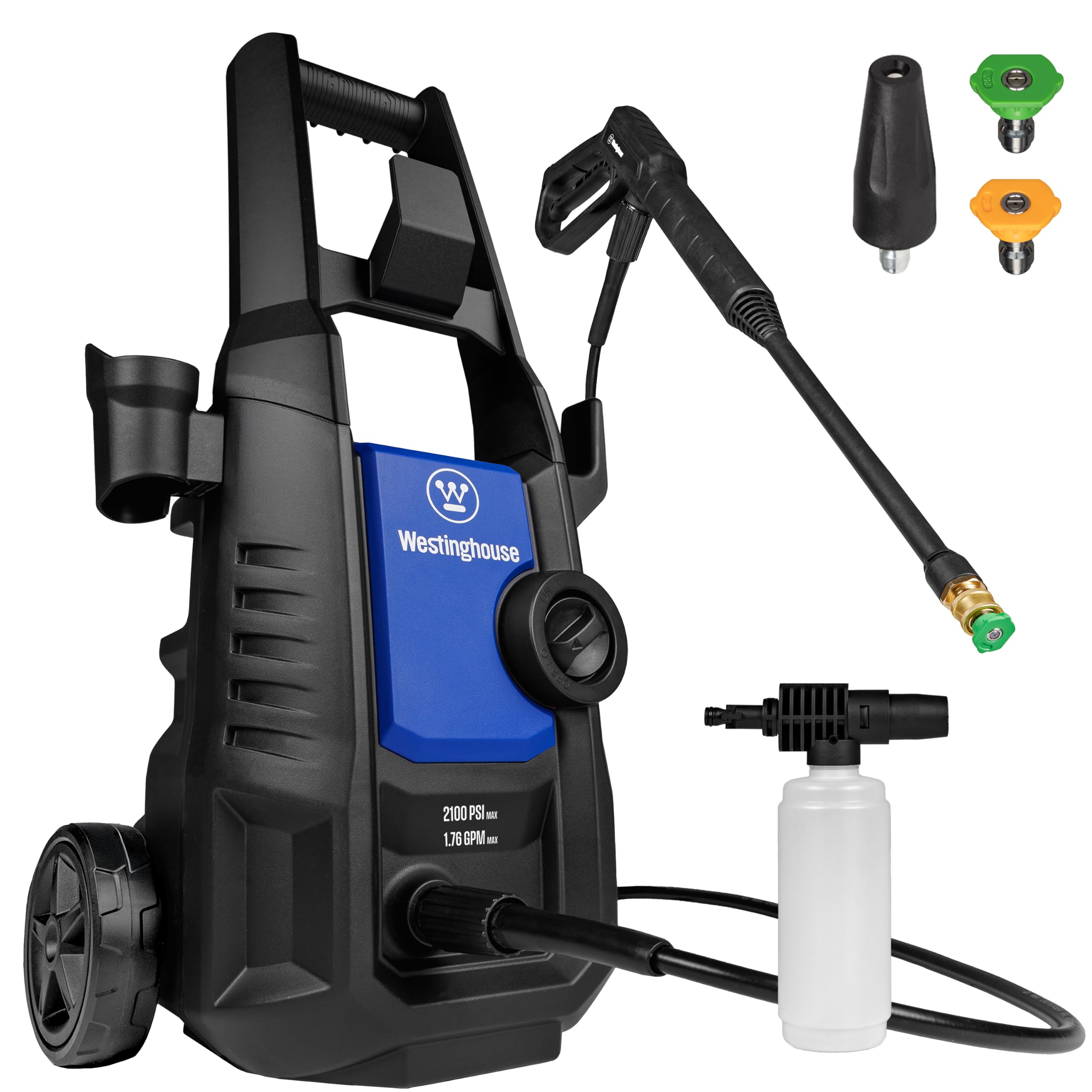
The featherweight that stows in a one-car garage and still holds its own on driveways and siding.
If space is your enemy, this is your washer. At just 17 pounds and a slim 12.4″L x 11.3″W x 25.8″H, it is 82% more compact in size than the WPX3000e above, and it slides into a corner of a one-car garage without a fight. It delivers 2100 max PSI and 1.76 max GPM (at lowest pressure), which is enough to clean a brick walkway or a vinyl fence without risking damage to the surface. Buyers report it is “very easy to use and set up,” with a foam cannon included for soapy pre-washes. and the foam cannon included in the box makes a soapy pre-wash genuinely satisfying.
Its low 26-inch profile and 5-inch never-flat wheels make it easy to walk around a patio, and the 35-foot GFCI (ground fault circuit interrupter) cord compensates for the shorter 20-foot hose. You get three quick-connect nozzles (15°, 25°, and turbo) plus the foam cannon, which is a slightly leaner kit than the 5-nozzle sets above — but for most car and siding work, the 25° and turbo cover the bases. The turbo nozzle is the standout on concrete, while the foam cannon lays down thick soap before you ever pull the high-pressure trigger.
Owners praise its quiet operation and surprising power for a 17-pound unit. Owners mention finishing a patio in hours, a job that took days with an older model., and the 1.76 GPM flow keeps rinse time short. The honest trade-off is a higher center of gravity when you tug the hose — one reviewer notes the gun storage is awkward and you have to hold it while walking — so treat the connections gently and it will serve you for years.
Small footprint, real output: 2100 max PSI and 17 pounds make it the easiest pick here to move, store, and manage for routine car and driveway washes.
The one caution: the 20′ hose is shorter than the 35′ cord, so avoid pulling the hose connection taut across a long driveway.
Reach for this if: you want a lightweight, compact unit that fits a small garage and handles cars, fences, and siding without drama.
Look elsewhere if: your main job is decades-old concrete stains that need the 3000 max PSI you only get from the bigger unit.
3. Westinghouse WPX2300e Electric Pressure Washer
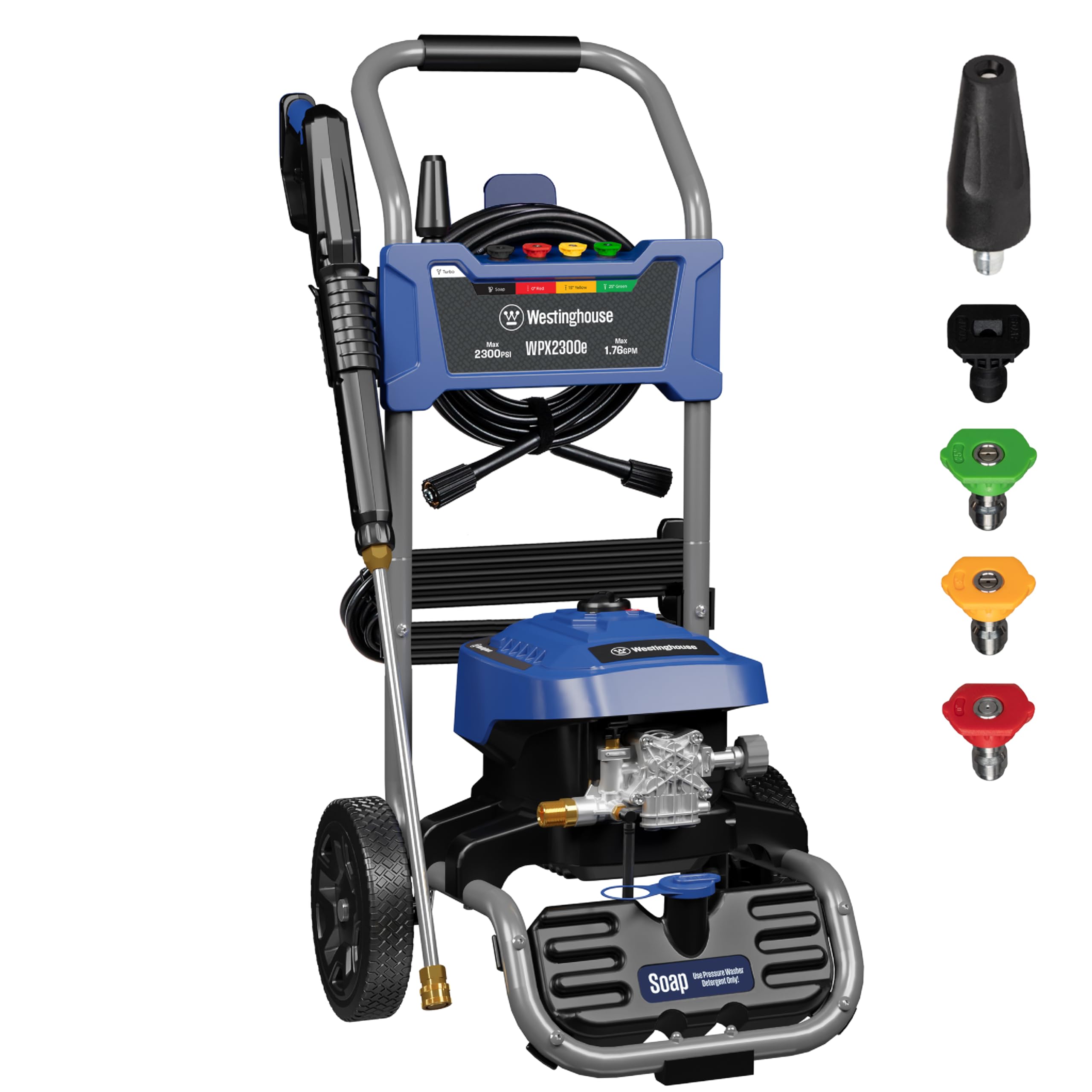
The middleweight that splits the difference — 2300 max PSI with a 25′ hose and a 27.5-pound frame.
This one is the just-right of the lineup, and buyers know it. It delivers 2300 max PSI and 1.76 max GPM (at lowest pressure), which sits comfortably between the 3000 PSI beast and the 2100 PSI compact. The rated output of 1900 PSI and 1.2 GPM still strips mold from vinyl siding and cleans pool concrete, and the 8″ never-flat wheels roll over most ground without complaint. Assembly takes about 10 minutes, and The induction motor, which runs cooler and lasts longer, is a durability point owners repeatedly mention..
The kit is complete from the start: a.42 gallon soap tank, a 25′ abrasion-resistant super-flex hose, and 5 quick-connect nozzles (0°, 15°, 25°, soap, and turbo). That full nozzle set plus the M22-compatible fittings (the standard thread size for most pressure washer attachments) means you can bolt on a surface cleaner or foam cannon later without buying adapters. Customers note cleaning a PVC fence with water alone, leaving it spotless., which speaks to the real-world effectiveness of the 1.76 GPM flow.
What stands out in the feedback is the simplicity: the unit starts with a simple turn of a dial, and the onboard storage for the power cable and hose keeps everything tidy. The recurring gripe is the soap dispenser — it has no off switch, so soap keeps flowing until the tank is empty, which makes rinsing a two-step dance. An occasional owner also notes the stiff hose twists, so give it a moment to relax before a long session.
Why It’s A Smart Buy
- 2300 max PSI handles siding, fences, and driveways
- Full 5-nozzle set with a.42 gallon soap tank included
- 8″ never-flat wheels and 27.5-pound frame balance power and portability
- 3-year limited service, labor, and parts coverage
Two Small Quirks
- Soap dispenser lacks an off switch, so soap flows until empty
- Stiff hose can twist during long cleaning sessions
Best for: anyone who wants one washer that does cars, fences, and patios well without paying for maximum pressure or carrying extra bulk.
Who should pass: detailers who need precision rinse control — the never-ending soap flow will frustrate you on every final rinse.
Understanding the Specs
Max PSI vs Rated PSI
Max PSI is the peak pressure the pump can produce for a moment, usually at the lowest flow setting. Rated PSI is the sustained pressure you get during normal use, which is why the spec sheets list two numbers (like 3000 max and 2600 rated). For everyday cleaning, the rated figure is the honest one to plan around — it tells you what the washer will actually do when you are holding the gun for 10 minutes straight.
Max GPM — The Flow Rate
GPM (gallons per minute) is how much water moves through the nozzle, and it decides rinse speed more than pressure does. All three kits here hit 1.76 max GPM, which is the “high flow” balance for washing a car quickly: enough water to carry soap and dirt off the panel in a single pass. A washer with high PSI but low GPM will strip stains but rinse painfully slowly, so a balanced 1.76 GPM rating is exactly what you want.
Axial Pump vs Induction Motor
The pump is the heart of the washer, and an axial 3-piston pump with auto-stop (a feature that shuts the motor off when you release the trigger) is what all three of these machines share. The “auto-stop” saves wear on the motor and protects the pump from running dry. The induction motor on the WPX models is a design known for running cooler and having a longer service life than cheaper universal motors.
Never-Flat Wheels and GFCI Cord
Never-flat wheels are solid rubber or foam tires that cannot puncture, which matters when you are dragging a 36.8-pound washer across a yard. The 35′ GFCI cord is a ground-fault circuit interrupter cord that cuts power if it detects a short, a key safety feature when you are spraying water near the outlet. Bigger wheels (10″ vs 8″ vs 5″) roll over grass and gravel far more easily than small ones.
FAQ
What does 1.76 GPM actually mean for washing my car?
Is 2100 PSI enough to clean a driveway?
Can I attach a foam cannon or surface cleaner to these washers?
Why does the spec sheet list both max and rated PSI?
How long is the power cord on these electric washers?
Are these washers easy to move around a yard or garage?
What is the warranty on these Westinghouse washers?
Is the soap tank big enough to foam a whole car?
Which nozzles do I use for which job?
Will a 1.76 GPM washer damage car paint?
Final Thoughts: The Verdict
For most buyers, the best 1.8 gpm automotive high flow pressure washer kit winner is the Westinghouse WPX3000e because its 3000 max PSI and 10″ never-flat wheels make it the most capable all-rounder for driveways, siding, and cars. If you want a lightweight unit that stows in a one-car garage and still cleans well, grab the Westinghouse ePX3050. And for the best balance of pressure and portability at a friendlier price, the Westinghouse WPX2300e with its full 5-nozzle set and 25′ hose is the one to reach for.
How We Picked
We do not accept paid placement. Every pick is matched to a real buyer and a real use-case; we do not hands-on test units.
Sources & Methodology
Specifications: manufacturer listings and product documentation. Review insights: verified customer reviews, as of July 2026. Pricing: not shown on this page (it changes often); check the current price via the retailer link.
As an Amazon Associate, Gadgets Feed earns from qualifying purchases. This does not affect which products we feature.