
Our readers keep the lights on and my morning glass full of iced black tea. As an Amazon Associate, I earn from qualifying purchases.
Specs are compiled from manufacturer listings and verified buyer reviews and can change over time — please confirm the key details on the product page before buying.
Your sump pit is not really the problem — the pump you drop into it is. A 1 HP submersible sump pump pulls water out of a flooded basement, window well, or yard pit while it sits entirely underwater, so it needs the right balance of flow rate, lift height, and switch reliability. Get that balance wrong and you find out during the storm, not before it.
I’m Min — the founder and writer behind Gadgets Feed. This guide is built by comparing the manufacturers’ published specifications and the patterns across verified customer reviews, so you get each pick’s real strengths and trade-offs instead of marketing spin.
The picks below span cast-iron workhorses, lighter utility drains, and dual-float setups, sorted by what each one actually does best in a wet basement. If your pit floods faster than you can bail it, here is the honest shortlist for a 1 hp submersible sump pump.
Our Picks at a Glance

How To Choose The Best 1 HP Submersible Sump Pump
Most buyers walk in thinking the horsepower number tells the whole story. It does not. A 1 HP motor is the engine, but the pump’s real job is moving a certain number of gallons per hour at a certain height. If you match those two figures to your pit, the pump lasts. If you guess, you get a pump that runs constantly and quits early.
Flow rate and how it drops as water climbs
Flow rate is the volume of water the pump pushes per hour, measured in gallons per hour (GPH) or gallons per minute (GPM). Pumps are rated at their best-case number — the flow at zero lift, meaning the water has nowhere to climb. As the discharge pipe rises, that number falls. A pump rated at 6,540 GPH at 0 feet of lift might pour out 4,440 GPH once the water has to climb 10 feet. Always check both numbers, not just the headline figure.
Float switch type and pit fit
The float switch is the part that turns the pump on and off automatically as the water rises and falls. A vertical float rides up and down on a stem, which suits a narrow, deep pit. A tethered float swings on a cord, which needs more horizontal room. A caged dual float uses two floats inside a guard so debris is less likely to jam it. Measure your pit before you buy — a pump that fits is a pump that works.
Housing material and discharge size
Cast iron and stainless steel resist corrosion in gritty, dirty water and add weight that keeps a pump sitting flat. Polypropylene (a sturdy plastic) is lighter and easier to lift but less tolerant of rough sediment. Discharge size — the diameter of the pipe the water exits through — decides how much water you can move at once. A 2-inch discharge moves more water than a 1-1/2-inch one, but it also needs a bigger pipe run to match.
Quick Comparison
| Model | Best For | Flow Rate | Max Lift Height | Weight | Amazon |
|---|---|---|---|---|---|
| Superior Pump 92151★ Best Overall | Basement sump pits with vertical clearance | 86 gpm | 10 feet | 17.7 pounds | Amazon |
| Taskstar 1 HP Submersible Water PumpMost Compact | Pool draining and shallow flood cleanup | 67 gpm | 28 feet | 10 pounds | Amazon |
| Basement Watchdog BWSS100 | High-output sump pits with room for a cage | 94 gpm | 22 feet | 36 pounds | Amazon |
| Wayne CDU1000ET | Fast-draining basements and hot tubs | 101.67 gpm | 25 feet | 20 pounds | Amazon |
| Red Lion RL-SS100T | Flood-prone yards and effluent pits | 88 gpm | — | 31.6 pounds | Amazon |
In‑Depth Reviews
1. Superior Pump 92151 1 HP Cast Iron Sump Pump Side Discharge with Vertical Float Switch
Our pick — over 4★ from 200+ verified ratings; the strongest balance of quality and price.
The cast-iron pick for a standard basement pit that drains out near ground level.
If your pit lives in a basement and gets fed water year-round, this is the pump to build a setup around. It moves up to 5,160 gallons per hour, which is the volume of water it clears in a single hour — enough to empty a typical flooded pit before it climbs the walls. The housing is cast iron and stainless steel, the two materials that hold up best when the water carries grit and sediment. And it runs continuous duty with a thermally protected split capacitor motor, meaning it is built to keep working without shutting down for a cooldown.
Where it fits: a vertical float switch rides up a stem as the water rises, which is the layout that suits a narrow, deep sump pit. The 10-foot power cord comes with a piggyback plug, so you can switch it to manual for testing without unplugging anything. The included 1-1/2 inch NPT discharge adapter threads onto your pipe, and the whole assembly weighs 17.7 pounds — manageable to lower into a pit alone. What buyers report most is simple effectiveness: it moves water hard and fast, and one buyer summed it up neatly, saying it “pumps water much faster and more efficiently” than the 1/3 HP unit it replaced.
The honest catch here is the switch. A few owners over the years have had the vertical float cut out intermittently when it sits submerged, so treat the float arm gently and keep the pit clear of stringy debris. The other thing to know: lift height tops out at 10 feet, so if your discharge has to climb a full story before it exits, this is not the pump for that job. For a standard basement pit that drains out near ground level, it is exactly right.
What Lands The Top Spot
- Moves up to 5,160 gallons per hour for serious drain-down speed
- Cast iron and stainless steel housing for gritty water
- Continuous duty, thermally protected split capacitor motor
- Vertical float switch suited to narrow, deep pits
- Piggyback plug lets you flip to manual for testing
Where It Draws The Line
- 10-foot maximum lift height limits where the discharge can run
- Vertical float can intermittently cut out when submerged — keep the pit clear
- Heavier to handle than a plastic utility pump
Land this one if: your sump pit is a standard deep well with a discharge that exits near ground level and you want a rugged cast-iron runner.
Pass it by if: your water has to climb well past 10 feet, because a higher-lift pump is the honest answer there.
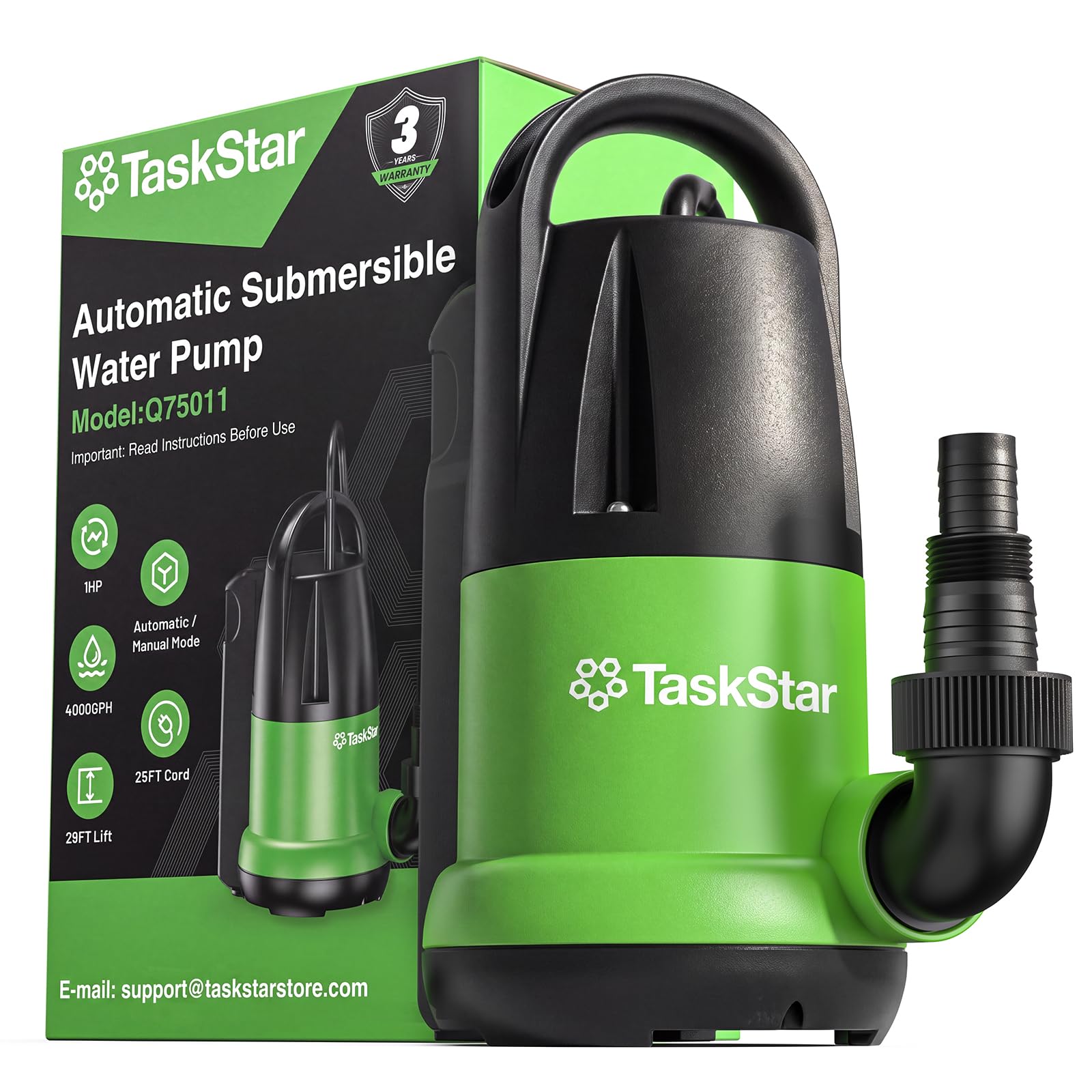
2. Taskstar 1 HP Submersible Water Pump, Auto/Manual Modes for Pool Draining
The 10-pound pool and spa drainer with a 25-foot cord and a built-in float.
This is the pick for someone standing over a drained pool, a hot tub, or a shallow flooded garage floor rather than a basement sump pit. It weighs 10 pounds, which is the kind of number that means you can lift it out of the water and carry it to the next job without a second person — a good deal lighter than the 36-pound Basement Watchdog below. It pushes 4,000 gallons per hour at its best and drains water down to 3/16 inches of residual depth, which is the leftover film most pumps leave behind. That low-level pickup is what makes it useful on flat roofs and shallow pools.
The tall number here is lift height: 28 feet, the highest of any pump on this list and nearly three times the Superior Pump’s 10-foot ceiling. The float is built inside the housing rather than hanging outside on a cord, so it is less likely to snag on the wall of a tight pit. It ships with adapters for 1 inch, 1-1/4 inch, and 1-1/2 inch outlets plus a 3/4 inch garden hose connector, so it threads onto whatever discharge hose you already own. And the cord is 25 feet long, which owners who drain spas appreciate — the review pages keep coming back to how fast it empties a body of water, with buyers reporting it “moved 20 gallons in ~3 minutes.”
The gripe worth knowing before you buy is the remote. Owners who tried it found it unreliable with a short range and a delay, and most simply abandoned it for the manual on/off switch. There is also a stray complaint about battery life, which does not match the rest of the feedback and looks like a review filed against the wrong item — the pump itself is corded, not battery-powered. The polypropylene body is lighter than cast iron but less forgiving of gritty sediment, so keep it to cleaner water.
Speed owners keep talking about: the flow is the headline feature, and it earns the praise — it clears standing water fast enough that a spa or pond drain feels like a five-minute job.
The trade-off to plan for: skip the remote and just use the manual switch, and keep this pump on clean water rather than a gritty basement pit.
The ideal owner: someone with a pool, hot tub, pond, or yard pit who needs a light pump that can be carried and repositioned.
Look past it if: your water is loaded with sediment or you want a set-and-forget basement install.
3. The Basement Watchdog Cast-Iron/Stainless-Steel 1 HP Submersible Sump Pump – Up to 6,540 GPH – Caged Dual Float Switch (BWSS100)

The 36-pound cast-iron pick that moves 6,540 GPH and shuts off as soon as the pit is clear.
If your basement has ever taken on water during a multi-day rain, this is the pump built for that exact nightmare. It moves up to 6,540 gallons per hour at zero lift and still delivers 4,440 gallons per hour once the water has to climb 10 feet — the highest flow rate on this list at 94 gpm. The 6.3-amp permanent split-capacitor motor is the engine behind that output, and the cast-iron and stainless-steel body is what lets it shrug off grit without corroding. The dual float switch sits inside a cage, so there are two floats doing the sensing and a guard keeping debris away from both.
Here is the number buyers feel immediately: 36 pounds. That is the weight that tells you it is built like equipment, and it is the flip side of the Taskstar’s 10 pounds — you are trading carry-anywhere convenience for durability that holds up in punishing conditions. Owners describe the drain sound as unmistakable, more like a toilet flushing than a quiet hum, but the flip side of that loudness is short run time: it clears the pit and shuts off. One buyer put it plainly, saying it “is powerful” and pumps out “in seconds” but “is louder than your typical 1/3 HP,” before adding that “it isn’t on as long.” A 2-inch discharge is the recommended match for that kind of output.
The one thing to check before you commit is the controller that ships with the float assembly. A stray unit over the years has arrived with a bad controller, and the brand’s service process was the sticking point rather than the pump itself. For the overwhelming majority of owners, though, the pump runs and the basement stays dry — which is the entire point of buying one.
Why It Punches Hardest
- 6,540 gallons per hour at zero lift, 4,440 GPH at 10 feet
- 94 gpm flow rate — the highest of any pick here
- Caged dual float switch adds a second layer of sensing protection
- Cast-iron and stainless-steel build for long-term durability
- 2-inch discharge for maximum output
What To Weigh First
- 36 pounds is heavy — not a one-hand lift into the pit
- Runs louder than a smaller HP pump while it drains
- Needs a 2-inch discharge run to make the most of its output
Built for: a basement in a wet climate where the pit fills fast and you want the most water moved per cycle.
Think twice if: you need something you can lift out easily, since 36 pounds is a two-handed job.
4. Wayne 1 HP Heavy Duty Submerisble Cast Iron and Stainless Steel Sump Pump with NEW Switch – Removes up to 6,100 Gallons of Water Per Hour
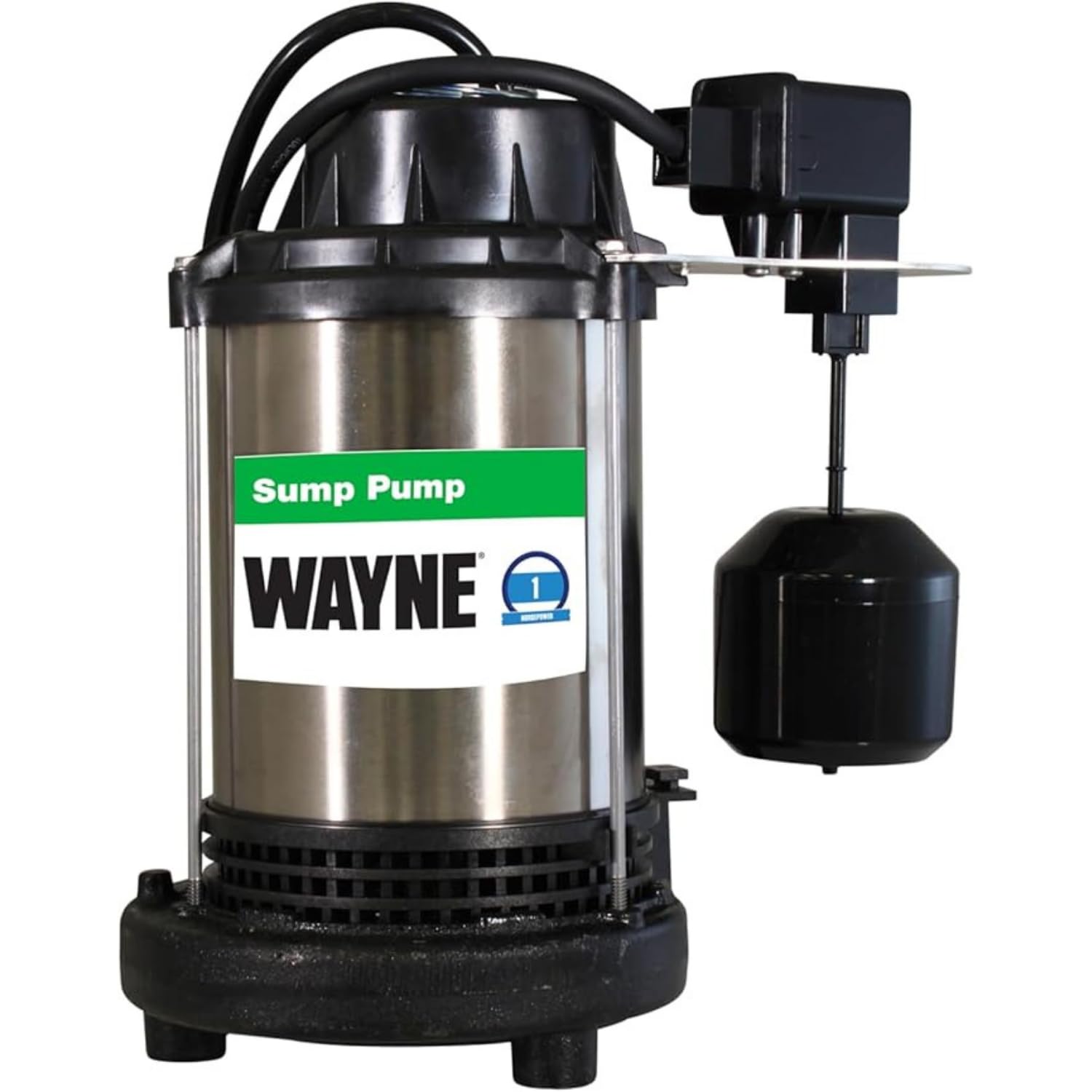
The 101.67 gpm indoor pick that empties a 200-gallon hot tub in under 5 minutes.
Start with the flow figure, because it is the reason this pump earns its spot: 101.67 gpm, the highest on the list. That is the volume of water it pushes per minute, which is why owners use it to drain things other pumps take all afternoon to finish. It runs a top suction design that pulls water from the top of the pump rather than the bottom, which cuts down on both air lock and the debris that settles in the base of a sump pit. The switch is a magnetic float type, which owners describe as quieter and longer-lasting than the older mechanical switches they replaced.
The stainless steel motor housing and fasteners paired with a cast-iron volute are the durability story, and the pump is tested to run over 1 million cycles — the maker’s own long-run figure for how long it holds up. It fits sump basins 11 inches in diameter or larger, and the 9-inch ON and 4-inch OFF levels mean it kicks in before the water gets high and quits with room to spare. One buyer timed it emptying a 200-gallon hot tub in under 5 minutes against 25 minutes with their old pump.
The trade-off is indoor-only use. This pump is meant for a basement sump, not an outdoor pit exposed to weather, so put it where it is protected. It also needs a 1-1/2 inch NPT discharge pipe with a separate threaded exit hose, which is a small extra you buy on the same trip. Getting either wrong is the only real friction here.
Fastest to empty a big body of water: that 101.67 gpm flow is the kind of speed that turns a chore into a few minutes, and it is the number to chase if throughput is what you care about.
Keep it indoors: the build is designed for basement and interior pits, so do not park it in an open outdoor basin.
Your pump if: you want the most throughput per minute and a fast, quiet installation in an indoor pit.
skip it if: you need an outdoor-rated pump for an exposed yard pit.
5. Red Lion RL-SS100T, 115V, 1 HP, 5300 GPH Automatic Sump/Effluent Pump

The effluent pick that passes 3/4-inch semi-solids ordinary sump pumps choke on.
This is the pick for a flooded driveway, a garage catch basin, or a septic-style effluent pit where the water carries solids. It handles up to 3/4 inch semi-solids, which means debris that would jam a finer pump passes straight through. It moves up to 5,300 gallons per hour and runs on 115 volts at 8 amps, so you need to check the circuit before install. The tethered float hangs on a cord and swings up as the water rises, and the piggyback plug lets you flip it into manual mode for testing or emergency removal.
The housing is cast iron and stainless steel, which is the combination that holds up to the harsh, gritty water an outdoor or effluent pit throws at it. It comes with a 2-inch FNPT discharge plus a 1-1/2 inch FNPT adapter and a 20-foot cord. The ON level sits at 15 to 18 inches and the OFF level at 7 to 10 inches, so the tethered float needs a pit deep enough to let it swing — check that before you buy, because a shallow well stops the float from traveling its full arc. Owners mention it handles major flooding with ease, moving big volumes fast and running quiet while it does.
The durability record is mixed in a way worth flagging honestly: some units last years without a hitch, while a few customers note an O-ring leak, a corroded connection, or a loose impeller down the line, and one unit quit within months. Given the volume of water this thing moves, it is a pump to inspect periodically and mount on a proper circuit — a dedicated 20-amp line came up as a real requirement. Treat it as equipment to maintain rather than set and forget.
The Case For Red Lion
- Passes up to 3/4 inch semi-solids without clogging
- 5300 gallons per hour for flood-prone yards and basins
- Cast iron and stainless steel body for harsh water
- Piggyback tethered float switches to manual for emergencies
- 20-foot cord and 2-inch FNPT discharge with adapter included
What Owners Watch For
- Needs a dedicated 20-amp circuit
- Tethered float needs a deep enough pit to swing freely
- A few units develop O-ring leaks or corrosion over time
The right fit for: yards, driveways, and effluent pits where the water carries solids a standard sump pump would choke on.
Reconsider if: your circuit is not dedicated or your pit is too shallow for the tethered float to travel.
Understanding the Specs
Flow Rate and GPH
Flow rate is how much water the pump moves per hour, written as GPH (gallons per hour) or GPM (gallons per minute). A 5,160 GPH rating means the pump can clear 5,160 gallons in one hour of running. The catch is that this number is measured at the easiest possible lift, so always look for the second figure — the flow at a real height, like 10 feet — before you compare two pumps. The higher the flow rate at height, the faster your pit drains during a storm.
Float Switch Types
The float switch is the automatic trigger that turns the pump on as water rises and off as it falls. A vertical float rides a stem and fits a narrow pit. A tethered float swings on a cord and needs a wider pit with room to travel. A caged dual float puts two floats inside a guard to resist debris. Matching the switch style to your pit’s shape and depth is what keeps the pump cycling reliably instead of sticking on or off.
Lift Height and Discharge Size
Lift height is the vertical distance the pump can push water upward — the higher this number, the more freedom you have in where the discharge pipe runs. Discharge size is the diameter of the outlet, and a wider discharge (like 2 inches versus 1-1/2 inches) moves more water but needs a matching pipe run. Choose a pump whose lift height clears the vertical rise from your pit to the drain point, with a little room to spare.
Housing Material and Motor
Cast iron and stainless steel resist corrosion and add weight that keeps the pump seated flat in the pit. A thermally protected split capacitor motor is built to run without overheating during long duty cycles. Polypropylene is lighter but less tolerant of gritty water. Match the housing to your water: clean water for a light utility pump, gritty or solid-bearing water for a cast-iron workhorse.
FAQ
What is the difference between 1 HP and 1/3 HP for a sump pump?
How high can a 1 HP sump pump push water?
Can I use a 1 HP submersible sump pump for a swimming pool?
What size discharge pipe does a 1 HP sump pump need?
Will a 1 HP sump pump fit in a small sump pit?
Can a 1 HP sump pump handle solids and debris?
How do I switch a submersible sump pump to manual mode?
Does a 1 HP sump pump need a dedicated electrical circuit?
How long does a 1 HP submersible sump pump last?
Is cast iron better than plastic for a sump pump?
Final Thoughts: The Verdict
For most basements, the winning 1 hp submersible sump pump is the Superior Pump 92151 because it pairs a 5,160 GPH flow rate and a rugged cast-iron and stainless-steel body with a vertical float switch that suits a standard deep pit, all in a 17.7-pound package that is manageable to install. It is the crowd favorite here for a reason — the pattern of owner feedback keeps landing on raw effectiveness, the thing you actually need when the water is rising. If throughput is your priority and you want the fastest drain in an indoor pit, grab the Wayne CDU1000ET and its 101.67 gpm flow. And for a pool, spa, or yard pit that a lighter pump can clear, the Taskstar is the one to reach for, with its 28-foot lift and 10-pound carry weight.
How We Picked
We do not accept paid placement. Every pick is matched to a real buyer and a real use-case; we do not hands-on test units.
Sources & Methodology
Specifications: manufacturer listings and product documentation. Review insights: verified customer reviews, as of September 2026. Pricing: not shown on this page (it changes often); check the current price via the retailer link.
As an Amazon Associate, Gadgets Feed earns from qualifying purchases. This does not affect which products we feature.